

Technology • Blockchain • Post-Quantum Cryptography • November 2026
The next major challenge facing blockchain technology may not come from competing networks, scalability limitations or transaction costs. It may come from a technology that is still developing but has the potential to undermine one of the fundamental security assumptions upon which much of the cryptocurrency industry was built: quantum computing.
As quantum computers advance, existing cryptographic systems used to secure digital assets could eventually become vulnerable. This raises an important question: what happens to Bitcoin, Ethereum and other blockchain networks if sufficiently powerful quantum computers become capable of deriving private keys from publicly exposed cryptographic keys?
Quantus Network is attempting to answer that question before it becomes an emergency.
Launched on 9 September 2026, Quantus is a Proof-of-Work Layer-1 blockchain built specifically around post-quantum cryptography. Its native token is QTC. Rather than positioning itself as another general-purpose smart-contract platform, Quantus concentrates on secure peer-to-peer electronic money, privacy and long-term preservation of digital value.
Its central proposition is straightforward: instead of waiting for quantum computers to threaten existing blockchains and then attempting complicated migrations, build a network around cryptographic standards designed to withstand quantum attacks from the beginning.
1. The Quantum Computing Problem
Most established blockchain networks rely on elliptic-curve cryptography to authenticate transactions and protect digital assets.
Bitcoin uses ECDSA and, in newer transaction formats, Schnorr signatures. Ethereum uses ECDSA, while other networks rely on cryptographic systems such as Ed25519.
These systems are considered secure against conventional computers. However, a sufficiently powerful, fault-tolerant quantum computer could use Shor's algorithm to break the mathematical assumptions behind elliptic-curve cryptography.
The implications would be significant. An attacker capable of deriving private keys from exposed public keys could potentially gain control of cryptocurrency wallets without knowing their original passwords or recovery phrases.
The challenge is not simply replacing one cryptographic algorithm with another. Existing networks would need to coordinate upgrades, migrate users, protect dormant wallets and deal with assets whose owners are no longer active.
Quantus approaches this problem differently. It seeks to eliminate the need for a future emergency migration by adopting post-quantum cryptographic standards at the protocol level.
This is particularly relevant as the cryptocurrency industry holds trillions of dollars in assets secured by cryptographic systems that were not originally designed with powerful quantum computers in mind.
2. The Technology Behind Quantus
#Quantus is built using Parity's Substrate framework, a modular blockchain development framework that supports custom blockchain architectures and forkless runtime upgrades.
Its architecture combines four important technological components.
A. Post-Quantum Digital Signatures: ML-DSA
One of Quantus's most important design decisions is its adoption of ML-DSA, formerly known as CRYSTALS-Dilithium.
ML-DSA is a lattice-based digital signature algorithm standardized by the US National Institute of Standards and Technology (NIST) under FIPS 204.
Unlike traditional elliptic-curve signatures, ML-DSA is designed to resist attacks from both conventional and quantum computers.
Quantus supports different security configurations, including ML-DSA-65, corresponding to NIST Security Level 3, and ML-DSA-87, corresponding to Level 5.
There is, however, a trade-off. Traditional ECDSA signatures are approximately 65 bytes, whereas ML-DSA signatures are several kilobytes. Public keys are also considerably larger.
This increases the amount of data that must be transmitted, stored and processed when validating transactions.
Quantus therefore has to solve an additional problem: how to maintain an efficient payment network while using substantially larger cryptographic signatures.
B. Secure Network Communications: ML-KEM
Blockchain security is not limited to protecting wallet balances. Communications between network participants must also be protected.
Quantus incorporates ML-KEM, formerly known as CRYSTALS-Kyber, standardized under NIST FIPS 203.
ML-KEM is a post-quantum key encapsulation mechanism used to establish shared encryption keys between communicating parties.
Combined with ML-DSA authentication, this provides a foundation for protecting peer-to-peer network communications against future quantum-enabled attacks.
The distinction is important: ML-DSA protects digital signatures, while ML-KEM establishes encryption keys for secure communications.
C. Proof-of-Work Consensus and Poseidon2
Quantus retains the Proof-of-Work model, making it philosophically closer to Bitcoin than to Proof-of-Stake networks such as Ethereum.
Miners participate in securing the network and receive block rewards. The project does not impose a developer tax on mining rewards.
One of its more unusual design decisions is the use of Poseidon2, an algebraic hash function designed to work efficiently within zero-knowledge proof systems.
Poseidon2 operates over the Goldilocks finite field and is particularly useful for cryptographic operations involving mathematical circuits.
This is important because Quantus relies heavily on zero-knowledge proofs for privacy and transaction aggregation.
Its target block time is approximately 12 seconds, with continuous difficulty adjustment.
However, Poseidon2 should not be confused with the post-quantum signature system. The security of the network depends on several distinct cryptographic components, each serving a different purpose.
D. Wormhole: Privacy and Transaction Scaling
Perhaps the most interesting component of Quantus is its Wormhole mechanism.
Wormhole allows users to move funds between transparent and encrypted account structures using zero-knowledge proofs.
Instead of recording a conventional transfer that publicly identifies both the sender and recipient, the mechanism allows funds to be deposited into a special address and subsequently reintroduced at another address using a cryptographic proof.
The proof demonstrates that the transaction is valid without publicly revealing the relationship between the original and destination accounts.
Quantus uses Plonky2-based zero-knowledge proofs and aggregation techniques to reduce the computational and data costs associated with these operations.
This is particularly relevant because large post-quantum signatures create additional pressure on blockchain throughput.
By aggregating multiple proofs, the network aims to process private transactions more efficiently than it would by handling every cryptographic operation independently.
Its privacy model should nevertheless be understood correctly. Wormhole offers transaction-linking protection, but it should not automatically be equated with fully shielded privacy systems that conceal transaction amounts and other metadata.
3. What Makes Quantus Different?
Quantus is not attempting to compete directly with every blockchain category.
It is not primarily designed to host decentralised applications, complex smart contracts or large DeFi ecosystems.
Its focus is closer to digital money: transferring value, maintaining ownership and protecting transactions against emerging cryptographic threats.
Several features distinguish its approach.
Dual account structures: Users can operate transparent accounts with publicly visible transactions and encrypted accounts using Wormhole. Both are accessible through the same recovery phrase, although they use different derivation paths.
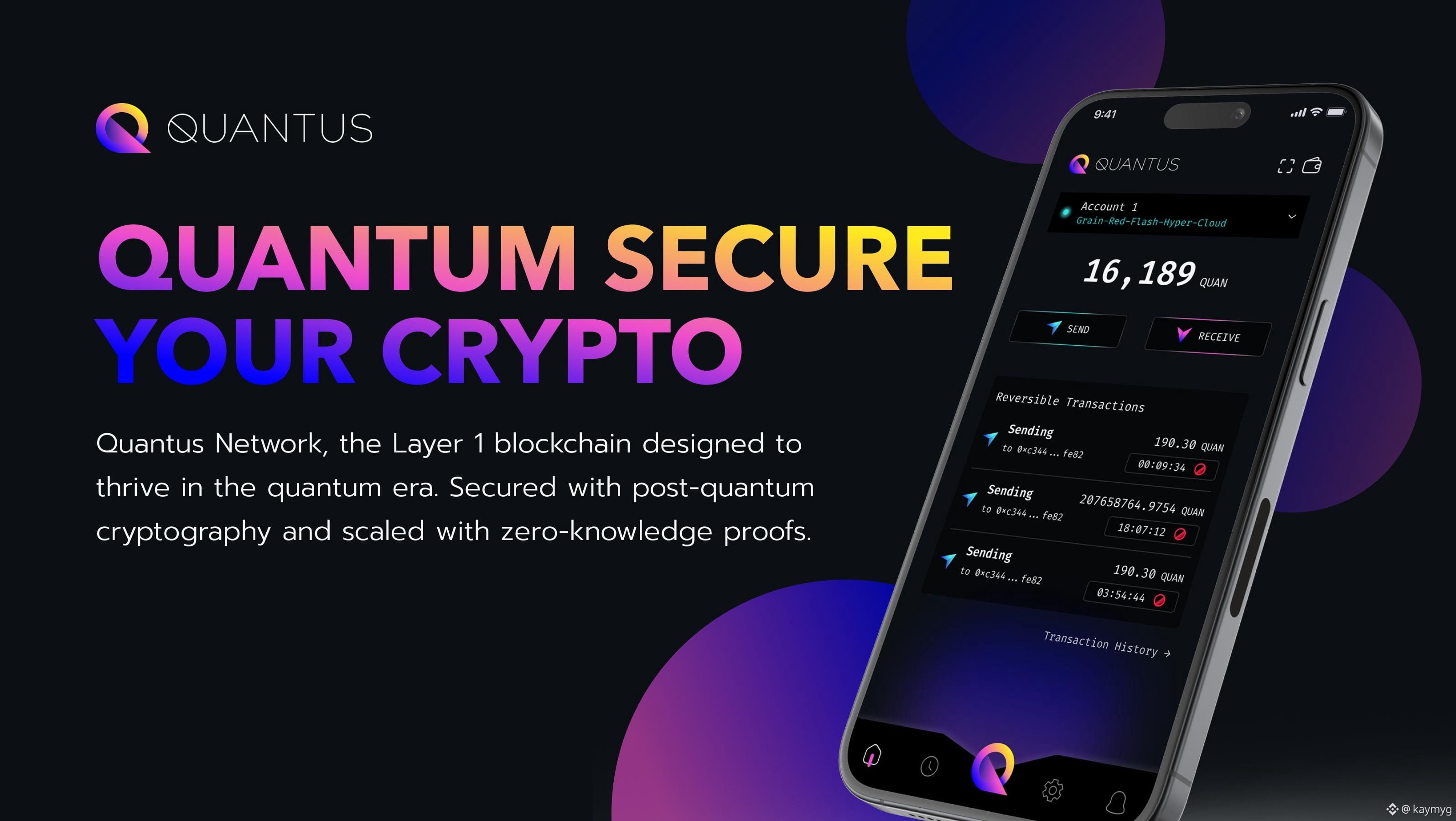
Reversible transfers: The network supports delayed transfers that can be cancelled within a designated period.
Guardian protection: High-security accounts can designate guardians who may cancel suspicious transactions but cannot independently spend the account's funds.
Multisignature: Accounts can require approval from multiple signatories, with support for configurations of up to approximately 100 participants.
Recovery mechanisms: Time-locks and additional security arrangements provide alternatives for recovering or protecting accounts.
Human-readable address verification: Check-phrases help users identify addresses and reduce the possibility of sending funds to an incorrectly copied destination.
Mobile and cold wallets: Quantus provides mobile wallets and an open-source cold-wallet application that can turn a spare smartphone into an offline signing device. Transactions are transferred using QR codes, keeping the signing device disconnected from the internet.
The cold-wallet approach is particularly interesting because it makes hardware-assisted offline signing more accessible without necessarily requiring users to purchase dedicated hardware wallets.
4. Scalability: Can Quantum Security Coexist With Performance?
One of the biggest questions surrounding post-quantum blockchain architecture is whether additional cryptographic security comes at the expense of performance.
Traditional blockchain signatures are relatively small. ML-DSA signatures are substantially larger, increasing the amount of information required to validate transactions and propagate them across the network.
Quantus addresses this through its zero-knowledge architecture.
Its transparent transactions are estimated to operate in the tens of transactions per second, while aggregated encrypted transactions are claimed to reach hundreds of transactions per second under favourable conditions.
These figures should be treated as project-reported or architectural estimates rather than independently established sustained mainnet performance.
The distinction matters because theoretical throughput and actual network performance are not necessarily the same.
Real-world performance depends on network participation, hardware, proof-generation costs, verification requirements and transaction demand.
Quantus is therefore making a different scalability proposition from networks such as Solana. Rather than maximising general-purpose transaction throughput, it seeks to make quantum-resistant value transfers practical through cryptographic efficiency and proof aggregation.
5. QTC: Supply, Mining and Tokenomics
The native cryptocurrency of Quantus is QTC, with a maximum supply of 21 million tokens.
This places its supply ceiling in the same numerical category as Bitcoin, although the two networks have different issuance mechanisms and economic structures.
The distribution model has two principal components:
Approximately 73% of the total supply is designated for mining.
Approximately 27% was allocated at genesis to investors, founders, the team and the company.
The majority of the genesis allocation is subject to a one-year lock followed by linear vesting over 36 months, with the vesting arrangements enforced on-chain.
Quantus also uses a gradually declining emission model rather than Bitcoin's fixed four-year halving schedule.
Its approximate reward formula is:
\[ \text{Block Reward} = \frac{\text{Maximum Supply}-\text{Current Supply}}{50,000,000} \]
This produces progressively declining rewards as the circulating supply approaches the maximum.
Transaction fees may also be partially burned under applicable network rules.
The economic argument is that mining incentives can gradually decline while the network maintains a predetermined supply ceiling.
However, the genesis allocation deserves attention. Although vesting reduces the immediate availability of those tokens, future unlocks could influence market supply and price dynamics.
6. The Team, Funding and Governance
Quantus was founded in 2024, with active development beginning towards the end of that year.
Its key figures include co-founder and CEO Christopher Smith and co-founder Joseph Mattia.
Christopher Smith has also been associated with Quantum Canary and the QDay podcast, alongside previous projects including BitMesh, Lunyr and FactoryDAO.
Reported funding totals approximately $2.4 million, with participation and advisory involvement from individuals in the wider cryptocurrency and privacy ecosystem, including Balaji Srinivasan.
Governance is structured around Quantus Improvement Proposals (QIPs), alongside Substrate-style governance mechanisms and a Technical Collective responsible for certain technical decisions.
The stated ambition is progressive decentralisation, although the extent to which governance and development responsibilities are distributed will become clearer as the network matures.
7. Mainnet Progress and Market Position
Reported project and market figures, late November 2026. These are not independently verified live measurements.
Quantus launched its mainnet on 9 September 2026. By late November, it had accumulated approximately two and a half months of operating history.
Project-reported network indicators include:
400,000+
Blocks produced
200+
Network nodes
10,000s
Accounts created
12,000+
Monthly active wallet users, reported
Market trackers have reported QTC trading around the $30 range, with a circulating market capitalisation of approximately $11 million and an all-time high approaching $186 shortly after its initial listings.
These figures are particularly sensitive to the circulating supply because the network is still in its early mining and distribution stages.
Liquidity remains relatively thin, with trading and cross-chain access involving platforms such as Raydium on Solana and NEAR Intents.
The availability of wrapped QTC through these ecosystems is an important development because it creates access to liquidity and users beyond the native Quantus network.
It is worth distinguishing between wrapped assets and native QTC. Wrapped tokens represent cross-chain versions of the underlying asset and introduce additional bridging and custody-related considerations.
8. How Quantus Relates to Bitcoin, Monero, Zcash and Other Blockchains
Quantus is easier to understand when compared with networks that have different priorities.
Bitcoin: Both use Proof-of-Work and have a fixed maximum supply of 21 million units. However, Bitcoin's existing signature infrastructure relies heavily on elliptic-curve cryptography. Quantus was designed around post-quantum signatures from its inception. Bitcoin has the advantage of a substantially longer operating history, greater liquidity and a more established monetary network.
Monero: Monero prioritises financial privacy through confidential transactions and stealth addresses. Quantus also incorporates privacy, but adds a post-quantum security focus. Monero's privacy architecture and operating history are considerably more mature.
Zcash: Zcash uses zero-knowledge proofs to enable shielded transactions. Quantus also uses zero-knowledge technology, particularly through Wormhole, but combines it with a different privacy model and post-quantum cryptographic architecture.
Ethereum: Ethereum is a general-purpose smart-contract platform supporting decentralised applications, financial protocols and token ecosystems. Quantus has a narrower purpose, concentrating on secure digital money rather than competing directly in the smart-contract space.
QRL (Quantum Resistant Ledger): QRL is another blockchain project specifically designed around quantum-resistant cryptography, using hash-based signature technology, particularly XMSS. Quantus takes a different approach through NIST-standardised lattice-based signatures and zero-knowledge proof aggregation.
It is important not to confuse Quantus Network with Quant Network, whose QNT token is associated with enterprise interoperability and Overledger technology. They are separate projects.
9. Security Audits and Outstanding Risks
Quantum resistance is a powerful proposition, but it does not automatically make a blockchain secure.
Quantus has reported external security reviews covering several components of its architecture, including its ML-DSA implementation, hierarchical deterministic wallet, Proof-of-Work mechanisms, Poseidon2 and zero-knowledge circuits.
Firms associated with these reviews include Neodyme, Equilibrium and Eiger. The project has also held an Immunefi audit competition.
However, the existence of audits should not be interpreted as a guarantee that the entire network is free from vulnerabilities. The scope of each audit, findings, remediation and subsequent code changes matter.
There are several risks worth watching.
Cryptographic maturity: ML-DSA is a NIST-standardised algorithm, but the broader implementation and integration of post-quantum systems in a live blockchain remain relatively new.
Performance: Large signatures and computationally demanding zero-knowledge proofs could create bottlenecks as network usage increases.
Privacy limitations: Wormhole provides additional transaction privacy, but optional privacy and incomplete concealment of transaction metadata mean users should not assume absolute anonymity.
Token distribution: The approximately 27% genesis allocation creates potential future selling pressure as vesting progresses.
Liquidity: A relatively small market and limited trading venues can result in significant price volatility and difficulties executing large transactions.
Adoption: A technically sophisticated blockchain still needs sustained demand. Its long-term success depends on whether users actually choose it for payments and long-term value preservation.
Protocol resilience: The security of the complete system depends on the cryptographic algorithms, implementation quality, consensus, networking and economic incentives working together.
Perhaps the most important consideration is that the quantum threat remains a developing technological risk. There is no certainty about when cryptographically relevant quantum computers will become practical. Quantus is making a long-term security bet, rather than responding to an already realised crisis.
10. The Bigger Question: Is Quantus Building for the Next Generation of Money?
The cryptocurrency industry has spent much of its existence competing over transaction speeds, smart-contract capabilities, decentralised finance and ecosystem growth.
Quantus is approaching the problem from another direction.
Its proposition is that the next generation of blockchain infrastructure must consider not only what conventional computers can break today, but also what sufficiently advanced quantum computers might break tomorrow.
That is a meaningful distinction.
Bitcoin demonstrated that decentralised digital money could operate without a central authority. Ethereum expanded the possibilities of blockchain technology through programmable financial infrastructure. Monero and Zcash advanced the conversation around financial privacy.
Quantus is attempting to combine some of these ideas with a different security foundation: post-quantum cryptography designed into the network from genesis.
Its strongest argument is not that quantum computers will necessarily break existing blockchains tomorrow. It is that cryptographic migration is difficult, expensive and potentially disruptive, making early preparation a reasonable engineering decision.
Nevertheless, being early is not the same as being successful. Quantus must demonstrate that its architecture can deliver reliable security, practical transaction speeds, meaningful privacy and sustainable decentralised participation.
My assessment: Quantus is an interesting project because it is addressing a problem that most blockchain networks will eventually have to confront. Its combination of NIST-standardised post-quantum signatures, Proof-of-Work, zero-knowledge technology and a fixed monetary supply gives it a distinct identity. However, its short mainnet history means that its strongest claims still need to be demonstrated through sustained independent scrutiny and real-world adoption.
If the quantum computing threat eventually becomes a defining issue for digital assets, networks that prepared their cryptographic foundations early could have an important advantage. Quantus is positioning itself to be one of them.