
#grayscalelaunches2xleveragedzcashetf
🚨Grayscale has introduced something interesting to the crypto investment market.
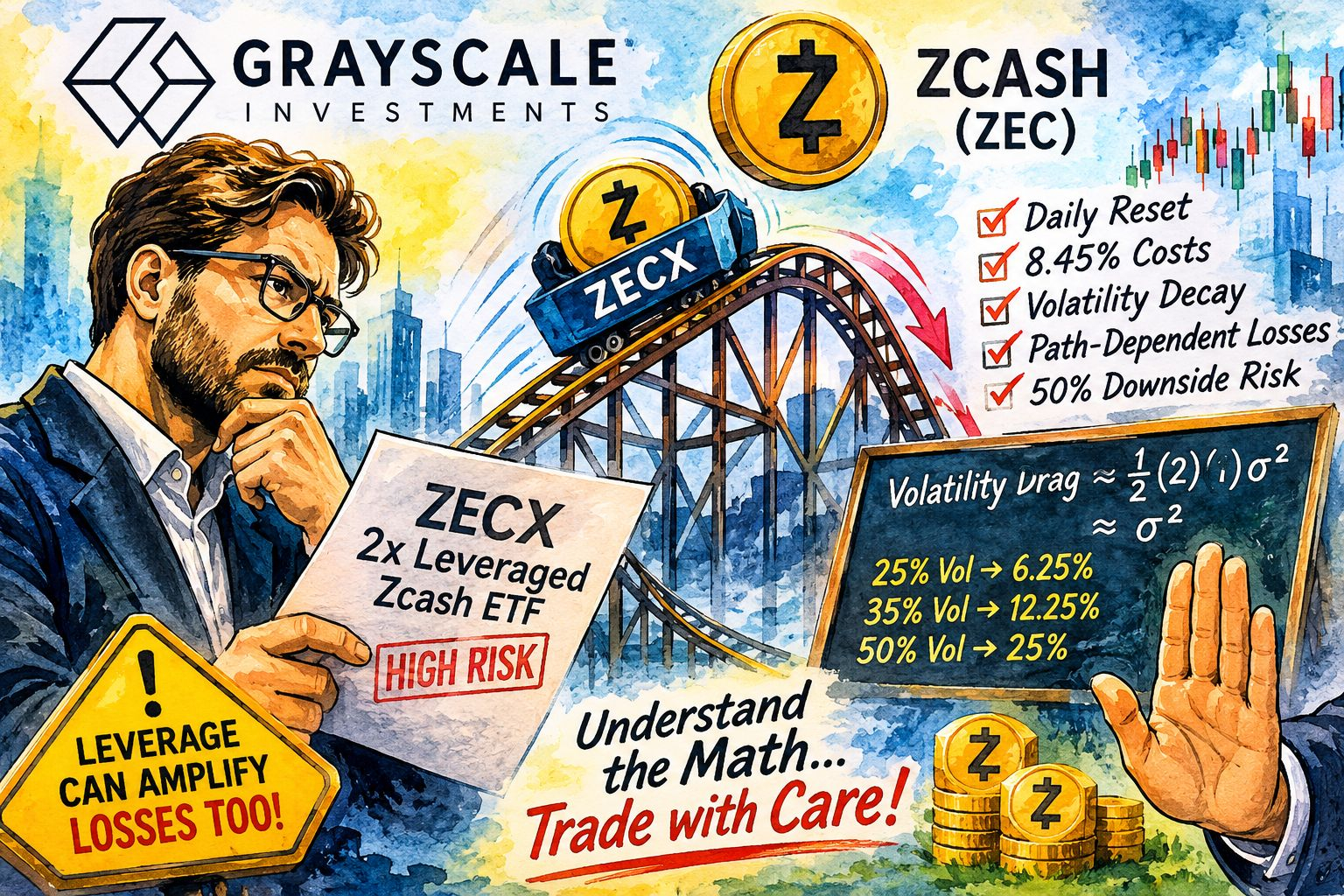
On November 23, 2026, its 2x ZCSH ETF (Ticker: ZECX) began trading on NYSE Arca, becoming the first 2x leveraged Zcash-focused ETF.
But before traders interpret this as another bullish milestone for Zcash, there is something important to understand:
A leveraged ETF can amplify your gains, but it can also destroy your capital even when your underlying market thesis is correct.
Let's break down what this means for traders, investors and the broader crypto market. 👇
⚙️ 1. WHAT EXACTLY IS ZECX?
ZECX targets 200% of the DAILY return of Grayscale's existing Zcash ETF (ZCSH), before fees and expenses.
It primarily uses total return swaps to obtain this exposure.
This means:
You don't need to purchase ZEC directly.
You don't need to open a traditional margin account.
You can access leveraged exposure through a brokerage account.
The fund resets its leverage target daily.
But remember:
ZECX does not directly hold Zcash, control private keys or provide ownership of the underlying cryptocurrency.
And its benchmark is ZCSH shares, not the spot price of ZEC.
That distinction matters.
📈 2. HOW DOES 2X DAILY LEVERAGE WORK?
Let's use a simple example.
Suppose ZCSH increases by 10% in one trading session.
ZECX targets approximately a 20% gain before fees and expenses.
Now reverse the situation.
If ZCSH declines by 10%, ZECX targets approximately a 20% loss.
Sounds simple?
The problem begins when you hold it across multiple trading sessions.
📉 3. THE DAILY RESET TRAP: HOW YOU CAN LOSE WHILE THE UNDERLYING IS FLAT
👉Consider this two-day example, ignoring fees and tracking differences.
Day 1:
ZCSH increases 10%.
ZECX increases approximately 20%.
Your initial $100 becomes $120.
Day 2:
ZCSH declines approximately 9.09%.
ZCSH returns to its original $100 level.
ZECX declines approximately 18.18%.
Your $120 investment becomes approximately $98.18.
Final result:
ZCSH is unchanged, but ZECX has lost approximately 1.82%.
This is the effect of daily compounding.
The lesson?
A leveraged ETF does not simply deliver twice the underlying asset's return over any period you choose.
The sequence of daily returns matters.
💸 4. THE HIDDEN COSTS: WHAT TRADERS MUST UNDERSTAND
The headline expense ratio is not the complete cost.
According to the SEC prospectus:
Total annual operating expenses: 1.95%.
Contractual fee waiver: 1.00%.
Net annual operating expenses after waiver: 0.95%.
Estimated embedded swap financing and other charges: approximately 7.50% annually.
This produces an estimated combined operating and embedded financing cost of approximately 8.45% annually, using the stated estimates.
The waiver is scheduled to remain in place through at least April 30, 2028, subject to the prospectus conditions.
And there is another important detail:
ZCSH itself has a 2.50% sponsor fee, which is reflected in ZCSH's performance.
Therefore, ZECX investors are exposed to an underlying investment product that also has its own costs.
These expenses and financing charges can materially reduce returns.
🌪️ 5. VOLATILITY DECAY: THE BIGGEST ENEMY OF LEVERAGED INVESTORS
Let's understand the mathematics.
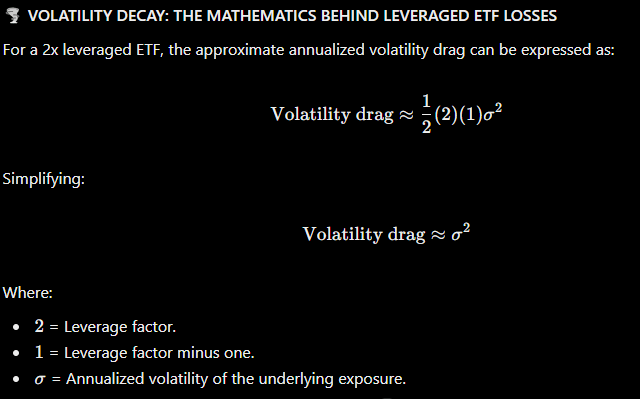
Under simplified assumptions, the approximate annualized volatility drag for a 2x leveraged product is:
Volatility drag ≈ Annualized volatility²
For example:
At 25% annualized volatility:
25% × 25% = approximately 6.25% annualized volatility drag.
At 50% annualized volatility:
50% × 50% = approximately 25% annualized volatility drag.
These are theoretical approximations, not guaranteed losses or exact forecasts.
Now combine volatility with financing costs and operating expenses.
A relatively flat but highly volatile market can become extremely expensive for a leveraged ETF investor.
Even if your long-term Zcash thesis is correct, the daily price journey can work against your position.
🚀 6. WHAT IF ZCASH RALLIES 50%?
This is where many traders make a mistake.
They assume:
ZEC rises 50% = ZECX rises 100%.
That is not how a daily leveraged ETF necessarily performs over multiple sessions.
A smooth upward move and a volatile upward move can produce substantially different results.
Daily compounding, swap financing, fund expenses, tracking differences and ZCSH's own performance relative to spot ZEC all matter.
Direction alone does not determine your final return. The path matters.
🚨 7. THE FIRST TRADING SESSION: A REAL-WORLD WARNING
ZECX's debut session provided an important lesson.
According to first-session reporting by The Block:
ZECX declined more than 13%, closing at $28.60.
ZEC initially rallied approximately 13% intraday.
ZEC subsequently surrendered those gains and finished approximately flat.
This is an interesting market observation.
However, one session is not enough to establish a long-term tracking pattern or attribute the entire ETF decline to volatility decay.
Intraday pricing, spreads, NAV differences, execution and tracking also deserve attention.
For traders, this is a reminder to monitor the ETF's actual market price and NAV rather than assuming that its intraday performance will always match a simple 2x calculation.
⚠️ 8. THE 50% DOWNSIDE SCENARIO
There is an especially serious warning in the prospectus.
If ZCSH falls 50% or more in a single day, ZECX investors could lose all or substantially all of their investment.
This is not an ordinary ETF risk.
It is a direct consequence of the fund's leveraged structure.
Crypto markets can experience extreme price movements, making this risk particularly important.
🏦 9. WHAT DOES THIS MEAN FOR THE BROADER CRYPTO MARKET?
I see three important developments.
First: Financial-market accessibility.
Investors can now obtain leveraged Zcash exposure through traditional brokerage infrastructure.
Second: The evolution of crypto investment products.
The market is moving beyond simple spot exposure into increasingly sophisticated financial instruments.
Third: Institutional product development.
Grayscale is expanding its Zcash investment-product ecosystem, creating additional ways for market participants to express directional views.
But let's not confuse product availability with actual capital inflows.
A leveraged ETF launch does not automatically mean institutional investors are accumulating spot ZEC.
To establish genuine demand, traders should monitor:
🔹 ZCSH assets and actual fund flows.
🔹 ZEC spot trading volume.
🔹 Exchange liquidity and order-book depth.
🔹 Price performance relative to broader crypto markets.
🔹 ETF trading volume, NAV premiums or discounts, and spreads.
These indicators provide a more meaningful picture than the ETF launch headline alone.
🎯 10. MY FINAL TAKE: TRADERS VS. LONG-TERM INVESTORS
For active traders:
ZECX can be a tactical instrument for expressing a short-term bullish view, provided they understand daily leverage, costs and the possibility of severe losses.
For long-term investors:
Do not confuse a 2x daily leveraged ETF with a conventional long-term Zcash investment.
For crypto exchanges and market participants:
This development deserves attention because it represents another step in the integration of crypto-linked exposure into traditional financial markets.
But the most important lesson is this:
Being right about Zcash's direction does not guarantee making money with ZECX.
You must understand the instrument, the financing costs, the daily reset and the volatility of the underlying exposure.
💡 THE BIGGER PICTURE:
Spot ETFs provide market access.
Leveraged ETFs amplify daily exposure.
But sustainable investment returns still depend on liquidity, risk management, market direction and the cost of maintaining that exposure.
Never confuse leverage with an investment advantage. Sometimes, the biggest risk is not getting the market direction wrong — it's choosing the wrong instrument to express your conviction.