

Founder-led companies and professionally managed public companies sit on opposite ends of a classic corporate governance trade-off: strategic speed, long-horizon vision, and concentrated ownership versus institutional checks, board accountability, and clear separation of ownership and control. Neither model is automatically superior; each excels at different growth stages and carries distinct agency and operational risks

Founder-Led Companies
Pros
Long-Term Horizon & R&D Conviction: Founders with meaningful equity—or dual-class voting control—are often more willing to fund multi-year research, capital expenditures, and bold strategic bets that might depress near-term earnings.
Speed & Product/Customer Intuition: Decisions can move quickly without layers of bureaucratic sign-off, particularly when the founder has deep technical or commercial insight into the core product.
Distinct Cultural Identity: A strong founder often anchors a cohesive mission and high internal urgency that attracts talent and customers.
Cons
Entrenchment & Weaker Board Oversight: Concentrated voting power or informal founder authority can turn the board into a rubber stamp, making it harder to challenge risky bets, replace underperforming leadership, or enforce compliance boundaries.
Key-Person & Bottleneck Risk: Over-reliance on one individual creates bottlenecks as the organization scales and exposes the firm to sharp market or operational shocks if the founder steps back or faces scrutiny.
Related-Party & Governance Blind Spots: Blurred lines between personal vision, family/inner-circle influence, and corporate assets can raise red flags for minority shareholders and regulators.
Professionally Managed Public Companies
Pros
Stronger Checks, Balances & Fiduciary Accountability: Independent directors, audit and compensation committees, and formal approval thresholds reduce reliance on any single personality and protect minority shareholders.
Scalable Processes & Succession Readiness: Clear reporting lines, delegation-of-authority matrices, and structured executive pipelines help operations run smoothly across leadership transitions.
Capital Market & Regulatory Discipline: Standardized disclosures, internal controls, and institutional oversight often make governance expectations more predictable for broad institutional investors.
Cons
Short-Termism & Risk Aversion: Hired executives evaluated on quarterly metrics or share-price targets may underinvest in long-gestation innovation or favor defensive, incremental moves over bold pivots.
Agency Costs & Bureaucracy: When managers hold small equity stakes relative to their compensation, incentives can diverge from long-term owners; heavy committee processes can also slow execution.
Leadership Turnover Friction: CEO changes can bring strategic whiplash or cost-cutting cycles that erode institutional knowledge if the board prioritizes short-term optics over operational depth.
Side-by-Side Comparison
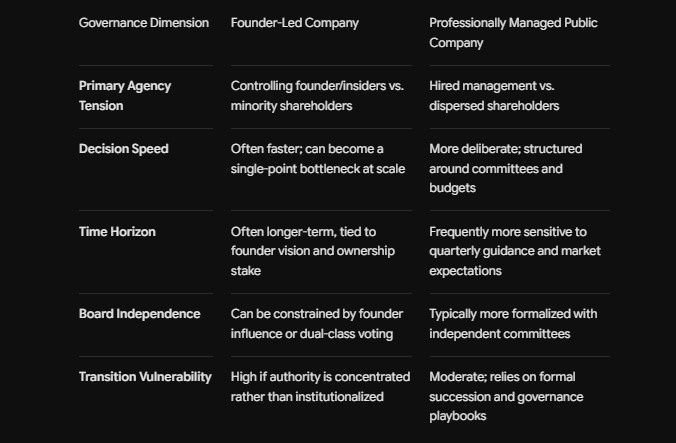
The strongest organizations often treat this as a structural evolution rather than a binary choice—pairing entrepreneurial drive and strategic clarity with documented authority, independent audit/compliance oversight, and clear succession planning before a crisis forces the issue.