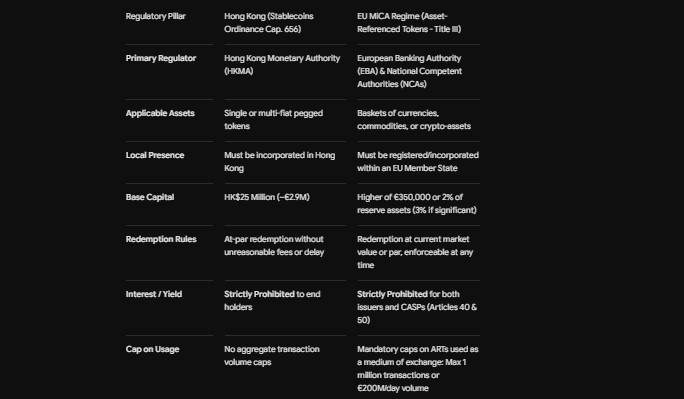
While both frameworks establish comprehensive, bank-grade oversight for stablecoins, Hong Kong’s Stablecoins Ordinance (Cap. 656) and the EU’s Markets in Crypto-Assets (MiCA) framework (Regulation EU 2023/1114) differ fundamentally in their scope, taxonomy, structural requirements, and prudential design.
The primary distinction lies in how they classify non-single-fiat tokens: Hong Kong explicitly excludes non-fiat asset-backed tokens from its Stablecoins Ordinance, whereas the EU’s MiCA regulates them under its specific Asset-Referenced Tokens (ARTs) regime.
Key Structural Differences
1. Scope & Categorization
Hong Kong (Cap. 656): Focuses exclusively on fiat-referenced stablecoins (FRSs)—tokens pegged to one or more official currencies. Algorithmic, commodity-backed, or crypto-backed tokens are entirely excluded from the stablecoin regime (and fall under broader SFC Virtual Asset Services Provider rules).
EU MiCA: Features a binary stablecoin taxonomy:
Electronic Money Tokens (EMTs): Stablecoins referencing a single official currency.
Asset-Referenced Tokens (ARTs): Tokens referencing a basket of fiat currencies, commodities, or crypto-assets.
2. Issuer Licensing & Authorization
Hong Kong: Requires a dedicated HKMA Stablecoin Issuer Licence. Authorized Financial Institutions (AFIs/banks) are eligible, but non-bank corporate entities can also apply directly if they meet the HK$25 million paid-up capital rule.
EU MiCA (ARTs): Only authorized credit institutions (banks) or legal entities specifically authorized by a national competent authority (NCA) following an approved white paper may issue ARTs.
3. Minimum Own Funds & Capital Requirements
Hong Kong: Fixed base paid-up capital of HK$25 million (approx. €2.9M / $3.2M), or 1% of outstanding stablecoins (whichever is higher), with additional discretionary liquidity cushions required by the HKMA.
EU MiCA (ARTs): Minimum own funds of €350,000, or 2% of the average reserve assets (whichever is higher). For "Significant ARTs" supervised directly by the European Banking Authority (EBA), the reserve capital requirement increases to 3%.
4. Reserve Composition & Custody Limits
Hong Kong: Requires 100% full par-value reserve backing in high-quality, liquid assets (cash, overnight deposits, short-term sovereign debt up to 1 year maturity). The HKMA allows high flexibility in reserve mix as long as assets match the currency exposure.
EU MiCA (ARTs): Imposes strict structural caps. At least 30% of reserve assets (and 50% for Significant ARTs) must be held as bank deposits spread across multiple distinct credit institutions to mitigate credit concentration risk.
Detailed Comparison Table