
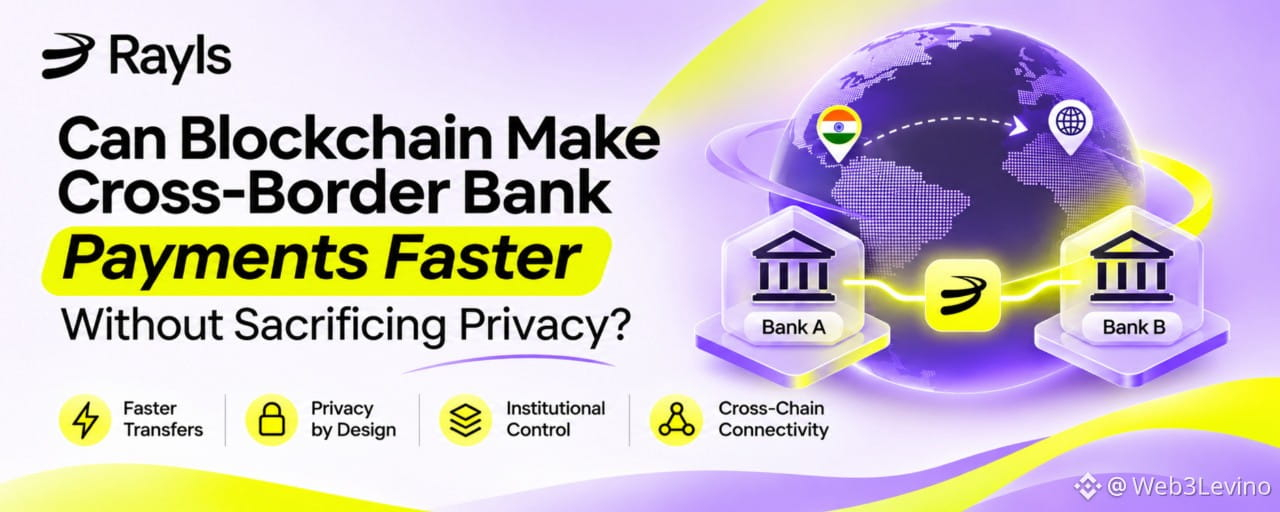

Imagine a company in India needs to send money to a business in another country.
The payment sounds simple. One company sends money, and the other receives it. But behind the scenes, international payments can involve multiple banks, intermediaries, different currencies and several verification processes.
Sometimes, moving money across borders is more complicated than it should be.
This raises an interesting question: Can blockchain make international payments faster without exposing sensitive banking information?
I wanted to explore this because speed is only one part of the problem. Banks also need privacy, security and control over their customers' financial information.
Why are international payments still complicated?
Most traditional international payments rely on correspondent banking relationships.
In simple terms, when two banks cannot directly process a payment between themselves, other banks may need to help move the money.
Each additional step can bring more processing, communication and verification.
According to the Bank for International Settlements (BIS), these challenges are among the reasons why improving cross-border payments has become an important focus for the financial industry.
The BIS Project Agorá is particularly interesting here. It explores how tokenised commercial bank money and central bank money could work together on a shared programmable platform.
This tells us something important: even major financial institutions are exploring new ways to improve how money moves internationally.
Why not just use a public blockchain?
At first, using a public blockchain might seem like an easy solution.
Transactions can be recorded and verified without depending entirely on traditional intermediaries.
But there is a problem.
Banks handle sensitive information. They cannot simply make every customer's financial activity visible to anyone with an internet connection.
Think about a bank transferring a large amount of money on behalf of a business. The bank may not want competitors, customers or unrelated observers to see its transaction details and financial activity.
This is where privacy becomes important.
Banks need the benefits of blockchain without exposing information that should remain confidential.
How could private blockchain infrastructure help?
One approach is to give each financial institution its own private blockchain while allowing approved institutions to communicate with each other.
This is the interesting part of Rayls.
Instead of forcing every bank to operate on one shared public ledger, Rayls allows institutions to maintain their own private EVM-compatible environments called Sovereign chains.
These chains can connect through the Rayls Private Network.
There are three important parts to understand:
1. Rayls Sovereign
Each institution operates its own blockchain environment. This allows it to manage its internal transactions and applications without automatically exposing everything to other institutions.
2. Private Network Hub
This acts as a connection point between participating institutions. It helps coordinate communication and cross-chain transactions.
3. Enygma
This is Rayls' privacy technology. It uses cryptographic techniques, including zero-knowledge proofs, to support verification without revealing selected sensitive transaction information.
What makes this architecture interesting is the separation between an institution's private activities and the transactions that need to happen between institutions.
Documentation: docs.rayls.com/docs/rayls-private-networks
Let's understand it with a simple example
Imagine Bank A wants to transfer tokenised money to Bank B.
Both banks operate their own private blockchain environments.
Here is what happens in a simplified cross-chain transfer:
Bank A initiates the transaction on its own chain.
A cross-chain message and cryptographic proof are prepared.
The message is encrypted before being sent outside Bank A's environment.
The Private Network Hub receives the message and verifies the relevant proof.
Bank B receives the message through its relayer.
Bank B processes the corresponding transaction on its own chain.
The important point is that Bank B does not need access to all of Bank A's internal banking activity to receive a transaction.
Rayls documentation describes a typical standard cross-chain transfer time of around 30–60 seconds.
That's an interesting technical detail, although it should not be confused with a guarantee that every real-world international bank payment will be completed in that time.
Technical reference: https://docs.rayls.com/docs/how-a-cross-chain-transaction-works
But does privacy mean nobody can monitor transactions?
Not exactly. And this is an important detail.
Banks cannot simply operate without oversight. Financial institutions have regulatory and compliance responsibilities.
Rayls' architecture distinguishes between ordinary network participants and the designated Private Network operator.
While institutions do not automatically get access to one another's internal transactions, the operator has the ability to inspect cross-chain activity through its governance and oversight mechanisms.
In my view, this is one of the most interesting parts of institutional blockchain design.
Privacy does not necessarily mean hiding everything. It means controlling who can access information and under what conditions.
Of course, this also means the operator's security, governance and access controls are extremely important.
Is blockchain ready to replace traditional international payments?
I wouldn't say that yet.
There are still several things that need to be considered:
Different countries have different financial regulations.
Banks need sufficient liquidity to complete transactions.
Currency conversion and foreign exchange still matter.
Existing banking infrastructure needs to be integrated.
Institutions need confidence in the security and governance of the network.
Even if a blockchain transaction takes seconds, the complete payment process may take longer because of these additional requirements.
So, faster blockchain transactions alone do not automatically solve every problem in international banking.
Why I think this matters for Rayls
What I find interesting about Rayls is its approach to connecting institutions without requiring them to give up their private environments.
Each institution can maintain its own infrastructure while still having a way to communicate and transfer value with other approved participants.
This could become useful as financial institutions explore tokenised deposits, digital assets and more programmable financial services.
It is not about replacing every existing banking system overnight.
It is about exploring whether financial institutions can work together more efficiently using blockchain technology.
Final thoughts
Can blockchain make cross-border bank payments faster without sacrificing privacy?
I believe the technology offers a promising direction, but there is still work to be done before it becomes a practical solution at global scale.
For me, the biggest takeaway is that the future of institutional blockchain is not just about making transactions public and transparent.
It's also about making transactions private when necessary, verifiable when required, and connected when institutions need to work together.
That's the problem Rayls is trying to address, and it's a development worth watching.
Sources
BIS – Project Agorá: https://www.bis.org/project/agora
Rayls – Private Networks: https://docs.rayls.com/docs/rayls-private-networks
Rayls – Cross-chain Transaction Workflow: https://docs.rayls.com/docs/how-a-cross-chain-transaction-works
Note: Technical descriptions reflect published Rayls documentation. Potential benefits discussed here are analysis, not claims of proven large-scale international bank payment deployment.