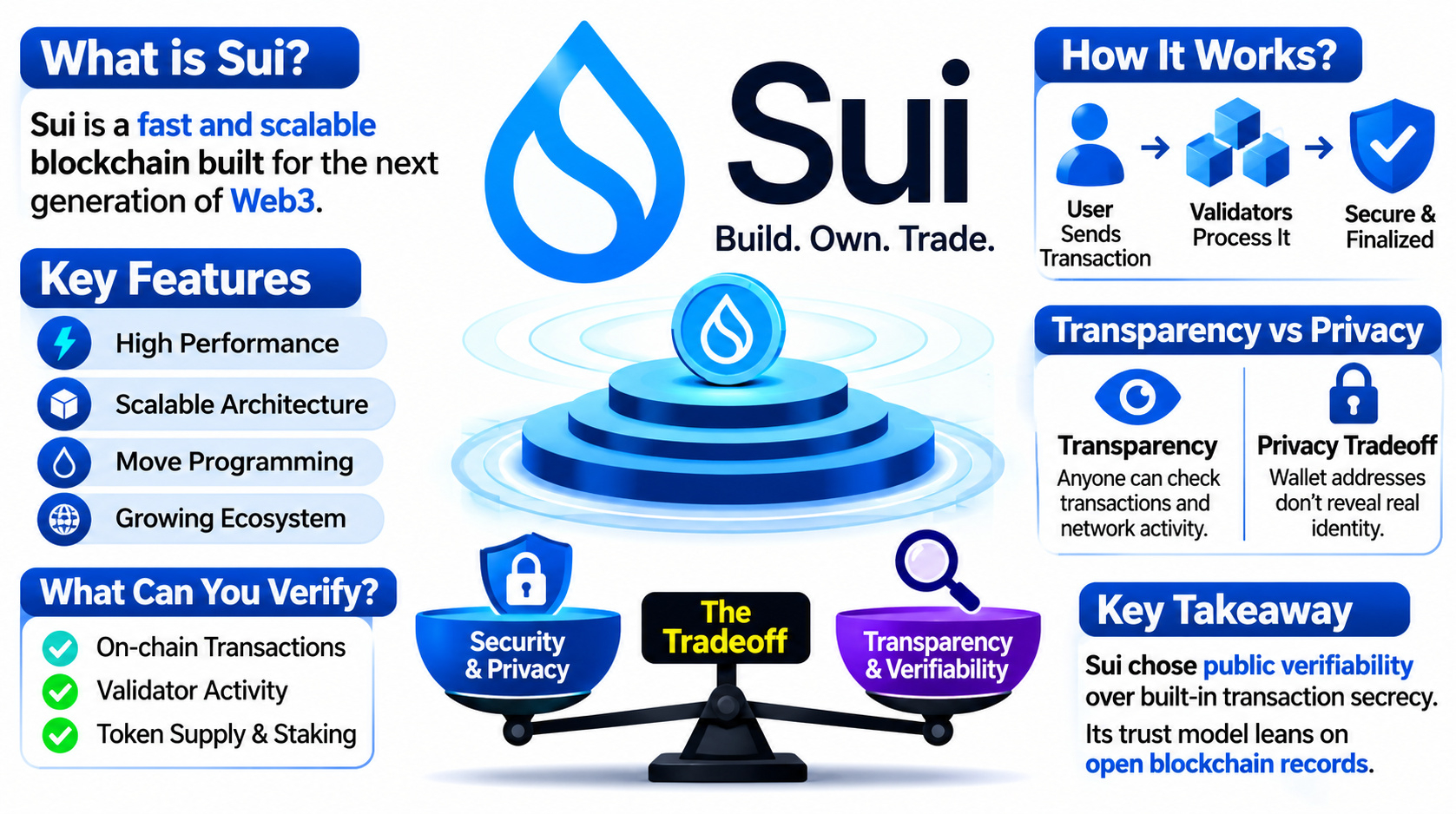

SUI is built around public on-chain transparency, with a maximum supply of 10 billion tokens and a delegated proof-of-stake security model. But there is a hidden tradeoff: every transaction and asset on Sui is publicly visible, while wallet addresses do not automatically reveal the real-world identity behind them. That's not an oversight. It's a stated choice. Sui Documentation +2
Sui prioritizes public verifiability over financial privacy. Anyone can inspect transaction histories and asset movements, which helps independent observers verify network activity. But the same visibility creates exposure to transaction tracking, wallet profiling and financial surveillance. Transparency comes at a privacy cost. Sui Documentation
Holders can examine on-chain transactions, validator activity, delegated stake and token supply. The protocol also records staking changes at epoch boundaries. However, SUI is not a reserve-backed asset, so traditional reserve attestations from firms such as BDO or Deloitte do not apply. Public blockchain data also cannot independently establish every user's real-world identity or custody arrangements. Sui Documentation +1
Compare this with Zcash (ZEC). Its shielded transactions use zero-knowledge proofs to conceal sender, receiver and transaction amounts while allowing the network to verify transaction validity. This provides more financial privacy, but outsiders lose access to individual transaction details. Zcash Documentation 6.12.2 documentation +1
Neither approach removes counterparty risk. SUI exposes transaction activity but still relies on validators, wallets and infrastructure. Zcash protects transaction privacy but relies on cryptography, software and secure wallet practices.
SUI chose verifiable public activity over built-in transaction secrecy. Its trust model leans on publicly inspectable blockchain records.
Which risk worries you more — financial surveillance through public transactions, or limited visibility into private