

Under the U.S. regulatory architecture established by the GENIUS Act, stablecoin issuers face a fundamental structural choice between pursuing a federal authorization through an OCC National Trust Bank Charter (or OCC Nonbank Issuer Approval) versus operating under a State Trust Charter (such as a New York DFSI Limited Purpose Trust).
While both structures demand strict reserve segregation, 1:1 liquid backing, and routine auditing, the operational and jurisdictional differences are significant.
While both structures demand strict reserve segregation, 1:1 liquid backing, and routine auditing, the operational and jurisdictional differences are significant.
Core Structural Differences
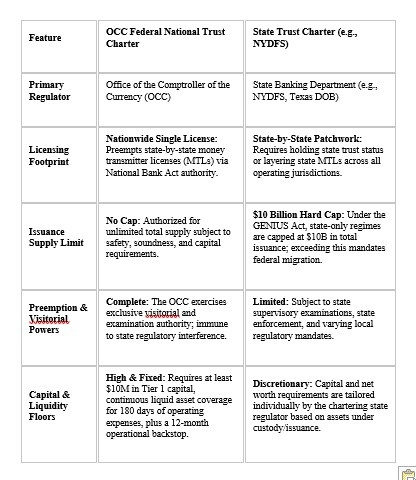
1. Nationwide Reach & Preemption vs. Multi-State Patchwork
OCC Charter: Operating as an OCC-chartered uninsured national trust bank grants nationwide regulatory preemption. The issuer obtains one single federal license and can conduct business in all 50 states without maintaining a web of individual state Money Transmitter Licenses (MTLs).
State Trust: While state trust companies (like Paxos or Gemini in NY) carry higher trust-level status than basic MTLs, they lack federal preemption outside their home state. Issuers often must obtain reciprocal permissions or separate MTL approvals to expand nationwide.
2. Issuance Scale (The $10 Billion Cap)
OCC Charter: Designed for institutional and high-scale issuance, an OCC national trust charter carries no federal limit on total token circulation under the GENIUS Act.
State Trust: The GENIUS Act imposes a $10 billion issuance limit on state-qualified stablecoin issuers. If a state trust's circulating token supply crosses $10 billion, it must initiate a transition to federal OCC supervision within 180 to 360 days or wind down excess minting.
3. Examination Burden & Visitorial Authority
OCC Charter: Features a single point of supervision. State regulators are statutorily blocked from subjecting national trust banks to state-level examinations, reports, or visitorial oversight.
State Trust: Issuers are subject to ongoing examinations from their chartering state banking department, as well as oversight from state attorneys general and joint supervisory checks when passporting across state borders.
4. Setup Complexity, Costs, and Capital Floor
OCC Charter: Significantly higher barrier to entry. Obtaining preliminary approval typically requires at least $10 million in Tier 1 capital, an explicit 12-month operational backstop, 180 days of liquid expense reserves, and an intensive bank-grade BSA/AML risk-management audit.
State Trust: State charters (e.g., NYDFS Limited Purpose Trust) can be faster to secure for early- or mid-stage companies, allowing lower initial capital commitments that scale relative to initial assets under custody.


