

The Markets in Crypto-Assets (MiCA) framework has transformed stablecoin adoption across the European Economic Area (EEA), fundamentally altering market share and liquidity routes between USD Coin (USDC) and Tether (USDT).
While USDT remains the undisputed global leader in liquidity and total market capitalization, MiCA’s rigid operational compliance has triggered a sharp regional divergence inside Europe.
1. Circle’s Early Compliance Strategy for USDC
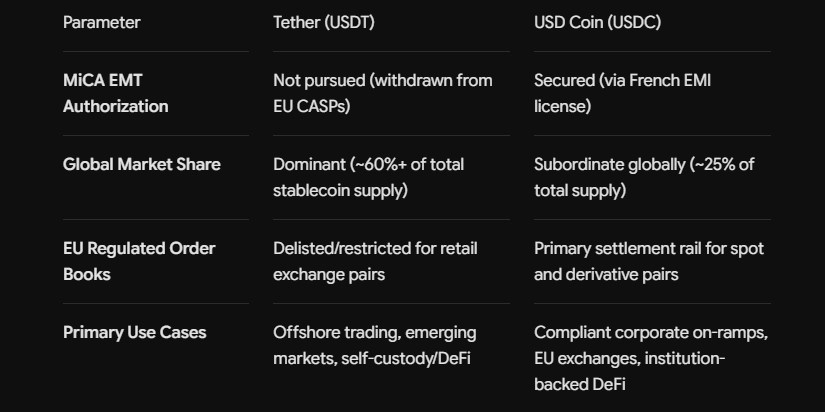
Circle proactively secured an Electronic Money Institution (EMI) license from France’s ACPR. This status gave USDC (and its euro-pegged counterpart EURC) a passport to operate as legally recognized Electronic Money Tokens (EMTs) across all 27 EU member states.
Default Compliant Rail: MiCA compliance allows centralized exchanges (CASPs) operating in the EEA—such as Coinbase, Kraken, Binance, and Bitvavo—to list USDC pairs without legal penalty.
Market Share Gain: As exchange order books migrated to MiCA-compliant base pairs, USDC’s share of stablecoin-to-euro trading volume expanded to over 56%, while its euro liquidity order-book depth surpassed USDT.
2. Tether’s Strategic Pivot Away from EU Licensing
Tether chose not to pursue MiCA authorization, primarily due to the framework's strict reserve mandates.
The Reserve Bottleneck: Under MiCA rules for "significant" EMTs, issuers must hold at least 60% of their fiat reserves in cash deposits across multiple EU banks. For Tether, this would require shifting tens of billions out of higher-yielding yield vehicles (like U.S. Treasuries) into European commercial bank deposits, exposing reserves to negative or low interest environments and bank concentration risks.
Exchange Delistings: Centralized exchanges licensed in the EU systematically delisted or restricted non-compliant tokens for EEA users. As a result, regulated spot liquidity for USDT inside the EU drastically declined.
3. Regional Fragmentation: Global vs. EEA Dominance
4. Self-Custody and Non-EEA Venue Carve-Outs
MiCA specifically targets regulated centralized intermediaries (exchanges, brokers, payment gateways) operating within the EU.
DeFi & Self-Custody Exemptions: European users retaining assets in self-custodial software or hardware wallets remain legally permitted to hold, transfer, and trade USDT via decentralized exchanges (DEXs).
Global Resilience: Tether’s global dominance remains structurally intact because major liquidity hubs in Asia, LATAM, Africa, and the Middle East continue to utilize USDT as their primary dollar settlement layer.


