

A 10% move against you can delete your whole futures account. In spot trading, the same move is just a red number you can wait out.
That one difference explains almost everything about spot and futures. Let me break it down in plain words.
What is spot trading?
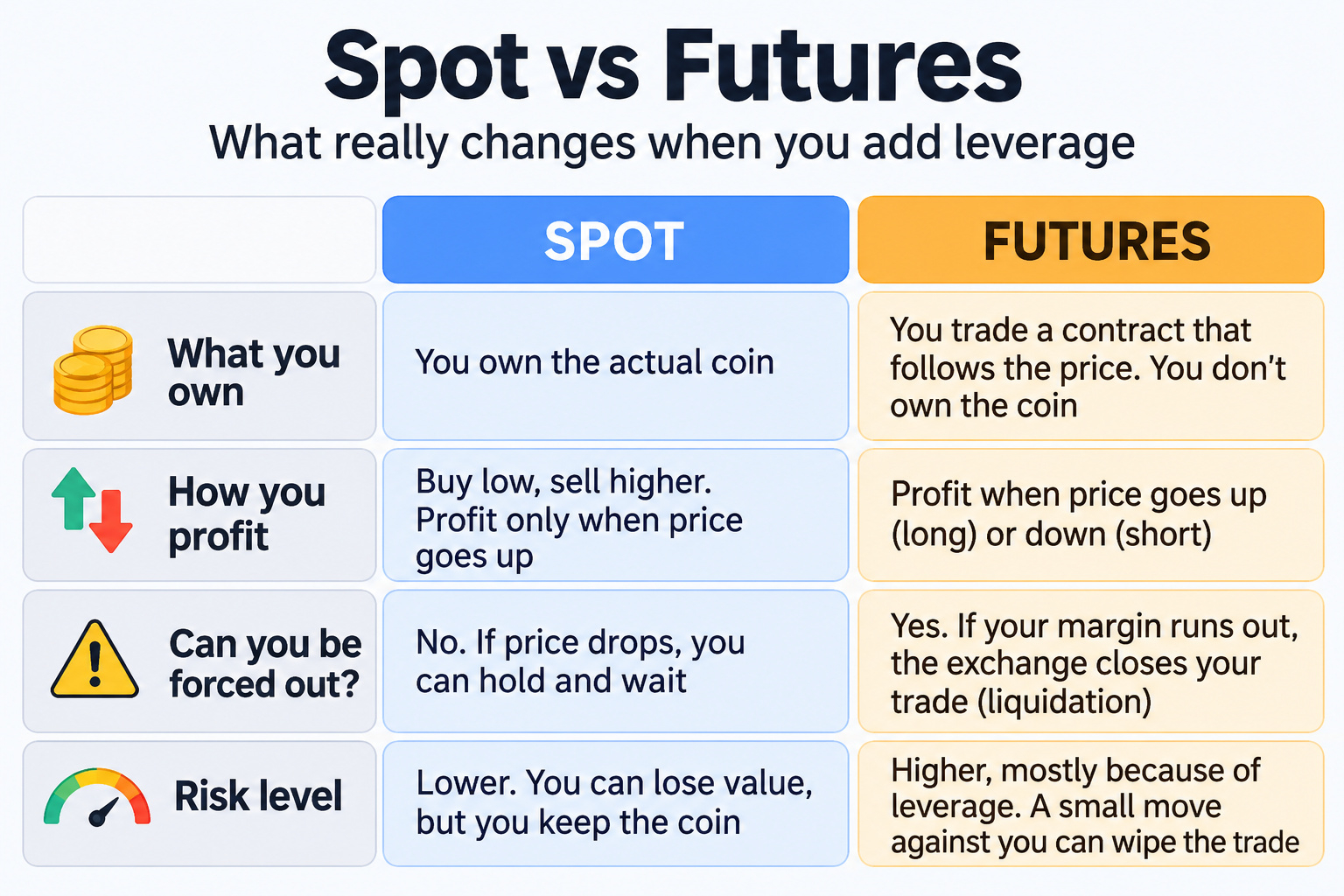
Spot trading is the simple one: buy low, sell high.
It works like buying a plot, a car, or a house. You buy it cheap, hold it for a month, six months, or a year, and sell when the price is higher. The profit is yours.
Here is the part beginners miss. Say you buy a coin at $100, and the price drops to $80, then $50.
You are down on paper
But you still own the coin
You only lose real money when you sell
If you don’t need that money, and you didn’t borrow it, you can sit and wait. No one is forcing you out. That’s the big advantage of spot.
What is futures trading?
Futures is where things get strange.
In spot, you must own something to sell it. In futures, you don’t. You can make money when the price goes down too.
Here is how it works in simple terms. You tell the exchange what you think will happen to the price. The exchange opens the trade for you.
If you think the price will go up (a long):
You open a trade at $120
Price goes to $150
You close it, and the $30 difference is your profit
If you think the price will go down (a short):
You open a short at $120
Price drops to $80
You close it, and the $40 difference is your profit
Notice that in the second case, you never owned anything. You made money from the price falling. You are not really borrowing coins. You are trading a contract that follows the price.
That alone sounds exciting. But the real story is leverage.
Leverage is the real difference
Leverage means the exchange lets you trade with more money than you actually have.
Say you have $100, but you want to trade $1,000. Normally, that’s impossible. With futures, the exchange says: bring your $100, and I will cover the other $900.
That is 10x leverage.
Your money: $100 (this is your margin)
Position size: $1,000
Exchange covers: $900
It feels great when it works. Your $1,000 trade moves like a $1,000 trade, even though you only put in $100. If $BTC moves 5% in your favor, you make $50 on a $100 account. That’s a 50% gain.
Now flip it.
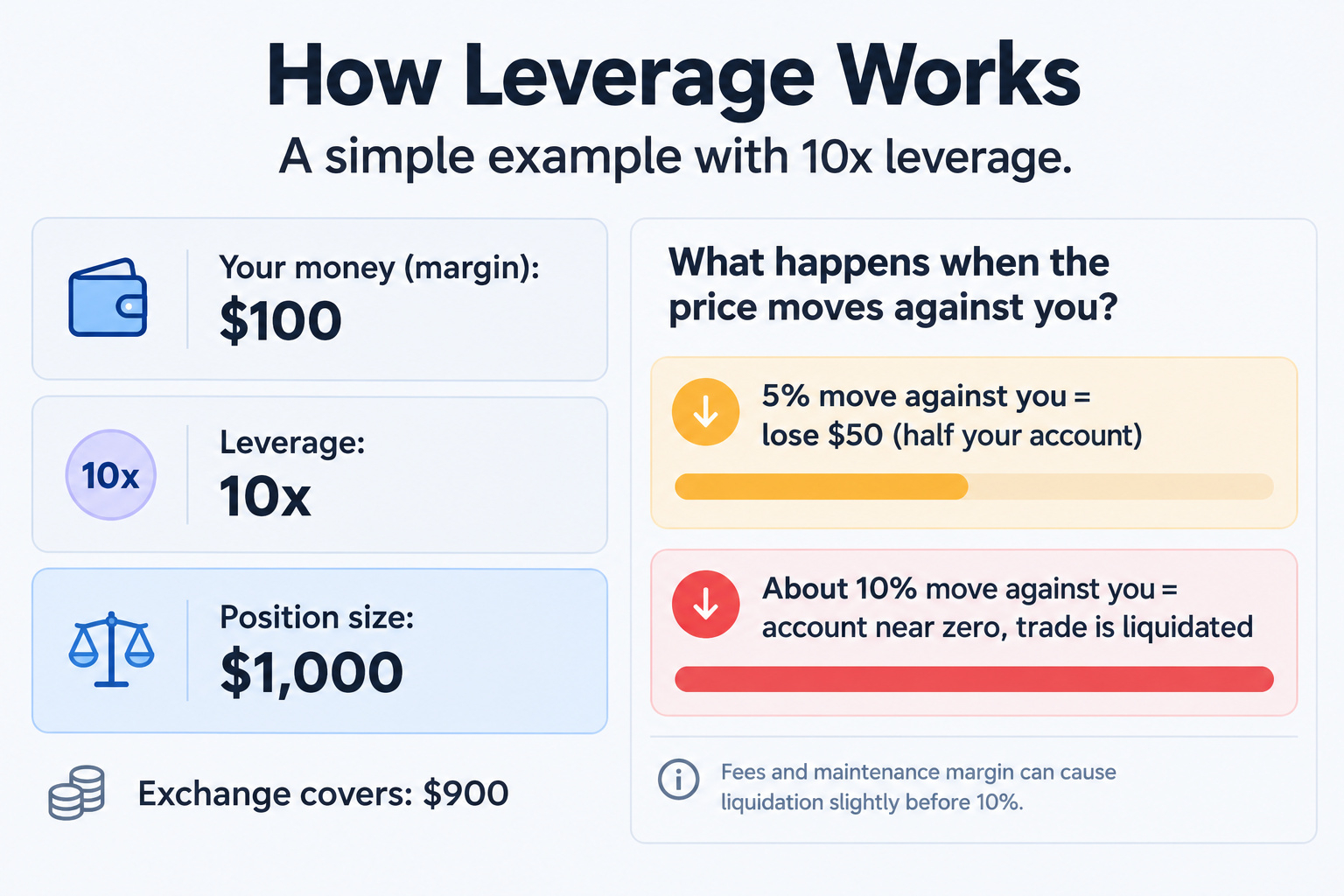
If the price moves 5% against you, you lose $50. That’s half your account gone.
If it moves around 10% against you, your $100 is almost gone. The exchange doesn’t wait for you to decide. It closes your trade automatically. That’s called liquidation.
Fees and maintenance margin mean liquidation can happen a little before the full 10%. So the real cushion is even smaller.
Why would the exchange do this?
Honestly, ask this question. It’s worth knowing.
The exchange is not lending you $900 out of kindness. Here is what’s in it for them:
They earn fees every time you open a trade
They earn fees every time you close a trade
The more you trade, the more they earn
They also protect themselves. The exchange is only risking your $100 margin. If your trade moves against you, they close it before your loss gets bigger than your money. They won’t risk their $900.
So when an exchange makes it easy to use high leverage, remember who benefits first.
Why futures looks safer than it is
This is the dark side, and I want to be straight about it.
When a futures trade goes well, you feel smart. The exchange is “supporting” you. Your account grows fast.
But the exchange is holding your margin as security the whole time. When your balance gets close to zero, it closes your position, and you are out. Gone. No waiting. No second chance on that trade.
Compare that with spot:
Spot: price drops 30%, you can hold and wait
Futures with leverage: price drops 10%, you can be liquidated
Same market. Very different outcome.
There is one way to reduce this risk. Many exchanges let you choose how much of your balance is used as margin for a trade. If you use only a small part of your account, the rest stays safe. It’s a smarter way to trade, but it still needs real discipline.
So which should you choose?
I’m not going to say futures is bad. Many experienced traders use it well. But here is my honest view for beginners:
Start with spot. Learn how price moves without the pressure of being forced out
If you try futures later, use small size and low leverage
Never put in money you can’t afford to lose
Don’t trade futures just because someone else made money on it
Your analysis has to be strong before leverage makes any sense. Leverage doesn’t make your analysis better. It only makes the result of being wrong faster and bigger.
My bottom line
Spot and futures can both make money. But they are not equal in risk.
Spot gives you time. Futures with leverage takes time away.
If a beginner has never held spot through a 30% drop without panic selling, should they be allowed to touch leverage at all?