

Why Global Markets and Cryptocurrencies Came Under Pressure
November 5–6, 2026 | Understanding the Connection Between Artificial Intelligence, US Employment Data, Federal Reserve Policy, and the Cryptocurrency Market
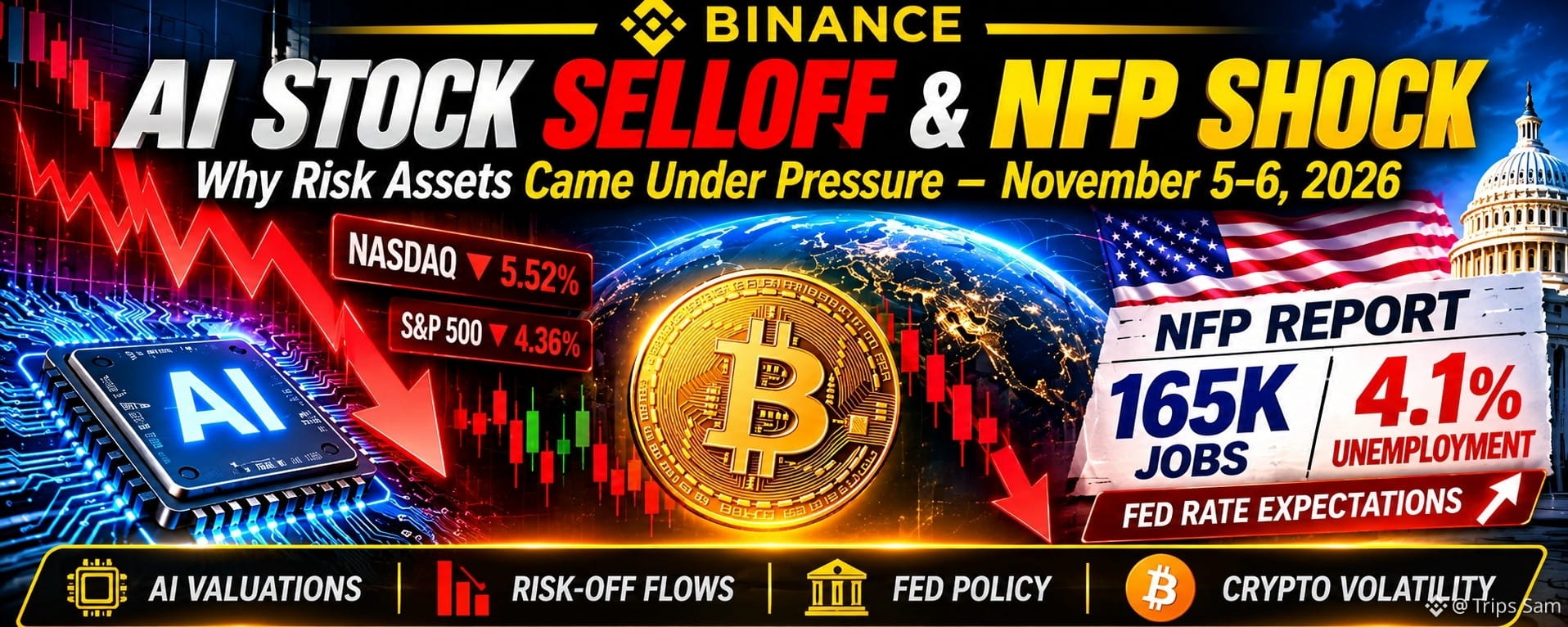
The latest market correction has delivered an important reminder: cryptocurrency markets do not operate independently of the global financial system. What began as a sharp sell-off in artificial intelligence and semiconductor stocks quickly developed into a broader risk-off movement, affecting technology shares, global equities, Bitcoin, and other digital assets. The situation became more complicated when the United States released its October Nonfarm Payrolls (NFP) report on November 6, showing considerably stronger employment growth than economists had anticipated.
These developments were not two versions of the same event. They were separate economic and financial catalysts that reinforced market uncertainty. Understanding how they interacted is essential for anyone investing in cryptocurrencies.
1. The AI Market Sell-Off: When Expectations Meet Reality
For much of 2026, artificial intelligence has been one of the strongest investment themes in global financial markets. Companies involved in AI chips, data centers, cloud computing, energy infrastructure, and advanced computing attracted enormous investor interest.
The investment thesis was straightforward: AI adoption would accelerate, demand for computing capacity would increase, and companies supplying the infrastructure would benefit from years of expanding investment.
However, markets eventually begin questioning whether expectations have moved too far ahead of actual financial returns.
On November 5, investors aggressively reassessed the valuations and future spending assumptions behind the AI industry. Concerns about infrastructure costs, financing requirements, potential regulatory restrictions, and the commercial return on enormous AI investments contributed to a sharp correction.
The Nasdaq Composite declined approximately 5.52%, while the S&P 500 lost 4.36%. Nvidia fell approximately 9.3%, and semiconductor companies experienced particularly heavy selling.
Approximately $3 trillion in market value was erased from the S&P 500 during the sell-off, according to market reporting.
This was not simply a correction in individual technology companies. It was a reassessment of an investment theme that had become deeply embedded in global market valuations.
The important question changed from how quickly AI can grow to how much investors are willing to pay for that growth.
2. Why AI Stocks Became Vulnerable
There were several factors behind the correction.
A. Excessive Valuation Expectations
Many AI-related companies had already experienced substantial increases in market capitalization. Their valuations reflected ambitious expectations about future revenue, profitability, and market dominance.
When investors begin questioning whether those expectations are achievable, even fundamentally strong companies can experience significant price declines.
B. The Cost of AI Infrastructure
Building AI infrastructure requires enormous capital expenditure. Data centers need advanced processors, cooling systems, electricity, networking equipment, and substantial financing.
The financial burden increases when borrowing costs remain elevated.
Investors are increasingly examining whether the revenue generated by AI services can justify the scale of investment.
C. Political and Regulatory Uncertainty
The November US midterm election results introduced additional uncertainty about the future regulatory environment for AI infrastructure.
Concerns emerged that increased political scrutiny could slow data-center construction, complicate permitting, and affect future investment decisions.
This does not mean AI development will stop. It means investors must reassess the pace, cost, and regulatory conditions under which the industry may expand.
D. Institutional De-Risking
When highly valued sectors begin declining, institutional investors may reduce exposure across multiple positions.
Funds using leverage may also sell assets to reduce portfolio risk or meet financing requirements.
This can create a chain reaction in which selling extends beyond the original sector that triggered the correction.
3. How the AI Sell-Off Reached Bitcoin and the Cryptocurrency Market
One of the most important observations from November 5 was that Bitcoin did not remain isolated from the technology market correction.
Bitcoin declined just over 5% during the AI-led sell-off, while more than $1 billion in leveraged cryptocurrency positions were liquidated, according to CoinShares.
This demonstrates the increasing relationship between digital assets and broader financial-market liquidity.
Why does this happen?
Because many institutional investors now hold exposure to multiple asset classes simultaneously. Their portfolios may include technology stocks, semiconductor companies, Bitcoin, Ethereum, and other digital assets.
When market volatility increases, portfolio managers may reduce exposure to risk assets collectively rather than evaluate each investment independently.
Furthermore, leveraged cryptocurrency traders face additional pressure when prices move sharply against their positions.
Forced liquidations can accelerate selling, increase volatility, and create temporary price dislocations.
A decline in technology stocks does not automatically mean Bitcoin's fundamentals have deteriorated. However, when liquidity contracts and investors reduce risk exposure, Bitcoin can become collateral damage in a broader financial-market correction.
4. The NFP Report: A Stronger US Labor Market Than Expected
On November 6, the US Bureau of Labor Statistics released its October employment report.
The headline figure surprised financial markets.
Actual nonfarm payroll growth: 165,000 jobs
Market expectation: approximately 65,000 jobs
Unemployment rate: 4.1%, down from 4.2%
Average hourly earnings: increased 0.4% month over month
Annual wage growth: 3.1%
The employment result was substantially stronger than anticipated.
Additionally, previous employment figures were revised upward, with August and September together receiving an additional 84,000 jobs.
At first glance, stronger employment should be positive news. It suggests that businesses are still hiring and that the US economy retains considerable resilience.
However, financial markets do not evaluate employment figures in isolation.
They also examine what those figures mean for inflation, interest rates, Federal Reserve policy, and the cost of capital.
Good economic news can become challenging financial-market news when investors believe it reduces the possibility of interest-rate cuts.
5. Why Strong NFP Data Can Pressure Bitcoin and Other Cryptocurrencies
The relationship between employment data and cryptocurrency prices is particularly important.
When employment growth is stronger than expected, investors may conclude that the Federal Reserve has less urgency to reduce interest rates.
A resilient labor market can give policymakers additional flexibility to maintain restrictive monetary conditions while addressing inflation.
Higher interest rates can create several challenges for cryptocurrency markets:
1. Higher Cost of Capital
When interest rates remain elevated, borrowing becomes more expensive for businesses, investors, and financial institutions.
This can reduce the availability of capital for speculative investments.
2. Stronger Dollar Expectations
Higher US interest-rate expectations can support demand for dollar-denominated assets.
A stronger dollar can create additional pressure on assets such as Bitcoin and other cryptocurrencies.
3. Reduced Risk Appetite
Investors may prefer cash equivalents, Treasury securities, and other interest-bearing instruments when their returns become more attractive relative to volatile assets.
4. Lower Liquidity for Speculative Markets
Cryptocurrencies are sensitive to changes in global liquidity.
When financial conditions tighten, capital may leave speculative assets, putting pressure on prices and trading volumes.
The November 6 employment report therefore introduced another challenge for an already nervous market.
US Treasury yields increased following the release, reinforcing expectations that the Federal Reserve could maintain or increase interest rates.
The market's reaction illustrates why cryptocurrency investors must monitor employment data alongside traditional crypto indicators.
6. The Two Catalysts: AI Valuation Concerns and Monetary Policy
The sequence of events is particularly important.
On November 5, the AI and technology sell-off triggered a major risk-off movement across global markets.
On November 6, the stronger-than-expected NFP report complicated the recovery by reinforcing concerns about restrictive monetary policy.
The two developments affected markets through different channels:
AI sell-off: concerns about valuations, investment returns, infrastructure spending, and technology-sector exposure.
NFP surprise: concerns about inflation, interest rates, Treasury yields, and future monetary policy.
Together, they created a difficult environment for risk assets.
The distinction matters because the solutions are different.
AI-related stocks may stabilize when valuations become more attractive and corporate investment expectations become clearer.
Cryptocurrency markets may recover when liquidity conditions improve, monetary expectations become less restrictive, and investors regain confidence.
One development does not automatically resolve the other.
7. Why the Cryptocurrency Market Is Becoming More Sensitive to Macroeconomic Data
Bitcoin was originally introduced as a decentralized monetary asset operating independently of traditional banking infrastructure.
However, its current market structure has evolved considerably.
Institutional participation, exchange-traded products, derivatives markets, and cross-asset investment strategies have increased the connection between cryptocurrencies and traditional financial markets.
This means Bitcoin is increasingly affected by:
Federal Reserve interest-rate decisions.
US inflation and employment reports.
Treasury yields and dollar movements.
Institutional investment flows.
Global liquidity conditions.
Equity-market volatility.
This does not eliminate Bitcoin's unique monetary characteristics.
It simply means that short-term price movements are increasingly influenced by the financial environment in which Bitcoin trades.
Investors who focus exclusively on cryptocurrency news may therefore miss some of the most important catalysts affecting market direction.
Understanding macroeconomics is no longer optional for serious cryptocurrency investors.
8. Bitcoin: Is This a Fundamental Problem or a Liquidity Correction?
One of the most important questions following the recent decline is whether Bitcoin's weakness reflects a deterioration in its long-term fundamentals or a temporary reduction in risk appetite.
The distinction is critical.
If Bitcoin declines because of a broader institutional reduction in risk exposure, its price may recover when liquidity and investor confidence improve.
However, if the decline is accompanied by sustained institutional outflows, weakening demand, and deteriorating market structure, the correction may become more prolonged.
Investors should monitor:
Spot Bitcoin ETF net flows.
Exchange inflows and outflows.
Futures open interest.
Funding rates and liquidation activity.
Bitcoin dominance.
Real yields and US dollar strength.
Trading volume around major support and resistance zones.
A single market decline is insufficient to establish a new long-term bearish trend.
Likewise, a short-term recovery does not necessarily confirm that the correction has ended.
9. What About Ethereum, Solana, NEAR, and Other Altcoins?
Altcoins can experience greater volatility than Bitcoin during periods of market stress.
This is partly because they generally have smaller market capitalizations, different liquidity conditions, and higher sensitivity to speculative capital flows.
Ethereum (ETH): Its performance depends on institutional demand, network activity, staking economics, and broader cryptocurrency liquidity. A restrictive monetary environment can affect its valuation and investment flows.
Solana (SOL): Solana's ecosystem activity and strong participation in decentralized applications remain important fundamental considerations. Nevertheless, its market price can be particularly sensitive to changes in speculative risk appetite.
NEAR Protocol (NEAR): Its developments in Chain Abstraction, NEAR Intents, and AI-related infrastructure should be evaluated separately from short-term market volatility. However, technological progress does not make the token immune to liquidity-driven corrections.
Other Altcoins: Smaller projects can experience disproportionate declines when traders reduce exposure, especially when order-book liquidity is limited.
The important lesson is that a market-wide decline does not necessarily mean every blockchain project has experienced a deterioration in its fundamentals.
Investors should distinguish between a decline caused by external liquidity conditions and a decline caused by project-specific problems.
10. Why Forced Liquidations Can Make the Situation Worse
Cryptocurrency derivatives introduce another layer of risk.
When traders use leverage, relatively small price movements can produce substantial changes in account equity.
If market prices decline beyond certain thresholds, leveraged positions may be forcibly closed.
This creates additional selling pressure.
During the November 5 correction, more than $1 billion in leveraged crypto positions were liquidated.
These liquidations can produce a feedback loop:
Market prices decline.
Leveraged positions approach liquidation thresholds.
Forced closures increase selling pressure.
Prices move further against remaining leveraged traders.
Additional positions are liquidated.
This mechanism can exaggerate market movements beyond what underlying spot demand and supply alone might suggest.
For this reason, investors should distinguish between ordinary Spot market selling and forced selling associated with leveraged positions.
Leverage can turn a market correction into a much more aggressive liquidation event.
11. The Federal Reserve: The Next Major Market Driver
Following the October employment report, investors must reassess their expectations for Federal Reserve policy.
The stronger employment figures provide policymakers with additional evidence that the labor market remains resilient.
However, employment is only one component of the Federal Reserve's decision-making process.
Inflation, wage growth, consumer spending, financial conditions, and economic expectations also matter.
The next important question is whether inflation continues moderating or remains sufficiently persistent to justify restrictive monetary policy.
If inflation remains elevated while employment remains strong, interest-rate expectations could become more restrictive.
That would create additional challenges for speculative investments.
Conversely, if inflation moderates and employment gradually cools without a severe economic contraction, markets may regain confidence in the possibility of more accommodative monetary conditions.
Investors should avoid assuming that one employment report determines the Federal Reserve's next decision.
The direction of monetary policy depends on a broader series of economic indicators.
12. Three Possible Scenarios for Cryptocurrency Markets
Scenario A: Recovery and Stabilization
AI stocks stabilize, technology-sector valuations become more attractive, and institutional selling begins to slow. If inflation data also provides room for more accommodative monetary expectations, cryptocurrency markets could recover.
Under this scenario, Bitcoin may regain strength first, followed by selected altcoins as market confidence improves.
Scenario B: Extended Consolidation
Technology stocks remain volatile, employment data continues showing economic resilience, and the Federal Reserve maintains a restrictive position.
Cryptocurrency markets may experience sideways trading, repeated attempts to recover, and further corrections.
This environment would favor patience and disciplined capital management rather than aggressive positioning.
Scenario C: Further Market Correction
AI valuations continue adjusting, institutional investors reduce risk exposure, and inflation prevents a more accommodative monetary policy.
In this environment, Bitcoin and altcoins could experience additional downside pressure, particularly if leveraged liquidations increase.
These scenarios are analytical possibilities, not guaranteed forecasts.
13. How Should Spot Investors Respond?
Market corrections often create emotional pressure.
Investors may feel compelled to sell immediately, buy every decline, or attempt to predict the exact market bottom.
None of these reactions is necessarily appropriate.
A disciplined Spot investor should focus on capital allocation, asset quality, entry levels, and the ability to withstand volatility.
Several principles are worth considering:
Avoid Concentration: Do not allocate excessive capital to one cryptocurrency simply because its price has declined.
Use Staggered Entries: Dividing available investment capital into several planned purchases can reduce dependence on a single entry price.
Maintain Liquidity: Keeping some capital uncommitted provides flexibility if market conditions deteriorate.
Reassess Fundamentals: A lower price does not automatically make an asset undervalued.
Avoid Unnecessary Leverage: A temporary market decline should not become an irreversible financial loss because of forced liquidation.
Spot trading removes leverage-driven liquidation from fully funded purchases, but it does not protect against the possibility of substantial or total investment losses.
The objective is to preserve the ability to make rational decisions when markets become unpredictable.
14. What Investors Should Watch During the Coming Trading Sessions
Rather than reacting to every headline, I would concentrate on a small number of indicators:
US Inflation: The next CPI release will help determine whether stronger employment is accompanied by persistent inflationary pressure.
Treasury Yields: Continued increases may indicate that financial conditions are becoming more restrictive.
US Dollar Index: Dollar strength can create additional pressure on risk-sensitive assets.
Nasdaq and Semiconductor Stocks: Stabilization in these sectors could help improve broader risk sentiment.
Bitcoin Spot Demand: ETF flows, exchange activity, and trading volume can reveal whether buyers are returning.
Crypto Liquidations: A reduction in forced selling may help establish more stable market conditions.
Altcoin Relative Strength: The performance of ETH, SOL, and NEAR against BTC can help identify whether investors are returning to higher-risk digital assets.
These indicators should be assessed together rather than treated as independent trading signals.
15. My Perspective: Corrections Reveal the Difference Between Hype and Fundamentals
The recent market movement highlights an important reality about modern financial markets.
AI stocks, semiconductor companies, Bitcoin, and altcoins may belong to different industries, but they increasingly compete for the same global pool of investment capital.
When confidence deteriorates, investors can reduce exposure across all these markets simultaneously.
That does not mean artificial intelligence has lost its long-term importance.
It does not mean Bitcoin's long-term monetary thesis has disappeared.
And it does not mean every cryptocurrency project has suddenly become less valuable.
What it demonstrates is that valuations, liquidity, interest rates, and investor positioning remain powerful short-term market drivers.
The most important task for investors is to separate temporary market pressure from genuine deterioration in an asset's long-term prospects.
A correction should encourage better analysis, not blind optimism or panic.
Final Thoughts: The Market Is Bigger Than Crypto
The November 5–6 sell-off provides an important lesson for every cryptocurrency investor.
AI investment expectations triggered a major correction in technology stocks. The movement spread into broader financial markets and cryptocurrencies, while the stronger-than-expected NFP report subsequently reinforced concerns about restrictive monetary policy.
These developments demonstrate how interconnected modern financial markets have become.
For Bitcoin and other cryptocurrencies, the direction of global liquidity, Treasury yields, institutional positioning, and Federal Reserve expectations remains extremely important.
I believe investors should approach the current environment with discipline, patience, and a clear understanding of risk.
Do not confuse a market correction with the permanent failure of an investment thesis.
Equally, do not assume that every decline represents a buying opportunity.
The strongest investors are not necessarily those who predict every market movement correctly. They are those who understand why markets move, manage their exposure responsibly, and preserve the ability to participate when genuine opportunities emerge.
The AI revolution is not over. Bitcoin's story is not over. The cryptocurrency market is not over.
But the market is reminding us that expectations must eventually be supported by economic reality.
In the long run, fundamentals matter. In the short run, liquidity matters. And throughout every market cycle, risk management matters most.
Market analysis dated November 7, 2026. Figures reflect reported market data and economic releases from November 5–6, 2026. This article is for educational purposes and does not constitute financial.


