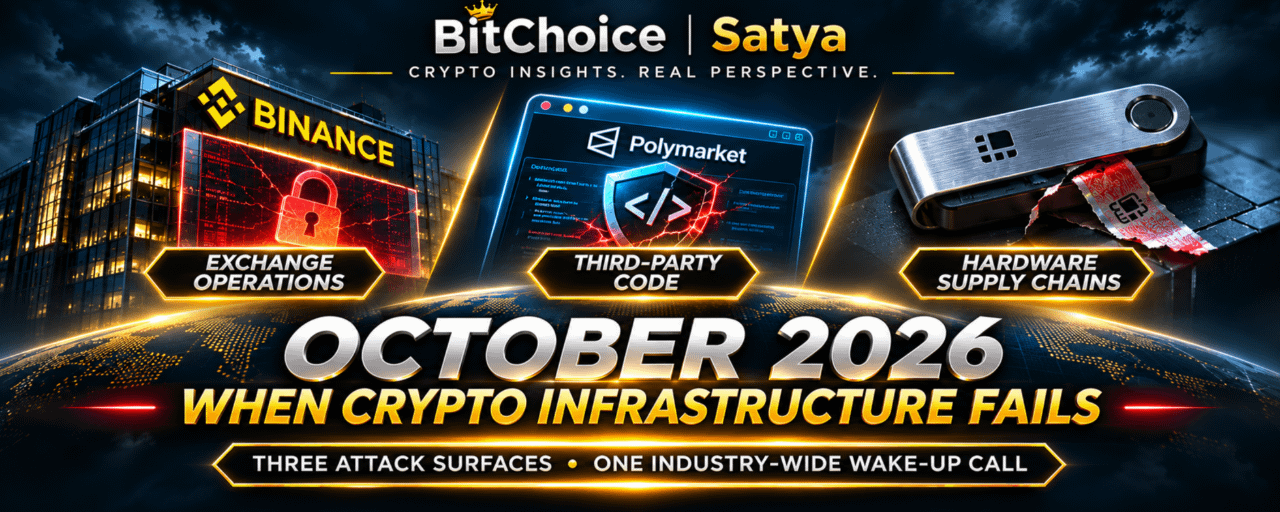

Three attack surfaces. Billions at risk. One industry-wide wake-up call.
BitChoice | Satya — Crypto Security & Market Infrastructure Intelligence
November 1, 2026
The Month That Exposed Crypto's Weakest Links
October 2026 will be remembered for more than Bitcoin volatility, institutional ETF flows and sudden market liquidations.
It also exposed a more fundamental problem: the systems surrounding blockchain technology can fail even when the underlying networks continue operating normally.
Within a short period, three different security incidents illustrated three very different vulnerabilities.
Binance suffered a multibillion-dollar hot-wallet security breach.
Polymarket users were targeted through compromised third-party website code.
And hardware-wallet customers in Singapore were affected by devices containing malicious components.
These were not identical attacks.
They did not exploit one universal flaw in blockchain technology.
But together, they revealed a common weakness:
Crypto security is only as strong as the complete infrastructure connecting users, platforms, devices and digital assets.
1. BINANCE: A $6.3 BILLION SECURITY SHOCK
On October 29, Binance experienced one of the largest reported cryptocurrency exchange security breaches.
According to the exchange's October 30 statement, compromised hot-wallet infrastructure enabled unauthorized withdrawals involving approximately $6.3 billion in digital assets.
Binance's preliminary investigation pointed to a potentially compromised DevOps engineer's laptop, followed by unauthorized access to operational infrastructure.
The exchange stated that it had found no evidence of leaked wallet private keys.
However, these findings remain preliminary. Binance has promised a more detailed technical report once the investigation is complete.
North Korea and TraderTraitor
On October 31, the FBI publicly attributed the theft of more than $6 billion in virtual assets to North Korean cyber actors associated with TraderTraitor.
The agency reported that the attackers were converting stolen assets primarily into Ethereum.
It also warned that further laundering could involve DeFi platforms and instant exchange services.
The FBI, alongside the US Secret Service and IRS Criminal Investigation, called on digital-asset service providers and infrastructure operators to help disrupt transactions connected to identified addresses.
This represents a significant escalation from a platform-specific incident to an international law-enforcement response.
Binance's Recovery Response
By November 1, Binance reported several important developments:
Approximately 95% of the affected asset amount had been replenished using company resources.
Major affected assets, including BTC, ETH, USDT, BNB, SOL, USDC and XRP, were reported as fully backed.
Withdrawal services were being restored in phases, subject to security and operational checks.
The remaining replenishment involved less-liquid assets that required additional sourcing.
Binance committed to absorbing the financial impact rather than passing the losses on to customers.
These announcements are important, but they require careful interpretation.
Replenishing customer assets is not the same as recovering stolen assets from attackers.
Nor does the resumption of withdrawals mean every network and asset has become available simultaneously.
The First Major Lesson
The Binance incident highlights the importance of operational security beyond private-key management.
Access controls, infrastructure isolation, authorization systems, monitoring and incident-response procedures are all critical.
Even a platform with extensive security resources can face serious consequences if attackers compromise a trusted operational component.
The central question is not simply how much money was stolen.
It is how unauthorized access could produce transfers at such a scale — and what controls will prevent similar failures.
2. POLYMARKET: WHEN A TRUSTED WEBSITE BECOMES THE ATTACK VECTOR
The second major incident demonstrated a different weakness.
On October 29, Polymarket confirmed that a third-party vendor whose script loaded on its website had been compromised.
Attackers replaced the script with malicious code targeting users of the international platform.
According to Polymarket's official incident report, some users with active sessions during the affected period had positions sold and funds moved from their wallets without authorization.
This was not the same type of compromise as the Binance incident.
Instead of breaking the underlying blockchain, attackers exploited software running in a trusted web interface.
What Was the Financial Impact?
Polymarket reported:
$2.7 million in stolen assets.
An additional $1.2 million in compensation for qualifying losses associated with the trading interruption.
Total compensation: $3.9 million.
The distinction matters because the total reimbursement exceeded the amount directly stolen.
Polymarket stated that it identified eligible wallets through trading and onchain records.
The Hidden Risk of Third-Party Dependencies
Modern websites rely on external scripts and services for functions such as monitoring, analytics and performance measurement.
These integrations can improve functionality.
But they also expand the number of systems that must remain secure.
If a compromised script executes inside a trusted trading interface, attackers may be able to exploit an authenticated user's session.
That creates an uncomfortable reality for Web3:
A secure smart contract cannot automatically protect a user from malicious software operating through the website they trust.
The Second Major Lesson
Security reviews must extend beyond smart contracts.
Trading platforms should evaluate third-party dependencies, script integrity, browser-session permissions and emergency containment procedures.
Reducing unnecessary third-party code is not just a performance optimization.
For financial applications, it is a security decision.
3. LEDGER: THE HARDWARE SUPPLY-CHAIN PROBLEM
The third incident reached beyond online platforms.
On October 28, the Singapore Police Force issued an advisory concerning tampered Ledger cryptocurrency hardware wallets.
Police reported at least two cases since September 10, involving combined losses of approximately S$3.5 million.
Preliminary investigations indicated that hardware wallets purchased from certain retail stores contained malicious components.
Those components could capture recovery phrases or private keys and enable unauthorized access to victims' assets.
The investigation remained ongoing.
Why This Case Is Different
Hardware wallets are designed to isolate sensitive cryptographic operations from ordinary computers and online environments.
But users still depend on the authenticity and integrity of the physical device they receive.
That creates a distinct attack surface: manufacturing, storage, transportation and retail distribution.
A malicious component introduced before the device reaches the customer can undermine assumptions about device security.
This does not establish that every Ledger device is compromised.
It also does not prove a universal failure of the company's secure-chip architecture.
The reported cases concern tampered devices, and the precise compromise mechanisms remain subject to investigation.
The Third Major Lesson
Self-custody reduces dependence on exchanges, but it does not eliminate operational risk.
Users still need to protect recovery phrases, obtain devices through trusted channels, verify authenticity and follow manufacturer guidance.
Self-custody means taking responsibility for additional security decisions — not escaping security risk entirely.
4. THREE INCIDENTS, THREE DIFFERENT ATTACK SURFACES
IncidentMain attack surfaceCentral failureBinanceExchange operational infrastructureUnauthorized withdrawal authorizationPolymarketThird-party website codeMalicious execution through trusted sessionsLedger casesHardware distribution chainTampered physical devices
The incidents illustrate why security cannot be reduced to a single question such as whether a blockchain is decentralized.
A user may interact with:
A centralized exchange
A web trading interface
A third-party analytics service
A hardware wallet
A blockchain network
A stablecoin issuer
A bridge or liquidity protocol
Each introduces different trust assumptions.
Each can create vulnerabilities.
And the failure of one component can affect assets stored or transferred through otherwise functional systems.
5. TRACED, FROZEN, RECOVERED AND REPLENISHED ARE NOT THE SAME
One of the most important lessons from October concerns financial reporting.
During a major security incident, several different figures circulate.
They must not be combined or treated as interchangeable.
Traced Assets
Investigators identify where assets moved.
Tracing improves visibility but does not necessarily provide control over the funds.
Frozen Assets
A relevant issuer, service or authority prevents certain assets from moving.
Freezing can interrupt further laundering.
However, a freeze does not automatically return the assets to victims.
Recovered Assets
Stolen funds are actually returned or restored through a recovery process.
This is a different outcome from merely identifying or immobilizing them.
Replenished Assets
A platform replaces missing customer assets using its own funds or reserves.
This can protect customer balances even when stolen funds remain outside its control.
Reimbursed Losses
Affected users receive compensation, potentially including damages beyond directly stolen assets.
For example, Polymarket's reported $3.9 million total compensation included $1.2 million related to trading-pause losses.
The real measure of incident response requires understanding which financial milestone has been achieved — not simply repeating the largest available number.
6. WHAT OCTOBER REVEALED ABOUT BLOCKCHAIN TRANSPARENCY
One genuine advantage of public blockchains is that asset movements can often be monitored by independent investigators.
Suspicious transactions may be traced across addresses, networks and protocols.
Blockchain analytics firms can assist exchanges, stablecoin issuers and law-enforcement agencies.
But transparency has limits.
A public ledger may reveal where certain funds moved without identifying every responsible individual.
Cross-chain activity and asset conversions complicate attribution.
Some assets are more readily frozen than others.
And technical visibility alone does not determine legal ownership or reimbursement rights.
The Binance response demonstrates how cooperation can help disrupt illicit flows.
At the same time, it raises important questions about centralized controls over assets operating within decentralized ecosystems.
Transparency is a powerful investigative tool. It is not a complete security system.
7. THE SYSTEMIC MARKET IMPACT
Security incidents can influence markets even when most traders are not directly affected.
Potential consequences include:
Liquidity pressure
Users may reduce exposure, move collateral or delay new positions.
Withdrawal uncertainty
Temporary restrictions can disrupt ordinary portfolio management and cross-exchange transfers.
Derivatives stress
Rapid market moves may trigger forced liquidations and additional volatility.
Counterparty reassessment
Market makers, institutions and other platforms may review their exposure to affected services.
Reputational damage
Repeated incidents can weaken confidence in financial infrastructure.
However, market losses cannot automatically be attributed entirely to a security breach.
ETF flows, macroeconomic developments, leverage and broader investor sentiment may also influence prices.
Establishing causation requires more than a simultaneous price decline.
8. WHAT NEEDS TO CHANGE AFTER OCTOBER?
The industry should focus on several priorities.
Stronger Operational Security
Critical withdrawal infrastructure needs tightly controlled authorization, independent verification and robust access isolation.
Secure Software Supply Chains
Third-party scripts and vendors should be treated as potential financial-security dependencies.
Hardware Authenticity
Wallet providers and retailers need reliable procedures for protecting distribution channels and detecting tampering.
Faster Cross-Industry Coordination
Exchanges, issuers, blockchain analytics providers and law enforcement need effective channels for responding to confirmed threats.
Clearer Incident Reporting
Users should receive precise information about affected assets, interrupted services, recovery progress and outstanding risks.
Better User Protection
Security education should focus on phishing, impersonation, recovery-phrase theft, suspicious browser interactions and counterfeit devices.
These measures cannot eliminate every attack.
But they can reduce the probability that a single compromised component produces catastrophic losses.
9. WILL THESE INCIDENTS DAMAGE CRYPTO ADOPTION?
There are two competing effects.
Repeated breaches can discourage users and institutions from trusting cryptocurrency platforms.
Large losses reveal weaknesses that mature financial systems cannot ignore.
But serious incidents can also accelerate improvements in monitoring, custody standards, governance and operational security.
The direction of that effect depends on what the industry actually does next.
Announcements and reimbursement promises matter.
Auditable improvements and demonstrable safeguards matter more.
The goal should not be convincing users that crypto is perfectly safe.
It should be building systems whose risks are understandable, controlled and transparently reported.
FINAL PERSPECTIVE: TRUST MUST BE EARNED AT EVERY LAYER
October 2026 exposed three different vulnerabilities:
An exchange operational compromise.
A third-party website script compromise.
A hardware-wallet supply-chain compromise.
Together, they revealed an uncomfortable truth.
Blockchain security and crypto-infrastructure security are not the same thing.
A network can continue processing valid transactions while users suffer devastating losses through the systems surrounding it.
The encouraging development is that the industry demonstrated growing capacity for coordinated investigation, asset tracing, freezing and customer compensation.
But those responses do not erase the failures that made them necessary.
The next stage of crypto maturity must be judged by prevention, transparency, independent verification and measurable resilience.
The future of digital finance depends not only on innovation — but on whether people can trust the infrastructure carrying their money.
Discussion
After October 2026, which security layer needs the most urgent upgrade: exchange operations, Web3 applications or hardware-wallet supply chains?
Primary sources
FBI Cyber — North Korea Responsible for $6 Billion+ Binance Attack, October 31, 2026.
Binance — Security Incident Update #2, October 30, 2026.
Binance — Recovery Update #4: Withdrawals Resume in Phases, November 1, 2026.
Polymarket Status — Security Incident: Third-Party Vendor Compromised, October 29–31, 2026.
Singapore Police Force — Police Advisory on Tampered Cryptocurrency Hardware Wallets, October 28, 2026.
Editorial disclosure: The investigation into Binance's technical compromise remains ongoing. The 95% figure reflects Binance's reported asset replenishment as of November 1, not recovered stolen funds. The Ledger cases remain under investigation. The incidents are analyzed separately and are not presented as evidence of one coordinated attack.
Educational and informational content only. Not financial or investment advice.
#CryptoSecurity #Binance #Bitcoin #Ethereum #RiskManagement $BTC $ETH $BNB