

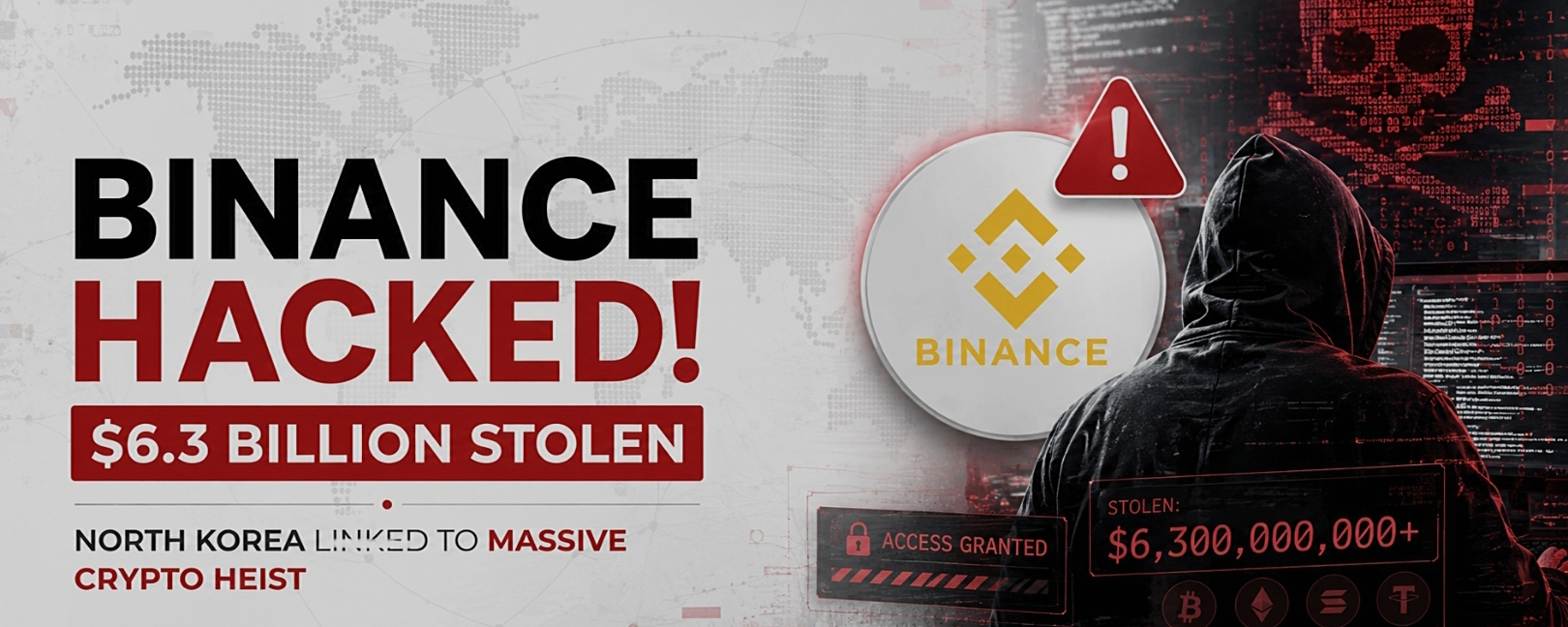

BINANCE HIT BY $6.3 BILLION HACK:
The cryptocurrency industry is facing one of its biggest security crises after Binance suffered a massive security breach involving approximately $6.3 billion in digital assets.
The incident, which took place on October 29, 2026, has potentially become the largest cryptocurrency theft ever recorded. Even more concerning, cybersecurity investigators believe North Korea's notorious hacking group, TraderTraitor, could be responsible.
But how did the attackers get access to billions of dollars, and how much of the stolen crypto can still be recovered?
• Let's break down what happened.
On October 29, billions of dollars worth of cryptocurrency began moving out of wallets associated with Binance across multiple blockchain networks.
According to blockchain analytics firm TRM Labs, approximately $6.36 billion was transferred to attacker-controlled addresses across 10 different blockchains.
The majority of the stolen assets moved within approximately 20 minutes, beginning around 20:05 UTC.
The affected networks included:
° Ethereum
° Bitcoin
° Tron
° XRP Ledger
° Solana
° Arbitrum
° Optimism
° Base
° Polygon
The scale and speed of the transactions raised serious questions about the security of centralized exchange infrastructure.
Binance's initial investigation pointed toward a compromised DevOps engineer's laptop.
According to the exchange, the compromised computer may have allowed attackers to access a service container and submit unauthorized withdrawal transactions.
Binance also stated that it had found no evidence of a wallet private-key leak at that stage of the investigation.
TRM Labs identified another important technical detail involving Ethereum.
The attacker reportedly exploited the EIP-7702 authorization mechanism to turn a Binance hot wallet into a transaction sweeper controlled by the attacker.
They prepared 50 signed authorizations in advance, allowing one valid authorization to execute when the transaction was submitted.
This enabled the attacker to drain the wallet and repeatedly collect incoming funds.
TRM believes the activity across multiple networks points to a possible compromise of Binance's hot-wallet signing infrastructure.
The complete attack method is still under investigation.
One of the most alarming developments is the suspected involvement of North Korea-linked hackers.
TRM Labs attributed the attack to TraderTraitor, a North Korean hacking unit, with high confidence based on on-chain and off-chain intelligence.
Chainalysis also pointed toward the same group.
On-chain investigator ZachXBT reported that funds from the Binance incident and an earlier Bitget exploit converged at the same address after moving through THORChain.
Investigators believe this connection could indicate the involvement of the same threat actor.
TraderTraitor has previously been linked to major cryptocurrency thefts, including the February 2025 Bybit hack, which resulted in approximately $1.5 billion in stolen assets.
However, the attribution remains an investigative assessment rather than a publicly established legal finding.
There is some positive news amid the crisis.
Binance confirmed that approximately $3 billion worth of assets had been located and frozen through cooperation with industry partners.
TRM Labs initially reported approximately $2.7 billion in frozen assets, including stablecoins and assets frozen through Arbitrum's Security Council.
Several major companies and blockchain organizations participated in the recovery effort, including:
- Tether
- Circle
- Ripple
- World Liberty Financial
- Arbitrum Security Council
These freezes prevented a substantial portion of the stolen assets from being moved or converted.
However, freezing assets does not automatically mean the funds have been returned to Binance.
According to TRM's assessment, the attacker still controlled more than 420,000 ETH and 18,270 BTC, worth approximately $2.4 billion at the time of its analysis, beyond the reach of token issuers.
Following the discovery of the security incident, Binance temporarily suspended withdrawals across several affected networks as a precaution.
The exchange confirmed that deposits were operating normally and said it was working with security partners to investigate the incident.
Binance also indicated that withdrawals were expected to resume within 48 hours, subject to security improvements.
Importantly, Binance co-founder Yi He stated that the exchange would cover all hacking losses.
Binance also maintained that user funds were safe.
This response is particularly important because the incident raises concerns about whether centralized exchanges can adequately protect customer assets against sophisticated attacks.
The news triggered significant selling pressure across the cryptocurrency market.
According to Reuters' October 30 report:
- Bitcoin dropped more than 3% to approximately $76,368.
- Ethereum declined more than 3% to around $2,178.
- BNB fell approximately 5% to $709.70.
- Coinbase shares dropped 4.8% in extended US trading.
Other market updates also reported additional weakness in BNB, Bitcoin and major DeFi tokens.
The incident has raised concerns about centralized exchange security, investor confidence and the potential risks of holding large amounts of cryptocurrency on exchange platforms.
The Binance incident is particularly significant because of its reported scale and technical complexity.
For comparison:
- Binance (2026): Approximately $6.36 billion.
- Bybit (2025): Approximately $1.5 billion.
- Ronin Network (2022): Approximately $625 million.
If the current estimates are confirmed, the Binance incident would be roughly four times larger than the Bybit hack.
It also demonstrates that even the largest cryptocurrency platforms can face serious vulnerabilities in their operational and transaction-signing systems.
The investigation is still developing, and several important questions remain unanswered:
1. Can Binance and its partners recover the remaining stolen assets?
2. Will investigators establish exactly how the attackers compromised the exchange's infrastructure?
3. Will authorities formally confirm the involvement of TraderTraitor?
4. Could this incident accelerate the shift toward decentralized exchanges?
5. Will the breach have a lasting impact on investor confidence in centralized exchanges?
MY TAKE:
The biggest lesson from this incident is that crypto security is not just about protecting private keys. Exchange infrastructure, employee devices, authorization systems and withdrawal procedures are equally important.
Binance's ability to freeze approximately $3 billion demonstrates the importance of cooperation across the crypto industry. However, recovering the remaining assets will be a much bigger challenge.
The market will be watching Binance's recovery efforts closely. The final outcome could influence how exchanges approach security and how investors manage custody risks.
What do you think? Can Binance fully recover from a $6.3 billion security breach, or will this permanently change investor confidence in centralized exchanges?
