


#USConsumerSentimentHoldsAtSecondLowestOnRecord
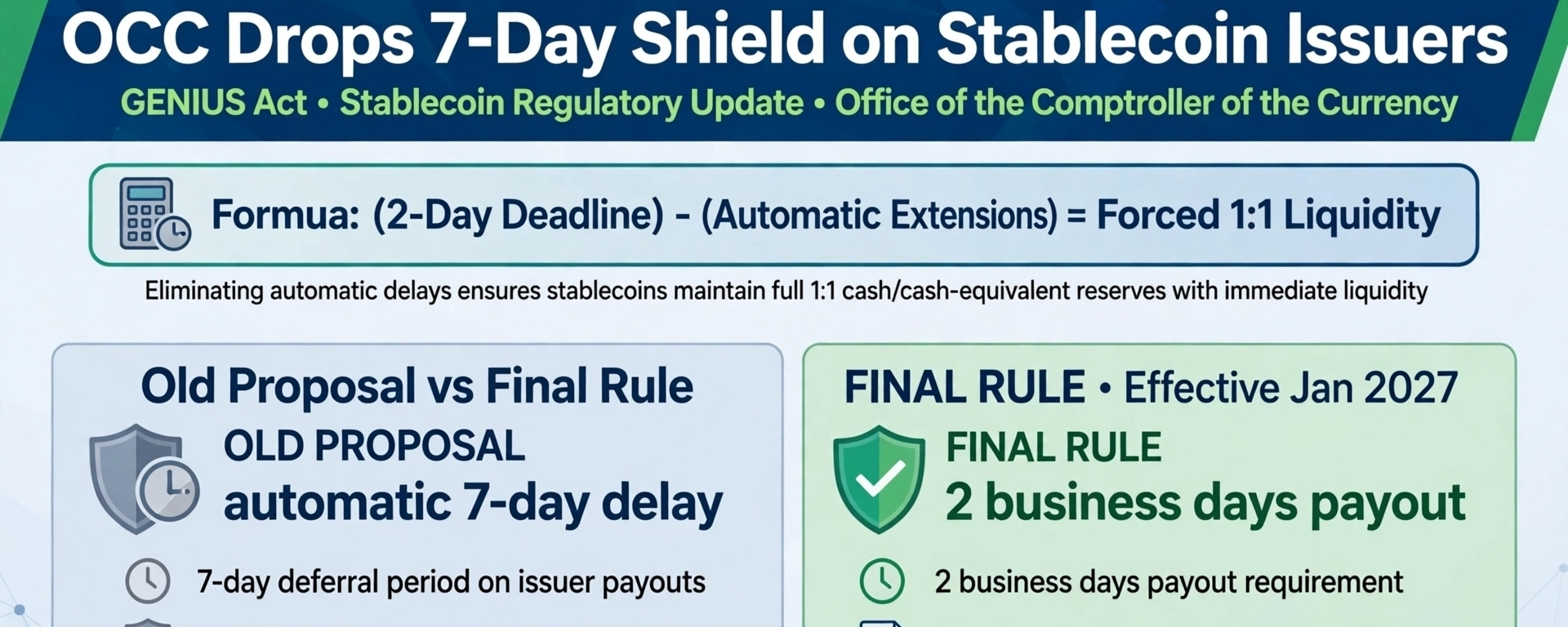
Stablecoin rules in the US just got **much stricter**. 😮 The **OCC (Office of the Comptroller of the Currency)** has finalized rules under the **GENIUS Act** that remove a proposed safety net for issuers. 🛡️ Instead of a long delay during a rush of withdrawals, issuers will now have to pay out **fast**. ⏱️
Note: your screenshot cuts off at the end, so this article covers only the visible text. Please check the OCC's official publication for the full rule. ✅
## 🧮 The "Math" Behind the New Rule
The post explains the change as a simple formula:
**(2-Day Deadline) − (Automatic Extensions) = Forced 1:1 Liquidity** 💵
In plain words: with a short deadline and no automatic extra time, issuers must keep **real, readily available reserves** to cover redemptions. 🏦
## 📜 The Rule Change: No Safety Net
According to the post, the OCC's **final GENIUS Act rules take effect in January 2027**. 📅 They **scrap an earlier proposal** that would have given issuers an **automatic 7-day delay** during massive redemption waves. 🌊
That earlier idea would have worked like a cushion. 🛟 If many users demanded their money back at once, an issuer could have taken extra time to pay. Under the final rules, **that cushion is gone**. 🚫
## ⏳ The New Baseline: 2 Business Days
The new standard for covered issuers is:
- 💸 **Fiat payouts must start within 2 business days.**
- 📈 If withdrawal requests exceed **10% of total supply within 24 hours**, the issuer must **notify the OCC within 24 hours**.
- 🙋 In that case, the issuer must **manually request an extension**. It is no longer automatic.
This creates a clear process with oversight, instead of an automatic delay. 👀
## 🔍 The Breakdown: Why the OCC Wants "True Liquidity"
The post says the OCC is **demanding true liquidity**. 💧 The idea behind this is simple. A stablecoin promises that **1 token can be redeemed for 1 dollar**. 🪙➡️💵 That promise only holds if the issuer can actually pay when users ask.
History shows what can go wrong. 📉 When doubts about reserves appear, users rush to redeem, and an issuer that cannot pay quickly can lose trust fast. 😰 Short deadlines push issuers to hold **cash and highly liquid assets** instead of assets that are slow or hard to sell. 🏦
## 📊 Old Proposal vs New Rule
| 🧩 Feature | 🕰️ Earlier Proposal | ⚖️ Final Rule |
|---|---|---|
| ⏳ **Delay during mass redemptions** | Automatic 7-day delay | No automatic delay |
| 💸 **Payout timeline** | Longer window | Start within 2 business days |
| 🚨 **Large withdrawal trigger** | Not required | Over 10% of supply in 24 hours: notify OCC within 24 hours |
| 🙋 **Extensions** | Automatic | Must be requested manually |
| 📅 **Effective date** | Not applicable | January 2027 |
## 💡 Why This Matters for Users 👥
- 🔐 **Stronger protection:** Faster redemption rights make stablecoins safer to hold.
- 🏆 **More trust:** Issuers with strong reserves can stand out.
- 🪙 **Clearer expectations:** Users know what an issuer owes them and when.
- 👀 **More transparency:** Large redemption waves must be reported to regulators.
## 🏢 Why This Matters for Issuers
- 💧 **Higher liquidity needs:** Reserves must be easy to turn into cash quickly.
- 💼 **Operational readiness:** Teams need processes to handle large redemption spikes.
- 📝 **Compliance work:** Monitoring the 10% threshold and the 24-hour notice requires clear systems.
- ⚖️ **Less flexibility:** Without automatic delays, planning matters more.
## 🪙 What This Could Mean for the Crypto Market
Stablecoins are the **main source of liquidity** in crypto trading. 🌐 Traders use them to enter and exit positions, move funds between exchanges and park money during volatility. 🔄
Stricter rules could:
- 📈 **Boost confidence** in well-reserved, compliant stablecoins
- 🧹 **Pressure weaker issuers** that lack strong liquidity
- 🏦 **Attract institutions** that want regulated, reliable stablecoins
- 🌍 **Influence global rules**, as other regions watch US policy
## ⚠️ Possible Risks and Challenges
- 💸 **Higher costs** for issuers could reduce competition.
- 🏗️ **Smaller issuers** may struggle to meet the standards.
- 😬 **Stress events** could still test even strict rules.
- 🧩 **Details matter.** How exemptions and extensions work in practice will shape the real impact.
## 🧠 Tips for Stablecoin Users 🛡️
- 📖 **Read the issuer's reserve reports** and disclosures.
- 🔎 **Check whether the issuer is regulated** in your region.
- 🧺 **Don't keep all your funds in a single stablecoin.**
- 📰 **Follow official OCC updates** for exact requirements.
- 🛑 **Be cautious during market stress,** when redemption demand can spike.
## ⚠️ Disclaimer
This article is for information only and is **not financial or legal advice**. 📌 Crypto and stablecoins carry risk, and regulations can change. Please do your own research. 🙏
## 🌟 Final Thoughts
The OCC's final GENIUS Act rules mark a big shift: **a 2-business-day payout standard, a 10% withdrawal trigger and no automatic 7-day cushion**. 🧮 The goal is clear: make sure stablecoins are backed by **real liquidity**, not just promises. 💧 For users, that could mean safer stablecoins. For issuers, it means getting serious about reserves before **January 2027**. 🚀🏦
**:** #Stablecoins #GENIUSAct #OCC #CryptoRegulation #CryptoNews
##SouthKoreaPlansToRegulateStablecoinsUnderFXLaw #MarketsPriceJust10%ChanceOfFedHikeNextWeek #SouthKoreaPlansToRegulateStablecoinsUnderFXLaw #IRSPlansLowerTaxDisclosurePenaltiesForCryptoCases #FranklinTempletonAdds$150MFundSharesToXRPLedger