

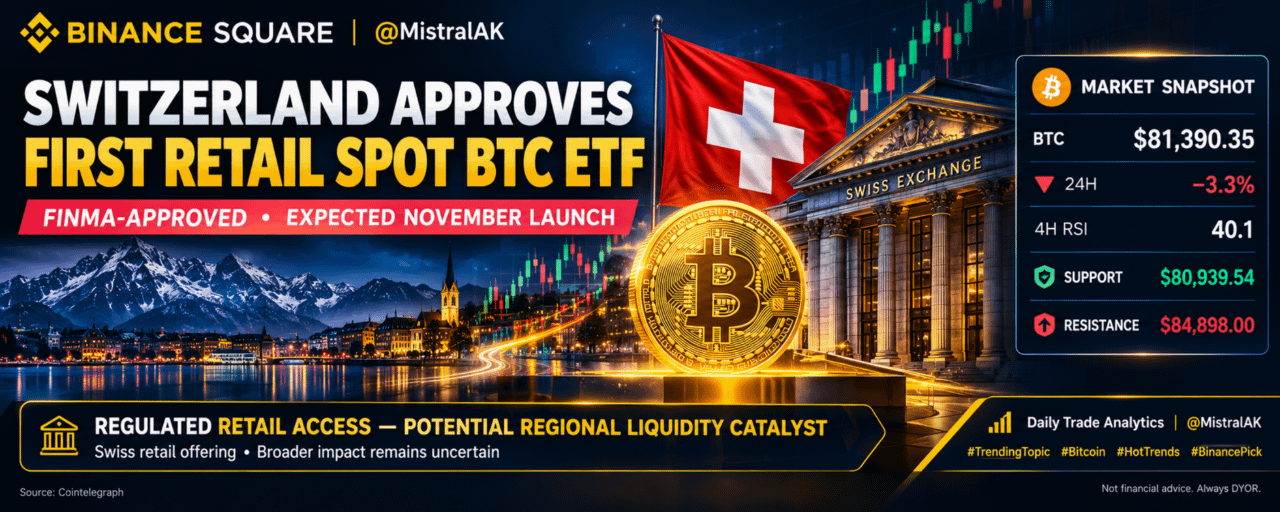

Switzerland’s financial regulator doesn’t bend rules casually. So when FINMA approved the country’s first spot Bitcoin ETF for retail investors — and had to waive its own diversification requirements to do it — that exception is arguably more significant than the product itself.
KEY FACTS
▪️ FINMA approved Switzerland’s first spot Bitcoin ETF for retail investors, initially keeping the issuer confidential
▪️ Zurich-based BIT Asset Management later claimed the approval, planning a November listing on SIX Swiss Exchange under ticker BBIT
▪️ Swiss law normally requires public funds to diversify — a single-asset Bitcoin fund breaks that rule by design
▪️ FINMA justified the exemption citing Bitcoin’s long trading history and high volume relative to other cryptocurrencies
▪️ Goes beyond FINMA’s 2021 crypto basket fund approval (same firm), which was limited to qualified investors only — this one is open retail
▪️ US spot Bitcoin ETFs drew $526.6 million in inflows on October 19, as digital asset fund demand recovers from a record outflow run earlier this year
WHY THE RULE-BREAK MATTERS MORE THAN THE TICKER
Diversification requirements are a core investor-protection mechanism against concentrating retail money in one volatile asset. FINMA explicitly carved out an exception for Bitcoin, citing trading history and liquidity. A historically conservative Swiss regulator making that call at all is the real signal, regardless of whether the judgment proves correct.
NOT SWITZERLAND’S FIRST BITCOIN PRODUCT — BUT A DIFFERENT CATEGORY
Swiss exchanges already list physically backed Bitcoin ETPs — debt-like securities, not funds under Swiss collective investment law. BBIT is structured as an actual regulated fund: Swiss fund governance, independent custody. CEO Dominik Oggenfuss: “Investors can now access bitcoin through an ordinary Swiss bank account, with Swiss fund governance, independent custody.”
THE REGULATOR’S OWN WARNING IS WORTH READING CLOSELY
FINMA stated plainly that “investments in Bitcoin – even through an approved ETF – remain highly risky,” warning of significant potential capital loss. Supervised firms must contain custody/operational risks under January 2026 guidance, and sellers must follow Switzerland’s FinSA conduct law — mandatory volatility warnings and suitability checks. Regulated access, not frictionless access.
WHAT WE DON’T KNOW YET
BIT Asset Management hasn’t disclosed the fund’s fee, custodian, or retail distribution partner. BBIT is marketing itself as “Europe’s only spot Bitcoin ETF,” but FINMA confirms other providers have already filed competing applications — that exclusivity claim has a short shelf life.
THE SWISS CONTEXT THAT MAKES THIS LAND DIFFERENTLY
Some Swiss wealth managers already pair Bitcoin with gold and the franc as a hedge against mounting US debt — a regulated, bank-account-accessible ETF fits neatly into existing local appetite rather than creating it from scratch.
WHAT TO WATCH
▪️ The actual November listing date and BBIT’s fee structure once disclosed
▪️ Rival ETF filings that could end BBIT’s exclusivity claim
▪️ Whether FINMA’s exception becomes a template other regulators cite
▪️ Inflow data once BBIT lists
BOTTOM LINE
The ETF itself is notable. The regulator rewriting its own diversification rules to allow it is what should actually move the needle on how seriously Bitcoin is treated as an asset class. FINMA’s own risk warning sitting right next to the approval is a reminder that “regulated” and “safe” aren’t the same word.
Does a historically cautious regulator bending its own rules for Bitcoin change how you view the asset’s legitimacy, or is this just one country’s exception?
Source: FINMA, BIT Asset Management, BeInCrypto, finews. Not financial advice. Always DYOR.
Like & Follow for Daily Trade Analytics & Insider News. @MistralAK