

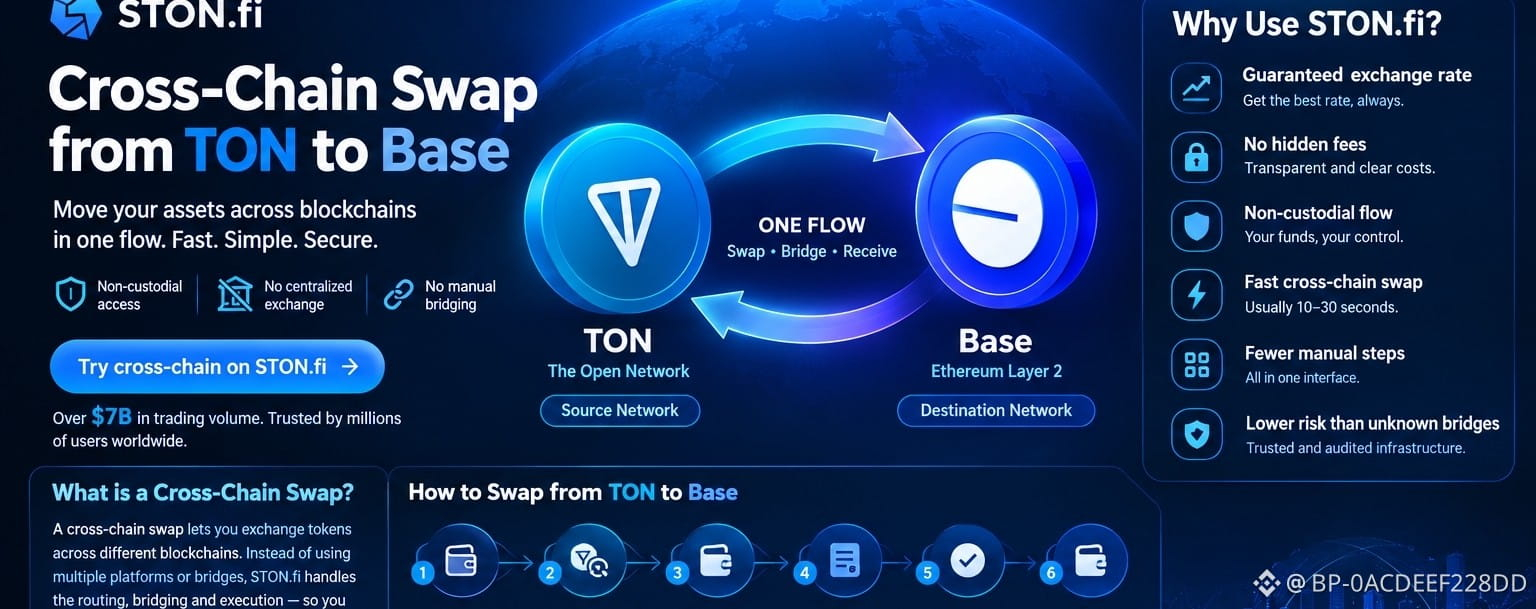

Cross-Chain Swaps from TON to Base: A Beginner’s Guide to STON.fi
The blockchain ecosystem is expanding, but one challenge remains: moving assets between different networks. With multiple blockchains offering different opportunities, users need simple, efficient, and secure ways to transfer value without dealing with complicated bridging processes.
This is where cross-chain swaps from TON to Base come in, with STON.fi helping simplify the process.
By connecting the TON ecosystem with Base, users can explore opportunities across different blockchain networks through a more streamlined experience.
In this article, we will explore how cross-chain swaps work, why they matter, how beginners can execute a swap using STON.fi, and how this technology supports the broader development of TON and DeFi.
1. What Is a Cross-Chain Swap?
A cross-chain swap allows users to exchange assets across two different blockchain networks.
For example, TON and Base operate on different blockchain infrastructures. A token held on TON cannot automatically be used on Base because each network maintains its own transactions, balances, and rules.
Traditionally, moving assets between networks could require users to find a compatible bridge, transfer tokens, wait for confirmations, and potentially perform another swap.
A cross-chain swap simplifies this process by combining the necessary steps into one coordinated flow.
Imagine holding USDt on TON and wanting to receive a supported token on Base. Instead of manually navigating several platforms, you can use a supported cross-chain route to initiate the transaction and receive the destination asset in your Base-compatible wallet.
The main idea is simple: send value from one blockchain and receive the selected asset on another.
However, cross-chain swaps are not risk-free. Users should always check the supported assets, exchange rate, fees, transaction status, and destination wallet before proceeding.
2. Why Connect TON and Base?
TON and Base serve different purposes within the broader blockchain ecosystem, creating opportunities for users to access different applications and liquidity.
The TON ecosystem
The Open Network (TON) is a blockchain ecosystem closely associated with Telegram, offering opportunities across decentralized finance, payments, digital assets, and applications.
Its integration with Telegram gives developers and users opportunities to explore blockchain technology through familiar digital experiences.
Projects such as STON.fi contribute to this ecosystem by providing decentralized token-swapping infrastructure and access to DeFi activities.
The Base ecosystem
Base is an Ethereum Layer 2 network designed to support applications with lower transaction costs than Ethereum mainnet in many circumstances.
Its ecosystem includes decentralized exchanges, DeFi protocols, consumer applications, and other on-chain services.
Why connect them?
Connecting TON and Base can help users explore opportunities across both ecosystems without relying entirely on centralized exchanges.
Potential benefits include:
Greater accessibility: Explore supported assets across different blockchain networks.
More flexibility: Move value to a network where your preferred applications operate.
Simplified transactions: Use an integrated cross-chain flow instead of manually coordinating multiple steps.
Broader DeFi participation: Access supported opportunities beyond a single blockchain.
The availability of these benefits depends on the route, liquidity, supported assets, and current service conditions.
3. How STON.fi Makes Cross-Chain Swapping Easier
STON.fi is a decentralized exchange built around the TON ecosystem.
Its cross-chain functionality aims to make moving assets between supported blockchain networks more straightforward by coordinating the required steps through an integrated interface.
Instead of manually researching multiple bridging options, users can begin with the source asset, select the destination network and token, review the available quote, and confirm the transaction.
Here are some important features to understand.
One integrated flow
The interface brings the steps of a cross-chain swap together, reducing the need to navigate multiple services manually.
Non-custodial access
A non-custodial transaction flow allows users to authorize transactions through their own wallets rather than depositing funds into a centralized exchange account. However, users should understand the permissions they grant and the infrastructure involved.
Transparent transaction details
Before confirming a swap, users should review the displayed exchange rate, estimated fees, price impact, and expected destination amount.
Access to supported assets
Available trading pairs depend on the routes and liquidity supported by the service at the time of the transaction.
Important: Never assume that every token on TON can be swapped directly into every token on Base. Always check the available options in the official interface.
Explore the available functionality through the official [STON.fi website](https://ston.fi/
4. Step-by-Step Guide: How Beginners Can Swap from TON to Base
If you are new to cross-chain transactions, the following steps provide a practical starting point.
Step 1: Prepare your wallets
You will need a TON-compatible wallet to hold and send your source assets and a Base-compatible wallet to receive your destination assets.
Examples include:
TON: Tonkeeper or another wallet that supports the selected TON asset.
Base: MetaMask, Rabby, Coinbase Wallet, or another compatible wallet.
Make sure you control the wallets and can access them.
For your Base wallet, confirm that Base is supported and selected where necessary.
Never share your seed phrase or private keys with anyone claiming to help you complete a swap.
Step 2: Visit STON.fi
Open the official https://ston.fi/ and navigate to the cross-chain swap feature, if available.
Verify that you are using the legitimate website before connecting your wallets.
Be cautious of advertisements, impersonation accounts, and links shared by unknown users.
Step 3: Connect your wallets
Follow the interface instructions to connect the wallet or wallets required for the selected route.
Approve only the wallet connection and transaction requests you understand.
Connecting a wallet does not mean you should automatically approve every subsequent request. Review each transaction individually.
Step 4: Select TON as the source network
Choose TON as the network from which your assets will be sent.
Next, select the token you want to swap.
For example, you might select USDt on TON if that asset and route are supported.
Enter the amount you wish to transfer, ensuring that you retain enough TON for any applicable network fees.
Step 5: Select Base as the destination network
Choose Base as the receiving network.
Then select the destination token from the available options.
Depending on the available route, this could be USDt, USDC, or another supported asset.
Confirm that the receiving wallet is compatible with Base and that the selected token is supported.
Do not assume that tokens with the same ticker are interchangeable across networks. Verify the network and token details before proceeding.
Step 6: Review the swap quote
Before confirming, carefully inspect the transaction details.
Check the following:
The amount being sent from TON.
The destination network and token.
The estimated amount you will receive.
The exchange rate.
Network and service fees.
Any price impact or minimum-receive conditions.
The destination wallet address, where displayed.
The final amount may be affected by network conditions, liquidity, route availability, and applicable fees.
If anything looks unfamiliar or different from your expectations, stop and investigate before signing.
Step 7: Confirm the transaction
If all the details are correct, authorize the transaction through your TON wallet and follow any additional instructions provided by the cross-chain interface.
Depending on the route, additional confirmations or processing steps may be required.
Never sign a transaction simply because the interface tells you to hurry.
Step 8: Track the transaction and verify receipt
Wait for the transaction to complete and check its status using the official interface or the relevant blockchain explorer.
Once the swap has completed, open your Base-compatible wallet and verify that the expected asset has arrived.
If the transaction takes longer than expected, check its status before attempting another swap. Sending a second transaction without understanding the first transaction's status could result in unnecessary costs.
Beginner's recommendation: Start with a small amount you can afford to lose before attempting a larger transfer. This helps you become familiar with the process and identify potential issues without exposing too much capital.
5. Understanding Cross-Chain Swaps, Bridges, and Centralized Exchanges
New users often confuse these three methods. Although they can all help move value between ecosystems, they work differently.
Feature = Cross-chain swap Traditional bridge Centralized exchange
Main purpose = Exchange assets across networks Transfer assets between networks Deposit, trade, and withdraw assets
User experience Can combine several steps into one flow Often requires selecting a bridge route Requires exchange deposits and withdrawals
Account requirements Compatible wallets Compatible wallets Usually an exchange account
KYC requirements = Depends on the service and route Usually not required by the bridge itself Commonly required
Potential risks Route, contract, liquidity, and execution risks Bridge, contract, and liquidity risks Custody, account, and withdrawal risks
Fees Network and applicable swap fees Network and bridge fees Trading, deposit, or withdrawal fees may apply
A cross-chain swap is not automatically safer or cheaper than every alternative. The best option depends on the available route, total cost, execution conditions, and security assumptions.
The key advantage of an integrated cross-chain interface is convenience: it can reduce the number of manual steps users must coordinate.
6. Security Tips Every Beginner Should Know
Cross-chain technology can make DeFi more accessible, but users must still understand the risks.
Verify the destination network. Sending or swapping to the wrong network can make funds difficult or impossible to recover.
Check the receiving address. Confirm that it belongs to your intended wallet and supports the destination asset.
Understand the fees. A low advertised fee does not necessarily mean the transaction offers the best overall exchange rate.
Review wallet permissions. Never approve unfamiliar transactions or unlimited token allowances without understanding the implications.
Beware of fake support accounts. Legitimate support should never require your seed phrase or private key.
Keep transaction records. Save the transaction hash and any available cross-chain tracking information in case you need to investigate a delay.
Understand the infrastructure risk. Cross-chain services may depend on smart contracts, routing protocols, liquidity providers, and other infrastructure. A problem with any of these components could affect your transaction.
Finally, remember that blockchain transactions are generally irreversible once finalized. Take your time and verify every detail before signing.
7. How Cross-Chain Swaps Support TON and STON.fi
Cross-chain functionality can play an important role in the continued development of the TON ecosystem.
Making TON more connected
When users can access supported assets on other networks more conveniently, TON becomes part of a broader multichain experience.
This can help users explore different DeFi applications while maintaining access to their preferred TON-compatible wallets.
Improving the user experience
Complex blockchain processes can discourage newcomers.
An interface that combines network selection, token selection, routing, and transaction review can make cross-chain activity easier to understand.
This is particularly valuable for users who are learning about wallets, network fees, and decentralized applications for the first time.
Supporting DeFi participation
Cross-chain access can create additional opportunities for users to explore supported assets and applications across ecosystems.
However, moving assets to another network does not guarantee profits, better returns, or access to every DeFi opportunity. Users should research each protocol independently.
Encouraging broader ecosystem participation
As blockchain networks become more interconnected, users increasingly expect applications to work across ecosystem boundaries.
Cross-chain infrastructure can help support that expectation by reducing friction when moving between supported networks.
For STON.fi, this functionality complements its role in TON's decentralized exchange ecosystem by giving users another way to interact with digital assets across networks.
The long-term value of these integrations will depend on reliability, security, liquidity, cost, and the quality of the user experience.
8. Practical Tips for Your First TON-to-Base Swap
If you want to learn by doing, follow this simple checklist:
1. Prepare a compatible TON wallet and Base wallet.
2. Confirm that you have the required source token and enough TON for applicable fees.
3. Visit the official STON.fi website.
4. Find the cross-chain feature and verify that a TON-to-Base route is currently available.
5. Select your source asset and destination token.
6. Enter a small test amount.
7. Review the final quote, fees, and receiving address.
8. Confirm the transaction through your wallet.
9. Track the transaction until it completes.
10. Verify that the destination asset appears in your Base wallet.
If the route is unavailable, do not force the transaction or follow unofficial instructions. Check the supported routes and try again when an appropriate option becomes available.
Also, do not assume that trying a cross-chain swap automatically qualifies you for a TON, STON.fi, or other ecosystem reward. Check the relevant campaign's official rules if you are participating in a quest or promotional activity.
Conclusion: A Simpler Path Toward a Multichain Future
Cross-chain swaps represent an important step toward making blockchain ecosystems more connected.
By helping users move assets between TON and Base through an integrated process, STON.fi can make cross-chain interactions easier to approach without requiring users to coordinate every step manually.
For beginners, the most important lesson is to understand the process before committing funds: prepare compatible wallets, verify the supported route, review the quote, confirm the destination, and track the transaction.
For the TON ecosystem, accessible cross-chain infrastructure can help users explore opportunities beyond a single network while supporting the broader development of decentralized finance.
The future of DeFi is not only about building more blockchains. It is also about making those blockchains easier to connect and use.
Explore the TON ecosystem, learn how cross-chain swaps work, and check the available options on STON.fi before making your first transaction.
Official resources:
STON.fi:https://ston.fi/
TON: https://ton.org/
Base: https://base.org/
Disclaimer: This article is for educational purposes only and does not constitute financial or investment advice. Digital assets and cross-chain transactions involve risks, including loss of funds, smart-contract vulnerabilities, liquidity limitations, and transaction failures. Features, supported routes, fees, and processing times may change. Always verify current details through official sources before proceeding.