

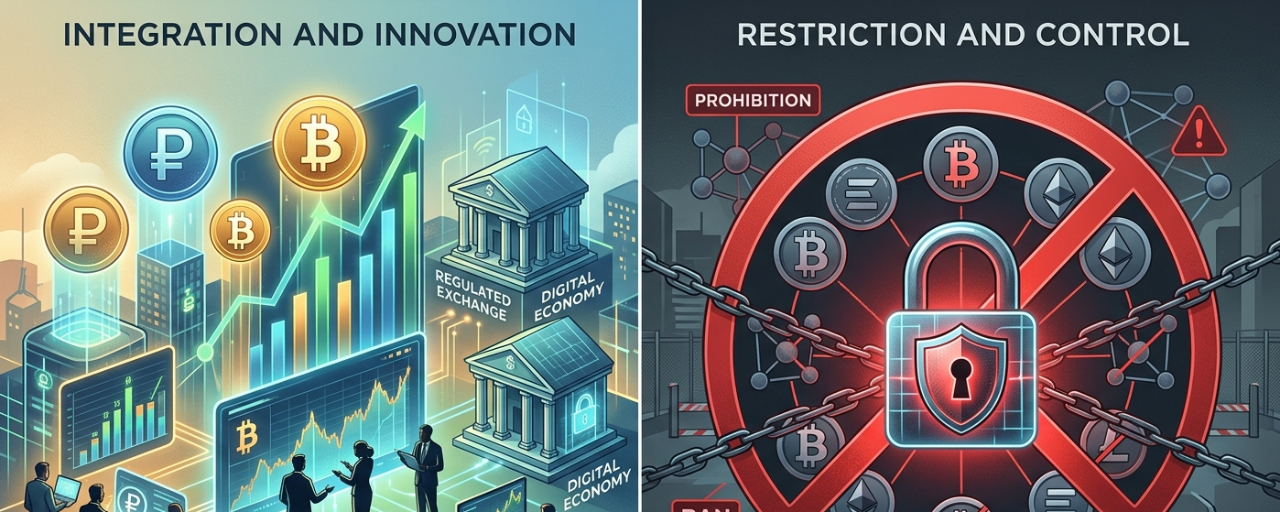

The global cryptocurrency market continues to be shaped by starkly contrasting regulatory approaches from major world powers. While nations strive to balance financial innovation, capital controls, and systemic security, regulatory shifts in economic powerhouses like Russia and China dictate the pace and structure of digital asset adoption.
Russia: Controlled Legalization and P2P Restrictions
Russia is reshaping its digital asset ecosystem by moving toward official recognition while tightly clamping down on informal channels. The Central Bank of Russia has confirmed strict measures targeting direct peer-to-peer (P2P) Bitcoin and cryptocurrency trading. Under upcoming frameworks, direct individual-to-individual transfers outside state-approved platforms are set to be heavily restricted, and retail investors face strict annual spending caps (such as a 300,000-ruble limit for non-qualified investors) alongside mandatory knowledge testing.
Despite these tight domestic retail controls, the state is actively channeling trading volume through authorized banking institutions like Sberbank. Financial analysts at Sberbank project that annual cryptocurrency trading volume in Russia could scale between 3.5 to 4 trillion rubles (roughly $46.43 billion) in its first year of legalization, eventually expanding up to 7.5 trillion rubles by 2029. Furthermore, while domestic retail payments for goods and services remain strictly illegal, Russia continues to permit digital assets for foreign trade settlements as a strategic mechanism to bypass international economic sanctions.
China: The Stance of Total Prohibition
In stark contrast to Russia's regulated integration, China maintains a resolute, comprehensive ban on all cryptocurrency operations. The Chinese government classifies all crypto-related transactions, exchange services, initial coin offerings (ICOs), and mining activities as illegal financial activities.
Driven by goals to maintain macroeconomic stability, prevent capital flight, curb energy consumption from mining farms, and promote its own state-backed Central Bank Digital Currency (CBDC)—the Digital Yuan—authorities have systematically dismantled domestic crypto infrastructure. Financial institutions and payment providers are legally barred from facilitating any crypto-related services, ensuring that digital assets remain outside the legal financial perimeter within mainland jurisdiction.
Market Dynamics and Regional Insights
Globally, benchmark digital assets like Bitcoin (BTC) and Ethereum (ETH) continue to anchor heavy trading volumes. As regional regulatory frameworks evolve, local communities increasingly rely on specialized financial portals and market trackers—including Urdu-language platforms like Urdu Markets and UrduPoint—to digest complex international updates, track peer-to-peer market shifts, and analyze how global regulatory policy influences day-to-day crypto asset behavior.
Ultimately, the divergent paths of Russia and China highlight a broader global trend: governments are aggressively asserting control over digital finance, choosing either to institutionalize and tax crypto flows through centralized entities or to completely eradicate decentralized alternatives in favor of sovereign digital currency systems.
#SouthKoreaTightensOversightOfOverseasPerpetualContracts #ChinaEconomy $BTC