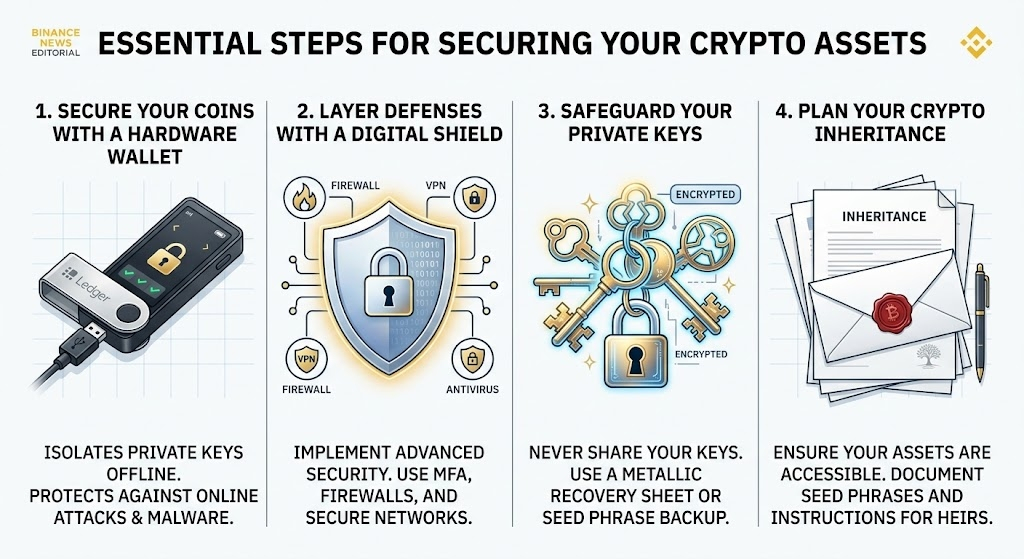

As cryptocurrency adoption grows, protecting digital assets requires more than choosing the right wallet or exchange. Investors must also prepare for device failures, phishing attacks, lost recovery phrases, and the possibility that family members may need access to their assets in the future.
In a security guide highlighted by Binance News on October 11, Binance founder Changpeng Zhao (CZ) revisited a fundamental principle of crypto security: investors need a plan to prevent theft, prevent accidental loss, and pass on their assets responsibly.
His central message is practical: crypto security should match the value of your holdings, your technical ability, and your long-term needs.
1. Prevent Theft: Protect Your Private Keys and Accounts
For self-custody wallets, private keys authorize transactions, while a seed phrase can restore wallet access. Anyone who obtains the necessary recovery credentials may be able to take control of the associated funds.
CZ’s recommendations emphasize reducing exposure to malware, unauthorized access, and insecure storage.
Key precautions include:
▪️Use trusted devices: Keep devices used for managing significant crypto holdings clean, updated, and protected from unnecessary software.
▪️Secure recovery information offline: Never casually store seed phrases in screenshots, photo galleries, email drafts, or cloud-synced folders.
▪️Consider a reputable hardware wallet: Verify transaction details and destination addresses on the device before approving a transfer.
▪️Protect account access: Use unique passwords and strong two-factor authentication, preferably a hardware security key where supported.
▪️Avoid phishing: Access exchanges through trusted bookmarks or carefully verified official websites. Never reveal recovery phrases to supposed support agents.
▪️Protect withdrawal settings: Where available, use withdrawal-address whitelisting and review account activity and connected devices regularly.
A hardware wallet can reduce certain online risks, but it is not a guarantee against theft. Compromised recovery backups, physical attacks, malicious software, and user mistakes can still put funds at risk.
2. Prevent Permanent Loss: Build Reliable Backups
Theft is only one side of crypto security. Assets can also become inaccessible when a device is damaged, a recovery phrase is misplaced, or the owner forgets how to restore a wallet.
CZ’s guidance stresses maintaining multiple protected backups, stored separately so that one accident or security breach does not destroy every recovery option.
Different backup methods have different trade-offs:
▪️Paper backups: Simple and inexpensive, but vulnerable to fire, water, deterioration, and unauthorized reading.
▪️Metal backups: Generally more resistant to physical damage, although anyone who obtains the readable recovery information may still access the wallet.
▪️Encrypted digital backups: Can support secure storage in separate locations, but require strong encryption, careful key management, and a tested recovery process.
Do not create unnecessary digital copies of a seed phrase. A screenshot or photograph may be synchronized to a cloud account without your knowledge.
Most importantly, verify your recovery procedure before relying on it. A backup that exists but cannot be restored correctly may offer little protection when it is needed.
3. Plan for Inheritance Before It Becomes an Emergency
Crypto inheritance is a frequently overlooked part of financial planning.
Unlike conventional financial accounts, self-custody assets may not be recoverable through a standard account-reset process. If the owner dies or becomes permanently incapacitated without leaving a workable recovery plan, the assets could remain inaccessible indefinitely.
CZ’s guidance highlights the need to prepare for this possibility without unnecessarily exposing funds during the owner's lifetime.
A responsible inheritance plan should consider:
▪️Documenting asset locations: Keep an up-to-date inventory of wallets, exchanges, and relevant account-recovery procedures.
▪️Providing secure instructions: Explain how authorized beneficiaries can begin recovery without leaving private keys or seed phrases openly accessible.
▪️Considering a dead man's switch: Such a system may release instructions after a defined period of inactivity, but it must be researched, configured, and tested carefully.
▪️Protecting sensitive documents: Use appropriate encryption and ensure the intended recipient can actually access the instructions when required.
▪️Aligning the plan with legal arrangements: Consult a qualified legal professional about wills, inheritance rules, and the requirements in your jurisdiction.
Giving someone your seed phrase today is not the same as creating a safe inheritance plan. It may give that person immediate control of the funds while you are still alive.
The objective is to make recovery possible for the right person at the right time, without creating unnecessary opportunities for theft.
4. Exchange Custody vs. Self-Custody: Understand the Trade-Off
Crypto investors must also decide where to hold their assets.
Exchange custody can provide account-recovery processes, security monitoring, and operational convenience. However, users remain exposed to platform, account-compromise, and counterparty risks.
Self-custody gives users direct control over their wallet credentials, but also makes them responsible for protecting keys, maintaining backups, and ensuring recovery is possible.
Neither option eliminates risk.
Investors should evaluate their technical skills, security habits, access requirements, and the amount they can afford to lose. Some may prefer exchange custody for convenience, while others may use personal wallets for assets they intend to hold independently over the long term.
Any decision to divide holdings between different custody methods should be based on a clear risk assessment rather than the assumption that one method is universally safest.
5. A Practical Crypto Security Checklist for 2026
Before adding more funds to a portfolio, investors should review these essential steps:
▪️Enable strong two-factor authentication on exchange and email accounts.
▪️Use unique passwords and keep account-recovery methods secure.
▪️Store self-custody recovery phrases offline and protect backups in separate locations.
▪️Verify wallet addresses and network details before sending transactions.
▪️Test wallet recovery using a safe procedure before depending on a backup.
▪️Avoid unsolicited links, fake support accounts, and requests for private keys.
▪️Maintain an inheritance plan that can be followed by a trusted, authorized beneficiary.
▪️Review custody arrangements and recovery instructions periodically.
Security is not a one-time setup. Devices change, accounts become outdated, and family circumstances evolve. Regular reviews help ensure that a plan remains useful.
Final Thoughts
CZ’s 2026 crypto-security message highlights three responsibilities every long-term crypto holder should take seriously: prevent theft, prevent permanent loss, and prepare for inheritance.
A secure portfolio is not defined only by its value or the wallet used to store it. It also depends on whether the owner can protect access today, recover it after an unexpected event, and pass it on responsibly in the future.
In crypto, protecting your assets means planning for both the risks you can see and the situations you may not be around to manage.
Disclaimer: This article is for educational purposes only and is not legal, financial, or cybersecurity advice. Security arrangements and inheritance requirements vary by wallet, platform, and jurisdiction.
Trade➡️ $STRK

➡️ $CHIP

➡️$MBL

#EthereumSurpasses2500USDT #EvernorthCompletesSPACMergerWithArmadaII #XRPLedgerPatchesXRPCreationBug #STRKRisesAbout20%In24Hours