


A research-based look at how Enygma protects payment information, why anonymity sets matter, and who may be able to access private transaction details.
Table of Contents
What Does Payment Privacy Really Mean?
How Rayls Enygma Protects Payment Information
Why the Number of Participants Matters
Who Can See Private Transactions?
View Keys vs. Spend Keys
What We Know About Retail Enygma
Key Takeaways
1. What Does Payment Privacy Really Mean?
When researching Rayls Enygma, one question stood out to me:
If a payment is private, who can actually see its details?
Privacy is not simply about hiding transaction amounts. It also involves sender and receiver identities, balances, encrypted information, and the permissions held by network operators.
I reviewed the official Rayls documentation and the Enygma repository to understand these distinctions. This is a documentation-based technical analysis, not a full security audit.
2. How Rayls Enygma Protects Payment Information
Enygma uses cryptographic techniques to help validate transactions without revealing every underlying detail.
Two important concepts are:
Zero-knowledge proofs: Allow the network to verify certain transaction rules without directly exposing the private values being checked.
Pedersen commitments: Help conceal transaction values while supporting cryptographic verification.
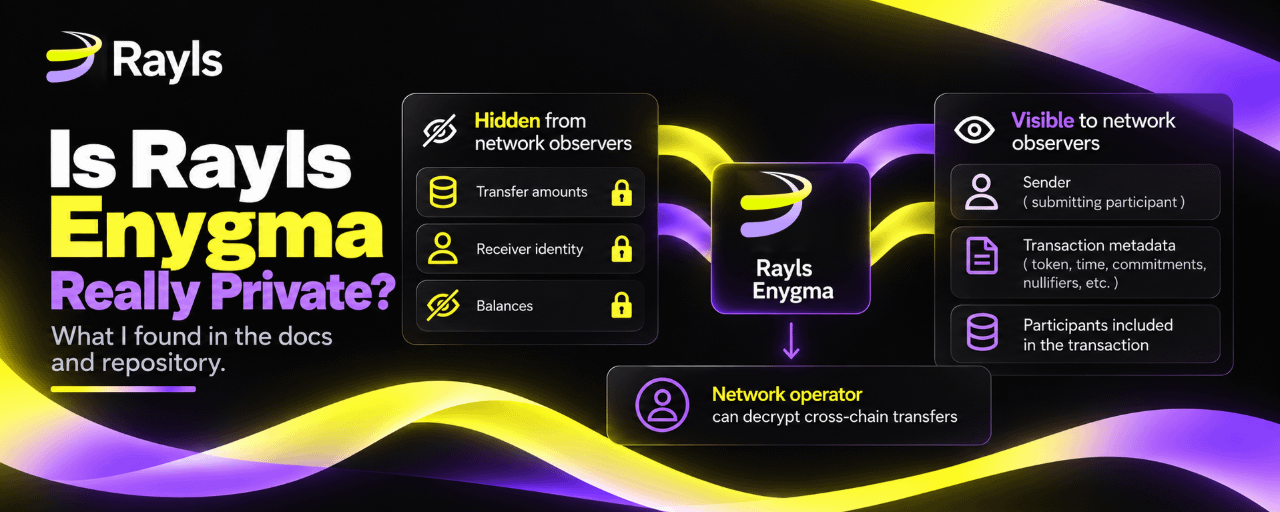
In the documented Institutional Payments model, ordinary network members do not automatically see all payment amounts, balances, or receiver identities.
However, privacy does not mean that every transaction detail is invisible to everyone.
Some metadata remains observable, and the sender can remain identifiable. Understanding exactly what is hidden and from whom is essential when evaluating the system.
3. Why the Number of Participants Matters
Anonymity sets are an important part of the privacy model.
The Institutional Enygma documentation discusses sets of up to six participants and explains how the number of participants affects the ability to infer a receiver.
Consider the difference:
Two participants: If the sender is known, identifying the receiver may be straightforward.
Three participants: Additional information about who did not receive the payment may help narrow down the receiver.
Four to six participants: Receiver identification can become more difficult for ordinary observers, depending on the information available.
The documentation recommends at least four participants when the goal is to reduce the ability of members to infer one another's activity.
But a larger anonymity set is not an automatic guarantee of complete anonymity. The result depends on what observers know and which metadata remains visible.
4. Who Can See Private Transactions?
This is one of the most important distinctions in the documented architecture.
The Rayls Private Network documentation describes an operator-controlled viewing capability.
During institutional registration, the institution's key service encrypts its view private key to the operator's public view key. The documentation also describes the operator's governance services holding a network view secret key used to decrypt cross-chain traffic, including Enygma transfers.
The operator can use the Auditor Explorer and grant access to regulators or other authorised parties.
This creates an important distinction:
Privacy from ordinary network participants is not necessarily privacy from the network operator.
The operator's viewing capability does not automatically mean it can spend institutional funds. Spending authority is a separate permission associated with the relevant spend key.
The current operational documentation does not establish a separate, independently keyed auditor with scoped or time-limited access. That is a question worth asking when evaluating the privacy and governance model.
5. View Keys vs. Spend Keys
A view key and a spend key serve different purposes.
View key: Provides access to relevant encrypted information.
Spend key: Authorises spending or control of funds.
The Enygma DvP design document describes BabyJubJub spend keys, ML-KEM-768 view-key mechanisms, and AES-256-GCM encryption for note payloads.
These are details of the documented DvP design. They should not automatically be assumed to apply identically to every Enygma variant.
The broader lesson is simple: being able to inspect information and being able to move funds are different capabilities.
6. What Do We Know About Retail Enygma?
The Enygma repository README lists four variants:
Institutional Payments — account-based.
Retail Payments — UTXO-based.
DvP — UTXO-based.
DvP Auctions — UTXO-based.
This confirms that Retail Payments is part of the documented Enygma design.
However, I could not establish all of Retail Enygma's detailed privacy properties, auditor permissions, or deployment status from the materials reviewed.
It would be inaccurate to assume that Retail works exactly like Institutional Payments or to conclude that a feature does not exist simply because its details were not confirmed.
Separating documented facts from unanswered questions is an important part of technical research.
7. Key Takeaways
My main findings are:
Enygma uses cryptographic techniques to protect sensitive payment information.
Anonymity sets matter: more participants can make receiver identification harder, but do not guarantee complete anonymity.
Sender visibility, receiver privacy, and transaction-value confidentiality are separate properties.
The documented network operator has significant viewing capabilities over cross-chain activity.
View permissions and spending permissions are different.
Retail Enygma's detailed privacy model requires further verification.
My conclusion: Evaluating private blockchain payments requires more than asking whether transaction data is encrypted. We also need to understand what metadata remains visible, who controls decryption capabilities, and how privacy behaves under different network configurations.
For me, these questions are central to understanding how Rayls approaches bringing finance onchain while addressing privacy and compliance requirements.
Sources consulted
Rayls Docs — Enygma Privacy and Auditing
Rayls Docs — How Enygma Works
Rayls Docs — Private Network Roles
Rayls Docs — Operating a Rayls Private Network
Rayls Docs — Private Network Design Options
Rayls Docs — Cryptographic Foundations of Enygma
Rayls Enygma GitHub Repository
Enygma Source of Truth Design Document
Source titles are listed for reference. External documentation links cannot be embedded in this Binance Square editor.