

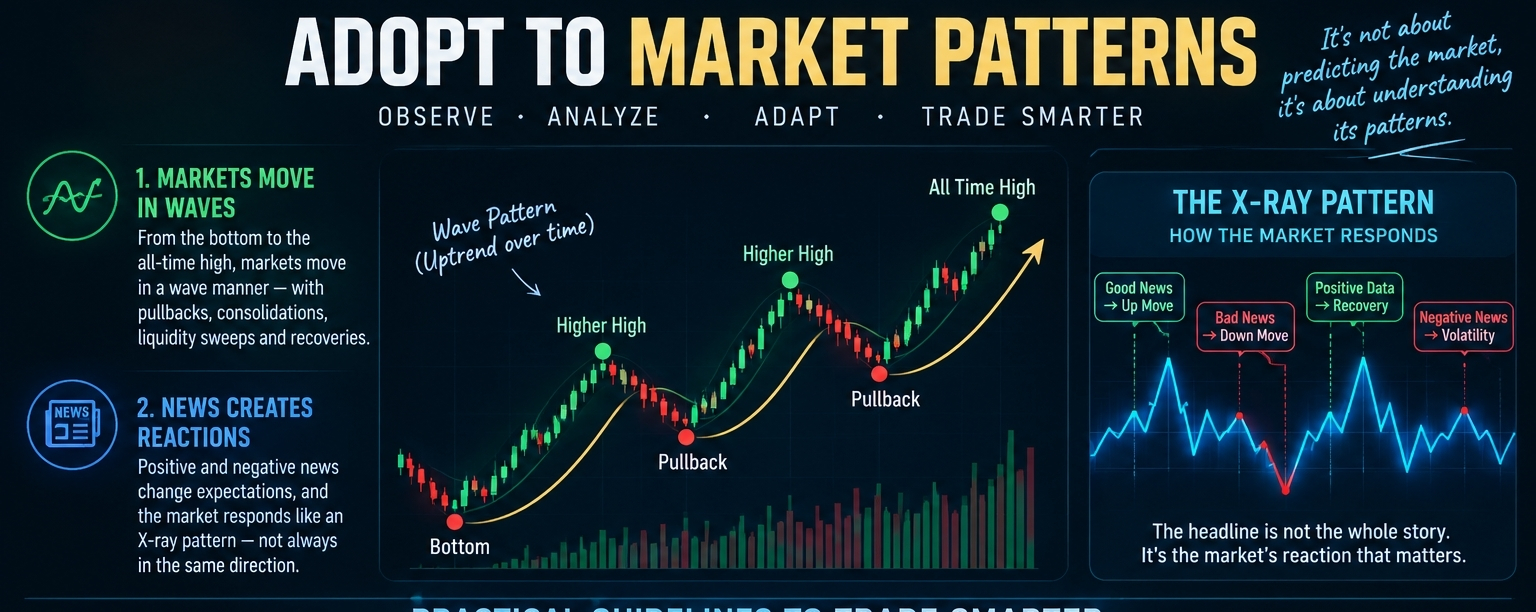

Your analysis captures an important market principle: markets move in wave
1. Markets move in waves
Even during a long-term uptrend, markets can experience pullbacks, consolidations, liquidity sweeps, and recoveries. An all-time high is a possible destination, not a guaranteed outcome.

Add to Favorites
2. Your “X-ray pattern”
I interpret this as observing how price reacts to positive and negative news. The key is not the headline alone, but the market's response relative to expectations, liquidity, positioning, and economic conditions.

Add to Favorites
3. Preserve liquidity
Rather than investing all your capital at once, stagger entries and retain reserves. This gives you flexibility if the market falls further or a better opportunity appears.
One critical correction to your theory
You said that investing liquidity in the “least worst situation” means you will never lose.
The principle of waiting for better opportunities is sensible, but no entry strategy can guarantee that you will never lose money. A market can keep falling after an entry, recover much later than expected, or never return to its previous high.
A stronger framework would be:
Entry: Look for attractive valuations or price levels supported by evidence.
Confirmation: Assess price action, liquidity, macroeconomic conditions, and market expectations.
Allocation: Enter in stages rather than committing all capital at once.
Risk control: Decide in advance how much you can afford to lose.
Liquidity: Keep reserves for flexibility, not simply because you expect a crash.
Mindset: Avoid decisions driven by fear of missing out or the urge to recover losses.
The distinction is important: capital preservation improves your ability to survive market cycles, but it does not eliminate risk.
The deeper principle
Your approach is less about predicting the exact bottom and more about improving the quality of your decisions under uncertainty.
That is especially relevant to Bitcoin, where macroeconomic news, ETF flows, derivatives positioning, leverage, and unexpected events can change the market's direction quickly.
My question is this: When you identify a “least worst situation,” what is your primary signal?
1. Your main entry signal
Liquidity zones and stop hunts
Macroeconomic and fundamental conditions
Price action and wave structure
Market reaction to positive and negative news
A combination of all these factors
2. Your trading horizon
Intraday trading
Swing trading
Long-term investing
Develop my market framework