

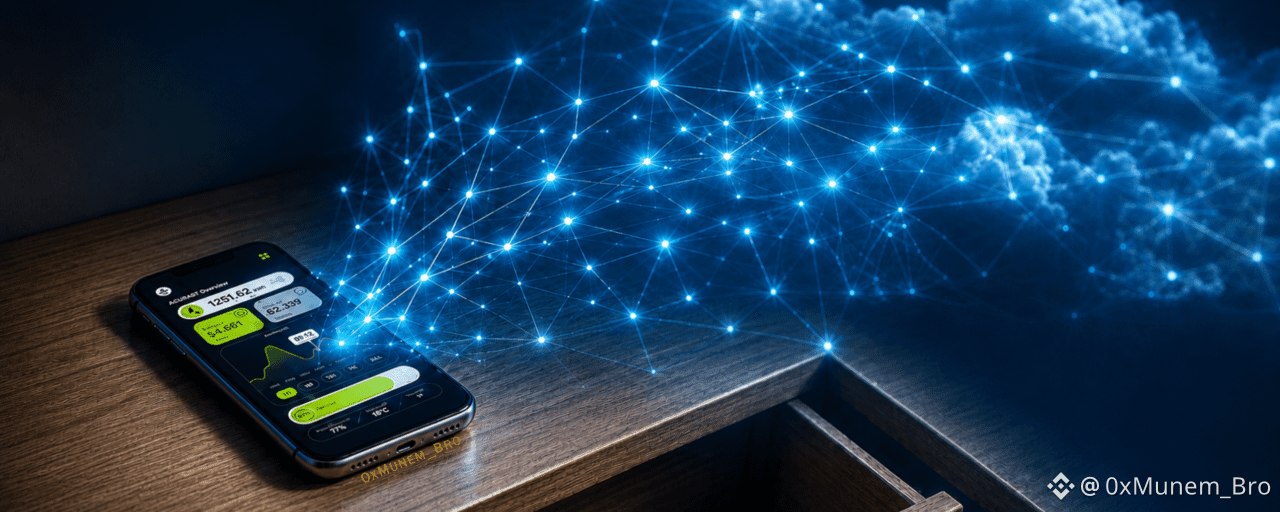

What if the next piece of cloud infrastructure is not another massive data center—but a smartphone sitting unused in someone’s drawer?
That question is what makes Acurast interesting to me.
The idea sounds simple at first: take smartphones that are no longer being used and turn them into productive computing resources. But Acurast is exploring something much bigger than recycling old hardware. It is building a decentralized compute network where developers can deploy real workloads to smartphones distributed around the world.
Instead of relying only on centralized cloud providers, Acurast connects developers with a global network of smartphone-based processors. These devices can contribute computing power while they are idle, charging, or otherwise not being actively used.
The result is a different way to think about cloud infrastructure—one that uses hardware that already exists.
The Hidden Computing Power Around Us
The demand for computing power is growing rapidly.
Artificial intelligence, automation, APIs, data processing, blockchain applications, and real-time services all require infrastructure. Traditionally, that infrastructure has been provided by centralized data centers operated by a small number of large companies.
These data centers are powerful, but they are also expensive to build, energy-intensive, and concentrated in the hands of a few providers.
At the same time, billions of smartphones already exist around the world. Many of them are replaced long before their hardware becomes useless. Some remain switched off in drawers. Others are connected to power overnight but perform no meaningful work.
This creates an interesting question:
Are we building more infrastructure because we need it—or because we are not efficiently using the hardware that already exists?
Acurast approaches this problem by allowing smartphones to become decentralized compute providers. The phone is no longer only a device that consumes applications and services. It can also provide infrastructure for applications and developers.
According to Acurast’s documentation, developers can deploy REST APIs, webhooks, scheduled jobs, headless browser tasks, WebAssembly workloads, LLM inference, and confidential computing applications on the network.
That makes the idea more concrete. This is not simply about saying that phones have unused processing power. It is about assigning actual workloads to a distributed network of devices.
How Acurast Works
The Acurast network consists of three important participants:
Developers who submit workloads.
Smartphone operators who provide computing resources.
The protocol that matches workloads with suitable devices.
A developer can specify what code needs to run, how much processing power is required, when it should run, and where the result should be delivered.
The network then matches that deployment with processors that meet the necessary requirements. Acurast describes this process as liquid matching, where workloads are assigned to appropriate devices based on factors such as availability and resource requirements.
The smartphone runs the Acurast Processor application. Users can contribute an everyday phone through Processor Lite or use a dedicated device through Processor Core. The Lite version is designed for flexible participation, while Core is intended for phones dedicated entirely to compute.
In practical terms, an old Android phone could remain connected to power and the internet, execute assigned workloads, and receive rewards for providing verified compute.
That changes the economic role of an unused device.
Instead of becoming electronic waste, it may become a small infrastructure node.
Compute Is More Than One Use Case
The word “compute” is often used so broadly that it can become difficult to understand what a network actually does.
Acurast’s use cases are more specific.
Developers can use the network for:
REST APIs and backend services.
Scheduled jobs and automation.
Webhooks and API integrations.
Headless browser workloads.
LLM and AI inference.
Privacy-preserving API calls.
Confidential computation.
Verifiable data feeds.
Decentralized trading strategies.
Website hosting.
Zero-knowledge proof generation.
Distributed computing tasks.
The important point is that these workloads do not all require the same type of infrastructure.
Some jobs may need to run continuously. Others may only need periodic execution. Some may require privacy. Others may benefit from geographical distribution or reduced dependence on a single cloud provider.
This is where decentralized compute may become useful—not necessarily by replacing every traditional server, but by providing another option for workloads that can operate across a distributed network.
Why Trusted Execution Environments Matter
The security question is probably the most important part of the entire idea.
If a developer sends code and sensitive data to a device owned by another person, why should the developer trust that device?
A phone operator could theoretically inspect the device, interfere with the workload, or attempt to manipulate the result. For decentralized compute to be practical, the network needs a way to protect the workload and verify that it ran correctly.
Acurast uses hardware-backed Trusted Execution Environments, commonly known as TEEs.
A TEE is an isolated area within a device’s hardware where code and data can be protected from the normal operating system, other applications, and even the person physically holding the device. Acurast says its smartphone TEEs help verify that code ran on genuine hardware, remained unmodified, and kept confidential inputs protected from the device owner.
This is a major distinction between simply running an application on someone’s phone and running a verifiable confidential workload.
The goal is not just to distribute computation. The goal is to make the computation:
Confidential.
Verifiable.
Resistant to tampering.
Executable without requiring complete trust in the device operator.
Of course, hardware security is not a magic solution to every risk. Developers still need to evaluate reliability, availability, performance, device diversity, and the specific security assumptions of each workload.
But TEEs provide an important foundation for applications that cannot expose their data or depend on unverifiable execution.
The AI Compute Question
Artificial intelligence has made the demand for compute even more visible.
Large AI models often require expensive hardware, substantial energy, and centralized infrastructure. That has led to an ongoing debate about whether future AI will be controlled primarily by a small number of cloud providers—or whether compute can become more distributed.
Acurast is exploring the second possibility.
The network’s documentation lists LLM inference and AI workloads among its supported use cases. In September 2026, reports stated that Acurast deployed the open-source Laya decision model across its decentralized smartphone network, with the model running on Android devices using CPU-based execution and hardware-backed TEEs. Reported decision times were approximately 0.2 to 1 second, although performance can vary depending on the workload and device.
This does not mean that smartphones will suddenly replace high-end GPU clusters for every AI task.
Training the largest models is a very different problem from running small or optimized inference workloads. Large-scale model training may still require specialized data-center hardware. But many AI applications do not require training a massive model from scratch.
They may only need:
Small-model inference.
Classification.
Recommendation logic.
Content filtering.
Event detection.
Local decision-making.
Automated responses.
Privacy-sensitive analysis.
Real-time scoring.
These types of workloads may be more suitable for distributed edge devices, especially when the workload is lightweight, stateless, and privacy-sensitive.
The more interesting question is not whether phones can replace data centers.
The better question is:
Which AI tasks can run efficiently on a distributed network of smartphones, and will developers find that model practical enough to use repeatedly?
From Idle Phones to Edge Infrastructure
One of the strongest arguments for Acurast is that smartphones are already widespread.
They are manufactured at enormous scale, distributed globally, and equipped with secure hardware. Many devices are powerful enough to handle workloads that would have required specialized machines in the past.
Acurast’s documentation describes smartphones as the hardware layer for a decentralized cloud, while its Processor app allows users to contribute devices to the network.
This could create several advantages:
More geographically distributed infrastructure.
Greater use of existing hardware.
Potentially lower infrastructure costs for suitable workloads.
Reduced dependence on a small number of cloud companies.
New earning opportunities for device owners.
More resilient infrastructure for certain applications.
Confidential execution close to the edge.
There is also a sustainability angle.
Reusing a smartphone does not eliminate energy consumption. The device still needs electricity, cooling, connectivity, and maintenance. However, extending the useful life of existing hardware may be more efficient than immediately manufacturing new dedicated machines for every additional computing requirement.
The strongest case for this model may be devices that are already owned, already powered, and otherwise sitting idle.
The Difficult Questions
The concept is promising, but it is not automatically practical for every workload.
Several questions still matter:
Reliability
A centralized cloud server is designed to operate continuously. A smartphone may lose power, disconnect from the internet, overheat, or become unavailable.
A decentralized network needs enough redundancy to handle these interruptions.
Performance
Smartphones vary widely in processor speed, memory, storage, operating system, and thermal capacity. A workload that performs well on one device may be slower on another.
Data availability
Some applications require large datasets or high-bandwidth communication. Moving data to and from thousands of mobile devices could create bottlenecks.
Developer experience
Developers will only use decentralized infrastructure if deployment is simple, documentation is clear, monitoring is reliable, and debugging does not become unnecessarily complicated.
Security assumptions
TEEs can strengthen confidentiality and verification, but developers still need to understand the hardware, software, attestation, and trust assumptions involved.
Economics
The network must create a sustainable balance between developer costs and processor rewards. If developers pay too much, they may use traditional cloud providers. If device operators earn too little, they may stop providing hardware.
These are not minor details. They will determine whether decentralized compute becomes a useful infrastructure category or remains mainly an interesting experiment.
A Different Vision of Cloud Computing
The traditional cloud model is based on centralized ownership.
A few providers operate enormous data centers, and developers rent access to that infrastructure. This model is powerful, convenient, and mature. It will not disappear simply because decentralized alternatives exist.
Acurast represents a different approach.
Instead of asking developers to depend entirely on a centralized provider, it creates a marketplace for distributed compute. The infrastructure can come from smartphones owned by people and organizations around the world.
That model may be especially valuable for workloads that need:
Confidential execution.
Geographically distributed processing.
Independent infrastructure.
Flexible capacity.
Edge-level responsiveness.
Reduced dependence on centralized platforms.
The future may not be “centralized cloud versus decentralized cloud.”
It may be a combination of both.
Large data centers will likely continue handling the heaviest workloads, while decentralized smartphone networks may handle smaller, private, distributed, or edge-oriented tasks.
Why Acurast Is Worth Following
For me, the most interesting part of Acurast is not the claim that smartphones will replace every data center.
That would be an overly simplistic way to describe the opportunity.
What makes the project worth following is that it connects a familiar resource—the smartphone—with a serious infrastructure problem: where will the world get enough affordable, private, and verifiable compute?
A phone sitting unused in a drawer may not look like cloud infrastructure.
But when thousands or millions of those phones are connected through a coordinated protocol, protected by hardware-backed security, and assigned real workloads, the idea starts to look different.
It becomes a distributed compute layer built from hardware that already exists.
The real test will be adoption.
Will developers deploy production workloads? Will the network provide predictable performance? Will the economics work for both developers and device operators? Can smartphone-based infrastructure deliver enough reliability and security for meaningful applications?
Those questions remain open.
But that is exactly why Acurast is interesting.
It is not only asking how to build bigger data centers. It is asking whether the next generation of cloud infrastructure can be assembled from the computing power already sitting in our pockets and sometimes, forgotten in our drawers.
#Acurast #DePIN #AI #DecentralizedCompute #Web3 #CloudComputing #ConfidentialComputing #Blockchain #AIInfrastructure