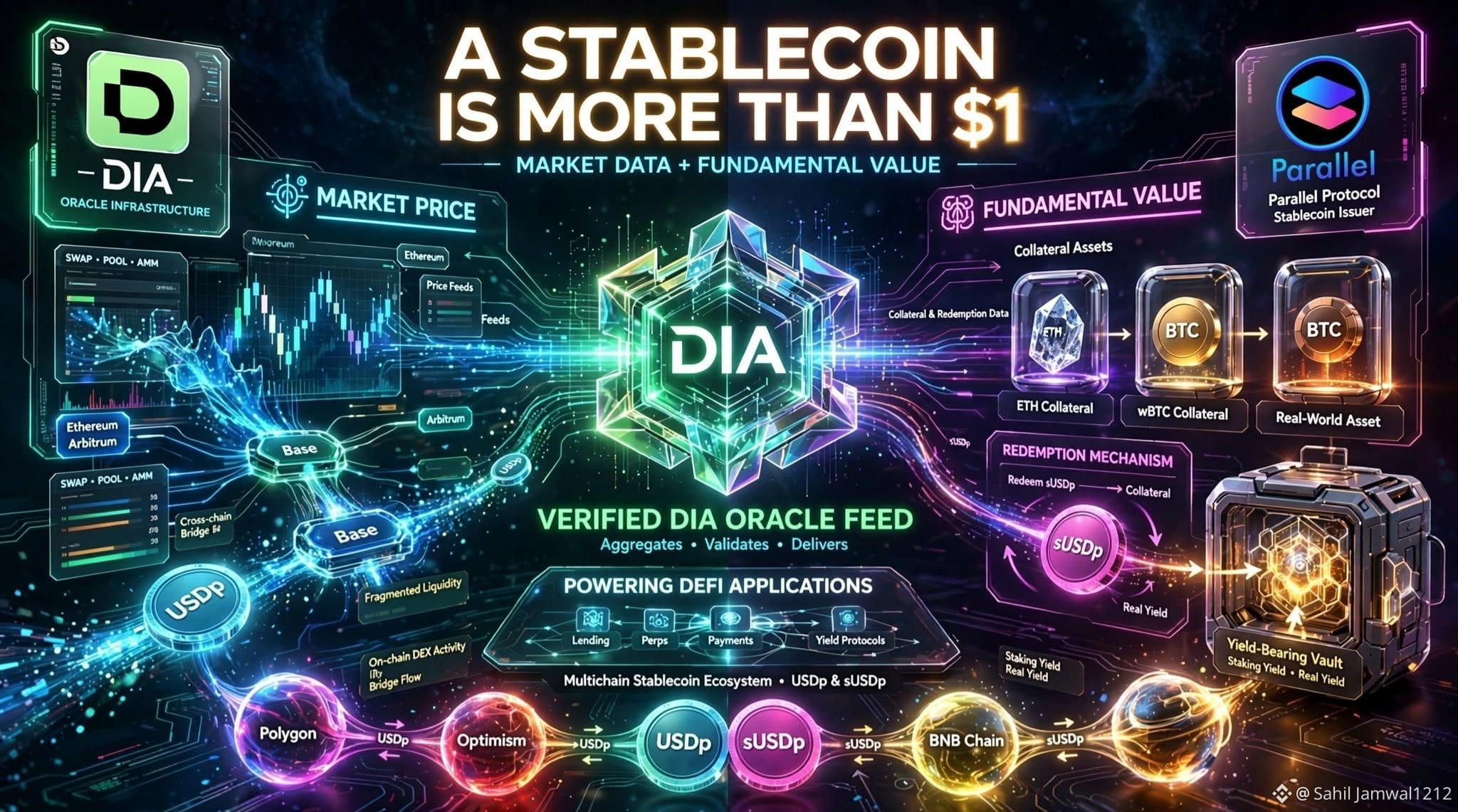
I've been looking at DIA's stablecoin integrations, and Parallel Protocol is a good example of why oracle design matters.
Parallel's USDp is deployed across multiple chains, while sUSDp adds a yield-bearing wrapper on top.
That creates a more complicated pricing problem.
You have:
→ Liquidity fragmented across chains
→ Different collateral components
→ Redemption mechanics
→ Yield-bearing vault rates
→ Potentially thin secondary markets
DIA's solution isn't simply “USDp = $1.”
DIA Value reads onchain collateral composition and redemption data to calculate a fundamental fair value for USDp.
For sUSDp, the methodology also incorporates the local vault exchange rate.
At the same time, DIA provides a separate market-price feed sourced from trading venues.
I think this distinction is important.
Market price and fundamental value aren't always the same thing.
For highly liquid assets, market-based pricing can work well.
For a stablecoin whose value depends heavily on collateral and redemption mechanics, looking at the underlying economics can provide another layer of information.
DIA is applying this approach across stablecoin use cases, including Parallel and River, while other integrations such as Davos use custom oracle infrastructure for their specific requirements.
As stablecoins become more multichain and structurally complex, their oracle requirements will become more sophisticated too.
That's the part of this sector I'm watching closely.
$DIA
Parallel's USDp is deployed across multiple chains, while sUSDp adds a yield-bearing wrapper on top.
That creates a more complicated pricing problem.
You have:
→ Liquidity fragmented across chains
→ Different collateral components
→ Redemption mechanics
→ Yield-bearing vault rates
→ Potentially thin secondary markets
DIA's solution isn't simply “USDp = $1.”
DIA Value reads onchain collateral composition and redemption data to calculate a fundamental fair value for USDp.
For sUSDp, the methodology also incorporates the local vault exchange rate.
At the same time, DIA provides a separate market-price feed sourced from trading venues.
I think this distinction is important.
Market price and fundamental value aren't always the same thing.
For highly liquid assets, market-based pricing can work well.
For a stablecoin whose value depends heavily on collateral and redemption mechanics, looking at the underlying economics can provide another layer of information.
DIA is applying this approach across stablecoin use cases, including Parallel and River, while other integrations such as Davos use custom oracle infrastructure for their specific requirements.
As stablecoins become more multichain and structurally complex, their oracle requirements will become more sophisticated too.
That's the part of this sector I'm watching closely.
$DIA