



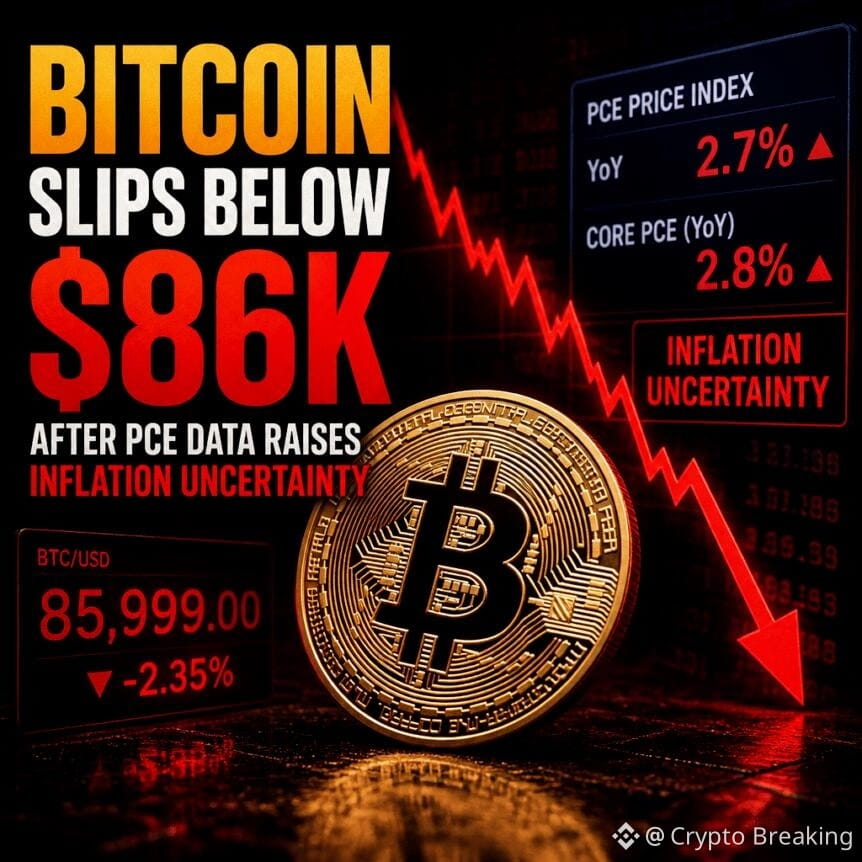
Bitcoin traded above $83,000 on Thursday, steadying after a rally that briefly stalled at $85,600. The pullback followed US Personal Consumption Expenditures (PCE) inflation data that was weaker than expected, but whose interpretation was clouded by changes in the underlying methodology.
While the day-to-day move looked modest—Coinbase data showed BTC/USD broadly flat—derivatives indicators pointed to a more nuanced picture. CoinGlass showed fresh liquidation clustering near key support levels, and Glassnode noted that BTC-denominated futures open interest fell even as price rose, a combination that can reduce the risk of forced leverage unwind.
Key takeaways
BTC/USD remained rangebound after reversing from $85,600, settling back above $83,000.
US PCE inflation printed lower than consensus (3.4% year-on-year vs. 3.7% expected), but methodology changes complicated the “core” read.
A new estimated liquidation exposure cluster of roughly $60 million appeared near $83,000, close to support around $82,500.
BTC-denominated open interest fell nearly 20% even as Bitcoin was up about 35% from its August low, with Glassnode saying open interest is at its lowest since March.
Inflation data lifts the tape—then the market trims risk
Bitcoin began the quarter at roughly $83,550, after a third-quarter gain of 42.7%, which CoinGlass data described as its strongest Q3 performance since 2017. Historically, Q4 has been one of the strongest quarters for Bitcoin, but the start of the period still depended on macro momentum.
Thursday’s consolidation came after Wednesday’s reversal. BTC/USD briefly pushed to $85,600 before giving back gains. The catalyst was the US PCE release: according to the Bureau of Economic Analysis (BEA), August PCE inflation came in at 3.4% year-on-year, below expectations of 3.7%.
The BEA also reported that excluding food and energy, core PCE rose 3.0% year-on-year. However, the same release referenced methodology updates tied to “portfolio management and investment advice,” “computer software and accessories,” and “legal services.” Those adjustments matter because they can shift how “core” inflation is measured and compared to prior prints.
Market commentary publication The Kobeissi Letter wrote on X that the methodology alone could reduce Core PCE inflation by up to 20 basis points, and that earlier headline and core PCE readings had been revised downward by 30 basis points.
In practical terms, traders appeared to discount the August print quickly. The S&P 500 finished Wednesday down 0.25% and the Dow Jones Industrial Average fell 0.86%. At the same time, CME’s FedWatch Tool showed the probability of a quarter-point rate increase at the October Fed meeting around 37%—not a major change from the prior day. Markets continued to lean toward holding the federal funds target range at 3.75%–4%.
Where liquidation liquidity concentrates near support
Even without a sustained selloff, derivatives positioning suggested that Bitcoin’s price floor could be tested. CoinGlass’s liquidation heatmap indicated potential clusters both above and below the prevailing market level.
On Thursday, CoinGlass data showed a new estimated liquidation exposure cluster of about $60 million near $83,000, close to a widely watched support zone around $82,500. Earlier analysis associated that level with the broader rebound from June lows, highlighting how technical “pinning” can emerge when macro catalysts pass and market structure takes over.
These liquidation clusters are important not because they guarantee movement, but because they can amplify short-term volatility. If price drifts toward a high-exposure area, forced closures on leveraged positions can mechanically accelerate price moves—either extending a move down through support or triggering a bounce if shorts are squeezed.
Price rises, but leverage measured in BTC terms shrinks
One of the more constructive reads for Bitcoin came from the disconnect between spot gains and BTC-denominated derivatives exposure. Glassnode flagged a divergence between BTC price and BTC-denominated open interest (OI)—a measure of outstanding futures positions expressed in Bitcoin rather than dollars.
Glassnode wrote on X that Bitcoin’s price was up about 35% from the August low, while coin-denominated open interest was down nearly 20%. In the same post, Glassnode added that this left open interest at its lowest since March, potentially making the rally less susceptible to “leverage flushes.”
Glassnode: “Price is up 35% from the August low, while coin-denominated open interest is down almost 20%. That puts open interest at its lowest since March, potentially making the rally less susceptible to leverage flushes.”
This matters for traders because falling BTC-denominated OI can imply that either fewer leveraged positions are being built, or that new exposure is less concentrated in BTC terms as the market moves higher. The result is often a reduction in the frequency of cascading liquidations during normal market pullbacks—though it doesn’t eliminate volatility entirely.
At the same time, resistance dynamics were still a concern. Earlier coverage by Cointelegraph noted that sell orders around $85,000 and long-term holder coins clustered in the $84,000–$85,000 range could reinforce resistance above current levels. Taken together with the stalled rally, that zone remained a key area to watch for whether buyers can keep momentum without needing a new surge in leveraged demand.
What to watch next as macro influence fades
With Bitcoin consolidating around the low-$80,000s after the PCE-driven reversal, attention is likely to shift to whether liquidation clusters near $83,000 draw additional volatility or quickly fade. Meanwhile, the key uncertainty is whether derivatives activity stays subdued—Glassnode’s “open interest at its lowest since March” thesis—or whether leverage rebuilds and reintroduces the risk of sharper swings if price approaches major technical levels like $82,500 or tests the resistance around $85,000.
This article was originally published as Bitcoin slips below $86K after PCE data raises inflation uncertainty on Crypto Breaking News – your trusted source for crypto news, Bitcoin news, and blockchain updates.