


South Korea’s FSC Unveils Three-Phase Roadmap for Tokenizing Stocks, Bonds & Funds
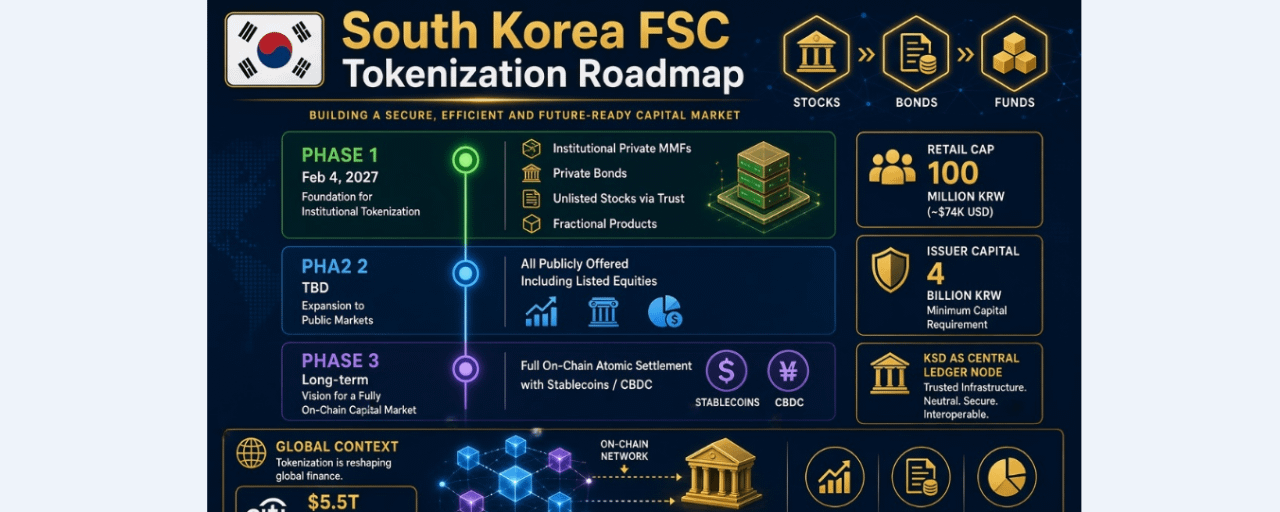
South Korea Advances National Blockchain Infrastructure for Traditional SecuritiesThe Financial Services Commission (FSC) has released a detailed three-phase regulatory roadmap to tokenize stocks, bonds, and funds using blockchain technology. This marks a major shift from earlier sandbox tests of fractional real-world assets (art, real estate, etc.) to a standardized, legally binding national system.
Key Legal Milestone
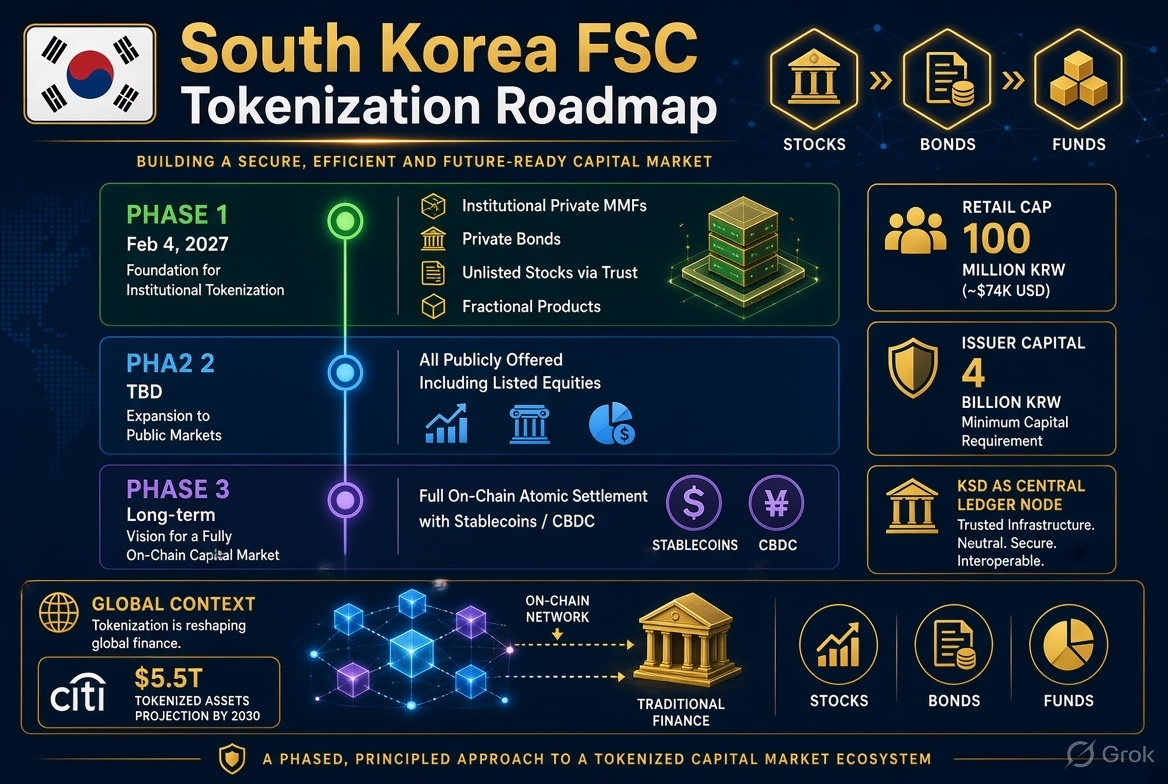
Security tokens will be legally recognized as a valid issuance format starting February 4, 2027, under revised Capital Markets Act (FSCMA) and Electronic Securities Act. Amendments passed the National Assembly in January 2026. Subordinate rules entered public comment (Oct 2–Nov 11, 2026 window).
Three-Phase Roadmap
• Phase 1 (from Feb 4, 2027)
Institutional private MMFs, private corporate bonds, unlisted stocks via trust structures, and publicly offered fractional investment products. Securities firms must build distributed ledgers connected to the Korea Securities Depository (KSD).
• Phase 2 (timeline flexible)
Expansion to all publicly offered securities, including listed equities and retail financial assets. Depends on Phase 1 results, tech adoption, and market demand.
• Phase 3 (long-term)
Full on-chain payments and atomic (DvP) settlement linked to regulated stablecoins or institutional CBDC elements — enabling near-instant settlement instead of T+1/T+2.
Investor Protection & Capital Rules
• Retail investors: Annual net purchase cap of 100 million KRW (~$73,000–74,000) per OTC tokenization platform.
• Specific fractional offerings: Illustrative subscription limit of the lower of ~30 million KRW or 5% of issuance.
• Licensed brokerages can operate under existing licenses (no new permits needed).
• Self-managing non-bank issuers: Minimum 4 billion KRW (~$3 million) equity capital + specialized staff (account management, internal control, IT).
KSD Role: Acts as central ledger node, monitors total issuance volumes across networks, bridges public distributed ledgers with the traditional depository system, and screens ledgers for suitability.
Market Context & Statistics
• South Korea stock market capitalization: Multi-trillion USD range (World Bank ~$2.76T in 2025; 2026 figures frequently cited near or above 6,000 trillion KRW for KOSPI + KOSDAQ combined, subject to volatility).
• Fund assets (public + private): Exceeded 1,300–1,500 trillion KRW in recent periods, with strong growth in equity funds and MMFs.
• Bond market: Large outstanding base (historically 2,000+ trillion KRW range, sovereign/public heavy).
• Global tokenized assets: Currently early-stage (~$17–22 billion mid-2026 estimates). Citi projects base case of $5.5 trillion by 2030 (range $2.7–8.2T), driven by public equities, Treasuries/MMFs, and stablecoin settlement rails.
Stablecoin Dependency (Critical for Phase 3)
Full on-chain settlement requires progress on the Digital Asset Framework / Basic Act (targeted for National Assembly review around November 2026, with government aim for completion in 2026). Debates continue on bank-led vs. broader issuance models for won-denominated stablecoins.
Outlook
This is a cautious, infrastructure-first approach prioritizing stability. Phase 1 focuses on institutional products and simpler fractional offerings while building the rails (KSD + securities firms + partners such as Samsung SDS). Success could position Korea as a leading Asian market for regulated tokenized securities, improving efficiency, fractional access, transparency, and eventual atomic settlement.
Infrastructure development is underway ahead of the February 2027 launch. Later phases remain flexible based on real-world results and stablecoin legislation.
#KoreaProposesTokenizingStocksAndBonds #US10YearYieldNears5.3% #BitcoinETFsTake$6.34BillionInQ3 #MicronBeatsEarningsLiftsGuidance