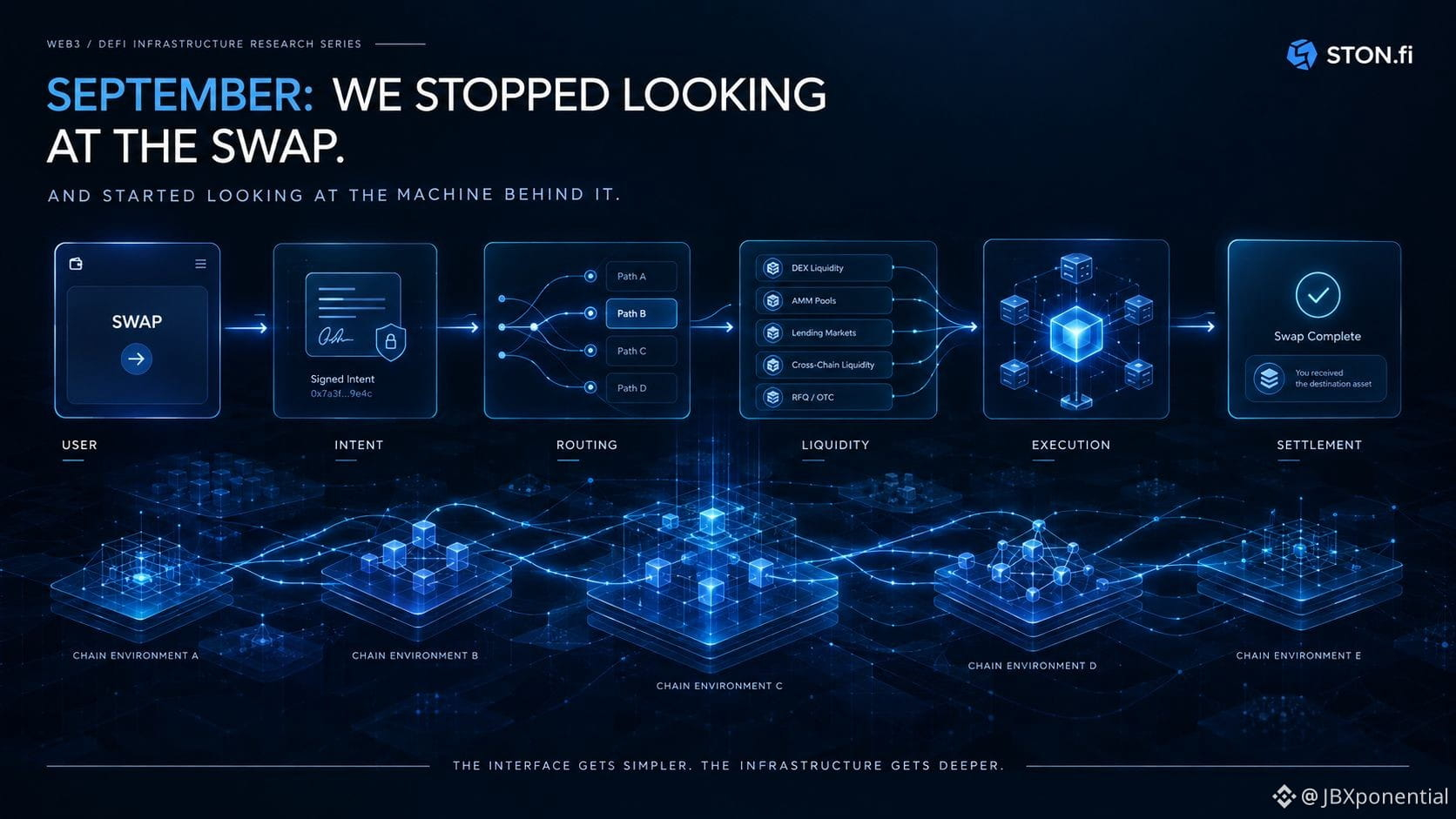
September's DeFi Lesson: The User Sees a Swap, Infrastructure Sees an Entire System
September's DeFi Lesson: The User Sees a Swap, Infrastructure Sees an Entire System
At the beginning of September, cross-chain DeFi looked like a user-interface problem.
Choose a chain.
Choose an asset.
Choose a destination.
Confirm.
Done.
But the deeper you look, the less simple the underlying operation becomes.
A cross-chain transaction can involve routing, liquidity sourcing, quoting, execution, settlement, gas management and failure handling.
The user should not need to understand every layer.
The infrastructure does.
That became one of the most interesting themes I followed throughout September.
From swap interface to execution infrastructure
STON.fi's Omniston architecture illustrates this transition.
Omniston is positioned as a cross-chain execution layer that coordinates RFQs, resolver liquidity and settlement across supported networks.
The current cross-chain product describes the execution model as atomic and non-custodial: either the swap completes and the destination asset arrives, or the transaction fails and the assets return.
That distinction matters.
Because cross-chain DeFi isn't simply about moving tokens.
It is about coordinating state across environments that were never designed as one unified system.
The invisible infrastructure
Think about modern internet applications.
You click a button.
You don't think about DNS.
You don't think about routing tables.
You don't think about packet delivery.
You experience the application.
DeFi is moving toward a similar abstraction.
Users increasingly want to think in terms of:
What do I want to accomplish?
rather than:
Which chain, bridge, gas token and liquidity venue do I need to operate?
That doesn't mean those components disappear.
It means they become infrastructure.
@ston_fi #STON.fi $STON #Stonbassador #DeFi #TON
September's DeFi Lesson: The User Sees a Swap, Infrastructure Sees an Entire System
At the beginning of September, cross-chain DeFi looked like a user-interface problem.
Choose a chain.
Choose an asset.
Choose a destination.
Confirm.
Done.
But the deeper you look, the less simple the underlying operation becomes.
A cross-chain transaction can involve routing, liquidity sourcing, quoting, execution, settlement, gas management and failure handling.
The user should not need to understand every layer.
The infrastructure does.
That became one of the most interesting themes I followed throughout September.
From swap interface to execution infrastructure
STON.fi's Omniston architecture illustrates this transition.
Omniston is positioned as a cross-chain execution layer that coordinates RFQs, resolver liquidity and settlement across supported networks.
The current cross-chain product describes the execution model as atomic and non-custodial: either the swap completes and the destination asset arrives, or the transaction fails and the assets return.
That distinction matters.
Because cross-chain DeFi isn't simply about moving tokens.
It is about coordinating state across environments that were never designed as one unified system.
The invisible infrastructure
Think about modern internet applications.
You click a button.
You don't think about DNS.
You don't think about routing tables.
You don't think about packet delivery.
You experience the application.
DeFi is moving toward a similar abstraction.
Users increasingly want to think in terms of:
What do I want to accomplish?
rather than:
Which chain, bridge, gas token and liquidity venue do I need to operate?
That doesn't mean those components disappear.
It means they become infrastructure.
@ston_fi #STON.fi $STON #Stonbassador #DeFi #TON