
The week of 28 September carries two US jobs reports. One of them has moved crypto more than any other release on the calendar. The other has never once had a quiet hour.
They are not the same release, and they are not the same risk.
How we measure it
For each release, take the hour it lands in and measure that hour's move, open to close, as an absolute percentage. Divide by the coin's median hourly move over the same window. 1.00 means the release hour looked like any other hour. We use BTC, ETH and SOL and take the median, over 399 days of releases that TradingView flags as high importance, and each hour is counted once however many lines print in it. The full ranking is in our previous idea.
JOLTs, Tuesday 29 September, 14:00 UTC
Median hour: 3.69 times an ordinary hour, the highest of any US release with a year of history. On the eight hours it had to itself, with nothing else printing, 4.33 times.
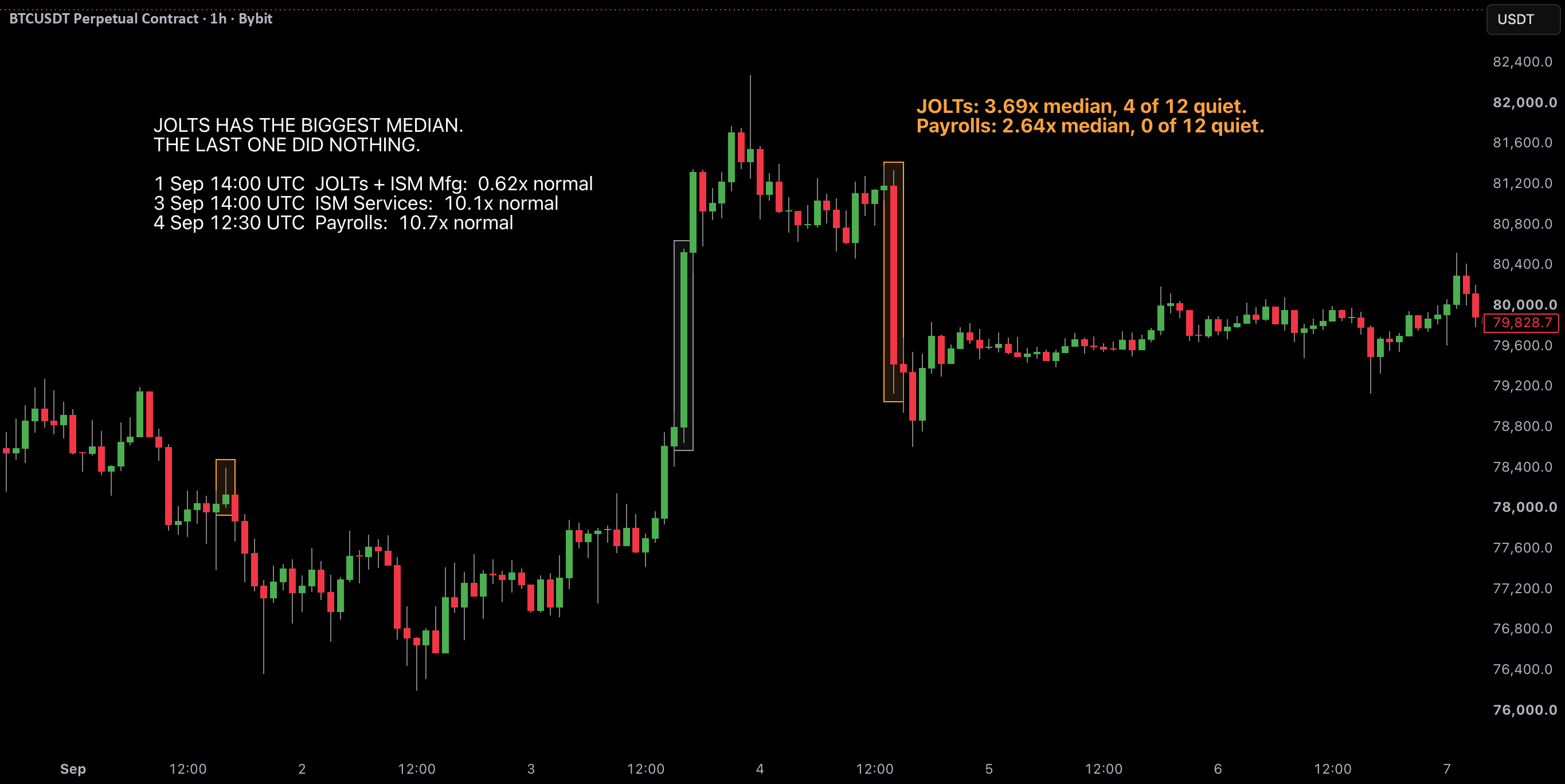
But look at the twelve hours one by one. The biggest moved 14.5 times normal. Four of the twelve moved less than an ordinary hour, and the most recent one, on 1 September, was one of them.
JOLTs is big when it moves, and about a third of the time it does not.
Payrolls, Friday 2 October, 12:30 UTC
Median hour: 2.64 times an ordinary hour. Lower than JOLTs.
But all twelve of its hours moved more than an ordinary hour. Not one was quiet. It prints in the same minute as the unemployment rate every time, so treat the two as one event.
The chart is the last jobs week, hour by hour. JOLTs on 1 September, in the same minute as ISM manufacturing: 0.62 times an ordinary hour. ISM services on 3 September: 10.1 times. Payrolls on 4 September: 10.7 times, the largest of its twelve hours, so the median above is the fairer number.
And the red flags in between
Wednesday 30 September, 12:30 UTC: Core PCE, personal income and personal spending all print in the same minute, and this time the final GDP estimate joins them. TradingView flags every one of them high importance. That hour has measured 1.04 times an ordinary hour, and half of its twelve hours were quieter than normal.
Thursday 1 October, 14:00 UTC: ISM manufacturing, 2.59 times, four quiet hours out of thirteen.
What this does not tell you
Which way. It measures how much the hour moved, not direction, and it is not a signal. Twelve hours per release is a small sample, and with about thirty release names compared, one of them landing high partly by luck is expected. It is in sample, thirteen months, three coins.
What it is good for is knowing what you are holding into. A position through JOLTs is holding a coin flip between nothing and a lot. A position through payrolls is holding something that has moved every single time.