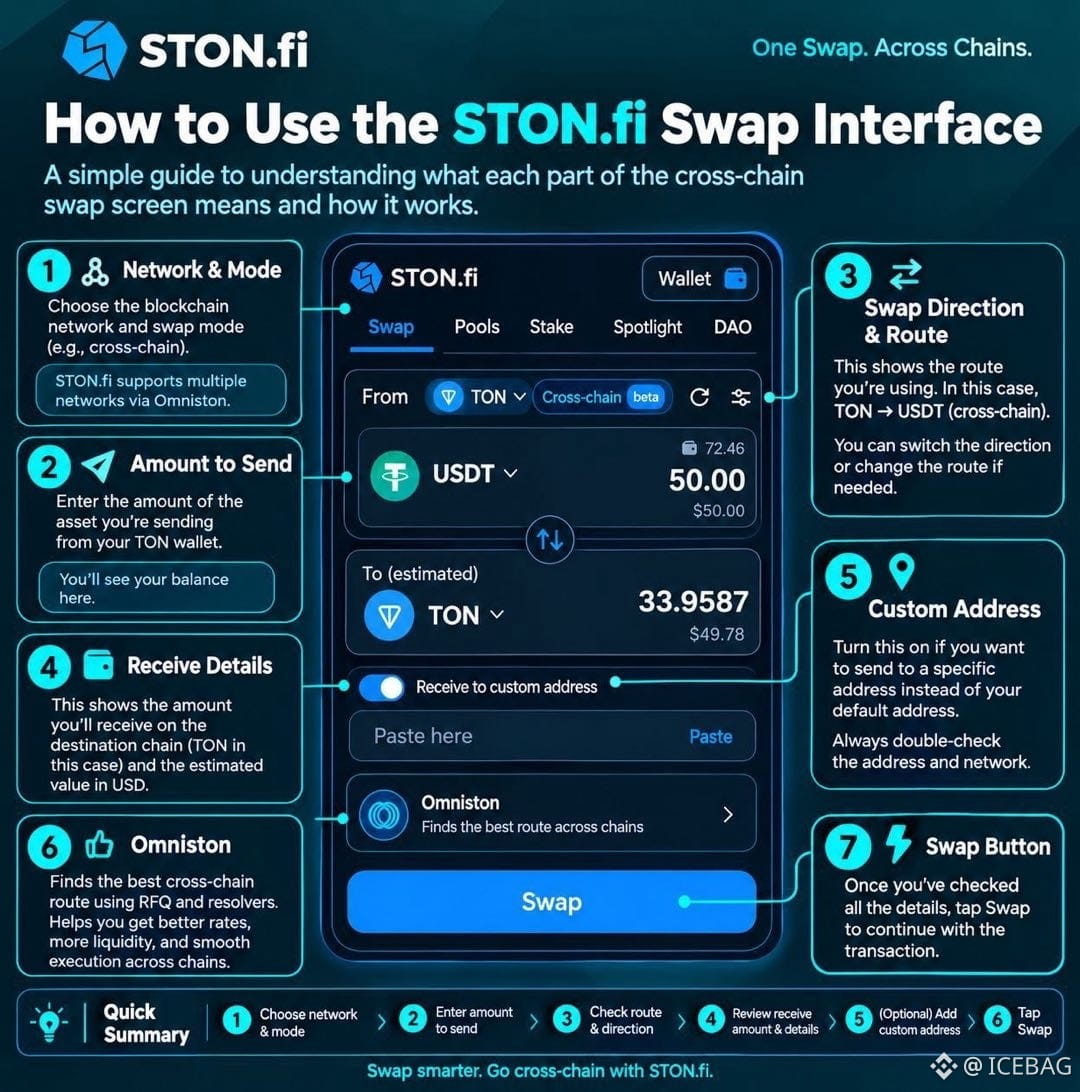
How to Compare Two Cross-Chain Swap Routes on STON.fi
Cross-chain swaps can feel confusing, especially when you have multiple routes to choose from.
But don’t look at the exchange rate alone. Here are the key things to compare:
1. Source & Destination
Check the network you’re sending from and the network where you want to receive your assets.
Example: $TON → Ethereum or $TON → $TRON.
2. Final Amount
The most important number is how much you will actually receive after fees and other costs.
3. Route & Execution
Look at how the swap will be executed. STON.fi Omniston uses RFQ and resolvers to find cross-chain liquidity and facilitate execution.
4. Fees & Price Impact
A route showing a better rate isn’t automatically better. Check the fees and how they affect your final amount.
5. Speed
If two routes provide similar final amounts, execution time can become an important factor.
6. Destination Address
Before confirming, make sure the destination network and address are compatible with the asset you want to receive.
Simple rule:
Route A → Better final amount + reasonable fees + faster execution
Route B → Lower quoted cost + slower execution + lower final amount
When comparing cross-chain routes, ask yourself:
“How much will I receive, how much will I pay, and how long will it take?”
That’s more useful than looking at the exchange rate alone.
One Swap. Across Chains.
🌐: https://app.ston.fi/
Cross-chain swaps can feel confusing, especially when you have multiple routes to choose from.
But don’t look at the exchange rate alone. Here are the key things to compare:
1. Source & Destination
Check the network you’re sending from and the network where you want to receive your assets.
Example: $TON → Ethereum or $TON → $TRON.
2. Final Amount
The most important number is how much you will actually receive after fees and other costs.
3. Route & Execution
Look at how the swap will be executed. STON.fi Omniston uses RFQ and resolvers to find cross-chain liquidity and facilitate execution.
4. Fees & Price Impact
A route showing a better rate isn’t automatically better. Check the fees and how they affect your final amount.
5. Speed
If two routes provide similar final amounts, execution time can become an important factor.
6. Destination Address
Before confirming, make sure the destination network and address are compatible with the asset you want to receive.
Simple rule:
Route A → Better final amount + reasonable fees + faster execution
Route B → Lower quoted cost + slower execution + lower final amount
When comparing cross-chain routes, ask yourself:
“How much will I receive, how much will I pay, and how long will it take?”
That’s more useful than looking at the exchange rate alone.
One Swap. Across Chains.
🌐: https://app.ston.fi/