
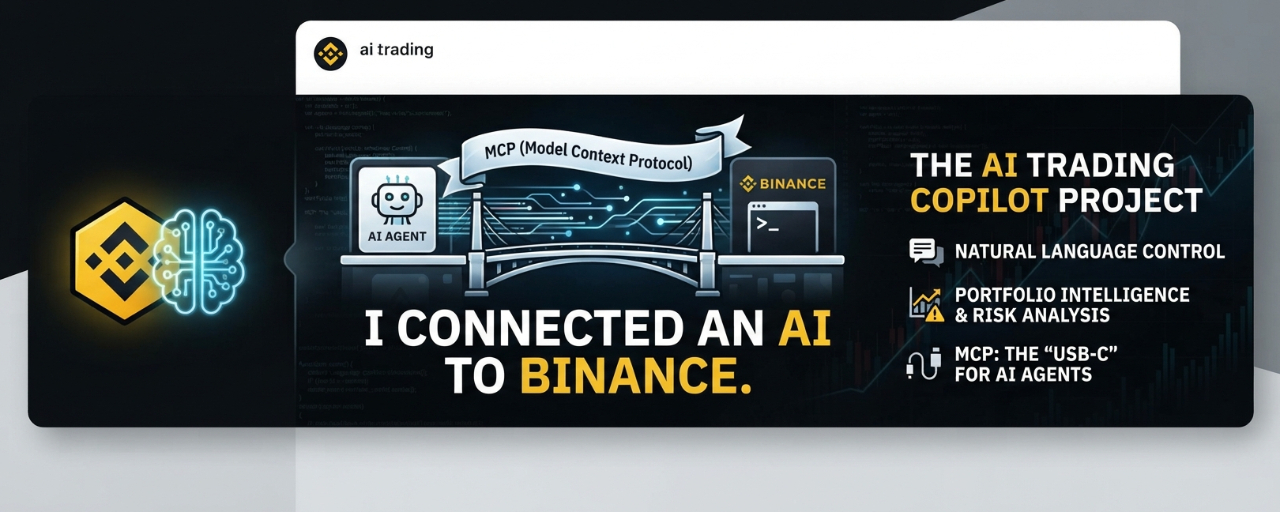

For the past few weeks, I've been building a project: an AI Trading Copilot connected to Binance Agent OS via MCP. Trading terminal, portfolio dashboard, and market intelligence—all controllable using natural language.
A quick reminder for those unfamiliar: MCP (Model Context Protocol) is basically the USB-C port for AI agents. Previously, each AI had to have a custom-built connector for each service. With MCP, a server exposes its capabilities once, and any compatible agent can connect to it. Binance has published its own: agent.binance.com/mcp/agentic.
What this really changes:
The AI doesn't "predict" the market. Forget about it. What it does well is something else entirely—and it's underrated:
It reads your portfolio and tells you what you refuse to see (your "diversification" in 8 altcoins that all move together, for example).
It transforms "show me my worst trades of the month and why" into a 3-second query instead of a Sunday spreadsheet.
It monitors tirelessly, without ego, without FOMO at 3 a.m.
The 3 lessons I learned from the build:
Demo mode isn't optional; it's the product. My app starts with TRADING_ENABLED=false by default. An AI agent with access to real orders from the first line of code is like learning to drive on the highway.
The real work isn't the model; it's the context. A brilliant AI with bad portfolio data gives bad advice with perfect confidence. 80% of my time is spent on the data layer.
UX decides everything. Nobody wants to chat with their wallet for 20 minutes. The right interface is a dashboard that responds, not a chatbot that displays charts.
The next crypto wave won't be "an AI that trades for you." It will be "an AI that stops you from making the mistake you were about to make."
I'm documenting the entire build here. Want to see more? Tell me which part interests you: the architecture, the MCP, or the UX.