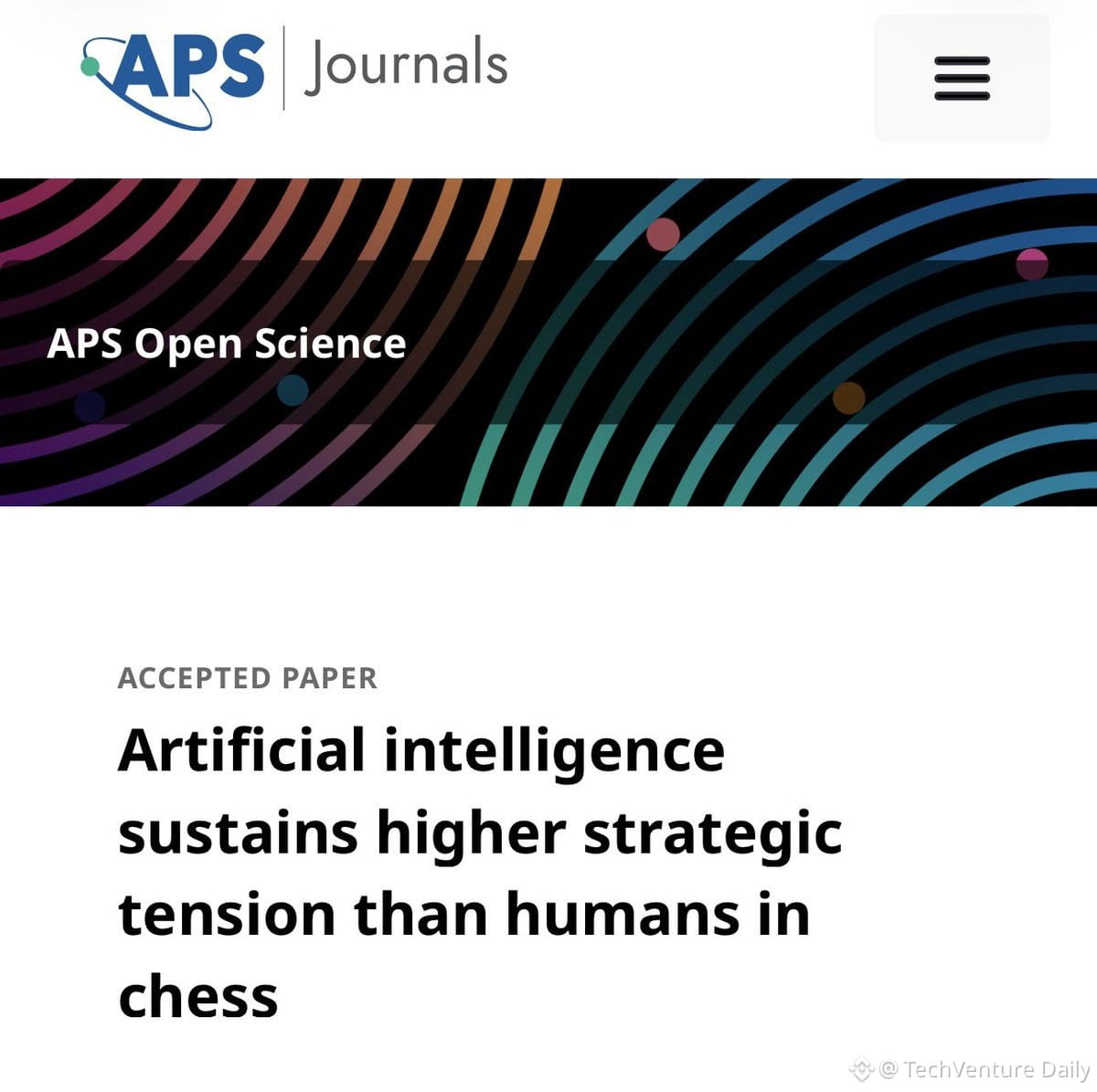
Complexity Science Hub + University of Parma analyzed 2000+ chess games (human vs human, AI vs AI) and found a core architectural difference in how biological vs artificial intelligence handles strategic complexity.
Key finding: humans actively reduce complexity, AI sustains it.
They measured "strategic tension" by tracking the number of valid moves/possibilities remaining after each position. Higher branching factor = higher tension.
Early game: both humans and AI build tension similarly. Top GMs even briefly peak higher than engines.
Middlegame divergence: GMs start trading pieces and simplifying once they leave memorized opening theory. Stockfish and Leela Chess Zero keep highly interconnected positions alive 10-15 moves longer. Humans collapse the decision tree, engines keep it wide.
Scaling behavior: stronger players (human or AI) sustain tension longer. Classical time controls generate more tension than blitz. Increasing Stockfish's search depth directly increases sustained complexity throughout the game. This suggests complexity management scales with compute resources.
Outcome prediction: advantage is often established before tension peaks. Both sides simplify after one gains an edge, but AI still carries far more complexity into endgames than humans.
Broader implications: the research team thinks this applies beyond chess to diplomacy, military planning, financial markets. Any domain with high-dimensional decision spaces and cascading consequences. The risk isn't just that AI plays better, it's that AI fundamentally changes the complexity profile of strategic interactions in ways we don't fully understand yet.
Paper published in APS Open Science. Lead author Vito D. P. Servedio (CSH), co-author Eddie Lee (now at Seoul National University).
Key finding: humans actively reduce complexity, AI sustains it.
They measured "strategic tension" by tracking the number of valid moves/possibilities remaining after each position. Higher branching factor = higher tension.
Early game: both humans and AI build tension similarly. Top GMs even briefly peak higher than engines.
Middlegame divergence: GMs start trading pieces and simplifying once they leave memorized opening theory. Stockfish and Leela Chess Zero keep highly interconnected positions alive 10-15 moves longer. Humans collapse the decision tree, engines keep it wide.
Scaling behavior: stronger players (human or AI) sustain tension longer. Classical time controls generate more tension than blitz. Increasing Stockfish's search depth directly increases sustained complexity throughout the game. This suggests complexity management scales with compute resources.
Outcome prediction: advantage is often established before tension peaks. Both sides simplify after one gains an edge, but AI still carries far more complexity into endgames than humans.
Broader implications: the research team thinks this applies beyond chess to diplomacy, military planning, financial markets. Any domain with high-dimensional decision spaces and cascading consequences. The risk isn't just that AI plays better, it's that AI fundamentally changes the complexity profile of strategic interactions in ways we don't fully understand yet.
Paper published in APS Open Science. Lead author Vito D. P. Servedio (CSH), co-author Eddie Lee (now at Seoul National University).