


La mayor ventaja de un ecosistema multi-chain también puede convertirse en su mayor problema.
Más cadenas significan más liquidez.
Más activos.
Más aplicaciones.
Más oportunidades.
Pero también significan más infraestructura.
Para los desarrolladores, apoyar otra red no es simplemente añadir un botón.
Puede significar otra integración, otra fuente de liquidez, otro sistema de enrutamiento y otro proceso de liquidación.
Esta es una de las razones por las que la infraestructura que hay detrás de la Omniston de STON.fi merece la pena echarle un vistazo.
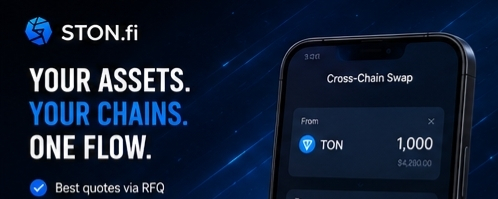
Omniston está diseñado como una capa de ejecución entre cadenas que las aplicaciones pueden integrar una sola vez, en lugar de construir infraestructuras separadas entre cadenas para cada red.
El sistema gestiona el enrutamiento y conecta aplicaciones con la liquidez proporcionada por el resolver.
Los resolvers proporcionan liquidez en el lado de destino para las órdenes y compiten en precio y ejecución.
Eso crea un modelo en el que la liquidez puede responder a la demanda, en lugar de que cada aplicación tenga que mantener saldos en varias cadenas.
Hay otra diferencia importante.
Omniston se construye en torno a la ejecución de activos nativos.
Los usuarios no necesitan recibir una representación envuelta de un activo solo porque se esté moviendo entre ecosistemas.
La ejecución también está diseñada sin un intermediario centralizado que mantenga los fondos del usuario durante el intercambio.
Para los desarrolladores, esto abre una posibilidad interesante.
Una wallet podría añadir intercambios entre cadenas sin construir su propia infraestructura de puentes.
Una bolsa podría admitir más flujos de trading entre cadenas sin prefondear cada red.
Una aplicación DeFi podría dar a los usuarios acceso a activos de otros ecosistemas sin enviarlos fuera de la aplicación.
Ese es un caso de uso mucho más amplio que simplemente intercambiar tokens en STON.fi.
El entorno actual de Omniston ya cubre TON, TRON, Ethereum, Base, BNB Chain, Polygon, Arbitrum, Avalanche y Robinhood Chain.
Se están añadiendo más redes por fases.
Y dado que la misma capa de ejecución puede servir para distintos tipos de aplicaciones, cada nueva integración puede ampliar potencialmente la utilidad de toda la red.
Esa es la parte que me parece más interesante.
El futuro de la DeFi quizá no consista en que las aplicaciones se conviertan en expertas en cada blockchain.
Puede tratarse de aplicaciones que se conectan a una infraestructura que ya comprende la complejidad por ellas.
Una integración.
Múltiples ecosistemas.
Activos nativos.
Liquidez del resolver.
Ejecución entre cadenas.
Esa es una dirección mucho más escalable para la DeFi multicanal.