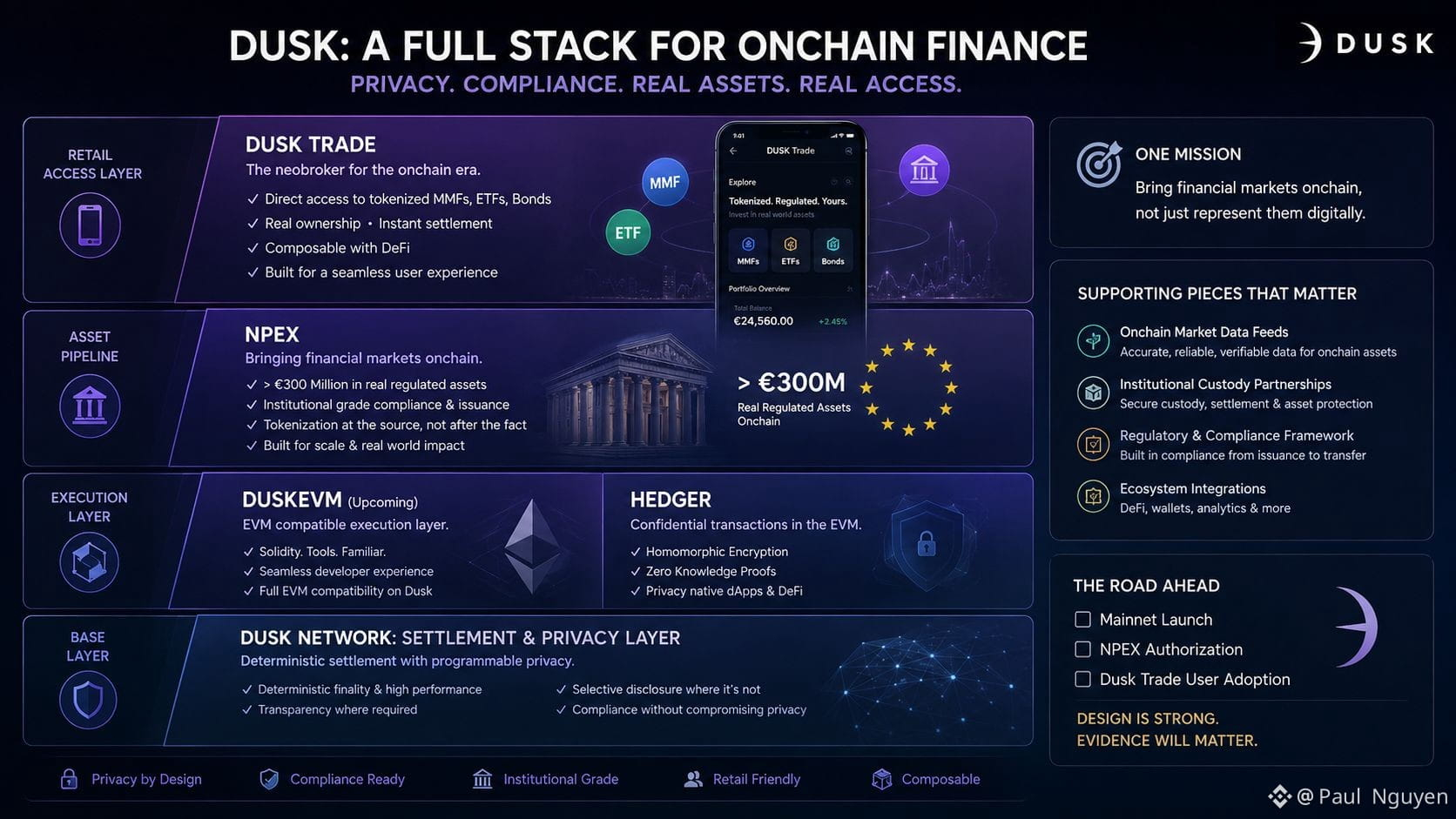
Dusk is the first Layer 1 blockchain natively supporting security tokens shows up often enough in how the project describes itself that it is worth actually testing the word first against the history of who else tried this.
Polymath set out to build compliance-focused infrastructure for tokenized securities years before Dusk's mainnet existed, eventually partnering with a co-founder of Cardano to design Polymesh as a purpose-built chain for exactly this use case. That project existed, raised money, and shipped a live network before Dusk did. So first cannot mean first to attempt a security-token-native Layer 1, because it was not.
Where the claim gets more defensible is a narrower framing: first among that cohort to reach a mainnet actually settling meaningful, regulator-supervised financing volume, rather than staying technically live but commercially quiet. NPEX's more than 200 million euros in financing actively trading on Dusk's infrastructure, with reported plans to push past 300 million euros in further assets over time, is a real, checkable outcome that is harder to point to for some of the earlier attempts in this category.
There is also a separate, adjacent set of projects, Aleo and Aztec among them, building general-purpose private smart contract platforms that overlap with Dusk's cryptography but were never built specifically around securities compliance the way Dusk was from its founding brief. They are not really competing for the same first at all, since the use case differs.
Worth separating native from adjacent too. Plenty of tokenization efforts issue securities on an existing chain without building their own consensus layer. Dusk's claim to first rests on owning that base layer itself, a real distinction but narrower than the marketing shorthand suggests.
So the honest version is not first, period. It is first in this narrow category to pair a live Layer 1 with real regulated trading volume, a smaller, more specific achievement than the unqualified word first implies.
@Dusk $DUSK #dusk
Polymath set out to build compliance-focused infrastructure for tokenized securities years before Dusk's mainnet existed, eventually partnering with a co-founder of Cardano to design Polymesh as a purpose-built chain for exactly this use case. That project existed, raised money, and shipped a live network before Dusk did. So first cannot mean first to attempt a security-token-native Layer 1, because it was not.
Where the claim gets more defensible is a narrower framing: first among that cohort to reach a mainnet actually settling meaningful, regulator-supervised financing volume, rather than staying technically live but commercially quiet. NPEX's more than 200 million euros in financing actively trading on Dusk's infrastructure, with reported plans to push past 300 million euros in further assets over time, is a real, checkable outcome that is harder to point to for some of the earlier attempts in this category.
There is also a separate, adjacent set of projects, Aleo and Aztec among them, building general-purpose private smart contract platforms that overlap with Dusk's cryptography but were never built specifically around securities compliance the way Dusk was from its founding brief. They are not really competing for the same first at all, since the use case differs.
Worth separating native from adjacent too. Plenty of tokenization efforts issue securities on an existing chain without building their own consensus layer. Dusk's claim to first rests on owning that base layer itself, a real distinction but narrower than the marketing shorthand suggests.
So the honest version is not first, period. It is first in this narrow category to pair a live Layer 1 with real regulated trading volume, a smaller, more specific achievement than the unqualified word first implies.
@Dusk $DUSK #dusk