

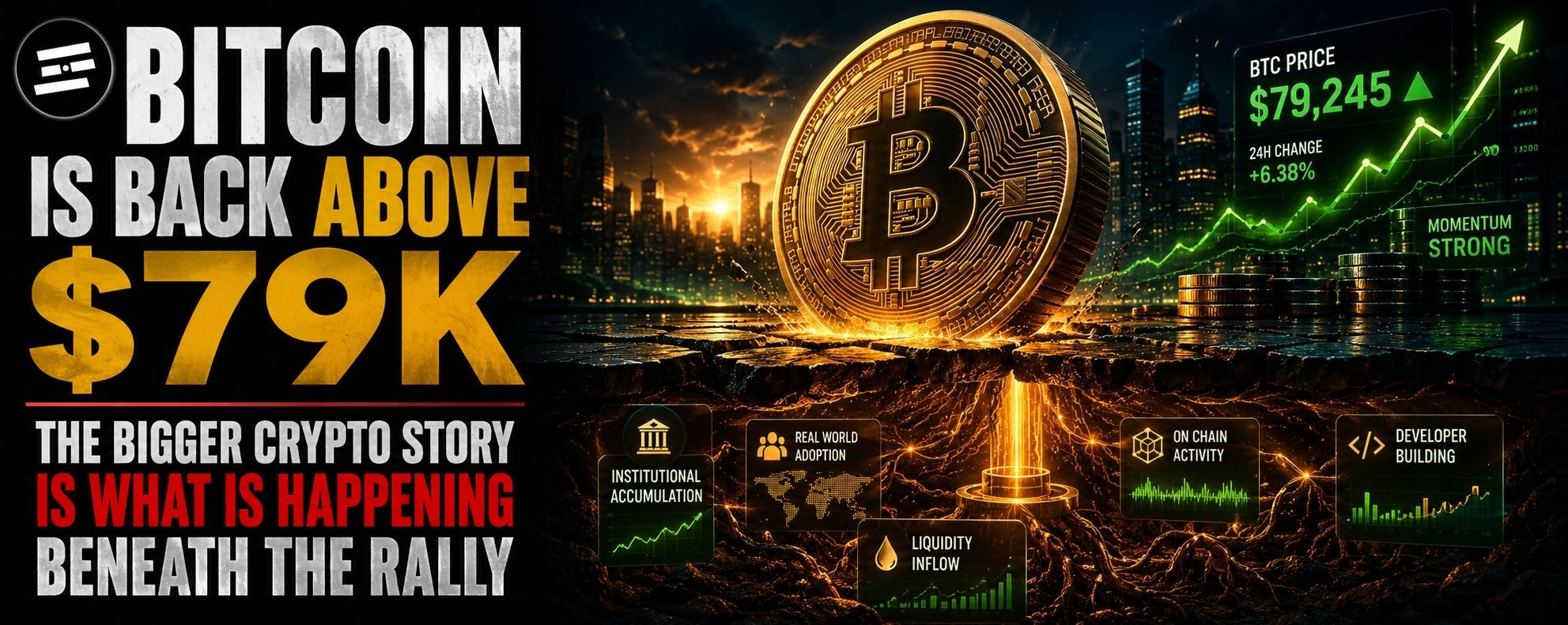

El bitcoin está teniendo una de sus semanas más fuertes en años.
El BTC alcanzó aproximadamente los 79.000 dólares, con el activo ganando más de un 20% durante la semana. Ethereum también ha repuntado, mientras varias acciones relacionadas con las criptomonedas y los principales activos digitales se han sumado al movimiento. (The Wall Street Journal)
Pero el desarrollo más importante no es el precio del bitcoin en sí.
Es la convergencia de liquidez, la demanda institucional, el impulso regulatorio y una participación más amplia del mercado.
Esa combinación merece más atención.
El bitcoin ya no está acaparando el rally en solitario
Bitcoin se ha movido con fuerza al alza y ha alcanzado niveles no vistos desde mayo.
El movimiento ha sido inusualmente potente.
Los informes del mercado indican que BTC ganó aproximadamente un 23% durante la semana, mientras que Ethereum ganó aproximadamente un 26%. Hyperliquid también registró un avance semanal significativo. (Investor’s Business Daily)
Esto cambia el carácter del mercado.
Un rally centrado solo en Bitcoin puede indicar que el capital se concentra en el activo digital más líquido.
Cuando BTC, ETH y otras grandes criptomonedas comienzan a moverse juntas, el mercado empieza a mostrar una mayor tolerancia al riesgo.
Eso no prueba que haya comenzado un nuevo mercado alcista.
Pero es un cambio importante en el comportamiento del mercado.
La demanda institucional está regresando
Una de las evidencias más sólidas detrás del movimiento actual es el flujo renovado hacia productos de Bitcoin spot de EE. UU.
Según los informes recientes del mercado, los ETF de Bitcoin registraron más de $1 mil millones en flujos netos de entrada en dos días y aproximadamente $1.61 mil millones en cuatro días. (The Wall Street Journal)
Esto importa porque la participación institucional puede proporcionar una fuente de demanda distinta de la especulación cripto de corto plazo.
Los flujos de ETF crean un puente entre las cuentas de inversión tradicionales y la exposición a Bitcoin.
Si esos flujos se mantienen fuertes, podrían convertirse en un componente estructural importante del mercado.
La pregunta crítica, por lo tanto, no es simplemente:
¿Qué tan alto puede llegar Bitcoin?
Es:
¿La demanda institucional continuará después del rally inicial?
La liquidez se está convirtiendo en una parte importante de la historia
Otro gran desarrollo está ocurriendo fuera del mundo cripto.
El Tesoro de EE. UU. ha anunciado planes para aumentar las recompras de bonos de larga duración.
El movimiento llega después de que una fuerte caída del mercado de bonos del Tesoro empujó los rendimientos de largo plazo con fuerza al alza.
Los participantes del mercado interpretaron la intervención como un apoyo para las condiciones financieras y los activos de riesgo. (Reuters)
Históricamente, Bitcoin ha sido sensible a cambios en las condiciones globales de liquidez.
Cuando las condiciones financieras se vuelven más favorables, los activos escasos y líquidos pueden atraer capital adicional.
Eso no significa que las recompras del Tesoro creen demanda por Bitcoin de forma directa.
La relación es más indirecta.
Pero la combinación de rendimientos más bajos, un dólar más débil y una mejora de la tolerancia al riesgo puede crear un entorno más favorable para los activos digitales. (Financial Times)
La regulación está añadiendo otra capa
La liquidez es solo una parte de la historia actual.
La regulación cripto de EE. UU. también se está moviendo.
El presidente Donald Trump ha impulsado al Congreso para que avance la Ley CLARITY, que busca establecer límites regulatorios más claros para los activos digitales.
La CFTC desarrolla simultáneamente su enfoque sobre la estructura del mercado cripto, mientras que la SEC ha propuesto un nuevo marco específicamente dirigido a los criptoactivos. (SEC)
Estos desarrollos son importantes porque el capital institucional necesita certeza regulatoria.
Los bancos, los gestores de activos y las corporaciones generalmente necesitan entender:
Qué activos entran en qué marco regulatorio
Qué productos se pueden ofrecer
Cómo debería funcionar la custodia
Cómo deberían operar las bolsas
¿Qué actividades están permitidas?
¿Qué requisitos de cumplimiento se aplican?
Una mayor claridad no garantiza más capital.
Pero la incertidumbre puede ser una barrera significativa para la asignación de capital.
El punto de inflexión cripto de tres capas
Por lo tanto, el mercado actual puede verse a través de tres capas conectadas.
Capa 1 — Liquidez
La intervención del Tesoro y el cambio en los rendimientos influyen en las condiciones financieras más amplias.
Capa 2 — Instituciones
Los flujos de ETF de Bitcoin sugieren que la demanda institucional se está volviendo visible de nuevo.
Capa 3 — Regulación
La SEC, la CFTC y el Congreso están trabajando hacia un marco de criptoactivos más definido.
Estos desarrollos están ocurriendo simultáneamente.
Eso es lo que hace interesante el entorno actual.
El efecto de segundo orden
Si la tendencia actual continúa, las consecuencias podrían extenderse mucho más allá de Bitcoin.
Una mayor demanda institucional podría aumentar el capital que fluye hacia:
Bitcoin
Ethereum
Fondos de criptoactivos
Infraestructura de custodia
Bolsas
Stablecoins
Activos tokenizados
Liquidación en blockchain
Infraestructura DeFi
La claridad regulatoria podría acelerar aún más la experimentación institucional.
Eso crea un posible bucle de retroalimentación:
Claridad regulatoria
↓
Participación institucional
↓
Más infraestructura cripto
↓
Más liquidez
↓
Mayor adopción
Esto es un escenario, no un resultado garantizado.
Pero es uno de los desarrollos estructurales más importantes que hay que vigilar.
Por qué importa Ethereum
Bitcoin recibe la mayor parte de la atención.
Ethereum merece una consideración igual.
Según los informes recientes del mercado, ETH ha ganado aproximadamente un 26% durante la semana actual. (Investor’s Business Daily)
Si Ethereum continúa superando a Bitcoin después de que este se estabilice, podría indicar que el capital se mueve más allá por la curva de riesgo cripto.
Eso sería una confirmación importante de la amplitud del mercado.
Ethereum también está profundamente conectado con varios de los mayores temas estructurales de cripto:
Stablecoins
DeFi
Tokenización
Infraestructura de Capa 2
Liquidación institucional
Aplicaciones financieras en la cadena
Por lo tanto, su desempeño aporta información sobre más que el propio ETH.
La pregunta de las altcoins
La siguiente gran pregunta es si el mercado más amplio de altcoins puede sostener la participación.
Una expansión saludable mostraría idealmente una amplitud creciente.
Eso significa que participan más sectores, en lugar de solo un puñado de tokens altamente especulativos.
Las áreas importantes para monitorear incluyen:
DeFi
Stablecoins
RWA
IA y cripto
DePIN
Capa 1
Capa 2
Infraestructura
Productos blockchain institucionales
Aquí es donde el ecosistema cripto ampliado se vuelve importante.
La siguiente fase podría no estar definida por un solo token dominante.
Podría definirse por qué sectores reciben capital sostenido y adopción por parte de los usuarios.
La cobertura de cortos añade combustible
Hay otro factor importante.
El rápido movimiento al alza ha obligado a que cierren grandes cantidades de posiciones bajistas.
Los informes recientes estiman que más de $4.3 mil millones de posiciones cortas se han liquidado desde el miércoles. (Investor’s Business Daily)
La cobertura de cortos puede acelerar un rally ya existente.
Pero también crea una distinción importante.
Parte de la apreciación de precio actual puede representar cambios forzados de posicionamiento en lugar de una demanda nueva de largo plazo completamente distinta.
Eso significa que el mercado necesita demostrar demanda spot continua después de que se desvanezca el squeeze de cortos.
¿Qué confirmaría una expansión sostenible?
Hay varios indicadores que merecen atención.
1. Ingresos continuos de ETF
Los flujos institucionales persistentes aportarían una evidencia más sólida de que la demanda no es puramente especulativa.
2. Mantener niveles más altos de Bitcoin
Una expansión de mercado sostenible requiere que el mercado absorba la toma de ganancias sin perder su estructura más amplia.
3. Fortaleza de Ethereum
La participación continua de ETH fortalecería el argumento a favor de una mayor amplitud del mercado cripto.
4. Expansión del sector
Más capital moviéndose hacia DeFi, RWA, stablecoins, infraestructura y otros sectores sugeriría que el rally se está volviendo más amplio a nivel de ecosistema.
5. Menor dependencia de la cobertura de cortos
El mercado se vuelve más constructivo si la demanda spot continúa después de que los cortos apalancados ya hayan sido eliminados.
6. Progreso regulatorio
El progreso real en materia legislativa y regulatoria fortalecería la tesis de adopción institucional.
¿Qué podría invalidar la narrativa?
Un rally fuerte no elimina el riesgo.
Varios desarrollos podrían poner en duda la interpretación actual.
Un giro en las condiciones de liquidez podría debilitar los activos de riesgo.
Los flujos de ETF podrían desacelerarse.
El apalancamiento excesivo podría reconstruirse.
Bitcoin podría no lograr mantener sus ganancias recientes.
La legislación regulatoria podría encontrar resistencia política adicional.
La inflación macro podría mantenerse más fuerte de lo esperado.
Y el riesgo geopolítico podría aumentar de repente la demanda de liquidez en lugar de activos especulativos.
Estas posibilidades no invalidan el rally actual.
Definen lo que el mercado necesita demostrar a continuación.
La brecha de información
La mayor parte de la cobertura cripto se enfoca actualmente en una sola pregunta:
¿Bitcoin está entrando en un nuevo mercado alcista?
Una pregunta más útil es:
¿Qué está provocando que el capital regrese a las criptomonedas y pueden persistir esas fuerzas?
Esa distinción importa.
El precio nos dice qué está pasando.
Los flujos de capital, la liquidez, la regulación y la amplitud del mercado ayudan a explicar por qué.
Es posible que el segundo grupo sea más importante para entender lo que ocurrirá a continuación.
La gran oportunidad cripto
Si el entorno actual se desarrolla hacia una expansión sostenida, los beneficiarios podrían extenderse mucho más allá de Bitcoin.
La siguiente fase del cripto podría implicar:
Bitcoin como colateral digital institucional
Ethereum como infraestructura financiera
Stablecoins como rieles de pago globales
RWA como infraestructura financiera tokenizada
DeFi como mercados financieros programables
Agentes de IA como participantes económicos autónomos
DePIN como infraestructura física descentralizada
Redes de Capa 1 y Capa 2 como infraestructura de liquidación
Por eso el cripto no debe analizarse exclusivamente a través de los precios de los tokens.
La industria se está convirtiendo en un ecosistema financiero y tecnológico cada vez más interconectado.
Lo que Nichie está observando a continuación
La siguiente señal importante no es otro objetivo de precio de Bitcoin para un solo día.
Es la interacción entre:
Flujos de ETF
Liquidez
Regulación
Amplitud del mercado
Participación institucional
Actividad en cadena
Crecimiento de stablecoins
Tokenización
Actividad de DeFi
Si varios de estos indicadores continúan mejorando simultáneamente, el rally actual se vuelve cada vez más interesante desde una perspectiva estructural.
Perspectiva final
Bitcoin por encima de $79,000 es significativo.
Pero la historia más grande es la convergencia debajo del precio.
Los flujos institucionales están regresando.
Las expectativas de liquidez están mejorando.
La regulación cripto de EE. UU. se está volviendo más definida.
Ethereum y otros criptoactivos están participando.
Las posiciones cortas se están eliminando.
Y el ecosistema más amplio empieza a responder.
Nada de esto garantiza que los precios sigan subiendo.
El mercado todavía tiene que demostrar que el movimiento actual puede sobrevivir a la toma de ganancias, a cambios en las condiciones macro y a la normalización del apalancamiento.
Pero hay algo que se vuelve cada vez más claro:
El cripto ya no se mueve con una sola narrativa.
Se está convirtiendo en una convergencia de capital, regulación, tecnología, infraestructura y adopción.
Ese es el desarrollo que vale la pena vigilar.