
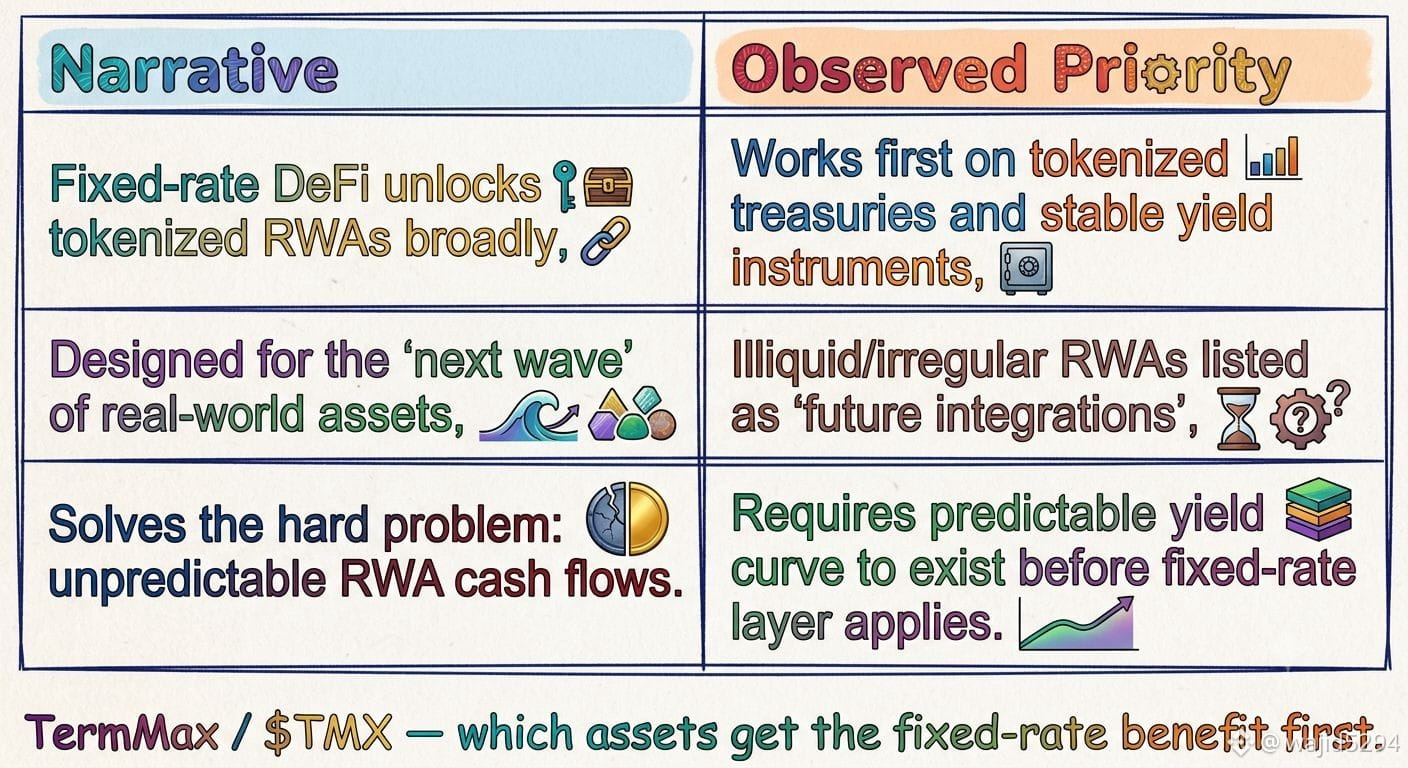
@TermMax #termmax What caught me was the order of operations, not the pitch. TermMax frames itself as the fixed-rate layer that will make RWAs "DeFi-native," but the actual product only works cleanly once an asset already has a stable, predictable yield curve, meaning it's tokenized treasuries and similar instruments that fit first, not the messier real-world assets like receivables or real estate that supposedly need fixed rates the most. $TMX and #TermMax talk about unlocking the next wave of tokenized assets, but the underlying mechanism, fixed-rate lending pools built on top of existing yield-bearing collateral, needs that collateral to already behave predictably before it can offer a fixed term on top. So the assets that benefit first are the ones that were already the easiest case: liquid, low-volatility, institutionally structured. The harder RWAs, the ones with irregular cash flows or illiquid underlying value, are still described as "future integrations." It's less that fixed-rate DeFi unlocks tokenized assets broadly, and more that it formalizes yield on the assets that had the least uncertainty to begin with. Does the fixed-rate layer expand the RWA market, or just make the easy part look more finished?


Publicación
Aviso legal: Incluye opiniones de terceros. No es asesoramiento. Binance Ai puede utilizarse sin garantía. Consultar Términos y condiciones.