

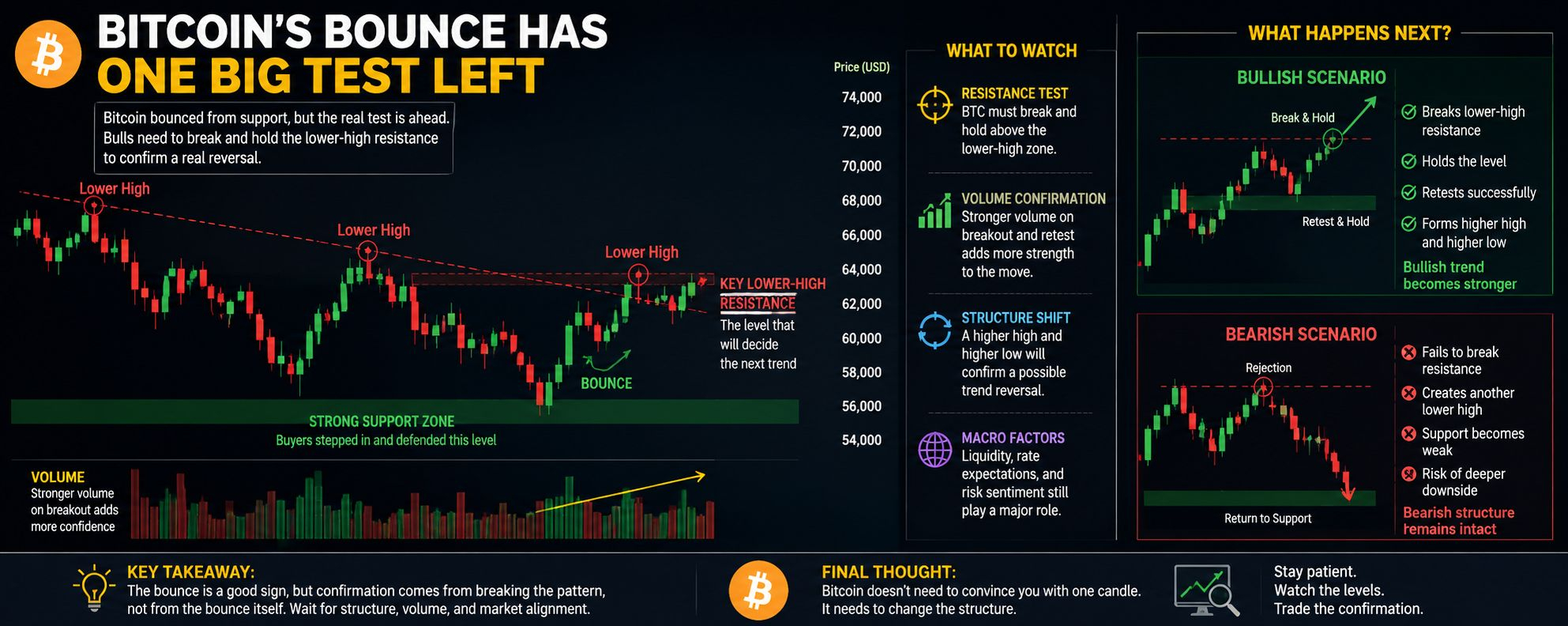

Bitcoin rebotó desde el soporte, pero aún no estoy convencido de que los vendedores hayan perdido el control.
Eso no significa que esté garantizado otro crash. Solo significa que el mercado todavía no ha dado a los alcistas suficiente evidencia como para llamar a esto una reversión real.
El rebote fue importante. Pero lo que suceda después podría ser incluso más importante.
Porque después de un mercado débil, el primer rebote a menudo crea la mayor confusión. Los traders ven velas verdes, el miedo empieza a desaparecer y, de repente, todo el mundo empieza a hablar sobre el próximo rally.
Prefiero esperar a que Bitcoin lo demuestre.
LA PRÓXIMA RESISTENCIA IMPORTA MÁS QUE EL ÚLTIMO REBOTE
Ahora mismo, me interesa menos hasta qué punto rebotó Bitcoin desde el soporte y más en dónde ese rebote se rechaza.
Bitcoin ha estado creando máximos más bajos, y eso sigue siendo el mayor problema para los alcistas.
Una reversión saludable necesita más que una sola vela fuerte.
Necesita un cambio en el comportamiento.
Si BTC sube pero no logra superar el máximo del swing anterior, podríamos simplemente obtener otro máximo más bajo. Eso mantendría viva la misma estructura:
Soporte → rebote → rechazo → máximo más bajo → prueba del soporte.
Y si ese ciclo continúa, la zona de soporte se vuelve cada vez más vulnerable.
Por eso no quiero perseguir el primer movimiento verde.
EL MERCADO NECESITA MOSTRAR FUERZA REAL DE COMPRA
Para mí, el escenario alcista empieza a volverse mucho más fuerte cuando Bitcoin puede recuperar la importante zona de máximos más bajos y realmente mantenerse por encima de ella.
Esa distinción importa.
Un movimiento rápido por encima de la resistencia seguido de un rechazo inmediato puede convertirse fácilmente en una falsa ruptura.
Pero si BTC rompe al alza, mantiene el nivel, lo vuelve a probar y los compradores defienden esa zona nuevamente, la historia cambia.
Ahora ya no estamos mirando un simple rebote.
Estamos observando una posible reversión estructural.
Esa es la clase de confirmación que quiero.
EL VOLUMEN PUEDE SEPARAR UN MOVIMIENTO REAL DE UNA TRAMPA
El precio nos dice qué está haciendo Bitcoin.
El volumen puede darnos una mejor idea de cuánta participación hay detrás de ese movimiento.
Una ruptura con participación débil merece cautela.
Una ruptura respaldada por un volumen más fuerte, seguida de una retest exitosa, tiene mucho más peso.
No estoy diciendo que el volumen tenga que explotar en cada vela verde.
Digo que cuanto más grande sea la ruptura estructural, más convincente debería ser la participación.
De lo contrario, Bitcoin podría simplemente estar avanzando a través de la liquidez antes de revertir.
LA MACRO AÚN TIENE LA PALABRA
El gráfico de Bitcoin no existe en el vacío.
Las expectativas de tasas, los datos de inflación, las condiciones de liquidez, los flujos institucionales y el apetito general por el riesgo pueden cambiar rápidamente la forma en que los traders reaccionan a niveles técnicos.
Por eso mantengo ambos lados abiertos.
Si mejoran las condiciones macro mientras BTC rompe su estructura de máximos más bajos, el escenario alcista se vuelve mucho más convincente.
Si la liquidez se mantiene ajustada y Bitcoin sigue siendo rechazado en resistencia, otro movimiento a la baja se vuelve más fácil de entender.
El gráfico nos da la estructura.
El entorno más amplio del mercado ayuda a determinar cuánta gasolina tiene esa estructura.
¿QUÉ CAMBIARÍA MI PENSAMIENTO?
Esta es la parte más importante.
No me interesa ser bajista solo por el hecho de serlo.
Si Bitcoin rompe la importante estructura de máximos más bajos, se mantiene por encima, convierte la resistencia en soporte y luego forma un mínimo más alto, yo lo tomaría en serio.
En ese punto, el mercado finalmente mostraría un patrón diferente.
En lugar de:
Máximo más bajo → rechazo
podríamos empezar a ver:
Máximo más alto → mínimo más alto → continuación.
Ese es el cambio que estoy esperando.
Hasta entonces, trato los repuntes como oportunidades para observar, no como razones para ponerse emocional.
Bitcoin no necesita convencerme con una sola vela verde.
Necesita cambiar la estructura.
Y cuando ocurra, prefiero seguir esa confirmación en lugar de intentar predecirla de antemano.
Puede que el próximo gran movimiento ya se esté formando. La pregunta es si Bitcoin rompe el patrón antiguo o lo repite una vez más.