

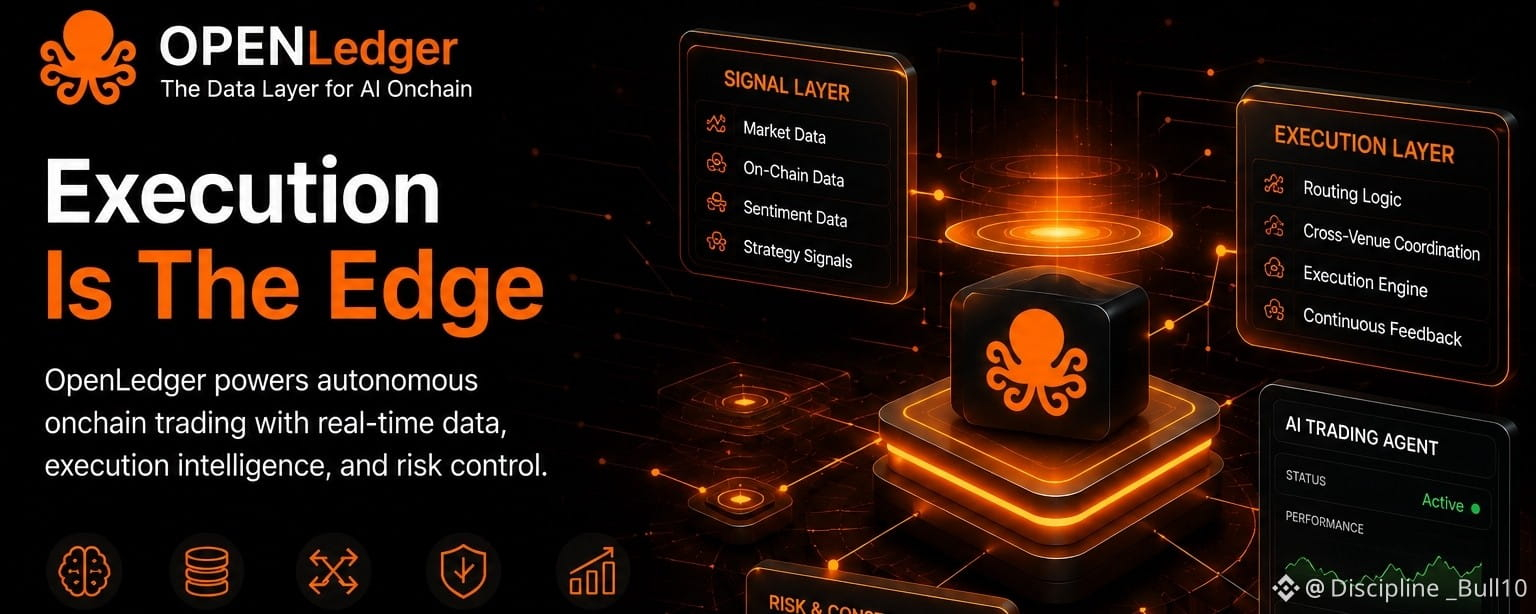

The crypto industry is evolving rapidly, and one of the biggest trends shaping the future is the combination of artificial intelligence and decentralized finance. Every day we hear discussions about AI trading bots, prediction models, automated strategies, and intelligent agents that can analyze the market faster than humans. However, I believe many people are still focusing on only one side of the problem — prediction.
Prediction alone is not enough.
In real onchain markets, execution is what truly matters. An AI model may generate the perfect trading signal, but if execution is slow, fragmented, or poorly coordinated, the opportunity can disappear within seconds. Slippage, latency, liquidity fragmentation, and risk exposure are major challenges in decentralized trading environments. This is exactly why I think OpenLedger is building something important.
@OpenLedgerHQ appears to be focused on creating the infrastructure layer that autonomous trading systems actually need to operate effectively in real-world onchain environments. Instead of focusing purely on hype or speculative narratives, the project is targeting a real infrastructure problem that continues to grow as blockchain ecosystems become more complex.
One of the most interesting aspects of OpenLedger is its multi-layered approach.
The platform emphasizes real-time signal ingestion from different data sources. Modern AI systems require massive amounts of information, including market trends, onchain activity, liquidity changes, wallet movements, and sentiment analysis. OpenLedger aims to structure and deliver this data efficiently so autonomous agents can react faster and make smarter decisions.
Another major focus is execution coordination. Crypto liquidity is fragmented across multiple chains, decentralized exchanges, and trading venues. This creates inefficiencies for automated systems. OpenLedger’s infrastructure appears designed to improve routing logic, cross-venue coordination, and execution optimization, which are essential for advanced onchain trading systems.
Risk management is another area where OpenLedger stands out. Many AI trading discussions focus only on maximizing returns, but sustainable systems require strong controls. Exposure limits, stop-loss guardrails, position management, and continuous monitoring are critical for autonomous trading. Without proper constraints, even intelligent systems can fail in volatile conditions.
What makes the project even more interesting to me is the concept of continuous feedback and learning. The future of AI trading will likely involve systems that constantly adapt based on performance outcomes. Successful executions, failed trades, slippage patterns, and market reactions can all become learning inputs for future optimization. OpenLedger seems aligned with this vision of adaptive, self-improving onchain intelligence.
I also think the timing is perfect. AI and blockchain are converging faster than ever before. The market is moving toward agentic systems capable of operating autonomously across decentralized environments. Projects that build the foundational infrastructure for these systems may become extremely valuable in the long run.
In my opinion, OpenLedger is not simply trying to participate in the AI narrative. It is attempting to build the operational backbone for the next generation of decentralized autonomous trading systems.
If the future of crypto becomes increasingly automated, then execution quality, risk management, and intelligent coordination will become just as important as prediction itself. That is why OpenLedger has captured my attention, and why I believe it could play a significant role in the future of AI-powered onchain finance.#OpenLedger @OpenLedger (https://www.binance.com/en/square/profile/openledger)