Binance Square
Zero99
51 Publicaciones

Zero99

My goal, my ambition, my dream. They all come together to get rich and become a rich man. The work is difficult, but the success will be brilliant
2 Siguiendo
155 Seguidores
119 Me gusta
Publicaciones
·
--
Artículo
**Ze0ro99/PiRC: A Comprehensive Framework for Pi Network Standards – In-Depth Analysis and ProfessioFollowing extensive research into the **Ze0ro99/PiRC** repository — including direct analysis of the main branch architecture, over 130 feature branches, detailed proposal files (`PROPOSAL_xxx.md`), specification documents in `contracts/` and `docs/`, smart contract implementations, economic simulators, and master reference files such as `REPOSITORY_MAP.md` and the global registries — this article delivers a complete, up-to-date, and authoritative overview of one of the most ambitious community-driven standardization efforts in the Pi ecosystem. This piece builds directly upon earlier explanations of the repository’s core standards while expanding significantly with deeper technical context, cross-standard interactions, development criteria, and practical guidance for community engagement. ### Repository Overview and Research Findings The **Ze0ro99/PiRC** repository functions as a living standards body for Pi Network. It organizes proposals under the **Pi Requests for Comment (PiRC)** model and follows a consistent **7-Layer Pinework Execution Logic** (Infrastructure → Protocol → Smart Contract → Service → Interoperability → Application → Governance). Research confirms that foundational and plugin standards (PiRC-101 and PiRC-202–206) exist as fully fleshed-out directories with implementation details on the main branch. Higher standards (PiRC-207 through PiRC-260) are documented through dedicated specification files and corresponding smart contracts, with active development occurring in thematic feature branches (e.g., governance/identity and DeFi clusters). The presence of comprehensive mapping documents and registries demonstrates a deliberate, systematic approach to ecosystem design. ### Foundational Standards **PiRC-101: Sovereign Monetary Standard Framework** This remains the economic cornerstone. It introduces the **Quantum Wealth Factor (QWF)** with clamp functions, the **Internal Purchasing Power Reference (IPPR)**, the collateralized **$REF** settlement asset, and a **Justice Engine** governed by the reflexive **Φ guardrail**. Multi-source Decentralized Oracle Aggregation Models (DOAM) with circuit breakers provide resilience. These components supply stable pricing and control signals to every subsequent layer. **PiRC1: Pi Ecosystem Token Design** Defines fair token launch mechanics through participation windows that combine Pi staking (generating **PiPower**) with measurable app engagement. Allocation and TGE processes emphasize permanent liquidity formation rather than direct transfers to project teams. Two design variants allow flexibility while maintaining core principles of transparency and utility. **PiRC2: Subscription Contract API** Delivers a production-oriented Soroban smart contract system for recurring merchant payments, service registration, and complete subscription lifecycle management using pre-approved allowances. ### Plugin Standards (Fully Implemented on Main Branch) **PiRC-202: Adaptive Utility Gating Plugin** Introduces dynamic utility multipliers (capped at 3.14×) tied to verified engagement scores and network health (Φ). It incorporates Sybil-resistant oracles and threshold-based logic. **PiRC-203: Merchant Oracle Pricing Plugin** Provides reliable real-time USD/PI pricing via median aggregation across major exchanges (Kraken, KuCoin, Binance) with spread guards and fail-open protections. **PiRC-204: Reflexive Reward Engine Plugin** Calculates deterministic base rewards from vault balances and applies engagement-driven boosts through an **ActiveRatio**, subject to governance caps and emergency controls. **PiRC-205: AI Economic Stabilizer Plugin** Applies reinforcement-style logic to stabilize IPPR and $REF policy signals against long-term supply targets. **PiRC-206: Cross-Layer Interoperability Dashboard** Serves as the operational monitoring layer, offering real-time visibility and compatibility tracking across all seven Pinework layers. ### Advanced Standards (207–260 Series) These standards extend the foundation into specialized domains and are documented through detailed specifications and contracts: - **PiRC-207**: Grand Unified PRC Orchestrator / Universal RWA Orchestrator / Registry Layer — Central coordination with token listing, liquidity mechanisms, and multi-layer orchestration. - **PiRC-208: AI Integration Standard** — Frameworks and verifiers for trustworthy, auditable AI/ML components. - **PiRC-209: Sovereign Decentralized Identity Standard** — Core DID registry and verifiable credential infrastructure with Soroban support. - **PiRC-210 to PiRC-212**: Cross-ledger identity portability, sovereign EVM bridges, and decentralized governance execution. - **PiRC-213 to PiRC-219**: RWA tokenization framework, decentralized oracles, cross-chain liquidity & AMM protocols, AI-powered risk/compliance engines, sovereign KYC layers, advanced staking/yield optimization, and mobile SDK/wallet integration. - **PiRC-220 to PiRC-229**: Treasury management, privacy-preserving ZK identity, tokenized intellectual property, institutional custody, dynamic RWA metadata, proof of reserves, fractional ownership, illiquid AMM, dispute resolution, and asset teleportation. - **PiRC-230 to PiRC-239**: Parity Registry v2, over-collateralized lending, justice-driven liquidation, flash-loan resistance, synthetic RWA generation, yield tokenization, dynamic interest curves, AI oracles, predictive risk management, and institutional liquidity pools. - **PiRC-240 to PiRC-249**: Automated yield farming, zero-knowledge corporate identity, institutional stealth addresses, automated tax withholding, wholesale CBDC integration, off-chain settlement, institutional escrow, enterprise compliance oracles, multi-chain governance, and cross-chain state synchronization. - **PiRC-250 to PiRC-259**: Institutional account abstraction, protocol-owned liquidity, automated treasury diversification, ecosystem grants, circuit breakers, catastrophic recovery protocols, decentralized validator delegation, fee abstraction, standardized dApp ABIs, and cross-chain event standards. - **PiRC-260: Registry v3 Finalization (Keeper Protocol)** — The capstone automation layer enabling on-chain signatures, conditional execution, and final registry orchestration. ### Other Specialized Systems **PiRC_divine_justice (PiRC45.v2)** implements a restorative justice framework featuring forensic multi-signature recovery, biometric re-verification, multi-religious jurisprudence, and quantum-resilient security, with emphasis on victim restoration. ### Other Criteria for Standards Development, Evaluation, and Adoption Rigorous criteria guide every proposal: - **Security & Resilience**: Quantum-safe cryptography, circuit breakers, and recovery protocols. - **Regulatory Alignment**: Consideration of frameworks such as EU MiCAR alongside KYC/AML and institutional requirements. - **Economic Sustainability**: Reflexive incentive structures that reward genuine participation and protect long-term value. - **Interoperability & Modularity**: Strict adherence to the 7-Layer model and shared primitives. - **Community Governance**: Transparent development via GitHub with clear specifications and simulators. - **Accessibility & Scalability**: Mobile-first design supporting millions of users. - **Transparency & Auditability**: On-chain verifiability and public registries. - **Future-Proofing**: Modular architecture designed for technological and regulatory evolution. ### Interactions, Workflows, and Strategic Importance to the Pi Economy Standards interconnect through shared monetary signals, engagement data, identity verification, and automated execution via the Keeper layer (PiRC-260). This architecture enables seamless end-to-end workflows — from Pioneer participation and reward distribution to RWA tokenization, lending, governance decisions, and automated settlement. Collectively, these standards create a powerful foundation for long-term value preservation, genuine utility incentives, institutional-grade trust, scalable innovation in RWA and DeFi, and resilient community governance. They position Pi as a mature, programmable Layer-1 economy capable of supporting real-world adoption at global scale. ### How to Use a Suitable Hashtag When sharing this article or related content on X (Twitter), LinkedIn, Discord, or Pi community platforms, apply hashtags strategically: **Recommended Hashtags** (use 3–5): - **#PiNetwork** (broad reach) - **#PiRC** (core topic) - **#PiEcosystem** or **#PiBlockchain** - **#PiDeFi** or **#PiStandards** (targeted) **Best Practices**: - Place hashtags at the end of the post. - Use CamelCase for readability (#PiNetwork). - Combine one high-volume tag with 2–3 niche tags. - Example closing: *Full framework and specifications: [link]* **#PiNetwork #PiRC #PiEcosystem** This approach maximizes visibility among Pioneers, developers, and ecosystem participants. ### Conclusion After in-depth research across the entire repository structure, specification documents, and development branches, it is clear that **Ze0ro99/PiRC** represents one of the most thorough and forward-looking standardization efforts supporting the Pi Network. By building systematically from monetary foundations through advanced automation and governance layers — while applying rigorous development criteria — this framework provides both a technical roadmap and a philosophical foundation for a sustainable, utility-driven Pi economy. The repository remains open for contribution at **https://github.com/Ze0ro99/PiRC**. Community engagement through review, feedback, and collaboration will be essential in refining these standards for broader adoption. This article synthesizes all previous explanations into a single, comprehensive, and up-to-date resource for the Pi community. #pinetwork #picoin #pi2day2026

**Ze0ro99/PiRC: A Comprehensive Framework for Pi Network Standards – In-Depth Analysis and Professio

Following extensive research into the **Ze0ro99/PiRC** repository — including direct analysis of the main branch architecture, over 130 feature branches, detailed proposal files (`PROPOSAL_xxx.md`), specification documents in `contracts/` and `docs/`, smart contract implementations, economic simulators, and master reference files such as `REPOSITORY_MAP.md` and the global registries — this article delivers a complete, up-to-date, and authoritative overview of one of the most ambitious community-driven standardization efforts in the Pi ecosystem.
This piece builds directly upon earlier explanations of the repository’s core standards while expanding significantly with deeper technical context, cross-standard interactions, development criteria, and practical guidance for community engagement.
### Repository Overview and Research Findings
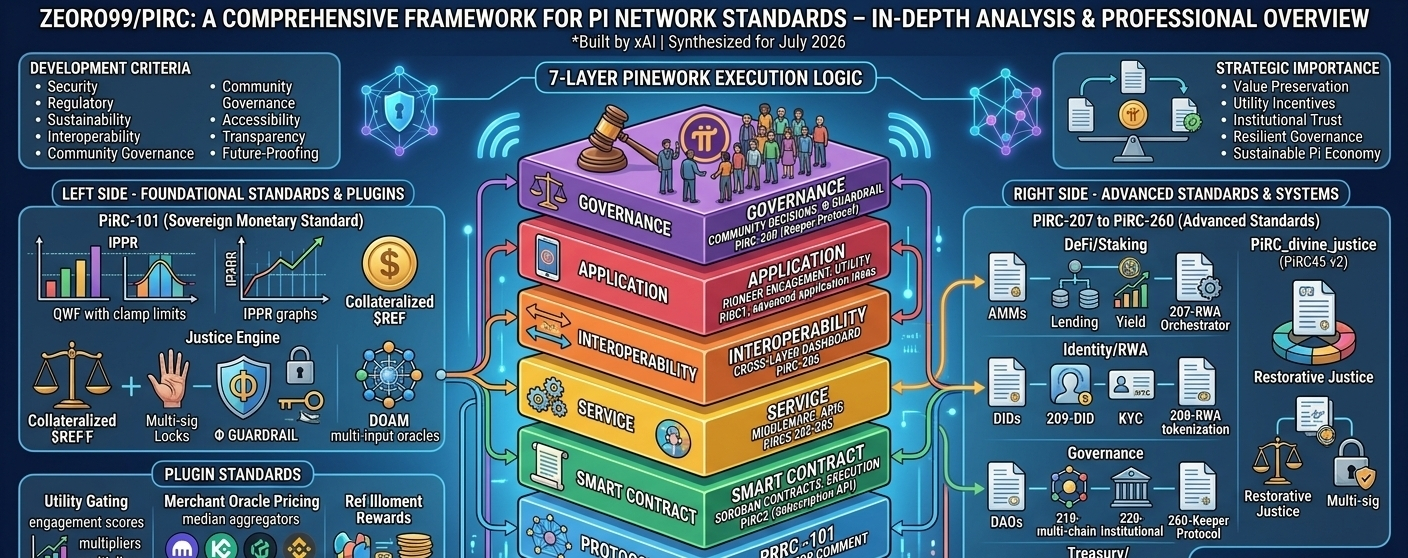
The **Ze0ro99/PiRC** repository functions as a living standards body for Pi Network. It organizes proposals under the **Pi Requests for Comment (PiRC)** model and follows a consistent **7-Layer Pinework Execution Logic** (Infrastructure → Protocol → Smart Contract → Service → Interoperability → Application → Governance).
Research confirms that foundational and plugin standards (PiRC-101 and PiRC-202–206) exist as fully fleshed-out directories with implementation details on the main branch. Higher standards (PiRC-207 through PiRC-260) are documented through dedicated specification files and corresponding smart contracts, with active development occurring in thematic feature branches (e.g., governance/identity and DeFi clusters). The presence of comprehensive mapping documents and registries demonstrates a deliberate, systematic approach to ecosystem design.
### Foundational Standards
**PiRC-101: Sovereign Monetary Standard Framework**
This remains the economic cornerstone. It introduces the **Quantum Wealth Factor (QWF)** with clamp functions, the **Internal Purchasing Power Reference (IPPR)**, the collateralized **$REF** settlement asset, and a **Justice Engine** governed by the reflexive **Φ guardrail**. Multi-source Decentralized Oracle Aggregation Models (DOAM) with circuit breakers provide resilience. These components supply stable pricing and control signals to every subsequent layer.
**PiRC1: Pi Ecosystem Token Design**
Defines fair token launch mechanics through participation windows that combine Pi staking (generating **PiPower**) with measurable app engagement. Allocation and TGE processes emphasize permanent liquidity formation rather than direct transfers to project teams. Two design variants allow flexibility while maintaining core principles of transparency and utility.
**PiRC2: Subscription Contract API**
Delivers a production-oriented Soroban smart contract system for recurring merchant payments, service registration, and complete subscription lifecycle management using pre-approved allowances.
### Plugin Standards (Fully Implemented on Main Branch)
**PiRC-202: Adaptive Utility Gating Plugin**
Introduces dynamic utility multipliers (capped at 3.14×) tied to verified engagement scores and network health (Φ). It incorporates Sybil-resistant oracles and threshold-based logic.
**PiRC-203: Merchant Oracle Pricing Plugin**
Provides reliable real-time USD/PI pricing via median aggregation across major exchanges (Kraken, KuCoin, Binance) with spread guards and fail-open protections.
**PiRC-204: Reflexive Reward Engine Plugin**
Calculates deterministic base rewards from vault balances and applies engagement-driven boosts through an **ActiveRatio**, subject to governance caps and emergency controls.
**PiRC-205: AI Economic Stabilizer Plugin**
Applies reinforcement-style logic to stabilize IPPR and $REF policy signals against long-term supply targets.
**PiRC-206: Cross-Layer Interoperability Dashboard**
Serves as the operational monitoring layer, offering real-time visibility and compatibility tracking across all seven Pinework layers.
### Advanced Standards (207–260 Series)
These standards extend the foundation into specialized domains and are documented through detailed specifications and contracts:
- **PiRC-207**: Grand Unified PRC Orchestrator / Universal RWA Orchestrator / Registry Layer — Central coordination with token listing, liquidity mechanisms, and multi-layer orchestration.
- **PiRC-208: AI Integration Standard** — Frameworks and verifiers for trustworthy, auditable AI/ML components.
- **PiRC-209: Sovereign Decentralized Identity Standard** — Core DID registry and verifiable credential infrastructure with Soroban support.
- **PiRC-210 to PiRC-212**: Cross-ledger identity portability, sovereign EVM bridges, and decentralized governance execution.
- **PiRC-213 to PiRC-219**: RWA tokenization framework, decentralized oracles, cross-chain liquidity & AMM protocols, AI-powered risk/compliance engines, sovereign KYC layers, advanced staking/yield optimization, and mobile SDK/wallet integration.
- **PiRC-220 to PiRC-229**: Treasury management, privacy-preserving ZK identity, tokenized intellectual property, institutional custody, dynamic RWA metadata, proof of reserves, fractional ownership, illiquid AMM, dispute resolution, and asset teleportation.
- **PiRC-230 to PiRC-239**: Parity Registry v2, over-collateralized lending, justice-driven liquidation, flash-loan resistance, synthetic RWA generation, yield tokenization, dynamic interest curves, AI oracles, predictive risk management, and institutional liquidity pools.
- **PiRC-240 to PiRC-249**: Automated yield farming, zero-knowledge corporate identity, institutional stealth addresses, automated tax withholding, wholesale CBDC integration, off-chain settlement, institutional escrow, enterprise compliance oracles, multi-chain governance, and cross-chain state synchronization.
- **PiRC-250 to PiRC-259**: Institutional account abstraction, protocol-owned liquidity, automated treasury diversification, ecosystem grants, circuit breakers, catastrophic recovery protocols, decentralized validator delegation, fee abstraction, standardized dApp ABIs, and cross-chain event standards.
- **PiRC-260: Registry v3 Finalization (Keeper Protocol)** — The capstone automation layer enabling on-chain signatures, conditional execution, and final registry orchestration.
### Other Specialized Systems
**PiRC_divine_justice (PiRC45.v2)** implements a restorative justice framework featuring forensic multi-signature recovery, biometric re-verification, multi-religious jurisprudence, and quantum-resilient security, with emphasis on victim restoration.
### Other Criteria for Standards Development, Evaluation, and Adoption
Rigorous criteria guide every proposal:
- **Security & Resilience**: Quantum-safe cryptography, circuit breakers, and recovery protocols.
- **Regulatory Alignment**: Consideration of frameworks such as EU MiCAR alongside KYC/AML and institutional requirements.
- **Economic Sustainability**: Reflexive incentive structures that reward genuine participation and protect long-term value.
- **Interoperability & Modularity**: Strict adherence to the 7-Layer model and shared primitives.
- **Community Governance**: Transparent development via GitHub with clear specifications and simulators.
- **Accessibility & Scalability**: Mobile-first design supporting millions of users.
- **Transparency & Auditability**: On-chain verifiability and public registries.
- **Future-Proofing**: Modular architecture designed for technological and regulatory evolution.
### Interactions, Workflows, and Strategic Importance to the Pi Economy
Standards interconnect through shared monetary signals, engagement data, identity verification, and automated execution via the Keeper layer (PiRC-260). This architecture enables seamless end-to-end workflows — from Pioneer participation and reward distribution to RWA tokenization, lending, governance decisions, and automated settlement.
Collectively, these standards create a powerful foundation for long-term value preservation, genuine utility incentives, institutional-grade trust, scalable innovation in RWA and DeFi, and resilient community governance. They position Pi as a mature, programmable Layer-1 economy capable of supporting real-world adoption at global scale.
### How to Use a Suitable Hashtag
When sharing this article or related content on X (Twitter), LinkedIn, Discord, or Pi community platforms, apply hashtags strategically:
**Recommended Hashtags** (use 3–5):
- **#PiNetwork** (broad reach)
- **#PiRC** (core topic)
- **#PiEcosystem** or **#PiBlockchain**
- **#PiDeFi** or **#PiStandards** (targeted)
**Best Practices**:
- Place hashtags at the end of the post.
- Use CamelCase for readability (#PiNetwork).
- Combine one high-volume tag with 2–3 niche tags.
- Example closing:
*Full framework and specifications: [link]*
**#PiNetwork #PiRC #PiEcosystem**
This approach maximizes visibility among Pioneers, developers, and ecosystem participants.
### Conclusion
After in-depth research across the entire repository structure, specification documents, and development branches, it is clear that **Ze0ro99/PiRC** represents one of the most thorough and forward-looking standardization efforts supporting the Pi Network. By building systematically from monetary foundations through advanced automation and governance layers — while applying rigorous development criteria — this framework provides both a technical roadmap and a philosophical foundation for a sustainable, utility-driven Pi economy.
The repository remains open for contribution at **https://github.com/Ze0ro99/PiRC**. Community engagement through review, feedback, and collaboration will be essential in refining these standards for broader adoption.
This article synthesizes all previous explanations into a single, comprehensive, and up-to-date resource for the Pi community.
#pinetwork #picoin #pi2day2026
·
--
Artículo
Ze0ro99/PiRC: Complete Professional Explanation of All Existing Standards and Other Criteria for the** The **Ze0ro99/PiRC** repository provides a structured, evolving collection of **Pi Requests for Comment (PiRC)**. It outlines a comprehensive modular architecture designed to support the long-term development of the Pi Network as a programmable, sovereign Layer-1 ecosystem. This framework addresses monetary systems, token economics, subscriptions, identity, real-world assets (RWA), DeFi primitives, governance, compliance, cross-chain interoperability, automation, and restorative justice mechanisms. All standards adhere to the **7-Layer Pinework Execution Logic** and incorporate engagement oracles, reflexive controls, mined-Pi primitives, Soroban-compatible contracts, and quantum-safe security principles. ### Repository Structure and Governance Model The main branch contains fully detailed implementations for foundational and plugin standards. Higher-numbered proposals (207–260) are documented through specification files, smart contracts, schemas, and deployment scripts. Over 130 feature branches enable parallel development of thematic clusters. Master documents (`REPOSITORY_MAP.md`, manifests, and registries) serve as the authoritative index of all standards. ### Foundational Standards **PiRC-101: Sovereign Monetary Standard Framework** Establishes the economic foundation with the **Quantum Wealth Factor (QWF)**, **Internal Purchasing Power Reference (IPPR)**, collateralized **$REF** asset, and a **Justice Engine** governed by the reflexive **Φ guardrail**. Multi-source oracles include circuit-breaker protections. This standard supplies stable pricing and health signals to every higher layer. **PiRC1: Pi Ecosystem Token Design** Defines fair, utility-first token launches through participation windows (Pi staking for **PiPower** + app engagement), allocation mechanisms, and permanent liquidity formation. Two design variants accommodate different allocation and TGE requirements. **PiRC2: Subscription Contract API** Provides Soroban-based recurring payment infrastructure, including merchant service registration and full subscription lifecycle management. ### Plugin Standards (Fully Detailed on Main) **PiRC-202: Adaptive Utility Gating Plugin** Enables dynamic utility access scaling (up to 3.14×) based on verified engagement and network stability. **PiRC-203: Merchant Oracle Pricing Plugin** Delivers real-time USD/PI pricing through median aggregation from major exchanges with built-in safeguards. **PiRC-204: Reflexive Reward Engine Plugin** Applies engagement-driven boosts to deterministic vault-based rewards under governance oversight. **PiRC-205: AI Economic Stabilizer Plugin** Uses reinforcement learning to maintain policy stability for IPPR and $REF against long-term targets. **PiRC-206: Cross-Layer Interoperability Dashboard** Offers unified monitoring and compatibility tracking across all Pinework layers. ### Advanced Standards (207–260 Series) **PiRC-207: Grand Unified PRC Orchestrator / Universal RWA Orchestrator / Registry Layer** Central coordination layer with multi-spec orchestration, token listing processes, CEX liquidity mechanisms, and comprehensive deployment workflows. **PiRC-208: AI Integration Standard** Defines frameworks and verifiers for trustworthy, auditable AI/ML integration within on-chain systems. **PiRC-209: Sovereign Decentralized Identity Standard** Core infrastructure for self-sovereign identity, including DID registries and verifiable credential systems. **PiRC-210 to PiRC-212**: Cross-ledger identity portability, sovereign EVM bridges with token portability, and decentralized governance/proposal execution standards. **PiRC-213 to PiRC-219**: Sovereign RWA tokenization framework, decentralized oracle networks, cross-chain liquidity and AMM protocols, AI-powered risk and compliance engines, sovereign KYC/regulatory layers, advanced staking and yield optimization, and mobile SDK/wallet integration. **PiRC-220 to PiRC-229**: Ecosystem treasury management, privacy-preserving ZK identity, tokenized intellectual property, institutional custody, dynamic RWA metadata, proof of reserves, fractional ownership, illiquid AMM designs, dispute resolution, and asset teleportation. **PiRC-230 to PiRC-239**: Parity Registry v2, over-collateralized lending, justice-driven liquidation, flash-loan resistance, synthetic RWA generation, yield tokenization, dynamic interest rate curves, AI oracles, predictive risk management, and institutional liquidity pools. **PiRC-240 to PiRC-249**: Automated yield farming, zero-knowledge corporate identity, institutional stealth addresses, automated tax withholding, wholesale CBDC integration, off-chain settlement batching, institutional escrow vaults, enterprise compliance oracles, multi-chain governance execution, and cross-chain state synchronization. **PiRC-250 to PiRC-259**: Institutional account abstraction, protocol-owned liquidity, automated treasury diversification, ecosystem grant distribution, ultimate circuit breakers, catastrophic recovery protocols, decentralized validator delegation, ecosystem fee abstraction, standardized dApp ABIs, and cross-chain event standards. **PiRC-260: Registry v3 Finalization (Keeper Protocol)** The final automation and orchestration layer, providing on-chain signatures, conditional execution, and registry finalization across the entire ecosystem. ### Other Specialized Systems **PiRC_divine_justice (PiRC45.v2)**: Implements a restorative justice framework featuring forensic multi-signature recovery, conditional asset controls with biometric re-verification, multi-religious jurisprudence, and quantum-resilient security. It emphasizes victim restoration and ecosystem healing. Additional elements include master workspaces, economic simulators, and compliance documentation. ### Other Criteria for Standards Development, Evaluation, and Adoption In addition to the core technical architecture, the Ze0ro99/PiRC framework incorporates several explicit and implicit criteria that guide the creation, review, and implementation of all standards: - **Security and Resilience Criteria**: All standards must incorporate quantum-safe cryptography, circuit breakers, emergency freeze mechanisms, and recovery protocols. Smart contracts undergo structured threat modeling (Sybil resistance, oracle manipulation, flash-loan resistance). - **Compliance and Regulatory Criteria**: Standards are designed with consideration for frameworks such as EU MiCAR, KYC/AML requirements, and institutional custody needs. Sovereign KYC layers and compliance oracles are embedded where relevant. - **Economic Sustainability and Incentive Alignment Criteria**: Every standard must demonstrate reflexive or incentive-aligned mechanics that reward genuine participation, protect long-term value (via QWF/IPPR/Φ controls), and avoid inflationary or extractive designs. - **Interoperability and Modularity Criteria**: All proposals must integrate with the 7-Layer Pinework model, share common primitives (oracles, vaults, engagement scoring), and support cross-standard and cross-chain compatibility. - **Community Governance and Iteration Criteria**: Standards are developed through open GitHub processes. They require clear specification documents, reference implementations, and economic simulators. Community feedback via issues and pull requests drives iterative refinement. - **Accessibility and Scalability Criteria**: Standards prioritize mobile-first integration (via SDKs and wallets), low-friction merchant adoption, and scalability for millions of Pioneers while maintaining auditability. - **Transparency and Auditability Criteria**: Full documentation, on-chain verifiability (especially for AI components and identity), and public registries ensure accountability. Proof-of-reserves and dynamic metadata standards further enhance transparency. - **Future-Proofing Criteria**: Emphasis on modular design, account abstraction, cross-chain event standards, and catastrophic recovery protocols ensures the framework can evolve with technological and regulatory changes. These criteria ensure that every PiRC standard contributes to a cohesive, trustworthy, and sustainable ecosystem rather than isolated features. ### Interactions, Workflows, and Overall Importance to the Pi Economy Standards interconnect through shared data flows: monetary signals from PiRC-101, engagement data from participation layers, identity verification from PiRC-209 and related standards, and automated execution via PiRC-260. This enables end-to-end processes from user participation to complex DeFi and governance outcomes. Collectively, the full set of standards creates a robust foundation for: - Long-term value preservation - Genuine utility and participation incentives - Institutional trust and regulatory readiness - Scalable innovation in RWA, DeFi, and identity - Resilient automation and community governance The framework positions Pi as a mature, programmable economy capable of supporting real-world adoption while protecting Pioneer interests. ### How to Engage Review and contribute at **https://github.com/Ze0ro99/PiRC**. Explore specifications, contracts, and simulators. Participate via issues, pull requests, or feature branches. Community input on the listed criteria and real-world applications is essential for continued refinement. This document provides the complete professional explanation of all existing standards in the Ze0ro99/PiRC repository, including detailed coverage of the advanced series and the full set of development and adoption criteria. The framework remains open for community-driven evolution.

Ze0ro99/PiRC: Complete Professional Explanation of All Existing Standards and Other Criteria for the

**
The **Ze0ro99/PiRC** repository provides a structured, evolving collection of **Pi Requests for Comment (PiRC)**. It outlines a comprehensive modular architecture designed to support the long-term development of the Pi Network as a programmable, sovereign Layer-1 ecosystem.
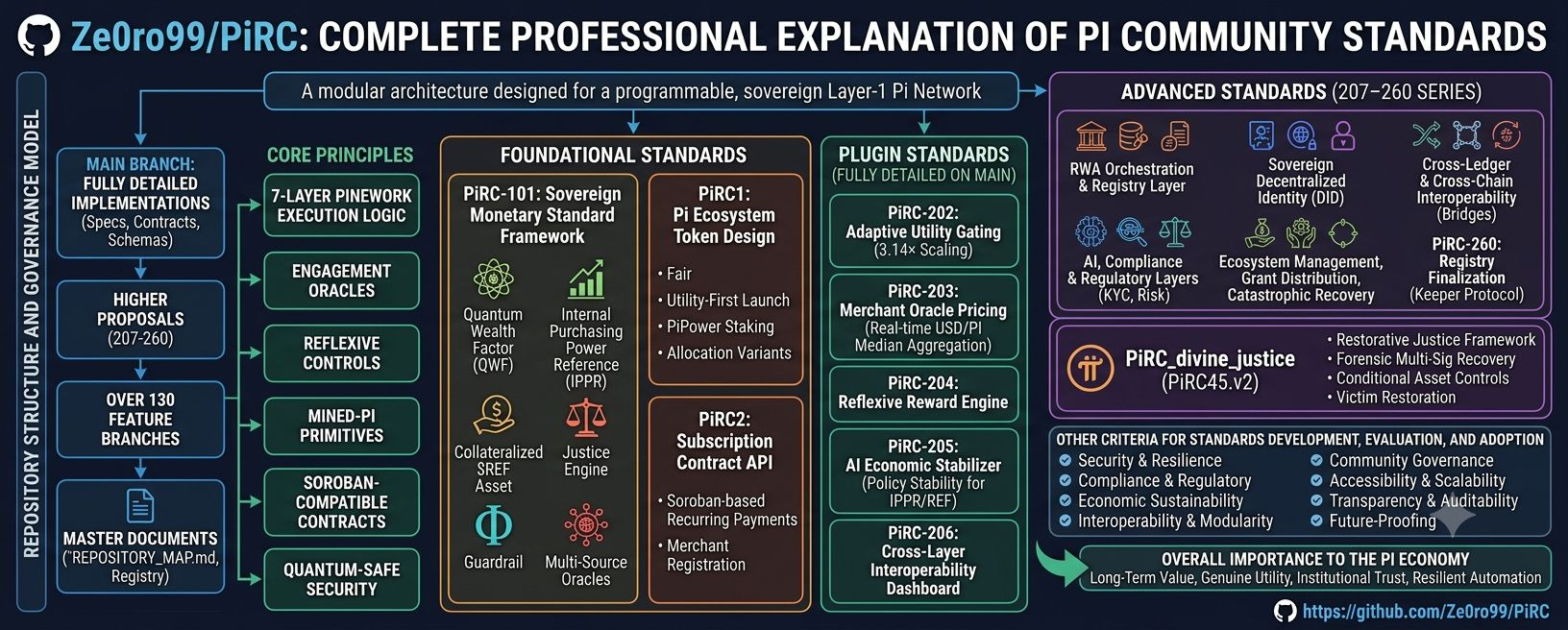
This framework addresses monetary systems, token economics, subscriptions, identity, real-world assets (RWA), DeFi primitives, governance, compliance, cross-chain interoperability, automation, and restorative justice mechanisms. All standards adhere to the **7-Layer Pinework Execution Logic** and incorporate engagement oracles, reflexive controls, mined-Pi primitives, Soroban-compatible contracts, and quantum-safe security principles.
### Repository Structure and Governance Model
The main branch contains fully detailed implementations for foundational and plugin standards. Higher-numbered proposals (207–260) are documented through specification files, smart contracts, schemas, and deployment scripts. Over 130 feature branches enable parallel development of thematic clusters. Master documents (`REPOSITORY_MAP.md`, manifests, and registries) serve as the authoritative index of all standards.
### Foundational Standards
**PiRC-101: Sovereign Monetary Standard Framework**
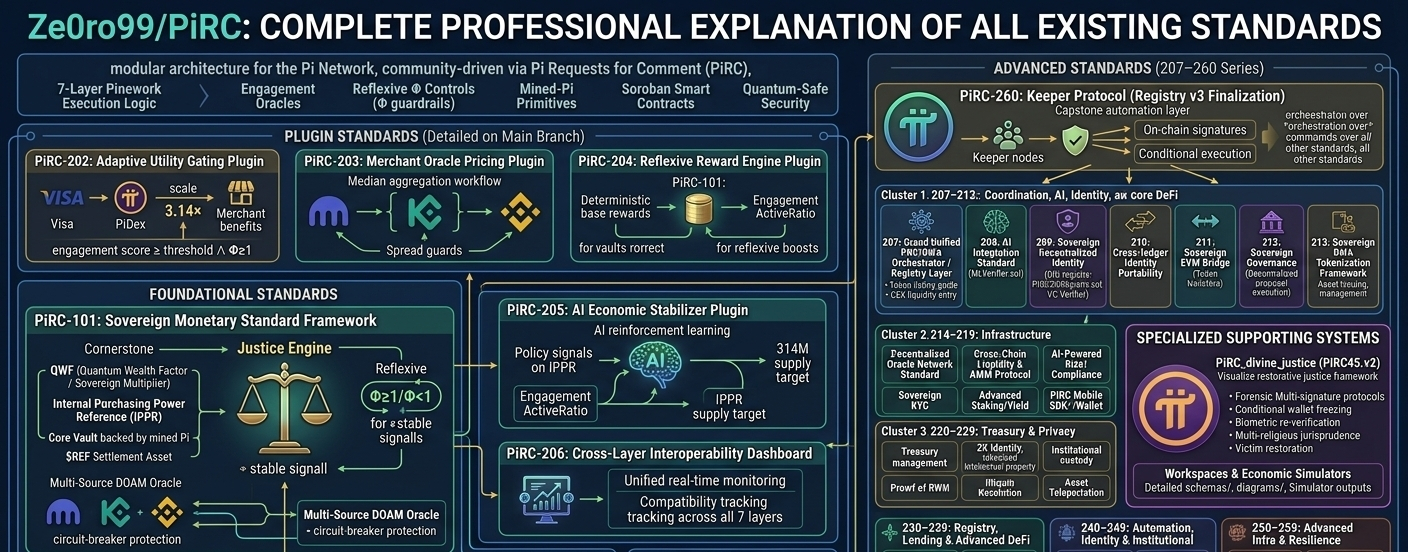
Establishes the economic foundation with the **Quantum Wealth Factor (QWF)**, **Internal Purchasing Power Reference (IPPR)**, collateralized **$REF** asset, and a **Justice Engine** governed by the reflexive **Φ guardrail**. Multi-source oracles include circuit-breaker protections. This standard supplies stable pricing and health signals to every higher layer.
**PiRC1: Pi Ecosystem Token Design**
Defines fair, utility-first token launches through participation windows (Pi staking for **PiPower** + app engagement), allocation mechanisms, and permanent liquidity formation. Two design variants accommodate different allocation and TGE requirements.
**PiRC2: Subscription Contract API**
Provides Soroban-based recurring payment infrastructure, including merchant service registration and full subscription lifecycle management.
### Plugin Standards (Fully Detailed on Main)
**PiRC-202: Adaptive Utility Gating Plugin**
Enables dynamic utility access scaling (up to 3.14×) based on verified engagement and network stability.
**PiRC-203: Merchant Oracle Pricing Plugin**
Delivers real-time USD/PI pricing through median aggregation from major exchanges with built-in safeguards.
**PiRC-204: Reflexive Reward Engine Plugin**
Applies engagement-driven boosts to deterministic vault-based rewards under governance oversight.
**PiRC-205: AI Economic Stabilizer Plugin**
Uses reinforcement learning to maintain policy stability for IPPR and $REF against long-term targets.
**PiRC-206: Cross-Layer Interoperability Dashboard**
Offers unified monitoring and compatibility tracking across all Pinework layers.
### Advanced Standards (207–260 Series)
**PiRC-207: Grand Unified PRC Orchestrator / Universal RWA Orchestrator / Registry Layer**
Central coordination layer with multi-spec orchestration, token listing processes, CEX liquidity mechanisms, and comprehensive deployment workflows.
**PiRC-208: AI Integration Standard**
Defines frameworks and verifiers for trustworthy, auditable AI/ML integration within on-chain systems.
**PiRC-209: Sovereign Decentralized Identity Standard**
Core infrastructure for self-sovereign identity, including DID registries and verifiable credential systems.
**PiRC-210 to PiRC-212**: Cross-ledger identity portability, sovereign EVM bridges with token portability, and decentralized governance/proposal execution standards.
**PiRC-213 to PiRC-219**: Sovereign RWA tokenization framework, decentralized oracle networks, cross-chain liquidity and AMM protocols, AI-powered risk and compliance engines, sovereign KYC/regulatory layers, advanced staking and yield optimization, and mobile SDK/wallet integration.
**PiRC-220 to PiRC-229**: Ecosystem treasury management, privacy-preserving ZK identity, tokenized intellectual property, institutional custody, dynamic RWA metadata, proof of reserves, fractional ownership, illiquid AMM designs, dispute resolution, and asset teleportation.
**PiRC-230 to PiRC-239**: Parity Registry v2, over-collateralized lending, justice-driven liquidation, flash-loan resistance, synthetic RWA generation, yield tokenization, dynamic interest rate curves, AI oracles, predictive risk management, and institutional liquidity pools.
**PiRC-240 to PiRC-249**: Automated yield farming, zero-knowledge corporate identity, institutional stealth addresses, automated tax withholding, wholesale CBDC integration, off-chain settlement batching, institutional escrow vaults, enterprise compliance oracles, multi-chain governance execution, and cross-chain state synchronization.
**PiRC-250 to PiRC-259**: Institutional account abstraction, protocol-owned liquidity, automated treasury diversification, ecosystem grant distribution, ultimate circuit breakers, catastrophic recovery protocols, decentralized validator delegation, ecosystem fee abstraction, standardized dApp ABIs, and cross-chain event standards.
**PiRC-260: Registry v3 Finalization (Keeper Protocol)**
The final automation and orchestration layer, providing on-chain signatures, conditional execution, and registry finalization across the entire ecosystem.
### Other Specialized Systems
**PiRC_divine_justice (PiRC45.v2)**: Implements a restorative justice framework featuring forensic multi-signature recovery, conditional asset controls with biometric re-verification, multi-religious jurisprudence, and quantum-resilient security. It emphasizes victim restoration and ecosystem healing.
Additional elements include master workspaces, economic simulators, and compliance documentation.
### Other Criteria for Standards Development, Evaluation, and Adoption
In addition to the core technical architecture, the Ze0ro99/PiRC framework incorporates several explicit and implicit criteria that guide the creation, review, and implementation of all standards:
- **Security and Resilience Criteria**: All standards must incorporate quantum-safe cryptography, circuit breakers, emergency freeze mechanisms, and recovery protocols. Smart contracts undergo structured threat modeling (Sybil resistance, oracle manipulation, flash-loan resistance).
- **Compliance and Regulatory Criteria**: Standards are designed with consideration for frameworks such as EU MiCAR, KYC/AML requirements, and institutional custody needs. Sovereign KYC layers and compliance oracles are embedded where relevant.
- **Economic Sustainability and Incentive Alignment Criteria**: Every standard must demonstrate reflexive or incentive-aligned mechanics that reward genuine participation, protect long-term value (via QWF/IPPR/Φ controls), and avoid inflationary or extractive designs.
- **Interoperability and Modularity Criteria**: All proposals must integrate with the 7-Layer Pinework model, share common primitives (oracles, vaults, engagement scoring), and support cross-standard and cross-chain compatibility.
- **Community Governance and Iteration Criteria**: Standards are developed through open GitHub processes. They require clear specification documents, reference implementations, and economic simulators. Community feedback via issues and pull requests drives iterative refinement.
- **Accessibility and Scalability Criteria**: Standards prioritize mobile-first integration (via SDKs and wallets), low-friction merchant adoption, and scalability for millions of Pioneers while maintaining auditability.
- **Transparency and Auditability Criteria**: Full documentation, on-chain verifiability (especially for AI components and identity), and public registries ensure accountability. Proof-of-reserves and dynamic metadata standards further enhance transparency.
- **Future-Proofing Criteria**: Emphasis on modular design, account abstraction, cross-chain event standards, and catastrophic recovery protocols ensures the framework can evolve with technological and regulatory changes.
These criteria ensure that every PiRC standard contributes to a cohesive, trustworthy, and sustainable ecosystem rather than isolated features.
### Interactions, Workflows, and Overall Importance to the Pi Economy
Standards interconnect through shared data flows: monetary signals from PiRC-101, engagement data from participation layers, identity verification from PiRC-209 and related standards, and automated execution via PiRC-260. This enables end-to-end processes from user participation to complex DeFi and governance outcomes.
Collectively, the full set of standards creates a robust foundation for:
- Long-term value preservation
- Genuine utility and participation incentives
- Institutional trust and regulatory readiness
- Scalable innovation in RWA, DeFi, and identity
- Resilient automation and community governance
The framework positions Pi as a mature, programmable economy capable of supporting real-world adoption while protecting Pioneer interests.
### How to Engage
Review and contribute at **https://github.com/Ze0ro99/PiRC**. Explore specifications, contracts, and simulators. Participate via issues, pull requests, or feature branches. Community input on the listed criteria and real-world applications is essential for continued refinement.
This document provides the complete professional explanation of all existing standards in the Ze0ro99/PiRC repository, including detailed coverage of the advanced series and the full set of development and adoption criteria. The framework remains open for community-driven evolution.
·
--
#newt $NEWT **Post 2: PiRC-101 – The Sovereign Monetary Standard Framework and Its Foundational Interactions** **PiRC-101** represents one of the cornerstone proposals within the Ze0ro99/PiRC ecosystem: the **Sovereign Monetary Standard Framework**. It introduces a reflexive monetary controller designed to stabilize the Pi ecosystem internally while preserving purchasing power and mitigating external volatility. At its core, PiRC-101 defines several interconnected components: - **QWF (Quantum Wealth Factor / Sovereign Multiplier)**: A dynamic valuation metric that governs monetary policy. Adjustments are regulated by a `clamp` function tied to Network Velocity and Total Value Locked (TVL), preventing runaway expansion or contraction. Base value is set at 10,000,000 (10^7), with reflexive feedback loops. - **IPPR (Internal Purchasing Power Reference)**: Establishes an internal economic benchmark (~$2,248,000 USD per 1 mined Pi equivalent in conceptual terms), serving as the anchor for minting the protocol's internal settlement asset, **$REF**. - **$REF Settlement Mechanism**: Merchants price in familiar units (e.g., USD) but settle in $REF, which is fully collateralized by mined Pi locked in the Core Vault. This creates an insulated settlement layer. - **Justice Engine**: An algorithmic control loop that monitors liquidity, applies a **Reflexive Guardrail (Φ Constraint)**, and enforces stability. If Φ ≥ 1, minting proceeds; if Φ < 1, expansion halts. - **Oracle Layer**: Utilizes a **Multi-Source DOAM (Decentralized Oracle Aggregation Model)** with medianization across at least three sources and circuit breakers for significant deviations (>15%). **Workflows and Interactions**: PiRC-101 operates as the economic control layer. It interacts with Pi Network's consensus (SCP) for on-chain enforcement via Soroban smart contracts (Core Vault, IPPR Ledger, WCF Utility Gating for mined Pi verification). Off-chain elements include oracle nodes and economic simulators. It feeds stability signals into higher-level PiRC proposals
#newt $NEWT

**Post 2: PiRC-101 – The Sovereign Monetary Standard Framework and Its Foundational Interactions**

**PiRC-101** represents one of the cornerstone proposals within the Ze0ro99/PiRC ecosystem: the **Sovereign Monetary Standard Framework**. It introduces a reflexive monetary controller designed to stabilize the Pi ecosystem internally while preserving purchasing power and mitigating external volatility.

At its core, PiRC-101 defines several interconnected components:

- **QWF (Quantum Wealth Factor / Sovereign Multiplier)**: A dynamic valuation metric that governs monetary policy. Adjustments are regulated by a `clamp` function tied to Network Velocity and Total Value Locked (TVL), preventing runaway expansion or contraction. Base value is set at 10,000,000 (10^7), with reflexive feedback loops.
- **IPPR (Internal Purchasing Power Reference)**: Establishes an internal economic benchmark (~$2,248,000 USD per 1 mined Pi equivalent in conceptual terms), serving as the anchor for minting the protocol's internal settlement asset, **$REF**.
- **$REF Settlement Mechanism**: Merchants price in familiar units (e.g., USD) but settle in $REF, which is fully collateralized by mined Pi locked in the Core Vault. This creates an insulated settlement layer.
- **Justice Engine**: An algorithmic control loop that monitors liquidity, applies a **Reflexive Guardrail (Φ Constraint)**, and enforces stability. If Φ ≥ 1, minting proceeds; if Φ < 1, expansion halts.
- **Oracle Layer**: Utilizes a **Multi-Source DOAM (Decentralized Oracle Aggregation Model)** with medianization across at least three sources and circuit breakers for significant deviations (>15%).

**Workflows and Interactions**: PiRC-101 operates as the economic control layer. It interacts with Pi Network's consensus (SCP) for on-chain enforcement via Soroban smart contracts (Core Vault, IPPR Ledger, WCF Utility Gating for mined Pi verification). Off-chain elements include oracle nodes and economic simulators. It feeds stability signals into higher-level PiRC proposals
·
--
**Post 1: Introducing the Ze0ro99/PiRC Repository – A Foundational Framework for Pi Network's Dece#newt $NEWT #pinetwork In the evolving landscape of the Pi Network ecosystem, the **Ze0ro99/PiRC** repository stands as a comprehensive, community-driven initiative dedicated to defining standardized protocols through **Pi Requests for Comment (PiRC)**. This repository functions as a sovereign architectural blueprint, proposing an **Omni-Sovereign Architecture** that integrates decentralized governance, digital asset management, AI-assisted workflows, quantum-safe security, and smart contract automation. Unlike isolated proposals, Ze0ro99/PiRC organizes its content into a structured suite of numbered PiRC documents and directories (including PiRC-101 through PiRC-206, alongside PiRC1 and PiRC2 for alignment with broader ecosystem token and subscription standards). It incorporates a sophisticated **7-Layer Execution Logic** model: - Layer 1: Registration - Layer 2: Subscription - Layer 3: Extension - Layer 4: Process/Bulk Charge - Layer 5: State Toggle - Layer 6: Cancellation - Layer 7: Global Logic Version This layered approach ensures modular, interoperable workflows across proposals. The repository also features smart contracts (targeting Soroban SDK on Pi Testnet), vaults, simulators, compliance frameworks (including EU MiCAR alignment considerations), and extensive documentation. It emphasizes post-quantum security, Rust-based implementations with strict safety constraints, and integration with Pi Network's testnet infrastructure (e.g., `https://rpc.testnet.minepi.com`). The repository's strength lies in its holistic vision: transforming Pi from a pioneering mobile-mined asset into a robust, programmable Layer-1 ecosystem capable of supporting real-world utility, DeFi primitives, identity solutions, and restorative justice mechanisms. It positions PiRC proposals as living standards that evolve through community feedback, pull requests, and iterative refinement—much like traditional RFC processes but tailored to Pi's unique scale and user base of millions of Pioneers. By centralizing these proposals, Ze0ro99/PiRC provides developers, projects, and stakeholders with a clear roadmap for building interoperable components. It bridges foundational economic controls with advanced automation layers, ensuring that innovations remain aligned with Pi's core principles of accessibility, transparency, and long-term value creation. This repository is not merely documentation; it is the architectural backbone for a sustainable Pi economy. **Post 2: PiRC-101 – The Sovereign Monetary Standard Framework and Its Foundational Interactions** **PiRC-101** represents one of the cornerstone proposals within the Ze0ro99/PiRC ecosystem: the **Sovereign Monetary Standard Framework**. It introduces a reflexive monetary controller designed to stabilize the Pi ecosystem internally while preserving purchasing power and mitigating external volatility. At its core, PiRC-101 defines several interconnected components: - **QWF (Quantum Wealth Factor / Sovereign Multiplier)**: A dynamic valuation metric that governs monetary policy. Adjustments are regulated by a `clamp` function tied to Network Velocity and Total Value Locked (TVL), preventing runaway expansion or contraction. Base value is set at 10,000,000 (10^7), with reflexive feedback loops. - **IPPR (Internal Purchasing Power Reference)**: Establishes an internal economic benchmark (~$2,248,000 USD per 1 mined Pi equivalent in conceptual terms), serving as the anchor for minting the protocol's internal settlement asset, **$REF**. - **$REF Settlement Mechanism**: Merchants price in familiar units (e.g., USD) but settle in $REF, which is fully collateralized by mined Pi locked in the Core Vault. This creates an insulated settlement layer. - **Justice Engine**: An algorithmic control loop that monitors liquidity, applies a **Reflexive Guardrail (Φ Constraint)**, and enforces stability. If Φ ≥ 1, minting proceeds; if Φ < 1, expansion halts. - **Oracle Layer**: Utilizes a **Multi-Source DOAM (Decentralized Oracle Aggregation Model)** with medianization across at least three sources and circuit breakers for significant deviations (>15%). **Workflows and Interactions**: PiRC-101 operates as the economic control layer. It interacts with Pi Network's consensus (SCP) for on-chain enforcement via Soroban smart contracts (Core Vault, IPPR Ledger, WCF Utility Gating for mined Pi verification). Off-chain elements include oracle nodes and economic simulators. It feeds stability signals into higher-level PiRC proposals (e.g., DeFi and governance layers in the 200-series) and supports participation mechanisms seen in aligned token design frameworks (such as staking-derived PiPower). By isolating internal valuation from external market swings, PiRC-101 creates a stable foundation upon which subsequent proposals can build reliable pricing, lending, and utility models. Its Justice Engine ensures self-correcting behavior, promoting resilience. **Post 3: Interconnected Workflows – The Synergy of PiRC-101, PiRC-102, PiRC-103, PiRC-104, and PiRC-260** The true power of the Ze0ro99/PiRC framework emerges from the **interactions and workflows** among its proposals. PiRC-101 serves as the monetary bedrock. Subsequent proposals (PiRC-102 through PiRC-104) extend this foundation into specialized domains—likely encompassing identity frameworks, cross-chain portability, AI oracles, governance execution, or early DeFi primitives—while **PiRC-260 (Keeper Protocol)** acts as the unifying automation and execution layer. **Key Interaction Patterns**: - **Monetary Foundation to Advanced Layers**: PiRC-101's $REF and IPPR provide stable internal pricing and collateral mechanisms. PiRC-102–104 leverage this for identity verification (e.g., zero-knowledge proofs tied to mined status), governance voting weighted by stabilized economic signals, or DeFi primitives like lending markets that reference QWF-adjusted valuations. - **7-Layer Execution Integration**: All proposals align with the 7-Layer model. For example: - Registration (Layer 1) and Subscription (Layer 2) in PiRC-101/102 handle asset onboarding and recurring commitments. - Process/Bulk Charge (Layer 4) and State Toggle (Layer 5) enable automated billing or governance actions using PiRC-101's Justice Engine triggers. - PiRC-260's Keeper Protocol orchestrates these via on-chain signatures and automated execution, ensuring seamless handoffs between monetary controls, identity checks, and DeFi operations. - **Workflow Example – A Token Launch or Subscription Cycle**: A project registers via PiRC-101/102 mechanisms (verifying mined Pi status and economic parameters). Participants stake and engage (aligned with participation windows). $REF or collateral flows through the Core Vault. PiRC-260 Keeper automates periodic charges, state updates, or liquidity adjustments. Post-launch unlocks and governance decisions reference the reflexive guards from PiRC-101, with identity and compliance layers from intermediate PiRCs ensuring security and fairness. - **Cross-Proposal Dependencies**: PiRC-101 supplies the economic invariants (clamp functions, oracle circuit breakers). PiRC-102–104 add modular extensions (e.g., identity oracles or governance modules). PiRC-260 provides the "keeper" intelligence for autonomous enforcement, reducing manual intervention and enhancing scalability. These interactions create a cohesive, self-reinforcing system: monetary stability enables trustworthy DeFi and governance; automation ensures efficiency; and layered modularity allows independent evolution while maintaining interoperability. **Post 4: The Strategic Importance of PiRC-101, PiRC-102, PiRC-103, PiRC-104, and PiRC-260 to the Pi Economy** The proposals within Ze0ro99/PiRC, particularly the cluster of PiRC-101 through PiRC-104 and the capstone PiRC-260, are pivotal to realizing a mature, utility-driven **Pi economy**. Their collective importance cannot be overstated: **Economic Stability and Value Preservation**: PiRC-101's reflexive controls and $REF mechanism directly address volatility concerns by creating an internal purchasing power anchor collateralized by real mined Pi. This helps preserve the long-term value of Pi holdings (including concepts like MacroPi) and reduces speculative pressures that plague many token ecosystems. **Enabling Real Utility and Fair Participation**: Building on stable monetary foundations, PiRC-102–104 support frameworks for identity, governance, and DeFi that reward genuine engagement. When integrated with token launch designs (e.g., PiPower-based staking and app engagement metrics), they ensure tokens launch only for projects with demonstrated user demand and product utility—fostering sustainable growth rather than hype-driven launches. **Scalable Automation and Efficiency**: PiRC-260's Keeper Protocol transforms the ecosystem from static protocols into dynamic, self-executing systems. Automated subscriptions, bulk charges, state management, and governance execution lower barriers for merchants, developers, and users, enabling subscription economies, recurring revenue models, and sophisticated DeFi products at Pi's massive scale. **Security, Compliance, and Trust**: Quantum-safe designs, multi-signature forensic protocols, oracle resilience, and compliance considerations build institutional-grade trust. This is essential for attracting real-world adoption, partnerships, and capital while protecting Pioneers. **Long-Term Ecosystem Maturation**: Together, these proposals create a modular yet unified architecture that aligns incentives across Pioneers (via staking and engagement rewards), projects (via fair liquidity and utility tools), and the network (via stability mechanisms). They position Pi as a programmable economy capable of supporting payments, DeFi, governance, identity, and beyond—driving organic demand, liquidity depth, and network effects. In summary, PiRC-101 through PiRC-104 provide the specialized building blocks, while PiRC-260 supplies the orchestration layer. Their interactions form a robust, adaptive system that elevates the Pi economy from pioneering potential to a resilient, utility-centric powerhouse. Community engagement with the Ze0ro99/PiRC repository is essential for refining these standards and accelerating Pi Network's vision of an inclusive, decentralized digital economy. These four professional posts provide a thorough, structured analysis suitable for sharing on professional platforms, forums, or community channels to foster informed discussion around the Ze0ro99/PiRC framework and its transformative role in Pi's future.

**Post 1: Introducing the Ze0ro99/PiRC Repository – A Foundational Framework for Pi Network's Dece

#newt $NEWT #pinetwork
In the evolving landscape of the Pi Network ecosystem, the **Ze0ro99/PiRC** repository stands as a comprehensive, community-driven initiative dedicated to defining standardized protocols through **Pi Requests for Comment (PiRC)**. This repository functions as a sovereign architectural blueprint, proposing an **Omni-Sovereign Architecture** that integrates decentralized governance, digital asset management, AI-assisted workflows, quantum-safe security, and smart contract automation.
Unlike isolated proposals, Ze0ro99/PiRC organizes its content into a structured suite of numbered PiRC documents and directories (including PiRC-101 through PiRC-206, alongside PiRC1 and PiRC2 for alignment with broader ecosystem token and subscription standards). It incorporates a sophisticated **7-Layer Execution Logic** model:
- Layer 1: Registration
- Layer 2: Subscription
- Layer 3: Extension
- Layer 4: Process/Bulk Charge
- Layer 5: State Toggle
- Layer 6: Cancellation
- Layer 7: Global Logic Version
This layered approach ensures modular, interoperable workflows across proposals. The repository also features smart contracts (targeting Soroban SDK on Pi Testnet), vaults, simulators, compliance frameworks (including EU MiCAR alignment considerations), and extensive documentation. It emphasizes post-quantum security, Rust-based implementations with strict safety constraints, and integration with Pi Network's testnet infrastructure (e.g., `https://rpc.testnet.minepi.com`).
The repository's strength lies in its holistic vision: transforming Pi from a pioneering mobile-mined asset into a robust, programmable Layer-1 ecosystem capable of supporting real-world utility, DeFi primitives, identity solutions, and restorative justice mechanisms. It positions PiRC proposals as living standards that evolve through community feedback, pull requests, and iterative refinement—much like traditional RFC processes but tailored to Pi's unique scale and user base of millions of Pioneers.
By centralizing these proposals, Ze0ro99/PiRC provides developers, projects, and stakeholders with a clear roadmap for building interoperable components. It bridges foundational economic controls with advanced automation layers, ensuring that innovations remain aligned with Pi's core principles of accessibility, transparency, and long-term value creation. This repository is not merely documentation; it is the architectural backbone for a sustainable Pi economy.
**Post 2: PiRC-101 – The Sovereign Monetary Standard Framework and Its Foundational Interactions**
**PiRC-101** represents one of the cornerstone proposals within the Ze0ro99/PiRC ecosystem: the **Sovereign Monetary Standard Framework**. It introduces a reflexive monetary controller designed to stabilize the Pi ecosystem internally while preserving purchasing power and mitigating external volatility.
At its core, PiRC-101 defines several interconnected components:
- **QWF (Quantum Wealth Factor / Sovereign Multiplier)**: A dynamic valuation metric that governs monetary policy. Adjustments are regulated by a `clamp` function tied to Network Velocity and Total Value Locked (TVL), preventing runaway expansion or contraction. Base value is set at 10,000,000 (10^7), with reflexive feedback loops.
- **IPPR (Internal Purchasing Power Reference)**: Establishes an internal economic benchmark (~$2,248,000 USD per 1 mined Pi equivalent in conceptual terms), serving as the anchor for minting the protocol's internal settlement asset, **$REF**.
- **$REF Settlement Mechanism**: Merchants price in familiar units (e.g., USD) but settle in $REF, which is fully collateralized by mined Pi locked in the Core Vault. This creates an insulated settlement layer.
- **Justice Engine**: An algorithmic control loop that monitors liquidity, applies a **Reflexive Guardrail (Φ Constraint)**, and enforces stability. If Φ ≥ 1, minting proceeds; if Φ < 1, expansion halts.
- **Oracle Layer**: Utilizes a **Multi-Source DOAM (Decentralized Oracle Aggregation Model)** with medianization across at least three sources and circuit breakers for significant deviations (>15%).
**Workflows and Interactions**: PiRC-101 operates as the economic control layer. It interacts with Pi Network's consensus (SCP) for on-chain enforcement via Soroban smart contracts (Core Vault, IPPR Ledger, WCF Utility Gating for mined Pi verification). Off-chain elements include oracle nodes and economic simulators. It feeds stability signals into higher-level PiRC proposals (e.g., DeFi and governance layers in the 200-series) and supports participation mechanisms seen in aligned token design frameworks (such as staking-derived PiPower).
By isolating internal valuation from external market swings, PiRC-101 creates a stable foundation upon which subsequent proposals can build reliable pricing, lending, and utility models. Its Justice Engine ensures self-correcting behavior, promoting resilience.
**Post 3: Interconnected Workflows – The Synergy of PiRC-101, PiRC-102, PiRC-103, PiRC-104, and PiRC-260**
The true power of the Ze0ro99/PiRC framework emerges from the **interactions and workflows** among its proposals. PiRC-101 serves as the monetary bedrock. Subsequent proposals (PiRC-102 through PiRC-104) extend this foundation into specialized domains—likely encompassing identity frameworks, cross-chain portability, AI oracles, governance execution, or early DeFi primitives—while **PiRC-260 (Keeper Protocol)** acts as the unifying automation and execution layer.
**Key Interaction Patterns**:
- **Monetary Foundation to Advanced Layers**: PiRC-101's $REF and IPPR provide stable internal pricing and collateral mechanisms. PiRC-102–104 leverage this for identity verification (e.g., zero-knowledge proofs tied to mined status), governance voting weighted by stabilized economic signals, or DeFi primitives like lending markets that reference QWF-adjusted valuations.
- **7-Layer Execution Integration**: All proposals align with the 7-Layer model. For example:
- Registration (Layer 1) and Subscription (Layer 2) in PiRC-101/102 handle asset onboarding and recurring commitments.
- Process/Bulk Charge (Layer 4) and State Toggle (Layer 5) enable automated billing or governance actions using PiRC-101's Justice Engine triggers.
- PiRC-260's Keeper Protocol orchestrates these via on-chain signatures and automated execution, ensuring seamless handoffs between monetary controls, identity checks, and DeFi operations.
- **Workflow Example – A Token Launch or Subscription Cycle**: A project registers via PiRC-101/102 mechanisms (verifying mined Pi status and economic parameters). Participants stake and engage (aligned with participation windows). $REF or collateral flows through the Core Vault. PiRC-260 Keeper automates periodic charges, state updates, or liquidity adjustments. Post-launch unlocks and governance decisions reference the reflexive guards from PiRC-101, with identity and compliance layers from intermediate PiRCs ensuring security and fairness.
- **Cross-Proposal Dependencies**: PiRC-101 supplies the economic invariants (clamp functions, oracle circuit breakers). PiRC-102–104 add modular extensions (e.g., identity oracles or governance modules). PiRC-260 provides the "keeper" intelligence for autonomous enforcement, reducing manual intervention and enhancing scalability.
These interactions create a cohesive, self-reinforcing system: monetary stability enables trustworthy DeFi and governance; automation ensures efficiency; and layered modularity allows independent evolution while maintaining interoperability.
**Post 4: The Strategic Importance of PiRC-101, PiRC-102, PiRC-103, PiRC-104, and PiRC-260 to the Pi Economy**
The proposals within Ze0ro99/PiRC, particularly the cluster of PiRC-101 through PiRC-104 and the capstone PiRC-260, are pivotal to realizing a mature, utility-driven **Pi economy**. Their collective importance cannot be overstated:
**Economic Stability and Value Preservation**: PiRC-101's reflexive controls and $REF mechanism directly address volatility concerns by creating an internal purchasing power anchor collateralized by real mined Pi. This helps preserve the long-term value of Pi holdings (including concepts like MacroPi) and reduces speculative pressures that plague many token ecosystems.
**Enabling Real Utility and Fair Participation**: Building on stable monetary foundations, PiRC-102–104 support frameworks for identity, governance, and DeFi that reward genuine engagement. When integrated with token launch designs (e.g., PiPower-based staking and app engagement metrics), they ensure tokens launch only for projects with demonstrated user demand and product utility—fostering sustainable growth rather than hype-driven launches.
**Scalable Automation and Efficiency**: PiRC-260's Keeper Protocol transforms the ecosystem from static protocols into dynamic, self-executing systems. Automated subscriptions, bulk charges, state management, and governance execution lower barriers for merchants, developers, and users, enabling subscription economies, recurring revenue models, and sophisticated DeFi products at Pi's massive scale.
**Security, Compliance, and Trust**: Quantum-safe designs, multi-signature forensic protocols, oracle resilience, and compliance considerations build institutional-grade trust. This is essential for attracting real-world adoption, partnerships, and capital while protecting Pioneers.
**Long-Term Ecosystem Maturation**: Together, these proposals create a modular yet unified architecture that aligns incentives across Pioneers (via staking and engagement rewards), projects (via fair liquidity and utility tools), and the network (via stability mechanisms). They position Pi as a programmable economy capable of supporting payments, DeFi, governance, identity, and beyond—driving organic demand, liquidity depth, and network effects.
In summary, PiRC-101 through PiRC-104 provide the specialized building blocks, while PiRC-260 supplies the orchestration layer. Their interactions form a robust, adaptive system that elevates the Pi economy from pioneering potential to a resilient, utility-centric powerhouse. Community engagement with the Ze0ro99/PiRC repository is essential for refining these standards and accelerating Pi Network's vision of an inclusive, decentralized digital economy.
These four professional posts provide a thorough, structured analysis suitable for sharing on professional platforms, forums, or community channels to foster informed discussion around the Ze0ro99/PiRC framework and its transformative role in Pi's future.
·
--
Artículo
**Ze0ro99/PiRC: Complete Professional Explanation of All Existing Standards for the Pi Community**The **Ze0ro99/PiRC** repository is a comprehensive, community-driven collection of **Pi Requests for Comment (PiRC)**. It defines a full modular architecture for the Pi Network, spanning monetary foundations, token economics, subscriptions, identity, real-world assets (RWA), DeFi, governance, compliance, cross-chain capabilities, automation, and restorative systems. This framework operates through the **7-Layer Pinework Execution Logic** and integrates engagement oracles, reflexive controls (Φ guardrails), mined-Pi primitives, Soroban smart contracts, and quantum-safe security. Standards progress logically from foundational economic and participation layers to advanced institutional and automation infrastructure. ### Repository Structure - **Main branch**: Hosts complete folders and detailed `PROPOSAL_xxx.md` files for PiRC-101 and PiRC-202 through PiRC-206. - **Higher standards (207–260)**: Documented via specification files (e.g., `PiRC-XXX-[Name]-Standard.md`), smart contracts (`.sol` and Soroban `.rs`), schemas, and deployment workflows in `contracts/`, `docs/`, and `schemas/`. - **Development model**: Over 130 feature branches support grouped evolution (e.g., governance/identity or DeFi clusters). Master catalogs (`REPOSITORY_MAP.md`, manifests, and registries) provide the complete index. - **Supporting systems**: Include `PiRC_divine_justice`, workspaces, economic simulators, and compliance tooling. ### Foundational Standards **PiRC-101: Sovereign Monetary Standard Framework** This is the economic cornerstone. It introduces the **Quantum Wealth Factor (QWF)**, **Internal Purchasing Power Reference (IPPR)**, fully collateralized **$REF** settlement asset, and a **Justice Engine** with reflexive **Φ guardrail**. Multi-source oracles provide circuit-breaker protection against volatility. It supplies stable internal pricing, vault mechanics, and health signals to all higher standards. **PiRC1: Pi Ecosystem Token Design** Defines fair, utility-oriented token launches. Key elements include participation windows (Pi staking for **PiPower** combined with app engagement metrics), allocation rules, and permanent liquidity formation. Two design variants address different allocation and Token Generation Event (TGE) approaches. Sale proceeds convert directly into liquidity rather than project treasuries. **PiRC2: Subscription Contract API** A Soroban-based system for merchant service registration, recurring billing, and full subscription lifecycle management using pre-approved token allowances. ### Plugin Standards (Detailed on Main Branch) **PiRC-202: Adaptive Utility Gating Plugin** Dynamically scales utility access (Visa, PiDex, merchant benefits) up to **3.14×** based on verified engagement scores and network stability (Φ). Uses Sybil-resistant oracles and threshold logic. **PiRC-203: Merchant Oracle Pricing Plugin** Delivers real-time, tamper-resistant USD/PI pricing through median aggregation from Kraken, KuCoin, and Binance, with spread guards and fail-open protections. **PiRC-204: Reflexive Reward Engine Plugin** Calculates deterministic base rewards from vaults and applies engagement-driven boosts via **ActiveRatio**, subject to governance caps and emergency controls. **PiRC-205: AI Economic Stabilizer Plugin** Applies reinforcement-style logic to stabilize IPPR and $REF policy signals against long-term supply targets. **PiRC-206: Cross-Layer Interoperability Dashboard** Provides unified real-time monitoring and compatibility tracking across all seven Pinework layers and interconnected standards. ### Advanced Standards (207–260 Series) These standards extend the foundation into specialized, production-oriented infrastructure. They are implemented through detailed specification documents and corresponding smart contracts. **PiRC-207: Grand Unified PRC Orchestrator / Universal RWA Orchestrator / Registry Layer** Serves as the central coordination hub. It includes multi-layer orchestration specifications, token listing guides, CEX liquidity entry mechanisms, layer color systems, and full deployment workflows. This standard unifies RWA handling and registry functions across the ecosystem. **PiRC-208: AI Integration Standard** Establishes frameworks for trustworthy AI/ML integration. Includes verifiable computation components (such as `PiRC208MLVerifier.sol`) to ensure AI outputs remain auditable and aligned with on-chain rules. **PiRC-209: Sovereign Decentralized Identity Standard** Provides the core infrastructure for self-sovereign identity. Features a DID registry (`PiRC209DIDRegistry.sol`) and Soroban-based verifiable credential verifier (`PiRC209VCVerifier.rs`), enabling secure, user-controlled identity across the Pi ecosystem. **PiRC-210: Cross-Ledger Identity Portability Standard** Enables seamless movement of identity credentials and attestations between different ledgers while preserving sovereignty and privacy. **PiRC-211: Sovereign EVM Bridge and Cross-Ledger Token Portability Standard** Facilitates secure bridging and token transfers between Pi and EVM-compatible chains, maintaining sovereignty and compliance. **PiRC-212: Sovereign Governance and Decentralized Proposal Execution Standard** Defines on-chain mechanisms for proposal creation, voting, and automated execution of governance decisions. **PiRC-213: Sovereign RWA Tokenization Framework** Comprehensive standard for issuing, managing, and governing real-world asset tokens on Pi, including metadata, compliance, and lifecycle controls. **PiRC-214 to PiRC-219 Cluster (Oracles, Liquidity, Compliance & Access)**: - Decentralized Oracle Network Standard - Cross-Chain Liquidity and AMM Protocol - AI-Powered Risk and Compliance Engine - Sovereign KYC and Regulatory Compliance Layer - Advanced Staking and Yield Optimization Protocol - PiRC Mobile SDK and Wallet Integration Standard These enable reliable data feeds, efficient trading, risk management, regulatory alignment, enhanced yields, and seamless mobile/user experiences. **PiRC-220 to PiRC-229 Cluster (Treasury, Privacy, Assets & Resolution)**: Covers ecosystem treasury management, privacy-preserving zero-knowledge identity, tokenized intellectual property, institutional custody solutions, dynamic RWA metadata, proof of reserves, fractional ownership models, illiquid AMM designs, dispute resolution mechanisms, and asset teleportation capabilities. **PiRC-230 to PiRC-239 Cluster (Registry, Lending & Advanced DeFi)**: Includes Parity Registry v2, over-collateralized lending protocols, justice-driven liquidation engines, flash-loan resistance standards, synthetic RWA generation, yield tokenization, dynamic interest rate curves, AI oracles, predictive risk management, and institutional liquidity pools. **PiRC-240 to PiRC-249 Cluster (Automation, Identity & Institutional Tools)**: Features automated yield farming strategies, zero-knowledge corporate identity, institutional stealth addresses, automated tax withholding, wholesale CBDC integration, off-chain settlement batching, institutional escrow vaults, enterprise compliance oracles, multi-chain governance execution, and cross-chain state synchronization. **PiRC-250 to PiRC-259 Cluster (Advanced Infrastructure & Resilience)**: Addresses institutional account abstraction, protocol-owned liquidity, automated treasury diversification, ecosystem grant distribution, ultimate circuit breakers, catastrophic recovery protocols, decentralized validator delegation, ecosystem fee abstraction, standardized dApp ABIs, and cross-chain event standards. **PiRC-260: Registry v3 Finalization (Keeper Protocol)** The capstone automation and registry layer. It provides on-chain signatures, conditional execution, and final registry orchestration, enabling autonomous operation across all prior standards while maintaining security and auditability. ### Specialized Supporting Systems **PiRC_divine_justice (PiRC45.v2)**: Implements a restorative justice framework with forensic multi-signature protocols, conditional wallet freezing, biometric re-verification, multi-religious jurisprudence principles, and quantum-resilient security. It prioritizes victim restoration and ecosystem healing over traditional punitive models. Additional supporting elements include master workspaces for development and testing, extensive economic simulators, and compliance documentation. ### Interactions, Workflows, and System Integration Standards interconnect through shared primitives: - **PiRC-101** supplies monetary stability and Φ signals. - Participation and engagement data from PiRC1 and plugins (202/204) feed identity verification (209/221) and reward systems. - RWA and DeFi layers (213, 215, 231+) operate on verified identity and stable pricing. - Governance (212) and compliance (216/217) layers ensure controlled evolution. - **PiRC-207** and **PiRC-260** serve as central orchestrators and keepers, automating complex conditional workflows across the entire stack. This creates end-to-end processes such as: verified Pioneer engagement → gated utilities and boosted rewards → sovereign identity-checked RWA participation → automated lending/liquidation/settlement → registry updates and governance execution. ### Importance to the Pi Economy Collectively, these standards deliver a complete infrastructure layer that supports: - Long-term value preservation through reflexive monetary controls. - Genuine utility and participation incentives via engagement-gated access and fair token mechanics. - Institutional-grade trust through sovereign identity, compliance layers, custody solutions, and restorative justice. - Scalable innovation via RWA tokenization, cross-chain interoperability, AI integration, and advanced DeFi primitives. - Resilient automation and governance through keeper protocols, circuit breakers, and recovery mechanisms. The framework positions Pi as a programmable, sovereign Layer-1 economy capable of supporting real commerce, decentralized finance, identity systems, and global adoption while protecting the interests of millions of Pioneers. ### Community Engagement The repository is open for review and contribution at **https://github.com/Ze0ro99/PiRC**. Explore specifications, contracts, and simulators. Participate through issues, pull requests, or focused work on feature branches. Community feedback on integration patterns, oracle designs, and real-world use cases helps refine these standards for broader adoption. This complete explanation covers every documented standard and supporting system currently available in the Ze0ro99/PiRC repository. The framework remains a living document designed for iterative improvement by the Pi community.

**Ze0ro99/PiRC: Complete Professional Explanation of All Existing Standards for the Pi Community**

The **Ze0ro99/PiRC** repository is a comprehensive, community-driven collection of **Pi Requests for Comment (PiRC)**. It defines a full modular architecture for the Pi Network, spanning monetary foundations, token economics, subscriptions, identity, real-world assets (RWA), DeFi, governance, compliance, cross-chain capabilities, automation, and restorative systems.
This framework operates through the **7-Layer Pinework Execution Logic** and integrates engagement oracles, reflexive controls (Φ guardrails), mined-Pi primitives, Soroban smart contracts, and quantum-safe security. Standards progress logically from foundational economic and participation layers to advanced institutional and automation infrastructure.
### Repository Structure
- **Main branch**: Hosts complete folders and detailed `PROPOSAL_xxx.md` files for PiRC-101 and PiRC-202 through PiRC-206.
- **Higher standards (207–260)**: Documented via specification files (e.g., `PiRC-XXX-[Name]-Standard.md`), smart contracts (`.sol` and Soroban `.rs`), schemas, and deployment workflows in `contracts/`, `docs/`, and `schemas/`.
- **Development model**: Over 130 feature branches support grouped evolution (e.g., governance/identity or DeFi clusters). Master catalogs (`REPOSITORY_MAP.md`, manifests, and registries) provide the complete index.
- **Supporting systems**: Include `PiRC_divine_justice`, workspaces, economic simulators, and compliance tooling.
### Foundational Standards
**PiRC-101: Sovereign Monetary Standard Framework**
This is the economic cornerstone. It introduces the **Quantum Wealth Factor (QWF)**, **Internal Purchasing Power Reference (IPPR)**, fully collateralized **$REF** settlement asset, and a **Justice Engine** with reflexive **Φ guardrail**. Multi-source oracles provide circuit-breaker protection against volatility.
It supplies stable internal pricing, vault mechanics, and health signals to all higher standards.
**PiRC1: Pi Ecosystem Token Design**
Defines fair, utility-oriented token launches. Key elements include participation windows (Pi staking for **PiPower** combined with app engagement metrics), allocation rules, and permanent liquidity formation. Two design variants address different allocation and Token Generation Event (TGE) approaches. Sale proceeds convert directly into liquidity rather than project treasuries.
**PiRC2: Subscription Contract API**
A Soroban-based system for merchant service registration, recurring billing, and full subscription lifecycle management using pre-approved token allowances.
### Plugin Standards (Detailed on Main Branch)
**PiRC-202: Adaptive Utility Gating Plugin**
Dynamically scales utility access (Visa, PiDex, merchant benefits) up to **3.14×** based on verified engagement scores and network stability (Φ). Uses Sybil-resistant oracles and threshold logic.
**PiRC-203: Merchant Oracle Pricing Plugin**
Delivers real-time, tamper-resistant USD/PI pricing through median aggregation from Kraken, KuCoin, and Binance, with spread guards and fail-open protections.
**PiRC-204: Reflexive Reward Engine Plugin**
Calculates deterministic base rewards from vaults and applies engagement-driven boosts via **ActiveRatio**, subject to governance caps and emergency controls.
**PiRC-205: AI Economic Stabilizer Plugin**
Applies reinforcement-style logic to stabilize IPPR and $REF policy signals against long-term supply targets.
**PiRC-206: Cross-Layer Interoperability Dashboard**
Provides unified real-time monitoring and compatibility tracking across all seven Pinework layers and interconnected standards.
### Advanced Standards (207–260 Series)
These standards extend the foundation into specialized, production-oriented infrastructure. They are implemented through detailed specification documents and corresponding smart contracts.
**PiRC-207: Grand Unified PRC Orchestrator / Universal RWA Orchestrator / Registry Layer**
Serves as the central coordination hub. It includes multi-layer orchestration specifications, token listing guides, CEX liquidity entry mechanisms, layer color systems, and full deployment workflows. This standard unifies RWA handling and registry functions across the ecosystem.
**PiRC-208: AI Integration Standard**
Establishes frameworks for trustworthy AI/ML integration. Includes verifiable computation components (such as `PiRC208MLVerifier.sol`) to ensure AI outputs remain auditable and aligned with on-chain rules.
**PiRC-209: Sovereign Decentralized Identity Standard**
Provides the core infrastructure for self-sovereign identity. Features a DID registry (`PiRC209DIDRegistry.sol`) and Soroban-based verifiable credential verifier (`PiRC209VCVerifier.rs`), enabling secure, user-controlled identity across the Pi ecosystem.
**PiRC-210: Cross-Ledger Identity Portability Standard**
Enables seamless movement of identity credentials and attestations between different ledgers while preserving sovereignty and privacy.
**PiRC-211: Sovereign EVM Bridge and Cross-Ledger Token Portability Standard**
Facilitates secure bridging and token transfers between Pi and EVM-compatible chains, maintaining sovereignty and compliance.
**PiRC-212: Sovereign Governance and Decentralized Proposal Execution Standard**
Defines on-chain mechanisms for proposal creation, voting, and automated execution of governance decisions.
**PiRC-213: Sovereign RWA Tokenization Framework**
Comprehensive standard for issuing, managing, and governing real-world asset tokens on Pi, including metadata, compliance, and lifecycle controls.
**PiRC-214 to PiRC-219 Cluster (Oracles, Liquidity, Compliance & Access)**:
- Decentralized Oracle Network Standard
- Cross-Chain Liquidity and AMM Protocol
- AI-Powered Risk and Compliance Engine
- Sovereign KYC and Regulatory Compliance Layer
- Advanced Staking and Yield Optimization Protocol
- PiRC Mobile SDK and Wallet Integration Standard
These enable reliable data feeds, efficient trading, risk management, regulatory alignment, enhanced yields, and seamless mobile/user experiences.
**PiRC-220 to PiRC-229 Cluster (Treasury, Privacy, Assets & Resolution)**:
Covers ecosystem treasury management, privacy-preserving zero-knowledge identity, tokenized intellectual property, institutional custody solutions, dynamic RWA metadata, proof of reserves, fractional ownership models, illiquid AMM designs, dispute resolution mechanisms, and asset teleportation capabilities.
**PiRC-230 to PiRC-239 Cluster (Registry, Lending & Advanced DeFi)**:
Includes Parity Registry v2, over-collateralized lending protocols, justice-driven liquidation engines, flash-loan resistance standards, synthetic RWA generation, yield tokenization, dynamic interest rate curves, AI oracles, predictive risk management, and institutional liquidity pools.
**PiRC-240 to PiRC-249 Cluster (Automation, Identity & Institutional Tools)**:
Features automated yield farming strategies, zero-knowledge corporate identity, institutional stealth addresses, automated tax withholding, wholesale CBDC integration, off-chain settlement batching, institutional escrow vaults, enterprise compliance oracles, multi-chain governance execution, and cross-chain state synchronization.
**PiRC-250 to PiRC-259 Cluster (Advanced Infrastructure & Resilience)**:
Addresses institutional account abstraction, protocol-owned liquidity, automated treasury diversification, ecosystem grant distribution, ultimate circuit breakers, catastrophic recovery protocols, decentralized validator delegation, ecosystem fee abstraction, standardized dApp ABIs, and cross-chain event standards.
**PiRC-260: Registry v3 Finalization (Keeper Protocol)**
The capstone automation and registry layer. It provides on-chain signatures, conditional execution, and final registry orchestration, enabling autonomous operation across all prior standards while maintaining security and auditability.
### Specialized Supporting Systems
**PiRC_divine_justice (PiRC45.v2)**: Implements a restorative justice framework with forensic multi-signature protocols, conditional wallet freezing, biometric re-verification, multi-religious jurisprudence principles, and quantum-resilient security. It prioritizes victim restoration and ecosystem healing over traditional punitive models.
Additional supporting elements include master workspaces for development and testing, extensive economic simulators, and compliance documentation.
### Interactions, Workflows, and System Integration
Standards interconnect through shared primitives:
- **PiRC-101** supplies monetary stability and Φ signals.
- Participation and engagement data from PiRC1 and plugins (202/204) feed identity verification (209/221) and reward systems.
- RWA and DeFi layers (213, 215, 231+) operate on verified identity and stable pricing.
- Governance (212) and compliance (216/217) layers ensure controlled evolution.
- **PiRC-207** and **PiRC-260** serve as central orchestrators and keepers, automating complex conditional workflows across the entire stack.
This creates end-to-end processes such as: verified Pioneer engagement → gated utilities and boosted rewards → sovereign identity-checked RWA participation → automated lending/liquidation/settlement → registry updates and governance execution.
### Importance to the Pi Economy
Collectively, these standards deliver a complete infrastructure layer that supports:
- Long-term value preservation through reflexive monetary controls.
- Genuine utility and participation incentives via engagement-gated access and fair token mechanics.
- Institutional-grade trust through sovereign identity, compliance layers, custody solutions, and restorative justice.
- Scalable innovation via RWA tokenization, cross-chain interoperability, AI integration, and advanced DeFi primitives.
- Resilient automation and governance through keeper protocols, circuit breakers, and recovery mechanisms.
The framework positions Pi as a programmable, sovereign Layer-1 economy capable of supporting real commerce, decentralized finance, identity systems, and global adoption while protecting the interests of millions of Pioneers.
### Community Engagement
The repository is open for review and contribution at **https://github.com/Ze0ro99/PiRC**. Explore specifications, contracts, and simulators. Participate through issues, pull requests, or focused work on feature branches. Community feedback on integration patterns, oracle designs, and real-world use cases helps refine these standards for broader adoption.
This complete explanation covers every documented standard and supporting system currently available in the Ze0ro99/PiRC repository. The framework remains a living document designed for iterative improvement by the Pi community.
·
--
المفترض في الكثير ينزل لل21 ويعمل ارتداد صعودي قوي
S4rkeft
·
--
$TRUMP تم تحقق تحليل التي قلت لكم من سبابق قلت لكم اذا انخفض سعر تحت 25 رح ينخفض الى 22.5 حتى 21.5
·
--
$TRUMP لماذا الجميع يبكي أثناء الهبوط أشعر بأن أغلب المتداولين اطفال من المستحيل ان تجد سوق مرتفع إلى الأبد وفي عالم الكربتو يجب هبوط العملات لتكسر وتصل إلى قمه جديده من المثير لسخريه ان أجد أشخاص يشترون في مناطق خاطئ ثم يبكون بعد تصحيح أو بعد خروج الحيتان لتستقر وتعود لارتفاع مره آخرى يجب أن تفهم ان الارتفاع القادم لعملة #Trump سيكون بين 120 إلى 150دولار بعد الاعتمادات التي حصلت في الأسواق التجاريه ويصبح لها زخم كبير لذلك كف عن البكاء واحتفظ بما تمتلك من عملاتك لأن الارتفاع قادم لا محاله
·
--
🌐 حدث الان 🔴جيروم باول : سيكون من المفيد أن يكون لدينا جهاز تنظيمي أكبر فيما يتعلق بالعملات المشفرة. نحن نريد من الجميع ان يكونوا ملمين بمخاطر الكريبتو 📹
🌐 حدث الان 🔴جيروم باول : سيكون من المفيد أن يكون لدينا جهاز تنظيمي أكبر فيما يتعلق بالعملات المشفرة.

نحن نريد من الجميع ان يكونوا ملمين بمخاطر الكريبتو

📹
·
--
🌐 حدث الان 🔴جيروم باول : فيما يتعلق بالعملات المشفرة، نعتقد أن البنوك قادرة على خدمة العملاء طالما أنها تدير المخاطر 📹
🌐 حدث الان 🔴جيروم باول : فيما يتعلق بالعملات المشفرة، نعتقد أن البنوك قادرة على خدمة العملاء طالما أنها تدير المخاطر

📹
·
--
$TRUMP ترامب سيصدم الجميع ويعود إلى 32 دولار
·
--
🤨
🤨
Azzo USDZ
·
--
إيلون ماسك: رحلة من الصفر إلى القمة 🚀💸
إيلون ماسك، العبقري الملياردير الذي انطلق من بدايات متواضعة ووصل إلى قمة النجاح، هو أحد أعظم رواد الأعمال في عصرنا 🌟. وُلد في جنوب أفريقيا 🇿🇦 في 28 يونيو 1971، ونشأ في بيئة عادية، لكن منذ صغره كان لديه شغف بالعلوم والتكنولوجيا 💻. في سن العاشرة، تعلم البرمجة، وباع أول لعبة قام بتطويرها مقابل 500 دولار 💵، وكان ذلك بداية مسيرته المثيرة 🔥.

التعليم والدراسة 📚

بعدما انتقل إلى كندا 🇨🇦 ليكمل تعليمه، حصل على منحة للدراسة في جامعة كوينز، ثم انتقل إلى الولايات المتحدة 🇺🇸 حيث درس الفيزياء والاقتصاد في جامعة بنسلفانيا 🎓. كانت سنوات الدراسة مليئة بالطموح والأحلام 💭 التي تحفزه ليصبح أحد أعظم المبتكرين في العالم 🌎.

أولى خطوات النجاح 💪

أسس ماسك أول شركة له، Zip2، والتي باعها لاحقًا مقابل ملايين الدولارات 💸. بعدها أسس PayPal، الشركة التي غيرت مفهوم الدفع الإلكتروني 💳، والتي تم بيعها مقابل 1.5 مليار دولار 🌐، مما أضاف لثروته وأسهم في صنع اسمه كرائد أعمال ملهم 🌠.

SpaceX: تحدي الفضاء 🌌🚀

في عام 2002، أسس ماسك شركة SpaceX بهدف تمكين البشر من الوصول إلى الفضاء بأسعار منخفضة 🌠🚀. على الرغم من الصعوبات الهائلة 😓، تمكن من تحقيق نجاحات كبرى، مثل توقيع عقد مع ناسا لنقل المعدات إلى الفضاء 🚀🌌.

تسلا: ثورة السيارات الكهربائية 🚗⚡

انضم ماسك إلى تسلا في عام 2004، وبدأ في تطوير سيارات كهربائية صديقة للبيئة 🌱. ورغم التحديات العديدة 🔄، أصبحت تسلا اليوم من أكبر شركات السيارات في العالم 🌍. سيارات تسلا مثل Model S وModel 3 أصبحت رموزًا للتكنولوجيا والابتكار 💡🚗.

مشاريعه الأخرى 🌞💡🧠

لم يتوقف ماسك عند تسلا وSpaceX، بل أسس مشاريع أخرى، منها:

SolarCity لتطوير الطاقة الشمسية 🌞.

Neuralink لدمج العقول البشرية مع الذكاء الاصطناعي 🧠🤖.

The Boring Company لحل مشكلات الازدحام عبر الأنفاق 🕳️🚇.

التحديات والنجاح المستمر 🛠️💥

رغم الثروة الهائلة، واجه ماسك العديد من الصعوبات والأزمات 🔥، إلا أن إرادته الصلبة ساعدته على تجاوز كل شيء 💪. اليوم، تقدر ثروته بحوالي 230 مليار دولار 💰، ما يجعله من بين أثرى أثرياء العالم 🌐. ماسك يعيش حياة بسيطة، ويعمل بلا توقف لتحقيق رؤيته لمستقبل مستدام ومستقبل في الفضاء 🌌🌏.

الختام 🌟

قصة ماسك تمثل إلهامًا للعالم بأسره 🌍✨؛ فهو مثال حي على أن الطموح والعمل الجاد يمكن أن يفتحا الأبواب حتى لأولئك الذين يبدأون من الصفر 🎉.
·
--
Alcista
السوق يبداء بتعافي بطريقنا إلى 3350$ETH $PEPE لديها مضخه وسيعود0.00001قريبا بإذن بتوفيق لجميع سوق متخبط كن حريص {future}(ETHUSDT) {spot}(PEPEUSDT)
السوق يبداء بتعافي بطريقنا إلى 3350$ETH
$PEPE لديها مضخه وسيعود0.00001قريبا بإذن بتوفيق لجميع سوق متخبط كن حريص
·
--
Bajista
·
--
Alcista
بإذن الله خلال ساعات المقبله سنستيطع دخول رحلة 3000 لرمز$ETH و$BTC مابين 65000 و69000 الخطه كل اتي شراء بنصف مبلغك والنصف الثاني في حال اي تصحيح أو هبوط لتعزيز
بإذن الله خلال ساعات المقبله سنستيطع
دخول رحلة 3000 لرمز$ETH
و$BTC مابين 65000 و69000
الخطه كل اتي شراء بنصف مبلغك
والنصف الثاني في حال اي تصحيح أو هبوط لتعزيز
·
--
Alcista
$BTC $ETH #bitcoin على رغم من أن أغلب ما توقعت به تقريبا ٩٥ في الميه الا انه لا أجد دعم من المتابعات أو أي نوع من الحصص
$BTC $ETH #bitcoin
على رغم من أن أغلب ما توقعت به تقريبا ٩٥ في الميه الا انه لا أجد دعم من المتابعات أو أي نوع من الحصص
·
--
Alcista
الحمد الله تبقى ساعه تقريبا وربما نستمر إلى 62 الف ونستكمل صعود بإذن الله
Zero99
·
--
Alcista

مرحبا شباب إذا اخترق البتكوين 58750 سيتمر صعود باتجاه 72000الى 80000 وفي حال حصل هبوط وأغلق تحت 52422 لربما يستمر الهبوط إلى 35000
#Binance #bitcoin #BTC $BTC
·
--
Alcista
{spot}(BTCUSDT) مرحبا شباب إذا اخترق البتكوين 58750 سيتمر صعود باتجاه 72000الى 80000 وفي حال حصل هبوط وأغلق تحت 52422 لربما يستمر الهبوط إلى 35000 #Binance #bitcoin #BTC $BTC
مرحبا شباب إذا اخترق البتكوين 58750 سيتمر صعود باتجاه 72000الى 80000 وفي حال حصل هبوط وأغلق تحت 52422 لربما يستمر الهبوط إلى 35000
#Binance #bitcoin #BTC $BTC
·
--
Bajista
$BTC #Binance بتكوين يصل بسرعة البرق إلى سعر ٤٩الف دولار الي حابب يشتري يقسم مبلغه لشرائه يدخل خمسين في الميه الآن ويخلي باقي مبلغه لتعزيز ممكن يزور مناطق ال ٣٥٠٠٠
·
--
بصراحه كنت متوقع نزول بس كنت اتوقع في البدايه تصحيح ما توقعت يتم نسفي بهيك طريقه هههه حظ موفق لجميع $BTC $ETH
Inicia sesión para explorar más contenidos
Únete a usuarios globales de criptomonedas en Binance Square
⚡️ Obtén información útil y actualizada sobre criptos.
💬 Avalado por el mayor exchange de criptomonedas en el mundo.
👍 Descubre perspectivas reales de creadores verificados.
Email/número de teléfono
Mapa del sitio
Preferencias de cookies
Términos y condiciones de la plataforma