

OroCryptoTrends
8.9k Publicaciones

OroCryptoTrends
 Verificado Plus de Binance Square
Denunciar
Bloquear usuario
OroCryptoTrends | Crypto Insights: Real-time crypto news, market analysis, Web3, DeFi & emerging trends. Research-driven, actionable insights. No hype.
Abrir trade
Trader frecuente
3.2 año(s)
3.2K+ Siguiendo
51.2K+ Seguidores
49.2K+ Me gusta
Publicaciones
Cartera
Todo
Citas
Videos
Live
Verificado
PayPay no está aceptando cripto. Y esa es, en realidad, la parte más interesante.
Los usuarios de Binance Pay que visitan Japón ahora pueden pagar en comercios compatibles con PayPay, con la conexión a través de la red HIVEX de TBCASoft. El comercio sigue recibiendo yenes japoneses, mientras que el visitante paga mediante Binance Pay.
Al principio, pensé que era solo otro titular de “los pagos cripto se están expandiendo”.
Espera: quizá no sea el marco correcto.
Lo más interesante es lo que permanece igual.
El comercio no necesita de repente entender wallets, tokens ni la liquidación en blockchain. No hay un nuevo sistema de checkout cripto que la tienda deba aprender. La infraestructura de pagos del lado del comercio se mantiene familiar, mientras que Binance Pay efectivamente se convierte en otra ruta de financiación detrás de la transacción.
Esa distinción importa.
Sugiere un posible camino para los pagos cripto: no pedir a los comercios que reconstruyan su pila de pagos. Conectar a los usuarios cripto con sistemas que la gente ya utiliza.
Pero hay una limitación aquí que no debería quedar enterrada. Este lanzamiento está dirigido a visitantes internacionales elegibles a Japón. No está disponible para residentes japoneses. Así que, por ahora, esto tiene mucho más que ver con pagos para viajes transfronterizos que con la adopción doméstica de cripto.
La verdadera prueba, para mí, es si esta arquitectura sigue conectándose a redes de pagos establecidas en otros mercados.
Ahí es donde esto podría volverse más interesante.
Aún intentando averiguar qué es lo que esto realmente cambia.
PayPay no está aceptando cripto. Y esa es, en realidad, la parte más interesante.
Los usuarios de Binance Pay que visitan Japón ahora pueden pagar en comercios compatibles con PayPay, con la conexión a través de la red HIVEX de TBCASoft. El comercio sigue recibiendo yenes japoneses, mientras que el visitante paga mediante Binance Pay.
Al principio, pensé que era solo otro titular de “los pagos cripto se están expandiendo”.
Espera: quizá no sea el marco correcto.
Lo más interesante es lo que permanece igual.
El comercio no necesita de repente entender wallets, tokens ni la liquidación en blockchain. No hay un nuevo sistema de checkout cripto que la tienda deba aprender. La infraestructura de pagos del lado del comercio se mantiene familiar, mientras que Binance Pay efectivamente se convierte en otra ruta de financiación detrás de la transacción.
Esa distinción importa.
Sugiere un posible camino para los pagos cripto: no pedir a los comercios que reconstruyan su pila de pagos. Conectar a los usuarios cripto con sistemas que la gente ya utiliza.
Pero hay una limitación aquí que no debería quedar enterrada. Este lanzamiento está dirigido a visitantes internacionales elegibles a Japón. No está disponible para residentes japoneses. Así que, por ahora, esto tiene mucho más que ver con pagos para viajes transfronterizos que con la adopción doméstica de cripto.
La verdadera prueba, para mí, es si esta arquitectura sigue conectándose a redes de pagos establecidas en otros mercados.
Ahí es donde esto podría volverse más interesante.
Aún intentando averiguar qué es lo que esto realmente cambia.
Los usuarios de Binance Pay que visitan Japón ahora pueden pagar en comercios compatibles con PayPay, con la conexión a través de la red HIVEX de TBCASoft. El comercio sigue recibiendo yenes japoneses, mientras que el visitante paga mediante Binance Pay.
Al principio, pensé que era solo otro titular de “los pagos cripto se están expandiendo”.
Espera: quizá no sea el marco correcto.
Lo más interesante es lo que permanece igual.
El comercio no necesita de repente entender wallets, tokens ni la liquidación en blockchain. No hay un nuevo sistema de checkout cripto que la tienda deba aprender. La infraestructura de pagos del lado del comercio se mantiene familiar, mientras que Binance Pay efectivamente se convierte en otra ruta de financiación detrás de la transacción.
Esa distinción importa.
Sugiere un posible camino para los pagos cripto: no pedir a los comercios que reconstruyan su pila de pagos. Conectar a los usuarios cripto con sistemas que la gente ya utiliza.
Pero hay una limitación aquí que no debería quedar enterrada. Este lanzamiento está dirigido a visitantes internacionales elegibles a Japón. No está disponible para residentes japoneses. Así que, por ahora, esto tiene mucho más que ver con pagos para viajes transfronterizos que con la adopción doméstica de cripto.
La verdadera prueba, para mí, es si esta arquitectura sigue conectándose a redes de pagos establecidas en otros mercados.
Ahí es donde esto podría volverse más interesante.
Aún intentando averiguar qué es lo que esto realmente cambia.

1
936
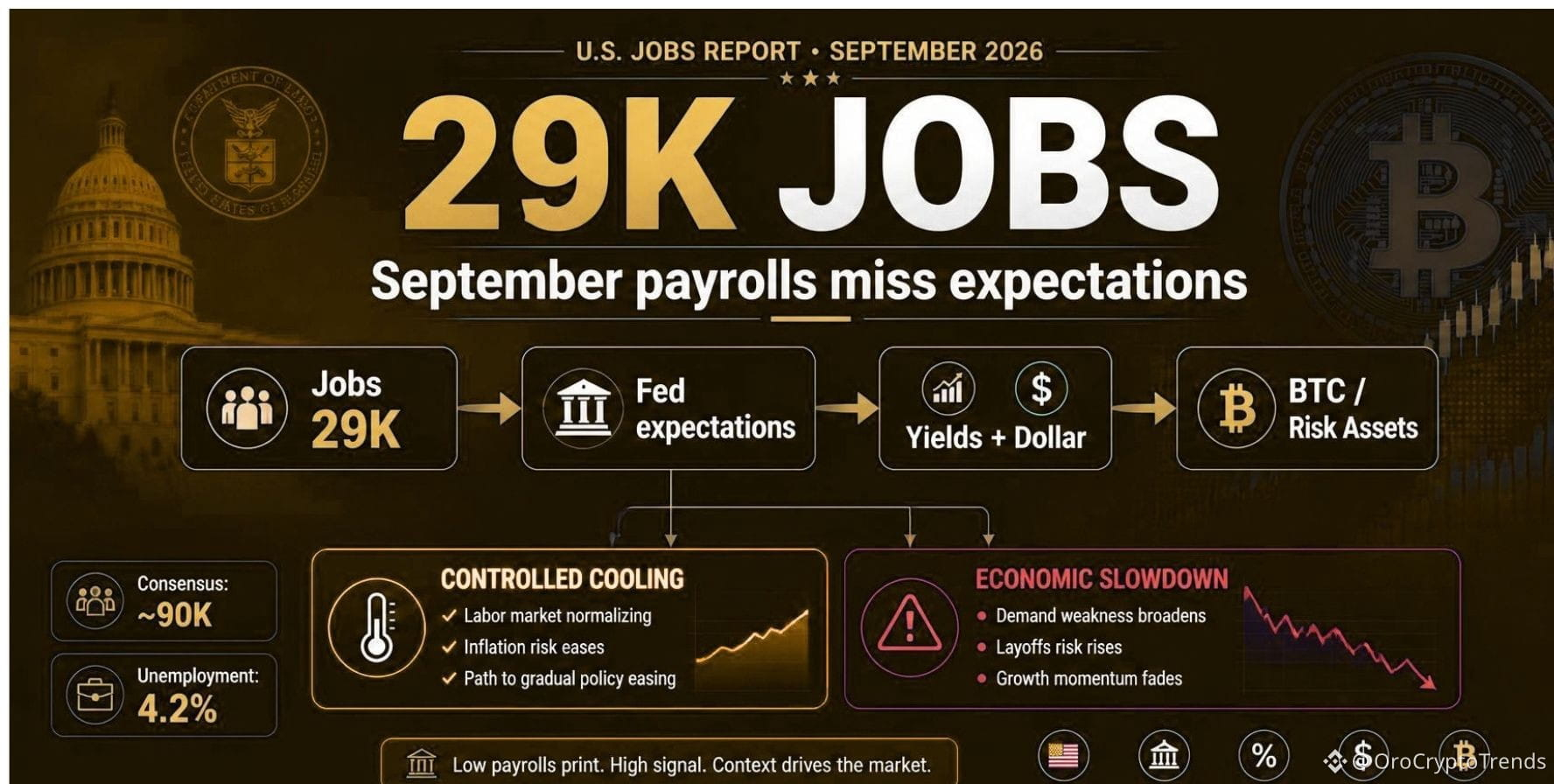
#NFPWatch 29K empleos. Ese es el número que cambia la conversación.
El informe de nóminas de EE. UU. de septiembre llegó muy por debajo del consenso aproximado de 90K, mientras que el desempleo subió al 4.2% desde el 4.1%.
Para las criptomonedas, creo que lo importante no es simplemente “empleos débiles = Bitcoin alcista”. Eso es demasiado fácil.
El mecanismo de transmisión más grande son las tasas.
Un mercado laboral más flojo puede reducir la presión sobre la Reserva Federal para seguir endureciendo, lo que puede llevar a que caigan los rendimientos del Tesoro y el dólar, y mejore el panorama relativo para los activos de riesgo. Reuters informó que los mercados se movieron hacia una probabilidad mucho menor de una subida de tasas en octubre después de los datos, mientras que las acciones subieron y los rendimientos del Tesoro cayeron.
Pero aquí hay una contradicción.
El empleo débil es favorable para los activos sensibles a las tasas solo si los inversores lo interpretan como un enfriamiento controlado. Si el mercado laboral comienza a deteriorarse rápidamente, la narrativa puede pasar de “la Fed menos restrictiva” a “desaceleración económica”.
Esa distinción importa para Bitcoin.
Así que estoy observando la reacción en los rendimientos, el dólar y el BTC, en lugar de tratar el titular de nóminas por sí solo como una señal de trading.
Aun así, sigo intentando averiguar qué es lo que esto realmente cambia.
#NFPWatch 29K empleos. Ese es el número que cambia la conversación.
El informe de nóminas de EE. UU. de septiembre llegó muy por debajo del consenso aproximado de 90K, mientras que el desempleo subió al 4.2% desde el 4.1%.
Para las criptomonedas, creo que lo importante no es simplemente “empleos débiles = Bitcoin alcista”. Eso es demasiado fácil.
El mecanismo de transmisión más grande son las tasas.
Un mercado laboral más flojo puede reducir la presión sobre la Reserva Federal para seguir endureciendo, lo que puede llevar a que caigan los rendimientos del Tesoro y el dólar, y mejore el panorama relativo para los activos de riesgo. Reuters informó que los mercados se movieron hacia una probabilidad mucho menor de una subida de tasas en octubre después de los datos, mientras que las acciones subieron y los rendimientos del Tesoro cayeron.
Pero aquí hay una contradicción.
El empleo débil es favorable para los activos sensibles a las tasas solo si los inversores lo interpretan como un enfriamiento controlado. Si el mercado laboral comienza a deteriorarse rápidamente, la narrativa puede pasar de “la Fed menos restrictiva” a “desaceleración económica”.
Esa distinción importa para Bitcoin.
Así que estoy observando la reacción en los rendimientos, el dólar y el BTC, en lugar de tratar el titular de nóminas por sí solo como una señal de trading.
Aun así, sigo intentando averiguar qué es lo que esto realmente cambia.
El informe de nóminas de EE. UU. de septiembre llegó muy por debajo del consenso aproximado de 90K, mientras que el desempleo subió al 4.2% desde el 4.1%.
Para las criptomonedas, creo que lo importante no es simplemente “empleos débiles = Bitcoin alcista”. Eso es demasiado fácil.
El mecanismo de transmisión más grande son las tasas.
Un mercado laboral más flojo puede reducir la presión sobre la Reserva Federal para seguir endureciendo, lo que puede llevar a que caigan los rendimientos del Tesoro y el dólar, y mejore el panorama relativo para los activos de riesgo. Reuters informó que los mercados se movieron hacia una probabilidad mucho menor de una subida de tasas en octubre después de los datos, mientras que las acciones subieron y los rendimientos del Tesoro cayeron.
Pero aquí hay una contradicción.
El empleo débil es favorable para los activos sensibles a las tasas solo si los inversores lo interpretan como un enfriamiento controlado. Si el mercado laboral comienza a deteriorarse rápidamente, la narrativa puede pasar de “la Fed menos restrictiva” a “desaceleración económica”.
Esa distinción importa para Bitcoin.
Así que estoy observando la reacción en los rendimientos, el dólar y el BTC, en lugar de tratar el titular de nóminas por sí solo como una señal de trading.
Aun así, sigo intentando averiguar qué es lo que esto realmente cambia.
3
1.9k
$NEAR $3.8M desaparecidos de NEAR Intents — y lo interesante es dónde ocurrió el fallo.
NEAR Intents dijo hoy que un error que involucró su infraestructura de depósito y retiro Omni y sus contratos inteligentes llevó a pérdidas de aproximadamente $3.8 millones. El equipo afirma que la vulnerabilidad fue corregida y que los usuarios afectados serán compensados por completo. Los depósitos y retiros en varias redes también se pausaron mientras se completa la solución.
Lo que me llama la atención es que esto no parece una historia simple de “la blockchain fue hackeada”. La debilidad reportada se encuentra alrededor de la infraestructura que conecta activos entre cadenas.
Esa distinción importa.
Los sistemas entre cadenas básicamente son conductos de confianza. Cada puente adicional, capa de custodia, mecanismo de liquidación o interacción de contrato crea otro lugar donde las suposiciones tienen que cumplirse. Puedes tener una buena supervisión en un lado y aun así salir herido cuando dos componentes interactúan de una manera que nadie esperaba.
Y sinceramente, probablemente esa sea la lección más grande aquí.
NEAR Intents acababa de demostrar su capacidad para bloquear gran parte de un flujo ilícito grande y separado días antes. Ahora, su propia infraestructura ha recibido el golpe.
El equipo dice que los usuarios quedarán completos, pero la compensación sigue siendo una promesa en lugar de un reembolso ya completado.
Así que estoy siguiendo el proceso de recuperación tan de cerca como el propio exploit.
Todavía tratando de averiguar qué es lo que realmente cambia.
$NEAR $3.8M desaparecidos de NEAR Intents — y lo interesante es dónde ocurrió el fallo.
NEAR Intents dijo hoy que un error que involucró su infraestructura de depósito y retiro Omni y sus contratos inteligentes llevó a pérdidas de aproximadamente $3.8 millones. El equipo afirma que la vulnerabilidad fue corregida y que los usuarios afectados serán compensados por completo. Los depósitos y retiros en varias redes también se pausaron mientras se completa la solución.
Lo que me llama la atención es que esto no parece una historia simple de “la blockchain fue hackeada”. La debilidad reportada se encuentra alrededor de la infraestructura que conecta activos entre cadenas.
Esa distinción importa.
Los sistemas entre cadenas básicamente son conductos de confianza. Cada puente adicional, capa de custodia, mecanismo de liquidación o interacción de contrato crea otro lugar donde las suposiciones tienen que cumplirse. Puedes tener una buena supervisión en un lado y aun así salir herido cuando dos componentes interactúan de una manera que nadie esperaba.
Y sinceramente, probablemente esa sea la lección más grande aquí.
NEAR Intents acababa de demostrar su capacidad para bloquear gran parte de un flujo ilícito grande y separado días antes. Ahora, su propia infraestructura ha recibido el golpe.
El equipo dice que los usuarios quedarán completos, pero la compensación sigue siendo una promesa en lugar de un reembolso ya completado.
Así que estoy siguiendo el proceso de recuperación tan de cerca como el propio exploit.
Todavía tratando de averiguar qué es lo que realmente cambia.
NEAR Intents dijo hoy que un error que involucró su infraestructura de depósito y retiro Omni y sus contratos inteligentes llevó a pérdidas de aproximadamente $3.8 millones. El equipo afirma que la vulnerabilidad fue corregida y que los usuarios afectados serán compensados por completo. Los depósitos y retiros en varias redes también se pausaron mientras se completa la solución.
Lo que me llama la atención es que esto no parece una historia simple de “la blockchain fue hackeada”. La debilidad reportada se encuentra alrededor de la infraestructura que conecta activos entre cadenas.
Esa distinción importa.
Los sistemas entre cadenas básicamente son conductos de confianza. Cada puente adicional, capa de custodia, mecanismo de liquidación o interacción de contrato crea otro lugar donde las suposiciones tienen que cumplirse. Puedes tener una buena supervisión en un lado y aun así salir herido cuando dos componentes interactúan de una manera que nadie esperaba.
Y sinceramente, probablemente esa sea la lección más grande aquí.
NEAR Intents acababa de demostrar su capacidad para bloquear gran parte de un flujo ilícito grande y separado días antes. Ahora, su propia infraestructura ha recibido el golpe.
El equipo dice que los usuarios quedarán completos, pero la compensación sigue siendo una promesa en lugar de un reembolso ya completado.
Así que estoy siguiendo el proceso de recuperación tan de cerca como el propio exploit.
Todavía tratando de averiguar qué es lo que realmente cambia.
2
993
$XLK.ETF
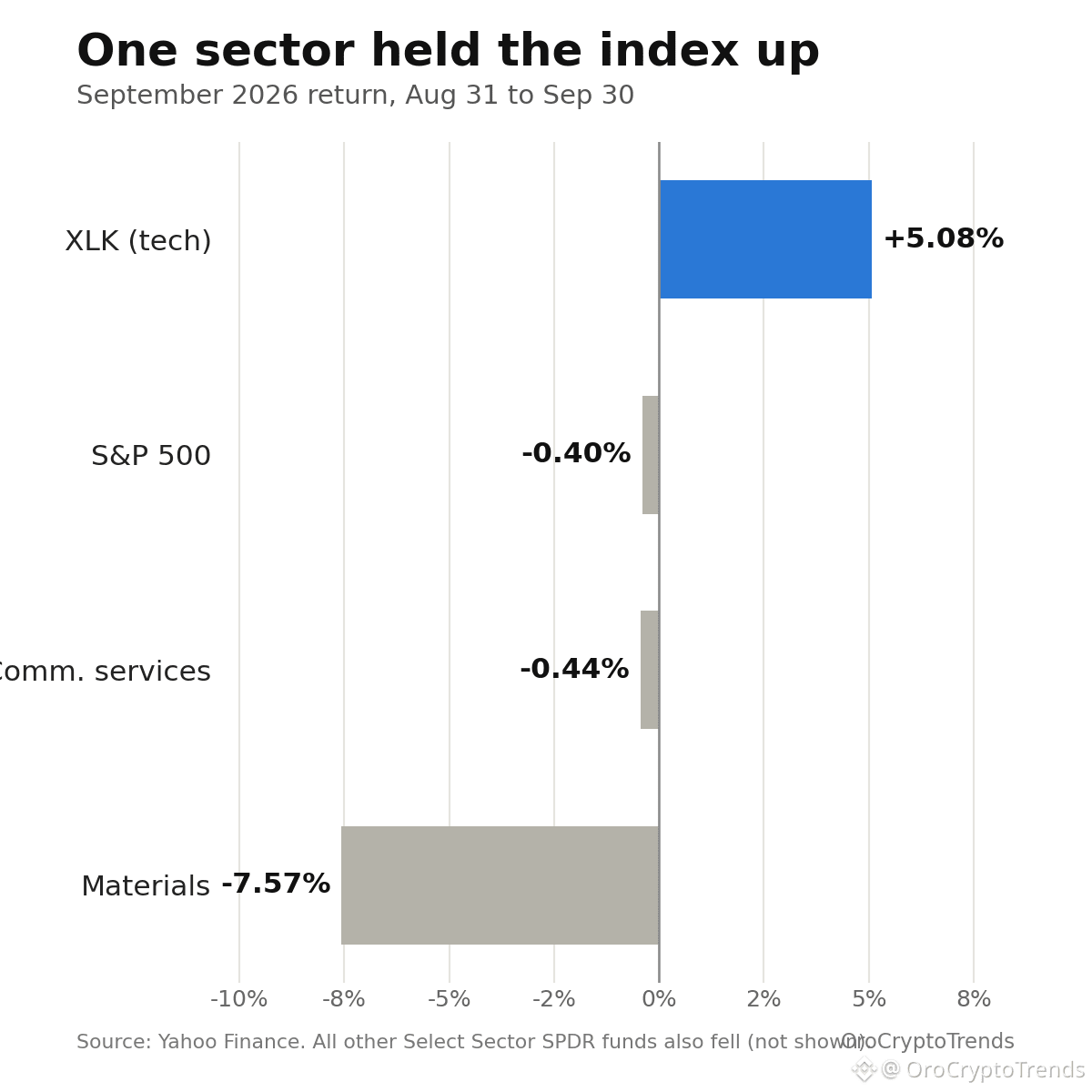
XLK devolvió un 5.08% en septiembre, mientras que todos los demás fondos sectoriales del S&P terminaron el mes en rojo.
Relee eso. Los materiales cayeron 7.57%, los servicios de comunicación perdieron 0.44% y el S&P 500 apenas retrocedió 0.4%. Un solo sector mantuvo el índice a flote.
Sigo viendo esto presentado como fortaleza tecnológica. Yo lo leo como un mercado con un solo pilar. La demanda de IA, el gasto en la nube y el impulso de los semiconductores son reales, pero el petróleo y los rendimientos del Tesoro estaban golpeando a la vez a los cíclicos y a los nombres sensibles a las tasas.
El dinero no rotó hacia el resto del mercado. Se aglomeró en la única operación que estaba funcionando. Eso parece fortaleza en el gráfico del índice, pero en realidad es fragilidad, porque el titular oculta cuán poco está participando.
El riesgo es sencillo. Si las ganancias de las mega-cap o la guía de semiconductores titubean, no hay nada debajo que pueda sostener el índice. Y si los rendimientos se mantienen elevados, el crecimiento de larga duración enfrenta presión sobre la valoración incluso con fundamentos sólidos.
Para los traders de cripto, esto importa. La aversión al riesgo que depende de un solo tema bursátil tiende a filtrarse hacia todo lo demás, así que estoy observando la amplitud más de cerca que el nivel del índice.
¿Estoy interpretándolo mal, o todos están celebrando una subida que en realidad es un problema de concentración?
$XLK.ETF
XLK devolvió un 5.08% en septiembre, mientras que todos los demás fondos sectoriales del S&P terminaron el mes en rojo.
Relee eso. Los materiales cayeron 7.57%, los servicios de comunicación perdieron 0.44% y el S&P 500 apenas retrocedió 0.4%. Un solo sector mantuvo el índice a flote.
Sigo viendo esto presentado como fortaleza tecnológica. Yo lo leo como un mercado con un solo pilar. La demanda de IA, el gasto en la nube y el impulso de los semiconductores son reales, pero el petróleo y los rendimientos del Tesoro estaban golpeando a la vez a los cíclicos y a los nombres sensibles a las tasas.
El dinero no rotó hacia el resto del mercado. Se aglomeró en la única operación que estaba funcionando. Eso parece fortaleza en el gráfico del índice, pero en realidad es fragilidad, porque el titular oculta cuán poco está participando.
El riesgo es sencillo. Si las ganancias de las mega-cap o la guía de semiconductores titubean, no hay nada debajo que pueda sostener el índice. Y si los rendimientos se mantienen elevados, el crecimiento de larga duración enfrenta presión sobre la valoración incluso con fundamentos sólidos.
Para los traders de cripto, esto importa. La aversión al riesgo que depende de un solo tema bursátil tiende a filtrarse hacia todo lo demás, así que estoy observando la amplitud más de cerca que el nivel del índice.
¿Estoy interpretándolo mal, o todos están celebrando una subida que en realidad es un problema de concentración?
XLK devolvió un 5.08% en septiembre, mientras que todos los demás fondos sectoriales del S&P terminaron el mes en rojo.
Relee eso. Los materiales cayeron 7.57%, los servicios de comunicación perdieron 0.44% y el S&P 500 apenas retrocedió 0.4%. Un solo sector mantuvo el índice a flote.
Sigo viendo esto presentado como fortaleza tecnológica. Yo lo leo como un mercado con un solo pilar. La demanda de IA, el gasto en la nube y el impulso de los semiconductores son reales, pero el petróleo y los rendimientos del Tesoro estaban golpeando a la vez a los cíclicos y a los nombres sensibles a las tasas.
El dinero no rotó hacia el resto del mercado. Se aglomeró en la única operación que estaba funcionando. Eso parece fortaleza en el gráfico del índice, pero en realidad es fragilidad, porque el titular oculta cuán poco está participando.
El riesgo es sencillo. Si las ganancias de las mega-cap o la guía de semiconductores titubean, no hay nada debajo que pueda sostener el índice. Y si los rendimientos se mantienen elevados, el crecimiento de larga duración enfrenta presión sobre la valoración incluso con fundamentos sólidos.
Para los traders de cripto, esto importa. La aversión al riesgo que depende de un solo tema bursátil tiende a filtrarse hacia todo lo demás, así que estoy observando la amplitud más de cerca que el nivel del índice.
¿Estoy interpretándolo mal, o todos están celebrando una subida que en realidad es un problema de concentración?
XLKETF+0.94%
SPYB+0.00%
2
332
8.065 ZEC en largo, casi 380.000 dólares bajo el agua — si la posición reportada es precisa, lo interesante no es la pérdida. Es la estructura de riesgo que hay detrás.
Un trader, según se informa, mantiene una enorme posición larga de ZEC en Hyperliquid mientras soporta una gran pérdida no realizada, después de que otra posición de varios millones de ZEC de la misma cuenta fuera liquidada.
Esa es la parte a la que vuelvo una y otra vez.
Una posición apalancada puede parecer manejable justo hasta que el umbral de liquidación se convierte en el único plazo real del mercado. Los costos de financiación siguen acumulándose, el margen se vuelve más delgado y cada movimiento contra la posición tiene un efecto mayor en la cuenta.
Y ZEC ha estado moviéndose con suficiente violencia últimamente como para que el apalancamiento convierta una tesis sólida en un problema de timing muy costoso.
Espera — quizá “alcista o bajista sobre ZEC” ni siquiera sea el marco adecuado aquí.
La pregunta más útil es cuán apalancado puede absorber el mercado antes de que las liquidaciones forzadas empiecen a convertirse en la propia historia.
El seguimiento reciente de Onchain Lens muestra lo grandes que se han vuelto las posiciones de ZEC en Hyperliquid, incluyendo traders que llevan exposición de varios millones de dólares en ambas direcciones.
Estoy observando los niveles de liquidación y los cambios de posición con más atención que el PnL de titular.
Aun así, sigo intentando averiguar qué es lo que esto realmente cambia.
8.065 ZEC en largo, casi 380.000 dólares bajo el agua — si la posición reportada es precisa, lo interesante no es la pérdida. Es la estructura de riesgo que hay detrás.
Un trader, según se informa, mantiene una enorme posición larga de ZEC en Hyperliquid mientras soporta una gran pérdida no realizada, después de que otra posición de varios millones de ZEC de la misma cuenta fuera liquidada.
Esa es la parte a la que vuelvo una y otra vez.
Una posición apalancada puede parecer manejable justo hasta que el umbral de liquidación se convierte en el único plazo real del mercado. Los costos de financiación siguen acumulándose, el margen se vuelve más delgado y cada movimiento contra la posición tiene un efecto mayor en la cuenta.
Y ZEC ha estado moviéndose con suficiente violencia últimamente como para que el apalancamiento convierta una tesis sólida en un problema de timing muy costoso.
Espera — quizá “alcista o bajista sobre ZEC” ni siquiera sea el marco adecuado aquí.
La pregunta más útil es cuán apalancado puede absorber el mercado antes de que las liquidaciones forzadas empiecen a convertirse en la propia historia.
El seguimiento reciente de Onchain Lens muestra lo grandes que se han vuelto las posiciones de ZEC en Hyperliquid, incluyendo traders que llevan exposición de varios millones de dólares en ambas direcciones.
Estoy observando los niveles de liquidación y los cambios de posición con más atención que el PnL de titular.
Aun así, sigo intentando averiguar qué es lo que esto realmente cambia.
Un trader, según se informa, mantiene una enorme posición larga de ZEC en Hyperliquid mientras soporta una gran pérdida no realizada, después de que otra posición de varios millones de ZEC de la misma cuenta fuera liquidada.
Esa es la parte a la que vuelvo una y otra vez.
Una posición apalancada puede parecer manejable justo hasta que el umbral de liquidación se convierte en el único plazo real del mercado. Los costos de financiación siguen acumulándose, el margen se vuelve más delgado y cada movimiento contra la posición tiene un efecto mayor en la cuenta.
Y ZEC ha estado moviéndose con suficiente violencia últimamente como para que el apalancamiento convierta una tesis sólida en un problema de timing muy costoso.
Espera — quizá “alcista o bajista sobre ZEC” ni siquiera sea el marco adecuado aquí.
La pregunta más útil es cuán apalancado puede absorber el mercado antes de que las liquidaciones forzadas empiecen a convertirse en la propia historia.
El seguimiento reciente de Onchain Lens muestra lo grandes que se han vuelto las posiciones de ZEC en Hyperliquid, incluyendo traders que llevan exposición de varios millones de dólares en ambas direcciones.
Estoy observando los niveles de liquidación y los cambios de posición con más atención que el PnL de titular.
Aun así, sigo intentando averiguar qué es lo que esto realmente cambia.
1.3k
$BTC US core PCE acaba de caer a 3.0% — y las criptomonedas reaccionaron al instante.
Las previsiones eran de 3.3%, así que la inflación más suave cambió de inmediato el relato sobre los tipos. Según se informa, Goldman Sachs movió la expectativa de su próximo incremento de la tasa de la Fed de octubre a diciembre, mientras que CME FedWatch mostró una probabilidad del 52.9% de mantenerla en octubre.
Y el BTC no esperó. Superó los $85K, mientras que el ETH recuperó los $2,700. Aproximadamente $255M en posiciones cortas en cripto fueron liquidadas.
Pero aquí está la parte que estoy vigilando.
Un PCE más suave no significa automáticamente que la Fed vaya a volverse agresivamente más “dovish”. La inflación todavía está por encima del objetivo del 2% de la Fed, y una sola lectura mensual no cambia todo el panorama macro.
Aun así, los mercados cotizan expectativas, no solo cifras absolutas. Si los traders empiezan a descontar menos subidas de tipos a corto plazo, los activos sensibles a la liquidez, como las criptomonedas, pueden reaccionar rápidamente.
Espera — quizá el mejor marco no sea “la inflación está resuelta”.
Más bien, es que el relato de la presión inmediata de los tipos se debilitó.
Esa distinción importa. Si los próximos datos de inflación y del mercado laboral confirman la tendencia, este movimiento podría tener más margen para desarrollarse. Si no, la reacción de hoy puede desvanecerse igual de rápido.
$BTC US core PCE acaba de caer a 3.0% — y las criptomonedas reaccionaron al instante.
Las previsiones eran de 3.3%, así que la inflación más suave cambió de inmediato el relato sobre los tipos. Según se informa, Goldman Sachs movió la expectativa de su próximo incremento de la tasa de la Fed de octubre a diciembre, mientras que CME FedWatch mostró una probabilidad del 52.9% de mantenerla en octubre.
Y el BTC no esperó. Superó los $85K, mientras que el ETH recuperó los $2,700. Aproximadamente $255M en posiciones cortas en cripto fueron liquidadas.
Pero aquí está la parte que estoy vigilando.
Un PCE más suave no significa automáticamente que la Fed vaya a volverse agresivamente más “dovish”. La inflación todavía está por encima del objetivo del 2% de la Fed, y una sola lectura mensual no cambia todo el panorama macro.
Aun así, los mercados cotizan expectativas, no solo cifras absolutas. Si los traders empiezan a descontar menos subidas de tipos a corto plazo, los activos sensibles a la liquidez, como las criptomonedas, pueden reaccionar rápidamente.
Espera — quizá el mejor marco no sea “la inflación está resuelta”.
Más bien, es que el relato de la presión inmediata de los tipos se debilitó.
Esa distinción importa. Si los próximos datos de inflación y del mercado laboral confirman la tendencia, este movimiento podría tener más margen para desarrollarse. Si no, la reacción de hoy puede desvanecerse igual de rápido.
Las previsiones eran de 3.3%, así que la inflación más suave cambió de inmediato el relato sobre los tipos. Según se informa, Goldman Sachs movió la expectativa de su próximo incremento de la tasa de la Fed de octubre a diciembre, mientras que CME FedWatch mostró una probabilidad del 52.9% de mantenerla en octubre.
Y el BTC no esperó. Superó los $85K, mientras que el ETH recuperó los $2,700. Aproximadamente $255M en posiciones cortas en cripto fueron liquidadas.
Pero aquí está la parte que estoy vigilando.
Un PCE más suave no significa automáticamente que la Fed vaya a volverse agresivamente más “dovish”. La inflación todavía está por encima del objetivo del 2% de la Fed, y una sola lectura mensual no cambia todo el panorama macro.
Aun así, los mercados cotizan expectativas, no solo cifras absolutas. Si los traders empiezan a descontar menos subidas de tipos a corto plazo, los activos sensibles a la liquidez, como las criptomonedas, pueden reaccionar rápidamente.
Espera — quizá el mejor marco no sea “la inflación está resuelta”.
Más bien, es que el relato de la presión inmediata de los tipos se debilitó.
Esa distinción importa. Si los próximos datos de inflación y del mercado laboral confirman la tendencia, este movimiento podría tener más margen para desarrollarse. Si no, la reacción de hoy puede desvanecerse igual de rápido.

1.3k
$BTC $3.55B fluyeron hacia productos de inversión en activos digitales la semana pasada. Ese es el mayor flujo semanal de 2026 — y Bitcoin captó $2.52B de ese total.
Sinceramente, esto es más interesante de lo que suena el titular.
Lo que estoy vigilando no es solo el tamaño de la cifra. Es hacia dónde está yendo el dinero. Bitcoin capturó aproximadamente el 71% del total semanal, mientras que Ethereum también atrajo $702M. El AUM total (activos bajo gestión) en productos de inversión en activos digitales subió hasta alrededor de $173B.
Esto me dice que la demanda institucional no está desapareciendo cuando las criptomonedas se vuelven aburridas. Sigue ahí, pero se está mostrando a través de productos de inversión regulados en lugar del tipo de euforia minorista que normalmente asociamos con flujos fuertes.
Pero espera — no creo que $3.55B signifique automáticamente que la próxima subida esté garantizada.
Los flujos semanales pueden ser una confirmación potente, pero aun así son una instantánea. La gran pregunta es si este nivel de asignación se mantiene después de que se apaga el impulso inicial de la demanda.
Esa es la parte que voy a seguir ahora: no si las instituciones volvieron, sino si siguen volviendo.
Todavía intento averiguar si esto es el inicio de una tendencia más amplia de asignación o simplemente una semana muy fuerte.
$BTC $3.55B fluyeron hacia productos de inversión en activos digitales la semana pasada. Ese es el mayor flujo semanal de 2026 — y Bitcoin captó $2.52B de ese total.
Sinceramente, esto es más interesante de lo que suena el titular.
Lo que estoy vigilando no es solo el tamaño de la cifra. Es hacia dónde está yendo el dinero. Bitcoin capturó aproximadamente el 71% del total semanal, mientras que Ethereum también atrajo $702M. El AUM total (activos bajo gestión) en productos de inversión en activos digitales subió hasta alrededor de $173B.
Esto me dice que la demanda institucional no está desapareciendo cuando las criptomonedas se vuelven aburridas. Sigue ahí, pero se está mostrando a través de productos de inversión regulados en lugar del tipo de euforia minorista que normalmente asociamos con flujos fuertes.
Pero espera — no creo que $3.55B signifique automáticamente que la próxima subida esté garantizada.
Los flujos semanales pueden ser una confirmación potente, pero aun así son una instantánea. La gran pregunta es si este nivel de asignación se mantiene después de que se apaga el impulso inicial de la demanda.
Esa es la parte que voy a seguir ahora: no si las instituciones volvieron, sino si siguen volviendo.
Todavía intento averiguar si esto es el inicio de una tendencia más amplia de asignación o simplemente una semana muy fuerte.
Sinceramente, esto es más interesante de lo que suena el titular.
Lo que estoy vigilando no es solo el tamaño de la cifra. Es hacia dónde está yendo el dinero. Bitcoin capturó aproximadamente el 71% del total semanal, mientras que Ethereum también atrajo $702M. El AUM total (activos bajo gestión) en productos de inversión en activos digitales subió hasta alrededor de $173B.
Esto me dice que la demanda institucional no está desapareciendo cuando las criptomonedas se vuelven aburridas. Sigue ahí, pero se está mostrando a través de productos de inversión regulados en lugar del tipo de euforia minorista que normalmente asociamos con flujos fuertes.
Pero espera — no creo que $3.55B signifique automáticamente que la próxima subida esté garantizada.
Los flujos semanales pueden ser una confirmación potente, pero aun así son una instantánea. La gran pregunta es si este nivel de asignación se mantiene después de que se apaga el impulso inicial de la demanda.
Esa es la parte que voy a seguir ahora: no si las instituciones volvieron, sino si siguen volviendo.
Todavía intento averiguar si esto es el inicio de una tendencia más amplia de asignación o simplemente una semana muy fuerte.
369
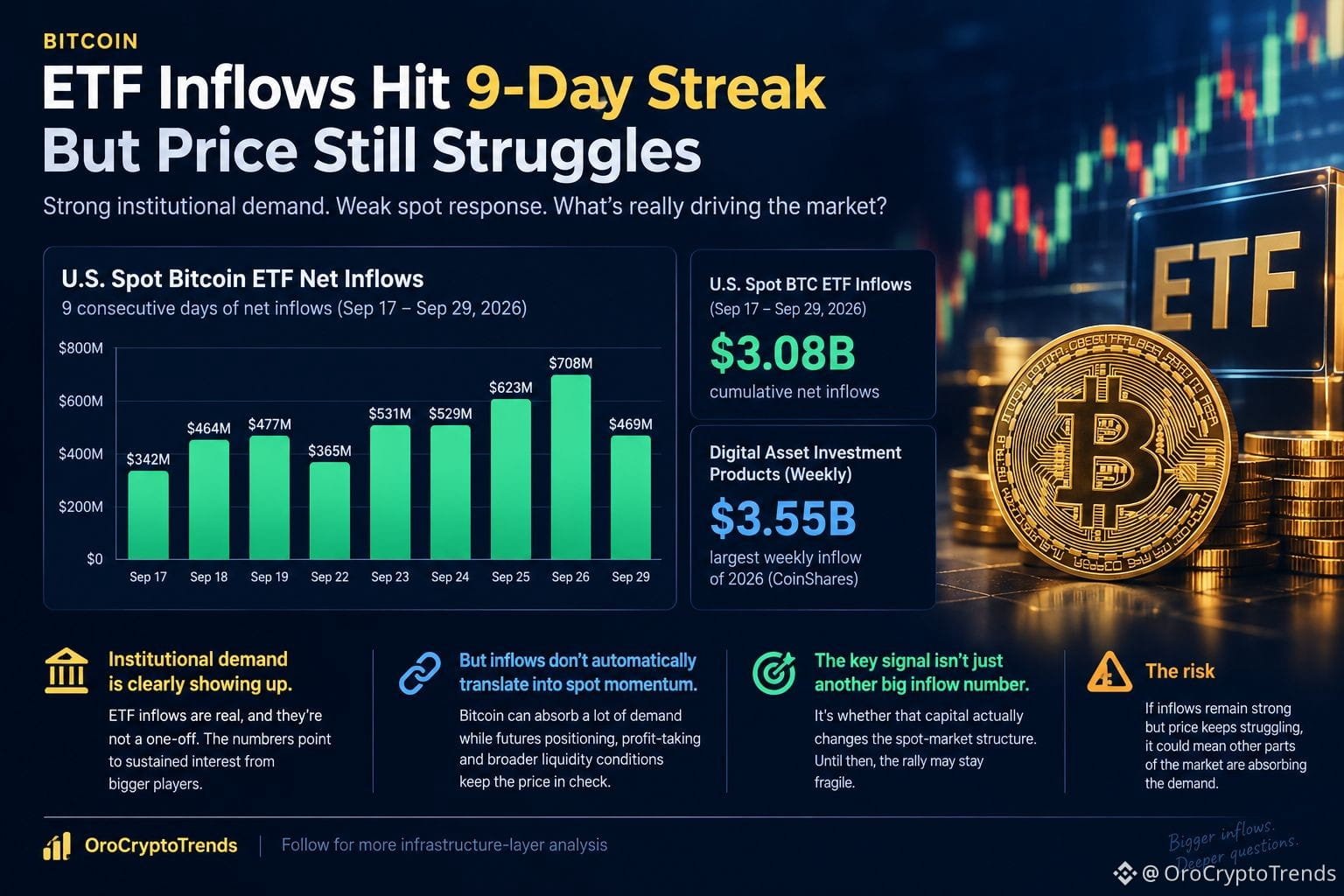
$BTC 9 días consecutivos de operaciones de entradas de BTC a ETF — y Bitcoin todavía no puede hacer que el movimiento se vea fácil.
Esa es la parte a la que sigo volviendo.
Del 17 de septiembre al 29 de septiembre, los ETF de Bitcoin al contado en EE. UU. registraron aproximadamente $3.08B en entradas netas acumuladas, según datos de Farside. CoinShares también informó que $3.55B fluyeron hacia productos de inversión en activos digitales en la última semana, la mayor entrada semanal de 2026 hasta ahora.
Así que sí, la demanda institucional se ve claramente.
Pero aquí es donde me convence menos la interpretación alcista.
El dinero que entra a los ETF no significa automáticamente impulso inmediato en el mercado al contado. Bitcoin puede absorber una demanda considerable mientras que la colocación en futuros, la toma de ganancias y las condiciones de liquidez más amplias impiden que el precio acelere.
Esa distinción importa.
Si las entradas a los ETF siguen acumulándose y la demanda al contado empieza a traducirse en un mejor proceso de descubrimiento de precios, la estructura se vuelve mucho más convincente. Si las entradas se mantienen fuertes mientras el precio sigue luchando, lo interpretaría como una señal de que otras partes del mercado están absorbiendo esa demanda.
Honestamente, creo que la próxima señal no es simplemente otro número grande de entradas. Es si ese capital realmente cambia la estructura del mercado al contado.
Sigo intentando entender qué es lo que esto cambia en realidad.
Sígueme para más análisis de la capa de infraestructura
$BTC 9 días consecutivos de operaciones de entradas de BTC a ETF — y Bitcoin todavía no puede hacer que el movimiento se vea fácil.
Esa es la parte a la que sigo volviendo.
Del 17 de septiembre al 29 de septiembre, los ETF de Bitcoin al contado en EE. UU. registraron aproximadamente $3.08B en entradas netas acumuladas, según datos de Farside. CoinShares también informó que $3.55B fluyeron hacia productos de inversión en activos digitales en la última semana, la mayor entrada semanal de 2026 hasta ahora.
Así que sí, la demanda institucional se ve claramente.
Pero aquí es donde me convence menos la interpretación alcista.
El dinero que entra a los ETF no significa automáticamente impulso inmediato en el mercado al contado. Bitcoin puede absorber una demanda considerable mientras que la colocación en futuros, la toma de ganancias y las condiciones de liquidez más amplias impiden que el precio acelere.
Esa distinción importa.
Si las entradas a los ETF siguen acumulándose y la demanda al contado empieza a traducirse en un mejor proceso de descubrimiento de precios, la estructura se vuelve mucho más convincente. Si las entradas se mantienen fuertes mientras el precio sigue luchando, lo interpretaría como una señal de que otras partes del mercado están absorbiendo esa demanda.
Honestamente, creo que la próxima señal no es simplemente otro número grande de entradas. Es si ese capital realmente cambia la estructura del mercado al contado.
Sigo intentando entender qué es lo que esto cambia en realidad.
Sígueme para más análisis de la capa de infraestructura
Esa es la parte a la que sigo volviendo.
Del 17 de septiembre al 29 de septiembre, los ETF de Bitcoin al contado en EE. UU. registraron aproximadamente $3.08B en entradas netas acumuladas, según datos de Farside. CoinShares también informó que $3.55B fluyeron hacia productos de inversión en activos digitales en la última semana, la mayor entrada semanal de 2026 hasta ahora.
Así que sí, la demanda institucional se ve claramente.
Pero aquí es donde me convence menos la interpretación alcista.
El dinero que entra a los ETF no significa automáticamente impulso inmediato en el mercado al contado. Bitcoin puede absorber una demanda considerable mientras que la colocación en futuros, la toma de ganancias y las condiciones de liquidez más amplias impiden que el precio acelere.
Esa distinción importa.
Si las entradas a los ETF siguen acumulándose y la demanda al contado empieza a traducirse en un mejor proceso de descubrimiento de precios, la estructura se vuelve mucho más convincente. Si las entradas se mantienen fuertes mientras el precio sigue luchando, lo interpretaría como una señal de que otras partes del mercado están absorbiendo esa demanda.
Honestamente, creo que la próxima señal no es simplemente otro número grande de entradas. Es si ese capital realmente cambia la estructura del mercado al contado.
Sigo intentando entender qué es lo que esto cambia en realidad.
Sígueme para más análisis de la capa de infraestructura
4
2.1k
Verificado
$XRP Brasil acaba de darle a la XRP Ledger un caso de uso mucho más interesante que otro simple ejemplo de tokenización.
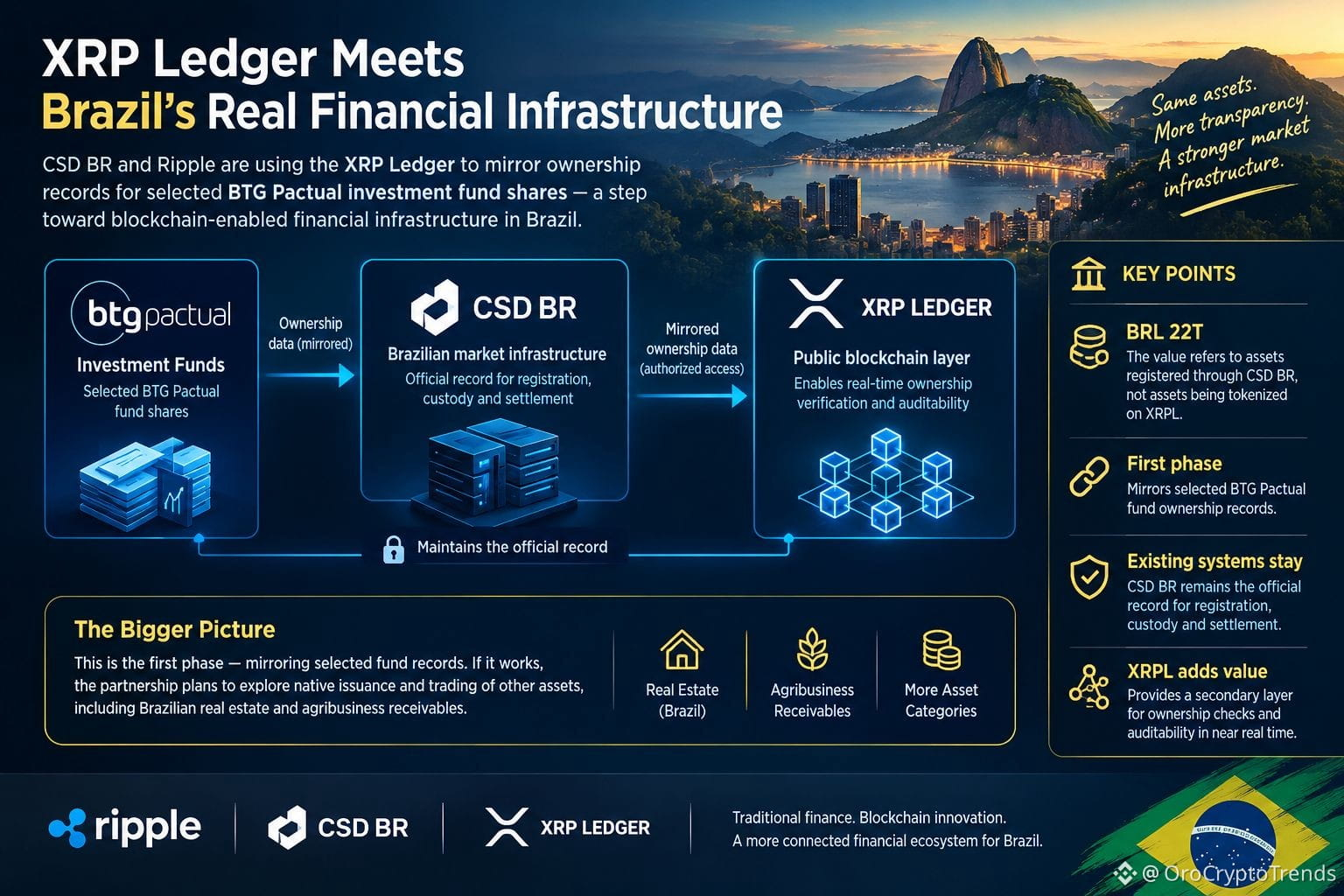
CSD BR, un operador de infraestructura de mercado brasileño regulado con más de 22 billones de BRL en activos registrados, ahora utiliza XRPL para reflejar registros de propiedad de acciones seleccionadas de fondos de inversión de BTG Pactual.
Pero esperen — la cifra de 22 billones de BRL necesita contexto. Ese monto completo NO se está moviendo a XRPL.
El sistema existente de CSD BR sigue siendo el registro oficial para la inscripción, la custodia y la liquidación. XRPL se está agregando como una capa secundaria donde las instituciones autorizadas pueden verificar datos de propiedad y auditar cambios en tiempo casi real.
Honestamente, creo que esa distinción lo hace más interesante, no menos.
El verdadero experimento aquí es si una blockchain pública puede coexistir junto a una infraestructura financiera crítica sin obligar a las instituciones a abandonar los sistemas que ya confían.
Ese es un camino de adopción muy distinto de “poner todo en la cadena”.
Y si funciona la fase de replicación, la asociación dice que planea explorar la emisión y negociación nativas de otros activos, incluidos bienes raíces en Brasil y cuentas por cobrar del sector agro.
Así que yo estoy observando la capa de infraestructura más que el titular.
La gran pregunta no es si XRPL puede tokenizar un activo. Es si las instituciones reguladas encuentran suficiente valor operativo como para seguir ampliando el papel del libro mayor.
Todavía intentando descubrir qué es lo que realmente cambia.
$XRP Brasil acaba de darle a la XRP Ledger un caso de uso mucho más interesante que otro simple ejemplo de tokenización.
CSD BR, un operador de infraestructura de mercado brasileño regulado con más de 22 billones de BRL en activos registrados, ahora utiliza XRPL para reflejar registros de propiedad de acciones seleccionadas de fondos de inversión de BTG Pactual.
Pero esperen — la cifra de 22 billones de BRL necesita contexto. Ese monto completo NO se está moviendo a XRPL.
El sistema existente de CSD BR sigue siendo el registro oficial para la inscripción, la custodia y la liquidación. XRPL se está agregando como una capa secundaria donde las instituciones autorizadas pueden verificar datos de propiedad y auditar cambios en tiempo casi real.
Honestamente, creo que esa distinción lo hace más interesante, no menos.
El verdadero experimento aquí es si una blockchain pública puede coexistir junto a una infraestructura financiera crítica sin obligar a las instituciones a abandonar los sistemas que ya confían.
Ese es un camino de adopción muy distinto de “poner todo en la cadena”.
Y si funciona la fase de replicación, la asociación dice que planea explorar la emisión y negociación nativas de otros activos, incluidos bienes raíces en Brasil y cuentas por cobrar del sector agro.
Así que yo estoy observando la capa de infraestructura más que el titular.
La gran pregunta no es si XRPL puede tokenizar un activo. Es si las instituciones reguladas encuentran suficiente valor operativo como para seguir ampliando el papel del libro mayor.
Todavía intentando descubrir qué es lo que realmente cambia.
CSD BR, un operador de infraestructura de mercado brasileño regulado con más de 22 billones de BRL en activos registrados, ahora utiliza XRPL para reflejar registros de propiedad de acciones seleccionadas de fondos de inversión de BTG Pactual.
Pero esperen — la cifra de 22 billones de BRL necesita contexto. Ese monto completo NO se está moviendo a XRPL.
El sistema existente de CSD BR sigue siendo el registro oficial para la inscripción, la custodia y la liquidación. XRPL se está agregando como una capa secundaria donde las instituciones autorizadas pueden verificar datos de propiedad y auditar cambios en tiempo casi real.
Honestamente, creo que esa distinción lo hace más interesante, no menos.
El verdadero experimento aquí es si una blockchain pública puede coexistir junto a una infraestructura financiera crítica sin obligar a las instituciones a abandonar los sistemas que ya confían.
Ese es un camino de adopción muy distinto de “poner todo en la cadena”.
Y si funciona la fase de replicación, la asociación dice que planea explorar la emisión y negociación nativas de otros activos, incluidos bienes raíces en Brasil y cuentas por cobrar del sector agro.
Así que yo estoy observando la capa de infraestructura más que el titular.
La gran pregunta no es si XRPL puede tokenizar un activo. Es si las instituciones reguladas encuentran suficiente valor operativo como para seguir ampliando el papel del libro mayor.
Todavía intentando descubrir qué es lo que realmente cambia.
1
5
2k
Verificado
$BNB CZ publicó “Pronto....” y de repente la gente lo está tomando como el inicio del “BNB szn.”
Quizá. Pero creo que lo más interesante es lo que está pasando alrededor de ese meme.
CZ también compartió contenido alcista de BNB Chain señalando que las acciones tokenizadas de EE. UU. se están moviendo on-chain. BNB Chain dice que su ecosistema tenía más de 709 acciones tokenizadas y ETFs para junio, con un volumen acumulado de acciones tokenizadas por encima de $5B. Esa es una tendencia real de infraestructura, no solo un meme.
Luego está la parte corporativa.
CEA Industries se convirtió oficialmente en BNB Standard Corporation el 29 de septiembre, manteniendo el ticker de Nasdaq BNC. La empresa dijo que se emitieron casi 5,800 votos de la comunidad sobre el nuevo nombre, y que BNB Standard recibió alrededor del 47%.
Esa combinación es lo que capta mi atención: expansión del ecosistema, activos tokenizados y una empresa pública construyéndose explícitamente alrededor de una tesorería de BNB.
Pero espera: tal vez le estoy dando demasiado peso al meme.
“Pronto....” no es una señal confirmada de CZ de que BNB esté a punto de subir. Bonk Guy lo interpretó de esa manera; el mercado todavía tiene que validar la narrativa.
Para mí, la pregunta real es si estos catalizadores se traducen en un uso sostenido y flujos de capital, en lugar de otra narrativa de corta duración.
Aún tratando de averiguar qué es lo que esto realmente cambia.
$BNB CZ publicó “Pronto....” y de repente la gente lo está tomando como el inicio del “BNB szn.”
Quizá. Pero creo que lo más interesante es lo que está pasando alrededor de ese meme.
CZ también compartió contenido alcista de BNB Chain señalando que las acciones tokenizadas de EE. UU. se están moviendo on-chain. BNB Chain dice que su ecosistema tenía más de 709 acciones tokenizadas y ETFs para junio, con un volumen acumulado de acciones tokenizadas por encima de $5B. Esa es una tendencia real de infraestructura, no solo un meme.
Luego está la parte corporativa.
CEA Industries se convirtió oficialmente en BNB Standard Corporation el 29 de septiembre, manteniendo el ticker de Nasdaq BNC. La empresa dijo que se emitieron casi 5,800 votos de la comunidad sobre el nuevo nombre, y que BNB Standard recibió alrededor del 47%.
Esa combinación es lo que capta mi atención: expansión del ecosistema, activos tokenizados y una empresa pública construyéndose explícitamente alrededor de una tesorería de BNB.
Pero espera: tal vez le estoy dando demasiado peso al meme.
“Pronto....” no es una señal confirmada de CZ de que BNB esté a punto de subir. Bonk Guy lo interpretó de esa manera; el mercado todavía tiene que validar la narrativa.
Para mí, la pregunta real es si estos catalizadores se traducen en un uso sostenido y flujos de capital, en lugar de otra narrativa de corta duración.
Aún tratando de averiguar qué es lo que esto realmente cambia.
Quizá. Pero creo que lo más interesante es lo que está pasando alrededor de ese meme.
CZ también compartió contenido alcista de BNB Chain señalando que las acciones tokenizadas de EE. UU. se están moviendo on-chain. BNB Chain dice que su ecosistema tenía más de 709 acciones tokenizadas y ETFs para junio, con un volumen acumulado de acciones tokenizadas por encima de $5B. Esa es una tendencia real de infraestructura, no solo un meme.
Luego está la parte corporativa.
CEA Industries se convirtió oficialmente en BNB Standard Corporation el 29 de septiembre, manteniendo el ticker de Nasdaq BNC. La empresa dijo que se emitieron casi 5,800 votos de la comunidad sobre el nuevo nombre, y que BNB Standard recibió alrededor del 47%.
Esa combinación es lo que capta mi atención: expansión del ecosistema, activos tokenizados y una empresa pública construyéndose explícitamente alrededor de una tesorería de BNB.
Pero espera: tal vez le estoy dando demasiado peso al meme.
“Pronto....” no es una señal confirmada de CZ de que BNB esté a punto de subir. Bonk Guy lo interpretó de esa manera; el mercado todavía tiene que validar la narrativa.
Para mí, la pregunta real es si estos catalizadores se traducen en un uso sostenido y flujos de capital, en lugar de otra narrativa de corta duración.
Aún tratando de averiguar qué es lo que esto realmente cambia.
3
3
4k
El 30 de septiembre es una fecha más grande para la cripto en el Reino Unido de lo que el titular da a entender.
La nueva ventana de autorización de la FCA abre hoy, y las empresas tienen hasta el 28 de febrero de 2027 para solicitar si quieren acogerse a las disposiciones de ahorro correspondientes. El régimen más amplio está previsto que entre en vigor el 25 de octubre de 2027.
Lo que capta mi atención no es simplemente “más regulación de cripto”.
Es que la autorización se está convirtiendo en parte de la infraestructura operativa real.
Las plataformas de trading, la intermediación y la organización, la salvaguarda, el staking y la emisión de stablecoins calificadas son algunas de las actividades que pasan a formar parte del nuevo marco. Y las inscripciones existentes no se convertirán automáticamente en los nuevos permisos.
Eso cambia la economía.
Un negocio cripto que opere en el Reino Unido tendrá cada vez más que tratar el cumplimiento, los controles, la custodia y la presentación de informes como parte del producto en sí — no como algo que queda al margen del negocio.
Y aquí hay un intercambio real.
Los estándares más altos pueden fortalecer la protección del consumidor y la integridad del mercado. Pero el costo de cumplir con esos estándares también podría afectar qué empresas pueden atender de manera económicamente viable a los usuarios del Reino Unido.
Por eso me interesa menos si esto es “alcista” o “bajista” para la cripto.
La pregunta más interesante es qué modelos de negocio siguen funcionando cuando la regulación pasa a formar parte del conjunto de infraestructura.
Aún tratando de averiguar qué es lo que realmente cambia.
El 30 de septiembre es una fecha más grande para la cripto en el Reino Unido de lo que el titular da a entender.
La nueva ventana de autorización de la FCA abre hoy, y las empresas tienen hasta el 28 de febrero de 2027 para solicitar si quieren acogerse a las disposiciones de ahorro correspondientes. El régimen más amplio está previsto que entre en vigor el 25 de octubre de 2027.
Lo que capta mi atención no es simplemente “más regulación de cripto”.
Es que la autorización se está convirtiendo en parte de la infraestructura operativa real.
Las plataformas de trading, la intermediación y la organización, la salvaguarda, el staking y la emisión de stablecoins calificadas son algunas de las actividades que pasan a formar parte del nuevo marco. Y las inscripciones existentes no se convertirán automáticamente en los nuevos permisos.
Eso cambia la economía.
Un negocio cripto que opere en el Reino Unido tendrá cada vez más que tratar el cumplimiento, los controles, la custodia y la presentación de informes como parte del producto en sí — no como algo que queda al margen del negocio.
Y aquí hay un intercambio real.
Los estándares más altos pueden fortalecer la protección del consumidor y la integridad del mercado. Pero el costo de cumplir con esos estándares también podría afectar qué empresas pueden atender de manera económicamente viable a los usuarios del Reino Unido.
Por eso me interesa menos si esto es “alcista” o “bajista” para la cripto.
La pregunta más interesante es qué modelos de negocio siguen funcionando cuando la regulación pasa a formar parte del conjunto de infraestructura.
Aún tratando de averiguar qué es lo que realmente cambia.
La nueva ventana de autorización de la FCA abre hoy, y las empresas tienen hasta el 28 de febrero de 2027 para solicitar si quieren acogerse a las disposiciones de ahorro correspondientes. El régimen más amplio está previsto que entre en vigor el 25 de octubre de 2027.
Lo que capta mi atención no es simplemente “más regulación de cripto”.
Es que la autorización se está convirtiendo en parte de la infraestructura operativa real.
Las plataformas de trading, la intermediación y la organización, la salvaguarda, el staking y la emisión de stablecoins calificadas son algunas de las actividades que pasan a formar parte del nuevo marco. Y las inscripciones existentes no se convertirán automáticamente en los nuevos permisos.
Eso cambia la economía.
Un negocio cripto que opere en el Reino Unido tendrá cada vez más que tratar el cumplimiento, los controles, la custodia y la presentación de informes como parte del producto en sí — no como algo que queda al margen del negocio.
Y aquí hay un intercambio real.
Los estándares más altos pueden fortalecer la protección del consumidor y la integridad del mercado. Pero el costo de cumplir con esos estándares también podría afectar qué empresas pueden atender de manera económicamente viable a los usuarios del Reino Unido.
Por eso me interesa menos si esto es “alcista” o “bajista” para la cripto.
La pregunta más interesante es qué modelos de negocio siguen funcionando cuando la regulación pasa a formar parte del conjunto de infraestructura.
Aún tratando de averiguar qué es lo que realmente cambia.

1
2.4k
El Reino Unido acaba de abrir la puerta a su nuevo régimen de autorización de cripto.
A partir del 30 de septiembre, las empresas pueden empezar a solicitar a la FCA la autorización bajo el nuevo marco de criptoactivos del Reino Unido. La ventana de solicitudes se extiende hasta el 28 de febrero de 2027, mientras que el régimen completo está previsto que entre en vigor el 25 de octubre de 2027.
Lo que destaca para mí no es solo el titular de “regulación de cripto”.
Es el cambio en lo que realmente se requerirá para operar un negocio de cripto en el Reino Unido.
La FCA dice que el nuevo régimen cubre actividades que incluyen plataformas de negociación de criptoactivos, intermediación y gestión, salvaguardas, acuerdos de staking y la emisión cualificada de stablecoins. Las inscripciones existentes tampoco se convertirán automáticamente y sin más en los nuevos permisos.
Esto es importante porque la regulación está pasando de ser algo que las empresas preparan a ser algo que cada vez está más integrado en la infraestructura del mercado.
Pero aquí hay un intercambio.
Los estándares más altos pueden mejorar la protección al consumidor y la integridad del mercado, aunque el costo y la complejidad de la autorización también podrían cambiar qué empresas pueden realmente atender a usuarios del Reino Unido.
Así que me interesa menos saber si esto es “alcista” o “bajista” para las criptomonedas.
La pregunta más grande es qué modelos de negocio siguen teniendo sentido económico una vez que el cumplimiento pasa a formar parte del “stack” operativo.
Todavía estoy intentando entender qué es lo que esto cambia realmente.
El Reino Unido acaba de abrir la puerta a su nuevo régimen de autorización de cripto.
A partir del 30 de septiembre, las empresas pueden empezar a solicitar a la FCA la autorización bajo el nuevo marco de criptoactivos del Reino Unido. La ventana de solicitudes se extiende hasta el 28 de febrero de 2027, mientras que el régimen completo está previsto que entre en vigor el 25 de octubre de 2027.
Lo que destaca para mí no es solo el titular de “regulación de cripto”.
Es el cambio en lo que realmente se requerirá para operar un negocio de cripto en el Reino Unido.
La FCA dice que el nuevo régimen cubre actividades que incluyen plataformas de negociación de criptoactivos, intermediación y gestión, salvaguardas, acuerdos de staking y la emisión cualificada de stablecoins. Las inscripciones existentes tampoco se convertirán automáticamente y sin más en los nuevos permisos.
Esto es importante porque la regulación está pasando de ser algo que las empresas preparan a ser algo que cada vez está más integrado en la infraestructura del mercado.
Pero aquí hay un intercambio.
Los estándares más altos pueden mejorar la protección al consumidor y la integridad del mercado, aunque el costo y la complejidad de la autorización también podrían cambiar qué empresas pueden realmente atender a usuarios del Reino Unido.
Así que me interesa menos saber si esto es “alcista” o “bajista” para las criptomonedas.
La pregunta más grande es qué modelos de negocio siguen teniendo sentido económico una vez que el cumplimiento pasa a formar parte del “stack” operativo.
Todavía estoy intentando entender qué es lo que esto cambia realmente.
A partir del 30 de septiembre, las empresas pueden empezar a solicitar a la FCA la autorización bajo el nuevo marco de criptoactivos del Reino Unido. La ventana de solicitudes se extiende hasta el 28 de febrero de 2027, mientras que el régimen completo está previsto que entre en vigor el 25 de octubre de 2027.
Lo que destaca para mí no es solo el titular de “regulación de cripto”.
Es el cambio en lo que realmente se requerirá para operar un negocio de cripto en el Reino Unido.
La FCA dice que el nuevo régimen cubre actividades que incluyen plataformas de negociación de criptoactivos, intermediación y gestión, salvaguardas, acuerdos de staking y la emisión cualificada de stablecoins. Las inscripciones existentes tampoco se convertirán automáticamente y sin más en los nuevos permisos.
Esto es importante porque la regulación está pasando de ser algo que las empresas preparan a ser algo que cada vez está más integrado en la infraestructura del mercado.
Pero aquí hay un intercambio.
Los estándares más altos pueden mejorar la protección al consumidor y la integridad del mercado, aunque el costo y la complejidad de la autorización también podrían cambiar qué empresas pueden realmente atender a usuarios del Reino Unido.
Así que me interesa menos saber si esto es “alcista” o “bajista” para las criptomonedas.
La pregunta más grande es qué modelos de negocio siguen teniendo sentido económico una vez que el cumplimiento pasa a formar parte del “stack” operativo.
Todavía estoy intentando entender qué es lo que esto cambia realmente.
1
2.3k
$AMD.US
AMD cruzó los 1 billón de dólares. Creo que el hito de la valoración en realidad es la parte menos interesante.
Lo que importa es lo que ahora están dispuestos a pagar los inversores por AMD.
El mercado está tratando cada vez más a AMD como algo más que una empresa que vende CPU y GPU. Su exposición a la IA ahora abarca aceleradores, sistemas de centros de datos, la demanda de inferencia, relaciones importantes con clientes y, cada vez más, la capa de software y de inteligencia que rodea a esos sistemas.
Y ahí es donde la tesis se vuelve más interesante.
AMD está intentando capturar más de la pila de infraestructura de IA, no solo vender más chips. Su expansión hacia áreas como la inteligencia espacial y la IA física apunta a una estrategia más amplia sobre dónde podría desarrollarse la próxima demanda de cómputo.
Pero hay un detalle.
Una valoración de 1 billón eleva el listón de ejecución. La demanda fuerte de IA por sí sola no alcanza. AMD aún necesita un crecimiento sostenido de los ingresos, mejorar los márgenes, lograr la adopción de aceleradores y establecer relaciones duraderas con hiperescaladores para justificar las expectativas que están integradas en esa valoración.
Así que estoy observando los fundamentos detrás del titular, no el titular en sí.
La siguiente fase trata, sobre todo, de si AMD puede convertir la demanda de IA en un valor económico duradero.
Esa es la parte de esta historia que creo que es la más importante.
$AMD.US
AMD cruzó los 1 billón de dólares. Creo que el hito de la valoración en realidad es la parte menos interesante.
Lo que importa es lo que ahora están dispuestos a pagar los inversores por AMD.
El mercado está tratando cada vez más a AMD como algo más que una empresa que vende CPU y GPU. Su exposición a la IA ahora abarca aceleradores, sistemas de centros de datos, la demanda de inferencia, relaciones importantes con clientes y, cada vez más, la capa de software y de inteligencia que rodea a esos sistemas.
Y ahí es donde la tesis se vuelve más interesante.
AMD está intentando capturar más de la pila de infraestructura de IA, no solo vender más chips. Su expansión hacia áreas como la inteligencia espacial y la IA física apunta a una estrategia más amplia sobre dónde podría desarrollarse la próxima demanda de cómputo.
Pero hay un detalle.
Una valoración de 1 billón eleva el listón de ejecución. La demanda fuerte de IA por sí sola no alcanza. AMD aún necesita un crecimiento sostenido de los ingresos, mejorar los márgenes, lograr la adopción de aceleradores y establecer relaciones duraderas con hiperescaladores para justificar las expectativas que están integradas en esa valoración.
Así que estoy observando los fundamentos detrás del titular, no el titular en sí.
La siguiente fase trata, sobre todo, de si AMD puede convertir la demanda de IA en un valor económico duradero.
Esa es la parte de esta historia que creo que es la más importante.
AMD cruzó los 1 billón de dólares. Creo que el hito de la valoración en realidad es la parte menos interesante.
Lo que importa es lo que ahora están dispuestos a pagar los inversores por AMD.
El mercado está tratando cada vez más a AMD como algo más que una empresa que vende CPU y GPU. Su exposición a la IA ahora abarca aceleradores, sistemas de centros de datos, la demanda de inferencia, relaciones importantes con clientes y, cada vez más, la capa de software y de inteligencia que rodea a esos sistemas.
Y ahí es donde la tesis se vuelve más interesante.
AMD está intentando capturar más de la pila de infraestructura de IA, no solo vender más chips. Su expansión hacia áreas como la inteligencia espacial y la IA física apunta a una estrategia más amplia sobre dónde podría desarrollarse la próxima demanda de cómputo.
Pero hay un detalle.
Una valoración de 1 billón eleva el listón de ejecución. La demanda fuerte de IA por sí sola no alcanza. AMD aún necesita un crecimiento sostenido de los ingresos, mejorar los márgenes, lograr la adopción de aceleradores y establecer relaciones duraderas con hiperescaladores para justificar las expectativas que están integradas en esa valoración.
Así que estoy observando los fundamentos detrás del titular, no el titular en sí.
La siguiente fase trata, sobre todo, de si AMD puede convertir la demanda de IA en un valor económico duradero.
Esa es la parte de esta historia que creo que es la más importante.
AMD-0.08%
AMDUS+2.80%
445
Verificado
$ACN Binance acaba de añadir siete TradFi perpetuos más. La historia más grande no son los tickers: es la estructura del mercado.
El lanzamiento de hoy incluye CRML, BWET, ACN, MP, SECZ, UNH y NKE, todos como contratos perpetuos con precio en USDT, negociación 24/7 y hasta 20x de apalancamiento.
Esto es importante porque Binance está tratando cada vez más las acciones tradicionales y otros activos del mundo real como instrumentos que pueden conectarse directamente a la infraestructura de derivados nativa de cripto.
Pero yo tendría cuidado con el encuadre de la “tokenización”.
SECZ, por ejemplo, sigue acciones comunes de Securitize Corp. El anuncio de Binance no dice que estos contratos representen propiedad tokenizada de las acciones subyacentes. Son derivados perpetuos que hacen referencia a esos activos subyacentes.
Esa distinción es clave. El desarrollo real aquí no es necesariamente llevar la propiedad de acciones on-chain. Es llevar una mayor exposición del mercado tradicional a un entorno de derivados liquidado en USDT y con operativa 24/7.
Y Binance ha estado ampliando esta categoría con rapidez, tras añadir otros cinco perpetuos TradFi justo ayer.
La pregunta interesante ahora es si esto se convierte en un puente genuino entre la liquidez cripto y los mercados tradicionales — o si simplemente crea otra capa de derivados alrededor de activos conocidos.
El impacto a largo plazo dependerá de si se mantiene la liquidez, la calidad del precio y la demanda de los usuarios a medida que se amplía el conjunto de productos.
$ACN Binance acaba de añadir siete TradFi perpetuos más. La historia más grande no son los tickers: es la estructura del mercado.
El lanzamiento de hoy incluye CRML, BWET, ACN, MP, SECZ, UNH y NKE, todos como contratos perpetuos con precio en USDT, negociación 24/7 y hasta 20x de apalancamiento.
Esto es importante porque Binance está tratando cada vez más las acciones tradicionales y otros activos del mundo real como instrumentos que pueden conectarse directamente a la infraestructura de derivados nativa de cripto.
Pero yo tendría cuidado con el encuadre de la “tokenización”.
SECZ, por ejemplo, sigue acciones comunes de Securitize Corp. El anuncio de Binance no dice que estos contratos representen propiedad tokenizada de las acciones subyacentes. Son derivados perpetuos que hacen referencia a esos activos subyacentes.
Esa distinción es clave. El desarrollo real aquí no es necesariamente llevar la propiedad de acciones on-chain. Es llevar una mayor exposición del mercado tradicional a un entorno de derivados liquidado en USDT y con operativa 24/7.
Y Binance ha estado ampliando esta categoría con rapidez, tras añadir otros cinco perpetuos TradFi justo ayer.
La pregunta interesante ahora es si esto se convierte en un puente genuino entre la liquidez cripto y los mercados tradicionales — o si simplemente crea otra capa de derivados alrededor de activos conocidos.
El impacto a largo plazo dependerá de si se mantiene la liquidez, la calidad del precio y la demanda de los usuarios a medida que se amplía el conjunto de productos.
El lanzamiento de hoy incluye CRML, BWET, ACN, MP, SECZ, UNH y NKE, todos como contratos perpetuos con precio en USDT, negociación 24/7 y hasta 20x de apalancamiento.
Esto es importante porque Binance está tratando cada vez más las acciones tradicionales y otros activos del mundo real como instrumentos que pueden conectarse directamente a la infraestructura de derivados nativa de cripto.
Pero yo tendría cuidado con el encuadre de la “tokenización”.
SECZ, por ejemplo, sigue acciones comunes de Securitize Corp. El anuncio de Binance no dice que estos contratos representen propiedad tokenizada de las acciones subyacentes. Son derivados perpetuos que hacen referencia a esos activos subyacentes.
Esa distinción es clave. El desarrollo real aquí no es necesariamente llevar la propiedad de acciones on-chain. Es llevar una mayor exposición del mercado tradicional a un entorno de derivados liquidado en USDT y con operativa 24/7.
Y Binance ha estado ampliando esta categoría con rapidez, tras añadir otros cinco perpetuos TradFi justo ayer.
La pregunta interesante ahora es si esto se convierte en un puente genuino entre la liquidez cripto y los mercados tradicionales — o si simplemente crea otra capa de derivados alrededor de activos conocidos.
El impacto a largo plazo dependerá de si se mantiene la liquidez, la calidad del precio y la demanda de los usuarios a medida que se amplía el conjunto de productos.
682
#EarningsSeason
¿Puede Micron superar un 86% de margen bruto y eso incluso será suficiente para MU?
Esa es la parte a la que le presto más atención de cara al informe del 4T fiscal de Micron para el año 2026, el 30 de septiembre.
La propia guía de Micron ya es enorme: 50 mil millones de dólares ± 1 mil millones en ingresos, aproximadamente 86% de margen bruto y 31 ± 1 dólar en EPS no-GAAP.
Y honestamente, creo que el 86% es alcanzable.
Pero tal vez esa no sea la pregunta real.
El 3T ya entregó un 84.9% de margen bruto no-GAAP, así que el paso hacia el 86% no es un salto tan extraordinario. El problema mayor es qué ocurre después.
Micron dice que su perspectiva de margen para el 4T ya asume una moderación significativa en la tasa de aumentos de precios.
Eso hace que la guía para el FY2027 sea realmente importante.
Si Micron supera el 4T pero suena cauta sobre la fijación de precios futura, los márgenes o la capacidad, el mercado podría enfocarse en la segunda mitad de la frase en lugar de en el titular del “beat”.
Y hay otra pieza interesante: Micron ya está enviando HBM4 en alto volumen a su cliente principal, mientras que se espera que la producción en volumen de HBM4E comience en 2027. La empresa también espera que el capex trimestral de FY2027 se mantenga por encima de los niveles del 4T mientras expande la capacidad de salas limpias para la demanda a mediano y largo plazo.
Así que tengo una postura constructiva sobre los fundamentos, pero me siento mucho menos cómodo asumiendo que la acción seguirá automáticamente.
La prueba real es si estos márgenes se están convirtiendo en una estructura de ganancias duradera — o si son simplemente un punto extraordinario dentro del ciclo de memoria.
Eso es lo que escucharé después de ver las cifras.
Aun sigo intentando descubrir qué es lo que esto realmente cambia.
#EarningsSeason
¿Puede Micron superar un 86% de margen bruto y eso incluso será suficiente para MU?
Esa es la parte a la que le presto más atención de cara al informe del 4T fiscal de Micron para el año 2026, el 30 de septiembre.
La propia guía de Micron ya es enorme: 50 mil millones de dólares ± 1 mil millones en ingresos, aproximadamente 86% de margen bruto y 31 ± 1 dólar en EPS no-GAAP.
Y honestamente, creo que el 86% es alcanzable.
Pero tal vez esa no sea la pregunta real.
El 3T ya entregó un 84.9% de margen bruto no-GAAP, así que el paso hacia el 86% no es un salto tan extraordinario. El problema mayor es qué ocurre después.
Micron dice que su perspectiva de margen para el 4T ya asume una moderación significativa en la tasa de aumentos de precios.
Eso hace que la guía para el FY2027 sea realmente importante.
Si Micron supera el 4T pero suena cauta sobre la fijación de precios futura, los márgenes o la capacidad, el mercado podría enfocarse en la segunda mitad de la frase en lugar de en el titular del “beat”.
Y hay otra pieza interesante: Micron ya está enviando HBM4 en alto volumen a su cliente principal, mientras que se espera que la producción en volumen de HBM4E comience en 2027. La empresa también espera que el capex trimestral de FY2027 se mantenga por encima de los niveles del 4T mientras expande la capacidad de salas limpias para la demanda a mediano y largo plazo.
Así que tengo una postura constructiva sobre los fundamentos, pero me siento mucho menos cómodo asumiendo que la acción seguirá automáticamente.
La prueba real es si estos márgenes se están convirtiendo en una estructura de ganancias duradera — o si son simplemente un punto extraordinario dentro del ciclo de memoria.
Eso es lo que escucharé después de ver las cifras.
Aun sigo intentando descubrir qué es lo que esto realmente cambia.
¿Puede Micron superar un 86% de margen bruto y eso incluso será suficiente para MU?
Esa es la parte a la que le presto más atención de cara al informe del 4T fiscal de Micron para el año 2026, el 30 de septiembre.
La propia guía de Micron ya es enorme: 50 mil millones de dólares ± 1 mil millones en ingresos, aproximadamente 86% de margen bruto y 31 ± 1 dólar en EPS no-GAAP.
Y honestamente, creo que el 86% es alcanzable.
Pero tal vez esa no sea la pregunta real.
El 3T ya entregó un 84.9% de margen bruto no-GAAP, así que el paso hacia el 86% no es un salto tan extraordinario. El problema mayor es qué ocurre después.
Micron dice que su perspectiva de margen para el 4T ya asume una moderación significativa en la tasa de aumentos de precios.
Eso hace que la guía para el FY2027 sea realmente importante.
Si Micron supera el 4T pero suena cauta sobre la fijación de precios futura, los márgenes o la capacidad, el mercado podría enfocarse en la segunda mitad de la frase en lugar de en el titular del “beat”.
Y hay otra pieza interesante: Micron ya está enviando HBM4 en alto volumen a su cliente principal, mientras que se espera que la producción en volumen de HBM4E comience en 2027. La empresa también espera que el capex trimestral de FY2027 se mantenga por encima de los niveles del 4T mientras expande la capacidad de salas limpias para la demanda a mediano y largo plazo.
Así que tengo una postura constructiva sobre los fundamentos, pero me siento mucho menos cómodo asumiendo que la acción seguirá automáticamente.
La prueba real es si estos márgenes se están convirtiendo en una estructura de ganancias duradera — o si son simplemente un punto extraordinario dentro del ciclo de memoria.
Eso es lo que escucharé después de ver las cifras.
Aun sigo intentando descubrir qué es lo que esto realmente cambia.
373
$BTC Strategy acaba de comprar otros 1,665 BTC.
Esta es la parte de esta historia a la que estoy prestando atención.
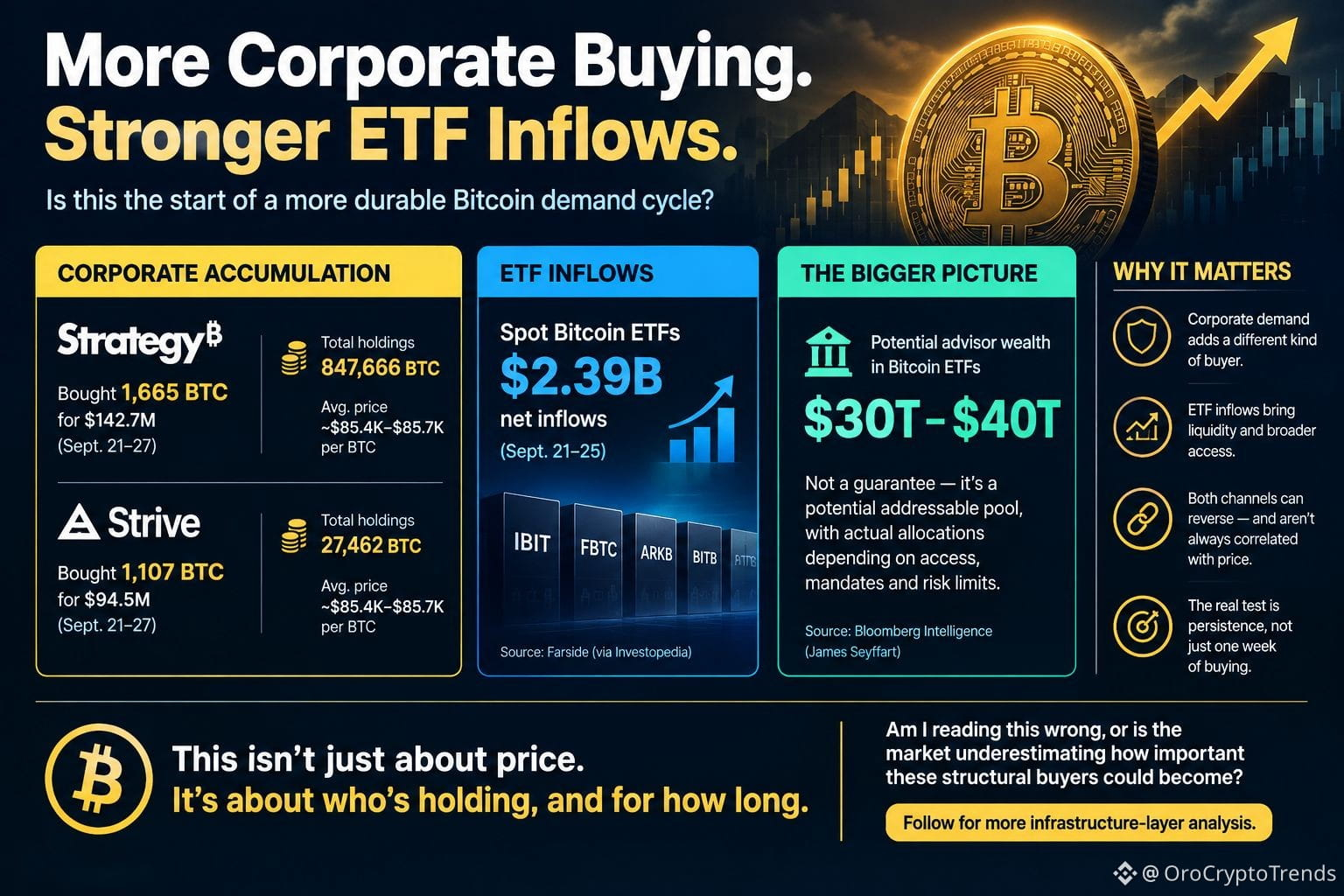
Strategy gastó 142,7M de dólares entre el 21 y el 27 de septiembre, llevando sus tenencias de Bitcoin a 847,666 BTC. Strive añadió otros 1,107 BTC por 94,5M de dólares, elevando su saldo a 27,462 BTC. Ambas compras se realizaron alrededor de 85,4K–85,7K dólares por BTC.
Pero creo que la señal más importante es la combinación de acumulación corporativa y demanda de ETF.
Los ETF spot de Bitcoin registraron aproximadamente 2,4B de dólares en entradas netas durante el 21–25 de septiembre, según datos de Farside citados por Investopedia.
Mientras tanto, James Seyffart, de Bloomberg Intelligence, ha señalado que hay alrededor de 30T–40T en riqueza gestionada por asesores que aún permanece en gran medida fuera de los ETF de Bitcoin. No son “40T esperando para comprar Bitcoin mañana” — es un grupo direccionable potencial, y las asignaciones reales dependen del acceso, los mandatos y los límites de riesgo.
Esa distinción importa.
Esto no es simplemente “las instituciones compran, así que BTC sube”. La demanda de tesorería corporativa puede financiarse mediante emisión de acciones, mientras que los flujos de ETF pueden revertirse igual de rápido que llegan. Lo interesante es si estos canales siguen absorbiendo la oferta en distintas condiciones de mercado.
Esa es la señal que estoy observando: persistencia, no una semana de compras.
¿Estoy interpretándolo mal, o el mercado está subestimando lo importantes que podrían volverse estos compradores estructurales?
$BTC
$BTC Strategy acaba de comprar otros 1,665 BTC.
Esta es la parte de esta historia a la que estoy prestando atención.
Strategy gastó 142,7M de dólares entre el 21 y el 27 de septiembre, llevando sus tenencias de Bitcoin a 847,666 BTC. Strive añadió otros 1,107 BTC por 94,5M de dólares, elevando su saldo a 27,462 BTC. Ambas compras se realizaron alrededor de 85,4K–85,7K dólares por BTC.
Pero creo que la señal más importante es la combinación de acumulación corporativa y demanda de ETF.
Los ETF spot de Bitcoin registraron aproximadamente 2,4B de dólares en entradas netas durante el 21–25 de septiembre, según datos de Farside citados por Investopedia.
Mientras tanto, James Seyffart, de Bloomberg Intelligence, ha señalado que hay alrededor de 30T–40T en riqueza gestionada por asesores que aún permanece en gran medida fuera de los ETF de Bitcoin. No son “40T esperando para comprar Bitcoin mañana” — es un grupo direccionable potencial, y las asignaciones reales dependen del acceso, los mandatos y los límites de riesgo.
Esa distinción importa.
Esto no es simplemente “las instituciones compran, así que BTC sube”. La demanda de tesorería corporativa puede financiarse mediante emisión de acciones, mientras que los flujos de ETF pueden revertirse igual de rápido que llegan. Lo interesante es si estos canales siguen absorbiendo la oferta en distintas condiciones de mercado.
Esa es la señal que estoy observando: persistencia, no una semana de compras.
¿Estoy interpretándolo mal, o el mercado está subestimando lo importantes que podrían volverse estos compradores estructurales?
$BTC
Esta es la parte de esta historia a la que estoy prestando atención.
Strategy gastó 142,7M de dólares entre el 21 y el 27 de septiembre, llevando sus tenencias de Bitcoin a 847,666 BTC. Strive añadió otros 1,107 BTC por 94,5M de dólares, elevando su saldo a 27,462 BTC. Ambas compras se realizaron alrededor de 85,4K–85,7K dólares por BTC.
Pero creo que la señal más importante es la combinación de acumulación corporativa y demanda de ETF.
Los ETF spot de Bitcoin registraron aproximadamente 2,4B de dólares en entradas netas durante el 21–25 de septiembre, según datos de Farside citados por Investopedia.
Mientras tanto, James Seyffart, de Bloomberg Intelligence, ha señalado que hay alrededor de 30T–40T en riqueza gestionada por asesores que aún permanece en gran medida fuera de los ETF de Bitcoin. No son “40T esperando para comprar Bitcoin mañana” — es un grupo direccionable potencial, y las asignaciones reales dependen del acceso, los mandatos y los límites de riesgo.
Esa distinción importa.
Esto no es simplemente “las instituciones compran, así que BTC sube”. La demanda de tesorería corporativa puede financiarse mediante emisión de acciones, mientras que los flujos de ETF pueden revertirse igual de rápido que llegan. Lo interesante es si estos canales siguen absorbiendo la oferta en distintas condiciones de mercado.
Esa es la señal que estoy observando: persistencia, no una semana de compras.
¿Estoy interpretándolo mal, o el mercado está subestimando lo importantes que podrían volverse estos compradores estructurales?
$BTC
4
2.3k
Verificado
$QNT QNT ya no se está moviendo dentro de una narrativa cripto normal. Esa es la parte que estoy observando.
Lo interesante no es simplemente que Quant esté recibiendo atención. Es dónde se está mostrando la infraestructura.
El 24 de septiembre, The Clearing House seleccionó a Quant para proporcionar la capa de interoperabilidad, orquestación y gestión de transacciones para su Iniciativa de Dinero On-Chain en EE. UU. — una red diseñada para compensar y liquidar depósitos bancarios tokenizados.
Se espera que la red se abra a las instituciones participantes en la primera mitad de 2027.
The Clearing House
Luego está el Reino Unido.
Siete bancos importantes —incluyendo Barclays, HSBC, Lloyds, NatWest, Nationwide, Santander y Monzo— completaron transacciones en vivo con clientes usando depósitos tokenizados en libras esterlinas en una plataforma compartida construida por Quant.
Eso cambia la forma en que veo la narrativa de QNT.
Esto no es una prueba de que el valor del token de QNT deba seguir subiendo. Y tampoco significa, de ninguna manera, que cada proyecto de tokenización vaya a crear automáticamente demanda de QNT.
Pero sí muestra algo más concreto: Quant se está convirtiendo en parte de la infraestructura que se está probando para que el dinero regulado se mueva on-chain.
Espera: tal vez esa es la mejor historia aquí.
La pregunta no es “¿qué tan alto puede llegar QNT?”.
Es si esta infraestructura se va a usar a una escala significativa.
Aún estoy intentando entender qué es lo que esto realmente cambia.
$QNT QNT ya no se está moviendo dentro de una narrativa cripto normal. Esa es la parte que estoy observando.
Lo interesante no es simplemente que Quant esté recibiendo atención. Es dónde se está mostrando la infraestructura.
El 24 de septiembre, The Clearing House seleccionó a Quant para proporcionar la capa de interoperabilidad, orquestación y gestión de transacciones para su Iniciativa de Dinero On-Chain en EE. UU. — una red diseñada para compensar y liquidar depósitos bancarios tokenizados.
Se espera que la red se abra a las instituciones participantes en la primera mitad de 2027.
The Clearing House
Luego está el Reino Unido.
Siete bancos importantes —incluyendo Barclays, HSBC, Lloyds, NatWest, Nationwide, Santander y Monzo— completaron transacciones en vivo con clientes usando depósitos tokenizados en libras esterlinas en una plataforma compartida construida por Quant.
Eso cambia la forma en que veo la narrativa de QNT.
Esto no es una prueba de que el valor del token de QNT deba seguir subiendo. Y tampoco significa, de ninguna manera, que cada proyecto de tokenización vaya a crear automáticamente demanda de QNT.
Pero sí muestra algo más concreto: Quant se está convirtiendo en parte de la infraestructura que se está probando para que el dinero regulado se mueva on-chain.
Espera: tal vez esa es la mejor historia aquí.
La pregunta no es “¿qué tan alto puede llegar QNT?”.
Es si esta infraestructura se va a usar a una escala significativa.
Aún estoy intentando entender qué es lo que esto realmente cambia.
Lo interesante no es simplemente que Quant esté recibiendo atención. Es dónde se está mostrando la infraestructura.
El 24 de septiembre, The Clearing House seleccionó a Quant para proporcionar la capa de interoperabilidad, orquestación y gestión de transacciones para su Iniciativa de Dinero On-Chain en EE. UU. — una red diseñada para compensar y liquidar depósitos bancarios tokenizados.
Se espera que la red se abra a las instituciones participantes en la primera mitad de 2027.
The Clearing House
Luego está el Reino Unido.
Siete bancos importantes —incluyendo Barclays, HSBC, Lloyds, NatWest, Nationwide, Santander y Monzo— completaron transacciones en vivo con clientes usando depósitos tokenizados en libras esterlinas en una plataforma compartida construida por Quant.
Eso cambia la forma en que veo la narrativa de QNT.
Esto no es una prueba de que el valor del token de QNT deba seguir subiendo. Y tampoco significa, de ninguna manera, que cada proyecto de tokenización vaya a crear automáticamente demanda de QNT.
Pero sí muestra algo más concreto: Quant se está convirtiendo en parte de la infraestructura que se está probando para que el dinero regulado se mueva on-chain.
Espera: tal vez esa es la mejor historia aquí.
La pregunta no es “¿qué tan alto puede llegar QNT?”.
Es si esta infraestructura se va a usar a una escala significativa.
Aún estoy intentando entender qué es lo que esto realmente cambia.
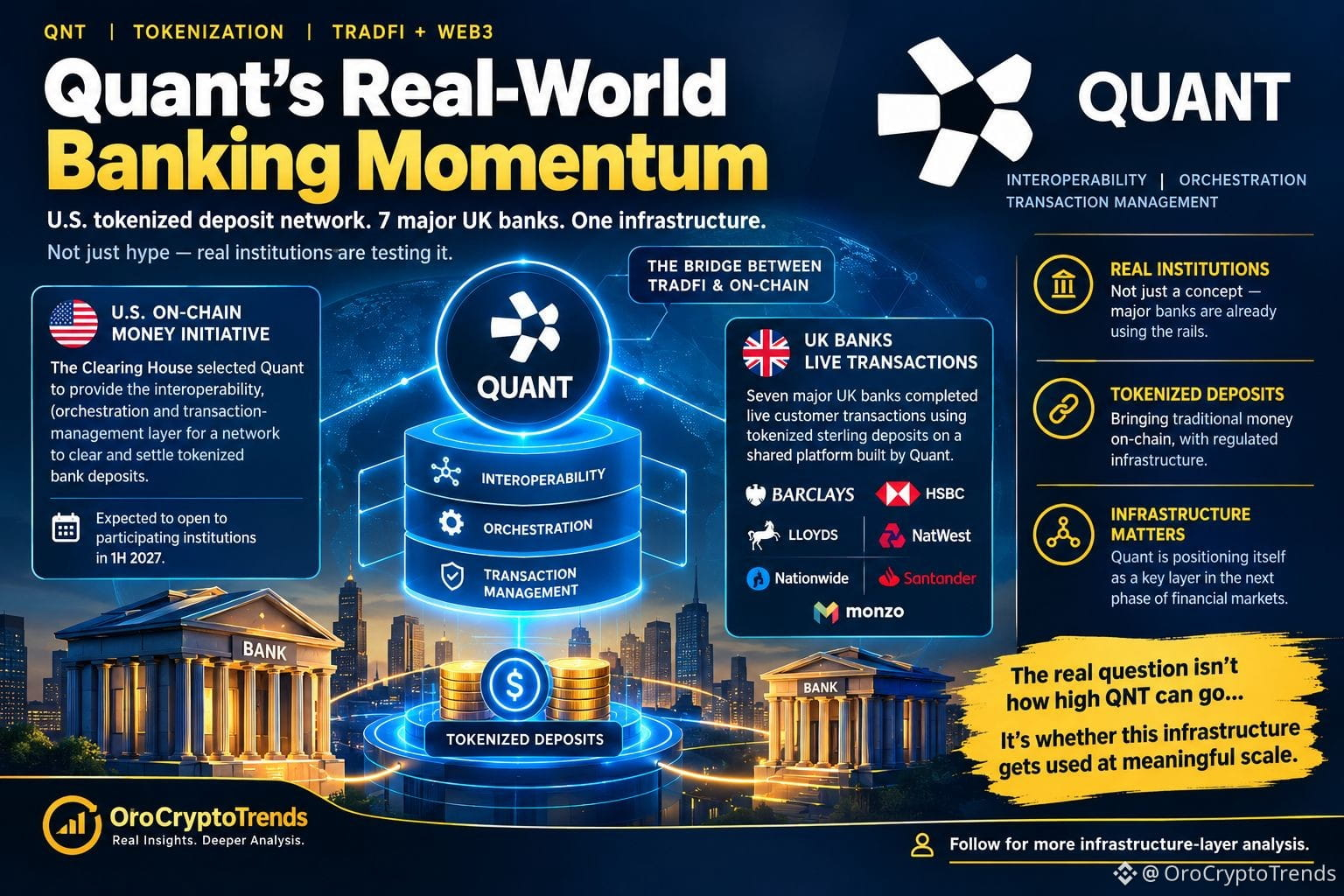
7
2.5k
$BTC La Fed subió tipos. Los rendimientos del Tesoro se dispararon. Bitcoin está absorbiendo el golpe.
El 16 de septiembre, la Fed elevó las tasas al 3,75%–4,00%, mientras que sus proyecciones aún mostraban al menos una subida más en 2026.
Luego, el rendimiento del bono del Tesoro a 10 años subió a 5,17%.
Ahí es donde la conexión con Bitcoin se vuelve interesante.
Una Fed más estricta aumenta el costo del dinero. Los rendimientos más altos del Tesoro, además, ofrecen a los inversores una alternativa más atractiva frente a los activos de riesgo volátiles. Las condiciones financieras se endurecen, el apalancamiento se vuelve más caro y la liquidez se hace más difícil de perseguir.
Bitcoin está directamente en ese canal de riesgo-liquidez.
Así que cuando los rendimientos se reprecian al alza, BTC no necesita un catalizador negativo específico de las criptomonedas para caer bajo presión. La tasa de descuento macro en sí puede convertirse en el catalizador.
Por eso le presto menos atención a la noticia del alza de la Fed y más a lo que ocurre con los rendimientos, la liquidez y la posición después.
Si los rendimientos del Tesoro se mantienen elevados, Bitcoin quizá tenga que luchar contra el entorno macro antes de que reciba otra entrada limpia de riesgo.
¿Estoy interpretando correctamente el mecanismo de transmisión, o el mercado ya está poniendo en precio la mayor parte de esto?
$BTC La Fed subió tipos. Los rendimientos del Tesoro se dispararon. Bitcoin está absorbiendo el golpe.
El 16 de septiembre, la Fed elevó las tasas al 3,75%–4,00%, mientras que sus proyecciones aún mostraban al menos una subida más en 2026.
Luego, el rendimiento del bono del Tesoro a 10 años subió a 5,17%.
Ahí es donde la conexión con Bitcoin se vuelve interesante.
Una Fed más estricta aumenta el costo del dinero. Los rendimientos más altos del Tesoro, además, ofrecen a los inversores una alternativa más atractiva frente a los activos de riesgo volátiles. Las condiciones financieras se endurecen, el apalancamiento se vuelve más caro y la liquidez se hace más difícil de perseguir.
Bitcoin está directamente en ese canal de riesgo-liquidez.
Así que cuando los rendimientos se reprecian al alza, BTC no necesita un catalizador negativo específico de las criptomonedas para caer bajo presión. La tasa de descuento macro en sí puede convertirse en el catalizador.
Por eso le presto menos atención a la noticia del alza de la Fed y más a lo que ocurre con los rendimientos, la liquidez y la posición después.
Si los rendimientos del Tesoro se mantienen elevados, Bitcoin quizá tenga que luchar contra el entorno macro antes de que reciba otra entrada limpia de riesgo.
¿Estoy interpretando correctamente el mecanismo de transmisión, o el mercado ya está poniendo en precio la mayor parte de esto?
El 16 de septiembre, la Fed elevó las tasas al 3,75%–4,00%, mientras que sus proyecciones aún mostraban al menos una subida más en 2026.
Luego, el rendimiento del bono del Tesoro a 10 años subió a 5,17%.
Ahí es donde la conexión con Bitcoin se vuelve interesante.
Una Fed más estricta aumenta el costo del dinero. Los rendimientos más altos del Tesoro, además, ofrecen a los inversores una alternativa más atractiva frente a los activos de riesgo volátiles. Las condiciones financieras se endurecen, el apalancamiento se vuelve más caro y la liquidez se hace más difícil de perseguir.
Bitcoin está directamente en ese canal de riesgo-liquidez.
Así que cuando los rendimientos se reprecian al alza, BTC no necesita un catalizador negativo específico de las criptomonedas para caer bajo presión. La tasa de descuento macro en sí puede convertirse en el catalizador.
Por eso le presto menos atención a la noticia del alza de la Fed y más a lo que ocurre con los rendimientos, la liquidez y la posición después.
Si los rendimientos del Tesoro se mantienen elevados, Bitcoin quizá tenga que luchar contra el entorno macro antes de que reciba otra entrada limpia de riesgo.
¿Estoy interpretando correctamente el mecanismo de transmisión, o el mercado ya está poniendo en precio la mayor parte de esto?
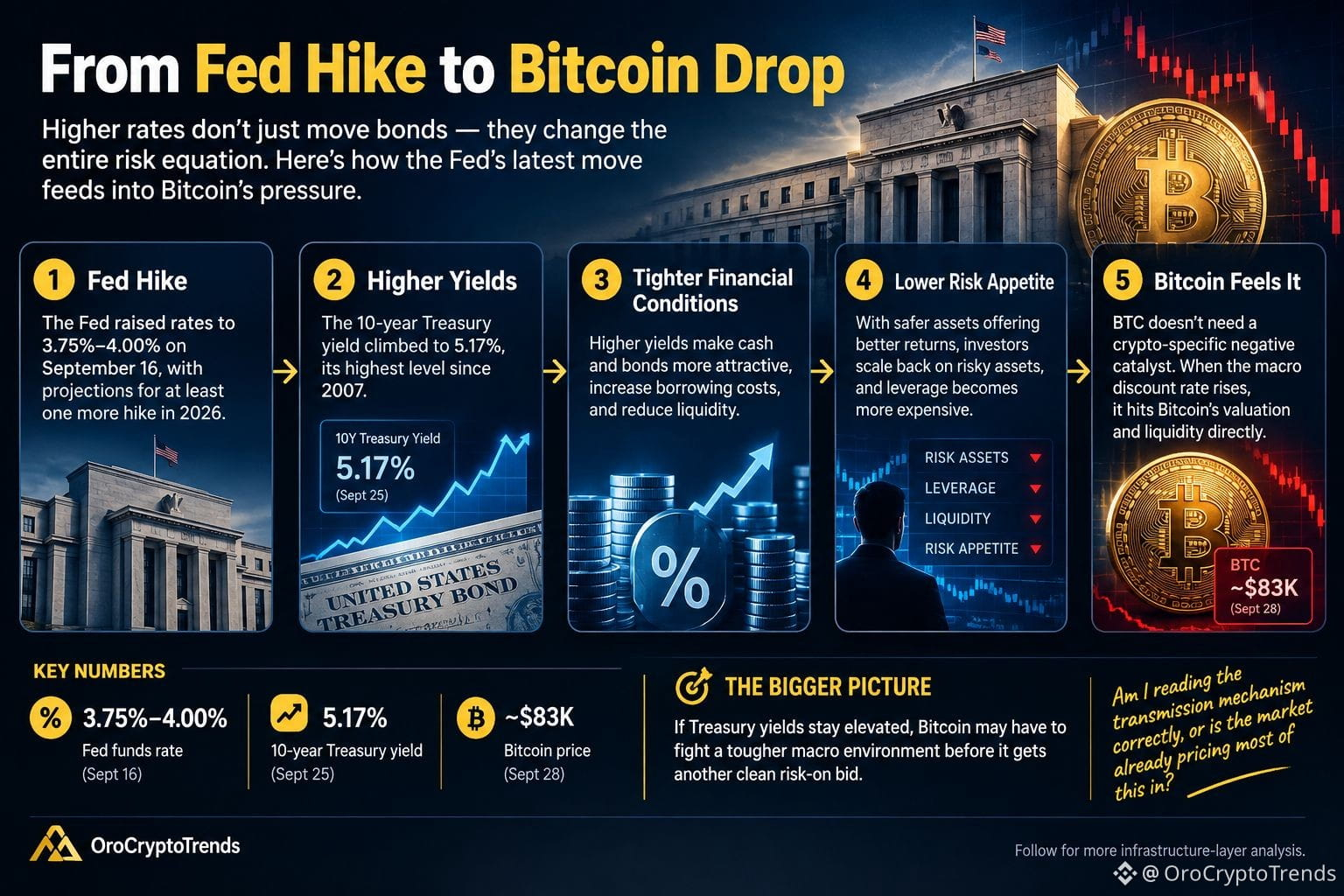
4
3
12
16.9k
Verificado
La Billetera de Binance acaba de hacer que una parte molesta de las criptomonedas sea mucho menos molesta.
Ahora puedes usar USDT para pagar las comisiones de gas directamente en BNB Smart Chain, Ethereum, Solana y TRON. Así que, en lugar de darte cuenta de que tienes USDT pero, de alguna manera, no tienes BNB, ETH, SOL o TRX para la transacción… puedes usar el propio USDT para el pago del gas.
Honestamente, esto parece una función pequeña de la billetera. Pero no lo creo.
La fricción de los tokens de gas es uno de esos problemas aburridos de UX que, en silencio, hace que la gente deje de usar aplicaciones on-chain. Puedes tener el activo que realmente quieres mover, pero aun así quedarte atascado porque te falta una cantidad mínima del token nativo de la red.
Eso crea pasos innecesarios: comprar el token de gas, transferirlo, elegir la red correcta, esperar y luego intentar de nuevo la transacción original.
Eliminar ese paso hace que la billetera se sienta más como un solo sistema en lugar de una colección de reglas separadas de distintas blockchains.
Lo interesante es lo que pasa si este enfoque se amplía a más redes. El anuncio actual de Binance confirma las cuatro redes admitidas, pero no proporciona un calendario de despliegue para las adicionales.
Esa es la parte que estaré vigilando.
¿Es solo una mejor UX de billetera o un cambio más grande para ocultar la complejidad de la blockchain al usuario promedio?
La Billetera de Binance acaba de hacer que una parte molesta de las criptomonedas sea mucho menos molesta.
Ahora puedes usar USDT para pagar las comisiones de gas directamente en BNB Smart Chain, Ethereum, Solana y TRON. Así que, en lugar de darte cuenta de que tienes USDT pero, de alguna manera, no tienes BNB, ETH, SOL o TRX para la transacción… puedes usar el propio USDT para el pago del gas.
Honestamente, esto parece una función pequeña de la billetera. Pero no lo creo.
La fricción de los tokens de gas es uno de esos problemas aburridos de UX que, en silencio, hace que la gente deje de usar aplicaciones on-chain. Puedes tener el activo que realmente quieres mover, pero aun así quedarte atascado porque te falta una cantidad mínima del token nativo de la red.
Eso crea pasos innecesarios: comprar el token de gas, transferirlo, elegir la red correcta, esperar y luego intentar de nuevo la transacción original.
Eliminar ese paso hace que la billetera se sienta más como un solo sistema en lugar de una colección de reglas separadas de distintas blockchains.
Lo interesante es lo que pasa si este enfoque se amplía a más redes. El anuncio actual de Binance confirma las cuatro redes admitidas, pero no proporciona un calendario de despliegue para las adicionales.
Esa es la parte que estaré vigilando.
¿Es solo una mejor UX de billetera o un cambio más grande para ocultar la complejidad de la blockchain al usuario promedio?
Ahora puedes usar USDT para pagar las comisiones de gas directamente en BNB Smart Chain, Ethereum, Solana y TRON. Así que, en lugar de darte cuenta de que tienes USDT pero, de alguna manera, no tienes BNB, ETH, SOL o TRX para la transacción… puedes usar el propio USDT para el pago del gas.
Honestamente, esto parece una función pequeña de la billetera. Pero no lo creo.
La fricción de los tokens de gas es uno de esos problemas aburridos de UX que, en silencio, hace que la gente deje de usar aplicaciones on-chain. Puedes tener el activo que realmente quieres mover, pero aun así quedarte atascado porque te falta una cantidad mínima del token nativo de la red.
Eso crea pasos innecesarios: comprar el token de gas, transferirlo, elegir la red correcta, esperar y luego intentar de nuevo la transacción original.
Eliminar ese paso hace que la billetera se sienta más como un solo sistema en lugar de una colección de reglas separadas de distintas blockchains.
Lo interesante es lo que pasa si este enfoque se amplía a más redes. El anuncio actual de Binance confirma las cuatro redes admitidas, pero no proporciona un calendario de despliegue para las adicionales.
Esa es la parte que estaré vigilando.
¿Es solo una mejor UX de billetera o un cambio más grande para ocultar la complejidad de la blockchain al usuario promedio?
2
629
$BTC $2.39B fluyeron hacia los ETF spot de Bitcoin en EE. UU. la semana pasada. Pero lo interesante no es el titular.
Es lo que pasó después de que llegó el dinero.
La semana del 21 al 25 de septiembre trajo entradas netas de alrededor de $2.39B, el mejor resultado semanal desde octubre de 2025. Los IBIT de BlackRock y los FBTC de Fidelity estuvieron entre los mayores receptores. Eso es demanda real a través de productos regulados, no solo el típico revuelo de Crypto Twitter.
Pero aún no estoy listo para llamar a esto una tendencia limpia de acumulación institucional.
Miren la secuencia de flujos. El lunes llegaron casi $999M. Para el viernes, la entrada diaria había caído a aproximadamente $134M. El dinero seguía entrando, sí, pero la intensidad se enfrió de forma drástica durante la semana.
Y aquí es donde la historia de la oferta se vuelve interesante.
Informes on-chain separados apuntan a que más de 30,000 BTC se habrían movido a manos de grandes tenedores durante la debilidad reciente del precio, mientras que el BTC permaneció alrededor de la zona de los $84K medios después de no lograr sostener el movimiento por encima de $87K.
Así que el escenario que estoy vigilando no es simplemente “entradas a ETF = alcista”.
Se trata de si la demanda de los ETF sigue absorbiendo la oferta mientras el BTC se mantiene debajo del área de resistencia de $86K–$87K.
Si los flujos se mantienen sólidos y esa oferta sigue siendo absorbida, la estructura cambia.
Si las entradas se debilitan mientras los vendedores siguen defendiendo los máximos, esto podría terminar siendo una sola semana muy grande de posicionamiento, en lugar del inicio de algo más.
Aun así, sigo intentando descubrir qué es lo que realmente cambia.
$BTC $2.39B fluyeron hacia los ETF spot de Bitcoin en EE. UU. la semana pasada. Pero lo interesante no es el titular.
Es lo que pasó después de que llegó el dinero.
La semana del 21 al 25 de septiembre trajo entradas netas de alrededor de $2.39B, el mejor resultado semanal desde octubre de 2025. Los IBIT de BlackRock y los FBTC de Fidelity estuvieron entre los mayores receptores. Eso es demanda real a través de productos regulados, no solo el típico revuelo de Crypto Twitter.
Pero aún no estoy listo para llamar a esto una tendencia limpia de acumulación institucional.
Miren la secuencia de flujos. El lunes llegaron casi $999M. Para el viernes, la entrada diaria había caído a aproximadamente $134M. El dinero seguía entrando, sí, pero la intensidad se enfrió de forma drástica durante la semana.
Y aquí es donde la historia de la oferta se vuelve interesante.
Informes on-chain separados apuntan a que más de 30,000 BTC se habrían movido a manos de grandes tenedores durante la debilidad reciente del precio, mientras que el BTC permaneció alrededor de la zona de los $84K medios después de no lograr sostener el movimiento por encima de $87K.
Así que el escenario que estoy vigilando no es simplemente “entradas a ETF = alcista”.
Se trata de si la demanda de los ETF sigue absorbiendo la oferta mientras el BTC se mantiene debajo del área de resistencia de $86K–$87K.
Si los flujos se mantienen sólidos y esa oferta sigue siendo absorbida, la estructura cambia.
Si las entradas se debilitan mientras los vendedores siguen defendiendo los máximos, esto podría terminar siendo una sola semana muy grande de posicionamiento, en lugar del inicio de algo más.
Aun así, sigo intentando descubrir qué es lo que realmente cambia.
Es lo que pasó después de que llegó el dinero.
La semana del 21 al 25 de septiembre trajo entradas netas de alrededor de $2.39B, el mejor resultado semanal desde octubre de 2025. Los IBIT de BlackRock y los FBTC de Fidelity estuvieron entre los mayores receptores. Eso es demanda real a través de productos regulados, no solo el típico revuelo de Crypto Twitter.
Pero aún no estoy listo para llamar a esto una tendencia limpia de acumulación institucional.
Miren la secuencia de flujos. El lunes llegaron casi $999M. Para el viernes, la entrada diaria había caído a aproximadamente $134M. El dinero seguía entrando, sí, pero la intensidad se enfrió de forma drástica durante la semana.
Y aquí es donde la historia de la oferta se vuelve interesante.
Informes on-chain separados apuntan a que más de 30,000 BTC se habrían movido a manos de grandes tenedores durante la debilidad reciente del precio, mientras que el BTC permaneció alrededor de la zona de los $84K medios después de no lograr sostener el movimiento por encima de $87K.
Así que el escenario que estoy vigilando no es simplemente “entradas a ETF = alcista”.
Se trata de si la demanda de los ETF sigue absorbiendo la oferta mientras el BTC se mantiene debajo del área de resistencia de $86K–$87K.
Si los flujos se mantienen sólidos y esa oferta sigue siendo absorbida, la estructura cambia.
Si las entradas se debilitan mientras los vendedores siguen defendiendo los máximos, esto podría terminar siendo una sola semana muy grande de posicionamiento, en lugar del inicio de algo más.
Aun así, sigo intentando descubrir qué es lo que realmente cambia.
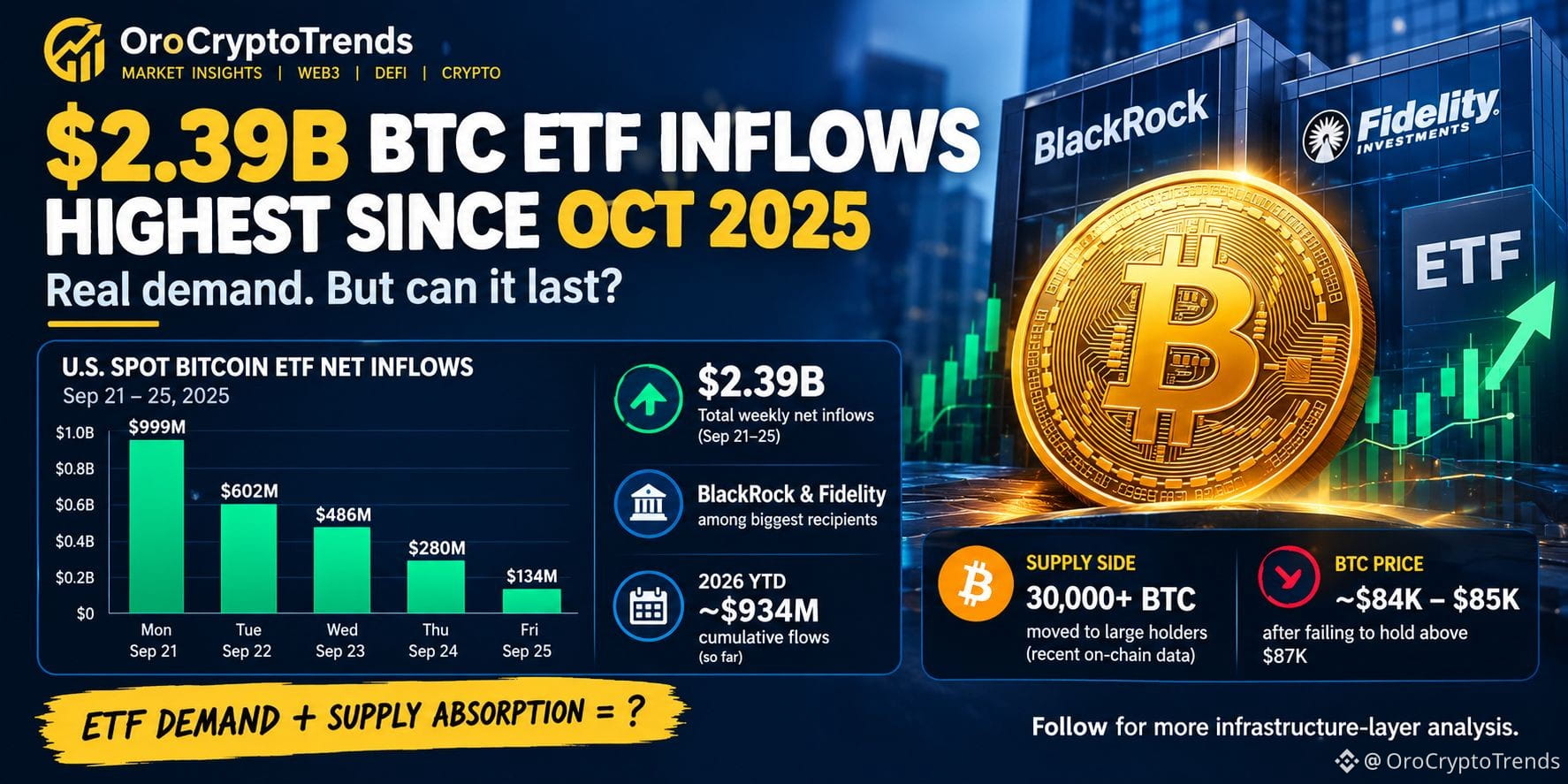
2
3k
Inicia sesión para explorar más contenidos
Únete a usuarios globales de criptomonedas en Binance Square
⚡️ Obtén información útil y actualizada sobre criptos.
💬 Avalado por el mayor exchange de criptomonedas en el mundo.
👍 Descubre perspectivas reales de creadores verificados.
Email/número de teléfono
Temas populares
BNBSurpasses$790
10,375 vistas
83 están debatiendo
$BNB plan estratégico largo -> ENFOCAR AHORA
BNB ha creado 2 mínimos fuertes después de eliminar la liquidez interna
Espero un movimiento hacia el máximo de la oscilación $815-$830 y busco una compra en un retesteo de la caja verde
#BNBSurpasses$790 #bnb
Ghost Writer
·4 me gusta
·5k vistas
ZamaRises15.99%ToIntradayHigh$0.09
4,858 vistas
72 están debatiendo
BitcoinSpotETFsDraw$6.34BInflowsInQ3
3,609 vistas
58 están debatiendo