#baby $BABY @BabylonLabs_io I sometimes think about a question.... Does trying to make Bitcoin productive always compromise its core features? From what I've seen so far, in most cases, if you want to get any additional utility or potential return from Bitcoin, you have to bridge it to another chain, convert it into a wrapped asset like wBTC, or deposit it with a third party. Gradually, it has become so normal that many people no longer ask the question: where is the real Bitcoin?
Babylon seems to be thinking a little differently here. They emphasizing one thing from the begining - Non-Custodial and Native Staking. When I first read it, I thought, is this just a new marketing term? But if you dig a little deeper, you can see that they are actually trying to solve a different problem. Using the Taproot Time-Lock Script, Bitcoin is locked directly on the Bitcoin mainnet for a certain period of time. That is, there is no additional layer of bridging or wrapping added here. And what I find more important is Self-Custody. The private key remains with the user. That is, the idea of handing over control of the funds to someone else is almost non-existent.
Of course, being non-custodial does not mean that all risks are gone.... That cannot be said. The security of the protocol, smart design, economic model and long-term stability - all of these are equally important. So it would not be right to reach a conclusion just by looking at the word "Self-Custody".
However, the most important aspect of Babylon to me lies elsewhere. They are trying to make Bitcoin productive, but in the process they are trying to preserve Bitcoin's own security and ownership as much as possible. It may seem like a small design change, but its impact can be large in long run.
Ultimately, the question may not be about staking. The question is:
Is it possible to make Bitcoin more efficient, without sacrificing its core features?
Babylon is trying to provide a possible answer to that question. Only time will tell how successful the answer will be🤔
I was looking at the SOL chart for a long time today. The funny thing is, at first it seemed like nothing much was happening in the market. The candles weren't very exciting either. But after zooming out a little, I realized that maybe this quiet time is telling the real story. SOL is currently hovering between $74 and $78. From the outside, it may seem like a sideways market. But I always notice one thing - when an asset repeatedly holds the same zone, it can weaken or gain strength. This is where the real difference lies. In my eyes, the $70-$72 zone is very important now. Because this area has acted as support several times. As long as this level holds, I can't see it as completely negative. Of course, it's also true that everything can change in a day. If this support breaks, then you may have to look for a new price downwards. And what if the opposite happens? If the bounce starts from here, I think the first big test will be the $85-$88 zone. Many people talk about $100 directly, but I don't think there's much reason to get too excited about $100 before $88. Because most of the time the market stops or retests before breaking major resistance. $100 number also has a different significance. It's not just a price on the chart, but a psychological level. Many traders attach importance to such round numbers. So if we ever see a strong daily candle close above $88, then $100 won't seem like a far-fetched goal. However, even if you make a decision based on the SOL chart alone, you won't understand the whole picture. What Bitcoin is doing is equally important. In my experience, if BTC is flat or slowly rising, then big altcoins like SOL have a chance to show their moves. But if BTC suddenly becomes volatile, even good charts often don't work. Another thing I can't ignore is the use of the Solana network. Low transaction fees, DeFi activity, memecoin trading... all these are still keeping the network busy. If positive news about ETFs or interest from big capital is added to this in the future, then that could also be helpful for the price. However, I keep one thing in mind..... charts never promise, only show possibilities. So for me right now, SOL is standing at a point where patience may be more important than excitement. Maybe $100 is really ahead. Or it could be that the market will test our patience again first. The chart is leaving both doors open for now. $SOL #solana
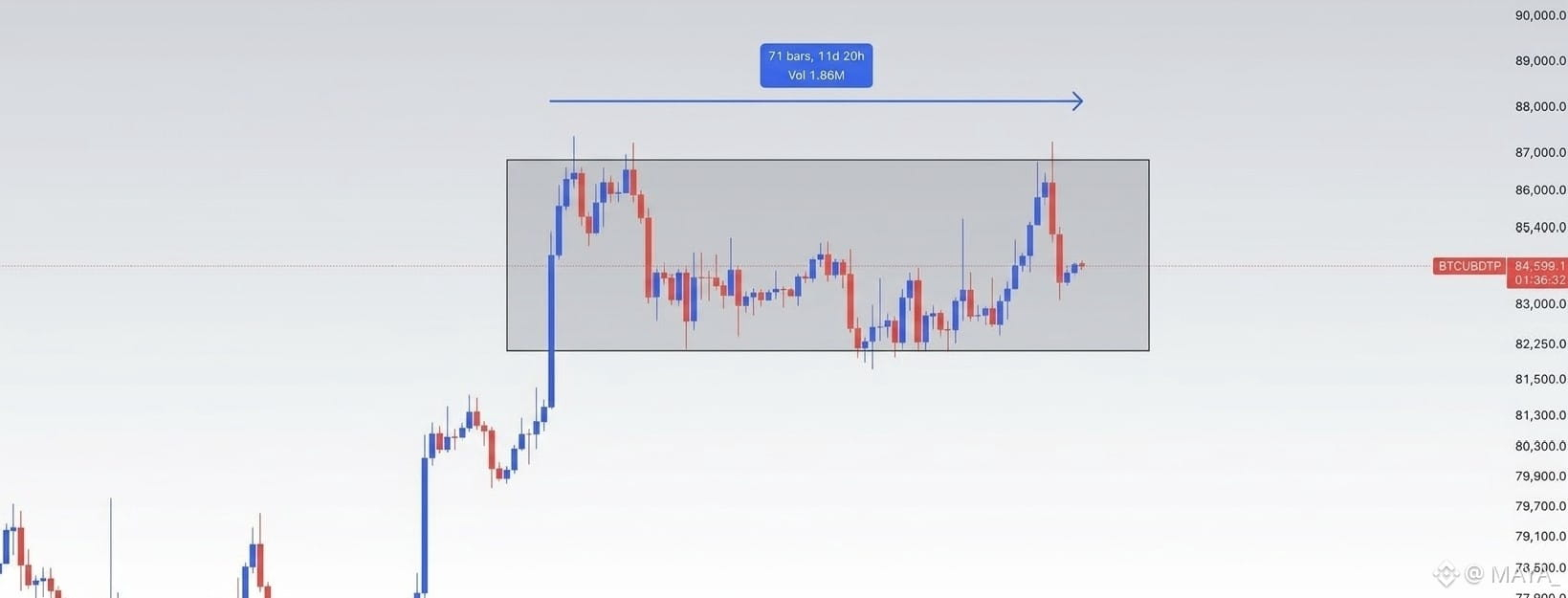
I'm watching this level closely. If BTC manages to hold yesterday's low, it could catch a lot of traders off guard. Market sentiment can shift fast when everyone expects the same move. Patience matters here, and the next reaction around this zone could reveal where momentum wants to go next. 📈
Where the crypto market stands now and why I’m paying the most attention to trust
I'll be honest.... The thing that has caught my eye the most over the past few days when I’ve been looking at the market isn’t price, it’s anticipation. Normally when we talk about crypto, everyone wants to know how much Bitcoin will go, whether altcoin season is coming, or when the next big rally will start. But this time, the picture seems a little different to me. The uncertainty over the Fed’s interest rates, the discussion about the regulatory framework, and at the same time the gradual increase in institutional participation, all three of these factors have combined to create an environment where the market is reassessing its position. To me, this doesn’t just look like another sideways market. Rather, it’s a time to understand what kind of infrastructure is really building a solid foundation to survive in the long run. This is where my perspective differs from the prevailing market thinking. I now place more importance on systems that can retain users even in the face of volatility than on price. What interests me more is the design of economic incentives. Having good technology in crypto is not enough. A network is only strong in the long term when there is a reasonable economic reason for all parties involved. Today we see the on-chain volume of stablecoins increasing, large financial institutions are making more realistic plans for digital assets, and at the same time the regulatory framework is gradually becoming clearer. These changes are important from a market perspective, because they are not only about bringing in new capital, but also about how long that capital will stay. If the economic structure of a network is such that only speculators benefit, then that model will weaken as soon as the market calms down. But if value is created from usage, transactions, and real demand, then the situation can be completely different. So I always try to look for reasons for price retention rather than price growth stories. Another thing I notice again and again is user behavior. Sometimes we make decisions too quickly based on total value locked, trading volume, or the number of new wallets. But the story behind these numbers is much more important. Are users really coming back regularly, or are they just for a short-term opportunity? Is liquidity coming from a variety of sources, or is it reliant on a few large participants? I also don’t see the growing trend of stablecoins as just a statistic. To me, it indicates that the demand for digital dollars is gradually becoming more deeply integrated with the real economy. At the same time, the nature of cyberattacks is changing. Where code vulnerabilities were previously discussed, attacks targeting private keys and users are now on the rise. This makes me think that user trust, along with technology, could become the biggest competitive advantage of the future. Because security is not just about code, it’s also about human behavior. I think about another shift. A few years ago, many people saw crypto as an alternative to the traditional financial system. Now, it seems that large institutions are gradually looking to use it not as an alternative, but as a new layer to the existing system. This shift has changed the way I look at the market. Because if banks, asset managers, and payment networks all move in the same direction, the competition will not be limited to blockchain. It will be about who can build the most reliable, most usable, and most enduring infrastructure. Many projects may be technically sound, but fail to build trust. Others may be slow to move forward, but will retain user trust. Which is more valuable in the long run, that’s the big question for me. Ultimately, what I observe most is not the price of a particular token. I watch how people react to each market shock. Do they leave the platform or continue to use it? Do institutions become more active or lag behind when new regulatory frameworks come in? And most importantly, can the pace of actual adoption ever outpace the pace of speculation? These questions may not be answered in the next few months. But in the long run, I think the future of the crypto market will be determined by one thing..... will people start to truly trust this infrastructure for everyday financial activities, or will it remain largely a place for investor speculation? #FOMCWatching
Today, Market has taken a big hit. Nearly $1.2 trillion in market value has disappeared from the US stock market in just one day. Seeing such a big drop, many investors are now cautiously watching what happens next.
Today, I saw that the shares of Chinese technology companies are under a lot of pressure. Companies that provide infrastructure and chips in the AI sector have also not been able to escape this shock. It seems that the impact of the global tech sell-off is now falling not only on large companies, but on the entire AI ecosystem.
I was reading this earlier and, honestly, the numbers caught my attention. An 18% jump in sales to $90 billion is pretty impressive, especially when it beats what analysts were expecting. What stood out even more to me is how the cloud business keeps gaining momentum. It really feels like cloud services are becoming one of the biggest growth drivers for major tech companies. Curious to see if they can keep this pace going over the next few quarters, because that's where things get really interesting.
Fed rates unchanged : Where is the real question for the crypto market ?
I mean.... What caught my attention most about the latest Federal Reserve decision was not just that it left interest rates unchanged in the 3.50% to 3.75% range. More importantly, I found the differences within the committee to be clear. 3 out of 12 members voted to raise interest rates by 25 basis points. The market usually sees such a decision as limited to the headline "rates unchanged." But from the perspective of a long-term crypto investor, the real issue is the uncertainty of policymakers. When the central bank itself is cautious about the future course of the economy, the valuation of risky assets also begins to rise anew. That's why I look not only at the decision, but also at the mentality behind the decision. From a market perspective, the issue is deeper. Keeping interest rates unchanged means that there is a positive environment for risky assets, I don't see it that simply. Because inflation is not yet fully under control, and the Fed does not want to put additional pressure on the economy. Maintaining this balance is very difficult. This is where the behavior of the crypto market becomes important. If investors think that monetary policy will gradually become more flexible in the future, then liquidity may increase. But if inflation becomes stressful again, then those expectations can change very quickly. So I always think that how the market interprets that decision often has a greater impact than a decision. What I observe most is the actual behavior of investors. The price of Bitcoin or other digital assets can fluctuate a few percent in a day, but that is not the whole story. I rather want to see whether institutional investors are changing their positions, whether new capital is entering stablecoins, and whether long-term holders are holding on to their positions or gradually selling. At the same time, the leverage of the derivatives market is also an important indicator for me. Because both over-optimism and over-fear tend to lead the market a little further from the real price. That’s why after every Fed meeting, I don’t just look at the charts, but also try to understand the changes in capital flows and investor sentiment. Ultimately, the biggest question for me is not how many months interest rates will remain unchanged. Rather, the question is whether the market is gradually entering an environment where investors will feel comfortable taking long-term risks again, or will uncertainty continue to be the main driver? Each Fed decision can create temporary price fluctuations, but in the long run, real change comes when economic expectations, liquidity, and investor confidence start to move in the same direction. It remains to be seen which signal the market will pay more attention to in the coming months—the news of an interest rate hold or the divided opinion that is signaling uncertainty about future policy. #FOMCWatching
#baby $BABY @BabylonLabs_io Sometimes a question keeps popping into my head.... where is Bitcoin's greatest strength? Just in its price, or in its ability to be used in ways that weren't considered important before? This is the question that kept coming to mind. Then I read Charles d'Haussy's statement again. To be honest, it made me think about it a little differently.
That's when I started to look more closely at Babylon's work. And from there, I started to think about the whole thing in a new light.
I mean.... He says that there are very few assets as powerful as Bitcoin to use as collateral. There is a lot of liquidity, and the market acceptance is also very high. But the problem lies elsewhere. Most platforms still can't use native BTC. So you have to rely on wrapped assets. And that's where the additional smart contracts and third-party risk come in. Although it may seem small.... this part actually makes a big difference. Importance of Babylon's emphasis on trustless native BTC collateral lies here. Uhm, it doesn't just seem like a new feature, but rather a different way of thinking about risk reduction.
Here's another update - registration for Phase 1 testnet rewards has already started. A total of 1,000,000 points will be distributed among eligible participants. However, registration must be completed before 12:00 UTC on August 2. From the same time, the $BABY reward pool will also start unlocking based on staking of 51,381.12 BTC, equivalent to about $3.42 billion. So it's worth rechecking the allocation once.... better safe than sorry.
I'm not saying anything for sure. However, it seems that Web3 is slowly moving to a place where not only new token launches, but also the competition to use existing assets more safely and effectively may become more important. Time will tell, but the direction looks quite interesting. Perhaps in the Web3 ecosystem of the future, initiatives like Babylon will prove that the real power of Bitcoin lies not only in holding it, but also in using it safely🚀
Real test of Bitcoin is not price now, but market confidence
What stands out to me isn't the recent rejection from resistance or the 3.5% move lower. Markets do this all the time. The interesting part is how quickly sentiment changes whenever price starts losing structure. A few green candles create confidence, while a few red ones suddenly convince people that the entire trend has changed. That difference between price action and investor psychology is what keeps pulling my attention back to Bitcoin. From a market perspective, technical levels matter because traders believe they matter, but long-term value isn't created by a chart alone. It comes from how participants respond when uncertainty returns. Everyone is watching the $62k-$61k region as an important support area, yet I'm more interested in what happens after the price reaches it. If buyers step in only because of a chart pattern, the move may not last. If capital flows back because investors still trust the broader thesis, that tells a very different story. That changes the way I look at every correction. What I keep watching is whether the market still rewards patience more than leverage. Every cycle creates the temptation to chase momentum, but sustainable markets usually develop when participants have incentives to stay involved beyond short-term volatility. If liquidity continues to concentrate around obvious technical levels, those areas become magnets for both buyers and sellers. That creates opportunity, but it also increases the chance of false breakdowns that force weak hands out before the next move begins. The real test is whether Bitcoin continues to attract capital during periods when excitement fades. Strong markets don't depend on constant optimism. They depend on enough conviction that people continue allocating capital even when headlines become less exciting. If that incentive weakens over time, price alone cannot compensate for it. Another thing I pay attention to is behavior rather than predictions. Social media often becomes extremely confident near turning points, but confidence is rarely a reliable indicator. I prefer watching liquidity, exchange balances, long-term holder activity, and whether new capital enters the ecosystem after corrections instead of before them. Those signals usually reveal more about underlying demand than daily price movements. Trust is difficult to measure directly, yet it quietly influences every transaction. A market supported by broad participation behaves differently from one driven by speculative enthusiasm. That's why I spend less time asking whether Bitcoin will bounce from a specific support and more time asking who is actually buying, why they are buying, and whether they remain committed after volatility returns. Biggest long-term question isn't whether Bitcoin holds one support level or breaks another. Markets eventually move beyond every number that seems critical today. The question that stays with me is whether each correction leaves the network stronger by bringing in investors with longer time horizons, or whether it simply rotates liquidity among traders looking for the next short-term opportunity. The answer to that question may matter far more than whether the next move begins from $61k, $62k, or somewhere else. And that's probably the signal worth watching most over the years ahead. Let's see 🚀🚀🚀 $BTC
Bearish momentum is building. Watch key resistance, manage risk carefully, and wait for confirmation before entering. Big downside move could follow if sellers stay in control. 📉
$XRP Spot Signal 🚀🚀 Target - 3.10. Where most people chase after late price increases, with a little patience, you can catch the moves early by entering early 😎
Zcash continues to improve its privacy technology with the Ironwood upgrade. The new shielded pool is designed to enhance transaction privacy while strengthening overall network security. It's encouraging to see active development focused on both usability and long-term resilience, showing the project remains committed to advancing privacy-preserving blockchain infrastructure.
#baby $BABY It's raining.... I'm soaking wet.... After freshening up, I was looking at the details of BTC's real function on the @BabylonLabs_io project on my laptop. And to be honest, sometimes I wonder, is the real power of Bitcoin really in its code, or in people's trust?
I don't know why.... At first, the question seems a little strange. Because technically, Bitcoin is actually a decentralized ledger. A kind of digital ledger, where only who sent how much BTC to whom is recorded. It sounds very simple. But.... It's probably not that simple. A spreadsheet is not valuable by itself. The information inside it, and People's trust in that information, is what's real. In the case of Bitcoin, I see this exact place again and again. Millions of people, thousands of nodes, countless miners and participants follow the same rules. No one is forcing anyone. Yet everyone is accepting the same truth. To be honest, this is where the matter seems a little different.
This is why @BabylonLabs_io 's perspective seems interesting to me. They don't just see Bitcoin as another asset. Rather, it sees the economic security and collective trust that has been built over the years as a foundation on which other decentralized networks can build their own security. This is not just a discussion about staking but also the idea of how trust can become a reusable infrastructure.
Of Course, this does not mean that everything is proven allready. Real-world testing of new models will take time. Adoption, sustainability and long-term incentives will ultimately be the biggest questions. Still, it seems that if @BabylonLabs_io can establish Bitcoin as not just a network for value transfer but also as a security layer, then the entire perspective of the Web3 ecosystem could slowly change. And perhaps, that is how real changes happen.... very slowly but profoundly. Let's see then🚀
#baby $BABY @BabylonLabs_io I kept thinking.... I’ve seen so many DeFi projects that leverage BTC , so what exactly is this project trying to fill?
Well, What I find particularly striking about @BabylonLabs_io isn’t just its list of well - known investors or ecosystem partners. Many projects raise capital from reputable funds and announce integrations before they’ve proven their Longterm viability. Interestingly, these relationShips only make sense when the underlying security model solves a real problem. This changes way I look at Babylon. Instead of asking whether partnerships are atractive, I ask myself why institutions believe that BITCOIN - based security can become important layer for the broader blockchain market.
From a market perspective, partnerships are valuable only when they strengthen the economic drivers. Capital from investors can accelerate development, while infrastructure and integration with DeFi protocols can create demand beyond speculation. But this model is sustainaBle only when each participant continues to benefit after the initial excitement has subsided. What I keep watching for is:
Are these partnerships translating into measurable network Activity?
Are more chains choosing Bitcoin-backed security?
Are developers building products because of the tangible benefits of this infrastructure?
Is there liquidity in the ecosystem even after incentives are normalized?
These questions are Not just a figment of the imagination, these signals are much more important than funding headlines or merger announcements, as they reveal whether trust is building over time.
Real test is whether @BabylonLabs_io can evolve from a well - funded protocol with strong industry ties to an infrastructure that other networks truly rely on. Partnerships can open doors to opportunity but they cannot create dependency on their own. The question that remains in my mind is: Will this ecosystem thrive because of those who support it today, or will the market eventually decide that it cannot function as efficiently without it? Let's see....🚀
#baby $BABY I read more about @BabylonLabs_io more it seems like its investment story isn’t really about the technology, but about how viable and balanced the token economy can be in a few years.
What strikes me most about Babylon is not its total supply of 10 billion tokens but rather the way those tokens are distributed. Most people talk about the technology but in my view, token distribution is just important in determining the Longterm outcome of a network. Babylon is setting aside 15% of its total supply for community incentives, which are not vested. On the other hand another 36% is set aside for ecosystem development and research, development and operations, which will be released to the market over a multi-year unlocking schedule. This has made me think in a new way about how Babylon intends to balance early participation with long-term development.
What interests me most is how these incentives will work over time. Distributing tokens to the community from the start can increase user participation quickly, but it also creates selling pressure, which needs to be absorbed by real demand to be sustainable. On the other hand, tokens allocated for the ecosystem and research and development will be unlocked gradually over three years. Of this, only 25% will be available at network launch, and the rest will be released to the market in phases after the first year, with 49% of the total supply going to early investors, core team, and advisors. After a one-year cliff, the tokens will be unlocked in stages over 36 months. If these tokens can truly create new activities and real use cases, Babylon can build a stronger incentive structure. But if not, this unlocking schedule could become an additional source of pressure for the market.
Ultimately, true test of Babylon may not be whether the market can easily absorb each unlock. Rather - bigger question is:
Is each new token that comes to market increasing the usage, demand, and efficiency of the network or are more tokens competing for the same amount of liquidity?
Most interesting thing for me today is the uncertainty surrounding the Clarity Act. It seemed like the bill would probably go through, but now that the odds have been lowered from 38% to 30%, the market sentiment has changed a bit. If it doesn't pass before the Senate recess, everyone is wondering how long the regulatory side will be hanging around. At the same time, the trading volume of the spot Bitcoin ETF has also decreased a lot. I think the big institutions are now taking a slow approach. That's why Bitcoin is hovering around $64,000 for now. At least I'm watching the market a little cautiously.