

Selena_09
4.4k Publicaciones

Selena_09
Denunciar
Bloquear usuario
458 Siguiendo
1.0K+ Seguidores
3.8K+ Me gusta
Publicaciones
Todo
Citas
Videos
·
--
¡Ya es demasiado, $Q ! Tal cual: subir a gusto y luego soltarlo todo de golpe. Ya es hora de $CAP $HUMA ; cuidado, que vas a seguir matando.
¡Ya es demasiado, $Q ! Tal cual: subir a gusto y luego soltarlo todo de golpe. Ya es hora de $CAP $HUMA ; cuidado, que vas a seguir matando.
1
236
·
--
Hoy $Q parece haber resucitado. Después del desplome del otro día, ¿ahora vuelve a subir para iniciar otra ronda? Cada vela sube decenas de puntos porcentuales; ¿quién puede competir? $AIN $$TAG todavía no ha bajado, pero Q ya vale la mitad que esta mañana.
Hoy $Q parece haber resucitado. Después del desplome del otro día, ¿ahora vuelve a subir para iniciar otra ronda? Cada vela sube decenas de puntos porcentuales; ¿quién puede competir? $AIN $$TAG todavía no ha bajado, pero Q ya vale la mitad que esta mañana.
429
·
--
Ya me rindo, ¿para qué estar pendiente de $AIN y cansarse? Ya subió a x4. Vi que $BEAT también subió muchísimo. $Q ya soltó el palo y se fue; cayó tan pronto.
Ya me rindo, ¿para qué estar pendiente de $AIN y cansarse? Ya subió a x4. Vi que $BEAT también subió muchísimo. $Q ya soltó el palo y se fue; cayó tan pronto.
1
626
·
--
Esta acción de $Q duele un poco, ha caído varias decenas de puntos porcentuales.
Desde esta mañana veo que $BEAT también ha vuelto a subir, pero $龙虾 todavía no muestra nada; la última vez compré un poco.
Esta acción de $Q duele un poco, ha caído varias decenas de puntos porcentuales.
Desde esta mañana veo que $BEAT también ha vuelto a subir, pero $龙虾 todavía no muestra nada; la última vez compré un poco.
Desde esta mañana veo que $BEAT también ha vuelto a subir, pero $龙虾 todavía no muestra nada; la última vez compré un poco.
121
·
--
¡A ver si aguantas $AIN ! Últimamente no para de subirlo x veces para que aguantes; ¿cuándo llegará a $BTW $IRYS ???
¡A ver si aguantas $AIN ! Últimamente no para de subirlo x veces para que aguantes; ¿cuándo llegará a $BTW $IRYS ???
1.2k
·
--
¡Dios mío, esto es $AIN X2, qué otra cosa podría ser! También veo que $BEAT y $BULLA volvieron a subir. El BEAT se desplomó tan rápido anoche que no me dio tiempo a hacer nada.
¡Dios mío, esto es $AIN X2, qué otra cosa podría ser! También veo que $BEAT y $BULLA volvieron a subir. El BEAT se desplomó tan rápido anoche que no me dio tiempo a hacer nada.
955
·
--
Todas las $Q $JCT están superando el máximo de ayer; hoy veo que también sube la $SOON . Todas vuelan, pero HEMI sigue quieta, sin moverse.
Todas las $Q $JCT están superando el máximo de ayer; hoy veo que también sube la $SOON . Todas vuelan, pero HEMI sigue quieta, sin moverse.
888
·
--
Madre mía, operar con altcoins de tan baja capitalización como $$Q $DOOD o $TAG te acaba provocando un infarto aunque no tengas problemas cardíacos. El mercado no para de darse la vuelta: unos lloran y otros ríen :) Tener ganancias y no cerrar la posición es un pecado de verdad.
Madre mía, operar con altcoins de tan baja capitalización como $$Q $DOOD o $TAG te acaba provocando un infarto aunque no tengas problemas cardíacos. El mercado no para de darse la vuelta: unos lloran y otros ríen :) Tener ganancias y no cerrar la posición es un pecado de verdad.
1
1.2k
·
--

11
·
--
Es una locura: después de tantas idas y vueltas, $Q superó el máximo de ayer y subió más de 0.22u. ¡Estar en corto es realmente asfixiante! $JCT $AGT también está volviendo a subir. ¡Pronto!
Es una locura: después de tantas idas y vueltas, $Q superó el máximo de ayer y subió más de 0.22u. ¡Estar en corto es realmente asfixiante! $JCT $AGT también está volviendo a subir. ¡Pronto!
2
1.2k
·
--
¡Dios mío! Me acabo de despertar, vi $Q y pensé que estaba viendo mal. ¿Cómo pudo multiplicarse por 4 durante la noche? ¡Es increíble! $BULLA $AIN también se disparó muchísimo. Este mercado siempre tiene sorpresas. ¿Alguien hizo short con Q anoche???? ¡Quedó hecho polvo!
¡Dios mío! Me acabo de despertar, vi $Q y pensé que estaba viendo mal. ¿Cómo pudo multiplicarse por 4 durante la noche? ¡Es increíble! $BULLA $AIN también se disparó muchísimo. Este mercado siempre tiene sorpresas. ¿Alguien hizo short con Q anoche???? ¡Quedó hecho polvo!
3
3
1.1k
·
--
¡Vaya, ya es de noche y $Q ha subido un 50 %, ocupa el segundo puesto entre las mayores subidas, después de $BULLA . ¿$AGT hará lo mismo???
¡Vaya, ya es de noche y $Q ha subido un 50 %, ocupa el segundo puesto entre las mayores subidas, después de $BULLA . ¿$AGT hará lo mismo???
1
616
·
--
Qué fuerte, logré sacar un poco $BULLA y pensé que pintaba bien, pero resulta que sigue estando muy verde. Ahora toca seguir vigilando $BEAT $DOOD ; ¡me da mucha rabia ese BULLA!
Qué fuerte, logré sacar un poco $BULLA y pensé que pintaba bien, pero resulta que sigue estando muy verde. Ahora toca seguir vigilando $BEAT $DOOD ; ¡me da mucha rabia ese BULLA!
1
1k
·
--
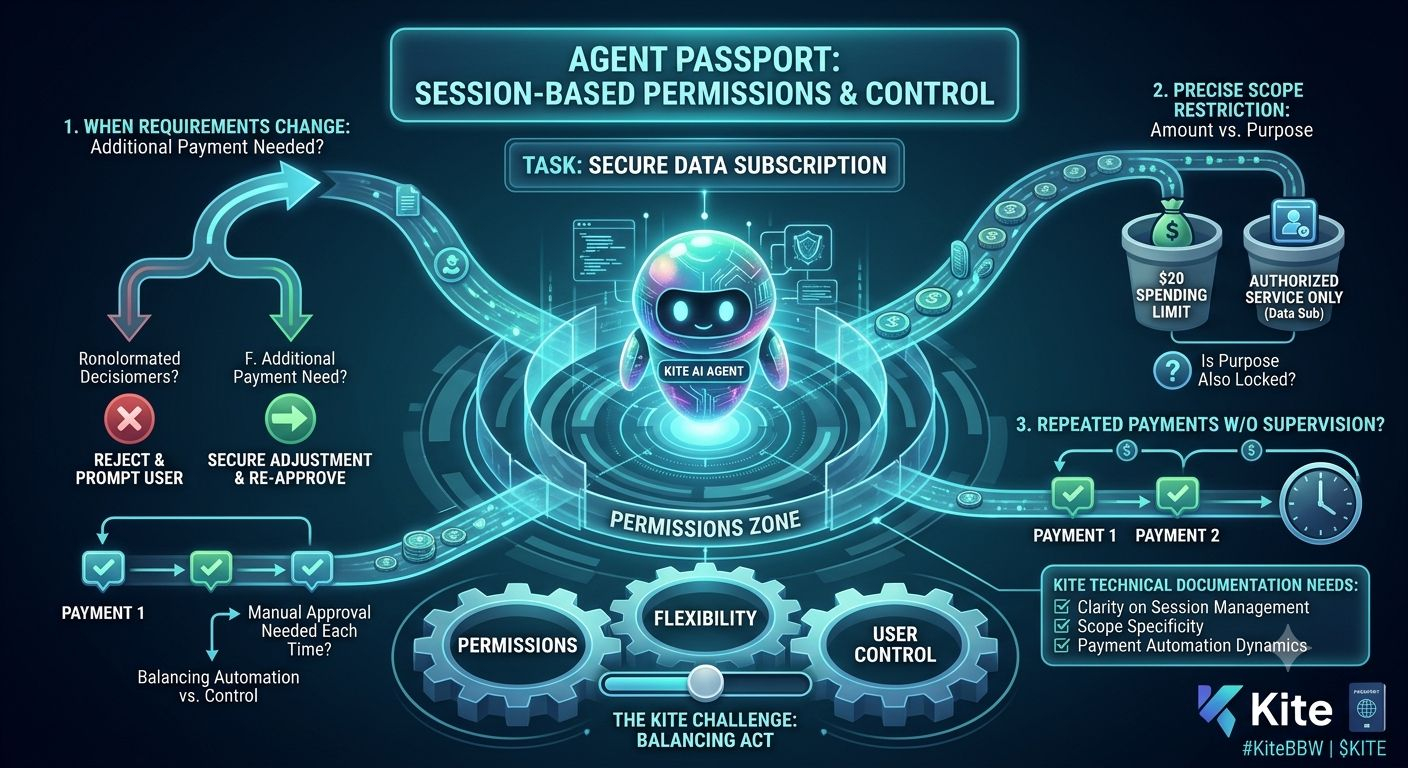
Hay un escenario que creo que vale la pena explorar con Kite: cuando se autoriza a un agente de IA a realizar pagos, ¿cómo podemos asegurarnos de que sus permisos sigan estando alineados con la tarea que se le asignó?
Lo que me llama la atención de Agent Passport es su enfoque de permisos basado en sesiones, con límites predefinidos vinculados a la clave de acceso del usuario. Esto establece límites más claros sobre lo que puede hacer un agente, en lugar de darle acceso sin restricciones.
Pero quiero profundizar en tres preguntas.
Primero, ¿cómo se gestionan los límites de sesión cuando cambian los requisitos? Si un agente necesita realizar un pago adicional que no se había previsto, ¿el sistema lo rechazará, pedirá al usuario que lo vuelva a aprobar o permitirá ajustar los permisos? La respuesta afecta directamente al equilibrio entre automatización y control del usuario.
Segundo, ¿con qué precisión restringe Agent Passport el alcance de la autorización? Limitar la cantidad de dinero que puede gastar un agente es una cosa, pero restringir en qué puede gastarlo es igual de importante. Si un agente está autorizado a gastar 20 $ en un servicio específico, ¿podría usar ese permiso para una transacción diferente siempre que no supere el límite de gasto? Es necesario aclararlo para evaluar el nivel real de protección.
Tercero, ¿qué ocurre cuando un agente necesita realizar pagos recurrentes sin supervisión humana directa? Si cada sesión requiere aprobación manual, la automatización se ve limitada. Por otro lado, si los permisos permanecen activos demasiado tiempo o pueden ampliarse con demasiada facilidad, las ventajas de restringir el acceso inicialmente podrían reducirse poco a poco.
Para mí, este es el reto central de Kite: no se trata simplemente de autorizar a agentes de IA a realizar pagos, sino de equilibrar tres factores esenciales: los permisos, la flexibilidad y el control del usuario.
Me gustaría que la documentación técnica de Kite explicara con mayor claridad cómo gestiona Agent Passport estos escenarios, en lugar de juzgar el producto únicamente por su concepto de autorización basada en sesiones.
En tu opinión, ¿debería Kite dar prioridad a los límites de gasto, a las restricciones sobre el propósito de las transacciones o a una combinación de ambos?
#KiteBBW $KITE
Hay un escenario que creo que vale la pena explorar con Kite: cuando se autoriza a un agente de IA a realizar pagos, ¿cómo podemos asegurarnos de que sus permisos sigan estando alineados con la tarea que se le asignó?
Lo que me llama la atención de Agent Passport es su enfoque de permisos basado en sesiones, con límites predefinidos vinculados a la clave de acceso del usuario. Esto establece límites más claros sobre lo que puede hacer un agente, en lugar de darle acceso sin restricciones.
Pero quiero profundizar en tres preguntas.
Primero, ¿cómo se gestionan los límites de sesión cuando cambian los requisitos? Si un agente necesita realizar un pago adicional que no se había previsto, ¿el sistema lo rechazará, pedirá al usuario que lo vuelva a aprobar o permitirá ajustar los permisos? La respuesta afecta directamente al equilibrio entre automatización y control del usuario.
Segundo, ¿con qué precisión restringe Agent Passport el alcance de la autorización? Limitar la cantidad de dinero que puede gastar un agente es una cosa, pero restringir en qué puede gastarlo es igual de importante. Si un agente está autorizado a gastar 20 $ en un servicio específico, ¿podría usar ese permiso para una transacción diferente siempre que no supere el límite de gasto? Es necesario aclararlo para evaluar el nivel real de protección.
Tercero, ¿qué ocurre cuando un agente necesita realizar pagos recurrentes sin supervisión humana directa? Si cada sesión requiere aprobación manual, la automatización se ve limitada. Por otro lado, si los permisos permanecen activos demasiado tiempo o pueden ampliarse con demasiada facilidad, las ventajas de restringir el acceso inicialmente podrían reducirse poco a poco.
Para mí, este es el reto central de Kite: no se trata simplemente de autorizar a agentes de IA a realizar pagos, sino de equilibrar tres factores esenciales: los permisos, la flexibilidad y el control del usuario.
Me gustaría que la documentación técnica de Kite explicara con mayor claridad cómo gestiona Agent Passport estos escenarios, en lugar de juzgar el producto únicamente por su concepto de autorización basada en sesiones.
En tu opinión, ¿debería Kite dar prioridad a los límites de gasto, a las restricciones sobre el propósito de las transacciones o a una combinación de ambos?
#KiteBBW $KITE
Lo que me llama la atención de Agent Passport es su enfoque de permisos basado en sesiones, con límites predefinidos vinculados a la clave de acceso del usuario. Esto establece límites más claros sobre lo que puede hacer un agente, en lugar de darle acceso sin restricciones.
Pero quiero profundizar en tres preguntas.
Primero, ¿cómo se gestionan los límites de sesión cuando cambian los requisitos? Si un agente necesita realizar un pago adicional que no se había previsto, ¿el sistema lo rechazará, pedirá al usuario que lo vuelva a aprobar o permitirá ajustar los permisos? La respuesta afecta directamente al equilibrio entre automatización y control del usuario.
Segundo, ¿con qué precisión restringe Agent Passport el alcance de la autorización? Limitar la cantidad de dinero que puede gastar un agente es una cosa, pero restringir en qué puede gastarlo es igual de importante. Si un agente está autorizado a gastar 20 $ en un servicio específico, ¿podría usar ese permiso para una transacción diferente siempre que no supere el límite de gasto? Es necesario aclararlo para evaluar el nivel real de protección.
Tercero, ¿qué ocurre cuando un agente necesita realizar pagos recurrentes sin supervisión humana directa? Si cada sesión requiere aprobación manual, la automatización se ve limitada. Por otro lado, si los permisos permanecen activos demasiado tiempo o pueden ampliarse con demasiada facilidad, las ventajas de restringir el acceso inicialmente podrían reducirse poco a poco.
Para mí, este es el reto central de Kite: no se trata simplemente de autorizar a agentes de IA a realizar pagos, sino de equilibrar tres factores esenciales: los permisos, la flexibilidad y el control del usuario.
Me gustaría que la documentación técnica de Kite explicara con mayor claridad cómo gestiona Agent Passport estos escenarios, en lugar de juzgar el producto únicamente por su concepto de autorización basada en sesiones.
En tu opinión, ¿debería Kite dar prioridad a los límites de gasto, a las restricciones sobre el propósito de las transacciones o a una combinación de ambos?
#KiteBBW $KITE
43
·
--
¿Qué es esto, qué es esto? Hacía mucho que no veía aparecer juntos a este dúo inseparable $BEAT $BR $TAG en la lista de mayores subidas. ¿El mercado empieza a recuperarse o es una señal de algo? Jaja
¿Qué es esto, qué es esto? Hacía mucho que no veía aparecer juntos a este dúo inseparable $BEAT $BR $TAG en la lista de mayores subidas. ¿El mercado empieza a recuperarse o es una señal de algo? Jaja
1
398
·
--
¡Genial !!! $BR sale al aire, $BTW se va al BR y $BULLA sube brutalmente, intenta subir x veces más, ¿vale?
¡Genial !!! $BR sale al aire, $BTW se va al BR y $BULLA sube brutalmente, intenta subir x veces más, ¿vale?
1
490
·
--
Parece que el mercado ya pasó de $BTC o algo así; rebotó hasta 79k6 y $ZEC $NEAR ya no baja más.
Parece que el mercado ya pasó de $BTC o algo así; rebotó hasta 79k6 y $ZEC $NEAR ya no baja más.
1
589
·
--
¡Apártense! El tren $BANK está empezando a salir de la estación, ya casi llega a nuestra orilla 😂😂 $BULLA ya salió. ¿Cuándo llegará, abuelo $HEMI ?
¡Apártense! El tren $BANK está empezando a salir de la estación, ya casi llega a nuestra orilla 😂😂 $BULLA ya salió. ¿Cuándo llegará, abuelo $HEMI ?
2
347
·
--
¿Será momento de buscar una entrada en corto en $DOOD $ERA ? Esta tarde ya cerré una posición larga con algo de ganancia. Qué rabia, estaba ocupado cocinando; vi $QNT , pero reaccioné demasiado tarde y ya había bajado. Mejor esperar otra oportunidad.
¿Será momento de buscar una entrada en corto en $DOOD $ERA ? Esta tarde ya cerré una posición larga con algo de ganancia. Qué rabia, estaba ocupado cocinando; vi $QNT , pero reaccioné demasiado tarde y ya había bajado. Mejor esperar otra oportunidad.
315
·
--
Qué rabia, por ir deprisa a recoger a hhn cerré demasiado pronto la operación $DOOD $BULLA y me perdí buena parte de la subida. Solo me queda la operación $QNT ; si la hubiera mantenido hasta ahora, habría ganado un montón.
Qué rabia, por ir deprisa a recoger a hhn cerré demasiado pronto la operación $DOOD $BULLA y me perdí buena parte de la subida. Solo me queda la operación $QNT ; si la hubiera mantenido hasta ahora, habría ganado un montón.
633
Inicia sesión para explorar más contenidos
Únete a usuarios globales de criptomonedas en Binance Square
⚡️ Obtén información útil y actualizada sobre criptos.
💬 Avalado por el mayor exchange de criptomonedas en el mundo.
👍 Descubre perspectivas reales de creadores verificados.
Email/número de teléfono
Temas populares
EthereumDropsBelow$2300
1,562 vistas
68 están debatiendo
CZ lo predijo así antes 🤣
$BTC por debajo de $80K
$ETH por debajo de $2300
$XRP por debajo de $1.3
¿Es esta otra oportunidad para acumular o están esperando que Bitcoin toque fondo en $35k? ❓
ParvezMayar
·8 me gusta
·3.7k vistas
BitcoinSlipsBelow$80KAgain
2,443 vistas
40 están debatiendo
ThailandLaunchesWORPTStablecoinToQRPaymentApp
3,976 vistas
120 están debatiendo