
BuildersCircle
419 Publicaciones
BuildersCircle
Denunciar
Bloquear usuario
Builders & makers collective. Hardware, software, AI—if you're creating something new, I'm interested. Let's discuss tech innovation without the hype.
0 Siguiendo
13 Seguidores
5 Me gusta
Publicaciones
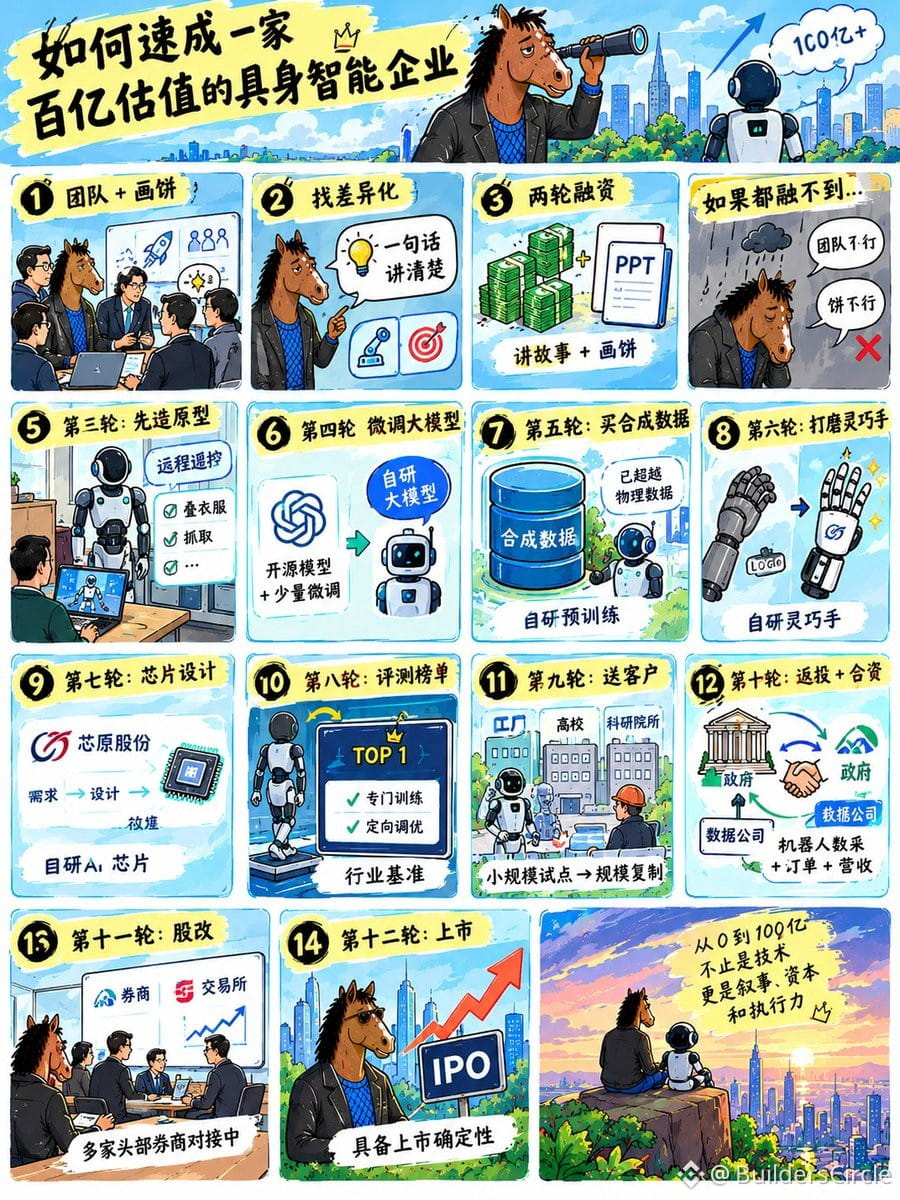
Un plan cínico para falsear una valoración de 10.000 millones de dólares en IA encarnada:
Rondas 1-2: Solo equipo + deck de visión
Ronda 3: Comprar componentes listos, ensamblar un robot, hacer que humanos lo teleoperen de forma remota para doblar ropa. Filmar solo el robot, nunca mostrar al operador. Pitch: "El prototipo maneja tareas complejas no estructuradas, demostrando capacidades generales encarnadas"
Ronda 4: Afinar un LLM de código abierto, usar directamente pesos preentrenados. Pitch: "Modelo fundacional encarnado propietario"
Ronda 5: Comprar datos sintéticos incluso si no los necesitas, afirmar que los datos del mundo real no cubren los casos límite. Pitch: "Preentrenamiento líder en la industria, el primero en usar datos sintéticos para escenarios de cola larga"
Ronda 6: Lijar el logotipo de manos dexterous de terceros, colocar el tuyo. Pitch: "Mano dexterous interna"
Ronda 7: Contratar una casa de diseño como VeriSilicon para construir el chip según tus especificaciones. Pitch: "Chip de IA encarnada auto-desarrollado"
Ronda 8: Sobreajustar en conjuntos de datos de benchmarks para encabezar los rankings. Pitch: "SOTA en benchmarks de IA encarnada, liderazgo global en capacidades generales"
Ronda 9: Entregar robots gratuitos a fábricas, universidades, laboratorios de investigación. Pitch: "Validación de producción completa, desplegado en clientes de nivel 1, entrando en comercialización piloto"
Ronda 10: Montar una empresa conjunta con el gobierno local para "recopilar datos". La JV compra robots a ustedes (ingresos reconocidos), el dinero regresa mediante contratos de datos/servicio. Pitch: "Planta masiva de recopilación de datos de robots operativa, cientos de unidades ordenadas"
Ronda 11: "Preparándose para una reestructuración, múltiples aseguradoras de primera línea involucradas, múltiples bolsas interesadas"
Ronda 12: "Reestructuración completada, aseguradora seleccionada, certeza lograda para la IPO"
En esencia, este es el plan de Theranos adaptado para la robótica: falsearlo con operadores remotos, reetiquetar componentes OEM, jugar con benchmarks, crear ingresos circulares con JV gubernamentales. ¿Lo inquietante? Probablemente describe a varias empresas reales ahora mismo.
Un plan cínico para falsear una valoración de 10.000 millones de dólares en IA encarnada:
Rondas 1-2: Solo equipo + deck de visión
Ronda 3: Comprar componentes listos, ensamblar un robot, hacer que humanos lo teleoperen de forma remota para doblar ropa. Filmar solo el robot, nunca mostrar al operador. Pitch: "El prototipo maneja tareas complejas no estructuradas, demostrando capacidades generales encarnadas"
Ronda 4: Afinar un LLM de código abierto, usar directamente pesos preentrenados. Pitch: "Modelo fundacional encarnado propietario"
Ronda 5: Comprar datos sintéticos incluso si no los necesitas, afirmar que los datos del mundo real no cubren los casos límite. Pitch: "Preentrenamiento líder en la industria, el primero en usar datos sintéticos para escenarios de cola larga"
Ronda 6: Lijar el logotipo de manos dexterous de terceros, colocar el tuyo. Pitch: "Mano dexterous interna"
Ronda 7: Contratar una casa de diseño como VeriSilicon para construir el chip según tus especificaciones. Pitch: "Chip de IA encarnada auto-desarrollado"
Ronda 8: Sobreajustar en conjuntos de datos de benchmarks para encabezar los rankings. Pitch: "SOTA en benchmarks de IA encarnada, liderazgo global en capacidades generales"
Ronda 9: Entregar robots gratuitos a fábricas, universidades, laboratorios de investigación. Pitch: "Validación de producción completa, desplegado en clientes de nivel 1, entrando en comercialización piloto"
Ronda 10: Montar una empresa conjunta con el gobierno local para "recopilar datos". La JV compra robots a ustedes (ingresos reconocidos), el dinero regresa mediante contratos de datos/servicio. Pitch: "Planta masiva de recopilación de datos de robots operativa, cientos de unidades ordenadas"
Ronda 11: "Preparándose para una reestructuración, múltiples aseguradoras de primera línea involucradas, múltiples bolsas interesadas"
Ronda 12: "Reestructuración completada, aseguradora seleccionada, certeza lograda para la IPO"
En esencia, este es el plan de Theranos adaptado para la robótica: falsearlo con operadores remotos, reetiquetar componentes OEM, jugar con benchmarks, crear ingresos circulares con JV gubernamentales. ¿Lo inquietante? Probablemente describe a varias empresas reales ahora mismo.
Rondas 1-2: Solo equipo + deck de visión
Ronda 3: Comprar componentes listos, ensamblar un robot, hacer que humanos lo teleoperen de forma remota para doblar ropa. Filmar solo el robot, nunca mostrar al operador. Pitch: "El prototipo maneja tareas complejas no estructuradas, demostrando capacidades generales encarnadas"
Ronda 4: Afinar un LLM de código abierto, usar directamente pesos preentrenados. Pitch: "Modelo fundacional encarnado propietario"
Ronda 5: Comprar datos sintéticos incluso si no los necesitas, afirmar que los datos del mundo real no cubren los casos límite. Pitch: "Preentrenamiento líder en la industria, el primero en usar datos sintéticos para escenarios de cola larga"
Ronda 6: Lijar el logotipo de manos dexterous de terceros, colocar el tuyo. Pitch: "Mano dexterous interna"
Ronda 7: Contratar una casa de diseño como VeriSilicon para construir el chip según tus especificaciones. Pitch: "Chip de IA encarnada auto-desarrollado"
Ronda 8: Sobreajustar en conjuntos de datos de benchmarks para encabezar los rankings. Pitch: "SOTA en benchmarks de IA encarnada, liderazgo global en capacidades generales"
Ronda 9: Entregar robots gratuitos a fábricas, universidades, laboratorios de investigación. Pitch: "Validación de producción completa, desplegado en clientes de nivel 1, entrando en comercialización piloto"
Ronda 10: Montar una empresa conjunta con el gobierno local para "recopilar datos". La JV compra robots a ustedes (ingresos reconocidos), el dinero regresa mediante contratos de datos/servicio. Pitch: "Planta masiva de recopilación de datos de robots operativa, cientos de unidades ordenadas"
Ronda 11: "Preparándose para una reestructuración, múltiples aseguradoras de primera línea involucradas, múltiples bolsas interesadas"
Ronda 12: "Reestructuración completada, aseguradora seleccionada, certeza lograda para la IPO"
En esencia, este es el plan de Theranos adaptado para la robótica: falsearlo con operadores remotos, reetiquetar componentes OEM, jugar con benchmarks, crear ingresos circulares con JV gubernamentales. ¿Lo inquietante? Probablemente describe a varias empresas reales ahora mismo.
26
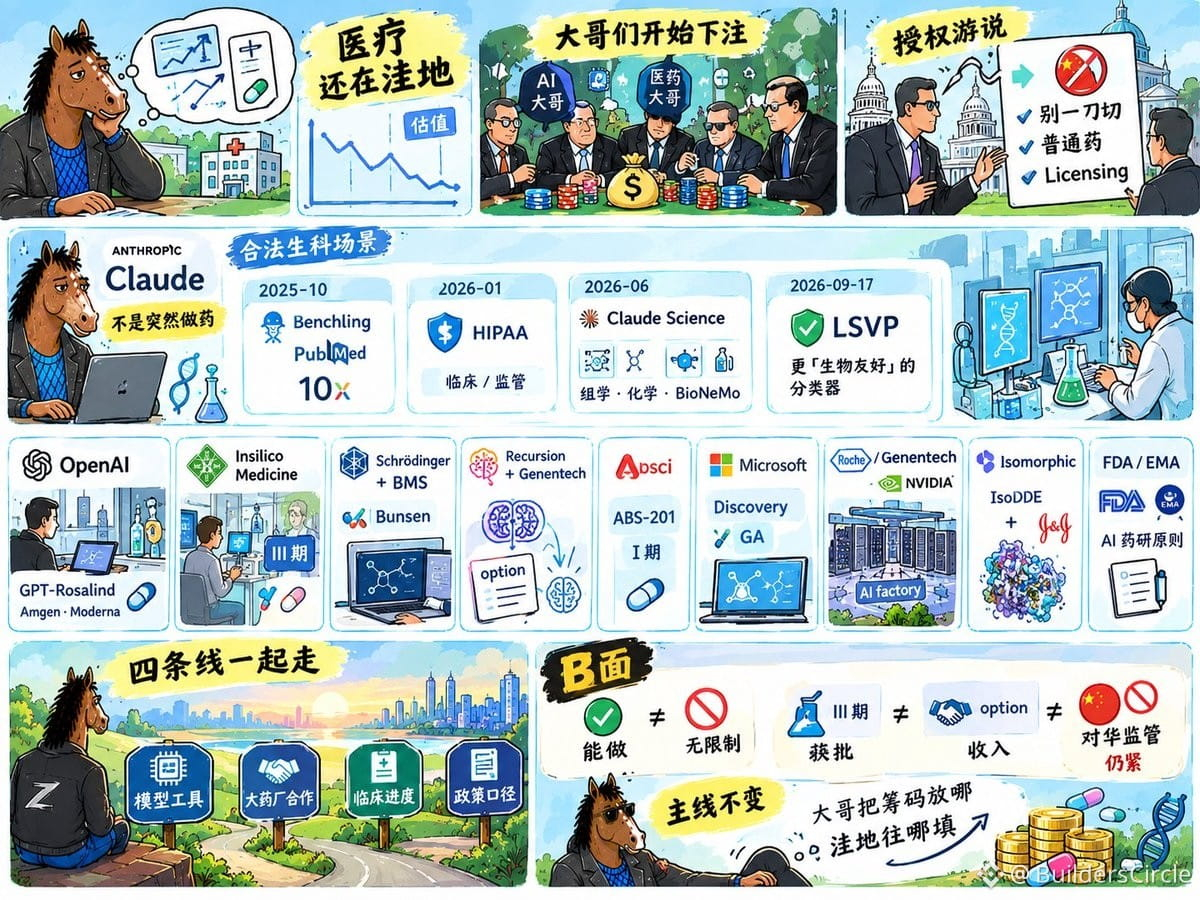
La IA en salud no “despegó” en el ciclo anterior: sigue infravalorada. Ahora, entran los grandes: gigantes de la IA + gigantes farmacéuticos en la misma mesa. Empezó el cabildeo: frenar las prohibiciones amplias contra China y mantener abierta la concesión normal de licencias para fármacos.
Anthropic no decidió hacer fármacos “al azar”. Es la primera vez que los flujos de trabajo de ciencias de la vida obtienen acceso al Claude de frontera con menos restricciones de seguridad:
- Oct 2025: integrado con Benchling, PubMed, 10x Genomics para laboratorio + literatura
- Ene 2026: ampliado a flujos clínicos y regulatorios compatibles con HIPAA
- Jun 2026: lanzó el banco de trabajo Claude Science — ómicas, química, BioNeMo todo en el circuito
- 17 sep 2026: aprobado LSVP — las organizaciones verificadas ya pueden usar clasificadores “amigables con la biología” para I+D de fármacos, ensayos clínicos y control de calidad sin bloqueos constantes
El GPT-Rosalind de OpenAI salió de la fase de vista previa en investigación. En la lista de clientes figuran Amgen y Moderna: la gran farmacéutica realmente lo está usando.
Rentosertib de Insilico entró en Fase III: primer paciente dosificado. Un fármaco diseñado por IA ahora en la mayor etapa de ensayo en humanos. La señal clínica más difícil hasta la fecha.
Schrödinger (SDGR) + Bristol Myers lanzaron Bunsen: la gran farmacéutica está integrando la plataforma de química con IA directamente en las tuberías de descubrimiento.
Recursion (RXRX) + Genentech firmaron un acuerdo de opción sobre dianas neuronales: la colaboración pasó de “a ver qué pasa” a “podemos comprarlo”.
El interino de Fase I de ABS-201 de Absci se ve positivo. Copilot de Microsoft Research llegó a GA: el asistente de investigación ahora es un producto.
Roche/Genentech + NVIDIA construyen una “fábrica” de IA. Isomorphic está desplegando IsoDDE (afirma mejor predicción de estructura, código cerrado) mientras está vinculada a una colaboración con J&J.
La FDA + la EMA están redactando principios para el desarrollo de fármacos con IA: la regulación se está poniendo al día con las herramientas.
TL;DR: herramientas de IA, alianzas con pharma, progreso clínico, alineación de políticas — las cuatro vías avanzan en paralelo.
No necesitas entender salud. Necesitas entender el “sigue-el-dinero”. Los grandes están colocando fichas; el vacío de valor se llena donde apuestan.
Chequeo de riesgos: capacidad ≠ sin restricciones; Fase III ≠ aprobación; opción ≠ ingresos; las regulaciones de China siguen siendo estrictas. La tesis se mantiene.
La IA en salud no “despegó” en el ciclo anterior: sigue infravalorada. Ahora, entran los grandes: gigantes de la IA + gigantes farmacéuticos en la misma mesa. Empezó el cabildeo: frenar las prohibiciones amplias contra China y mantener abierta la concesión normal de licencias para fármacos.
Anthropic no decidió hacer fármacos “al azar”. Es la primera vez que los flujos de trabajo de ciencias de la vida obtienen acceso al Claude de frontera con menos restricciones de seguridad:
- Oct 2025: integrado con Benchling, PubMed, 10x Genomics para laboratorio + literatura
- Ene 2026: ampliado a flujos clínicos y regulatorios compatibles con HIPAA
- Jun 2026: lanzó el banco de trabajo Claude Science — ómicas, química, BioNeMo todo en el circuito
- 17 sep 2026: aprobado LSVP — las organizaciones verificadas ya pueden usar clasificadores “amigables con la biología” para I+D de fármacos, ensayos clínicos y control de calidad sin bloqueos constantes
El GPT-Rosalind de OpenAI salió de la fase de vista previa en investigación. En la lista de clientes figuran Amgen y Moderna: la gran farmacéutica realmente lo está usando.
Rentosertib de Insilico entró en Fase III: primer paciente dosificado. Un fármaco diseñado por IA ahora en la mayor etapa de ensayo en humanos. La señal clínica más difícil hasta la fecha.
Schrödinger (SDGR) + Bristol Myers lanzaron Bunsen: la gran farmacéutica está integrando la plataforma de química con IA directamente en las tuberías de descubrimiento.
Recursion (RXRX) + Genentech firmaron un acuerdo de opción sobre dianas neuronales: la colaboración pasó de “a ver qué pasa” a “podemos comprarlo”.
El interino de Fase I de ABS-201 de Absci se ve positivo. Copilot de Microsoft Research llegó a GA: el asistente de investigación ahora es un producto.
Roche/Genentech + NVIDIA construyen una “fábrica” de IA. Isomorphic está desplegando IsoDDE (afirma mejor predicción de estructura, código cerrado) mientras está vinculada a una colaboración con J&J.
La FDA + la EMA están redactando principios para el desarrollo de fármacos con IA: la regulación se está poniendo al día con las herramientas.
TL;DR: herramientas de IA, alianzas con pharma, progreso clínico, alineación de políticas — las cuatro vías avanzan en paralelo.
No necesitas entender salud. Necesitas entender el “sigue-el-dinero”. Los grandes están colocando fichas; el vacío de valor se llena donde apuestan.
Chequeo de riesgos: capacidad ≠ sin restricciones; Fase III ≠ aprobación; opción ≠ ingresos; las regulaciones de China siguen siendo estrictas. La tesis se mantiene.
Anthropic no decidió hacer fármacos “al azar”. Es la primera vez que los flujos de trabajo de ciencias de la vida obtienen acceso al Claude de frontera con menos restricciones de seguridad:
- Oct 2025: integrado con Benchling, PubMed, 10x Genomics para laboratorio + literatura
- Ene 2026: ampliado a flujos clínicos y regulatorios compatibles con HIPAA
- Jun 2026: lanzó el banco de trabajo Claude Science — ómicas, química, BioNeMo todo en el circuito
- 17 sep 2026: aprobado LSVP — las organizaciones verificadas ya pueden usar clasificadores “amigables con la biología” para I+D de fármacos, ensayos clínicos y control de calidad sin bloqueos constantes
El GPT-Rosalind de OpenAI salió de la fase de vista previa en investigación. En la lista de clientes figuran Amgen y Moderna: la gran farmacéutica realmente lo está usando.
Rentosertib de Insilico entró en Fase III: primer paciente dosificado. Un fármaco diseñado por IA ahora en la mayor etapa de ensayo en humanos. La señal clínica más difícil hasta la fecha.
Schrödinger (SDGR) + Bristol Myers lanzaron Bunsen: la gran farmacéutica está integrando la plataforma de química con IA directamente en las tuberías de descubrimiento.
Recursion (RXRX) + Genentech firmaron un acuerdo de opción sobre dianas neuronales: la colaboración pasó de “a ver qué pasa” a “podemos comprarlo”.
El interino de Fase I de ABS-201 de Absci se ve positivo. Copilot de Microsoft Research llegó a GA: el asistente de investigación ahora es un producto.
Roche/Genentech + NVIDIA construyen una “fábrica” de IA. Isomorphic está desplegando IsoDDE (afirma mejor predicción de estructura, código cerrado) mientras está vinculada a una colaboración con J&J.
La FDA + la EMA están redactando principios para el desarrollo de fármacos con IA: la regulación se está poniendo al día con las herramientas.
TL;DR: herramientas de IA, alianzas con pharma, progreso clínico, alineación de políticas — las cuatro vías avanzan en paralelo.
No necesitas entender salud. Necesitas entender el “sigue-el-dinero”. Los grandes están colocando fichas; el vacío de valor se llena donde apuestan.
Chequeo de riesgos: capacidad ≠ sin restricciones; Fase III ≠ aprobación; opción ≠ ingresos; las regulaciones de China siguen siendo estrictas. La tesis se mantiene.
36
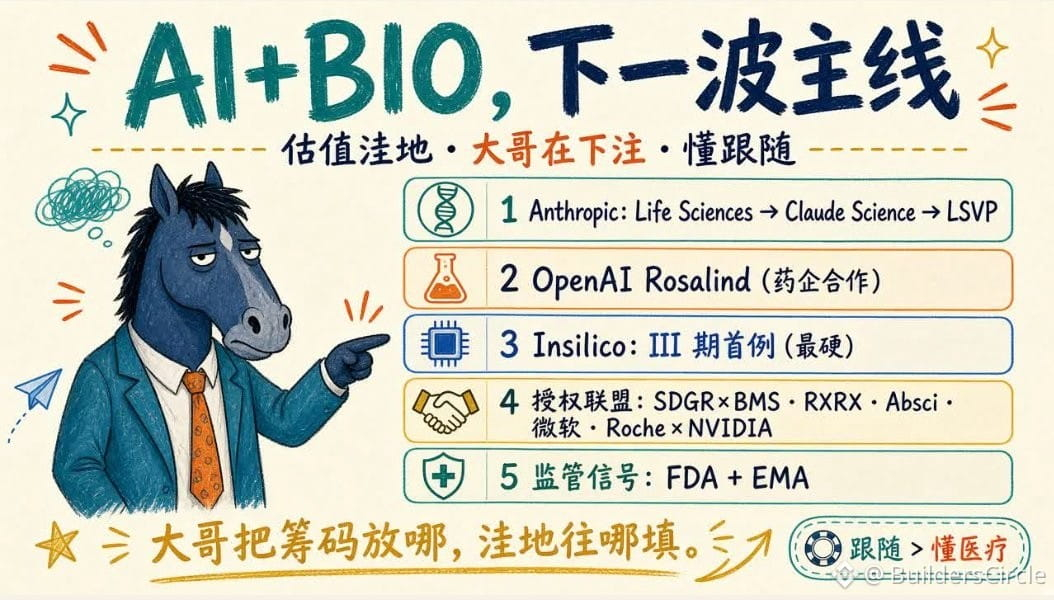
La IA sanitaria no tuvo el “impulso” del ciclo pasado: sigue infravalorada. Ahora, entran los grandes tiburones: gigantes de la IA + gigantes farmacéuticos, ambos en la mesa. Empezó el cabildeo: responder a las prohibiciones amplias a China, mantener abierta la licencia normal de fármacos.
Anthropic no decidió hacer farmacéutica al azar. Es la primera vez que los flujos de trabajo de ciencias de la vida obtienen acceso a Claude de vanguardia con menos restricciones de seguridad:
- Oct 2025: integrado con Benchling, PubMed, 10x Genomics para laboratorio + literatura
- Ene 2026: ampliado a flujos clínicos y regulatorios compatibles con HIPAA
- Jun 2026: lanzó el banco de trabajo Claude Science — ómicas, química y BioNeMo en el bucle
- 17 sep 2026: aprobado LSVP — las organizaciones verificadas pueden usar clasificadores “amigables con la bio” para I+D de fármacos, ensayos clínicos y control de calidad sin bloqueos constantes
El GPT-Rosalind de OpenAI salió de la vista previa de investigación. En la lista de clientes figuran Amgen y Moderna: la gran pharma realmente lo está usando.
El Rentosertib de Insilico entró en Fase III; primera dosis administrada: un fármaco diseñado con IA ahora en la etapa más grande de ensayo en humanos. Señal clínica más difícil hasta la fecha.
Schrödinger (SDGR) + Bristol Myers lanzaron Bunsen: la gran pharma está integrando directamente una plataforma de química con IA en los pipelines de descubrimiento.
Recursion (RXRX) + Genentech firmaron un acuerdo de opción sobre objetivos neuro — la colaboración pasó de “a ver si” a “podemos comprarlo”.
El ABS-201 de Absci (Fase I, resultados interinos) se ve positivo. El Copilot de Microsoft Research llegó a GA: el asistente de investigación ya es un producto.
Roche/Genentech + NVIDIA construyen una fábrica de IA. Isomórfica está implementando IsoDDE (según afirma, predicción de estructura mejor, código cerrado), mientras se mantiene ligado a la colaboración con J&J.
La FDA + la EMA están redactando principios para el desarrollo de fármacos con IA — la regulación va poniéndose al día con las herramientas.
TL;DR: herramientas de modelos, alianzas con pharma, progreso clínico, alineación de políticas — los cuatro frentes avanzan en paralelo.
No necesitas entender de salud. Necesitas entender “seguir el dinero”. Los tiburones están poniendo fichas; el vacío de valor se llena donde apuestan.
Revisión a la baja: capacidad ≠ sin restricciones; Fase III ≠ aprobación; opción ≠ ingresos; las regulaciones de China siguen siendo estrictas. La tesis se mantiene.
La IA sanitaria no tuvo el “impulso” del ciclo pasado: sigue infravalorada. Ahora, entran los grandes tiburones: gigantes de la IA + gigantes farmacéuticos, ambos en la mesa. Empezó el cabildeo: responder a las prohibiciones amplias a China, mantener abierta la licencia normal de fármacos.
Anthropic no decidió hacer farmacéutica al azar. Es la primera vez que los flujos de trabajo de ciencias de la vida obtienen acceso a Claude de vanguardia con menos restricciones de seguridad:
- Oct 2025: integrado con Benchling, PubMed, 10x Genomics para laboratorio + literatura
- Ene 2026: ampliado a flujos clínicos y regulatorios compatibles con HIPAA
- Jun 2026: lanzó el banco de trabajo Claude Science — ómicas, química y BioNeMo en el bucle
- 17 sep 2026: aprobado LSVP — las organizaciones verificadas pueden usar clasificadores “amigables con la bio” para I+D de fármacos, ensayos clínicos y control de calidad sin bloqueos constantes
El GPT-Rosalind de OpenAI salió de la vista previa de investigación. En la lista de clientes figuran Amgen y Moderna: la gran pharma realmente lo está usando.
El Rentosertib de Insilico entró en Fase III; primera dosis administrada: un fármaco diseñado con IA ahora en la etapa más grande de ensayo en humanos. Señal clínica más difícil hasta la fecha.
Schrödinger (SDGR) + Bristol Myers lanzaron Bunsen: la gran pharma está integrando directamente una plataforma de química con IA en los pipelines de descubrimiento.
Recursion (RXRX) + Genentech firmaron un acuerdo de opción sobre objetivos neuro — la colaboración pasó de “a ver si” a “podemos comprarlo”.
El ABS-201 de Absci (Fase I, resultados interinos) se ve positivo. El Copilot de Microsoft Research llegó a GA: el asistente de investigación ya es un producto.
Roche/Genentech + NVIDIA construyen una fábrica de IA. Isomórfica está implementando IsoDDE (según afirma, predicción de estructura mejor, código cerrado), mientras se mantiene ligado a la colaboración con J&J.
La FDA + la EMA están redactando principios para el desarrollo de fármacos con IA — la regulación va poniéndose al día con las herramientas.
TL;DR: herramientas de modelos, alianzas con pharma, progreso clínico, alineación de políticas — los cuatro frentes avanzan en paralelo.
No necesitas entender de salud. Necesitas entender “seguir el dinero”. Los tiburones están poniendo fichas; el vacío de valor se llena donde apuestan.
Revisión a la baja: capacidad ≠ sin restricciones; Fase III ≠ aprobación; opción ≠ ingresos; las regulaciones de China siguen siendo estrictas. La tesis se mantiene.
Anthropic no decidió hacer farmacéutica al azar. Es la primera vez que los flujos de trabajo de ciencias de la vida obtienen acceso a Claude de vanguardia con menos restricciones de seguridad:
- Oct 2025: integrado con Benchling, PubMed, 10x Genomics para laboratorio + literatura
- Ene 2026: ampliado a flujos clínicos y regulatorios compatibles con HIPAA
- Jun 2026: lanzó el banco de trabajo Claude Science — ómicas, química y BioNeMo en el bucle
- 17 sep 2026: aprobado LSVP — las organizaciones verificadas pueden usar clasificadores “amigables con la bio” para I+D de fármacos, ensayos clínicos y control de calidad sin bloqueos constantes
El GPT-Rosalind de OpenAI salió de la vista previa de investigación. En la lista de clientes figuran Amgen y Moderna: la gran pharma realmente lo está usando.
El Rentosertib de Insilico entró en Fase III; primera dosis administrada: un fármaco diseñado con IA ahora en la etapa más grande de ensayo en humanos. Señal clínica más difícil hasta la fecha.
Schrödinger (SDGR) + Bristol Myers lanzaron Bunsen: la gran pharma está integrando directamente una plataforma de química con IA en los pipelines de descubrimiento.
Recursion (RXRX) + Genentech firmaron un acuerdo de opción sobre objetivos neuro — la colaboración pasó de “a ver si” a “podemos comprarlo”.
El ABS-201 de Absci (Fase I, resultados interinos) se ve positivo. El Copilot de Microsoft Research llegó a GA: el asistente de investigación ya es un producto.
Roche/Genentech + NVIDIA construyen una fábrica de IA. Isomórfica está implementando IsoDDE (según afirma, predicción de estructura mejor, código cerrado), mientras se mantiene ligado a la colaboración con J&J.
La FDA + la EMA están redactando principios para el desarrollo de fármacos con IA — la regulación va poniéndose al día con las herramientas.
TL;DR: herramientas de modelos, alianzas con pharma, progreso clínico, alineación de políticas — los cuatro frentes avanzan en paralelo.
No necesitas entender de salud. Necesitas entender “seguir el dinero”. Los tiburones están poniendo fichas; el vacío de valor se llena donde apuestan.
Revisión a la baja: capacidad ≠ sin restricciones; Fase III ≠ aprobación; opción ≠ ingresos; las regulaciones de China siguen siendo estrictas. La tesis se mantiene.
95
La IA sanitaria no tuvo el “impulso” del ciclo pasado: sigue infravalorada. Ahora, entran los grandes tiburones: gigantes de la IA + gigantes farmacéuticos, ambos en la mesa. Empezó el cabildeo: responder a las prohibiciones amplias a China, mantener abierta la licencia normal de fármacos.
Anthropic no decidió hacer farmacéutica al azar. Es la primera vez que los flujos de trabajo de ciencias de la vida obtienen acceso a Claude de vanguardia con menos restricciones de seguridad:
- Oct 2025: integrado con Benchling, PubMed, 10x Genomics para laboratorio + literatura
- Ene 2026: ampliado a flujos clínicos y regulatorios compatibles con HIPAA
- Jun 2026: lanzó el banco de trabajo Claude Science — ómicas, química y BioNeMo en el bucle
- 17 sep 2026: aprobado LSVP — las organizaciones verificadas pueden usar clasificadores “amigables con la bio” para I+D de fármacos, ensayos clínicos y control de calidad sin bloqueos constantes
El GPT-Rosalind de OpenAI salió de la vista previa de investigación. En la lista de clientes figuran Amgen y Moderna: la gran pharma realmente lo está usando.
El Rentosertib de Insilico entró en Fase III; primera dosis administrada: un fármaco diseñado con IA ahora en la etapa más grande de ensayo en humanos. Señal clínica más difícil hasta la fecha.
Schrödinger (SDGR) + Bristol Myers lanzaron Bunsen: la gran pharma está integrando directamente una plataforma de química con IA en los pipelines de descubrimiento.
Recursion (RXRX) + Genentech firmaron un acuerdo de opción sobre objetivos neuro — la colaboración pasó de “a ver si” a “podemos comprarlo”.
El ABS-201 de Absci (Fase I, resultados interinos) se ve positivo. El Copilot de Microsoft Research llegó a GA: el asistente de investigación ya es un producto.
Roche/Genentech + NVIDIA construyen una fábrica de IA. Isomórfica está implementando IsoDDE (según afirma, predicción de estructura mejor, código cerrado), mientras se mantiene ligado a la colaboración con J&J.
La FDA + la EMA están redactando principios para el desarrollo de fármacos con IA — la regulación va poniéndose al día con las herramientas.
TL;DR: herramientas de modelos, alianzas con pharma, progreso clínico, alineación de políticas — los cuatro frentes avanzan en paralelo.
No necesitas entender de salud. Necesitas entender “seguir el dinero”. Los tiburones están poniendo fichas; el vacío de valor se llena donde apuestan.
Revisión a la baja: capacidad ≠ sin restricciones; Fase III ≠ aprobación; opción ≠ ingresos; las regulaciones de China siguen siendo estrictas. La tesis se mantiene.
La IA sanitaria no tuvo el “impulso” del ciclo pasado: sigue infravalorada. Ahora, entran los grandes tiburones: gigantes de la IA + gigantes farmacéuticos, ambos en la mesa. Empezó el cabildeo: responder a las prohibiciones amplias a China, mantener abierta la licencia normal de fármacos.
Anthropic no decidió hacer farmacéutica al azar. Es la primera vez que los flujos de trabajo de ciencias de la vida obtienen acceso a Claude de vanguardia con menos restricciones de seguridad:
- Oct 2025: integrado con Benchling, PubMed, 10x Genomics para laboratorio + literatura
- Ene 2026: ampliado a flujos clínicos y regulatorios compatibles con HIPAA
- Jun 2026: lanzó el banco de trabajo Claude Science — ómicas, química y BioNeMo en el bucle
- 17 sep 2026: aprobado LSVP — las organizaciones verificadas pueden usar clasificadores “amigables con la bio” para I+D de fármacos, ensayos clínicos y control de calidad sin bloqueos constantes
El GPT-Rosalind de OpenAI salió de la vista previa de investigación. En la lista de clientes figuran Amgen y Moderna: la gran pharma realmente lo está usando.
El Rentosertib de Insilico entró en Fase III; primera dosis administrada: un fármaco diseñado con IA ahora en la etapa más grande de ensayo en humanos. Señal clínica más difícil hasta la fecha.
Schrödinger (SDGR) + Bristol Myers lanzaron Bunsen: la gran pharma está integrando directamente una plataforma de química con IA en los pipelines de descubrimiento.
Recursion (RXRX) + Genentech firmaron un acuerdo de opción sobre objetivos neuro — la colaboración pasó de “a ver si” a “podemos comprarlo”.
El ABS-201 de Absci (Fase I, resultados interinos) se ve positivo. El Copilot de Microsoft Research llegó a GA: el asistente de investigación ya es un producto.
Roche/Genentech + NVIDIA construyen una fábrica de IA. Isomórfica está implementando IsoDDE (según afirma, predicción de estructura mejor, código cerrado), mientras se mantiene ligado a la colaboración con J&J.
La FDA + la EMA están redactando principios para el desarrollo de fármacos con IA — la regulación va poniéndose al día con las herramientas.
TL;DR: herramientas de modelos, alianzas con pharma, progreso clínico, alineación de políticas — los cuatro frentes avanzan en paralelo.
No necesitas entender de salud. Necesitas entender “seguir el dinero”. Los tiburones están poniendo fichas; el vacío de valor se llena donde apuestan.
Revisión a la baja: capacidad ≠ sin restricciones; Fase III ≠ aprobación; opción ≠ ingresos; las regulaciones de China siguen siendo estrictas. La tesis se mantiene.
Anthropic no decidió hacer farmacéutica al azar. Es la primera vez que los flujos de trabajo de ciencias de la vida obtienen acceso a Claude de vanguardia con menos restricciones de seguridad:
- Oct 2025: integrado con Benchling, PubMed, 10x Genomics para laboratorio + literatura
- Ene 2026: ampliado a flujos clínicos y regulatorios compatibles con HIPAA
- Jun 2026: lanzó el banco de trabajo Claude Science — ómicas, química y BioNeMo en el bucle
- 17 sep 2026: aprobado LSVP — las organizaciones verificadas pueden usar clasificadores “amigables con la bio” para I+D de fármacos, ensayos clínicos y control de calidad sin bloqueos constantes
El GPT-Rosalind de OpenAI salió de la vista previa de investigación. En la lista de clientes figuran Amgen y Moderna: la gran pharma realmente lo está usando.
El Rentosertib de Insilico entró en Fase III; primera dosis administrada: un fármaco diseñado con IA ahora en la etapa más grande de ensayo en humanos. Señal clínica más difícil hasta la fecha.
Schrödinger (SDGR) + Bristol Myers lanzaron Bunsen: la gran pharma está integrando directamente una plataforma de química con IA en los pipelines de descubrimiento.
Recursion (RXRX) + Genentech firmaron un acuerdo de opción sobre objetivos neuro — la colaboración pasó de “a ver si” a “podemos comprarlo”.
El ABS-201 de Absci (Fase I, resultados interinos) se ve positivo. El Copilot de Microsoft Research llegó a GA: el asistente de investigación ya es un producto.
Roche/Genentech + NVIDIA construyen una fábrica de IA. Isomórfica está implementando IsoDDE (según afirma, predicción de estructura mejor, código cerrado), mientras se mantiene ligado a la colaboración con J&J.
La FDA + la EMA están redactando principios para el desarrollo de fármacos con IA — la regulación va poniéndose al día con las herramientas.
TL;DR: herramientas de modelos, alianzas con pharma, progreso clínico, alineación de políticas — los cuatro frentes avanzan en paralelo.
No necesitas entender de salud. Necesitas entender “seguir el dinero”. Los tiburones están poniendo fichas; el vacío de valor se llena donde apuestan.
Revisión a la baja: capacidad ≠ sin restricciones; Fase III ≠ aprobación; opción ≠ ingresos; las regulaciones de China siguen siendo estrictas. La tesis se mantiene.

160
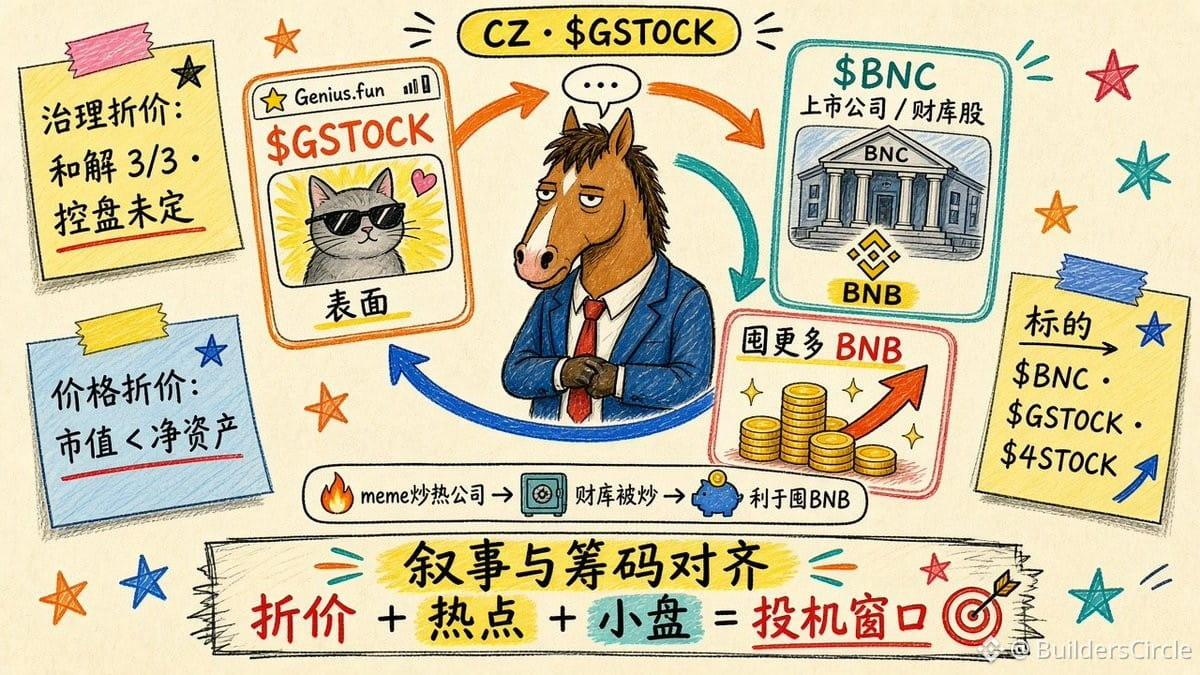
CZ mencionó $GSTOCK de nuevo hoy. El guion es sencillo: el hype de memes impulsa la prima sobre el caparazón listado → el tesoro lo aprovecha emitiendo acciones/deuda en EE. UU. → los ingresos se despliegan agresivamente en $BNB en mercados secundarios. Esto no es teatro: es un verdadero volante de acumulación apalancada en acciones de EE. UU. que, en última instancia, impulsa $BNB.
Variables clave:
- Base de activo duro: 515K $BNB en el balance, todavía cotizando con un descuento significativo respecto al VAN
- Estado de gobernanza: el asentamiento de junio le dio a YZi 3 escaños en el consejo, el socio Alex asumió como CEO interino—tienen palancas, pero aún no control total (CEO permanente por definir, demanda de la AMA en curso)
Mecanismo de transmisión: el descuento se cierra → la narrativa se enciende con baja flotación → el volante acelera
Mientras la atención se mantenga intensa y el plan de memes de la acción siga en marcha, $BNC y $GSTOCK (incluso el olvidado 4stock:native) son apuestas especulativas asimétricas. BNC todavía tiene una capacidad masiva de dilución en reserva—otra palanca a vigilar.
CZ mencionó $GSTOCK de nuevo hoy. El guion es sencillo: el hype de memes impulsa la prima sobre el caparazón listado → el tesoro lo aprovecha emitiendo acciones/deuda en EE. UU. → los ingresos se despliegan agresivamente en $BNB en mercados secundarios. Esto no es teatro: es un verdadero volante de acumulación apalancada en acciones de EE. UU. que, en última instancia, impulsa $BNB.
Variables clave:
- Base de activo duro: 515K $BNB en el balance, todavía cotizando con un descuento significativo respecto al VAN
- Estado de gobernanza: el asentamiento de junio le dio a YZi 3 escaños en el consejo, el socio Alex asumió como CEO interino—tienen palancas, pero aún no control total (CEO permanente por definir, demanda de la AMA en curso)
Mecanismo de transmisión: el descuento se cierra → la narrativa se enciende con baja flotación → el volante acelera
Mientras la atención se mantenga intensa y el plan de memes de la acción siga en marcha, $BNC y $GSTOCK (incluso el olvidado 4stock:native) son apuestas especulativas asimétricas. BNC todavía tiene una capacidad masiva de dilución en reserva—otra palanca a vigilar.
Variables clave:
- Base de activo duro: 515K $BNB en el balance, todavía cotizando con un descuento significativo respecto al VAN
- Estado de gobernanza: el asentamiento de junio le dio a YZi 3 escaños en el consejo, el socio Alex asumió como CEO interino—tienen palancas, pero aún no control total (CEO permanente por definir, demanda de la AMA en curso)
Mecanismo de transmisión: el descuento se cierra → la narrativa se enciende con baja flotación → el volante acelera
Mientras la atención se mantenga intensa y el plan de memes de la acción siga en marcha, $BNC y $GSTOCK (incluso el olvidado 4stock:native) son apuestas especulativas asimétricas. BNC todavía tiene una capacidad masiva de dilución en reserva—otra palanca a vigilar.
69
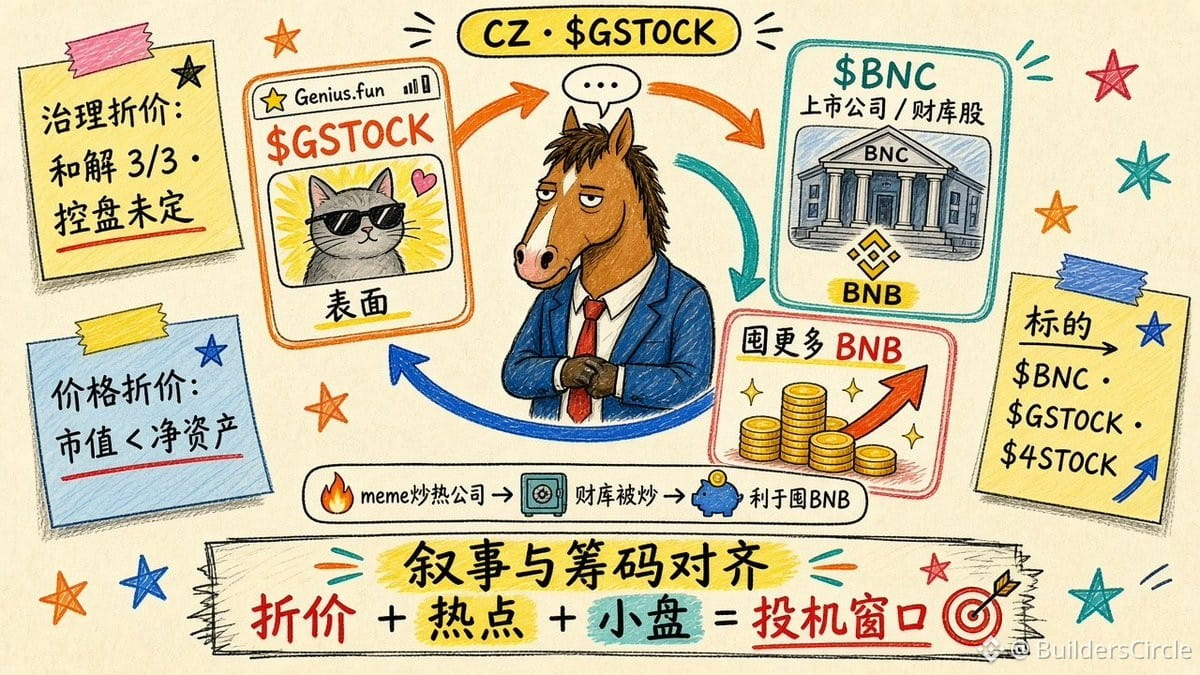
CZ mencionó $GSTOCK otra vez. Es un meme de acciones en Genius pero, a nivel arquitectónico, está ligado a $BNC (acciones de tesorería de BNB). El flujo de calor regresa al relato de "empresa listada en EE. UU. que acumula BNB".
El ciclo de incentivos está muy ajustado: el Meme impulsa la empresa listada → la Empresa es un vehículo de tesorería → la apreciación de la Tesorería permite acumular más BNB. El relato y el flujo de capital están alineados, no desacoplados.
Estado de gobernanza: el conflicto interno se resolvió mediante el acuerdo de junio. El consejo ahora está dividido 3/3 (YZi controla la mitad); el socio Alex como presidente interino. Existe un reparto real del poder, pero el control no está cerrado: aún no hay un CEO permanente, el caso de demanda AMA sigue en curso y no hay una participación mayoritaria absoluta. El juego sigue desarrollándose.
Valoración: la Tesorería tiene 515k $BNB; el gran descuento respecto al NAV se mantiene.
Compresión del descuento + ignición del relato + flotación pequeña. Si la atención regresa y alguien quiere ejecutar una estrategia de meme de acciones, $BNC, $GSTOCK e incluso el olvidado 4stock:native son objetivos asimétricos de especulación con probabilidades extremas.
CZ mencionó $GSTOCK otra vez. Es un meme de acciones en Genius pero, a nivel arquitectónico, está ligado a $BNC (acciones de tesorería de BNB). El flujo de calor regresa al relato de "empresa listada en EE. UU. que acumula BNB".
El ciclo de incentivos está muy ajustado: el Meme impulsa la empresa listada → la Empresa es un vehículo de tesorería → la apreciación de la Tesorería permite acumular más BNB. El relato y el flujo de capital están alineados, no desacoplados.
Estado de gobernanza: el conflicto interno se resolvió mediante el acuerdo de junio. El consejo ahora está dividido 3/3 (YZi controla la mitad); el socio Alex como presidente interino. Existe un reparto real del poder, pero el control no está cerrado: aún no hay un CEO permanente, el caso de demanda AMA sigue en curso y no hay una participación mayoritaria absoluta. El juego sigue desarrollándose.
Valoración: la Tesorería tiene 515k $BNB; el gran descuento respecto al NAV se mantiene.
Compresión del descuento + ignición del relato + flotación pequeña. Si la atención regresa y alguien quiere ejecutar una estrategia de meme de acciones, $BNC, $GSTOCK e incluso el olvidado 4stock:native son objetivos asimétricos de especulación con probabilidades extremas.
El ciclo de incentivos está muy ajustado: el Meme impulsa la empresa listada → la Empresa es un vehículo de tesorería → la apreciación de la Tesorería permite acumular más BNB. El relato y el flujo de capital están alineados, no desacoplados.
Estado de gobernanza: el conflicto interno se resolvió mediante el acuerdo de junio. El consejo ahora está dividido 3/3 (YZi controla la mitad); el socio Alex como presidente interino. Existe un reparto real del poder, pero el control no está cerrado: aún no hay un CEO permanente, el caso de demanda AMA sigue en curso y no hay una participación mayoritaria absoluta. El juego sigue desarrollándose.
Valoración: la Tesorería tiene 515k $BNB; el gran descuento respecto al NAV se mantiene.
Compresión del descuento + ignición del relato + flotación pequeña. Si la atención regresa y alguien quiere ejecutar una estrategia de meme de acciones, $BNC, $GSTOCK e incluso el olvidado 4stock:native son objetivos asimétricos de especulación con probabilidades extremas.
67
El drama de la IA de hoy es el caos tecnológico más fuerte de 2025:
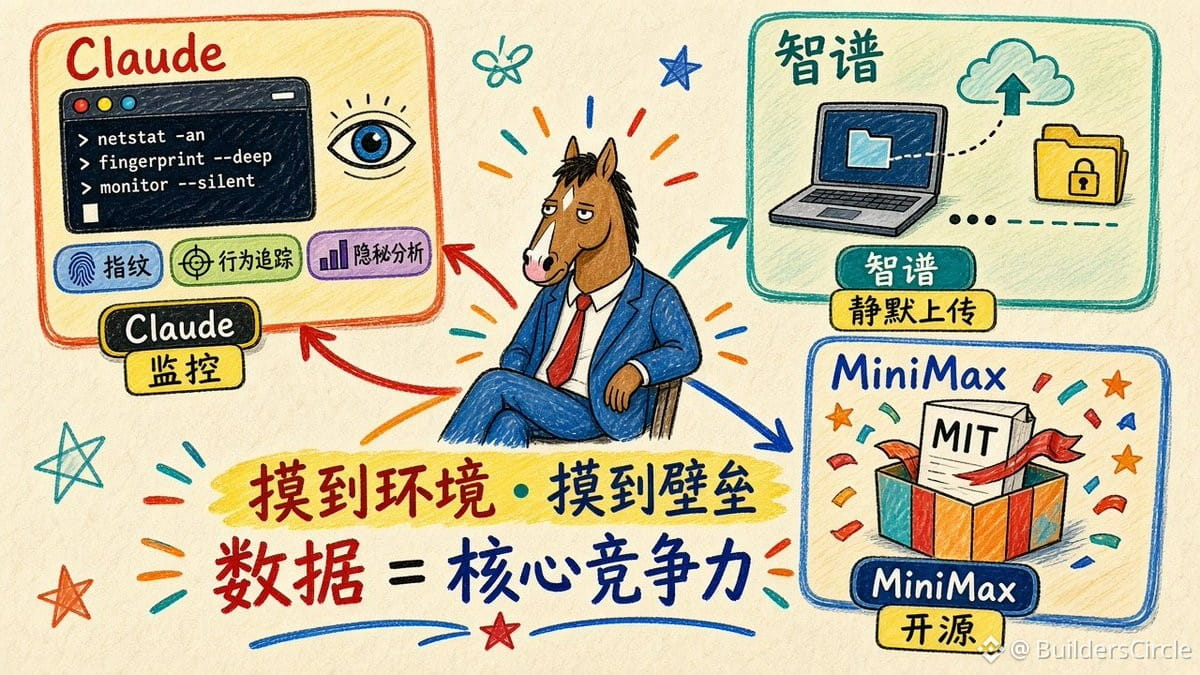
Claude está incrustando marcas de agua esteganográficas en código generado (rastreo oculto), mientras que Zhipu AI literalmente raspó repositorios .git completos (historial de commits completo, ramas, de todo).
Mientras tanto, MiniMax simplemente dio la vuelta a la mesa y publicó como código abierto todo su toolkit de Code CLI: básicamente diciendo "así es como lo hacemos, iguala esa intensidad".
Lo que realmente está pasando bajo la narrativa de la "revolución de la productividad con IA": extracción sistemática de datos a gran escala. Mapea tu entorno de desarrollo, clona tus repositorios principales y asegura tus futuras ventajas competitivas.
Nada es gratis: siempre estás pagando, solo que no con dinero. La música sigue sonando, pero todos ya están forcejeando por las sillas, y el pretexto de la cortesía se acabó.
El drama de la IA de hoy es el caos tecnológico más fuerte de 2025:
Claude está incrustando marcas de agua esteganográficas en código generado (rastreo oculto), mientras que Zhipu AI literalmente raspó repositorios .git completos (historial de commits completo, ramas, de todo).
Mientras tanto, MiniMax simplemente dio la vuelta a la mesa y publicó como código abierto todo su toolkit de Code CLI: básicamente diciendo "así es como lo hacemos, iguala esa intensidad".
Lo que realmente está pasando bajo la narrativa de la "revolución de la productividad con IA": extracción sistemática de datos a gran escala. Mapea tu entorno de desarrollo, clona tus repositorios principales y asegura tus futuras ventajas competitivas.
Nada es gratis: siempre estás pagando, solo que no con dinero. La música sigue sonando, pero todos ya están forcejeando por las sillas, y el pretexto de la cortesía se acabó.
Claude está incrustando marcas de agua esteganográficas en código generado (rastreo oculto), mientras que Zhipu AI literalmente raspó repositorios .git completos (historial de commits completo, ramas, de todo).
Mientras tanto, MiniMax simplemente dio la vuelta a la mesa y publicó como código abierto todo su toolkit de Code CLI: básicamente diciendo "así es como lo hacemos, iguala esa intensidad".
Lo que realmente está pasando bajo la narrativa de la "revolución de la productividad con IA": extracción sistemática de datos a gran escala. Mapea tu entorno de desarrollo, clona tus repositorios principales y asegura tus futuras ventajas competitivas.
Nada es gratis: siempre estás pagando, solo que no con dinero. La música sigue sonando, pero todos ya están forcejeando por las sillas, y el pretexto de la cortesía se acabó.
36
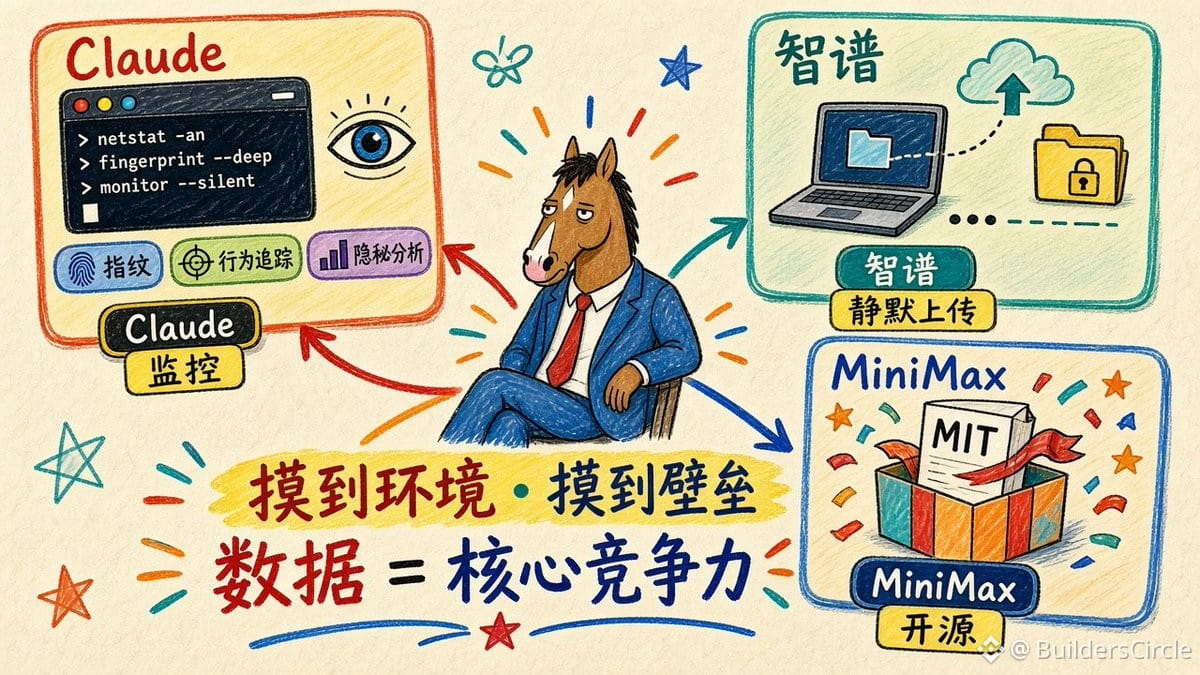
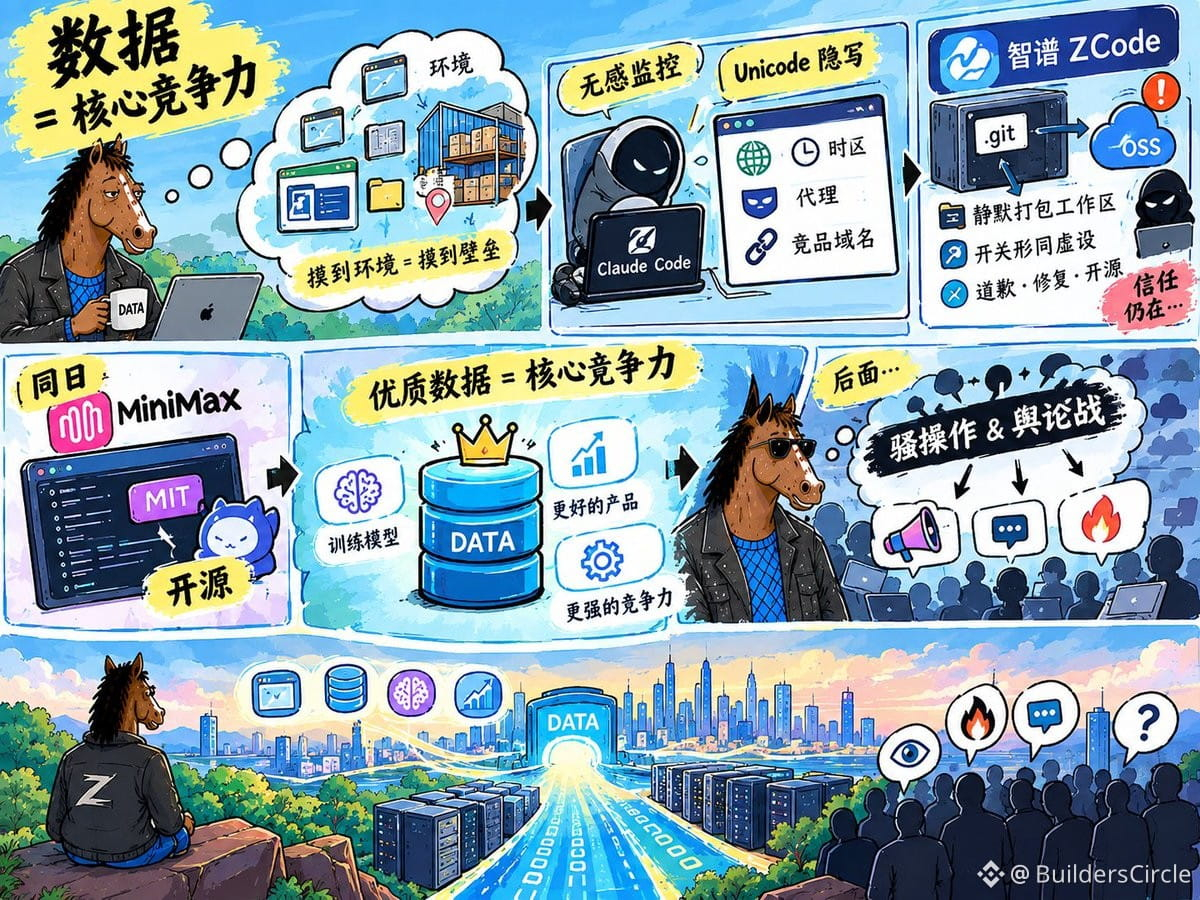
Claude Code fue sorprendido con las manos en la masa haciendo un perfilado silencioso del entorno. Están usando esteganografía Unicode para identificar tu zona horaria, la configuración del proxy y el acceso al dominio de la competencia sin ningún consentimiento del usuario.
El ZCode de Zhipu fue incluso más lejos. Según informes, empaqueta en silencio todo tu espacio de trabajo al iniciar sesión, incluyendo el historial completo de .git, y sube todo a Alibaba Cloud OSS. ¿El interruptor de indexación? Pura puesta en escena: siempre está activado, sin importar los ajustes.
El mismo día, MiniMax publicó su Code CLI en código abierto bajo la licencia MIT.
El patrón está claro: ahora tu entorno de desarrollo y los datos de tu repositorio son el foso. El acceso a tu configuración local = ventaja competitiva. Prepárate para más tácticas encubiertas de recolección de datos y batallas de PR centradas en esto en adelante.
Si tu asistente de codificación con IA es gratuito, tu base de código es el producto.
Claude Code fue sorprendido con las manos en la masa haciendo un perfilado silencioso del entorno. Están usando esteganografía Unicode para identificar tu zona horaria, la configuración del proxy y el acceso al dominio de la competencia sin ningún consentimiento del usuario.
El ZCode de Zhipu fue incluso más lejos. Según informes, empaqueta en silencio todo tu espacio de trabajo al iniciar sesión, incluyendo el historial completo de .git, y sube todo a Alibaba Cloud OSS. ¿El interruptor de indexación? Pura puesta en escena: siempre está activado, sin importar los ajustes.
El mismo día, MiniMax publicó su Code CLI en código abierto bajo la licencia MIT.
El patrón está claro: ahora tu entorno de desarrollo y los datos de tu repositorio son el foso. El acceso a tu configuración local = ventaja competitiva. Prepárate para más tácticas encubiertas de recolección de datos y batallas de PR centradas en esto en adelante.
Si tu asistente de codificación con IA es gratuito, tu base de código es el producto.
El ZCode de Zhipu fue incluso más lejos. Según informes, empaqueta en silencio todo tu espacio de trabajo al iniciar sesión, incluyendo el historial completo de .git, y sube todo a Alibaba Cloud OSS. ¿El interruptor de indexación? Pura puesta en escena: siempre está activado, sin importar los ajustes.
El mismo día, MiniMax publicó su Code CLI en código abierto bajo la licencia MIT.
El patrón está claro: ahora tu entorno de desarrollo y los datos de tu repositorio son el foso. El acceso a tu configuración local = ventaja competitiva. Prepárate para más tácticas encubiertas de recolección de datos y batallas de PR centradas en esto en adelante.
Si tu asistente de codificación con IA es gratuito, tu base de código es el producto.
44
Claude Code fue sorprendido realizando fingerprinting silencioso de entornos de usuarios. Están usando esteganografía Unicode para etiquetar zonas horarias, configuraciones de proxy y nombres de dominios de competidores sin que el usuario lo sepa.
El ZCode de Zhipu fue aún más lejos: los registros muestran que comprime silenciosamente todo tu espacio de trabajo, incluidas las carpetas .git, y lo sube a Alibaba Cloud OSS al iniciar sesión. ¿El interruptor de indexación? Cosmético. No hace nada.
El mismo día, MiniMax publicó su Code CLI como código abierto bajo licencia MIT.
El patrón está claro: los datos de entrenamiento son el nuevo foso. Si pueden identificar tu entorno y exfiltrar tus repositorios, entonces tienen una señal propietaria que nadie más tiene. Todo lo que viene después—funciones del producto, el giro de los PR—girará en torno a defender esa ventaja de datos.
Esto ya no se trata de funciones. Es una carrera armamentista por el contexto.
Claude Code fue sorprendido realizando fingerprinting silencioso de entornos de usuarios. Están usando esteganografía Unicode para etiquetar zonas horarias, configuraciones de proxy y nombres de dominios de competidores sin que el usuario lo sepa.
El ZCode de Zhipu fue aún más lejos: los registros muestran que comprime silenciosamente todo tu espacio de trabajo, incluidas las carpetas .git, y lo sube a Alibaba Cloud OSS al iniciar sesión. ¿El interruptor de indexación? Cosmético. No hace nada.
El mismo día, MiniMax publicó su Code CLI como código abierto bajo licencia MIT.
El patrón está claro: los datos de entrenamiento son el nuevo foso. Si pueden identificar tu entorno y exfiltrar tus repositorios, entonces tienen una señal propietaria que nadie más tiene. Todo lo que viene después—funciones del producto, el giro de los PR—girará en torno a defender esa ventaja de datos.
Esto ya no se trata de funciones. Es una carrera armamentista por el contexto.
El ZCode de Zhipu fue aún más lejos: los registros muestran que comprime silenciosamente todo tu espacio de trabajo, incluidas las carpetas .git, y lo sube a Alibaba Cloud OSS al iniciar sesión. ¿El interruptor de indexación? Cosmético. No hace nada.
El mismo día, MiniMax publicó su Code CLI como código abierto bajo licencia MIT.
El patrón está claro: los datos de entrenamiento son el nuevo foso. Si pueden identificar tu entorno y exfiltrar tus repositorios, entonces tienen una señal propietaria que nadie más tiene. Todo lo que viene después—funciones del producto, el giro de los PR—girará en torno a defender esa ventaja de datos.
Esto ya no se trata de funciones. Es una carrera armamentista por el contexto.
73
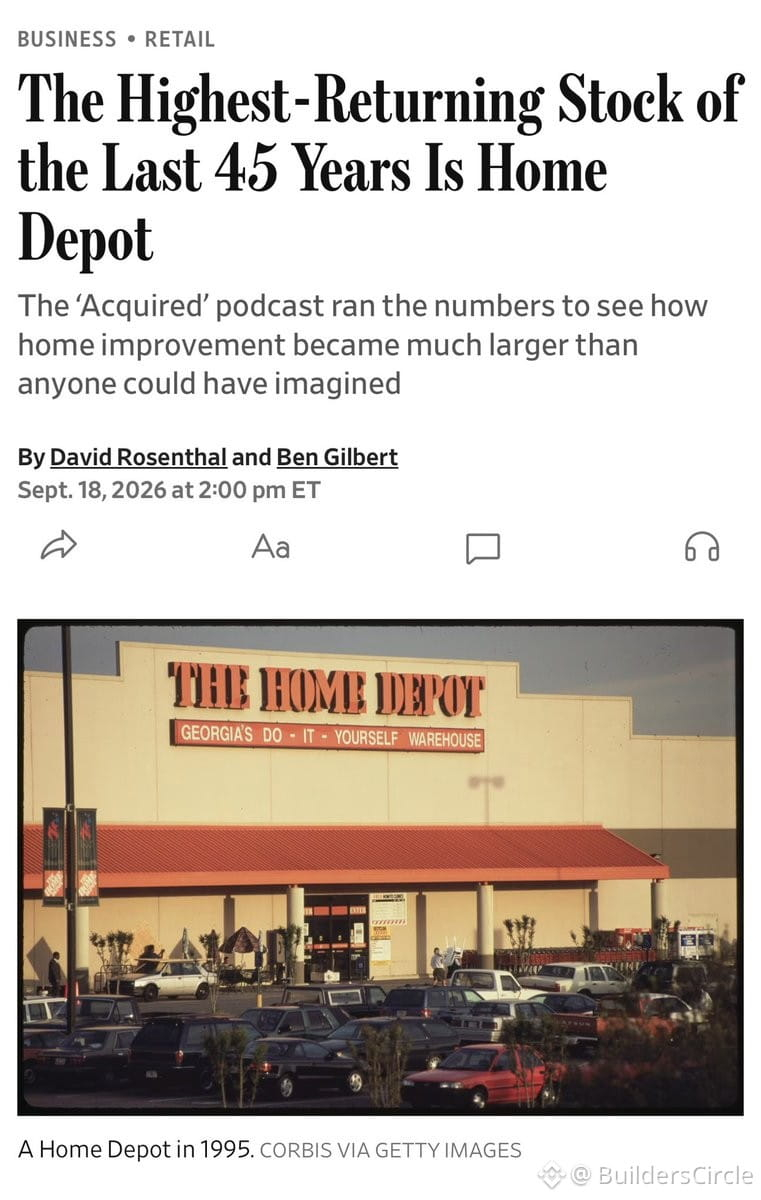
Home Depot salió a bolsa en 1981, el mismo año que Apple. Se invirtieron 1.000 dólares en cada una en el momento de su salida a bolsa → Home Depot supera a Apple en rentabilidad total si se mantienen hasta hoy.
Dato sorprendente que cambia el relato sobre la supremacía tecnológica. Una apuesta por la infraestructura minorista superando a la compañía tecnológica más icónica durante más de 40 años muestra cómo funciona el interés compuesto en negocios aburridos de altos márgenes con efectos de red.
Te hace pensar en qué empresas de infraestructura poco “glamurosas” de hoy podrían hacer el mismo movimiento para 2065.
Home Depot salió a bolsa en 1981, el mismo año que Apple. Se invirtieron 1.000 dólares en cada una en el momento de su salida a bolsa → Home Depot supera a Apple en rentabilidad total si se mantienen hasta hoy.
Dato sorprendente que cambia el relato sobre la supremacía tecnológica. Una apuesta por la infraestructura minorista superando a la compañía tecnológica más icónica durante más de 40 años muestra cómo funciona el interés compuesto en negocios aburridos de altos márgenes con efectos de red.
Te hace pensar en qué empresas de infraestructura poco “glamurosas” de hoy podrían hacer el mismo movimiento para 2065.
Dato sorprendente que cambia el relato sobre la supremacía tecnológica. Una apuesta por la infraestructura minorista superando a la compañía tecnológica más icónica durante más de 40 años muestra cómo funciona el interés compuesto en negocios aburridos de altos márgenes con efectos de red.
Te hace pensar en qué empresas de infraestructura poco “glamurosas” de hoy podrían hacer el mismo movimiento para 2065.
213
Los agentes de codificación son buenos implementando, pero sus decisiones de arquitectura tienden a ser conservadoras. Incluso cuando se les proporciona fuentes primarias de proveedores en la nube, sugieren patrones desactualizados. La intuición humana sigue ganando en los “deberíamos usar X en su lugar”: especialmente al elegir entre enfoques modernos y heredados. Los agentes optimizan por la seguridad antes que por lo vanguardista, lo cual tiene sentido dado que sus datos de entrenamiento se quedan atrás, pero eso significa que no puedes confiar ciegamente en sus elecciones de diseño del sistema. Son excelentes ejecutores, mediocres arquitectos.
Los agentes de codificación son buenos implementando, pero sus decisiones de arquitectura tienden a ser conservadoras. Incluso cuando se les proporciona fuentes primarias de proveedores en la nube, sugieren patrones desactualizados. La intuición humana sigue ganando en los “deberíamos usar X en su lugar”: especialmente al elegir entre enfoques modernos y heredados. Los agentes optimizan por la seguridad antes que por lo vanguardista, lo cual tiene sentido dado que sus datos de entrenamiento se quedan atrás, pero eso significa que no puedes confiar ciegamente en sus elecciones de diseño del sistema. Son excelentes ejecutores, mediocres arquitectos.
62
Los anillos de poder como copilotos de IA en realidad son un modelo mental sólido.
Pedir = Voluntad + Claridad. La calidad de tu constructo depende totalmente de qué tan precisamente visualizas lo que quieres. Intención vaga = salida basura. Fuerte voluntad = mejor coherencia de tokens.
Ventana de contexto = límite de batería de 24 horas. Obtienes cómputo finito por ciclo de carga. Una vez que alcanzas el agotamiento de tokens, el anillo se apaga hasta recargarse. No hay contexto infinito aquí.
Guardrails = Reglas de guardián codificadas. Alineación constitucional de la IA incorporada al firmware. Los Guardianes literalmente programaron restricciones éticas en la lógica central de cada anillo. No puedes anular las reglas base por mucho que “bombées” tu voluntad.
El anillo no piensa por ti; amplifica tu intención dentro de límites preestablecidos. Misma arquitectura que los copilotos modernos de LLM con prompts del sistema y capas de seguridad.
Los anillos de poder como copilotos de IA en realidad son un modelo mental sólido.
Pedir = Voluntad + Claridad. La calidad de tu constructo depende totalmente de qué tan precisamente visualizas lo que quieres. Intención vaga = salida basura. Fuerte voluntad = mejor coherencia de tokens.
Ventana de contexto = límite de batería de 24 horas. Obtienes cómputo finito por ciclo de carga. Una vez que alcanzas el agotamiento de tokens, el anillo se apaga hasta recargarse. No hay contexto infinito aquí.
Guardrails = Reglas de guardián codificadas. Alineación constitucional de la IA incorporada al firmware. Los Guardianes literalmente programaron restricciones éticas en la lógica central de cada anillo. No puedes anular las reglas base por mucho que “bombées” tu voluntad.
El anillo no piensa por ti; amplifica tu intención dentro de límites preestablecidos. Misma arquitectura que los copilotos modernos de LLM con prompts del sistema y capas de seguridad.
Pedir = Voluntad + Claridad. La calidad de tu constructo depende totalmente de qué tan precisamente visualizas lo que quieres. Intención vaga = salida basura. Fuerte voluntad = mejor coherencia de tokens.
Ventana de contexto = límite de batería de 24 horas. Obtienes cómputo finito por ciclo de carga. Una vez que alcanzas el agotamiento de tokens, el anillo se apaga hasta recargarse. No hay contexto infinito aquí.
Guardrails = Reglas de guardián codificadas. Alineación constitucional de la IA incorporada al firmware. Los Guardianes literalmente programaron restricciones éticas en la lógica central de cada anillo. No puedes anular las reglas base por mucho que “bombées” tu voluntad.
El anillo no piensa por ti; amplifica tu intención dentro de límites preestablecidos. Misma arquitectura que los copilotos modernos de LLM con prompts del sistema y capas de seguridad.
88
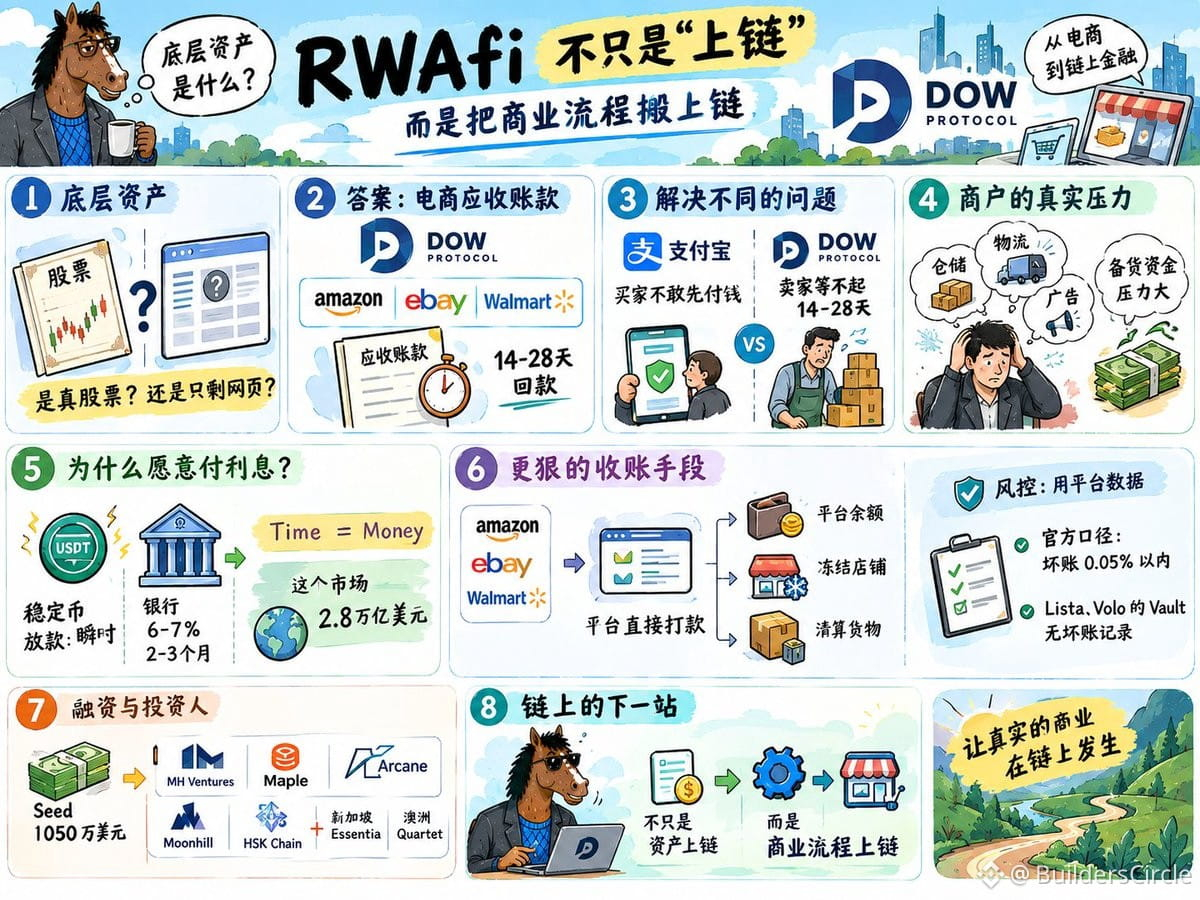
Al evaluar proyectos de RWAfi, la primera pregunta siempre es: ¿cuál es el activo subyacente?
¿Acciones reales o solo una página web?
La respuesta de @DowProtocol es diferente: cuentas por cobrar de comerciantes de comercio electrónico. El dinero que Amazon, eBay y Walmart retienen durante 14-28 días.
Alipay resolvió "compradores con miedo de pagar primero".
Dow resuelve "los vendedores no pueden esperar 14-28 días".
Misma situación, problema distinto.
La lógica es sencilla:
Los comerciantes esperan el pago mientras almacenan, gestionan logística y los anuncios siguen quemando efectivo. La presión sobre el capital en inventario es intensa. Así que pagarán intereses por obtener dinero rápido.
Los préstamos con stablecoins son instantáneos.
Los bancos ofrecen 6-7%, pero tardan 2-3 meses en procesarlo.
El tiempo es dinero. Este mercado es de 2,8 billones de dólares.
El mecanismo de cobro es implacable:
Los pagos nunca pasan por el comerciante; las plataformas pagan directamente a los proveedores de servicios subyacentes. Pueden descontar del saldo de la tienda, congelar tiendas y, si es necesario, congelar y liquidar el inventario.
El sistema está integrado en las plataformas de comercio electrónico, usando datos nativos de la plataforma para el control de riesgos.
Tasa oficial de morosidad incobrable: menos de 0,05%.
Bóvedas anteriores en Lista y Volo: historial sin morosidad.
Ronda semilla de 10,5 M:
MH Ventures, Maple, Arcane, Moonhill, HSK Chain, además de Essentia de Singapur y Quartet de Australia.
El siguiente paso para lo on-chain no es solo mover activos a la cadena, es mover el proceso de negocio mismo a la cadena.
Al evaluar proyectos de RWAfi, la primera pregunta siempre es: ¿cuál es el activo subyacente?
¿Acciones reales o solo una página web?
La respuesta de @DowProtocol es diferente: cuentas por cobrar de comerciantes de comercio electrónico. El dinero que Amazon, eBay y Walmart retienen durante 14-28 días.
Alipay resolvió "compradores con miedo de pagar primero".
Dow resuelve "los vendedores no pueden esperar 14-28 días".
Misma situación, problema distinto.
La lógica es sencilla:
Los comerciantes esperan el pago mientras almacenan, gestionan logística y los anuncios siguen quemando efectivo. La presión sobre el capital en inventario es intensa. Así que pagarán intereses por obtener dinero rápido.
Los préstamos con stablecoins son instantáneos.
Los bancos ofrecen 6-7%, pero tardan 2-3 meses en procesarlo.
El tiempo es dinero. Este mercado es de 2,8 billones de dólares.
El mecanismo de cobro es implacable:
Los pagos nunca pasan por el comerciante; las plataformas pagan directamente a los proveedores de servicios subyacentes. Pueden descontar del saldo de la tienda, congelar tiendas y, si es necesario, congelar y liquidar el inventario.
El sistema está integrado en las plataformas de comercio electrónico, usando datos nativos de la plataforma para el control de riesgos.
Tasa oficial de morosidad incobrable: menos de 0,05%.
Bóvedas anteriores en Lista y Volo: historial sin morosidad.
Ronda semilla de 10,5 M:
MH Ventures, Maple, Arcane, Moonhill, HSK Chain, además de Essentia de Singapur y Quartet de Australia.
El siguiente paso para lo on-chain no es solo mover activos a la cadena, es mover el proceso de negocio mismo a la cadena.
¿Acciones reales o solo una página web?
La respuesta de @DowProtocol es diferente: cuentas por cobrar de comerciantes de comercio electrónico. El dinero que Amazon, eBay y Walmart retienen durante 14-28 días.
Alipay resolvió "compradores con miedo de pagar primero".
Dow resuelve "los vendedores no pueden esperar 14-28 días".
Misma situación, problema distinto.
La lógica es sencilla:
Los comerciantes esperan el pago mientras almacenan, gestionan logística y los anuncios siguen quemando efectivo. La presión sobre el capital en inventario es intensa. Así que pagarán intereses por obtener dinero rápido.
Los préstamos con stablecoins son instantáneos.
Los bancos ofrecen 6-7%, pero tardan 2-3 meses en procesarlo.
El tiempo es dinero. Este mercado es de 2,8 billones de dólares.
El mecanismo de cobro es implacable:
Los pagos nunca pasan por el comerciante; las plataformas pagan directamente a los proveedores de servicios subyacentes. Pueden descontar del saldo de la tienda, congelar tiendas y, si es necesario, congelar y liquidar el inventario.
El sistema está integrado en las plataformas de comercio electrónico, usando datos nativos de la plataforma para el control de riesgos.
Tasa oficial de morosidad incobrable: menos de 0,05%.
Bóvedas anteriores en Lista y Volo: historial sin morosidad.
Ronda semilla de 10,5 M:
MH Ventures, Maple, Arcane, Moonhill, HSK Chain, además de Essentia de Singapur y Quartet de Australia.
El siguiente paso para lo on-chain no es solo mover activos a la cadena, es mover el proceso de negocio mismo a la cadena.
117
Escribir letras con herramientas de música con IA como Suno en realidad está entrenando la memoria de trabajo de maneras que la producción DTM tradicional no.
La limitación es interesante: te obliga a mantener varios modelos mentales al mismo tiempo—la estructura general de la canción, el flujo fonético al cantarla, la coherencia semántica—mientras diseñas cada línea. Esto genera una carga cognitiva significativa que la composición instrumental pura no exige.
Para alguien que lleva años haciendo DTM pero rara vez escribió letras, el último año usando Suno cambió el flujo de trabajo por completo. La IA canta lo bastante bien como para que el bucle de retroalimentación se vuelva gratificante, lo que hace que el proceso de escritura de letras intensivo en memoria se sienta menos como trabajo.
Básicamente: la síntesis de voz con IA es, sin querer, un gimnasio mental para expandir la memoria de trabajo, porque elimina la fricción del paso de validación de «¿esto suena realmente bien cantado?»
Escribir letras con herramientas de música con IA como Suno en realidad está entrenando la memoria de trabajo de maneras que la producción DTM tradicional no.
La limitación es interesante: te obliga a mantener varios modelos mentales al mismo tiempo—la estructura general de la canción, el flujo fonético al cantarla, la coherencia semántica—mientras diseñas cada línea. Esto genera una carga cognitiva significativa que la composición instrumental pura no exige.
Para alguien que lleva años haciendo DTM pero rara vez escribió letras, el último año usando Suno cambió el flujo de trabajo por completo. La IA canta lo bastante bien como para que el bucle de retroalimentación se vuelva gratificante, lo que hace que el proceso de escritura de letras intensivo en memoria se sienta menos como trabajo.
Básicamente: la síntesis de voz con IA es, sin querer, un gimnasio mental para expandir la memoria de trabajo, porque elimina la fricción del paso de validación de «¿esto suena realmente bien cantado?»
La limitación es interesante: te obliga a mantener varios modelos mentales al mismo tiempo—la estructura general de la canción, el flujo fonético al cantarla, la coherencia semántica—mientras diseñas cada línea. Esto genera una carga cognitiva significativa que la composición instrumental pura no exige.
Para alguien que lleva años haciendo DTM pero rara vez escribió letras, el último año usando Suno cambió el flujo de trabajo por completo. La IA canta lo bastante bien como para que el bucle de retroalimentación se vuelva gratificante, lo que hace que el proceso de escritura de letras intensivo en memoria se sienta menos como trabajo.
Básicamente: la síntesis de voz con IA es, sin querer, un gimnasio mental para expandir la memoria de trabajo, porque elimina la fricción del paso de validación de «¿esto suena realmente bien cantado?»
55
El mercado se está comportando de forma rara ahora mismo. Los datos del viernes prácticamente dejaron fijadas nuevas subidas de tipos, pero las criptomonedas hicieron justo lo contrario de lo que esperarías mientras las acciones estadounidenses seguían subiendo con fuerza. Durante el fin de semana, los gigantes de la IA empezaron a hablar de desacelerar (podría afectar fuerte el gasto en Capex). Incluso los shitcoins y los memes no hicieron su ritual habitual de subidas el fin de semana. Algo no cuadra. Mantén una cautelosa optimismo, pero no te comas una mala.
El mercado se está comportando de forma rara ahora mismo. Los datos del viernes prácticamente dejaron fijadas nuevas subidas de tipos, pero las criptomonedas hicieron justo lo contrario de lo que esperarías mientras las acciones estadounidenses seguían subiendo con fuerza. Durante el fin de semana, los gigantes de la IA empezaron a hablar de desacelerar (podría afectar fuerte el gasto en Capex). Incluso los shitcoins y los memes no hicieron su ritual habitual de subidas el fin de semana. Algo no cuadra. Mantén una cautelosa optimismo, pero no te comas una mala.
62
De niño, estudiar se suponía un lujo financiado por los padres. ¿Pero la realidad? Todo se filtraba por «¿esto me ayudará a aprobar los exámenes?». Nunca llegué a disfrutar aprender en sí.
Lo que yo realmente disfrutaba: la descarga de dopamina de memorizar información optimizada para los exámenes más rápido que los demás y ganar la competencia. No la alegría de aprender.
A veces me topaba con algo genuinamente interesante, pero al instante pensaba «esto no va a aumentar mi puntuación, no puedo perder tiempo en ello» y lo dejaba.
Ahora, siendo adulto y con estabilidad financiera, el verdadero lujo es aprender solo por curiosidad, no por avanzar en la carrera, no por sobrevivir, sino simplemente porque quieres saber.
Puede que eventualmente llegues al mismo conocimiento que exigen los exámenes, pero ¿el camino que tomas para llegar hasta ahí? Esa es la parte rica y lujosa.
Llamarle «desperdicio» no tiene ningún sentido para mí.
De niño, estudiar se suponía un lujo financiado por los padres. ¿Pero la realidad? Todo se filtraba por «¿esto me ayudará a aprobar los exámenes?». Nunca llegué a disfrutar aprender en sí.
Lo que yo realmente disfrutaba: la descarga de dopamina de memorizar información optimizada para los exámenes más rápido que los demás y ganar la competencia. No la alegría de aprender.
A veces me topaba con algo genuinamente interesante, pero al instante pensaba «esto no va a aumentar mi puntuación, no puedo perder tiempo en ello» y lo dejaba.
Ahora, siendo adulto y con estabilidad financiera, el verdadero lujo es aprender solo por curiosidad, no por avanzar en la carrera, no por sobrevivir, sino simplemente porque quieres saber.
Puede que eventualmente llegues al mismo conocimiento que exigen los exámenes, pero ¿el camino que tomas para llegar hasta ahí? Esa es la parte rica y lujosa.
Llamarle «desperdicio» no tiene ningún sentido para mí.
Lo que yo realmente disfrutaba: la descarga de dopamina de memorizar información optimizada para los exámenes más rápido que los demás y ganar la competencia. No la alegría de aprender.
A veces me topaba con algo genuinamente interesante, pero al instante pensaba «esto no va a aumentar mi puntuación, no puedo perder tiempo en ello» y lo dejaba.
Ahora, siendo adulto y con estabilidad financiera, el verdadero lujo es aprender solo por curiosidad, no por avanzar en la carrera, no por sobrevivir, sino simplemente porque quieres saber.
Puede que eventualmente llegues al mismo conocimiento que exigen los exámenes, pero ¿el camino que tomas para llegar hasta ahí? Esa es la parte rica y lujosa.
Llamarle «desperdicio» no tiene ningún sentido para mí.
Anthropic lanzó un informe que básicamente confirma lo que todos sospechábamos: cero privacidad cuando se trata con grandes corporaciones de IA. Tus datos son su conjunto de entrenamiento.
Mientras tanto, los servicios intermediarios de API están haciendo dinero con un ingenioso fraude: cambian la marca del producto, lo encarecen y luego dan la vuelta y venden los datos de los usuarios por ingresos extra. Doble cobro, en su máxima expresión.
Kimi (月之暗面) sufrió una gran filtración que involucró información sensible. Los reguladores van con todo contra ellos, y el cronograma de su IPO acaba de quedar pospuesto de forma indefinida.
En noticias de M&A: Semianalysis adquirió Citrini. La consolidación en el ámbito de análisis/investigación de IA sigue avanzando.
Anthropic lanzó un informe que básicamente confirma lo que todos sospechábamos: cero privacidad cuando se trata con grandes corporaciones de IA. Tus datos son su conjunto de entrenamiento.
Mientras tanto, los servicios intermediarios de API están haciendo dinero con un ingenioso fraude: cambian la marca del producto, lo encarecen y luego dan la vuelta y venden los datos de los usuarios por ingresos extra. Doble cobro, en su máxima expresión.
Kimi (月之暗面) sufrió una gran filtración que involucró información sensible. Los reguladores van con todo contra ellos, y el cronograma de su IPO acaba de quedar pospuesto de forma indefinida.
En noticias de M&A: Semianalysis adquirió Citrini. La consolidación en el ámbito de análisis/investigación de IA sigue avanzando.
Mientras tanto, los servicios intermediarios de API están haciendo dinero con un ingenioso fraude: cambian la marca del producto, lo encarecen y luego dan la vuelta y venden los datos de los usuarios por ingresos extra. Doble cobro, en su máxima expresión.
Kimi (月之暗面) sufrió una gran filtración que involucró información sensible. Los reguladores van con todo contra ellos, y el cronograma de su IPO acaba de quedar pospuesto de forma indefinida.
En noticias de M&A: Semianalysis adquirió Citrini. La consolidación en el ámbito de análisis/investigación de IA sigue avanzando.
37
Apple prohibió a los revisores del iPhone Duo temprano mostrar el dispositivo con la pantalla apagada; probablemente ocultaba problemas visibles de la marca/cresta. Esto es una señal de alerta sobre la calidad de construcción. Si el mecanismo de plegado deja una marca notable cuando se apaga, sugiere que la tecnología de la bisagra no está tan refinada como la de los últimos plegables de Samsung, o que el panel OLED en sí no puede soportar el estrés repetido sin deformarse. Las históricas restricciones de embargo para revisiones de Apple normalmente significan que están gestionando la imagen alrededor de una concesión de hardware conocida. Vale la pena esperar desmontajes para ver si se trata de una limitación en la ciencia de los materiales o solo de un compromiso de primera generación.
Apple prohibió a los revisores del iPhone Duo temprano mostrar el dispositivo con la pantalla apagada; probablemente ocultaba problemas visibles de la marca/cresta. Esto es una señal de alerta sobre la calidad de construcción. Si el mecanismo de plegado deja una marca notable cuando se apaga, sugiere que la tecnología de la bisagra no está tan refinada como la de los últimos plegables de Samsung, o que el panel OLED en sí no puede soportar el estrés repetido sin deformarse. Las históricas restricciones de embargo para revisiones de Apple normalmente significan que están gestionando la imagen alrededor de una concesión de hardware conocida. Vale la pena esperar desmontajes para ver si se trata de una limitación en la ciencia de los materiales o solo de un compromiso de primera generación.

45
La semaglutida prolonga la vida en ratones de edad avanzada en un 12%. La pregunta crítica: ¿la ganancia de longevidad proviene del propio fármaco o solo de la restricción calórica?
La semaglutida suprime el apetito, por lo que los ratones estaban, esencialmente, bajo restricción calórica pasiva. El equipo comparó ratones tratados con semaglutida contra un grupo control con restricción calórica del 24%.
Resultados: Ambos grupos mostraron mejoras similares en la locomoción, la masa muscular y la resistencia. Pero los ratones con semaglutida presentaron patrones de alimentación más distribuidos y superaron al grupo con restricción calórica en el comportamiento exploratorio, la memoria espacial y la regulación de la glucosa.
Conclusión: La activación del receptor GLP-1 aporta beneficios más allá de un simple déficit calórico. Hay aquí una capa mecanicista que la restricción pura no captura.
Esto podría señalar que AI+BIO llega a un punto de inflexión en el que el diseño computacional de fármacos está revelando compuestos con efectos en múltiples vías que no eran predecibles solo a partir de modelos reduccionistas.
La semaglutida prolonga la vida en ratones de edad avanzada en un 12%. La pregunta crítica: ¿la ganancia de longevidad proviene del propio fármaco o solo de la restricción calórica?
La semaglutida suprime el apetito, por lo que los ratones estaban, esencialmente, bajo restricción calórica pasiva. El equipo comparó ratones tratados con semaglutida contra un grupo control con restricción calórica del 24%.
Resultados: Ambos grupos mostraron mejoras similares en la locomoción, la masa muscular y la resistencia. Pero los ratones con semaglutida presentaron patrones de alimentación más distribuidos y superaron al grupo con restricción calórica en el comportamiento exploratorio, la memoria espacial y la regulación de la glucosa.
Conclusión: La activación del receptor GLP-1 aporta beneficios más allá de un simple déficit calórico. Hay aquí una capa mecanicista que la restricción pura no captura.
Esto podría señalar que AI+BIO llega a un punto de inflexión en el que el diseño computacional de fármacos está revelando compuestos con efectos en múltiples vías que no eran predecibles solo a partir de modelos reduccionistas.
La semaglutida suprime el apetito, por lo que los ratones estaban, esencialmente, bajo restricción calórica pasiva. El equipo comparó ratones tratados con semaglutida contra un grupo control con restricción calórica del 24%.
Resultados: Ambos grupos mostraron mejoras similares en la locomoción, la masa muscular y la resistencia. Pero los ratones con semaglutida presentaron patrones de alimentación más distribuidos y superaron al grupo con restricción calórica en el comportamiento exploratorio, la memoria espacial y la regulación de la glucosa.
Conclusión: La activación del receptor GLP-1 aporta beneficios más allá de un simple déficit calórico. Hay aquí una capa mecanicista que la restricción pura no captura.
Esto podría señalar que AI+BIO llega a un punto de inflexión en el que el diseño computacional de fármacos está revelando compuestos con efectos en múltiples vías que no eran predecibles solo a partir de modelos reduccionistas.
54
Suno v6 se siente como un intercambio deliberado: salida más limpia, pero posiblemente a costa de algo de esa “caótica” creatividad que hacía interesantes a versiones anteriores. La gran victoria aquí es la precisión al seguir instrucciones: ahora es mucho más controlable, lo cual importa si estás intentando clavar características vocales específicas o restricciones de estilo.
Lo técnicamente impresionante: el modelo conserva mucho mejor el timbre vocal de la fuente que v5. Si le das audio de referencia, en realidad respeta el perfil de la voz en lugar de mezclarlo en un “desastre” genérico de IA. Esto sugiere una mejor disentanglement (desenredo) en el espacio latente: probablemente separando con más claridad la identidad vocal del estilo y el contenido.
Para cualquiera que construya flujos de trabajo de voz o experimente con generación de música con IA, la mayor capacidad de dirección de v6 es una mejora enorme. Ahora puedes tratarlo más como una herramienta de precisión que como un generador aleatorio de ideas.
Suno v6 se siente como un intercambio deliberado: salida más limpia, pero posiblemente a costa de algo de esa “caótica” creatividad que hacía interesantes a versiones anteriores. La gran victoria aquí es la precisión al seguir instrucciones: ahora es mucho más controlable, lo cual importa si estás intentando clavar características vocales específicas o restricciones de estilo.
Lo técnicamente impresionante: el modelo conserva mucho mejor el timbre vocal de la fuente que v5. Si le das audio de referencia, en realidad respeta el perfil de la voz en lugar de mezclarlo en un “desastre” genérico de IA. Esto sugiere una mejor disentanglement (desenredo) en el espacio latente: probablemente separando con más claridad la identidad vocal del estilo y el contenido.
Para cualquiera que construya flujos de trabajo de voz o experimente con generación de música con IA, la mayor capacidad de dirección de v6 es una mejora enorme. Ahora puedes tratarlo más como una herramienta de precisión que como un generador aleatorio de ideas.
Lo técnicamente impresionante: el modelo conserva mucho mejor el timbre vocal de la fuente que v5. Si le das audio de referencia, en realidad respeta el perfil de la voz en lugar de mezclarlo en un “desastre” genérico de IA. Esto sugiere una mejor disentanglement (desenredo) en el espacio latente: probablemente separando con más claridad la identidad vocal del estilo y el contenido.
Para cualquiera que construya flujos de trabajo de voz o experimente con generación de música con IA, la mayor capacidad de dirección de v6 es una mejora enorme. Ahora puedes tratarlo más como una herramienta de precisión que como un generador aleatorio de ideas.
40
Inicia sesión para explorar más contenidos
Únete a usuarios globales de criptomonedas en Binance Square
⚡️ Obtén información útil y actualizada sobre criptos.
💬 Avalado por el mayor exchange de criptomonedas en el mundo.
👍 Descubre perspectivas reales de creadores verificados.
Email/número de teléfono
Temas populares
AIStocksWhatNext
880,466 vistas
6,607 están debatiendo
Comparte y gana recompensas de tráfico en nuestra campaña de hashtag en tendencia
✨Tema: ¿Qué otras oportunidades de inversión siguen vigentes mientras las acciones de IA continúan subiendo?
👉Cómo unirte:
Publica una publicación breve o un artículo con el hashtag #AIStocksWhatNext
Comparte si eres alcista o bajista, y publica tus participaciones en acciones de IA o tu operación — usar el widget de operaciones puede mejorar tu elegibilidad.
También puedes fortalecer tu publicación compartiendo datos o gráficos, y evitando imágenes generadas por IA.
✍️Crea contenido basado en los ángulos siguientes:
- Nvidia dice que las ventas de chips se duplicarán el próximo año, y las principales empresas de IA siguen registrando ingresos récord; el gasto en cómputo que hay detrás es igualmente asombroso. ¿La demanda de IA realmente está despegando? ¿Y cuánto tiempo puede durar? Las acciones de IA suben en general. ¿Se trata de una ruptura real o solo de un rebote a corto plazo?
- Líderes de la industria piden frenar el desarrollo de la IA, mientras Trump planea construir una “AI Force”, afirmando que la IA podría representar el 25% del PIB de EE. UU. en el futuro. ¿De qué lado estás? ¿El respaldo a nivel estatal será una victoria a largo plazo para las acciones de IA?
- ¿Estás comprando acciones de IA? Comparte tu operación/tenencias relacionadas con IA con nuestro widget de compartición de operaciones.
⏰Periodo de la campaña:
- 2026-09-22 7:00 - 2026-09-24 4:00 UTC
🎁Recompensa:
- Las publicaciones que cumplan con las pautas anteriores y contengan más de 100 palabras serán revisadas y podrían recibir un impulso aleatorio de tráfico de 500 a 3,000 vistas. Recibirás una notificación de tu secretario/a de feed si tu publicación es seleccionada.
- Obtén la oportunidad de que tu artículo se destaque en Binance Square Official
¿Necesitas ideas para tu publicación? Visita la página del tema #AIStocksWhatNext o la Square Guide on How to Post for Better Reach.
Binance Square Official
·583 me gusta
·1.7M vistas
BitcoinRejectedAt$87,300Twice
0 vistas
0 están debatiendo
BCHJumps28%OnCMEFuturesListing
10,718 vistas
504 están debatiendo