
Wendy 1
222 Publicaciones

Wendy 1
Denunciar
Bloquear usuario
🇻🇳 Verified Binance Square & CoinmarketCap | Research | Insight | Onchain | DM for Collab & Promo @wendyr9
0 Siguiendo
0 Seguidores
0 Me gusta
Publicaciones
·
--
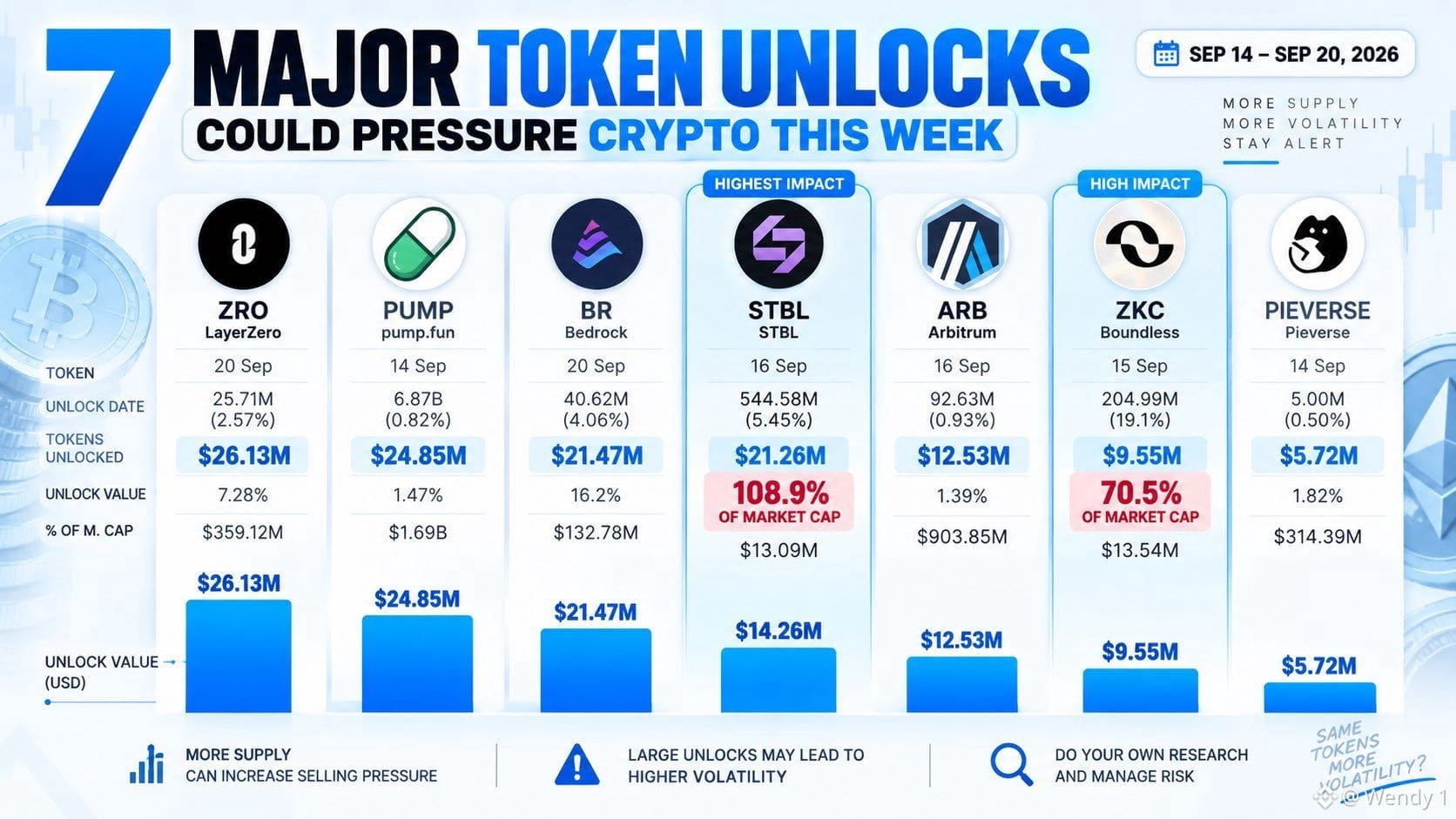
7 GRANDES DESBLOQUEOS DE TOKENS PODRÍAN PONER PRESIÓN SOBRE CRIPTO ESTA SEMANA
Viene una nueva oleada de oferta.
$ZRO lidera la semana con $26.13M en tokens desbloqueados, seguido por PUMP con $24.85M y BR con $21.47M. $STBL , $ARB , $ZKC y $PIEVERSE añaden otro bloque de nueva oferta.
Pero el riesgo principal es STBL . Su desbloqueo de $14.26M equivale al 108.9% de su capitalización de mercado actual, con las asignaciones de Advisors, Team y Private Sale 1 abriéndose después del periodo de cliff.
ZKC es otro a tener en cuenta, con un 70.5% de la capitalización de mercado.
Esto sugiere que el porcentaje de la oferta que llega al mercado puede importar más que el valor en dólares del titular.
La pregunta real es quién absorbe esta oferta sin convertirse en la liquidez de salida.
#TokenUnlocks #Crypto
7 GRANDES DESBLOQUEOS DE TOKENS PODRÍAN PONER PRESIÓN SOBRE CRIPTO ESTA SEMANA
Viene una nueva oleada de oferta.
$ZRO lidera la semana con $26.13M en tokens desbloqueados, seguido por PUMP con $24.85M y BR con $21.47M. $STBL , $ARB , $ZKC y $PIEVERSE añaden otro bloque de nueva oferta.
Pero el riesgo principal es STBL . Su desbloqueo de $14.26M equivale al 108.9% de su capitalización de mercado actual, con las asignaciones de Advisors, Team y Private Sale 1 abriéndose después del periodo de cliff.
ZKC es otro a tener en cuenta, con un 70.5% de la capitalización de mercado.
Esto sugiere que el porcentaje de la oferta que llega al mercado puede importar más que el valor en dólares del titular.
La pregunta real es quién absorbe esta oferta sin convertirse en la liquidez de salida.
#TokenUnlocks #Crypto
Viene una nueva oleada de oferta.
$ZRO lidera la semana con $26.13M en tokens desbloqueados, seguido por PUMP con $24.85M y BR con $21.47M. $STBL , $ARB , $ZKC y $PIEVERSE añaden otro bloque de nueva oferta.
Pero el riesgo principal es STBL . Su desbloqueo de $14.26M equivale al 108.9% de su capitalización de mercado actual, con las asignaciones de Advisors, Team y Private Sale 1 abriéndose después del periodo de cliff.
ZKC es otro a tener en cuenta, con un 70.5% de la capitalización de mercado.
Esto sugiere que el porcentaje de la oferta que llega al mercado puede importar más que el valor en dólares del titular.
La pregunta real es quién absorbe esta oferta sin convertirse en la liquidez de salida.
#TokenUnlocks #Crypto
35
·
--
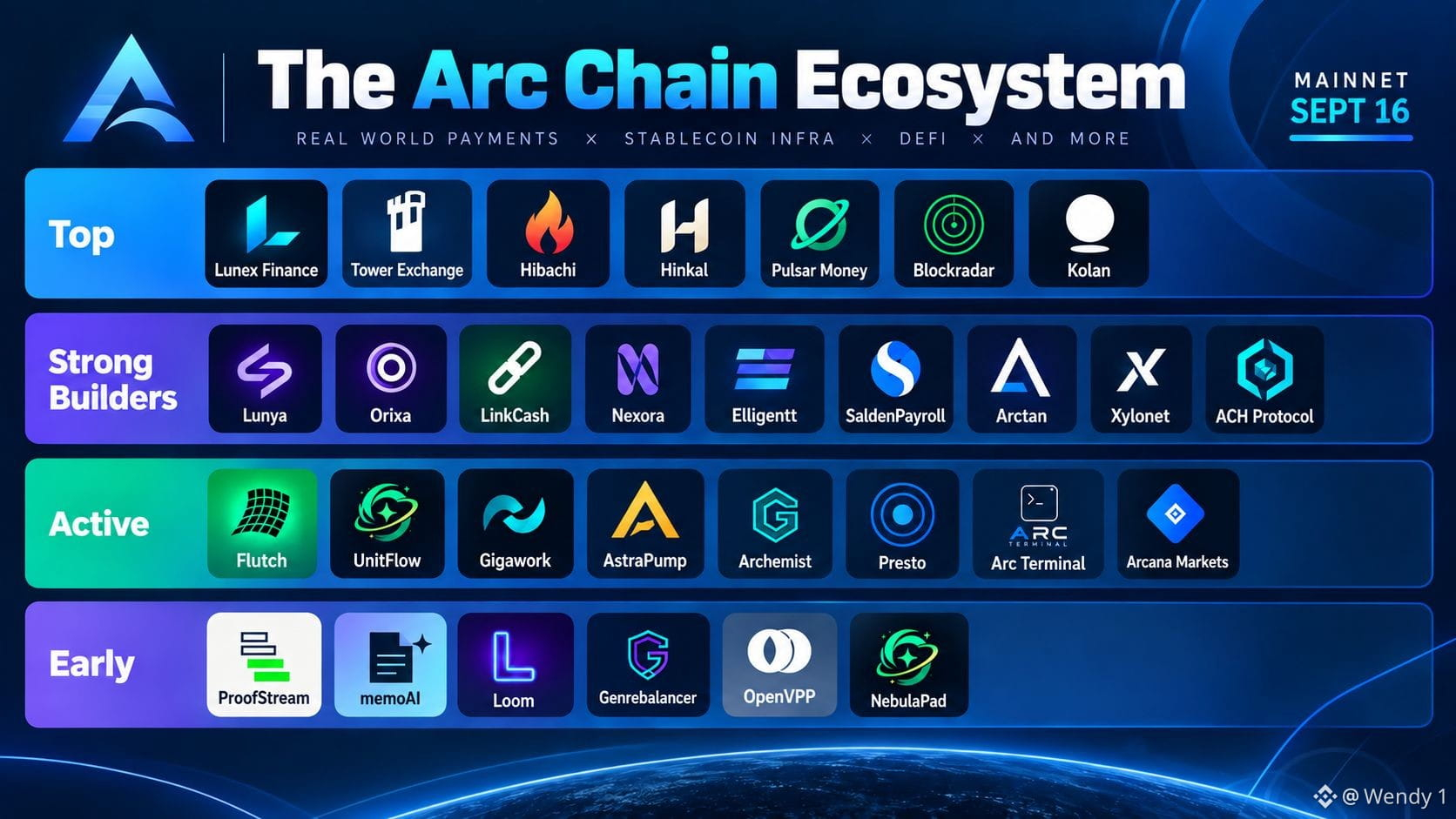
La Mainnet de Arc se pone en marcha el 16 de septiembre. Antes de que eso ocurra, ya hay varios proyectos construyéndose alrededor de Arc, y algunos de ellos valen la pena mantenerlos en tu radar. Principales • Lunex Finance: StableSwap AMM centrado en USDC/EURC • Tower Exchange: agregador DEX de stablecoins • Hibachi: libro de órdenes nativo de FX con stablecoin • Hinkal: liquidación confidencial de stablecoins • Pulsar Money: cuentas de stablecoin multimoneda y tarjeta Visa • Blockradar: infraestructura de wallets para fintechs • Kolan: rieles bancarios en USD que se convierten en USDC Grandes constructores Lunya, Orixa, LinkCash, Nexora, Elligentt, SaldenPayroll, Arctan, Xylonet y ACH Protocol están construyendo en DeFi, pagos, nóminas, FX e infraestructura de stablecoins. Flutch, UnitFlow, Gigawork, AstraPump, Archemist, Presto, Arc Terminal y Arcana Markets ya están desarrollando productos que van desde launchpads y hubs de DeFi hasta pagos con agentes, perps y mercados de predicción. En etapa inicial ProofStream, memoAI, Loom, Genrebalancer, OpenVPP y NebulaPad todavía están más temprano en su desarrollo. Lo interesante es la mezcla. Arc no solo está atrayendo a otro grupo de DEXs. El ecosistema ya abarca pagos con stablecoins, FX, DeFi, agentes de IA, nóminas, mercados de predicción y energía tokenizada. La Mainnet está casi aquí. ¿Qué proyecto de Arc crees que tiene más potencial? Aviso legal: Esto no es asesoramiento financiero. Por favor, haz tu propia investigación antes de interactuar con cualquier proyecto. #ARC
La Mainnet de Arc se pone en marcha el 16 de septiembre. Antes de que eso ocurra, ya hay varios proyectos construyéndose alrededor de Arc, y algunos de ellos valen la pena mantenerlos en tu radar. Principales • Lunex Finance: StableSwap AMM centrado en USDC/EURC • Tower Exchange: agregador DEX de stablecoins • Hibachi: libro de órdenes nativo de FX con stablecoin • Hinkal: liquidación confidencial de stablecoins • Pulsar Money: cuentas de stablecoin multimoneda y tarjeta Visa • Blockradar: infraestructura de wallets para fintechs • Kolan: rieles bancarios en USD que se convierten en USDC Grandes constructores Lunya, Orixa, LinkCash, Nexora, Elligentt, SaldenPayroll, Arctan, Xylonet y ACH Protocol están construyendo en DeFi, pagos, nóminas, FX e infraestructura de stablecoins. Flutch, UnitFlow, Gigawork, AstraPump, Archemist, Presto, Arc Terminal y Arcana Markets ya están desarrollando productos que van desde launchpads y hubs de DeFi hasta pagos con agentes, perps y mercados de predicción. En etapa inicial ProofStream, memoAI, Loom, Genrebalancer, OpenVPP y NebulaPad todavía están más temprano en su desarrollo. Lo interesante es la mezcla. Arc no solo está atrayendo a otro grupo de DEXs. El ecosistema ya abarca pagos con stablecoins, FX, DeFi, agentes de IA, nóminas, mercados de predicción y energía tokenizada. La Mainnet está casi aquí. ¿Qué proyecto de Arc crees que tiene más potencial? Aviso legal: Esto no es asesoramiento financiero. Por favor, haz tu propia investigación antes de interactuar con cualquier proyecto. #ARC
43
·
--
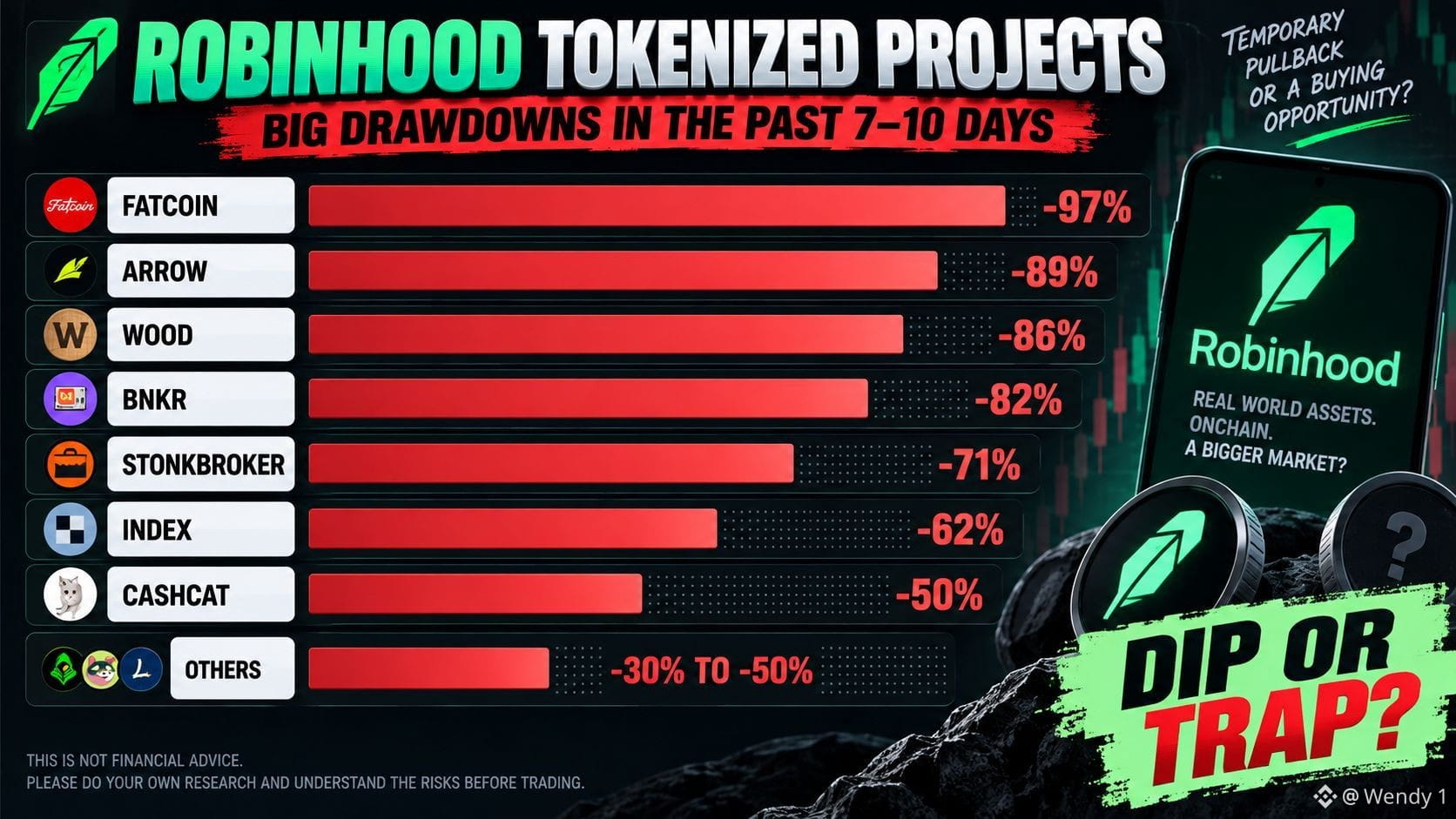
Los proyectos tokenizados de Robinhood han sufrido algunos golpes serios en los últimos 7 a 10 días.
Algunas de las caídas son brutales:
$FATCOIN: -97%
$ARROW: -89%
$WOOD: -86%
$BNKR: -82%
$STONKBROKER: -71%
$INDEX: -62%
$CASHCAT: -50%
Y hay muchos más que han bajado entre un 30% y un 50%.
Eso plantea la pregunta interesante.
¿Están simplemente perdiendo impulso, o algunas empiezan a verse atractivas después del retroceso?
Yo sería muy selectivo aquí. Una gran caída por sí sola no hace que un token esté infravalorado.
¿Cuál estás acumulando en la caída? 👀
Aviso: Esto no es asesoramiento financiero. Por favor, haz tu propia investigación y entiende los riesgos antes de operar. #Robinhood
Los proyectos tokenizados de Robinhood han sufrido algunos golpes serios en los últimos 7 a 10 días.
Algunas de las caídas son brutales:
$FATCOIN: -97%
$ARROW: -89%
$WOOD: -86%
$BNKR: -82%
$STONKBROKER: -71%
$INDEX: -62%
$CASHCAT: -50%
Y hay muchos más que han bajado entre un 30% y un 50%.
Eso plantea la pregunta interesante.
¿Están simplemente perdiendo impulso, o algunas empiezan a verse atractivas después del retroceso?
Yo sería muy selectivo aquí. Una gran caída por sí sola no hace que un token esté infravalorado.
¿Cuál estás acumulando en la caída? 👀
Aviso: Esto no es asesoramiento financiero. Por favor, haz tu propia investigación y entiende los riesgos antes de operar. #Robinhood
Algunas de las caídas son brutales:
$FATCOIN: -97%
$ARROW: -89%
$WOOD: -86%
$BNKR: -82%
$STONKBROKER: -71%
$INDEX: -62%
$CASHCAT: -50%
Y hay muchos más que han bajado entre un 30% y un 50%.
Eso plantea la pregunta interesante.
¿Están simplemente perdiendo impulso, o algunas empiezan a verse atractivas después del retroceso?
Yo sería muy selectivo aquí. Una gran caída por sí sola no hace que un token esté infravalorado.
¿Cuál estás acumulando en la caída? 👀
Aviso: Esto no es asesoramiento financiero. Por favor, haz tu propia investigación y entiende los riesgos antes de operar. #Robinhood
50
·
--
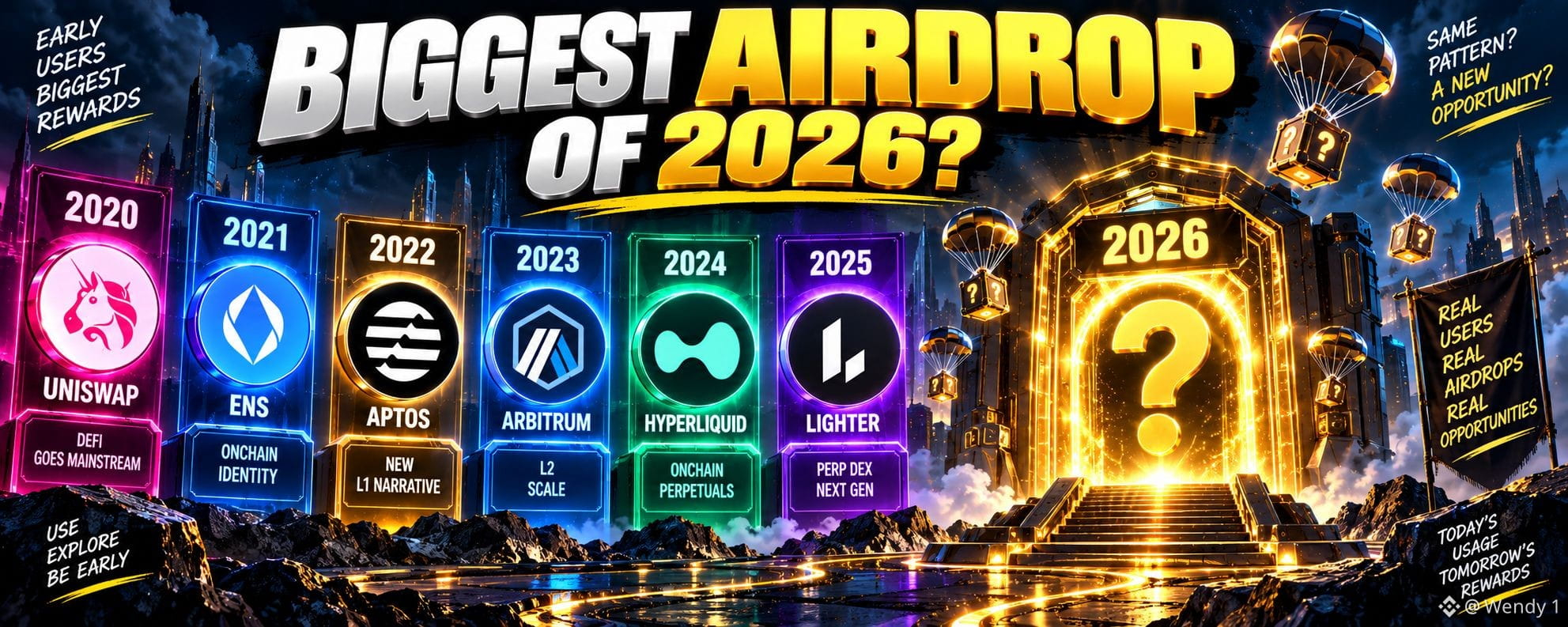
Parece que cada año tiene ese airdrop que la gente desearía haber cultivado con más esfuerzo.
2020: Uniswap
2021: ENS
2022: Aptos
2023: Arbitrum
2024: Hyperliquid
2025: Lighter
2026: ?????
Lo interesante es que los airdrops más grandes suelen recompensar a quienes estuvieron al principio y de verdad usaron el protocolo antes de que el token se convirtiera en la historia principal.
Así que la pregunta real para 2026 es:
¿Qué proyecto está usando la gente hoy que podría convertirse en el $ARB o $HYPE de mañana?
Tengo algunos nombres en mente, pero quiero oír los tuyos primero.
¿Qué crees que será el mayor airdrop de 2026? 👀
Parece que cada año tiene ese airdrop que la gente desearía haber cultivado con más esfuerzo.
2020: Uniswap
2021: ENS
2022: Aptos
2023: Arbitrum
2024: Hyperliquid
2025: Lighter
2026: ?????
Lo interesante es que los airdrops más grandes suelen recompensar a quienes estuvieron al principio y de verdad usaron el protocolo antes de que el token se convirtiera en la historia principal.
Así que la pregunta real para 2026 es:
¿Qué proyecto está usando la gente hoy que podría convertirse en el $ARB o $HYPE de mañana?
Tengo algunos nombres en mente, pero quiero oír los tuyos primero.
¿Qué crees que será el mayor airdrop de 2026? 👀
2020: Uniswap
2021: ENS
2022: Aptos
2023: Arbitrum
2024: Hyperliquid
2025: Lighter
2026: ?????
Lo interesante es que los airdrops más grandes suelen recompensar a quienes estuvieron al principio y de verdad usaron el protocolo antes de que el token se convirtiera en la historia principal.
Así que la pregunta real para 2026 es:
¿Qué proyecto está usando la gente hoy que podría convertirse en el $ARB o $HYPE de mañana?
Tengo algunos nombres en mente, pero quiero oír los tuyos primero.
¿Qué crees que será el mayor airdrop de 2026? 👀
49
·
--
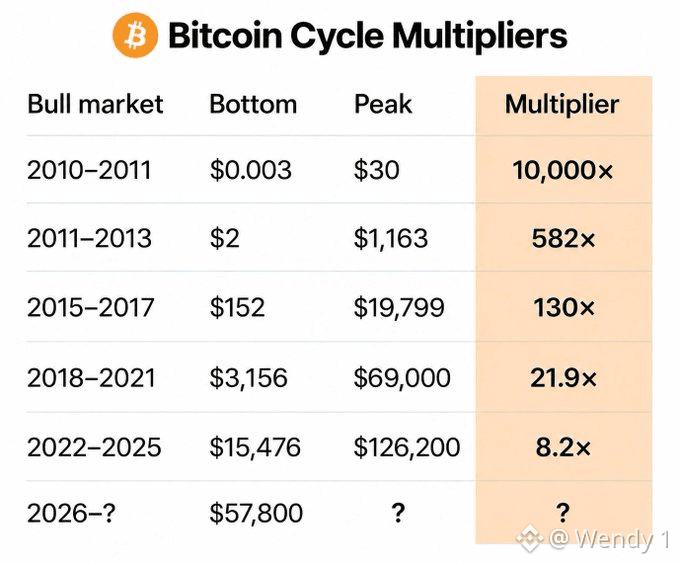
Los mayores ciclos de Bitcoin se están haciendo más pequeños. Mira los multiplicadores históricos: 2010–2011: 10,000x 2011–2013: 582x 2015–2017: 130x 2018–2021: 21.9x 2022–2025: 8.2x El patrón es claro. Si $BTC empieza este ciclo alrededor de $57,800, incluso un movimiento de 2x a 4x lo llevaría a aproximadamente $116K a $231K. Un 3x significaría cerca de $173K. Pero los multiplicadores del pasado se han comprimido de forma drástica, así que esperar otro 10x o 20x desde aquí requeriría una estructura de mercado muy diferente. ¿Mi rango personal? $150K a $200K se siente como una zona más interesante para vigilar que perseguir un objetivo poco realista. ¿Dónde crees que $BTC toca el máximo de este ciclo? 👀 Aviso legal: Esto no es asesoramiento financiero. El rendimiento pasado no garantiza resultados futuros.
Los mayores ciclos de Bitcoin se están haciendo más pequeños. Mira los multiplicadores históricos: 2010–2011: 10,000x 2011–2013: 582x 2015–2017: 130x 2018–2021: 21.9x 2022–2025: 8.2x El patrón es claro. Si $BTC empieza este ciclo alrededor de $57,800, incluso un movimiento de 2x a 4x lo llevaría a aproximadamente $116K a $231K. Un 3x significaría cerca de $173K. Pero los multiplicadores del pasado se han comprimido de forma drástica, así que esperar otro 10x o 20x desde aquí requeriría una estructura de mercado muy diferente. ¿Mi rango personal? $150K a $200K se siente como una zona más interesante para vigilar que perseguir un objetivo poco realista. ¿Dónde crees que $BTC toca el máximo de este ciclo? 👀 Aviso legal: Esto no es asesoramiento financiero. El rendimiento pasado no garantiza resultados futuros.
63
·
--
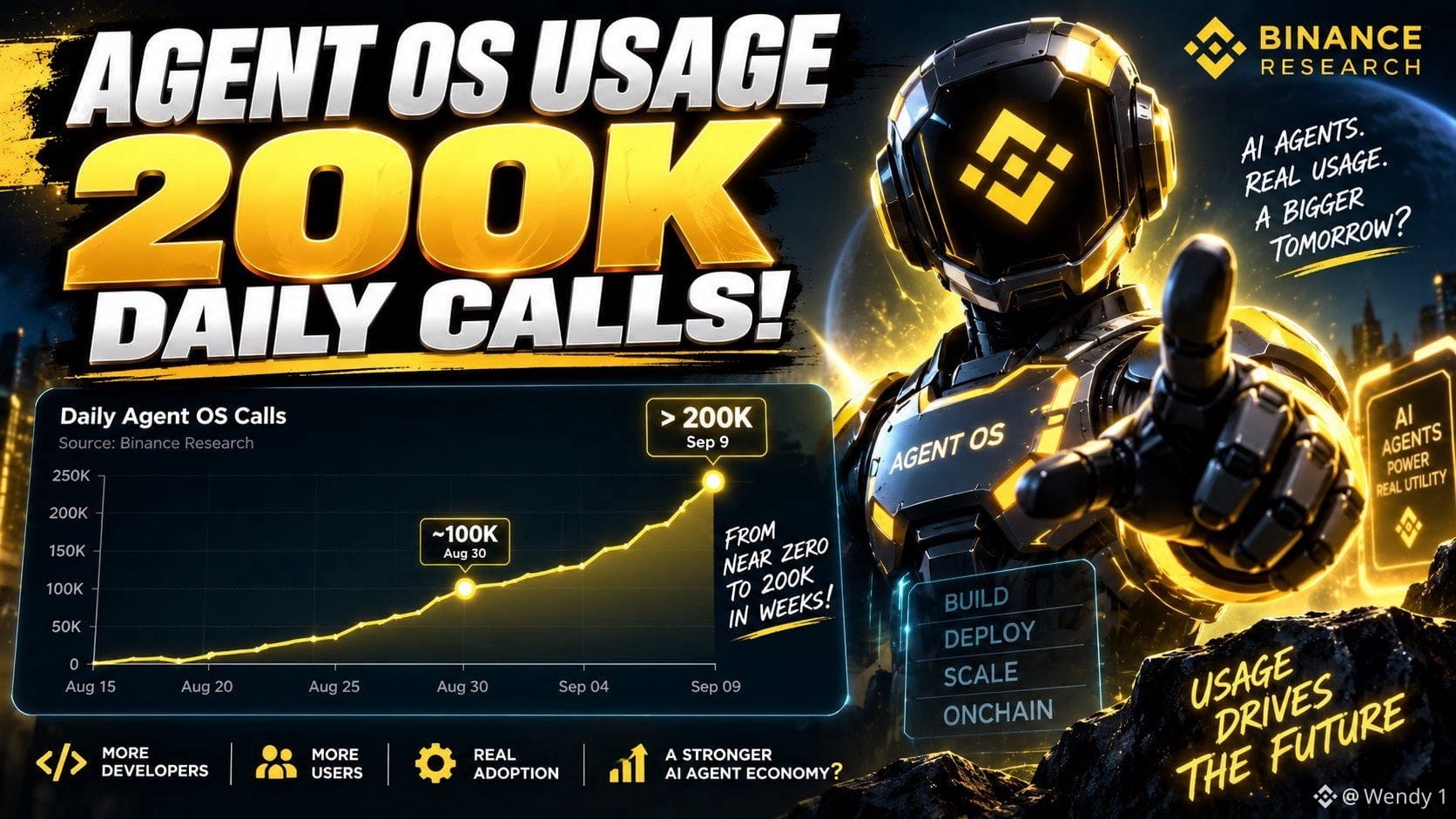
El uso de Agent OS acaba de superar las 200K llamadas diarias. 👀
Esa curva se está volviendo difícil de ignorar.
Según Binance Research, las llamadas diarias a Agent OS pasaron de casi cero a mediados de agosto a más de 200K por día para el 9 de septiembre.
La parte interesante es la aceleración.
Cerca del 30 de agosto, las llamadas diarias ya estaban cerca de 100K. Una semana después, el gráfico muestra que ese nivel ya es más del doble.
Esto no es un gráfico de precios.
Es uso.
Si desarrolladores y usuarios siguen interactuando con Agent OS a este ritmo, la siguiente pregunta es si esta actividad puede traducirse en una demanda sostenida en torno a la economía más amplia de agentes de IA.
200K llamadas diarias es un hito.
Ahora veamos si se convierte en un nuevo punto de referencia. 👀
#Binance #IA #Cripto
El uso de Agent OS acaba de superar las 200K llamadas diarias. 👀
Esa curva se está volviendo difícil de ignorar.
Según Binance Research, las llamadas diarias a Agent OS pasaron de casi cero a mediados de agosto a más de 200K por día para el 9 de septiembre.
La parte interesante es la aceleración.
Cerca del 30 de agosto, las llamadas diarias ya estaban cerca de 100K. Una semana después, el gráfico muestra que ese nivel ya es más del doble.
Esto no es un gráfico de precios.
Es uso.
Si desarrolladores y usuarios siguen interactuando con Agent OS a este ritmo, la siguiente pregunta es si esta actividad puede traducirse en una demanda sostenida en torno a la economía más amplia de agentes de IA.
200K llamadas diarias es un hito.
Ahora veamos si se convierte en un nuevo punto de referencia. 👀
#Binance #IA #Cripto
Esa curva se está volviendo difícil de ignorar.
Según Binance Research, las llamadas diarias a Agent OS pasaron de casi cero a mediados de agosto a más de 200K por día para el 9 de septiembre.
La parte interesante es la aceleración.
Cerca del 30 de agosto, las llamadas diarias ya estaban cerca de 100K. Una semana después, el gráfico muestra que ese nivel ya es más del doble.
Esto no es un gráfico de precios.
Es uso.
Si desarrolladores y usuarios siguen interactuando con Agent OS a este ritmo, la siguiente pregunta es si esta actividad puede traducirse en una demanda sostenida en torno a la economía más amplia de agentes de IA.
200K llamadas diarias es un hito.
Ahora veamos si se convierte en un nuevo punto de referencia. 👀
#Binance #IA #Cripto
53
·
--
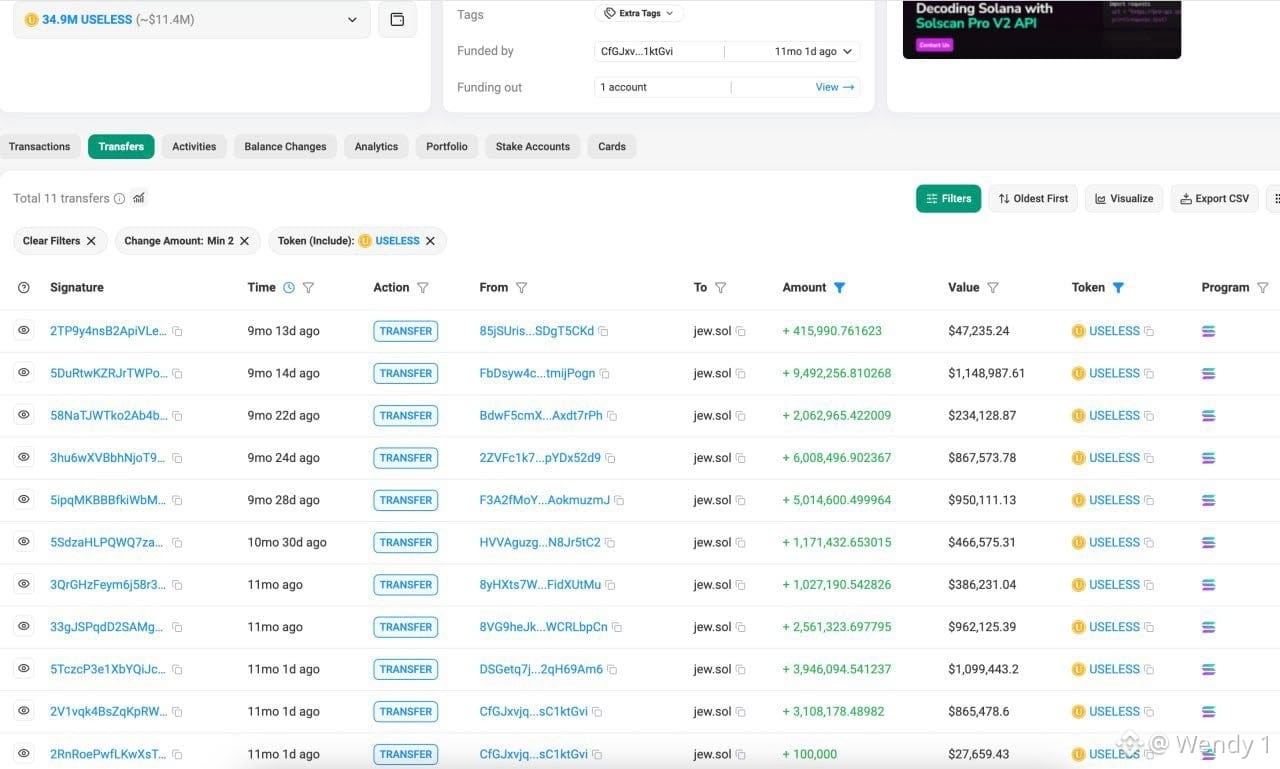
La paciencia dio sus frutos para este titular de $USELESS. 👀
jew.sol ha mantenido 34,9M de $USELESS, que actualmente valen alrededor de $11,4M, durante más de 9 meses.
En septiembre y octubre de 2025, gastó aproximadamente $6,4M acumulando los tokens a un precio promedio de $0,1833.
La posición se puso fea primero.
En un momento, estaba perdiendo más de $5M.
Ahora $USELESS se ha recuperado con fuerza, dejándolo con más de $5M en ganancias no realizadas.
A veces, la operación más difícil es simplemente esperar.
Aviso: Esto no es asesoramiento financiero. Los criptoactivos pueden ser extremadamente volátiles. Haz tu propia investigación antes de tomar cualquier decisión de trading o inversión.
La paciencia dio sus frutos para este titular de $USELESS. 👀
jew.sol ha mantenido 34,9M de $USELESS, que actualmente valen alrededor de $11,4M, durante más de 9 meses.
En septiembre y octubre de 2025, gastó aproximadamente $6,4M acumulando los tokens a un precio promedio de $0,1833.
La posición se puso fea primero.
En un momento, estaba perdiendo más de $5M.
Ahora $USELESS se ha recuperado con fuerza, dejándolo con más de $5M en ganancias no realizadas.
A veces, la operación más difícil es simplemente esperar.
Aviso: Esto no es asesoramiento financiero. Los criptoactivos pueden ser extremadamente volátiles. Haz tu propia investigación antes de tomar cualquier decisión de trading o inversión.
jew.sol ha mantenido 34,9M de $USELESS, que actualmente valen alrededor de $11,4M, durante más de 9 meses.
En septiembre y octubre de 2025, gastó aproximadamente $6,4M acumulando los tokens a un precio promedio de $0,1833.
La posición se puso fea primero.
En un momento, estaba perdiendo más de $5M.
Ahora $USELESS se ha recuperado con fuerza, dejándolo con más de $5M en ganancias no realizadas.
A veces, la operación más difícil es simplemente esperar.
Aviso: Esto no es asesoramiento financiero. Los criptoactivos pueden ser extremadamente volátiles. Haz tu propia investigación antes de tomar cualquier decisión de trading o inversión.
48
·
--
Una mala operación hace daño.
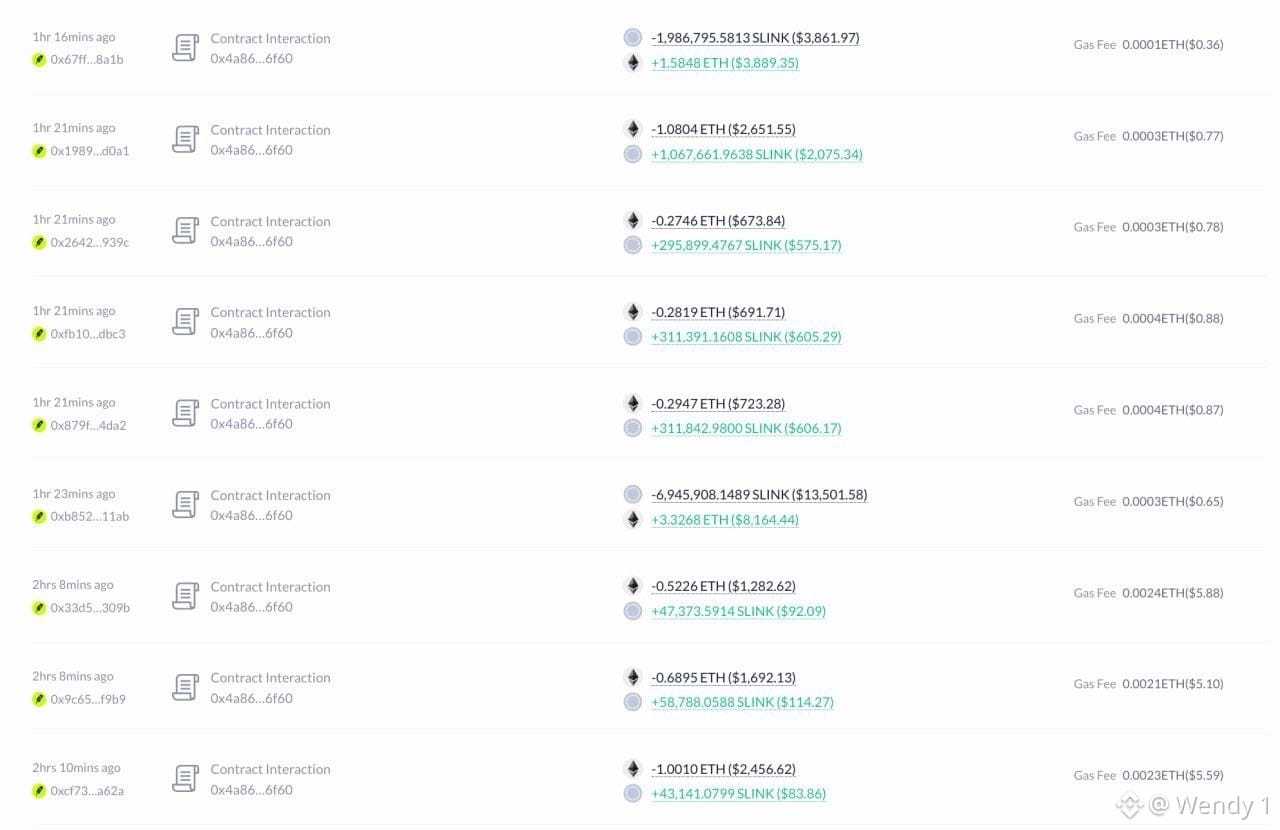
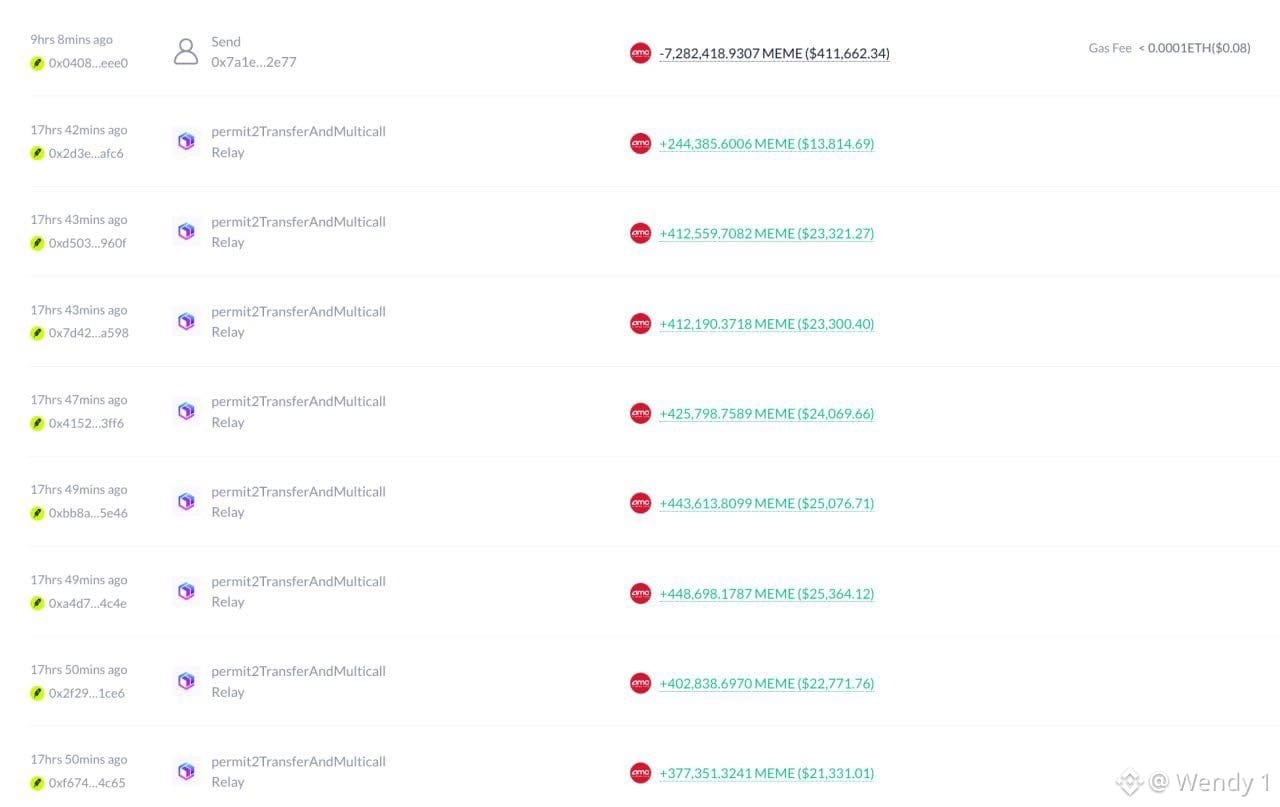
Dos operaciones por FOMO en el mismo día le costaron a este trader aproximadamente $907K. 😬
Gastó $916.5K comprando 7.28M de $MEME alrededor de $0.126, y luego vendió por solo $353K.
Pérdida: $563K (-61.45%)
Luego vino $SLINK.
Gastó otros $356K para comprar 8.93M de $SLINK alrededor de $0.04, pero finalmente vendió por solo $12K.
Pérdida: $344K (-96.62%)
Daño total: ~$907K.
La parte dolorosa no es solo el dinero. Es lo que pasó entre las dos operaciones.
Después de sufrir una gran pérdida con $MEME, pasó directamente a otra operación en lugar de dar un paso atrás.
Eso es FOMO.
Una mala operación le puede pasar a cualquiera. Perseguir el siguiente movimiento justo después de que algo sale mal puede empeorarlo mucho.
La actividad de la billetera está aquí:
https://debank.com/profile/0x010496b7017b9ed0c8e9c2ecebdc7d6b325c4af1
No dejes que una pérdida se convierta en la siguiente.
Descargo de responsabilidad: esto no es asesoramiento financiero. Haz tu propia investigación y gestiona tu riesgo con cuidado.
Una mala operación hace daño.
Dos operaciones por FOMO en el mismo día le costaron a este trader aproximadamente $907K. 😬
Gastó $916.5K comprando 7.28M de $MEME alrededor de $0.126, y luego vendió por solo $353K.
Pérdida: $563K (-61.45%)
Luego vino $SLINK.
Gastó otros $356K para comprar 8.93M de $SLINK alrededor de $0.04, pero finalmente vendió por solo $12K.
Pérdida: $344K (-96.62%)
Daño total: ~$907K.
La parte dolorosa no es solo el dinero. Es lo que pasó entre las dos operaciones.
Después de sufrir una gran pérdida con $MEME, pasó directamente a otra operación en lugar de dar un paso atrás.
Eso es FOMO.
Una mala operación le puede pasar a cualquiera. Perseguir el siguiente movimiento justo después de que algo sale mal puede empeorarlo mucho.
La actividad de la billetera está aquí:
https://debank.com/profile/0x010496b7017b9ed0c8e9c2ecebdc7d6b325c4af1
No dejes que una pérdida se convierta en la siguiente.
Descargo de responsabilidad: esto no es asesoramiento financiero. Haz tu propia investigación y gestiona tu riesgo con cuidado.
Dos operaciones por FOMO en el mismo día le costaron a este trader aproximadamente $907K. 😬
Gastó $916.5K comprando 7.28M de $MEME alrededor de $0.126, y luego vendió por solo $353K.
Pérdida: $563K (-61.45%)
Luego vino $SLINK.
Gastó otros $356K para comprar 8.93M de $SLINK alrededor de $0.04, pero finalmente vendió por solo $12K.
Pérdida: $344K (-96.62%)
Daño total: ~$907K.
La parte dolorosa no es solo el dinero. Es lo que pasó entre las dos operaciones.
Después de sufrir una gran pérdida con $MEME, pasó directamente a otra operación en lugar de dar un paso atrás.
Eso es FOMO.
Una mala operación le puede pasar a cualquiera. Perseguir el siguiente movimiento justo después de que algo sale mal puede empeorarlo mucho.
La actividad de la billetera está aquí:
https://debank.com/profile/0x010496b7017b9ed0c8e9c2ecebdc7d6b325c4af1
No dejes que una pérdida se convierta en la siguiente.
Descargo de responsabilidad: esto no es asesoramiento financiero. Haz tu propia investigación y gestiona tu riesgo con cuidado.
79
·
--
El Top 10 de las criptomonedas ha cambiado, pero algunos nombres siguen resistiendo
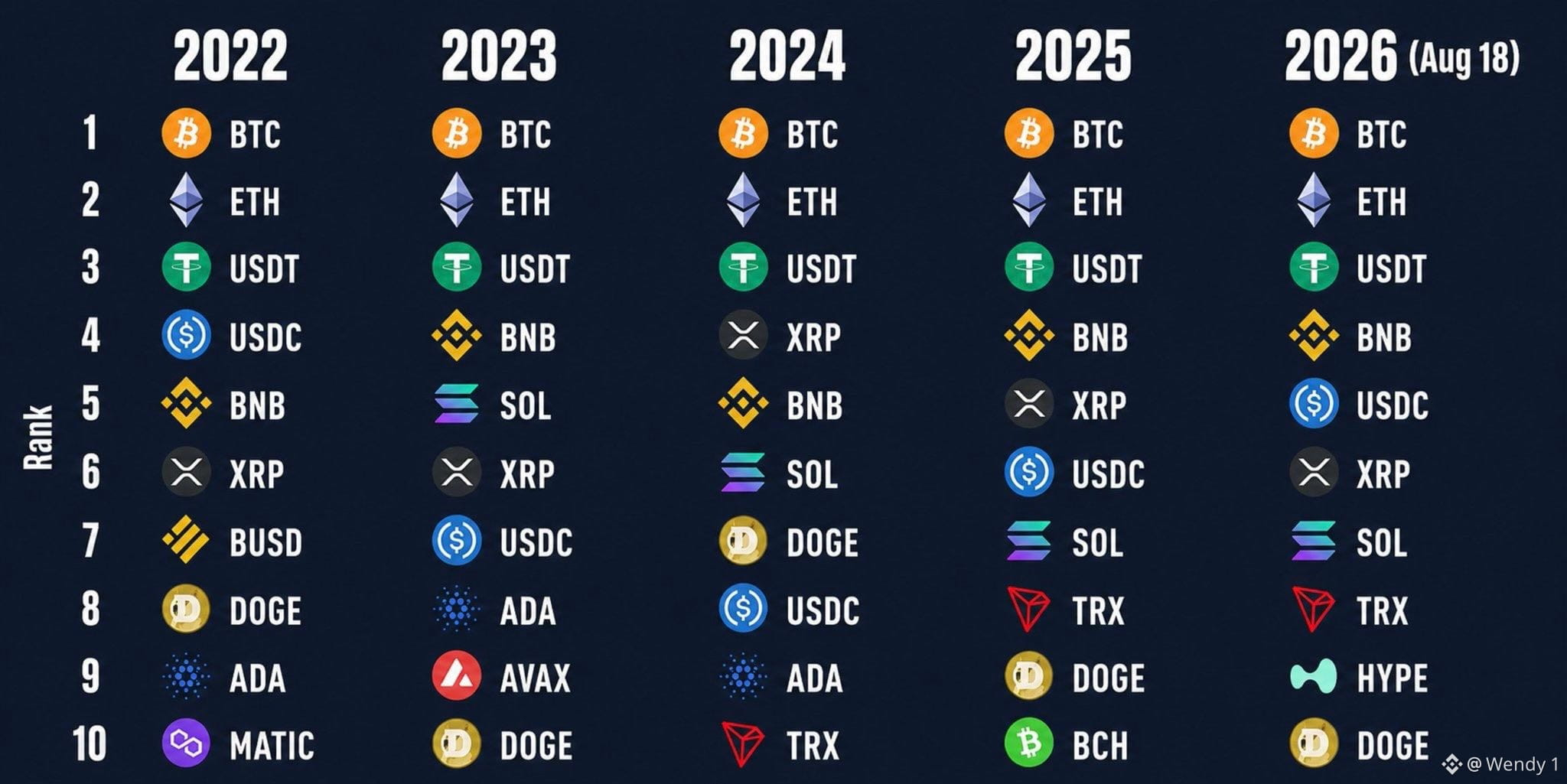
Al observar los 10 principales activos cripto de 2022 a agosto de 2026, hay algo que destaca:
Algunos proyectos aparecen y desaparecen. Otros siguen mostrando presencia.
$BTC, $ETH y $USDT se han mantenido en el Top 10 durante todo el período mostrado.
Luego está otro grupo interesante:
• $BNB aparece en los 5 años
• $XRP aparece en los 5 años
• $DOGE aparece en 4 de los 5 años
• $SOL aparece en 3 años
• $TRX y $ADA aparecen en 3 años
Mientras tanto, $MATIC, $AVAX, $BCH y $HYPE aparecen solo una vez en esta instantánea.
Eso no nos dice automáticamente qué token rendirá mejor.
Pero sí muestra algo que vale la pena tener en cuenta: la supervivencia importa.
Las narrativas cripto pueden cambiar extremadamente rápido. Un proyecto puede dominar la atención durante un ciclo y luego desaparecer de los primeros puestos más tarde.
Mantenerse relevante a través de múltiples ciclos de mercado es un reto diferente.
Así que, al evaluar una altcoin, yo no solo preguntaría:
“¿Cuánto potencial alcista tiene?”
También preguntaría:
“¿Este proyecto todavía puede estar aquí en el próximo ciclo?”
El ranking del Top 10 es solo un dato, pero la persistencia histórica de estos nombres definitivamente merece la pena seguirla de cerca.
El Top 10 de las criptomonedas ha cambiado, pero algunos nombres siguen resistiendo
Al observar los 10 principales activos cripto de 2022 a agosto de 2026, hay algo que destaca:
Algunos proyectos aparecen y desaparecen. Otros siguen mostrando presencia.
$BTC, $ETH y $USDT se han mantenido en el Top 10 durante todo el período mostrado.
Luego está otro grupo interesante:
• $BNB aparece en los 5 años
• $XRP aparece en los 5 años
• $DOGE aparece en 4 de los 5 años
• $SOL aparece en 3 años
• $TRX y $ADA aparecen en 3 años
Mientras tanto, $MATIC, $AVAX, $BCH y $HYPE aparecen solo una vez en esta instantánea.
Eso no nos dice automáticamente qué token rendirá mejor.
Pero sí muestra algo que vale la pena tener en cuenta: la supervivencia importa.
Las narrativas cripto pueden cambiar extremadamente rápido. Un proyecto puede dominar la atención durante un ciclo y luego desaparecer de los primeros puestos más tarde.
Mantenerse relevante a través de múltiples ciclos de mercado es un reto diferente.
Así que, al evaluar una altcoin, yo no solo preguntaría:
“¿Cuánto potencial alcista tiene?”
También preguntaría:
“¿Este proyecto todavía puede estar aquí en el próximo ciclo?”
El ranking del Top 10 es solo un dato, pero la persistencia histórica de estos nombres definitivamente merece la pena seguirla de cerca.
Al observar los 10 principales activos cripto de 2022 a agosto de 2026, hay algo que destaca:
Algunos proyectos aparecen y desaparecen. Otros siguen mostrando presencia.
$BTC, $ETH y $USDT se han mantenido en el Top 10 durante todo el período mostrado.
Luego está otro grupo interesante:
• $BNB aparece en los 5 años
• $XRP aparece en los 5 años
• $DOGE aparece en 4 de los 5 años
• $SOL aparece en 3 años
• $TRX y $ADA aparecen en 3 años
Mientras tanto, $MATIC, $AVAX, $BCH y $HYPE aparecen solo una vez en esta instantánea.
Eso no nos dice automáticamente qué token rendirá mejor.
Pero sí muestra algo que vale la pena tener en cuenta: la supervivencia importa.
Las narrativas cripto pueden cambiar extremadamente rápido. Un proyecto puede dominar la atención durante un ciclo y luego desaparecer de los primeros puestos más tarde.
Mantenerse relevante a través de múltiples ciclos de mercado es un reto diferente.
Así que, al evaluar una altcoin, yo no solo preguntaría:
“¿Cuánto potencial alcista tiene?”
También preguntaría:
“¿Este proyecto todavía puede estar aquí en el próximo ciclo?”
El ranking del Top 10 es solo un dato, pero la persistencia histórica de estos nombres definitivamente merece la pena seguirla de cerca.
71
·
--
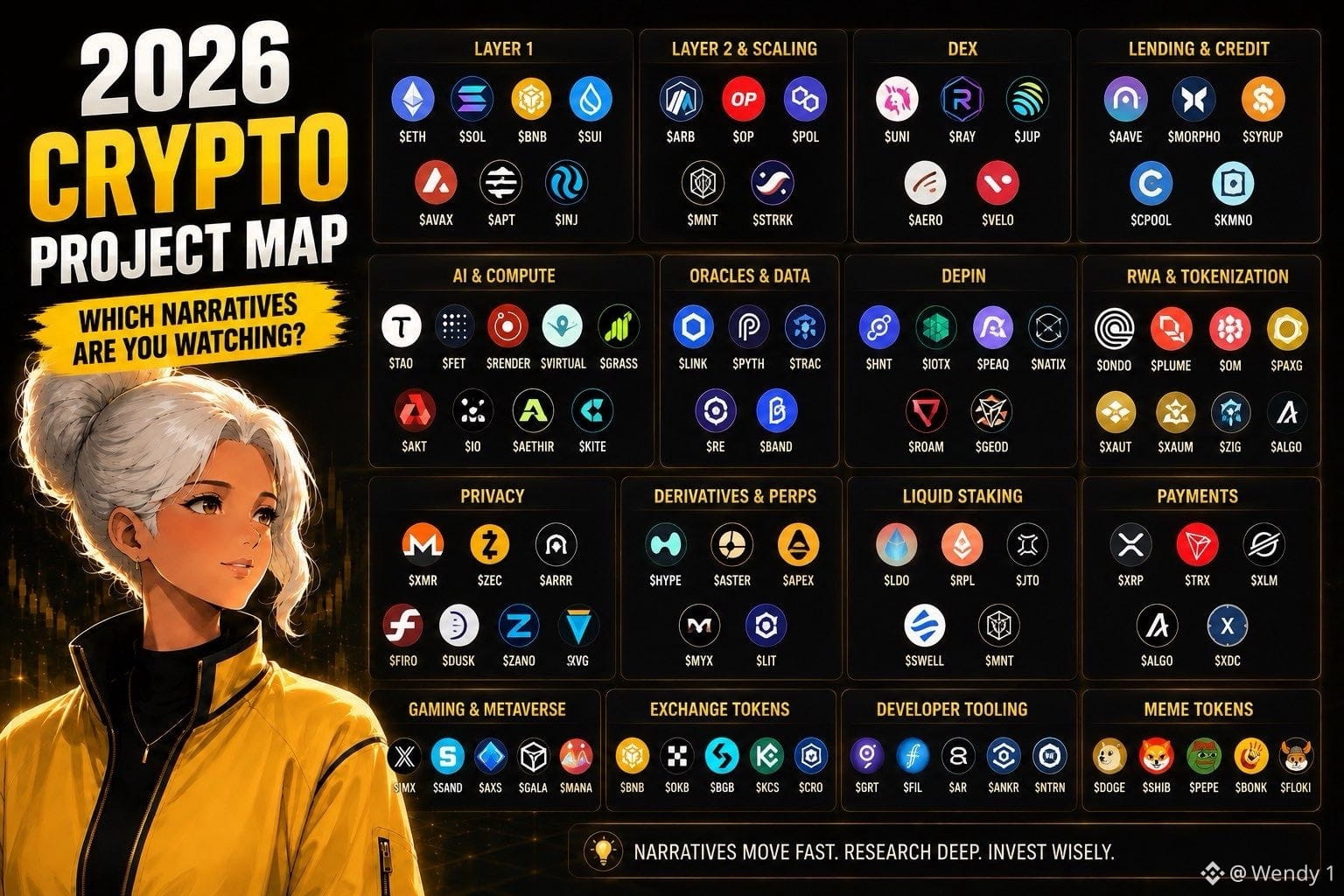
Mapa de proyectos cripto 2026: ¿Qué narrativas estás siguiendo?
Las criptomonedas en 2026 son mucho más grandes que solo $BTC y $ETH.
Este mapa ofrece una visión útil de los proyectos en los sectores principales:
Capa 1: $ETH, $SOL, $BNB, $SUI, $AVAX, $APT, $INJ
Capa 2 y escalado: $ARB, $OP, $POL, $MNT, $STRK
DEX: $UNI, $RAY, $JUP, $AERO, $VELO
Préstamos y crédito: $AAVE, $MORPHO, $SYRUP, $CPOOL, $KMNO
IA y cómputo: $TAO, $FET, $RENDER, $VIRTUAL, $GRASS, $AKT, $IO, $AETHIR, $KITE
Oráculos y datos: $LINK, $PYTH, $TRAC, $RE, $BAND
DePIN: $HNT, $IOTX, $PEAQ, $NATIX, $ROAM, $GEOD
RWA y tokenización: $ONDO, $PLUME, $OM, $PAXG, $XAUT, $XAUM, $ZIG, $ALGO
Privacidad: $XMR, $ZEC, $ARRR, $FIRO, $DUSK, $ZANO, $XVG
Derivados y perps: $HYPE, $ASTER, $APEX, $MYX, $LIT
También hay categorías dedicadas para Liquid Staking, Pagos, Gaming y Metaverso, Exchange Tokens, herramientas para desarrolladores y Meme Tokens.
Lo útil no es tratar esto como una lista de tokens para comprar.
Es una forma de dar un paso atrás y ver dónde se están desarrollando las principales narrativas cripto, y luego hacer una investigación más profunda sobre los proyectos que realmente tienen tracción, adopción y una economía de tokens sostenible.
Una narrativa fuerte por sí sola no es suficiente. El proyecto aún tiene que demostrarse.
Si pudieras elegir solo 3 sectores para seguir el resto de 2026, ¿cuáles elegirías?
Aviso legal: Esto no es asesoramiento financiero. Por favor, realiza tu propia investigación antes de tomar cualquier decisión de inversión.
Mapa de proyectos cripto 2026: ¿Qué narrativas estás siguiendo?
Las criptomonedas en 2026 son mucho más grandes que solo $BTC y $ETH.
Este mapa ofrece una visión útil de los proyectos en los sectores principales:
Capa 1: $ETH, $SOL, $BNB, $SUI, $AVAX, $APT, $INJ
Capa 2 y escalado: $ARB, $OP, $POL, $MNT, $STRK
DEX: $UNI, $RAY, $JUP, $AERO, $VELO
Préstamos y crédito: $AAVE, $MORPHO, $SYRUP, $CPOOL, $KMNO
IA y cómputo: $TAO, $FET, $RENDER, $VIRTUAL, $GRASS, $AKT, $IO, $AETHIR, $KITE
Oráculos y datos: $LINK, $PYTH, $TRAC, $RE, $BAND
DePIN: $HNT, $IOTX, $PEAQ, $NATIX, $ROAM, $GEOD
RWA y tokenización: $ONDO, $PLUME, $OM, $PAXG, $XAUT, $XAUM, $ZIG, $ALGO
Privacidad: $XMR, $ZEC, $ARRR, $FIRO, $DUSK, $ZANO, $XVG
Derivados y perps: $HYPE, $ASTER, $APEX, $MYX, $LIT
También hay categorías dedicadas para Liquid Staking, Pagos, Gaming y Metaverso, Exchange Tokens, herramientas para desarrolladores y Meme Tokens.
Lo útil no es tratar esto como una lista de tokens para comprar.
Es una forma de dar un paso atrás y ver dónde se están desarrollando las principales narrativas cripto, y luego hacer una investigación más profunda sobre los proyectos que realmente tienen tracción, adopción y una economía de tokens sostenible.
Una narrativa fuerte por sí sola no es suficiente. El proyecto aún tiene que demostrarse.
Si pudieras elegir solo 3 sectores para seguir el resto de 2026, ¿cuáles elegirías?
Aviso legal: Esto no es asesoramiento financiero. Por favor, realiza tu propia investigación antes de tomar cualquier decisión de inversión.
Las criptomonedas en 2026 son mucho más grandes que solo $BTC y $ETH.
Este mapa ofrece una visión útil de los proyectos en los sectores principales:
Capa 1: $ETH, $SOL, $BNB, $SUI, $AVAX, $APT, $INJ
Capa 2 y escalado: $ARB, $OP, $POL, $MNT, $STRK
DEX: $UNI, $RAY, $JUP, $AERO, $VELO
Préstamos y crédito: $AAVE, $MORPHO, $SYRUP, $CPOOL, $KMNO
IA y cómputo: $TAO, $FET, $RENDER, $VIRTUAL, $GRASS, $AKT, $IO, $AETHIR, $KITE
Oráculos y datos: $LINK, $PYTH, $TRAC, $RE, $BAND
DePIN: $HNT, $IOTX, $PEAQ, $NATIX, $ROAM, $GEOD
RWA y tokenización: $ONDO, $PLUME, $OM, $PAXG, $XAUT, $XAUM, $ZIG, $ALGO
Privacidad: $XMR, $ZEC, $ARRR, $FIRO, $DUSK, $ZANO, $XVG
Derivados y perps: $HYPE, $ASTER, $APEX, $MYX, $LIT
También hay categorías dedicadas para Liquid Staking, Pagos, Gaming y Metaverso, Exchange Tokens, herramientas para desarrolladores y Meme Tokens.
Lo útil no es tratar esto como una lista de tokens para comprar.
Es una forma de dar un paso atrás y ver dónde se están desarrollando las principales narrativas cripto, y luego hacer una investigación más profunda sobre los proyectos que realmente tienen tracción, adopción y una economía de tokens sostenible.
Una narrativa fuerte por sí sola no es suficiente. El proyecto aún tiene que demostrarse.
Si pudieras elegir solo 3 sectores para seguir el resto de 2026, ¿cuáles elegirías?
Aviso legal: Esto no es asesoramiento financiero. Por favor, realiza tu propia investigación antes de tomar cualquier decisión de inversión.
5
·
--
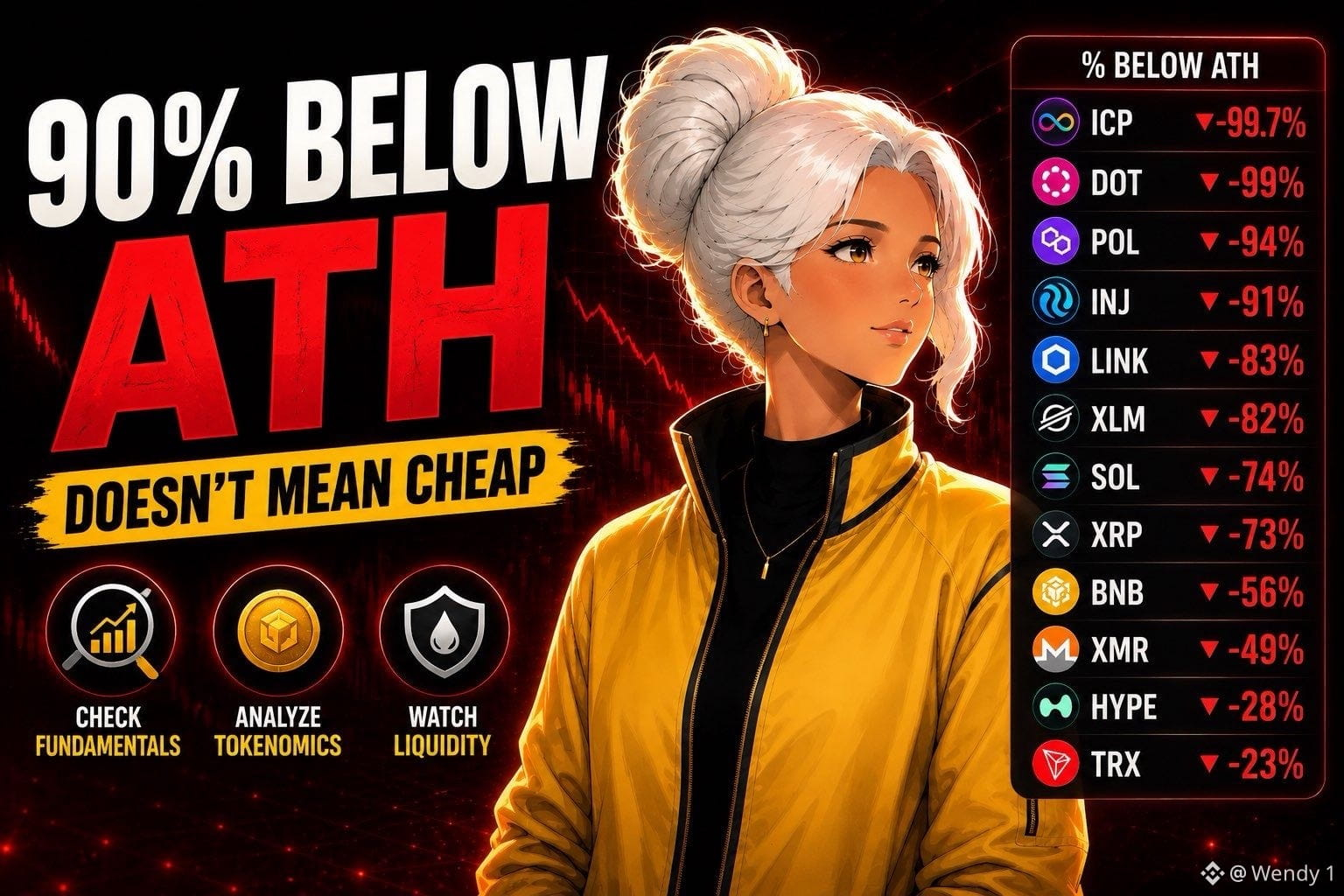
Que una altcoin esté un 90% por debajo de su ATH no significa automáticamente que sea barata.
La distancia actual desde su ATH es bastante extrema para algunos tokens importantes:
🔻 $ICP: -99.7%
🔻 $DOT: -99%
🔻 $POL: -94%
🔻 $INJ: -91%
🔻 $LINK: -83%
🔻 $XLM: -82%
🔻 $SOL: -74%
🔻 $XRP: -73%
🔻 $BNB: -56%
🔻 $XMR: -49%
🔻 $HYPE: -28%
🔻 $TRX: -23%
Pero hay una distinción importante.
Estar muy por debajo de un ATH te dice cuánto ha caído un activo. No te dice si el activo está infravalorado hoy.
Por ejemplo, un token que ha bajado un 90% necesita aproximadamente una ganancia del 900% solo para volver a su ATH anterior.
Así que, en lugar de mirar solo el retroceso, yo revisaría:
• ¿El proyecto sigue creciendo?
• ¿El token todavía tiene demanda o utilidad real?
• ¿Cómo se compara la oferta actual con los desbloqueos previstos?
• ¿La liquidez sigue siendo saludable?
• ¿El precio realmente está construyendo una base o todavía está haciendo mínimos más bajos?
La distancia desde el ATH es un filtro útil, pero no debería ser la tesis de inversión por sí sola.
Barato y fuertemente descontado no siempre es lo mismo.
Aviso: Esto no es asesoramiento financiero. Los activos cripto son altamente volátiles, así que por favor haz tu propia investigación antes de tomar decisiones de inversión.
Que una altcoin esté un 90% por debajo de su ATH no significa automáticamente que sea barata.
La distancia actual desde su ATH es bastante extrema para algunos tokens importantes:
🔻 $ICP: -99.7%
🔻 $DOT: -99%
🔻 $POL: -94%
🔻 $INJ: -91%
🔻 $LINK: -83%
🔻 $XLM: -82%
🔻 $SOL: -74%
🔻 $XRP: -73%
🔻 $BNB: -56%
🔻 $XMR: -49%
🔻 $HYPE: -28%
🔻 $TRX: -23%
Pero hay una distinción importante.
Estar muy por debajo de un ATH te dice cuánto ha caído un activo. No te dice si el activo está infravalorado hoy.
Por ejemplo, un token que ha bajado un 90% necesita aproximadamente una ganancia del 900% solo para volver a su ATH anterior.
Así que, en lugar de mirar solo el retroceso, yo revisaría:
• ¿El proyecto sigue creciendo?
• ¿El token todavía tiene demanda o utilidad real?
• ¿Cómo se compara la oferta actual con los desbloqueos previstos?
• ¿La liquidez sigue siendo saludable?
• ¿El precio realmente está construyendo una base o todavía está haciendo mínimos más bajos?
La distancia desde el ATH es un filtro útil, pero no debería ser la tesis de inversión por sí sola.
Barato y fuertemente descontado no siempre es lo mismo.
Aviso: Esto no es asesoramiento financiero. Los activos cripto son altamente volátiles, así que por favor haz tu propia investigación antes de tomar decisiones de inversión.
La distancia actual desde su ATH es bastante extrema para algunos tokens importantes:
🔻 $ICP: -99.7%
🔻 $DOT: -99%
🔻 $POL: -94%
🔻 $INJ: -91%
🔻 $LINK: -83%
🔻 $XLM: -82%
🔻 $SOL: -74%
🔻 $XRP: -73%
🔻 $BNB: -56%
🔻 $XMR: -49%
🔻 $HYPE: -28%
🔻 $TRX: -23%
Pero hay una distinción importante.
Estar muy por debajo de un ATH te dice cuánto ha caído un activo. No te dice si el activo está infravalorado hoy.
Por ejemplo, un token que ha bajado un 90% necesita aproximadamente una ganancia del 900% solo para volver a su ATH anterior.
Así que, en lugar de mirar solo el retroceso, yo revisaría:
• ¿El proyecto sigue creciendo?
• ¿El token todavía tiene demanda o utilidad real?
• ¿Cómo se compara la oferta actual con los desbloqueos previstos?
• ¿La liquidez sigue siendo saludable?
• ¿El precio realmente está construyendo una base o todavía está haciendo mínimos más bajos?
La distancia desde el ATH es un filtro útil, pero no debería ser la tesis de inversión por sí sola.
Barato y fuertemente descontado no siempre es lo mismo.
Aviso: Esto no es asesoramiento financiero. Los activos cripto son altamente volátiles, así que por favor haz tu propia investigación antes de tomar decisiones de inversión.
31
·
--
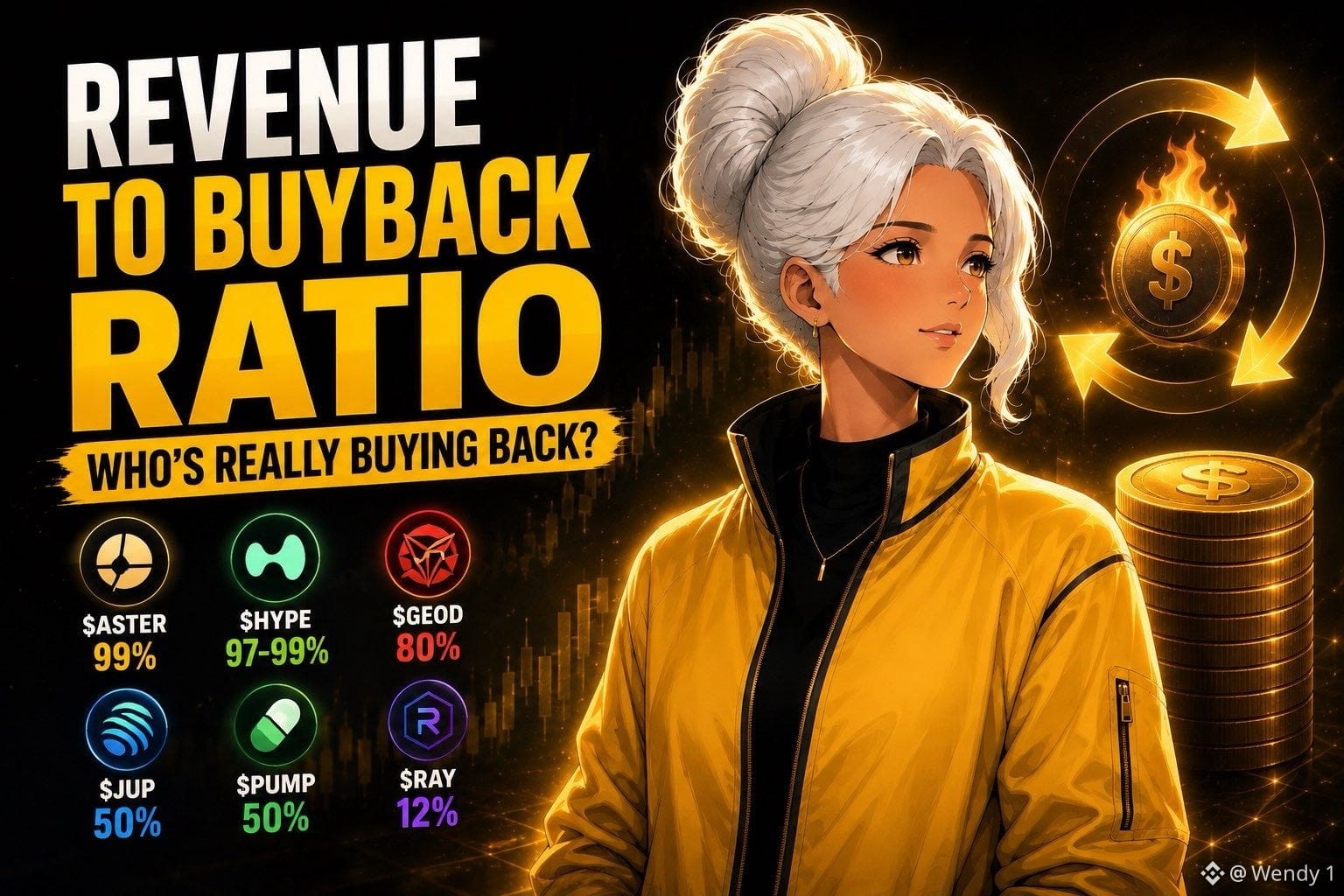
Una alta tasa de recompra suena genial. Pero ¿de dónde sale realmente el dinero?
Ahí es donde la relación ingresos-recompras se vuelve útil.
Mide cuánto de los ingresos reales de un proyecto se dirige a recomprar y quemar su propio token.
Así es como se comparan varios proyectos:
🔥 $ASTER: 99%
🟢 $HYPE: 97% a 99%
🔴 $GEOD: 80%
🔵 $JUP: 50%
🟢 $PUMP: 50%
🟣 $RAY: 12%
A primera vista, $ASTER y $HYPE destacan porque la mayor parte de sus ingresos se asigna a recompras y quemas.
Pero hay un detalle importante.
La relación por sí sola no te dice qué tan fuerte es realmente la recompra.
Un proyecto puede asignar el 99% de sus ingresos a recompras, pero si los ingresos caen, la cantidad real en dólares que va al mercado también puede reducirse.
Mientras tanto, un proyecto con un porcentaje menor pero con ingresos mucho más grandes podría, potencialmente, generar recompras más grandes en términos absolutos.
Entonces, antes de declarar a cualquier modelo como ganador, yo comprobaría tres cosas:
1. ¿Los ingresos realmente están creciendo?
2. ¿Las recompras anunciadas se están ejecutando on-chain?
3. ¿Las quemas están al ritmo de la nueva emisión de tokens?
El porcentaje es un filtro inicial útil.
La verdadera prueba es si los ingresos reales siguen fluyendo de vuelta al token, de forma constante y on-chain.
Descargo de responsabilidad: Esto no es asesoramiento financiero. Por favor, haz tu propia investigación antes de tomar decisiones de inversión.
Una alta tasa de recompra suena genial. Pero ¿de dónde sale realmente el dinero?
Ahí es donde la relación ingresos-recompras se vuelve útil.
Mide cuánto de los ingresos reales de un proyecto se dirige a recomprar y quemar su propio token.
Así es como se comparan varios proyectos:
🔥 $ASTER: 99%
🟢 $HYPE: 97% a 99%
🔴 $GEOD: 80%
🔵 $JUP: 50%
🟢 $PUMP: 50%
🟣 $RAY: 12%
A primera vista, $ASTER y $HYPE destacan porque la mayor parte de sus ingresos se asigna a recompras y quemas.
Pero hay un detalle importante.
La relación por sí sola no te dice qué tan fuerte es realmente la recompra.
Un proyecto puede asignar el 99% de sus ingresos a recompras, pero si los ingresos caen, la cantidad real en dólares que va al mercado también puede reducirse.
Mientras tanto, un proyecto con un porcentaje menor pero con ingresos mucho más grandes podría, potencialmente, generar recompras más grandes en términos absolutos.
Entonces, antes de declarar a cualquier modelo como ganador, yo comprobaría tres cosas:
1. ¿Los ingresos realmente están creciendo?
2. ¿Las recompras anunciadas se están ejecutando on-chain?
3. ¿Las quemas están al ritmo de la nueva emisión de tokens?
El porcentaje es un filtro inicial útil.
La verdadera prueba es si los ingresos reales siguen fluyendo de vuelta al token, de forma constante y on-chain.
Descargo de responsabilidad: Esto no es asesoramiento financiero. Por favor, haz tu propia investigación antes de tomar decisiones de inversión.
Ahí es donde la relación ingresos-recompras se vuelve útil.
Mide cuánto de los ingresos reales de un proyecto se dirige a recomprar y quemar su propio token.
Así es como se comparan varios proyectos:
🔥 $ASTER: 99%
🟢 $HYPE: 97% a 99%
🔴 $GEOD: 80%
🔵 $JUP: 50%
🟢 $PUMP: 50%
🟣 $RAY: 12%
A primera vista, $ASTER y $HYPE destacan porque la mayor parte de sus ingresos se asigna a recompras y quemas.
Pero hay un detalle importante.
La relación por sí sola no te dice qué tan fuerte es realmente la recompra.
Un proyecto puede asignar el 99% de sus ingresos a recompras, pero si los ingresos caen, la cantidad real en dólares que va al mercado también puede reducirse.
Mientras tanto, un proyecto con un porcentaje menor pero con ingresos mucho más grandes podría, potencialmente, generar recompras más grandes en términos absolutos.
Entonces, antes de declarar a cualquier modelo como ganador, yo comprobaría tres cosas:
1. ¿Los ingresos realmente están creciendo?
2. ¿Las recompras anunciadas se están ejecutando on-chain?
3. ¿Las quemas están al ritmo de la nueva emisión de tokens?
El porcentaje es un filtro inicial útil.
La verdadera prueba es si los ingresos reales siguen fluyendo de vuelta al token, de forma constante y on-chain.
Descargo de responsabilidad: Esto no es asesoramiento financiero. Por favor, haz tu propia investigación antes de tomar decisiones de inversión.
33
·
--
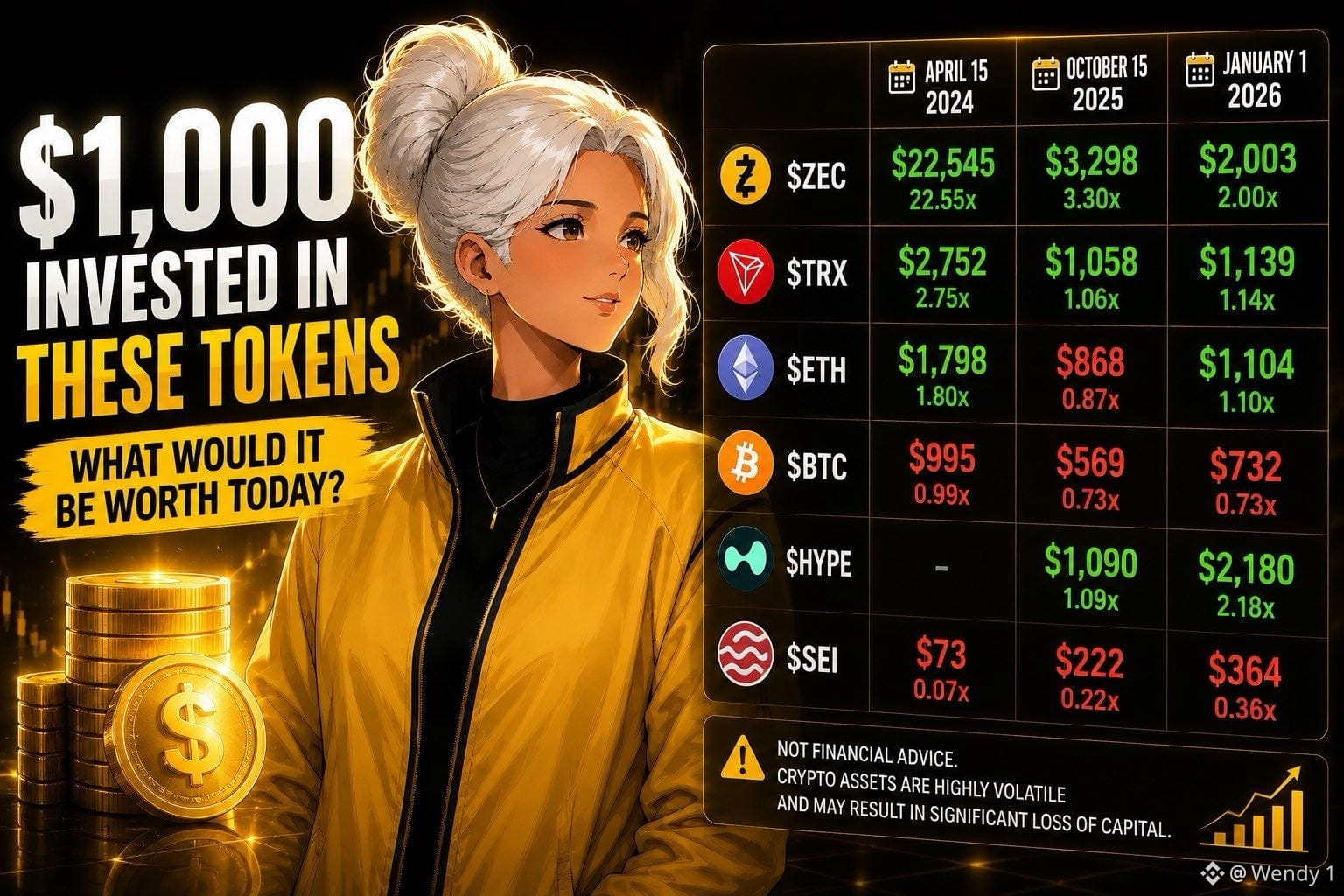
$1,000 invertidos en estos tokens: ¿cuánto valdría hoy?
El mismo $1,000.
Resultados muy distintos, según cuándo los compraste.
El gráfico compara tres fechas de entrada:
📅 15 de abril de 2024
📅 15 de octubre de 2025
📅 1 de enero de 2026
Hay algunos resultados que destacan.
$ZEC es el mayor caso atípico.
Una inversión de $1,000 desde abril de 2024 valdría $22,545, o 22.55x.
$TRX es el ganador más constante.
Los tres puntos de entrada siguen siendo rentables:
2.75x desde abril de 2024
1.06x desde octubre de 2025
1.14x desde enero de 2026
Luego está $HYPE.
No se estaba negociando en abril de 2024, pero una inversión de $1,000 desde octubre de 2025 ahora sería $1,090, mientras que la entrada de enero de 2026 valdría $2,180.
Del otro lado, $SEI ha tenido dificultades en cada punto de entrada:
$73 desde abril de 2024
$222 desde octubre de 2025
$364 desde enero de 2026
Incluso $BTC no es inmune a un mal momento. La entrada de abril de 2024 está casi plana en $995, mientras que las entradas de octubre de 2025 y enero de 2026 caen a $569 y $732.
La lección más grande aquí no es simplemente qué token tuvo mejor desempeño.
El momento de entrada puede cambiar completamente el resultado.
Un proyecto sólido comprado cerca de un pico aún puede generar una pérdida dolorosa, mientras que una entrada posterior en el mismo activo puede verse completamente diferente.
A veces “¿Es este un buen token?” no es suficiente.
La mejor pregunta es:
“¿En qué parte del ciclo lo estoy comprando?”
Aviso legal: Esto no es asesoramiento financiero. Los criptoactivos son extremadamente volátiles y pueden provocar pérdidas significativas de capital.
#Crypto #BTC #ETH #ZEC #TRX
$1,000 invertidos en estos tokens: ¿cuánto valdría hoy?
El mismo $1,000.
Resultados muy distintos, según cuándo los compraste.
El gráfico compara tres fechas de entrada:
📅 15 de abril de 2024
📅 15 de octubre de 2025
📅 1 de enero de 2026
Hay algunos resultados que destacan.
$ZEC es el mayor caso atípico.
Una inversión de $1,000 desde abril de 2024 valdría $22,545, o 22.55x.
$TRX es el ganador más constante.
Los tres puntos de entrada siguen siendo rentables:
2.75x desde abril de 2024
1.06x desde octubre de 2025
1.14x desde enero de 2026
Luego está $HYPE.
No se estaba negociando en abril de 2024, pero una inversión de $1,000 desde octubre de 2025 ahora sería $1,090, mientras que la entrada de enero de 2026 valdría $2,180.
Del otro lado, $SEI ha tenido dificultades en cada punto de entrada:
$73 desde abril de 2024
$222 desde octubre de 2025
$364 desde enero de 2026
Incluso $BTC no es inmune a un mal momento. La entrada de abril de 2024 está casi plana en $995, mientras que las entradas de octubre de 2025 y enero de 2026 caen a $569 y $732.
La lección más grande aquí no es simplemente qué token tuvo mejor desempeño.
El momento de entrada puede cambiar completamente el resultado.
Un proyecto sólido comprado cerca de un pico aún puede generar una pérdida dolorosa, mientras que una entrada posterior en el mismo activo puede verse completamente diferente.
A veces “¿Es este un buen token?” no es suficiente.
La mejor pregunta es:
“¿En qué parte del ciclo lo estoy comprando?”
Aviso legal: Esto no es asesoramiento financiero. Los criptoactivos son extremadamente volátiles y pueden provocar pérdidas significativas de capital.
#Crypto #BTC #ETH #ZEC #TRX
El mismo $1,000.
Resultados muy distintos, según cuándo los compraste.
El gráfico compara tres fechas de entrada:
📅 15 de abril de 2024
📅 15 de octubre de 2025
📅 1 de enero de 2026
Hay algunos resultados que destacan.
$ZEC es el mayor caso atípico.
Una inversión de $1,000 desde abril de 2024 valdría $22,545, o 22.55x.
$TRX es el ganador más constante.
Los tres puntos de entrada siguen siendo rentables:
2.75x desde abril de 2024
1.06x desde octubre de 2025
1.14x desde enero de 2026
Luego está $HYPE.
No se estaba negociando en abril de 2024, pero una inversión de $1,000 desde octubre de 2025 ahora sería $1,090, mientras que la entrada de enero de 2026 valdría $2,180.
Del otro lado, $SEI ha tenido dificultades en cada punto de entrada:
$73 desde abril de 2024
$222 desde octubre de 2025
$364 desde enero de 2026
Incluso $BTC no es inmune a un mal momento. La entrada de abril de 2024 está casi plana en $995, mientras que las entradas de octubre de 2025 y enero de 2026 caen a $569 y $732.
La lección más grande aquí no es simplemente qué token tuvo mejor desempeño.
El momento de entrada puede cambiar completamente el resultado.
Un proyecto sólido comprado cerca de un pico aún puede generar una pérdida dolorosa, mientras que una entrada posterior en el mismo activo puede verse completamente diferente.
A veces “¿Es este un buen token?” no es suficiente.
La mejor pregunta es:
“¿En qué parte del ciclo lo estoy comprando?”
Aviso legal: Esto no es asesoramiento financiero. Los criptoactivos son extremadamente volátiles y pueden provocar pérdidas significativas de capital.
#Crypto #BTC #ETH #ZEC #TRX
43
·
--
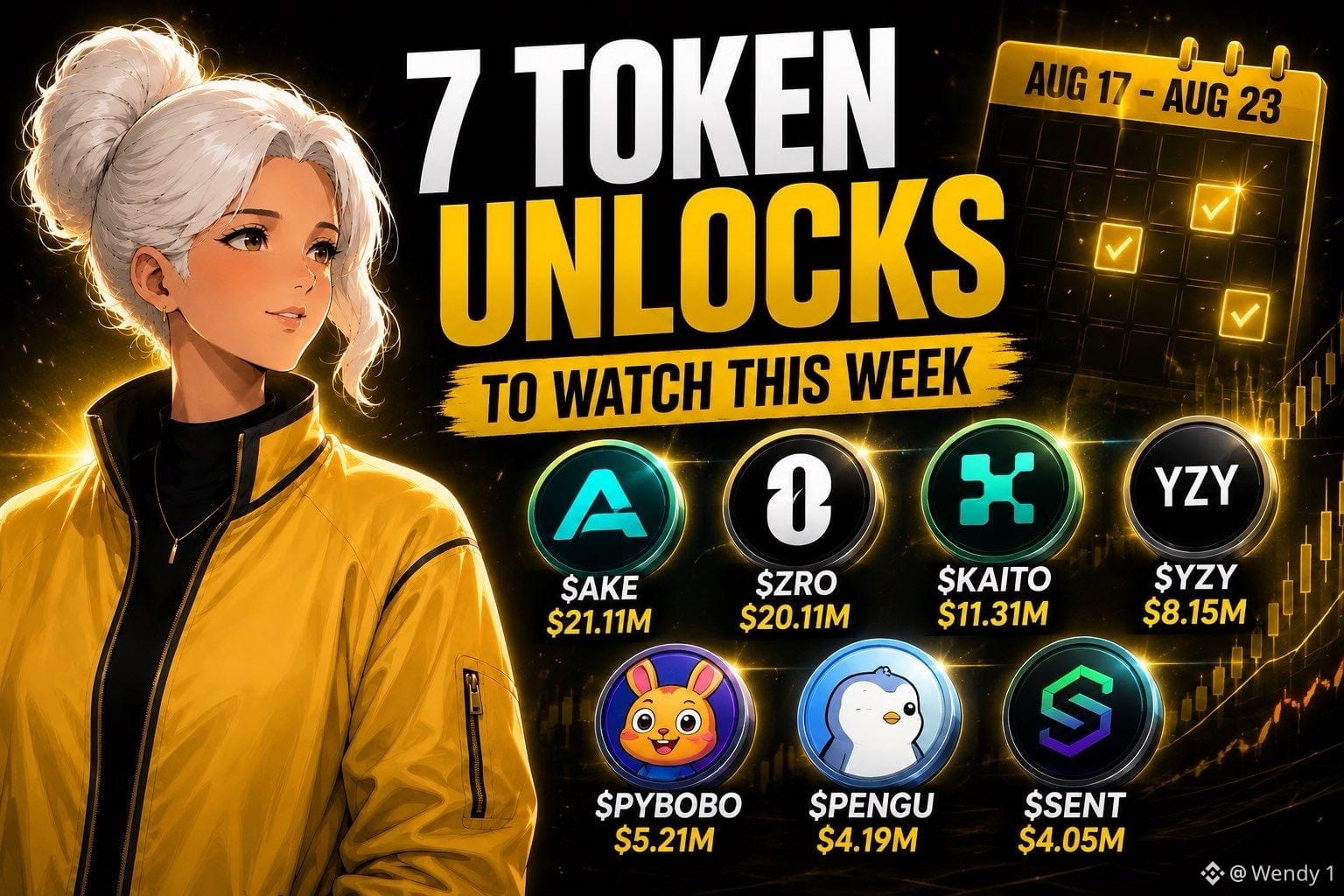
7 desbloqueos de tokens a tener en cuenta esta semana
Los desbloqueos de tokens pueden cambiar silenciosamente el panorama de la oferta, y la lista de esta semana incluye algunos números que vale la pena observar.
Entre el 17 de agosto y el 23 de agosto, estos siete tokens tienen los valores de desbloqueo más altos en los datos de CryptoRank:
• $AKE: $21.11M
• $ZRO: $20.11M
• $KAITO: $11.31M
• $YZY: $8.15M
• $PYBOBO: $5.21M
• $PENGU: $4.19M
• $SENT: $4.05M
El número más interesante no siempre es el valor en dólares.
Para $KAITO, el desbloqueo programado equivale a aproximadamente el 13.5% de su capitalización de mercado actual según el gráfico. Es un evento de oferta mucho más grande en relación con el tamaño de su mercado de lo que podría sugerir el titular de $11.31M.
$AKE le sigue con 9.25%, mientras que $ZRO está en 7.28%.
El calendario se distribuye a lo largo de la semana:
$PENGU se desbloquea el 17 de agosto.
$ZRO y $KAITO siguen el 20 de agosto.
$AKE, $YZY y $PYBOBO se desbloquean el 21 de agosto.
$SENT se sigue el 22 de agosto.
Un desbloqueo no significa automáticamente que un token vaya a venderse. El impacto real depende de quién reciba los tokens, si los vende y cuánta demanda haya disponible en ese momento.
Aun así, para cualquiera que tenga estos activos, la oferta que entra al mercado es algo que conviene mantener en el radar.
Aviso legal: Esto no es asesoramiento financiero. Por favor, revisa la tokenómica oficial del proyecto y el calendario de desbloqueos antes de operar.
#Crypto #TokenUnlock #KAITO
7 desbloqueos de tokens a tener en cuenta esta semana
Los desbloqueos de tokens pueden cambiar silenciosamente el panorama de la oferta, y la lista de esta semana incluye algunos números que vale la pena observar.
Entre el 17 de agosto y el 23 de agosto, estos siete tokens tienen los valores de desbloqueo más altos en los datos de CryptoRank:
• $AKE: $21.11M
• $ZRO: $20.11M
• $KAITO: $11.31M
• $YZY: $8.15M
• $PYBOBO: $5.21M
• $PENGU: $4.19M
• $SENT: $4.05M
El número más interesante no siempre es el valor en dólares.
Para $KAITO, el desbloqueo programado equivale a aproximadamente el 13.5% de su capitalización de mercado actual según el gráfico. Es un evento de oferta mucho más grande en relación con el tamaño de su mercado de lo que podría sugerir el titular de $11.31M.
$AKE le sigue con 9.25%, mientras que $ZRO está en 7.28%.
El calendario se distribuye a lo largo de la semana:
$PENGU se desbloquea el 17 de agosto.
$ZRO y $KAITO siguen el 20 de agosto.
$AKE, $YZY y $PYBOBO se desbloquean el 21 de agosto.
$SENT se sigue el 22 de agosto.
Un desbloqueo no significa automáticamente que un token vaya a venderse. El impacto real depende de quién reciba los tokens, si los vende y cuánta demanda haya disponible en ese momento.
Aun así, para cualquiera que tenga estos activos, la oferta que entra al mercado es algo que conviene mantener en el radar.
Aviso legal: Esto no es asesoramiento financiero. Por favor, revisa la tokenómica oficial del proyecto y el calendario de desbloqueos antes de operar.
#Crypto #TokenUnlock #KAITO
Los desbloqueos de tokens pueden cambiar silenciosamente el panorama de la oferta, y la lista de esta semana incluye algunos números que vale la pena observar.
Entre el 17 de agosto y el 23 de agosto, estos siete tokens tienen los valores de desbloqueo más altos en los datos de CryptoRank:
• $AKE: $21.11M
• $ZRO: $20.11M
• $KAITO: $11.31M
• $YZY: $8.15M
• $PYBOBO: $5.21M
• $PENGU: $4.19M
• $SENT: $4.05M
El número más interesante no siempre es el valor en dólares.
Para $KAITO, el desbloqueo programado equivale a aproximadamente el 13.5% de su capitalización de mercado actual según el gráfico. Es un evento de oferta mucho más grande en relación con el tamaño de su mercado de lo que podría sugerir el titular de $11.31M.
$AKE le sigue con 9.25%, mientras que $ZRO está en 7.28%.
El calendario se distribuye a lo largo de la semana:
$PENGU se desbloquea el 17 de agosto.
$ZRO y $KAITO siguen el 20 de agosto.
$AKE, $YZY y $PYBOBO se desbloquean el 21 de agosto.
$SENT se sigue el 22 de agosto.
Un desbloqueo no significa automáticamente que un token vaya a venderse. El impacto real depende de quién reciba los tokens, si los vende y cuánta demanda haya disponible en ese momento.
Aun así, para cualquiera que tenga estos activos, la oferta que entra al mercado es algo que conviene mantener en el radar.
Aviso legal: Esto no es asesoramiento financiero. Por favor, revisa la tokenómica oficial del proyecto y el calendario de desbloqueos antes de operar.
#Crypto #TokenUnlock #KAITO
46
·
--
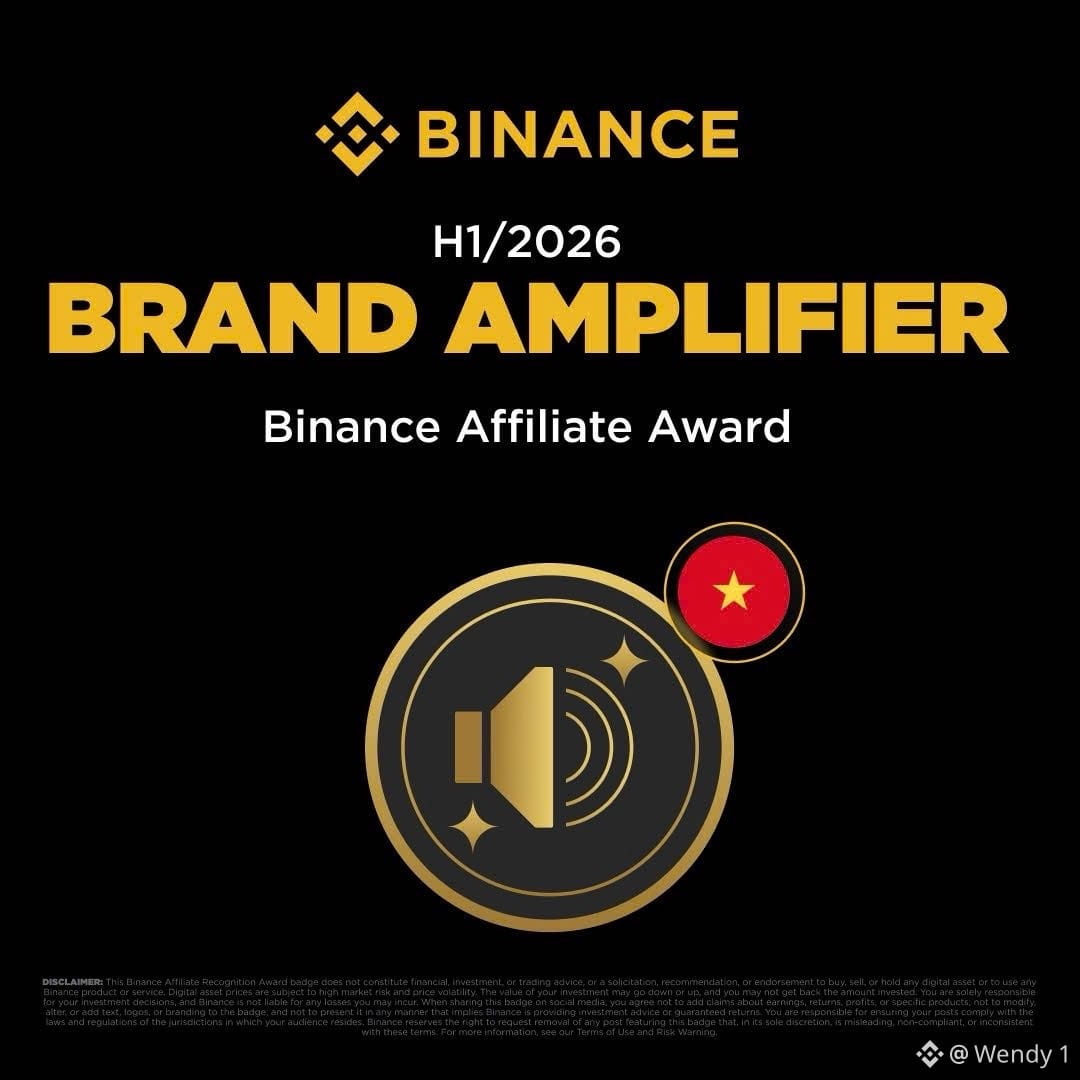
Solo 7 personas en Vietnam recibieron este reconocimiento. Y ¡soy una de ellas! 🥹💛
Me alegra muchísimo compartir que he sido seleccionada como ganadora del Programa de Reconocimiento para Afiliados H1/2026 de Binance Vietnam, recibiendo el premio Brand Amplifier.
Según mi Gerente de Afiliados de Binance, solo 7 afiliados en Vietnam fueron seleccionados para este reconocimiento.
Honestamente, esto significa mucho para mí.
Durante los últimos meses, he dedicado mucho tiempo a crear contenido sobre Binance: desde actualizaciones de producto y Binance P2P hasta distintos temas que creo que son útiles para la comunidad cripto.
Algunas publicaciones solo tardan unos minutos en leerse, pero se invierte bastante tiempo en investigarlas y reunirlas.
Nunca comencé a crear contenido esperando un premio.
Así que ver que Binance reconoce ese esfuerzo con el premio Brand Amplifier se siente realmente especial.
El premio reconoce a afiliados que crean contenido de calidad de Binance en distintas plataformas sociales y ayudan a amplificar la marca Binance dentro de la comunidad cripto vietnamita.
De verdad, estoy muy agradecida.
Gracias a Binance, a mi Affiliate Manager y a todas las personas que han estado leyendo mis publicaciones, dejando comentarios, compartiendo opiniones o, simplemente, siguiendo el contenido.
Este reconocimiento no significaría lo mismo sin la comunidad que hay detrás. ❤️
También hay una pequeña sorpresa mencionada en el paquete del premio.
Binance incluyó 10 artículos de swag para sorteos dirigidos a nuevos usuarios.
Aún estoy esperando los detalles sobre cómo los recibiré.
Pero si esos 10 regalos son, de hecho, para un sorteo de la comunidad...
Ya tengo una idea de lo que quiero hacer con ellos. 👀🎁
Estén atentos.
$BNB #Binance #BNBChain
Solo 7 personas en Vietnam recibieron este reconocimiento. Y ¡soy una de ellas! 🥹💛
Me alegra muchísimo compartir que he sido seleccionada como ganadora del Programa de Reconocimiento para Afiliados H1/2026 de Binance Vietnam, recibiendo el premio Brand Amplifier.
Según mi Gerente de Afiliados de Binance, solo 7 afiliados en Vietnam fueron seleccionados para este reconocimiento.
Honestamente, esto significa mucho para mí.
Durante los últimos meses, he dedicado mucho tiempo a crear contenido sobre Binance: desde actualizaciones de producto y Binance P2P hasta distintos temas que creo que son útiles para la comunidad cripto.
Algunas publicaciones solo tardan unos minutos en leerse, pero se invierte bastante tiempo en investigarlas y reunirlas.
Nunca comencé a crear contenido esperando un premio.
Así que ver que Binance reconoce ese esfuerzo con el premio Brand Amplifier se siente realmente especial.
El premio reconoce a afiliados que crean contenido de calidad de Binance en distintas plataformas sociales y ayudan a amplificar la marca Binance dentro de la comunidad cripto vietnamita.
De verdad, estoy muy agradecida.
Gracias a Binance, a mi Affiliate Manager y a todas las personas que han estado leyendo mis publicaciones, dejando comentarios, compartiendo opiniones o, simplemente, siguiendo el contenido.
Este reconocimiento no significaría lo mismo sin la comunidad que hay detrás. ❤️
También hay una pequeña sorpresa mencionada en el paquete del premio.
Binance incluyó 10 artículos de swag para sorteos dirigidos a nuevos usuarios.
Aún estoy esperando los detalles sobre cómo los recibiré.
Pero si esos 10 regalos son, de hecho, para un sorteo de la comunidad...
Ya tengo una idea de lo que quiero hacer con ellos. 👀🎁
Estén atentos.
$BNB #Binance #BNBChain
Me alegra muchísimo compartir que he sido seleccionada como ganadora del Programa de Reconocimiento para Afiliados H1/2026 de Binance Vietnam, recibiendo el premio Brand Amplifier.
Según mi Gerente de Afiliados de Binance, solo 7 afiliados en Vietnam fueron seleccionados para este reconocimiento.
Honestamente, esto significa mucho para mí.
Durante los últimos meses, he dedicado mucho tiempo a crear contenido sobre Binance: desde actualizaciones de producto y Binance P2P hasta distintos temas que creo que son útiles para la comunidad cripto.
Algunas publicaciones solo tardan unos minutos en leerse, pero se invierte bastante tiempo en investigarlas y reunirlas.
Nunca comencé a crear contenido esperando un premio.
Así que ver que Binance reconoce ese esfuerzo con el premio Brand Amplifier se siente realmente especial.
El premio reconoce a afiliados que crean contenido de calidad de Binance en distintas plataformas sociales y ayudan a amplificar la marca Binance dentro de la comunidad cripto vietnamita.
De verdad, estoy muy agradecida.
Gracias a Binance, a mi Affiliate Manager y a todas las personas que han estado leyendo mis publicaciones, dejando comentarios, compartiendo opiniones o, simplemente, siguiendo el contenido.
Este reconocimiento no significaría lo mismo sin la comunidad que hay detrás. ❤️
También hay una pequeña sorpresa mencionada en el paquete del premio.
Binance incluyó 10 artículos de swag para sorteos dirigidos a nuevos usuarios.
Aún estoy esperando los detalles sobre cómo los recibiré.
Pero si esos 10 regalos son, de hecho, para un sorteo de la comunidad...
Ya tengo una idea de lo que quiero hacer con ellos. 👀🎁
Estén atentos.
$BNB #Binance #BNBChain
114
·
--
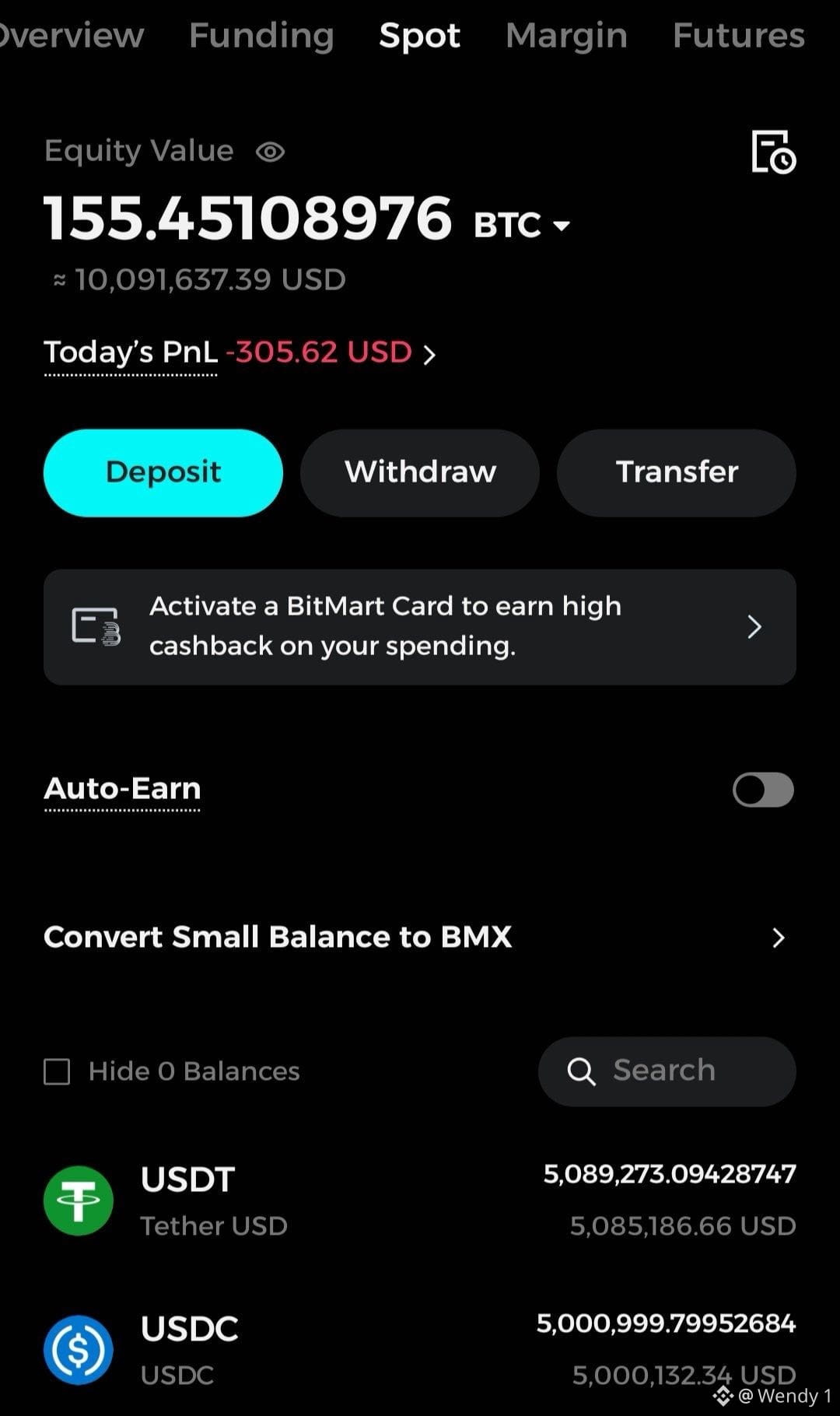
Un usuario de BitMart dice que no puede retirar 10,1 M$. Esto es lo que sabemos
Un usuario de BitMart ha planteado públicamente dudas sobre los retiros después de afirmar que no ha podido retirar fondos desde el 26 de julio.
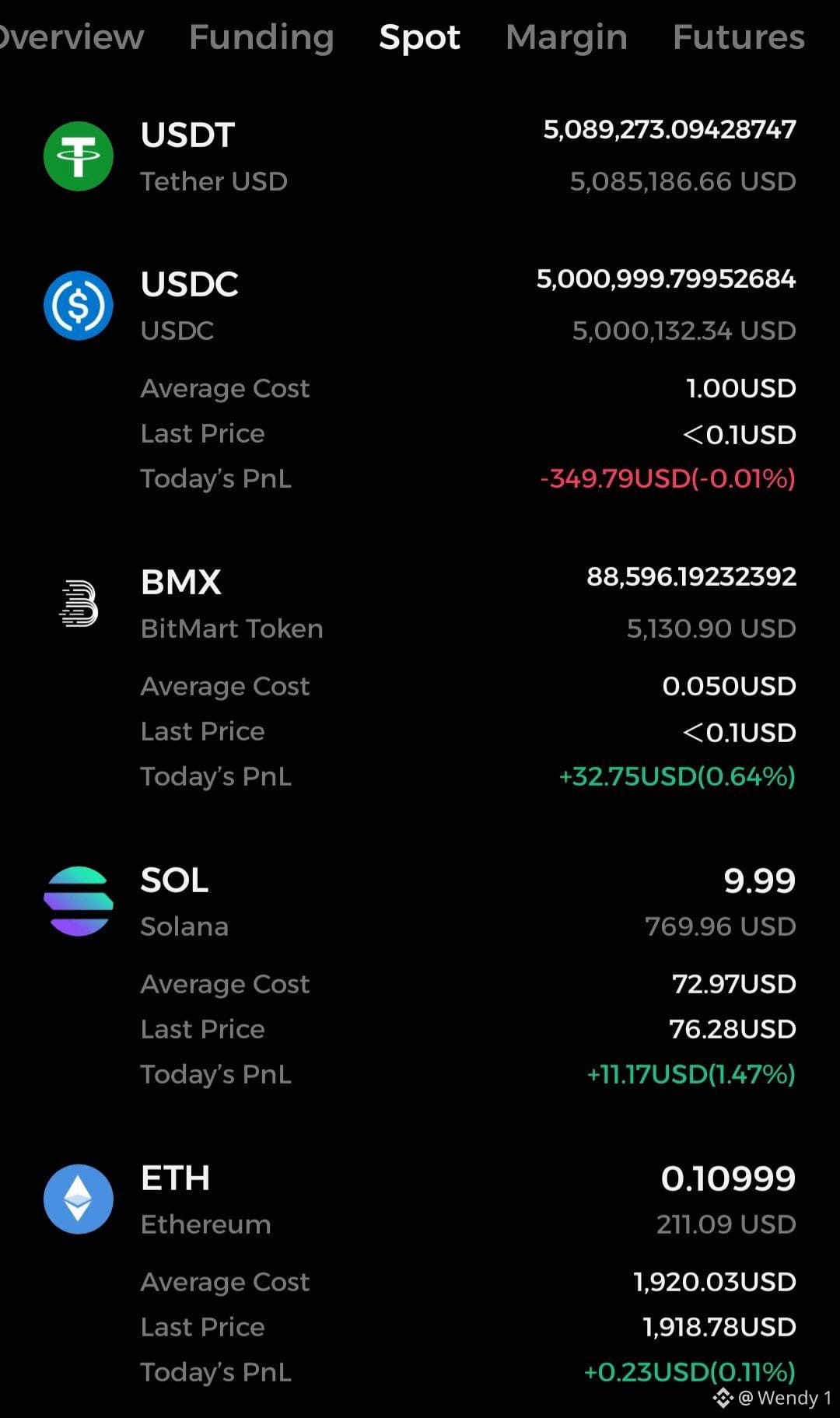
Según la publicación y las capturas de pantalla compartidas por el usuario, su cuenta antes tenía alrededor de 10,1 millones de dólares, incluidos:
* 155,45 BTC, con un valor aproximado de 10,09 M$ en la captura
* 5,09 M USDT
* 5,00 M USDC
* Varias posiciones cripto más pequeñas
El usuario también afirma que su gerente VIP de BitMart, identificado como Tony, eliminó su cuenta de Telegram el 26 de julio, mientras que otros miembros del equipo supuestamente desaparecieron o también eliminaron sus cuentas.
Aquí hay una distinción importante.
Son afirmaciones hechas por el usuario. Las capturas de pantalla, por sí solas, no demuestran que BitMart haya perdido, congelado o se haya apropiado indebidamente de los fondos de los clientes.
Pero si de verdad se están retrasando los retiros para una cantidad significativa de usuarios, la situación merece una explicación clara.
Las preguntas son directas:
¿Por qué no se están procesando los retiros?
¿Dónde están los fondos de los usuarios afectados?
¿Y cuándo pueden los clientes esperar tener acceso a su dinero?
Para un exchange centralizado, la transparencia en los retiros importa tanto como las funciones de trading. El silencio solo hace que los usuarios estén más preocupados cuando están involucrados sus fondos.
Fuente: publicación del usuario y capturas de pantalla enviadas. Las afirmaciones no han sido verificadas de forma independiente aquí.
#BitMart #Crypto #Bitcoin #USDT
Un usuario de BitMart dice que no puede retirar 10,1 M$. Esto es lo que sabemos
Un usuario de BitMart ha planteado públicamente dudas sobre los retiros después de afirmar que no ha podido retirar fondos desde el 26 de julio.
Según la publicación y las capturas de pantalla compartidas por el usuario, su cuenta antes tenía alrededor de 10,1 millones de dólares, incluidos:
* 155,45 BTC, con un valor aproximado de 10,09 M$ en la captura
* 5,09 M USDT
* 5,00 M USDC
* Varias posiciones cripto más pequeñas
El usuario también afirma que su gerente VIP de BitMart, identificado como Tony, eliminó su cuenta de Telegram el 26 de julio, mientras que otros miembros del equipo supuestamente desaparecieron o también eliminaron sus cuentas.
Aquí hay una distinción importante.
Son afirmaciones hechas por el usuario. Las capturas de pantalla, por sí solas, no demuestran que BitMart haya perdido, congelado o se haya apropiado indebidamente de los fondos de los clientes.
Pero si de verdad se están retrasando los retiros para una cantidad significativa de usuarios, la situación merece una explicación clara.
Las preguntas son directas:
¿Por qué no se están procesando los retiros?
¿Dónde están los fondos de los usuarios afectados?
¿Y cuándo pueden los clientes esperar tener acceso a su dinero?
Para un exchange centralizado, la transparencia en los retiros importa tanto como las funciones de trading. El silencio solo hace que los usuarios estén más preocupados cuando están involucrados sus fondos.
Fuente: publicación del usuario y capturas de pantalla enviadas. Las afirmaciones no han sido verificadas de forma independiente aquí.
#BitMart #Crypto #Bitcoin #USDT
Un usuario de BitMart ha planteado públicamente dudas sobre los retiros después de afirmar que no ha podido retirar fondos desde el 26 de julio.
Según la publicación y las capturas de pantalla compartidas por el usuario, su cuenta antes tenía alrededor de 10,1 millones de dólares, incluidos:
* 155,45 BTC, con un valor aproximado de 10,09 M$ en la captura
* 5,09 M USDT
* 5,00 M USDC
* Varias posiciones cripto más pequeñas
El usuario también afirma que su gerente VIP de BitMart, identificado como Tony, eliminó su cuenta de Telegram el 26 de julio, mientras que otros miembros del equipo supuestamente desaparecieron o también eliminaron sus cuentas.
Aquí hay una distinción importante.
Son afirmaciones hechas por el usuario. Las capturas de pantalla, por sí solas, no demuestran que BitMart haya perdido, congelado o se haya apropiado indebidamente de los fondos de los clientes.
Pero si de verdad se están retrasando los retiros para una cantidad significativa de usuarios, la situación merece una explicación clara.
Las preguntas son directas:
¿Por qué no se están procesando los retiros?
¿Dónde están los fondos de los usuarios afectados?
¿Y cuándo pueden los clientes esperar tener acceso a su dinero?
Para un exchange centralizado, la transparencia en los retiros importa tanto como las funciones de trading. El silencio solo hace que los usuarios estén más preocupados cuando están involucrados sus fondos.
Fuente: publicación del usuario y capturas de pantalla enviadas. Las afirmaciones no han sido verificadas de forma independiente aquí.
#BitMart #Crypto #Bitcoin #USDT
58
·
--
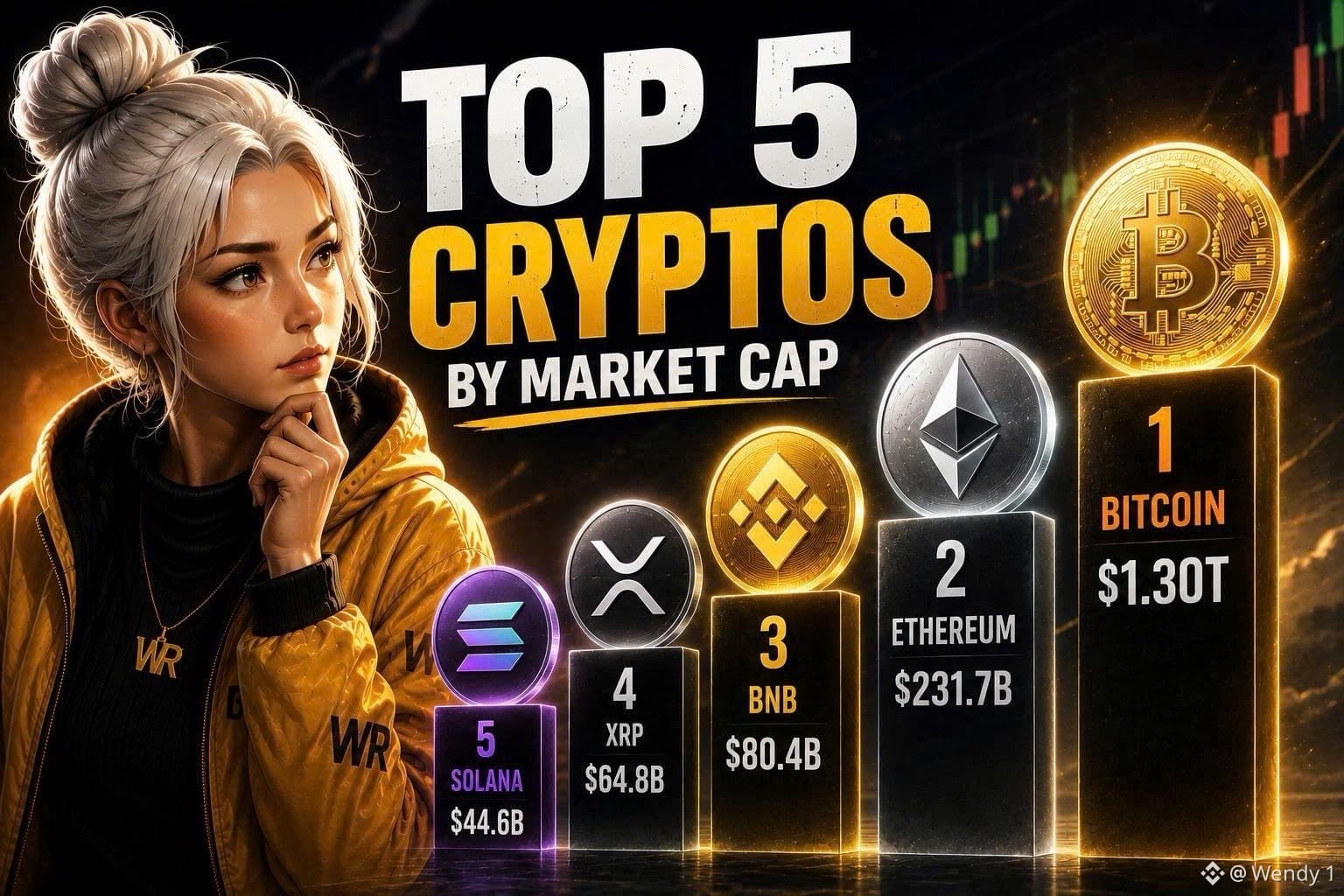
Los 5 criptoactivos principales por capitalización de mercado ahora mismo
La brecha entre los criptoactivos más grandes sigue siendo bastante amplia.
Estos son los cinco primeros actuales por capitalización de mercado:
🟠 Bitcoin: $1.30T
⚪ Ethereum: $231.7B
🟡 BNB: $80.4B
⚫ XRP: $64.8B
🟣 Solana: $44.6B
Bitcoin sigue estando en una liga aparte.
Su capitalización de mercado ya es más de 5 veces la de Ethereum, mientras que ETH tiene una ventaja considerable sobre el resto del top cinco.
La carrera más cerrada está más abajo en la lista.
BNB ocupa actualmente el tercer lugar con $80.4B, seguido por XRP con $64.8B y Solana con $44.6B.
Estas clasificaciones pueden cambiar rápidamente. La capitalización de mercado se mueve con el precio, y un cambio relativamente pequeño en los activos más grandes puede reajustar el orden por debajo de ellos.
La pregunta interesante no es solo quién está hoy en el top cinco.
Sino qué activo podría subir más rápido desde aquí.
Las cifras de capitalización de mercado se proporcionan en los datos de la fuente.
#Bitcoin #Ethereum #BNB #XRP
Los 5 criptoactivos principales por capitalización de mercado ahora mismo
La brecha entre los criptoactivos más grandes sigue siendo bastante amplia.
Estos son los cinco primeros actuales por capitalización de mercado:
🟠 Bitcoin: $1.30T
⚪ Ethereum: $231.7B
🟡 BNB: $80.4B
⚫ XRP: $64.8B
🟣 Solana: $44.6B
Bitcoin sigue estando en una liga aparte.
Su capitalización de mercado ya es más de 5 veces la de Ethereum, mientras que ETH tiene una ventaja considerable sobre el resto del top cinco.
La carrera más cerrada está más abajo en la lista.
BNB ocupa actualmente el tercer lugar con $80.4B, seguido por XRP con $64.8B y Solana con $44.6B.
Estas clasificaciones pueden cambiar rápidamente. La capitalización de mercado se mueve con el precio, y un cambio relativamente pequeño en los activos más grandes puede reajustar el orden por debajo de ellos.
La pregunta interesante no es solo quién está hoy en el top cinco.
Sino qué activo podría subir más rápido desde aquí.
Las cifras de capitalización de mercado se proporcionan en los datos de la fuente.
#Bitcoin #Ethereum #BNB #XRP
La brecha entre los criptoactivos más grandes sigue siendo bastante amplia.
Estos son los cinco primeros actuales por capitalización de mercado:
🟠 Bitcoin: $1.30T
⚪ Ethereum: $231.7B
🟡 BNB: $80.4B
⚫ XRP: $64.8B
🟣 Solana: $44.6B
Bitcoin sigue estando en una liga aparte.
Su capitalización de mercado ya es más de 5 veces la de Ethereum, mientras que ETH tiene una ventaja considerable sobre el resto del top cinco.
La carrera más cerrada está más abajo en la lista.
BNB ocupa actualmente el tercer lugar con $80.4B, seguido por XRP con $64.8B y Solana con $44.6B.
Estas clasificaciones pueden cambiar rápidamente. La capitalización de mercado se mueve con el precio, y un cambio relativamente pequeño en los activos más grandes puede reajustar el orden por debajo de ellos.
La pregunta interesante no es solo quién está hoy en el top cinco.
Sino qué activo podría subir más rápido desde aquí.
Las cifras de capitalización de mercado se proporcionan en los datos de la fuente.
#Bitcoin #Ethereum #BNB #XRP
71
·
--
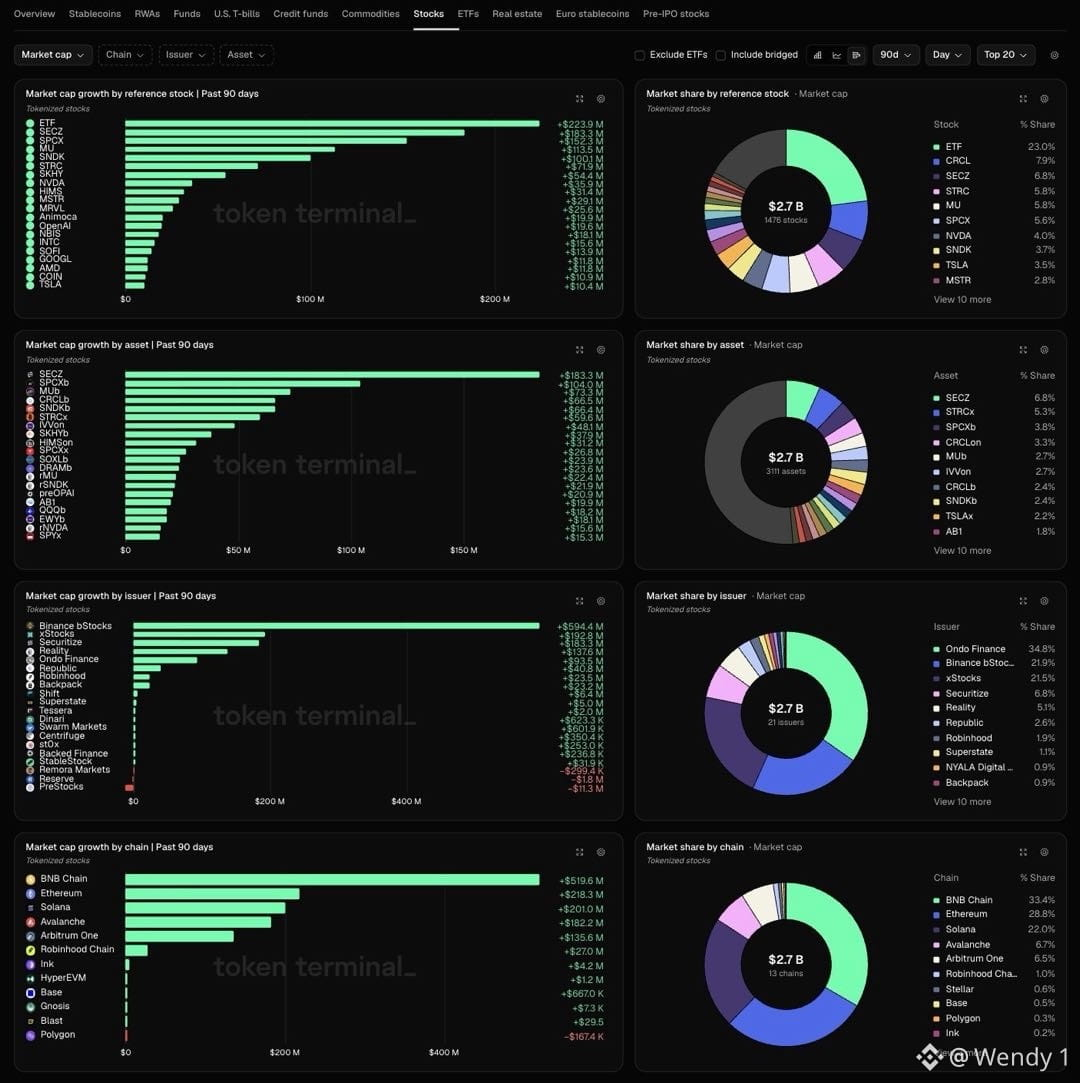
Binance bStocks Está Ganando Terreno en Acciones Tokenizadas
El mercado de acciones tokenizadas ha estado creciendo, pero la distribución de ese crecimiento empieza a resultar interesante.
Durante los últimos 90 días, Binance bStocks agregó $594.4 millones en capitalización de mercado, quedando muy por delante de varias otras plataformas importantes.
Para comparar:
* xStocks: +$192.8M
* Securitize: +$183.3M
* Reality: +$137.6M
Luego está el lado de blockchain.
BNB Chain añadió $519.6 millones en capitalización de mercado de acciones tokenizadas en el mismo período.
Ethereum agregó $218.3M, mientras que Solana añadió $201.0M.
Esa brecha es difícil de ignorar.
Sugiere que el crecimiento de las acciones tokenizadas no está ocurriendo de manera uniforme en todas las cadenas. Binance bStocks está ganando capitalización de mercado con rapidez, mientras que BNB Chain también está captando una gran parte del crecimiento entre las redes que se monitorean aquí.
Para mí, la pregunta interesante no es solo si las acciones tokenizadas seguirán creciendo.
Sino dónde se asentará ese crecimiento.
Si más emisores y usuarios continúan eligiendo BNB Chain, la competencia en acciones tokenizadas podría eventualmente centrarse tanto en la liquidez y la distribución como en las propias acciones.
Fuente: Token Terminal.
Binance bStocks Está Ganando Terreno en Acciones Tokenizadas
El mercado de acciones tokenizadas ha estado creciendo, pero la distribución de ese crecimiento empieza a resultar interesante.
Durante los últimos 90 días, Binance bStocks agregó $594.4 millones en capitalización de mercado, quedando muy por delante de varias otras plataformas importantes.
Para comparar:
* xStocks: +$192.8M
* Securitize: +$183.3M
* Reality: +$137.6M
Luego está el lado de blockchain.
BNB Chain añadió $519.6 millones en capitalización de mercado de acciones tokenizadas en el mismo período.
Ethereum agregó $218.3M, mientras que Solana añadió $201.0M.
Esa brecha es difícil de ignorar.
Sugiere que el crecimiento de las acciones tokenizadas no está ocurriendo de manera uniforme en todas las cadenas. Binance bStocks está ganando capitalización de mercado con rapidez, mientras que BNB Chain también está captando una gran parte del crecimiento entre las redes que se monitorean aquí.
Para mí, la pregunta interesante no es solo si las acciones tokenizadas seguirán creciendo.
Sino dónde se asentará ese crecimiento.
Si más emisores y usuarios continúan eligiendo BNB Chain, la competencia en acciones tokenizadas podría eventualmente centrarse tanto en la liquidez y la distribución como en las propias acciones.
Fuente: Token Terminal.
El mercado de acciones tokenizadas ha estado creciendo, pero la distribución de ese crecimiento empieza a resultar interesante.
Durante los últimos 90 días, Binance bStocks agregó $594.4 millones en capitalización de mercado, quedando muy por delante de varias otras plataformas importantes.
Para comparar:
* xStocks: +$192.8M
* Securitize: +$183.3M
* Reality: +$137.6M
Luego está el lado de blockchain.
BNB Chain añadió $519.6 millones en capitalización de mercado de acciones tokenizadas en el mismo período.
Ethereum agregó $218.3M, mientras que Solana añadió $201.0M.
Esa brecha es difícil de ignorar.
Sugiere que el crecimiento de las acciones tokenizadas no está ocurriendo de manera uniforme en todas las cadenas. Binance bStocks está ganando capitalización de mercado con rapidez, mientras que BNB Chain también está captando una gran parte del crecimiento entre las redes que se monitorean aquí.
Para mí, la pregunta interesante no es solo si las acciones tokenizadas seguirán creciendo.
Sino dónde se asentará ese crecimiento.
Si más emisores y usuarios continúan eligiendo BNB Chain, la competencia en acciones tokenizadas podría eventualmente centrarse tanto en la liquidez y la distribución como en las propias acciones.
Fuente: Token Terminal.
52
·
--
X Está Cambiando la Forma en que los Creadores Ganan. Ahora Importa Más el Contenido Original. X ha presentado su Programa de Recompensas por Contenido Original, mientras cierra la inscripción nueva para el programa existente de Revenue Sharing. A primera vista, esto parece otra actualización de monetización para creadores. Creo que el cambio más importante está en lo que X realmente intenta recompensar. El nuevo programa da más peso a ideas originales, análisis, informes, experiencia, comentarios, creatividad y perspectiva personal. Simplemente volver a publicar el contenido de otra persona y agregar un subtítulo corto no es suficiente. Esa distinción importa. X específicamente dice que las ediciones menores, los resúmenes descriptivos, la atribución, las superposiciones de texto simples o las reacciones de bajo valor, en general, no cuentan como una transformación significativa. Si el valor principal aún proviene del contenido de otra persona, la publicación puede no calificar como original. Para creadores que quieran calificar, los requisitos principales incluyen: • Al menos 500 seguidores verificados • Al menos 500,000 impresiones en la Home Timeline de usuarios verificados en los últimos 90 días • Una suscripción de X Premium, Premium+ o Premium Business • Una cuenta Personal o Business en buen estado • Publicar regularmente contenido original Los creadores elegibles ganan a partir de impresiones calificadas, que son impresiones únicas de usuarios Premium en la Home Timeline donde al menos el 50% de la publicación es visible. Los pagos se programan cada dos semanas. También hay un cambio claro para los creadores existentes de Revenue Sharing. Las ganancias de Revenue Sharing continúan hasta el 7 de septiembre de 2026, con acceso para solicitar Recompensas por Contenido Original que se implementará a partir del 8 de septiembre. Pero la parte que encuentro más útil es mucho más simple: Antes de publicar, pregúntate qué es lo que realmente estás aportando. Si la publicación sería igual de valiosa sin tu contribución, probablemente todavía no hay suficiente perspectiva propia en ella. Eso cambia un poco el juego para los creadores. El objetivo ya no es solo encontrar algo en lo que la gente vaya a hacer clic. Necesitas darles una razón para quedarse por tu punto de vista.
X Está Cambiando la Forma en que los Creadores Ganan. Ahora Importa Más el Contenido Original. X ha presentado su Programa de Recompensas por Contenido Original, mientras cierra la inscripción nueva para el programa existente de Revenue Sharing. A primera vista, esto parece otra actualización de monetización para creadores. Creo que el cambio más importante está en lo que X realmente intenta recompensar. El nuevo programa da más peso a ideas originales, análisis, informes, experiencia, comentarios, creatividad y perspectiva personal. Simplemente volver a publicar el contenido de otra persona y agregar un subtítulo corto no es suficiente. Esa distinción importa. X específicamente dice que las ediciones menores, los resúmenes descriptivos, la atribución, las superposiciones de texto simples o las reacciones de bajo valor, en general, no cuentan como una transformación significativa. Si el valor principal aún proviene del contenido de otra persona, la publicación puede no calificar como original. Para creadores que quieran calificar, los requisitos principales incluyen: • Al menos 500 seguidores verificados • Al menos 500,000 impresiones en la Home Timeline de usuarios verificados en los últimos 90 días • Una suscripción de X Premium, Premium+ o Premium Business • Una cuenta Personal o Business en buen estado • Publicar regularmente contenido original Los creadores elegibles ganan a partir de impresiones calificadas, que son impresiones únicas de usuarios Premium en la Home Timeline donde al menos el 50% de la publicación es visible. Los pagos se programan cada dos semanas. También hay un cambio claro para los creadores existentes de Revenue Sharing. Las ganancias de Revenue Sharing continúan hasta el 7 de septiembre de 2026, con acceso para solicitar Recompensas por Contenido Original que se implementará a partir del 8 de septiembre. Pero la parte que encuentro más útil es mucho más simple: Antes de publicar, pregúntate qué es lo que realmente estás aportando. Si la publicación sería igual de valiosa sin tu contribución, probablemente todavía no hay suficiente perspectiva propia en ella. Eso cambia un poco el juego para los creadores. El objetivo ya no es solo encontrar algo en lo que la gente vaya a hacer clic. Necesitas darles una razón para quedarse por tu punto de vista.
72
·
--
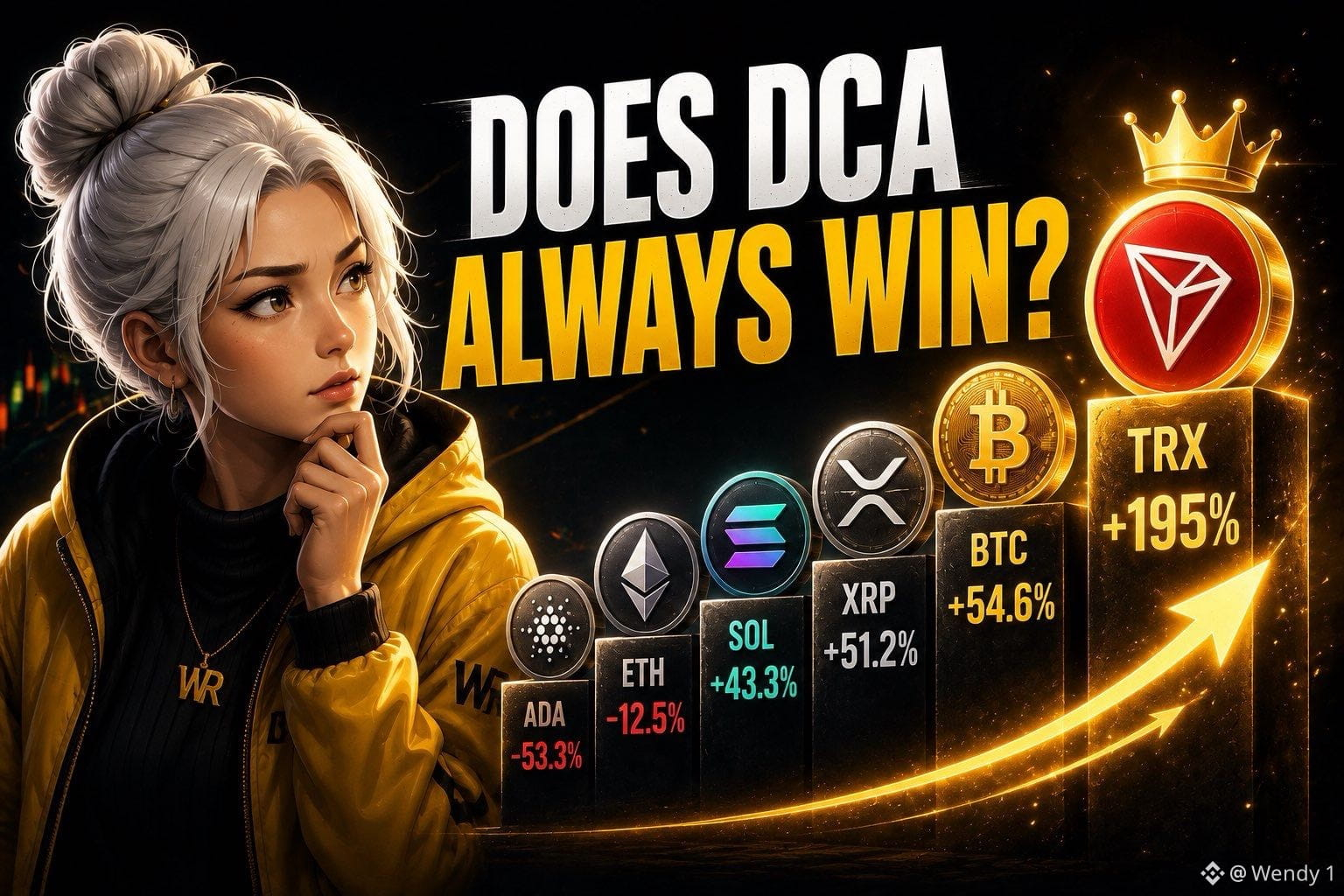
¿El DCA siempre gana? Estos resultados dicen lo contrario.
El promedio del costo en dólares (DCA) es una de las estrategias de inversión más populares en cripto, pero tu elección de activo sigue importando.
Suponiendo que invertiste $100 cada mes de 2022 a agosto de 2026, tu inversión total sería de $5,600.
Los resultados habrían sido muy diferentes según el activo.
Rendimiento
* $TRX: $16,521 (+195.0%)
* $BTC: $8,660 (+54.6%)
* $XRP: $8,465 (+51.2%)
* $SOL: $8,025 (+43.3%)
* $ETH: $4,898 (−12.5%)
* $ADA: $2,616 (−53.3%)
La constancia supera la volatilidad
El mejor desempeño es $TRX, que casi triplicó el capital invertido gracias a compras mensuales constantes.
$BTC, $XRP y $SOL también generaron rendimientos positivos, a pesar de haber atravesado múltiples correcciones durante el período.
Mientras tanto, $ETH y $ADA recuerdan a los inversionistas que el DCA no elimina el riesgo específico de cada activo. Invertir de forma constante en un activo con bajo rendimiento aún puede producir resultados negativos a lo largo de varios años.
La lección
El DCA reduce el impacto de intentar acertar el momento del mercado, pero no garantiza ganancias.
El éxito a largo plazo aún depende de elegir activos que sigan creando valor, atrayendo usuarios y manteniendo la demanda del mercado con el tiempo.
Una estrategia disciplinada importa, pero también importa lo que estás comprando.
¿El DCA siempre gana? Estos resultados dicen lo contrario.
El promedio del costo en dólares (DCA) es una de las estrategias de inversión más populares en cripto, pero tu elección de activo sigue importando.
Suponiendo que invertiste $100 cada mes de 2022 a agosto de 2026, tu inversión total sería de $5,600.
Los resultados habrían sido muy diferentes según el activo.
Rendimiento
* $TRX: $16,521 (+195.0%)
* $BTC: $8,660 (+54.6%)
* $XRP: $8,465 (+51.2%)
* $SOL: $8,025 (+43.3%)
* $ETH: $4,898 (−12.5%)
* $ADA: $2,616 (−53.3%)
La constancia supera la volatilidad
El mejor desempeño es $TRX, que casi triplicó el capital invertido gracias a compras mensuales constantes.
$BTC, $XRP y $SOL también generaron rendimientos positivos, a pesar de haber atravesado múltiples correcciones durante el período.
Mientras tanto, $ETH y $ADA recuerdan a los inversionistas que el DCA no elimina el riesgo específico de cada activo. Invertir de forma constante en un activo con bajo rendimiento aún puede producir resultados negativos a lo largo de varios años.
La lección
El DCA reduce el impacto de intentar acertar el momento del mercado, pero no garantiza ganancias.
El éxito a largo plazo aún depende de elegir activos que sigan creando valor, atrayendo usuarios y manteniendo la demanda del mercado con el tiempo.
Una estrategia disciplinada importa, pero también importa lo que estás comprando.
El promedio del costo en dólares (DCA) es una de las estrategias de inversión más populares en cripto, pero tu elección de activo sigue importando.
Suponiendo que invertiste $100 cada mes de 2022 a agosto de 2026, tu inversión total sería de $5,600.
Los resultados habrían sido muy diferentes según el activo.
Rendimiento
* $TRX: $16,521 (+195.0%)
* $BTC: $8,660 (+54.6%)
* $XRP: $8,465 (+51.2%)
* $SOL: $8,025 (+43.3%)
* $ETH: $4,898 (−12.5%)
* $ADA: $2,616 (−53.3%)
La constancia supera la volatilidad
El mejor desempeño es $TRX, que casi triplicó el capital invertido gracias a compras mensuales constantes.
$BTC, $XRP y $SOL también generaron rendimientos positivos, a pesar de haber atravesado múltiples correcciones durante el período.
Mientras tanto, $ETH y $ADA recuerdan a los inversionistas que el DCA no elimina el riesgo específico de cada activo. Invertir de forma constante en un activo con bajo rendimiento aún puede producir resultados negativos a lo largo de varios años.
La lección
El DCA reduce el impacto de intentar acertar el momento del mercado, pero no garantiza ganancias.
El éxito a largo plazo aún depende de elegir activos que sigan creando valor, atrayendo usuarios y manteniendo la demanda del mercado con el tiempo.
Una estrategia disciplinada importa, pero también importa lo que estás comprando.
60
Inicia sesión para explorar más contenidos
Únete a usuarios globales de criptomonedas en Binance Square
⚡️ Obtén información útil y actualizada sobre criptos.
💬 Avalado por el mayor exchange de criptomonedas en el mundo.
👍 Descubre perspectivas reales de creadores verificados.
Email/número de teléfono
Temas populares
FedRateWatch
778,308 vistas
3,702 están debatiendo
Comparte y gana recompensas de tráfico en nuestra campaña de hashtag en tendencia
✨Tema: FOMC septiembre, ¿cuál será el próximo movimiento de la Fed?
👉Cómo unirte:
Publica una publicación breve o un artículo con el hashtag #FedRateWatch
Crea contenido basado en los siguientes enfoques:
- El CPI subyacente de agosto aumentó 0.3% mes a mes, y las probabilidades de una subida de 25 pb esta semana ahora están cerca del 90%. ¿Anticipas una subida de tasas esta semana? ¿Es algo puntual o el inicio de un ciclo de subidas más largo?
- Si la subida ocurre, ¿cómo se desarrolla para BTC, acciones tecnológicas y oro? ¿Alcista o bajista?
- ¿Cómo planeas operar a continuación? Comparte tu operación/tenencias de BTC, acciones u oro con nuestro widget para compartir operaciones.
⏰Periodo de la campaña:
- 2026-09-15 11:00 - 2026-09-17 3:00 UTC
🎁Recompensa:
- Las publicaciones que cumplan con las pautas anteriores y tengan más de 100 palabras serán revisadas y podrían recibir un impulso aleatorio de tráfico de 500 a 3,000 visitas. Recibirás una notificación de tu secretario/a de feed si tu publicación es seleccionada.
- Obtén la oportunidad de que tu artículo aparezca destacado en Binance Square Official
¿Necesitas ideas para tu publicación? Visita la página del tema #FedRateWatch o la Square Guide on How to Post for Better Reach.
Binance Square Official
·485 me gusta
·1.1M vistas
BitcoinFalls4%
225 vistas
44 están debatiendo
ArgentinaCommitsToOECDCryptoReportingBy2029
4,466 vistas
148 están debatiendo