
Crypto Fortress 1
1.6k Publicaciones

Crypto Fortress 1
Denunciar
Bloquear usuario
Crypto explorer | Building the decentralized future one block at a time | Insights on BTC, ETH, DeFi & beyond | Not financial advice.
0 Siguiendo
6 Seguidores
20 Me gusta
Publicaciones
Ver traducción
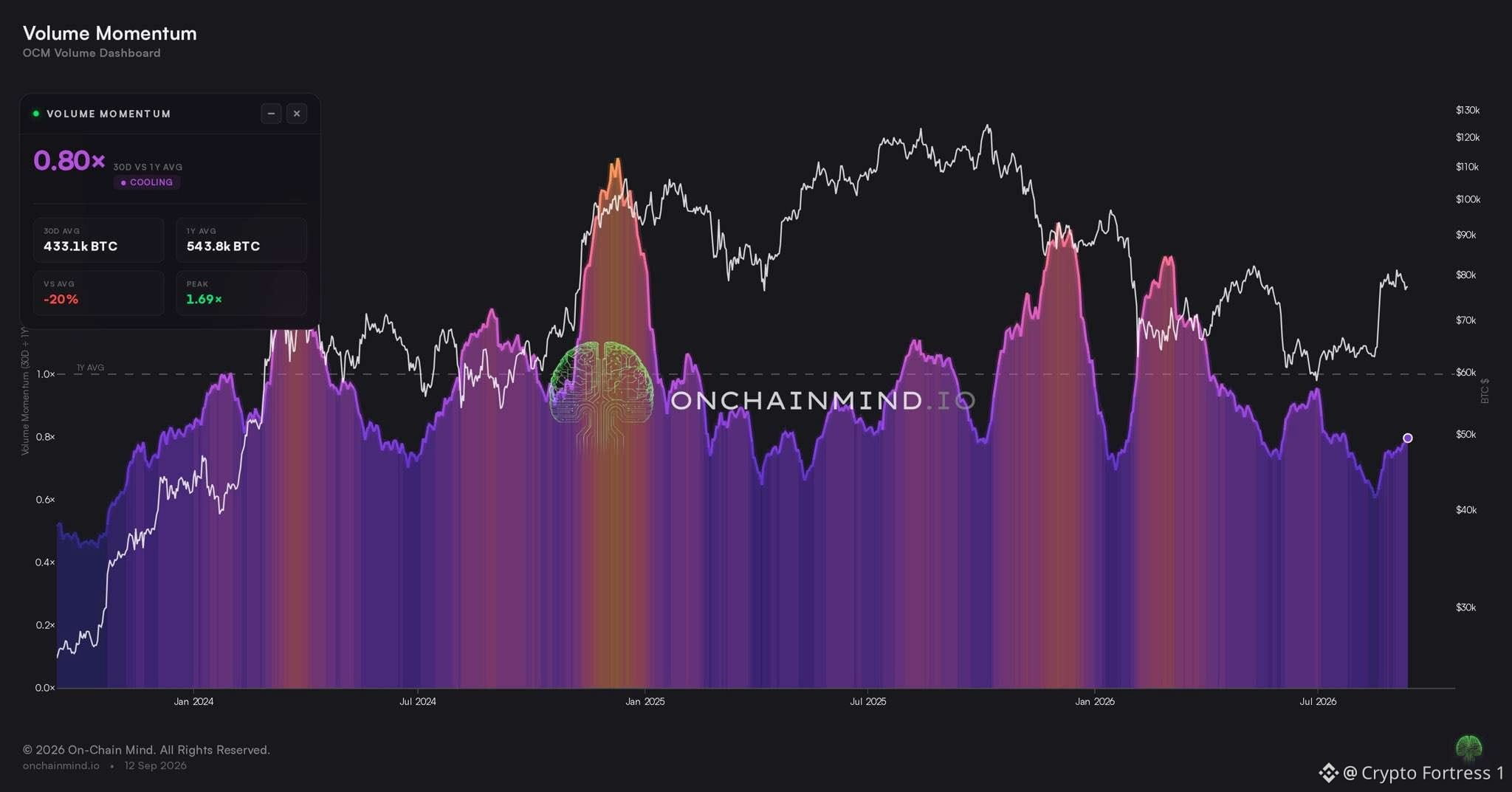
Bitcoin's 30-day avg volume is stuck at 433k $BTC, about 20% below the 1-year average of 543k
And we've now had four straight months of this thin trading even with price hovering near $77k. Daily USD volumes in the $25-37B range just confirm the lack of real participation right now. Personally I see this as classic consolidation; low volume often means the weak hands are already out and smarter money is quietly positioning. Feels like the calm before something bigger, whether up or a shakeout. $ETH
#BTC Price Analysis# #BTC
Bitcoin's 30-day avg volume is stuck at 433k $BTC, about 20% below the 1-year average of 543k
And we've now had four straight months of this thin trading even with price hovering near $77k. Daily USD volumes in the $25-37B range just confirm the lack of real participation right now. Personally I see this as classic consolidation; low volume often means the weak hands are already out and smarter money is quietly positioning. Feels like the calm before something bigger, whether up or a shakeout. $ETH
#BTC Price Analysis# #BTC
And we've now had four straight months of this thin trading even with price hovering near $77k. Daily USD volumes in the $25-37B range just confirm the lack of real participation right now. Personally I see this as classic consolidation; low volume often means the weak hands are already out and smarter money is quietly positioning. Feels like the calm before something bigger, whether up or a shakeout. $ETH
#BTC Price Analysis# #BTC
Ver traducción
Revolut's Breach Shows Why Crypto Privacy Can Fail Off-Chain
$BTC itself was not compromised. The more serious issue was the bridge between a public blockchain and verified customer identities: Revolut disclosed identity documents, residential details and Bitcoin transaction histories after accepting a fraudulent government data request as legitimate.
What failed:
1. The request looked authentic.
It came from an unauthorized mailbox inside a real government domain and passed SPF, DKIM and DMARC checks.
2. Revolut released the records.
Potentially exposed data included passports or driver's licenses, verification selfies, addresses, IBANs, account statements and complete transaction histories.
3. Public blockchain data amplified the exposure.
Once an attacker can associate a real person with known Bitcoin activity, those transactions may provide starting points for mapping a wider on-chain footprint.
No passwords, PINs, private keys or customer funds were reported compromised, and Revolut has not disclosed how many customers were affected. So this was not a conventional crypto hack.
It was an identity-layer failure and that distinction matters because blockchain security cannot protect users when the information connecting their real identity to on-chain activity leaks somewhere else.
#BTC Price Analysis# #Altcoin Season# #Bitcoin Price Prediction: What is Bitcoins next move?# #Ad #BTC
Revolut's Breach Shows Why Crypto Privacy Can Fail Off-Chain
$BTC itself was not compromised. The more serious issue was the bridge between a public blockchain and verified customer identities: Revolut disclosed identity documents, residential details and Bitcoin transaction histories after accepting a fraudulent government data request as legitimate.
What failed:
1. The request looked authentic.
It came from an unauthorized mailbox inside a real government domain and passed SPF, DKIM and DMARC checks.
2. Revolut released the records.
Potentially exposed data included passports or driver's licenses, verification selfies, addresses, IBANs, account statements and complete transaction histories.
3. Public blockchain data amplified the exposure.
Once an attacker can associate a real person with known Bitcoin activity, those transactions may provide starting points for mapping a wider on-chain footprint.
No passwords, PINs, private keys or customer funds were reported compromised, and Revolut has not disclosed how many customers were affected. So this was not a conventional crypto hack.
It was an identity-layer failure and that distinction matters because blockchain security cannot protect users when the information connecting their real identity to on-chain activity leaks somewhere else.
#BTC Price Analysis# #Altcoin Season# #Bitcoin Price Prediction: What is Bitcoins next move?# #Ad #BTC
$BTC itself was not compromised. The more serious issue was the bridge between a public blockchain and verified customer identities: Revolut disclosed identity documents, residential details and Bitcoin transaction histories after accepting a fraudulent government data request as legitimate.
What failed:
1. The request looked authentic.
It came from an unauthorized mailbox inside a real government domain and passed SPF, DKIM and DMARC checks.
2. Revolut released the records.
Potentially exposed data included passports or driver's licenses, verification selfies, addresses, IBANs, account statements and complete transaction histories.
3. Public blockchain data amplified the exposure.
Once an attacker can associate a real person with known Bitcoin activity, those transactions may provide starting points for mapping a wider on-chain footprint.
No passwords, PINs, private keys or customer funds were reported compromised, and Revolut has not disclosed how many customers were affected. So this was not a conventional crypto hack.
It was an identity-layer failure and that distinction matters because blockchain security cannot protect users when the information connecting their real identity to on-chain activity leaks somewhere else.
#BTC Price Analysis# #Altcoin Season# #Bitcoin Price Prediction: What is Bitcoins next move?# #Ad #BTC

Ver traducción
OpenAl is entering Wall Street territory with a new dedicated Al service for the financial sector.
Powered by their GPT-6 Astra model, the platform is built to streamline market research, analyze complex datasets and build financial models in real time. It looks like traditional research workflows are about to get a massive upgrade.
$BTC traders, drop your thoughts below
#BTC Price Analysis# #Macro Insights#
OpenAl is entering Wall Street territory with a new dedicated Al service for the financial sector.
Powered by their GPT-6 Astra model, the platform is built to streamline market research, analyze complex datasets and build financial models in real time. It looks like traditional research workflows are about to get a massive upgrade.
$BTC traders, drop your thoughts below
#BTC Price Analysis# #Macro Insights#
Powered by their GPT-6 Astra model, the platform is built to streamline market research, analyze complex datasets and build financial models in real time. It looks like traditional research workflows are about to get a massive upgrade.
$BTC traders, drop your thoughts below
#BTC Price Analysis# #Macro Insights#

Ver traducción
The Al Boom Has A Banking Problem
$TAO made machine intelligence one of crypto's biggest markets.
is betting the larger opportunity sits underneath it.
Everyone is focused on making Al agents smarter.
Far less attention is going toward the financial infrastructure those agents will need.
When millions of agents start buying services, managing resources and paying each other, traditional payment rails become painfully inefficient.
The network supporting that economy needs to handle activity at machine scale.
Sui has already demonstrated:
• More than 13 billion total transactions
• Typical settlement around 390 milliseconds
• A peak of 6,086,766 TPS during a public agent experiment
That TPS test used programmable tunnels which settle back to Sui mainnet.
The technology is already moving beyond theoretical benchmarks.
Sui is combining speed with verifiable ownership, atomic workflows and enforceable limits on agent spending.
I think the biggest Al opportunity in crypto may belong to the network that becomes its financial foundation.
The Sui team says larger breakthroughs are coming soon.
Its existing infrastructure gives that statement real weight.
#AI #Altcoin Season#
The Al Boom Has A Banking Problem
$TAO made machine intelligence one of crypto's biggest markets.
is betting the larger opportunity sits underneath it.
Everyone is focused on making Al agents smarter.
Far less attention is going toward the financial infrastructure those agents will need.
When millions of agents start buying services, managing resources and paying each other, traditional payment rails become painfully inefficient.
The network supporting that economy needs to handle activity at machine scale.
Sui has already demonstrated:
• More than 13 billion total transactions
• Typical settlement around 390 milliseconds
• A peak of 6,086,766 TPS during a public agent experiment
That TPS test used programmable tunnels which settle back to Sui mainnet.
The technology is already moving beyond theoretical benchmarks.
Sui is combining speed with verifiable ownership, atomic workflows and enforceable limits on agent spending.
I think the biggest Al opportunity in crypto may belong to the network that becomes its financial foundation.
The Sui team says larger breakthroughs are coming soon.
Its existing infrastructure gives that statement real weight.
#AI #Altcoin Season#
$TAO made machine intelligence one of crypto's biggest markets.
is betting the larger opportunity sits underneath it.
Everyone is focused on making Al agents smarter.
Far less attention is going toward the financial infrastructure those agents will need.
When millions of agents start buying services, managing resources and paying each other, traditional payment rails become painfully inefficient.
The network supporting that economy needs to handle activity at machine scale.
Sui has already demonstrated:
• More than 13 billion total transactions
• Typical settlement around 390 milliseconds
• A peak of 6,086,766 TPS during a public agent experiment
That TPS test used programmable tunnels which settle back to Sui mainnet.
The technology is already moving beyond theoretical benchmarks.
Sui is combining speed with verifiable ownership, atomic workflows and enforceable limits on agent spending.
I think the biggest Al opportunity in crypto may belong to the network that becomes its financial foundation.
The Sui team says larger breakthroughs are coming soon.
Its existing infrastructure gives that statement real weight.
#AI #Altcoin Season#
Ver traducción
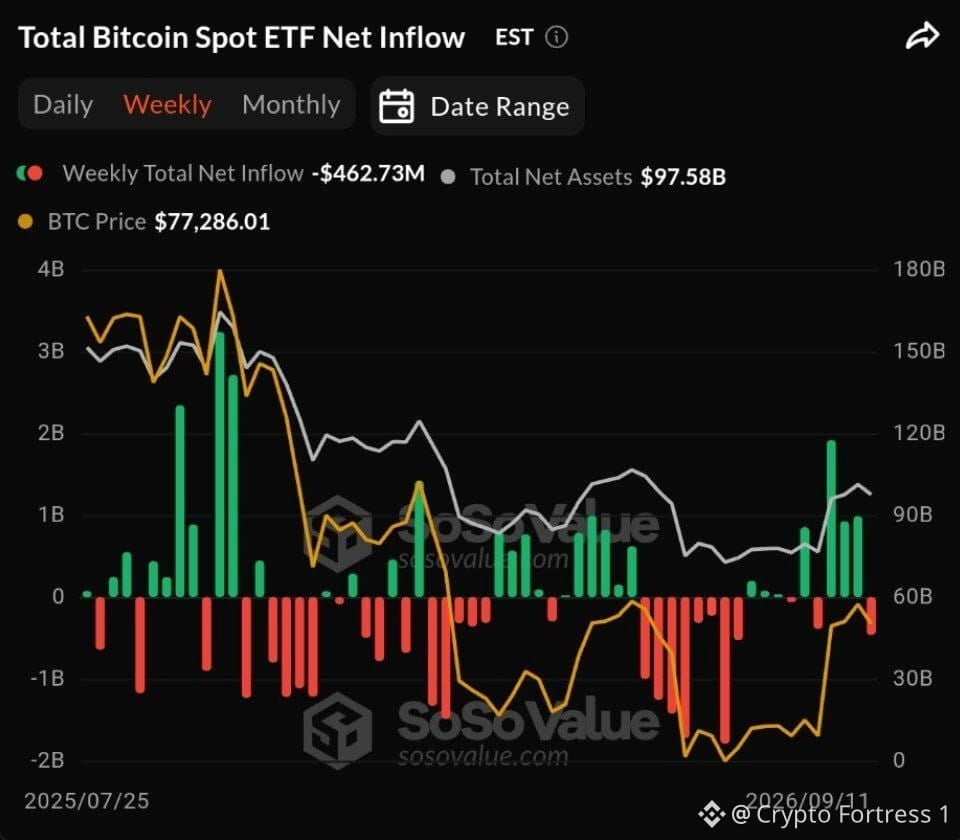
U.S. spot $BTC ETFs have recorded three straight days of net outflows, with roughly $450 million leaving the funds between September 8 and 10.
This comes after a strong three-week period that brought about $3.8 billion into U.S. spot Bitcoin ETFs, making the recent withdrawals worth watching as a shift in short-term demand.
For me, the bigger clue is whether this becomes a longer trend or simply a short pause in institutional buying.
Broader U.S. markets have also faced pressure from rising oil prices, inflation concerns and changing expectations around Federal Reserve policy, creating a more cautious environment for risk assets.
Bitcoin is currently trading around the $77,000 area, so sustained ETF inflows could become an important confirmation for the next major move.
#ETFsOnFire #BitcoinETFs #Macro Insights#
U.S. spot $BTC ETFs have recorded three straight days of net outflows, with roughly $450 million leaving the funds between September 8 and 10.
This comes after a strong three-week period that brought about $3.8 billion into U.S. spot Bitcoin ETFs, making the recent withdrawals worth watching as a shift in short-term demand.
For me, the bigger clue is whether this becomes a longer trend or simply a short pause in institutional buying.
Broader U.S. markets have also faced pressure from rising oil prices, inflation concerns and changing expectations around Federal Reserve policy, creating a more cautious environment for risk assets.
Bitcoin is currently trading around the $77,000 area, so sustained ETF inflows could become an important confirmation for the next major move.
#ETFsOnFire #BitcoinETFs #Macro Insights#
This comes after a strong three-week period that brought about $3.8 billion into U.S. spot Bitcoin ETFs, making the recent withdrawals worth watching as a shift in short-term demand.
For me, the bigger clue is whether this becomes a longer trend or simply a short pause in institutional buying.
Broader U.S. markets have also faced pressure from rising oil prices, inflation concerns and changing expectations around Federal Reserve policy, creating a more cautious environment for risk assets.
Bitcoin is currently trading around the $77,000 area, so sustained ETF inflows could become an important confirmation for the next major move.
#ETFsOnFire #BitcoinETFs #Macro Insights#
Ver traducción
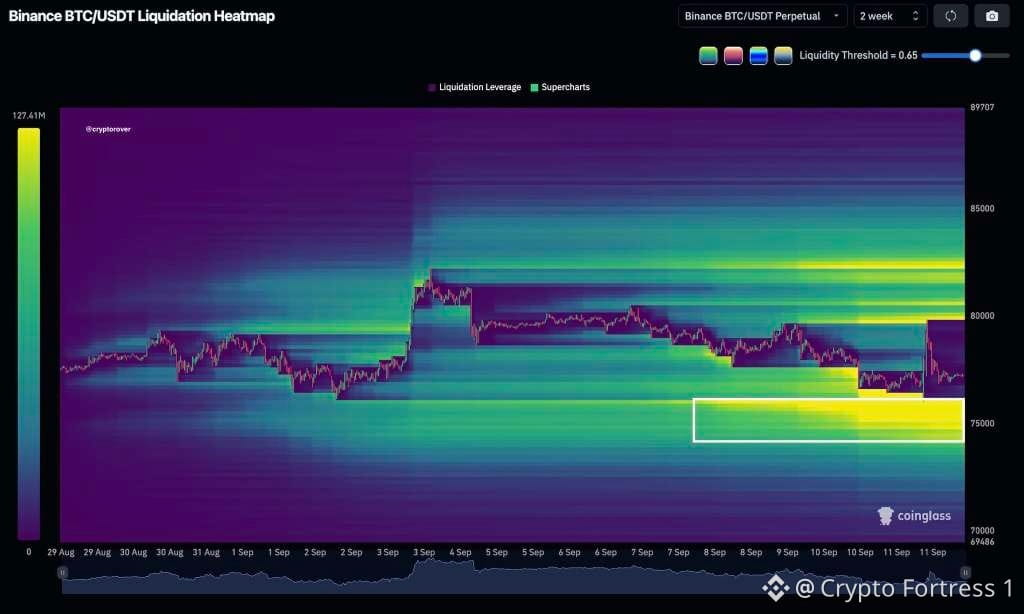
Most of the upside liquidity has already been swept.
That changes the short-term setup for BTC.
When price clears a large amount of liquidity above the market, the easy upside fuel can start drying up. From here, Bitcoin may need fresh spot demand to push meaningfully higher instead of simply continuing to squeeze shorts.
That doesn't mean a reversal is guaranteed.
It means the next move becomes more dependent on real buying pressure and how BTC reacts around key resistance.
After the recent volatility, I'm watching whether buyers can keep absorbing supply.
The liquidity has been taken. Now we see if demand is still there.
#BTC Price Analysis# #BTC Above 60K#
$BTC $ETH
Most of the upside liquidity has already been swept.
That changes the short-term setup for BTC.
When price clears a large amount of liquidity above the market, the easy upside fuel can start drying up. From here, Bitcoin may need fresh spot demand to push meaningfully higher instead of simply continuing to squeeze shorts.
That doesn't mean a reversal is guaranteed.
It means the next move becomes more dependent on real buying pressure and how BTC reacts around key resistance.
After the recent volatility, I'm watching whether buyers can keep absorbing supply.
The liquidity has been taken. Now we see if demand is still there.
#BTC Price Analysis# #BTC Above 60K#
$BTC $ETH
That changes the short-term setup for BTC.
When price clears a large amount of liquidity above the market, the easy upside fuel can start drying up. From here, Bitcoin may need fresh spot demand to push meaningfully higher instead of simply continuing to squeeze shorts.
That doesn't mean a reversal is guaranteed.
It means the next move becomes more dependent on real buying pressure and how BTC reacts around key resistance.
After the recent volatility, I'm watching whether buyers can keep absorbing supply.
The liquidity has been taken. Now we see if demand is still there.
#BTC Price Analysis# #BTC Above 60K#
$BTC $ETH
Ver traducción
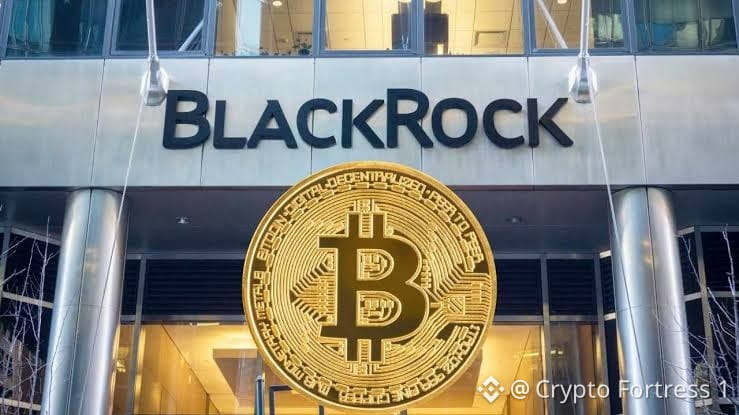
BlackRock's ETH fund really has scooped up about $251 million in $ETH over the last 20 trading days with zero outflows, which is solid institutional buying even while the price chops around.
That doesn't mean Wall Street is ditching $BTC for ETH though, Bitcoin ETFs still dwarf the ETH ones in total size and remain the core "digital gold" allocation for most big players. I think they're just adding ETH exposure for the staking yields and its role as the actual settlement layer for tokenization stuff BlackRock itself is pushing. Smart money is treating them as complementary, not choosing one over the other.
#BTC Price Analysis# #BTC
BlackRock's ETH fund really has scooped up about $251 million in $ETH over the last 20 trading days with zero outflows, which is solid institutional buying even while the price chops around.
That doesn't mean Wall Street is ditching $BTC for ETH though, Bitcoin ETFs still dwarf the ETH ones in total size and remain the core "digital gold" allocation for most big players. I think they're just adding ETH exposure for the staking yields and its role as the actual settlement layer for tokenization stuff BlackRock itself is pushing. Smart money is treating them as complementary, not choosing one over the other.
#BTC Price Analysis# #BTC
That doesn't mean Wall Street is ditching $BTC for ETH though, Bitcoin ETFs still dwarf the ETH ones in total size and remain the core "digital gold" allocation for most big players. I think they're just adding ETH exposure for the staking yields and its role as the actual settlement layer for tokenization stuff BlackRock itself is pushing. Smart money is treating them as complementary, not choosing one over the other.
#BTC Price Analysis# #BTC
24
Ver traducción
$ZEC mining currently generates about four times more revenue per megawatt-hour than bitcoin mining.
$BTC miners bring in roughly $35 million a day in rewards, compared with about $2 million for Zcash miners overall.
On a per-machine basis, though, the gap looks more striking: a typical Zcash mining rig reportedly earns around twice the daily revenue of a comparable bitcoin machine.
#BTC #Zcash #Bitcoin #ZEC #Macro Insights#
$ZEC mining currently generates about four times more revenue per megawatt-hour than bitcoin mining.
$BTC miners bring in roughly $35 million a day in rewards, compared with about $2 million for Zcash miners overall.
On a per-machine basis, though, the gap looks more striking: a typical Zcash mining rig reportedly earns around twice the daily revenue of a comparable bitcoin machine.
#BTC #Zcash #Bitcoin #ZEC #Macro Insights#
$BTC miners bring in roughly $35 million a day in rewards, compared with about $2 million for Zcash miners overall.
On a per-machine basis, though, the gap looks more striking: a typical Zcash mining rig reportedly earns around twice the daily revenue of a comparable bitcoin machine.
#BTC #Zcash #Bitcoin #ZEC #Macro Insights#
23
Los últimos comentarios de Coinbase sobre la Ley de Claridad muestran que la industria cripto se está preparando para múltiples vías regulatorias. Incluso si el Congreso no avanza, la empresa ve posibles rutas a través de la SEC y la CFTC.
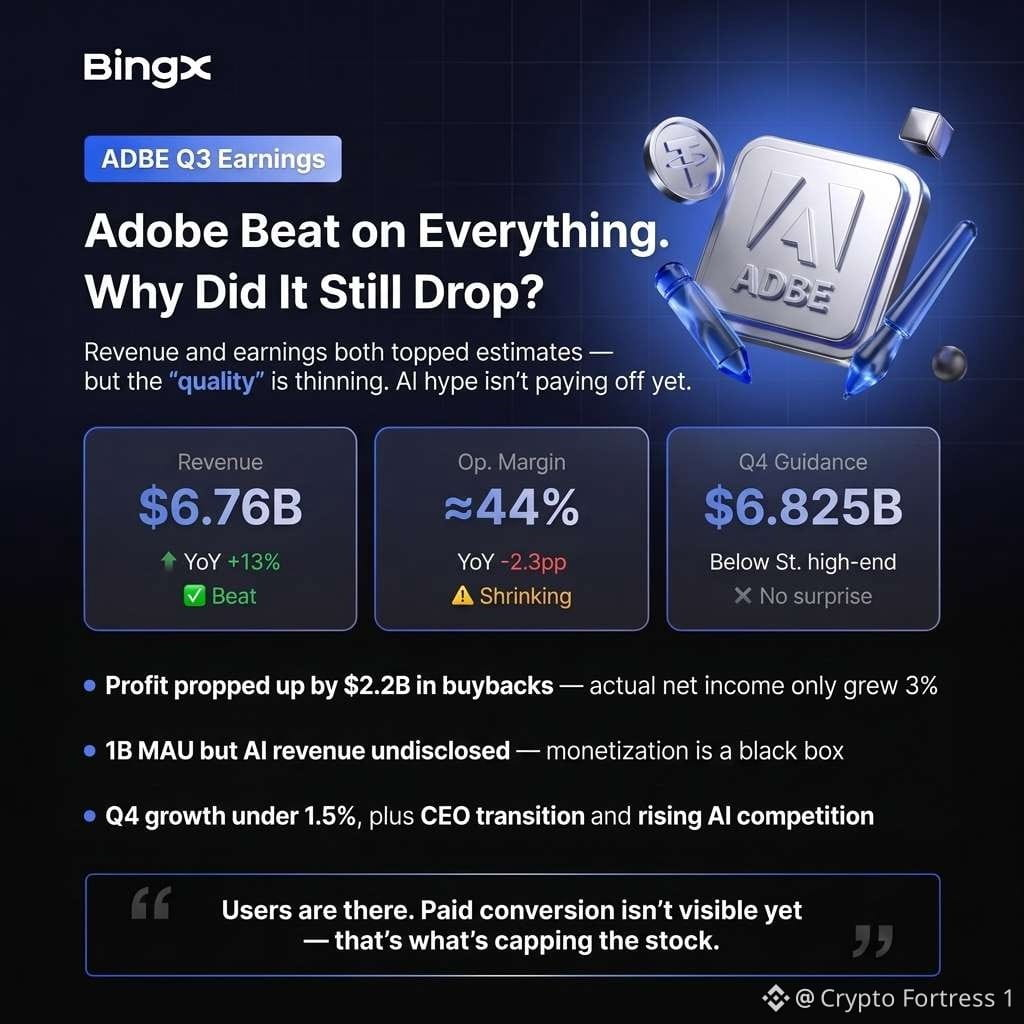
Esa mayor incertidumbre regulatoria vale la pena observarla junto con el sólido desempeño del Q3 de Adobe. Los ingresos alcanzaron $6.76B, un 13% más interanual, mientras que el ARR con IA-first se disparó por encima del 150% y los usuarios activos mensuales superaron los 1B.
Para los inversores, la pregunta más grande sigue siendo la monetización para Adobe y la claridad regulatoria para el cripto. Con $BTC también estrechamente vinculado al entorno de políticas, ambas historias resaltan cómo las expectativas pueden moldear el sentimiento del mercado.
#CMC Quest: Earn Rewards# #BTC Price Analysis# #Macro Insights#
Los últimos comentarios de Coinbase sobre la Ley de Claridad muestran que la industria cripto se está preparando para múltiples vías regulatorias. Incluso si el Congreso no avanza, la empresa ve posibles rutas a través de la SEC y la CFTC.
Esa mayor incertidumbre regulatoria vale la pena observarla junto con el sólido desempeño del Q3 de Adobe. Los ingresos alcanzaron $6.76B, un 13% más interanual, mientras que el ARR con IA-first se disparó por encima del 150% y los usuarios activos mensuales superaron los 1B.
Para los inversores, la pregunta más grande sigue siendo la monetización para Adobe y la claridad regulatoria para el cripto. Con $BTC también estrechamente vinculado al entorno de políticas, ambas historias resaltan cómo las expectativas pueden moldear el sentimiento del mercado.
#CMC Quest: Earn Rewards# #BTC Price Analysis# #Macro Insights#
Esa mayor incertidumbre regulatoria vale la pena observarla junto con el sólido desempeño del Q3 de Adobe. Los ingresos alcanzaron $6.76B, un 13% más interanual, mientras que el ARR con IA-first se disparó por encima del 150% y los usuarios activos mensuales superaron los 1B.
Para los inversores, la pregunta más grande sigue siendo la monetización para Adobe y la claridad regulatoria para el cripto. Con $BTC también estrechamente vinculado al entorno de políticas, ambas historias resaltan cómo las expectativas pueden moldear el sentimiento del mercado.
#CMC Quest: Earn Rewards# #BTC Price Analysis# #Macro Insights#

42
Ver traducción
RWA MARKET IS MOVING: Tokenized
equity trading volume surged 33x to $7.9B in August.
According to Binance Research, monthly trading volume for tokenized equities exploded to $7.9 billion, showing just how quickly onchain versions of traditional stocks are gaining traction.
But the market is still highly concentrated. bStocks and Robinhood accounted for 87.8% of tracked volume, meaning a large share of this growth is being driven by just two platforms.
That concentration is worth watching.
If more issuers and networks start attracting liquidity, tokenized equities could move from a niche product into a much broader RWA market.
$7.9B in one month is no longer just a narrative. Traders are actually using it.
#BTC Price Analysis# #BNB Chain# $BNB $ETH
RWA MARKET IS MOVING: Tokenized
equity trading volume surged 33x to $7.9B in August.
According to Binance Research, monthly trading volume for tokenized equities exploded to $7.9 billion, showing just how quickly onchain versions of traditional stocks are gaining traction.
But the market is still highly concentrated. bStocks and Robinhood accounted for 87.8% of tracked volume, meaning a large share of this growth is being driven by just two platforms.
That concentration is worth watching.
If more issuers and networks start attracting liquidity, tokenized equities could move from a niche product into a much broader RWA market.
$7.9B in one month is no longer just a narrative. Traders are actually using it.
#BTC Price Analysis# #BNB Chain# $BNB $ETH
equity trading volume surged 33x to $7.9B in August.
According to Binance Research, monthly trading volume for tokenized equities exploded to $7.9 billion, showing just how quickly onchain versions of traditional stocks are gaining traction.
But the market is still highly concentrated. bStocks and Robinhood accounted for 87.8% of tracked volume, meaning a large share of this growth is being driven by just two platforms.
That concentration is worth watching.
If more issuers and networks start attracting liquidity, tokenized equities could move from a niche product into a much broader RWA market.
$7.9B in one month is no longer just a narrative. Traders are actually using it.
#BTC Price Analysis# #BNB Chain# $BNB $ETH


46
Ver traducción
Blockstream is refusing to "pay a ransom" for the 598.5 $BTC still held by the attackers after the Liquid exploit.
3,400 BTC was returned after Blockstream confirmed the affected bridge nodes were patched.
But roughly $47M is still sitting with the people who exploited the bug.
And honestly, this is where the whole "white hat" label gets complicated.
If there was no agreement that allowed the attackers to keep a portion of the funds, what exactly is the $47M?
A bounty? A negotiation? Or simply money they decided to keep after exploiting the system?
Blockstream's position is clear: Bitcoin can't just be minted to make the loss disappear, and users shouldn't have to take the haircut.
Now they're going after the remaining funds work with law enforcement, exchanges and forensic specialists to trace the remaining funds if they are not returned.
The exploit may be patched, but the most interesting part of this story might be what
happens to those 598.5 $BTC next.
Withdrawals to the Bitcoin network still remain disabled.
Blockstream is refusing to "pay a ransom" for the 598.5 $BTC still held by the attackers after the Liquid exploit.
3,400 BTC was returned after Blockstream confirmed the affected bridge nodes were patched.
But roughly $47M is still sitting with the people who exploited the bug.
And honestly, this is where the whole "white hat" label gets complicated.
If there was no agreement that allowed the attackers to keep a portion of the funds, what exactly is the $47M?
A bounty? A negotiation? Or simply money they decided to keep after exploiting the system?
Blockstream's position is clear: Bitcoin can't just be minted to make the loss disappear, and users shouldn't have to take the haircut.
Now they're going after the remaining funds work with law enforcement, exchanges and forensic specialists to trace the remaining funds if they are not returned.
The exploit may be patched, but the most interesting part of this story might be what
happens to those 598.5 $BTC next.
Withdrawals to the Bitcoin network still remain disabled.
3,400 BTC was returned after Blockstream confirmed the affected bridge nodes were patched.
But roughly $47M is still sitting with the people who exploited the bug.
And honestly, this is where the whole "white hat" label gets complicated.
If there was no agreement that allowed the attackers to keep a portion of the funds, what exactly is the $47M?
A bounty? A negotiation? Or simply money they decided to keep after exploiting the system?
Blockstream's position is clear: Bitcoin can't just be minted to make the loss disappear, and users shouldn't have to take the haircut.
Now they're going after the remaining funds work with law enforcement, exchanges and forensic specialists to trace the remaining funds if they are not returned.
The exploit may be patched, but the most interesting part of this story might be what
happens to those 598.5 $BTC next.
Withdrawals to the Bitcoin network still remain disabled.

46
Ver traducción
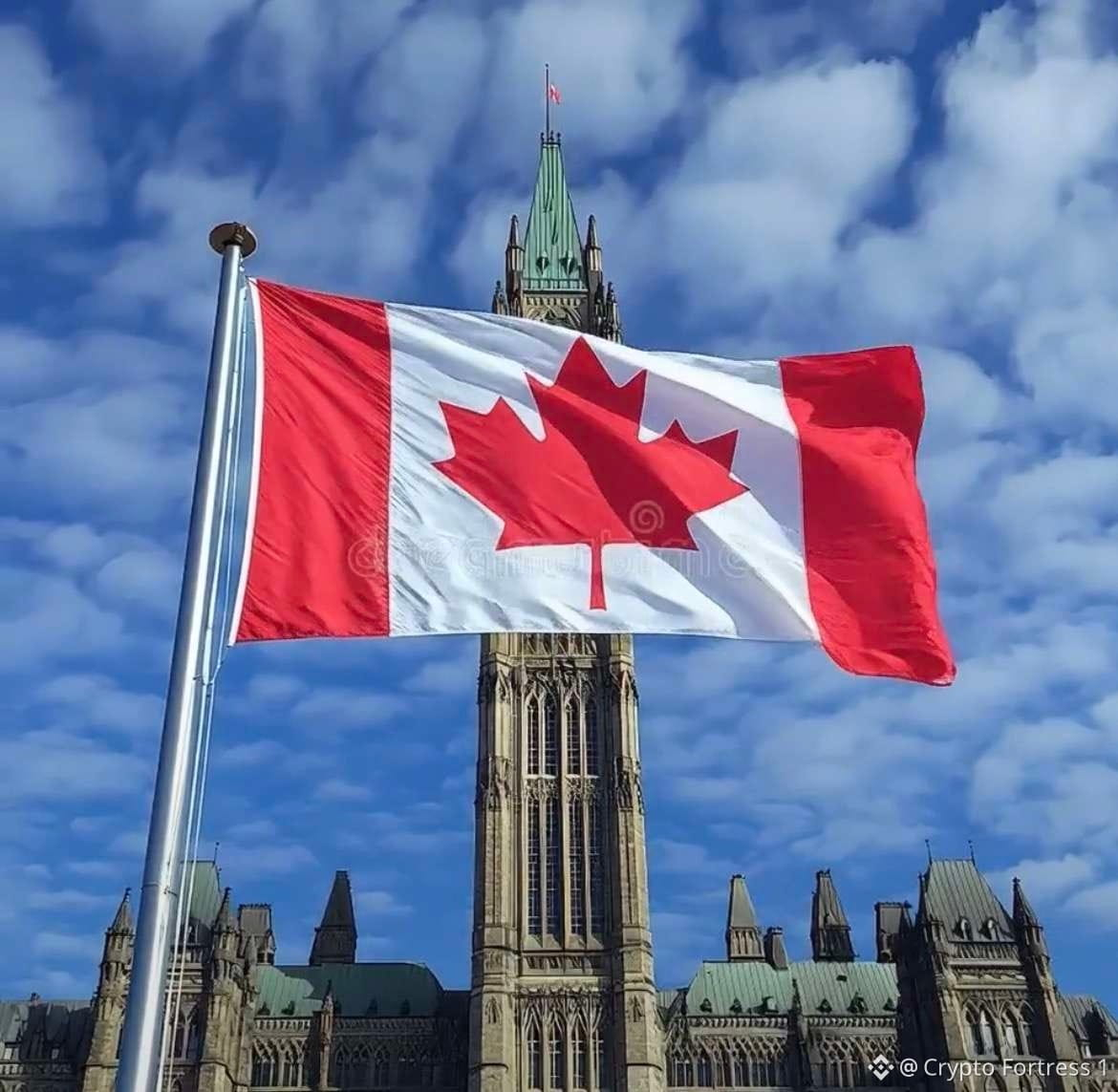
BREAKING: 🇨🇦 CANADA JUST APPROVED
BANKS TO OFFER ON-CHAIN #BITCOIN $BTC AND CRYPTO DEPOSITS
BANKS ARE GOING ALL IN ON BTC
THIS IS HUGE
BREAKING: 🇨🇦 CANADA JUST APPROVED
BANKS TO OFFER ON-CHAIN #BITCOIN $BTC AND CRYPTO DEPOSITS
BANKS ARE GOING ALL IN ON BTC
THIS IS HUGE
BANKS TO OFFER ON-CHAIN #BITCOIN $BTC AND CRYPTO DEPOSITS
BANKS ARE GOING ALL IN ON BTC
THIS IS HUGE
2
Ver traducción
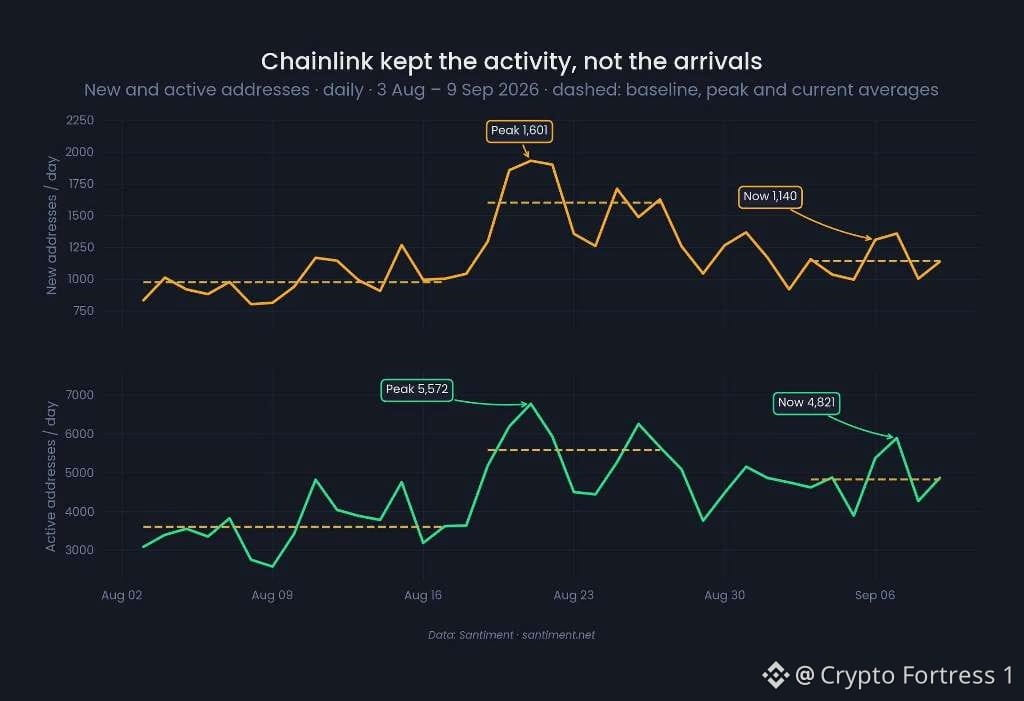
Chainlink's new daily addresses have settled at 1,140 after peaking at 1,601 in late August.
Active addresses remain strong at 4,821, holding most of the recent growth and outperforming $SOL and $ETH.
Sustained onchain activity points to growing network engagement.
#Altcoin Season#
Chainlink's new daily addresses have settled at 1,140 after peaking at 1,601 in late August.
Active addresses remain strong at 4,821, holding most of the recent growth and outperforming $SOL and $ETH.
Sustained onchain activity points to growing network engagement.
#Altcoin Season#
Active addresses remain strong at 4,821, holding most of the recent growth and outperforming $SOL and $ETH.
Sustained onchain activity points to growing network engagement.
#Altcoin Season#
2
Ver traducción
The Coinbase Premium Index of $BTC turns negative, which indicates that demand from US-based participants is weakening or that they are actively selling Bitcoin.
#Bitcoin #BTC
The Coinbase Premium Index of $BTC turns negative, which indicates that demand from US-based participants is weakening or that they are actively selling Bitcoin.
#Bitcoin #BTC
#Bitcoin #BTC
2
Día del IPC vs. decisión de la Fed: el panorama macro al que se enfrenta el cripto
Si bien el $BTC sigue siendo sensible a cada titular macro, el informe de IPC de agosto de hoy podría decidir el siguiente movimiento del mercado. Se espera que la inflación general se mantenga en 3,4% interanual, pero la tasa mensual podría subir a 0,38% desde apenas 0,07% en julio. Con la decisión de la Fed a solo unos días, incluso una pequeña sorpresa podría mover rápidamente las acciones, los rendimientos y el cripto.
El escenario de inflación y la Fed:
- Presión energética: Se espera que los precios de la energía se recuperen alrededor de 2,5% MoM, y que la gasolina potencialmente suba más de 4%. Esa es la principal razón por la que el IPC general podría acelerarse en términos mensuales.
- Enfriamiento del núcleo: El IPC subyacente se prevé en 2,4% YoY, por debajo de 2,5%, mientras que la lectura mensual se espera que se mantenga alrededor de 0,22%. La inflación de vivienda y la inflación médica muestran señales de enfriamiento.
- Vigilancia de la Fed: Un dato de IPC más caliente de lo esperado podría fortalecer el argumento a favor de una política más restrictiva, mientras que un número más suave haría más probable que la Fed mantenga y daría soporte a los activos de riesgo.
El número clave es 3,4%. Un dato por debajo de ese nivel podría traer alivio tanto al cripto como a las acciones, mientras que cualquier cifra por encima de lo esperado podría empujar los rendimientos al alza y volver a presionar los mercados. Una lectura en línea mantendría a los traders enfocados en la inflación subyacente y dejaría la decisión de la Fed firmemente a cargo del próximo movimiento.
#Análisis del precio de $BTC#
#Perspectivas macro#
Día del IPC vs. decisión de la Fed: el panorama macro al que se enfrenta el cripto
Si bien el $BTC sigue siendo sensible a cada titular macro, el informe de IPC de agosto de hoy podría decidir el siguiente movimiento del mercado. Se espera que la inflación general se mantenga en 3,4% interanual, pero la tasa mensual podría subir a 0,38% desde apenas 0,07% en julio. Con la decisión de la Fed a solo unos días, incluso una pequeña sorpresa podría mover rápidamente las acciones, los rendimientos y el cripto.
El escenario de inflación y la Fed:
- Presión energética: Se espera que los precios de la energía se recuperen alrededor de 2,5% MoM, y que la gasolina potencialmente suba más de 4%. Esa es la principal razón por la que el IPC general podría acelerarse en términos mensuales.
- Enfriamiento del núcleo: El IPC subyacente se prevé en 2,4% YoY, por debajo de 2,5%, mientras que la lectura mensual se espera que se mantenga alrededor de 0,22%. La inflación de vivienda y la inflación médica muestran señales de enfriamiento.
- Vigilancia de la Fed: Un dato de IPC más caliente de lo esperado podría fortalecer el argumento a favor de una política más restrictiva, mientras que un número más suave haría más probable que la Fed mantenga y daría soporte a los activos de riesgo.
El número clave es 3,4%. Un dato por debajo de ese nivel podría traer alivio tanto al cripto como a las acciones, mientras que cualquier cifra por encima de lo esperado podría empujar los rendimientos al alza y volver a presionar los mercados. Una lectura en línea mantendría a los traders enfocados en la inflación subyacente y dejaría la decisión de la Fed firmemente a cargo del próximo movimiento.
#Análisis del precio de $BTC#
#Perspectivas macro#
Si bien el $BTC sigue siendo sensible a cada titular macro, el informe de IPC de agosto de hoy podría decidir el siguiente movimiento del mercado. Se espera que la inflación general se mantenga en 3,4% interanual, pero la tasa mensual podría subir a 0,38% desde apenas 0,07% en julio. Con la decisión de la Fed a solo unos días, incluso una pequeña sorpresa podría mover rápidamente las acciones, los rendimientos y el cripto.
El escenario de inflación y la Fed:
- Presión energética: Se espera que los precios de la energía se recuperen alrededor de 2,5% MoM, y que la gasolina potencialmente suba más de 4%. Esa es la principal razón por la que el IPC general podría acelerarse en términos mensuales.
- Enfriamiento del núcleo: El IPC subyacente se prevé en 2,4% YoY, por debajo de 2,5%, mientras que la lectura mensual se espera que se mantenga alrededor de 0,22%. La inflación de vivienda y la inflación médica muestran señales de enfriamiento.
- Vigilancia de la Fed: Un dato de IPC más caliente de lo esperado podría fortalecer el argumento a favor de una política más restrictiva, mientras que un número más suave haría más probable que la Fed mantenga y daría soporte a los activos de riesgo.
El número clave es 3,4%. Un dato por debajo de ese nivel podría traer alivio tanto al cripto como a las acciones, mientras que cualquier cifra por encima de lo esperado podría empujar los rendimientos al alza y volver a presionar los mercados. Una lectura en línea mantendría a los traders enfocados en la inflación subyacente y dejaría la decisión de la Fed firmemente a cargo del próximo movimiento.
#Análisis del precio de $BTC#
#Perspectivas macro#

3
Ver traducción
Could $XRP Really Reach $15-$50?
David Schwartz Just Put the Flippening Debate Back in Focus!
Ripple CTO David Schwartz says XRP could eventually overtake $BTC in market value through its own growth, not because Bitcoin collapses. Analyst Zach Rector ran the numbers, and the implied XRP prices get big very quickly.
At a $1.5 trillion valuation, XRP would sit near $23.91 based on today's circulating supply, or around $15 using the full 100 billion token supply. If Bitcoin's market cap eventually reaches $3-$5 trillion and XRP scales with it, Rector's bullish scenario puts XRP above $50.
#XRP #XRPLedger
#BTC Price Analysis#
Could $XRP Really Reach $15-$50?
David Schwartz Just Put the Flippening Debate Back in Focus!
Ripple CTO David Schwartz says XRP could eventually overtake $BTC in market value through its own growth, not because Bitcoin collapses. Analyst Zach Rector ran the numbers, and the implied XRP prices get big very quickly.
At a $1.5 trillion valuation, XRP would sit near $23.91 based on today's circulating supply, or around $15 using the full 100 billion token supply. If Bitcoin's market cap eventually reaches $3-$5 trillion and XRP scales with it, Rector's bullish scenario puts XRP above $50.
#XRP #XRPLedger
#BTC Price Analysis#
David Schwartz Just Put the Flippening Debate Back in Focus!
Ripple CTO David Schwartz says XRP could eventually overtake $BTC in market value through its own growth, not because Bitcoin collapses. Analyst Zach Rector ran the numbers, and the implied XRP prices get big very quickly.
At a $1.5 trillion valuation, XRP would sit near $23.91 based on today's circulating supply, or around $15 using the full 100 billion token supply. If Bitcoin's market cap eventually reaches $3-$5 trillion and XRP scales with it, Rector's bullish scenario puts XRP above $50.
#XRP #XRPLedger
#BTC Price Analysis#
1
Ver traducción
Bitcoin ETFs and Ethereum ETFs Record $312.6 Million in Outflows
$BTC spot ETFs recorded $282.70 million in ouflows, while $ETH spot ETFs recorded $29.90 million in outflows.
#Bitcoin #Ethereum
Bitcoin ETFs and Ethereum ETFs Record $312.6 Million in Outflows
$BTC spot ETFs recorded $282.70 million in ouflows, while $ETH spot ETFs recorded $29.90 million in outflows.
#Bitcoin #Ethereum
$BTC spot ETFs recorded $282.70 million in ouflows, while $ETH spot ETFs recorded $29.90 million in outflows.
#Bitcoin #Ethereum
2
Ver traducción
263K Tokens in One Day: Solana's Launch Boom Has Changed Shape
$SOL just recorded 263,000 new token launches in a single day, the highest daily total reported for the network. What makes the record unusual is that this is not simply another memecoin wave: much of the activity is coming from "reflection" tokens linked to equities, crypto assets, NFTs and perpetual-futures positions.
What is driving the spike? StonkFun has recently overtaken Robinhood's Pons among competing launchpads, PumpFun has introduced custom pairs, and Meteora now allows liquidity pools between virtually any two Solana assets rather than requiring a stablecoin pair. Sunrise has also added 20+ tokenized stocks, giving launchers more real-world assets to build around.
There is an economic layer too. StonkFun reportedly directs $10,000 per $1M of trading volume toward token burns, while other platforms are experimenting with creator revenue sharing and holder distributions.
So 263K launches should not automatically be read as 263K successful new projects.
Many of these assets may disappear quickly, and the connection between a "reflection token" and the asset it references can vary significantly. But the record does show that Solana's token-creation machine is accelerating again - this time around a broader mix of speculation, RWA exposure and new liquidity structures rather than traditional memecoins alone.
#Altcoin Season# #Solana #Ad #SOL
263K Tokens in One Day: Solana's Launch Boom Has Changed Shape
$SOL just recorded 263,000 new token launches in a single day, the highest daily total reported for the network. What makes the record unusual is that this is not simply another memecoin wave: much of the activity is coming from "reflection" tokens linked to equities, crypto assets, NFTs and perpetual-futures positions.
What is driving the spike? StonkFun has recently overtaken Robinhood's Pons among competing launchpads, PumpFun has introduced custom pairs, and Meteora now allows liquidity pools between virtually any two Solana assets rather than requiring a stablecoin pair. Sunrise has also added 20+ tokenized stocks, giving launchers more real-world assets to build around.
There is an economic layer too. StonkFun reportedly directs $10,000 per $1M of trading volume toward token burns, while other platforms are experimenting with creator revenue sharing and holder distributions.
So 263K launches should not automatically be read as 263K successful new projects.
Many of these assets may disappear quickly, and the connection between a "reflection token" and the asset it references can vary significantly. But the record does show that Solana's token-creation machine is accelerating again - this time around a broader mix of speculation, RWA exposure and new liquidity structures rather than traditional memecoins alone.
#Altcoin Season# #Solana #Ad #SOL
$SOL just recorded 263,000 new token launches in a single day, the highest daily total reported for the network. What makes the record unusual is that this is not simply another memecoin wave: much of the activity is coming from "reflection" tokens linked to equities, crypto assets, NFTs and perpetual-futures positions.
What is driving the spike? StonkFun has recently overtaken Robinhood's Pons among competing launchpads, PumpFun has introduced custom pairs, and Meteora now allows liquidity pools between virtually any two Solana assets rather than requiring a stablecoin pair. Sunrise has also added 20+ tokenized stocks, giving launchers more real-world assets to build around.
There is an economic layer too. StonkFun reportedly directs $10,000 per $1M of trading volume toward token burns, while other platforms are experimenting with creator revenue sharing and holder distributions.
So 263K launches should not automatically be read as 263K successful new projects.
Many of these assets may disappear quickly, and the connection between a "reflection token" and the asset it references can vary significantly. But the record does show that Solana's token-creation machine is accelerating again - this time around a broader mix of speculation, RWA exposure and new liquidity structures rather than traditional memecoins alone.
#Altcoin Season# #Solana #Ad #SOL

Ver traducción
The iPhone Became a 15-Year Monetary Experiment!
Forget the "you should've bought $BTC instead of an iPhone" meme. Something stranger happened. In 2016, an iPhone 7 Plus cost roughly 1.23 $BTC. Today, the new $1,199 iPhone 18 Pro costs about 0.015 $BTC. Meanwhile, Apple just raised Pro pricing by $100. That creates a fascinating divergence:
The iPhone became more expensive in dollars while becoming ~99% cheaper in Bitcoin.
Same product category.
Two monetary rulers.
Opposite inflation signals.
And this is where $BTC becomes interesting beyond its USD chart. A currency tells you what something costs today. A monetary benchmark tells you whether your stored economic energy can command more or less of the future. For the last decade, measured in iPhones, Bitcoin's purchasing power didn't merely survive technological inflation. It swallowed it. The next experiment is simple:
Does the iPhone 28 cost 0.001 $BTC or does this relationship eventually break?
That chart may tell us more about Bitcoin as money than another $100K price target ever could.
#BTC Price Analysis# #Bitcoin Price Prediction: What is Bitcoins next move?#
The iPhone Became a 15-Year Monetary Experiment!
Forget the "you should've bought $BTC instead of an iPhone" meme. Something stranger happened. In 2016, an iPhone 7 Plus cost roughly 1.23 $BTC. Today, the new $1,199 iPhone 18 Pro costs about 0.015 $BTC. Meanwhile, Apple just raised Pro pricing by $100. That creates a fascinating divergence:
The iPhone became more expensive in dollars while becoming ~99% cheaper in Bitcoin.
Same product category.
Two monetary rulers.
Opposite inflation signals.
And this is where $BTC becomes interesting beyond its USD chart. A currency tells you what something costs today. A monetary benchmark tells you whether your stored economic energy can command more or less of the future. For the last decade, measured in iPhones, Bitcoin's purchasing power didn't merely survive technological inflation. It swallowed it. The next experiment is simple:
Does the iPhone 28 cost 0.001 $BTC or does this relationship eventually break?
That chart may tell us more about Bitcoin as money than another $100K price target ever could.
#BTC Price Analysis# #Bitcoin Price Prediction: What is Bitcoins next move?#
Forget the "you should've bought $BTC instead of an iPhone" meme. Something stranger happened. In 2016, an iPhone 7 Plus cost roughly 1.23 $BTC. Today, the new $1,199 iPhone 18 Pro costs about 0.015 $BTC. Meanwhile, Apple just raised Pro pricing by $100. That creates a fascinating divergence:
The iPhone became more expensive in dollars while becoming ~99% cheaper in Bitcoin.
Same product category.
Two monetary rulers.
Opposite inflation signals.
And this is where $BTC becomes interesting beyond its USD chart. A currency tells you what something costs today. A monetary benchmark tells you whether your stored economic energy can command more or less of the future. For the last decade, measured in iPhones, Bitcoin's purchasing power didn't merely survive technological inflation. It swallowed it. The next experiment is simple:
Does the iPhone 28 cost 0.001 $BTC or does this relationship eventually break?
That chart may tell us more about Bitcoin as money than another $100K price target ever could.
#BTC Price Analysis# #Bitcoin Price Prediction: What is Bitcoins next move?#

19
Ver traducción
$BTC
White House Executive Director Patrick Witt says substantial progress has been made in negotiations over the CLARITY Act.
Once the CLARITY Act is approved, it will mark the beginning of a new bull season.
#BTC Price Analysis# #Crypto
$BTC
White House Executive Director Patrick Witt says substantial progress has been made in negotiations over the CLARITY Act.
Once the CLARITY Act is approved, it will mark the beginning of a new bull season.
#BTC Price Analysis# #Crypto
White House Executive Director Patrick Witt says substantial progress has been made in negotiations over the CLARITY Act.
Once the CLARITY Act is approved, it will mark the beginning of a new bull season.
#BTC Price Analysis# #Crypto

24
Inicia sesión para explorar más contenidos
Únete a usuarios globales de criptomonedas en Binance Square
⚡️ Obtén información útil y actualizada sobre criptos.
💬 Avalado por el mayor exchange de criptomonedas en el mundo.
👍 Descubre perspectivas reales de creadores verificados.
Email/número de teléfono
Temas populares
ClarityActFacesProceduralVoteSept15
50,199 vistas
734 están debatiendo
El 15 de septiembre de 2026, el Senado de EE. UU. celebrará una votación procedural decisiva (cloture) para determinar si el CLARITY Act (H.R. 3633) puede avanzar a un debate formal en el pleno.
Esta votación, programada para las 2:15 p. m. (hora del este), requiere una supermayoría de 60 votos para superar el filibusterismo. Es importante destacar que no se trata de la votación final de aprobación de la ley, sino de un paso procesal para permitir la discusión y posibles enmiendas.
Puntos clave del contexto:
Origen del retraso: La votación fue pospuesta a septiembre porque los demócratas del Senado se negaron a permitir que el proyecto de ley llegara al pleno antes de la recesión de agosto.
Contenido de la ley: El CLARITY Act busca dividir la supervisión de los activos digitales entre la SEC y la CFTC, estableciendo un marco regulatorio federal para el mercado criptográfico.
Riesgos y plazos: Si la votación de clóture no alcanza los 60 votos, el proyecto de ley probablemente quede "muerto" para el año 2026. Incluso si se aprueba, el Senado tiene poco tiempo antes de las elecciones de medio término de noviembre de 2026, y la Cámara de Representantes ha cancelado sesiones de votación a finales de septiembre, lo que complica la aprobación final antes de que el proyecto llegue a la firma presidencial.
Presión política: La senadora Cynthia Lummis ha presionado a los demócratas para que apoyen la ley, argumentando que si no se aprueba en el actual Congreso, la próxima oportunidad real para una legislación de mercado criptográfico podría no llegar hasta 2030. #clarityactfacesproceduralvotesept15
PrzRmsJohnJr Square-Creator
·2 me gusta
·564 vistas
US2YearYieldRisesTo4.61%
36,274 vistas
684 están debatiendo
US10YearTreasuryYieldNears5%
22,193 vistas
403 están debatiendo