

Muzzamil Baig
1.2k Publicaciones

Muzzamil Baig
Denunciar
Bloquear usuario
🌐Sharing the Crypto Future knowledge 🚀
193 Siguiendo
1.2K+ Seguidores
450 Me gusta
Publicaciones
Todo
Live
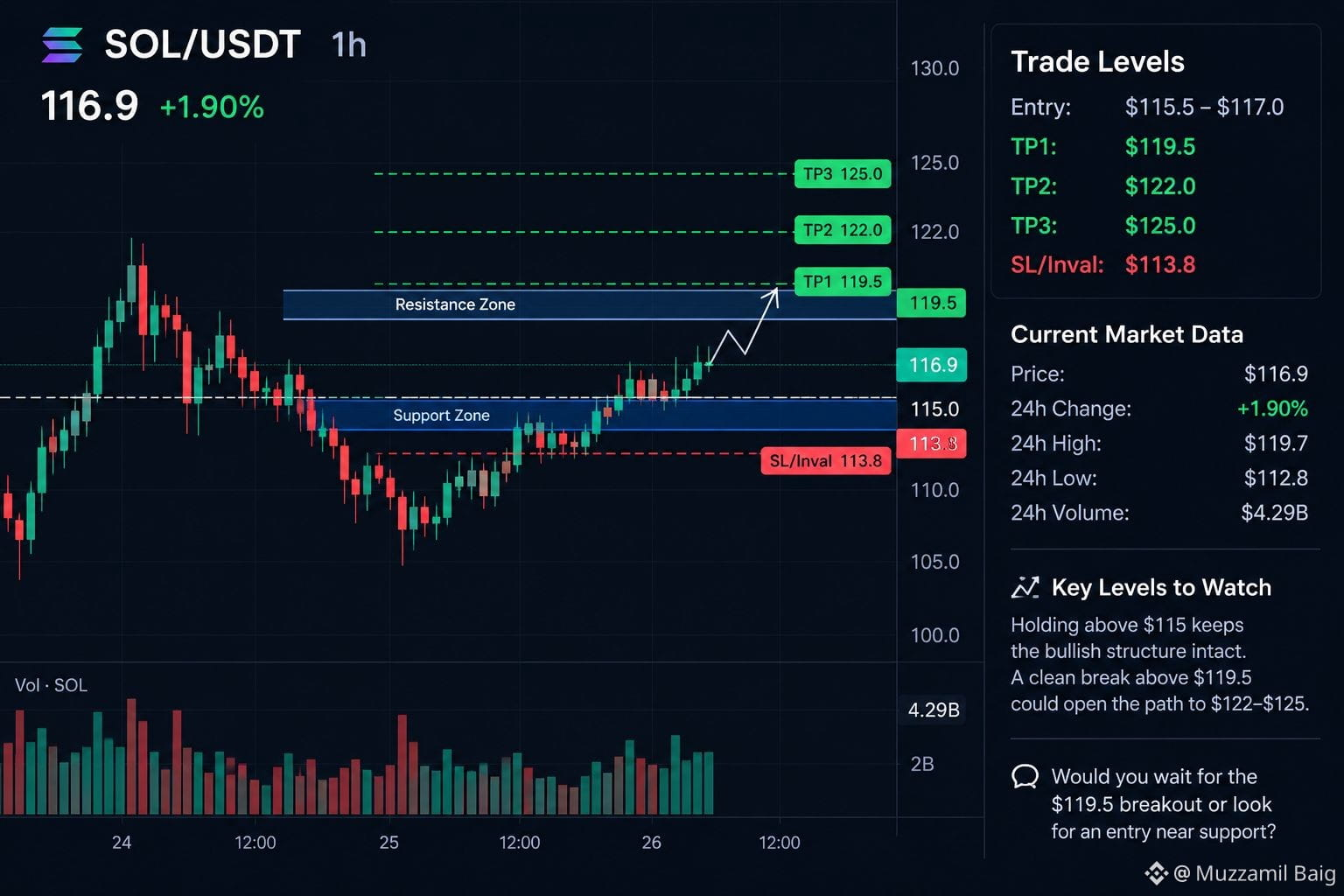
$SOL está sentado cerca de $116.9 después de recuperar el área de $115 y mantenerse por encima de ella.
Entrada: $115.5–$117.0
TP1: $119.5
TP2: $122
TP3: $125
SL/Inval: $113.8
Estoy observando el soporte de $115 y una ruptura limpia por encima de $119.5; el volumen debe mantenerse de forma favorable para la continuación.
¿Esperarías la ruptura de $119.5 o buscarías una entrada cerca del soporte?
{future}(SOLUSDT)
$SOL está sentado cerca de $116.9 después de recuperar el área de $115 y mantenerse por encima de ella.
Entrada: $115.5–$117.0
TP1: $119.5
TP2: $122
TP3: $125
SL/Inval: $113.8
Estoy observando el soporte de $115 y una ruptura limpia por encima de $119.5; el volumen debe mantenerse de forma favorable para la continuación.
¿Esperarías la ruptura de $119.5 o buscarías una entrada cerca del soporte?
Entrada: $115.5–$117.0
TP1: $119.5
TP2: $122
TP3: $125
SL/Inval: $113.8
Estoy observando el soporte de $115 y una ruptura limpia por encima de $119.5; el volumen debe mantenerse de forma favorable para la continuación.
¿Esperarías la ruptura de $119.5 o buscarías una entrada cerca del soporte?
78
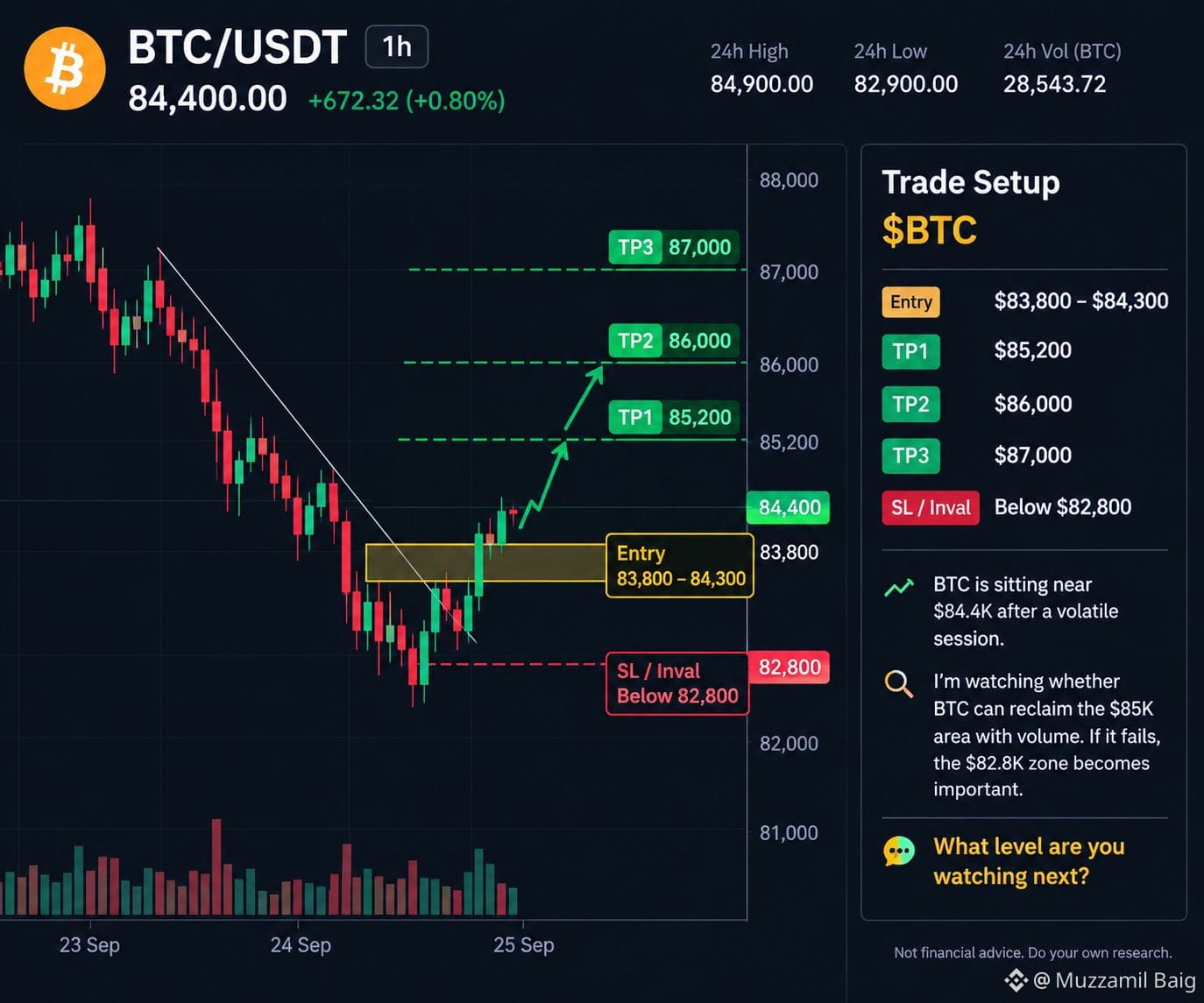
$BTC está sentado cerca de $84.4K tras una sesión volátil.
Entrada: $83,800–$84,300
TP1: $85,200
TP2: $86,000
TP3: $87,000
SL/Inval: Por debajo de $82,800
Estoy observando si BTC puede recuperar el área de $85K con volumen. Si falla, la zona de $82.8K se vuelve importante.
¿Qué nivel estás vigilando después?
{future}(BTCUSDT)
$BTC está sentado cerca de $84.4K tras una sesión volátil.
Entrada: $83,800–$84,300
TP1: $85,200
TP2: $86,000
TP3: $87,000
SL/Inval: Por debajo de $82,800
Estoy observando si BTC puede recuperar el área de $85K con volumen. Si falla, la zona de $82.8K se vuelve importante.
¿Qué nivel estás vigilando después?
Entrada: $83,800–$84,300
TP1: $85,200
TP2: $86,000
TP3: $87,000
SL/Inval: Por debajo de $82,800
Estoy observando si BTC puede recuperar el área de $85K con volumen. Si falla, la zona de $82.8K se vuelve importante.
¿Qué nivel estás vigilando después?
85
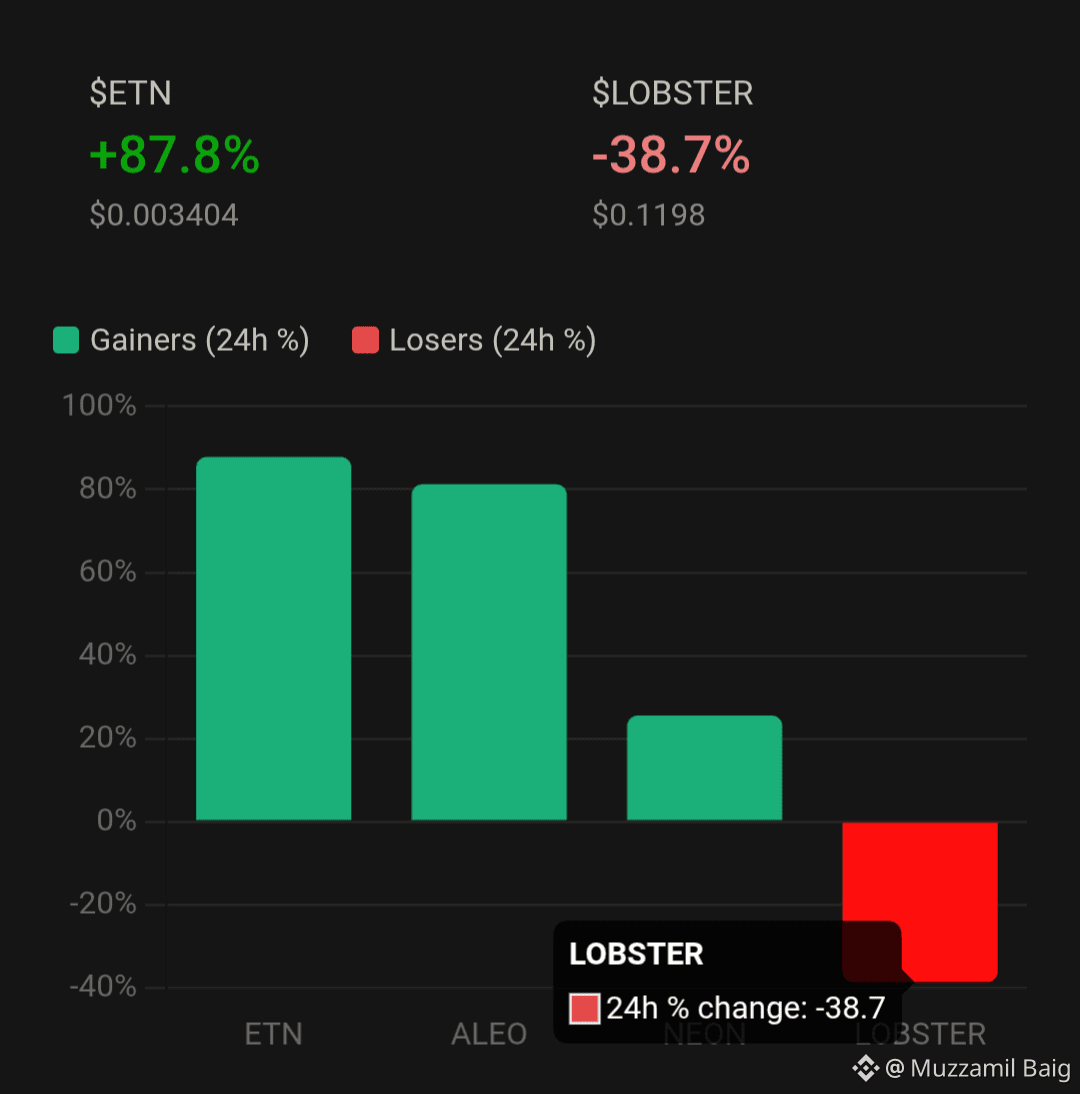
📈 $ETN.US (ETN) es el mejor activo de hoy, con +87.8% en las últimas 24h — ahora en $0.003404
📉 $LOB.US lidera a los perdedores, bajando -38.7%, cotizando a $0.1198
También en tendencia: $ALEO (+81.2%) y $NEON (+25.5%), mostrando un fuerte impulso hoy.
No es asesoramiento financiero, solo seguimiento de los movimientos del mercado de hoy. 📊
{stock_us}(ETN.US)
{stock_us}(LOB.US)
{alpha}(560x6cfffa5bfd4277a04d83307feedfe2d18d944dd2)
📈 $ETN.US (ETN) es el mejor activo de hoy, con +87.8% en las últimas 24h — ahora en $0.003404
📉 $LOB.US lidera a los perdedores, bajando -38.7%, cotizando a $0.1198
También en tendencia: $ALEO (+81.2%) y $NEON (+25.5%), mostrando un fuerte impulso hoy.
No es asesoramiento financiero, solo seguimiento de los movimientos del mercado de hoy. 📊
📉 $LOB.US lidera a los perdedores, bajando -38.7%, cotizando a $0.1198
También en tendencia: $ALEO (+81.2%) y $NEON (+25.5%), mostrando un fuerte impulso hoy.
No es asesoramiento financiero, solo seguimiento de los movimientos del mercado de hoy. 📊
217
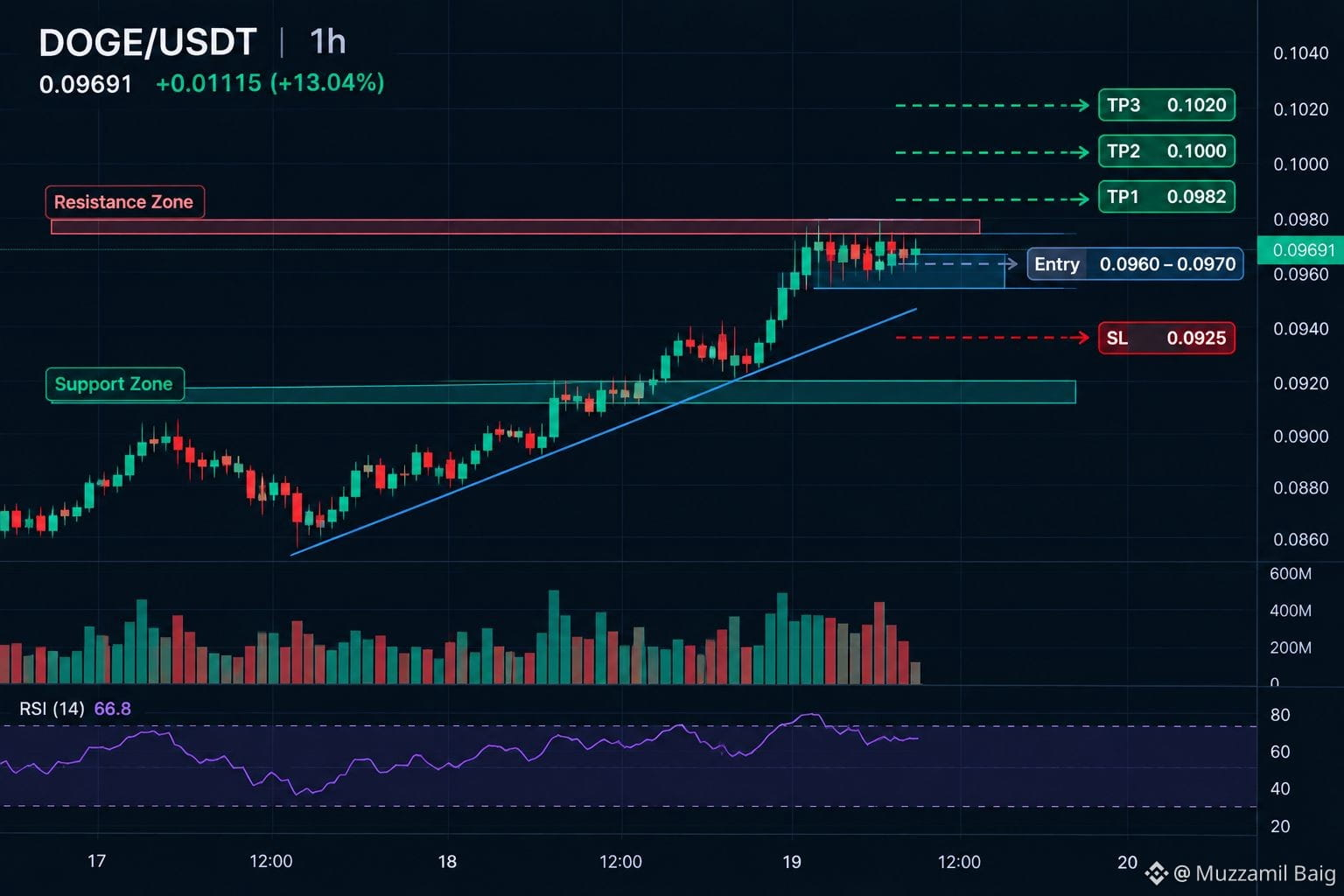
$DOGE está manteniéndose cerca de la resistencia de $0.098
Entrada: $0.0960–$0.0970
TP1: $0.0982
TP2: $0.1000
TP3: $0.1020
SL: $0.0925
El impulso es fuerte: importa la confirmación por encima de $0.0982.
**¿Puede $DOGE romper el máximo diario?**
$DOGE está manteniéndose cerca de la resistencia de $0.098
Entrada: $0.0960–$0.0970
TP1: $0.0982
TP2: $0.1000
TP3: $0.1020
SL: $0.0925
El impulso es fuerte: importa la confirmación por encima de $0.0982.
**¿Puede $DOGE romper el máximo diario?**
Entrada: $0.0960–$0.0970
TP1: $0.0982
TP2: $0.1000
TP3: $0.1020
SL: $0.0925
El impulso es fuerte: importa la confirmación por encima de $0.0982.
**¿Puede $DOGE romper el máximo diario?**
95
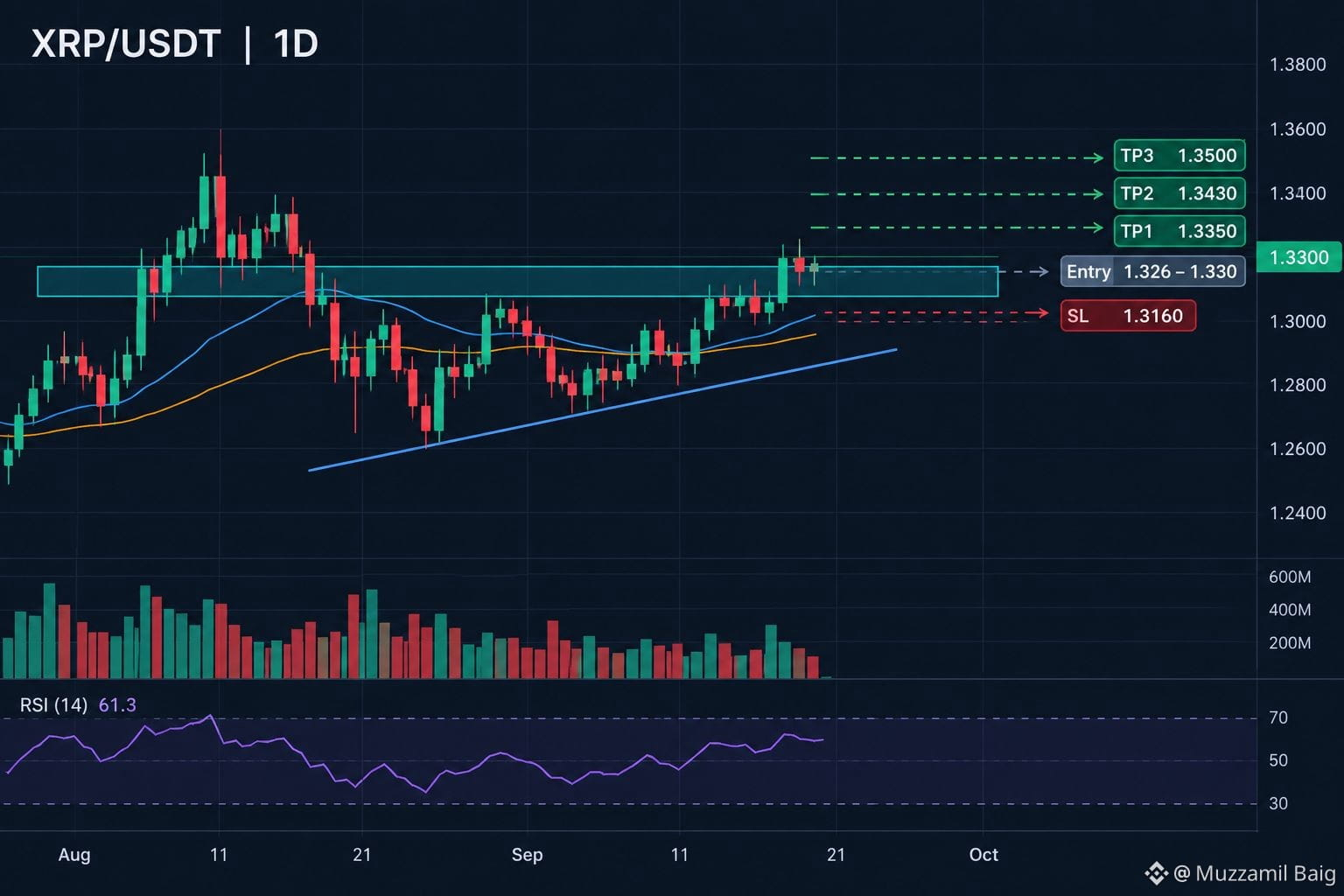
$XRP está probando la zona de $1.33–$1.34
Entrada: $1.326–$1.330
TP1: $1.335
TP2: $1.343
TP3: $1.350
SL: $1.316
El impulso está mejorando, pero la confirmación por encima de la resistencia es lo que importa.
¿Puede $XRP romper $1.34?
$XRP está probando la zona de $1.33–$1.34
Entrada: $1.326–$1.330
TP1: $1.335
TP2: $1.343
TP3: $1.350
SL: $1.316
El impulso está mejorando, pero la confirmación por encima de la resistencia es lo que importa.
¿Puede $XRP romper $1.34?
Entrada: $1.326–$1.330
TP1: $1.335
TP2: $1.343
TP3: $1.350
SL: $1.316
El impulso está mejorando, pero la confirmación por encima de la resistencia es lo que importa.
¿Puede $XRP romper $1.34?
104
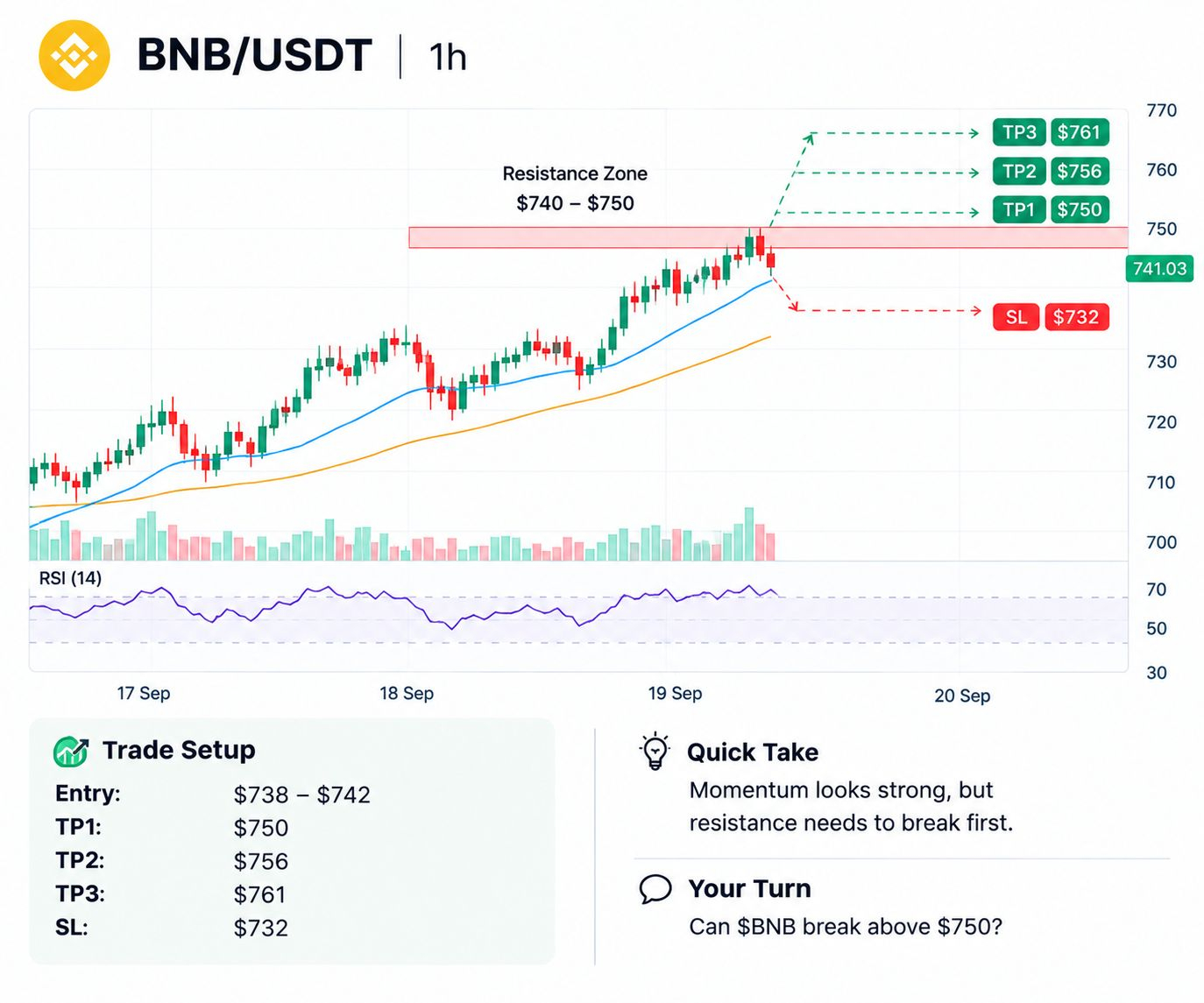
$BNB está probando la zona de resistencia de $740–$750
Entrada: $738–$742
TP1: $750
TP2: $756
TP3: $761
SL: $732
El impulso parece fuerte, pero la resistencia primero necesita romper.
¿Puede $BNB romper por encima de $750?
{future}(BNBUSDT)
$BNB está probando la zona de resistencia de $740–$750
Entrada: $738–$742
TP1: $750
TP2: $756
TP3: $761
SL: $732
El impulso parece fuerte, pero la resistencia primero necesita romper.
¿Puede $BNB romper por encima de $750?
Entrada: $738–$742
TP1: $750
TP2: $756
TP3: $761
SL: $732
El impulso parece fuerte, pero la resistencia primero necesita romper.
¿Puede $BNB romper por encima de $750?
63
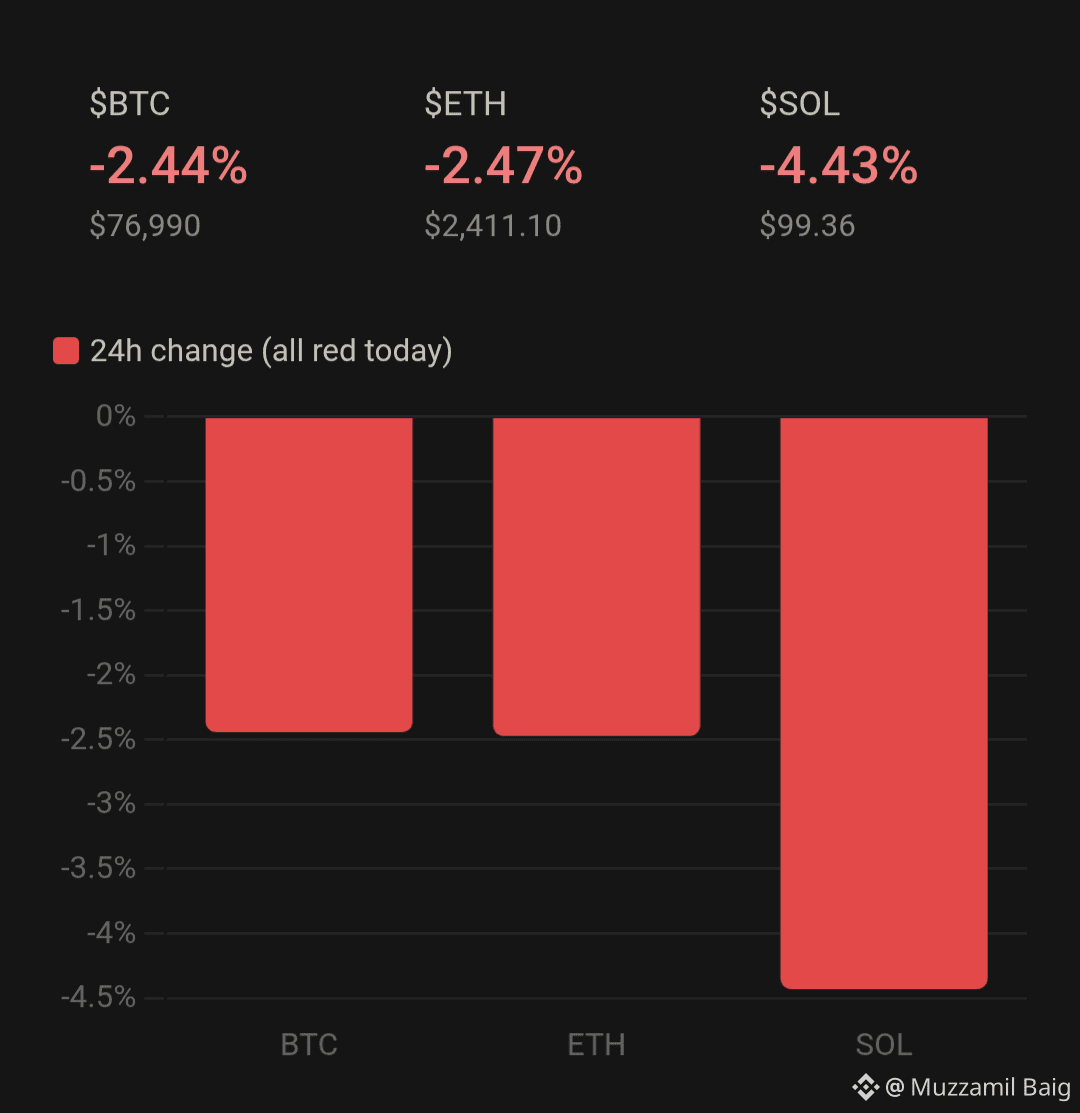
📉 $BTC ahora en $76,990, bajando -2.44% en las últimas 24h
$ETH también cae, operando a $2,411.10, bajando -2.47%
$SOL lidera las pérdidas entre los principales, bajando -4.43% a $99.36
No es asesoramiento financiero, solo seguimiento del ambiente del mercado de hoy. 📊
{future}(BTCUSDT)
{future}(ETHUSDT)
{future}(SOLUSDT)
📉 $BTC ahora en $76,990, bajando -2.44% en las últimas 24h
$ETH también cae, operando a $2,411.10, bajando -2.47%
$SOL lidera las pérdidas entre los principales, bajando -4.43% a $99.36
No es asesoramiento financiero, solo seguimiento del ambiente del mercado de hoy. 📊
$ETH también cae, operando a $2,411.10, bajando -2.47%
$SOL lidera las pérdidas entre los principales, bajando -4.43% a $99.36
No es asesoramiento financiero, solo seguimiento del ambiente del mercado de hoy. 📊
93
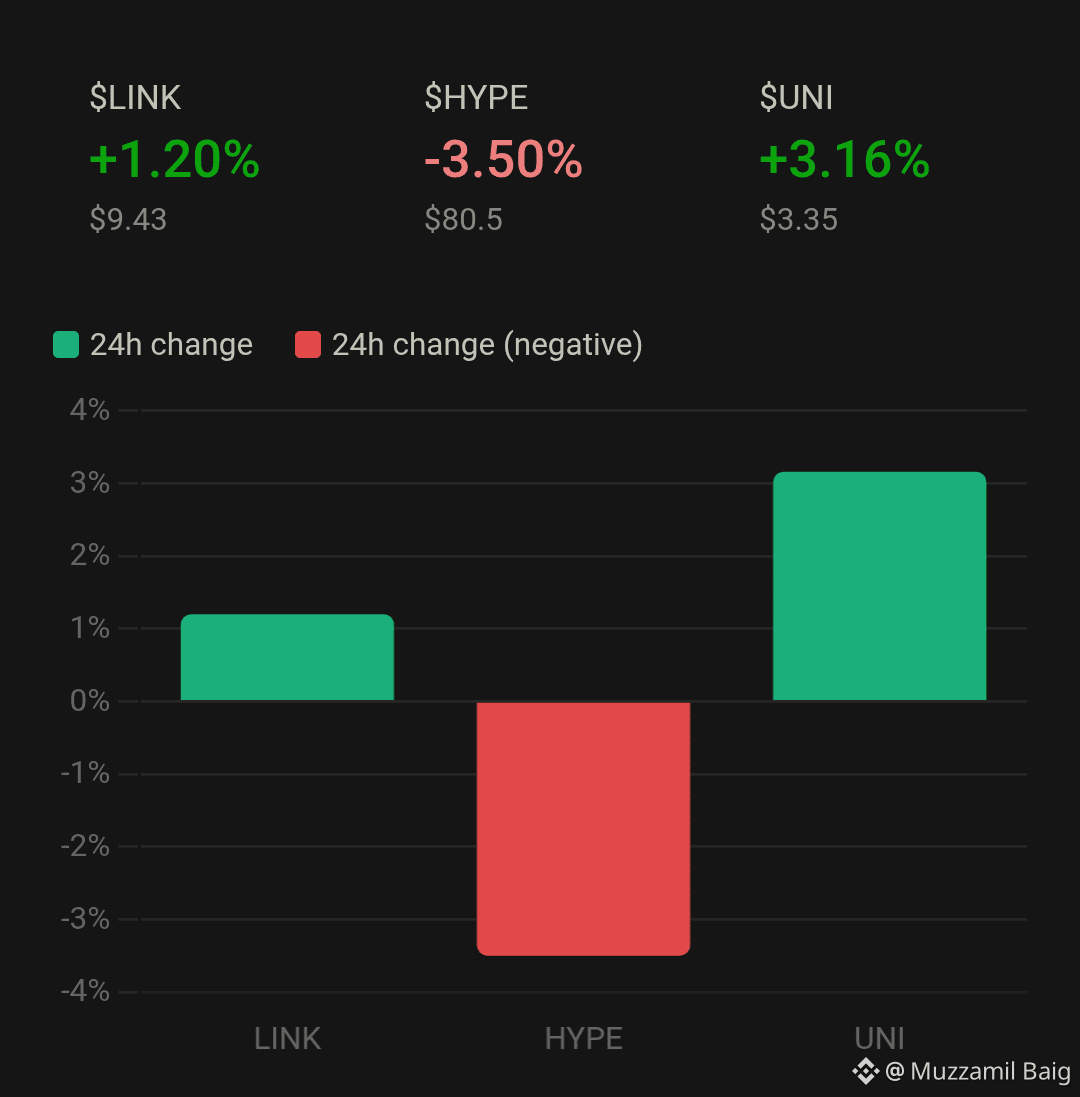
$LINK (Chainlink) al alza +1.20% en 24h, cotizando a 9.43 $ — demanda constante de infraestructura de oráculos
$HYPE (Hyperliquid) a la baja -3.50% hoy, pero aún +7.37% en la semana, a 80.5 $
$UNI (Uniswap) subiendo también — +3.16% hoy, +7.57% esta semana, ahora en 3.35 $
No es asesoramiento financiero, solo seguimiento de los movimientos del sector DeFi.
{future}(LINKUSDT)
{future}(HYPEUSDT)
{future}(UNIUSDT)
$LINK (Chainlink) al alza +1.20% en 24h, cotizando a 9.43 $ — demanda constante de infraestructura de oráculos
$HYPE (Hyperliquid) a la baja -3.50% hoy, pero aún +7.37% en la semana, a 80.5 $
$UNI (Uniswap) subiendo también — +3.16% hoy, +7.57% esta semana, ahora en 3.35 $
No es asesoramiento financiero, solo seguimiento de los movimientos del sector DeFi.
$HYPE (Hyperliquid) a la baja -3.50% hoy, pero aún +7.37% en la semana, a 80.5 $
$UNI (Uniswap) subiendo también — +3.16% hoy, +7.57% esta semana, ahora en 3.35 $
No es asesoramiento financiero, solo seguimiento de los movimientos del sector DeFi.
334
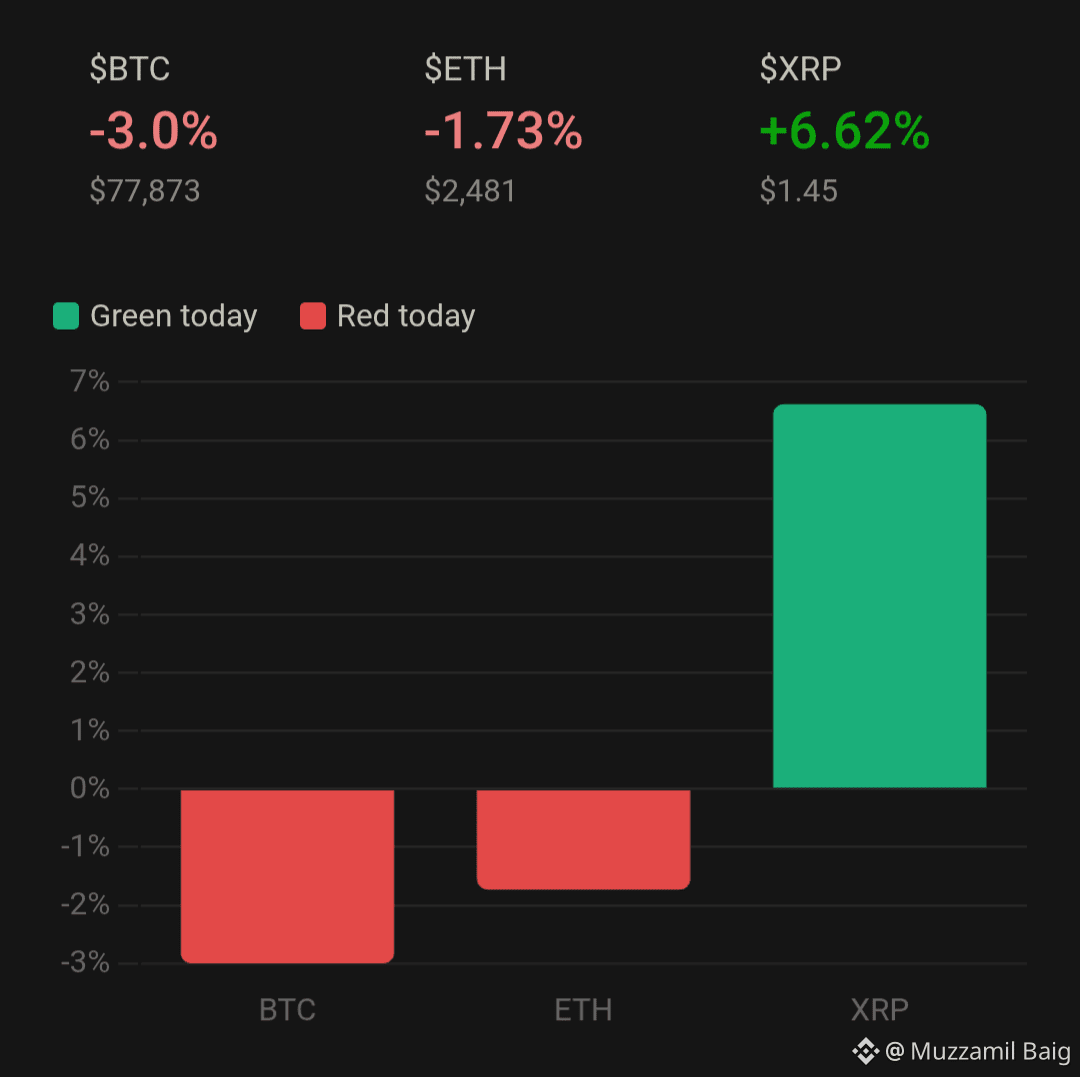
📉 $BTC cayó ~3% desde el máximo de la noche, ahora cotiza alrededor de $77,873 mientras el Senado vota la Ley de Transparencia
$ETH también baja, manteniéndose cerca de $2,481 con el impulso a corto plazo volviéndose bajista
Punto positivo: $XRP sube +6.62%, uno de los pocos grandes valores que sigue en verde hoy 🟢
No es asesoramiento financiero, solo estoy siguiendo el ambiente del mercado de hoy. 📊
{future}(BTCUSDT)
{future}(ETHUSDT)
{future}(XRPUSDT)
📉 $BTC cayó ~3% desde el máximo de la noche, ahora cotiza alrededor de $77,873 mientras el Senado vota la Ley de Transparencia
$ETH también baja, manteniéndose cerca de $2,481 con el impulso a corto plazo volviéndose bajista
Punto positivo: $XRP sube +6.62%, uno de los pocos grandes valores que sigue en verde hoy 🟢
No es asesoramiento financiero, solo estoy siguiendo el ambiente del mercado de hoy. 📊
$ETH también baja, manteniéndose cerca de $2,481 con el impulso a corto plazo volviéndose bajista
Punto positivo: $XRP sube +6.62%, uno de los pocos grandes valores que sigue en verde hoy 🟢
No es asesoramiento financiero, solo estoy siguiendo el ambiente del mercado de hoy. 📊
120
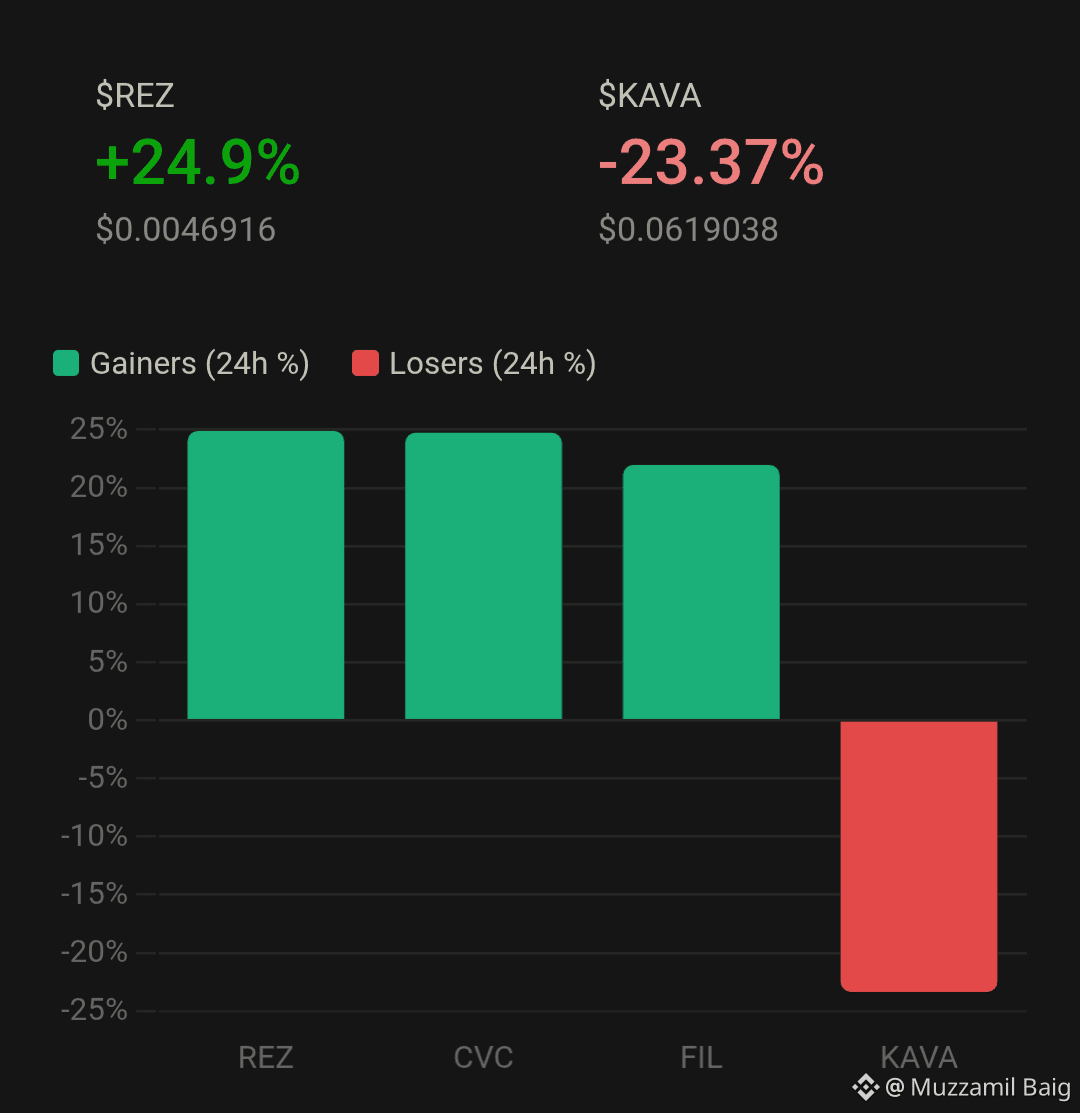
📈 $REZ (Renzo) es el mejor activo de hoy, sube +24.9% en las últimas 24h — ahora en $0.0046916
📉 $KAVA lidera a los perdedores, baja -23.37%, operando a $0.0619038
También en tendencia: $CVC (Civic) +24.74% y $FIL (Filecoin) +21.97% mostrando un fuerte impulso.
No es asesoramiento financiero, solo seguimiento de los movimientos del mercado de hoy. 📊
{future}(REZUSDT)
{future}(KAVAUSDT)
{future}(CVCUSDT)
📈 $REZ (Renzo) es el mejor activo de hoy, sube +24.9% en las últimas 24h — ahora en $0.0046916
📉 $KAVA lidera a los perdedores, baja -23.37%, operando a $0.0619038
También en tendencia: $CVC (Civic) +24.74% y $FIL (Filecoin) +21.97% mostrando un fuerte impulso.
No es asesoramiento financiero, solo seguimiento de los movimientos del mercado de hoy. 📊
📉 $KAVA lidera a los perdedores, baja -23.37%, operando a $0.0619038
También en tendencia: $CVC (Civic) +24.74% y $FIL (Filecoin) +21.97% mostrando un fuerte impulso.
No es asesoramiento financiero, solo seguimiento de los movimientos del mercado de hoy. 📊
300
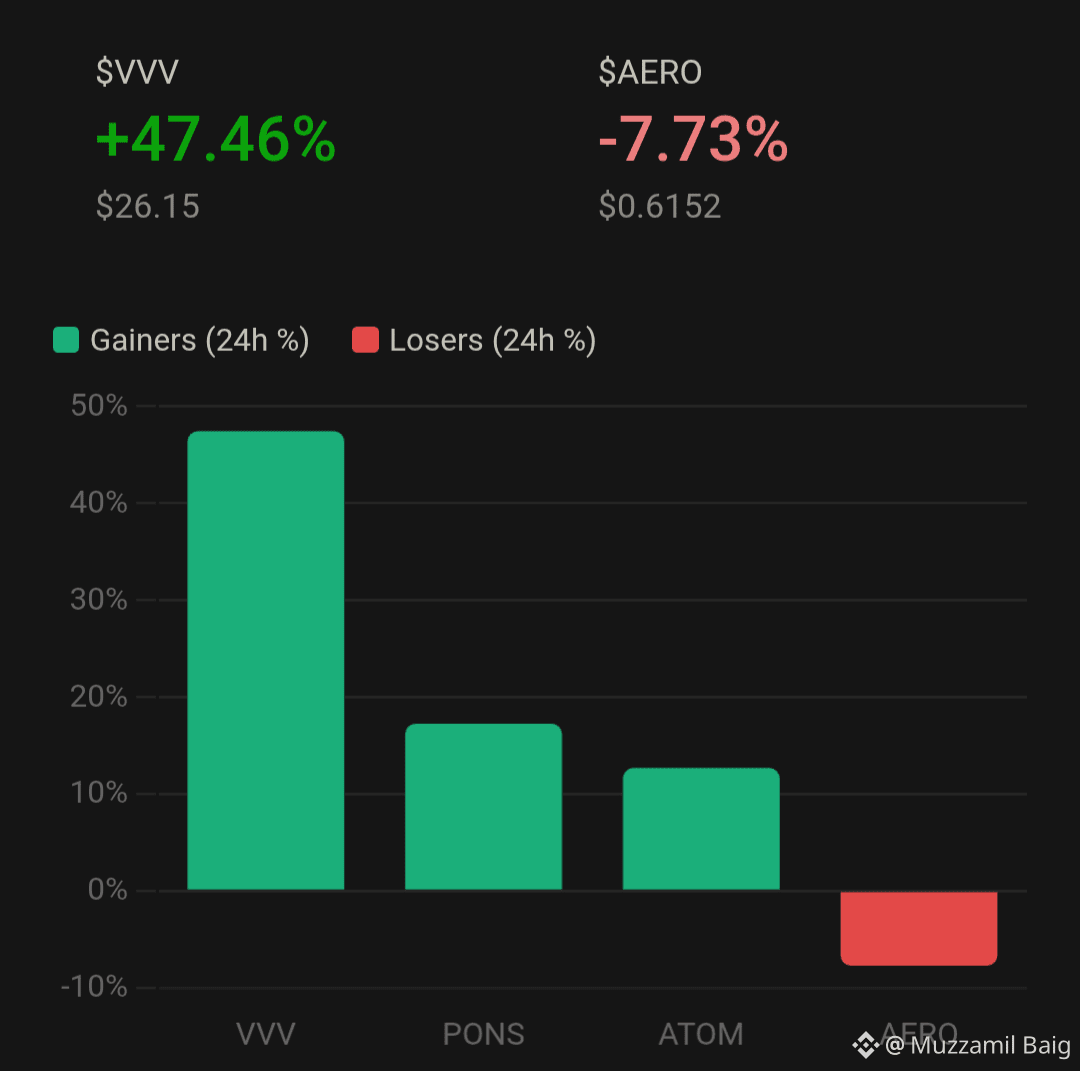
📈 $VVV (Venice Token) es el mejor activo de hoy, con +47.46% en las últimas 24h — ahora en $26.15
📉 $AERO (Aerodrome Finance) lidera los perdedores, bajando -7.73%, operando a $0.6152
También en tendencia: $PONS (+17.25%) y $ATOM (+12.67%) mostrando un fuerte impulso hoy.
No es asesoramiento financiero, solo seguimiento de los movimientos de mercado de hoy. 📊
📈 $VVV (Venice Token) es el mejor activo de hoy, con +47.46% en las últimas 24h — ahora en $26.15
📉 $AERO (Aerodrome Finance) lidera los perdedores, bajando -7.73%, operando a $0.6152
También en tendencia: $PONS (+17.25%) y $ATOM (+12.67%) mostrando un fuerte impulso hoy.
No es asesoramiento financiero, solo seguimiento de los movimientos de mercado de hoy. 📊
📉 $AERO (Aerodrome Finance) lidera los perdedores, bajando -7.73%, operando a $0.6152
También en tendencia: $PONS (+17.25%) y $ATOM (+12.67%) mostrando un fuerte impulso hoy.
No es asesoramiento financiero, solo seguimiento de los movimientos de mercado de hoy. 📊
70
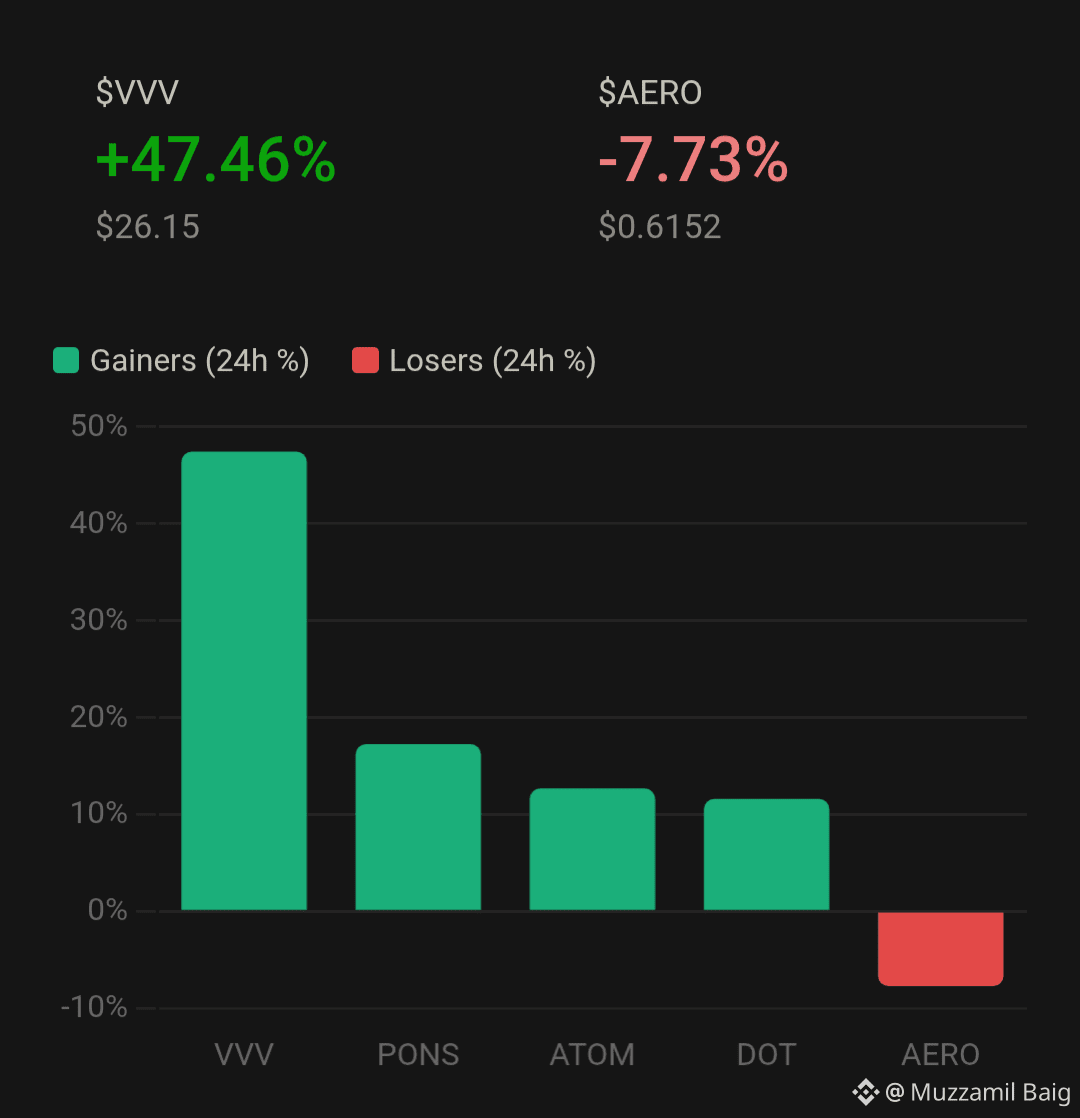
📈 $VVV (Venice Token) es el mayor ganador de hoy, +47.46% en las últimas 24 h — ahora en $26.15
📉 $AERO (Aerodrome Finance) lidera los perdedores, -7.73%, cotizando a $0.6152
También para vigilar: $ATOM (+12.67%) y $DOT (+11.60%) mostrando un fuerte impulso hoy.
No es asesoramiento financiero, solo seguimiento de los movimientos del mercado de hoy. 📊
📈 $VVV (Venice Token) es el mayor ganador de hoy, +47.46% en las últimas 24 h — ahora en $26.15
📉 $AERO (Aerodrome Finance) lidera los perdedores, -7.73%, cotizando a $0.6152
También para vigilar: $ATOM (+12.67%) y $DOT (+11.60%) mostrando un fuerte impulso hoy.
No es asesoramiento financiero, solo seguimiento de los movimientos del mercado de hoy. 📊
📉 $AERO (Aerodrome Finance) lidera los perdedores, -7.73%, cotizando a $0.6152
También para vigilar: $ATOM (+12.67%) y $DOT (+11.60%) mostrando un fuerte impulso hoy.
No es asesoramiento financiero, solo seguimiento de los movimientos del mercado de hoy. 📊
218
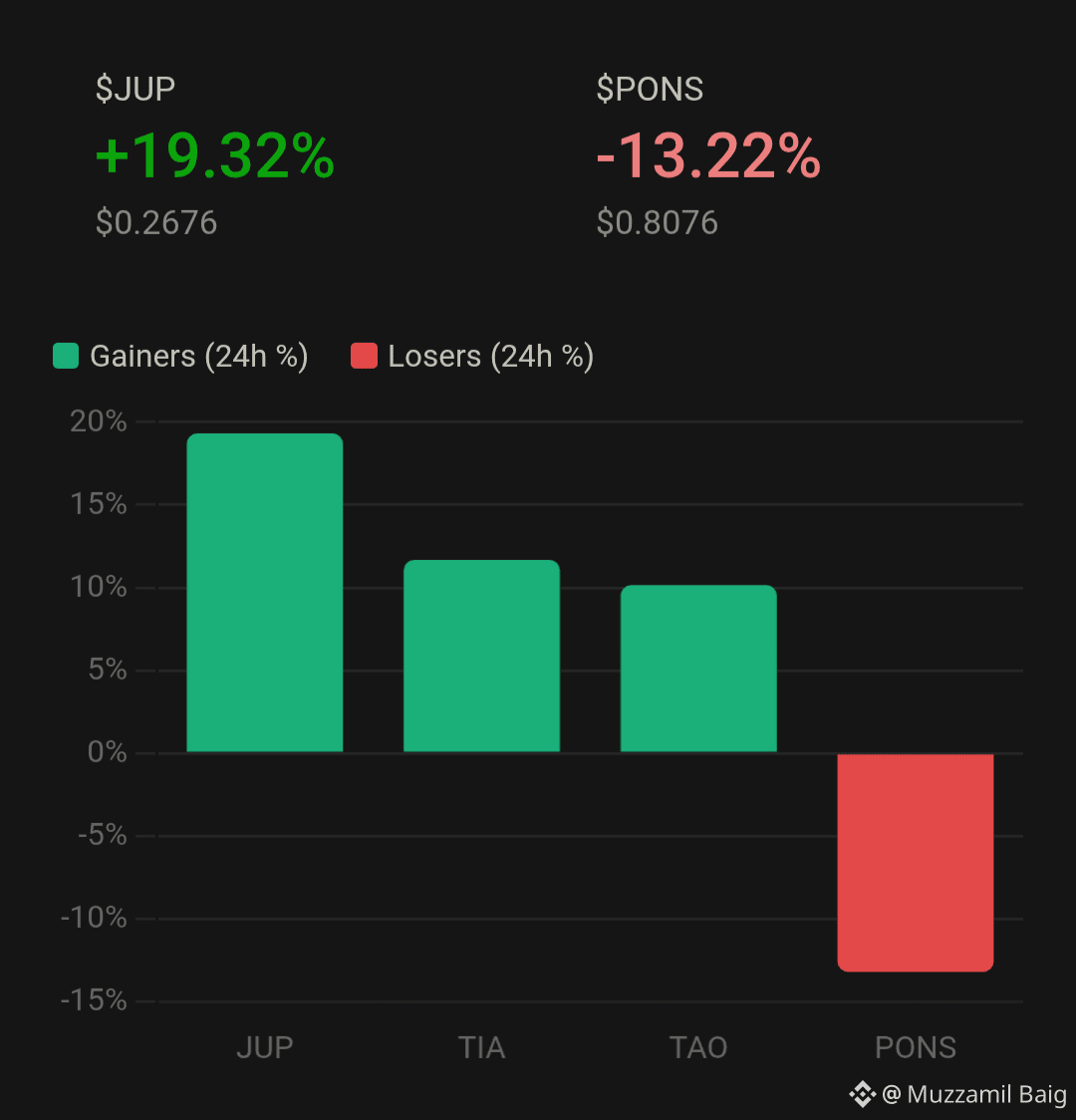
📈 $JUP lidera a los ganadores de hoy, con +19.32% en las últimas 24 h — ahora en $0.2676
📉 $PONS es el principal perdedor de hoy, bajando -13.22%, operando a $0.8076
También en tendencia: $TIA (+11.68%) y $TAO (+10.15%). Índice Fear & Greed en 74 — el mercado en la zona de "Greed".
No es asesoramiento financiero, solo comparto el resumen de mercado de hoy. 📊
📈 $JUP lidera a los ganadores de hoy, con +19.32% en las últimas 24 h — ahora en $0.2676
📉 $PONS es el principal perdedor de hoy, bajando -13.22%, operando a $0.8076
También en tendencia: $TIA (+11.68%) y $TAO (+10.15%). Índice Fear & Greed en 74 — el mercado en la zona de "Greed".
No es asesoramiento financiero, solo comparto el resumen de mercado de hoy. 📊
📉 $PONS es el principal perdedor de hoy, bajando -13.22%, operando a $0.8076
También en tendencia: $TIA (+11.68%) y $TAO (+10.15%). Índice Fear & Greed en 74 — el mercado en la zona de "Greed".
No es asesoramiento financiero, solo comparto el resumen de mercado de hoy. 📊
72
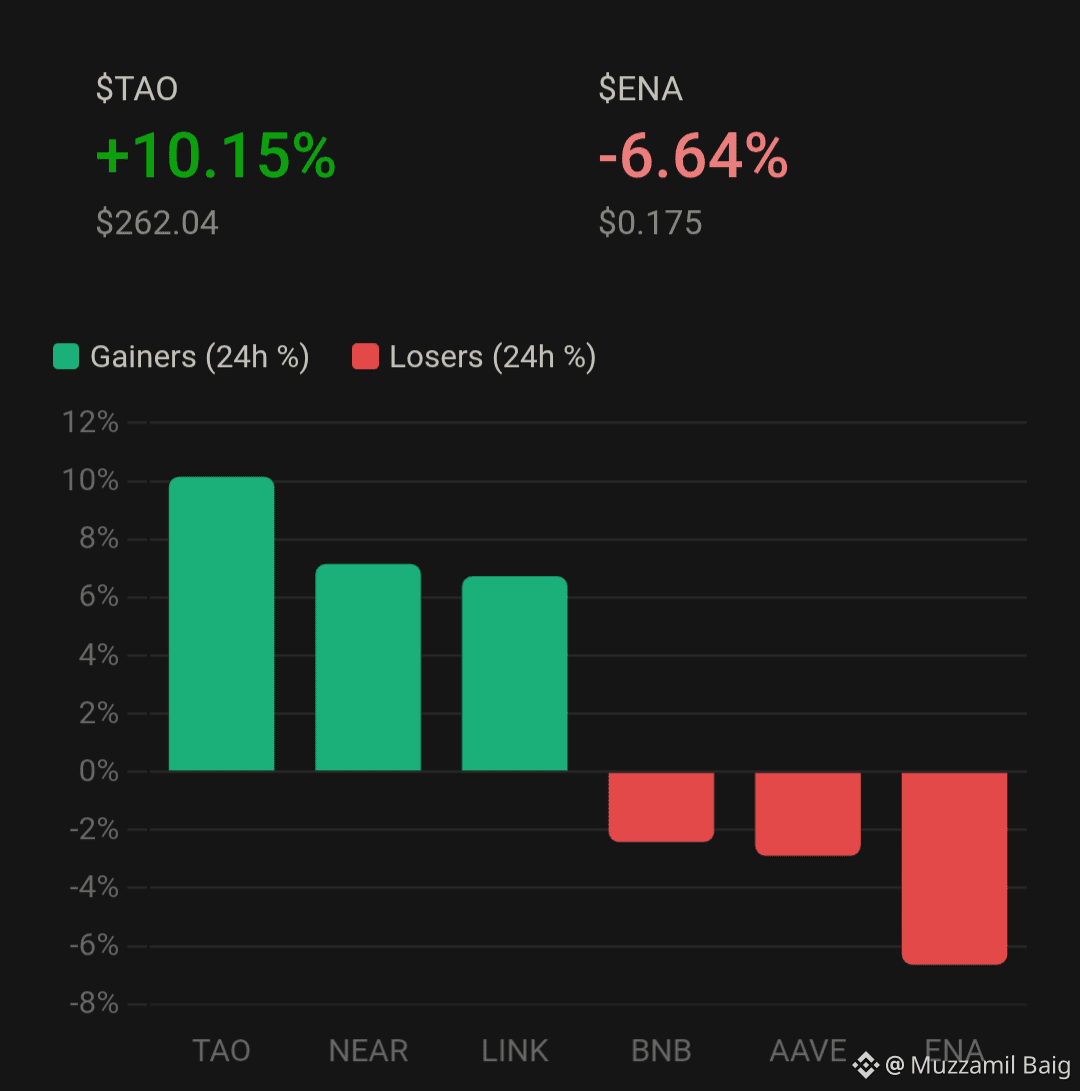
Gran movimiento hoy: $TAO (Bittensor) sube +10.15%, ahora en $262.04 📈
Por otro lado, $ENA baja -6.64%, cotizando a $0.175 📉
Sentimiento general del mercado: Índice Miedo y Codicia en 74 — estamos en territorio de "Codicia". La dominancia de BTC se mantiene estable en 59.2%.
Solo comparto el resumen de mercado de hoy, no es asesoramiento financiero. 📊
Gran movimiento hoy: $TAO (Bittensor) sube +10.15%, ahora en $262.04 📈
Por otro lado, $ENA baja -6.64%, cotizando a $0.175 📉
Sentimiento general del mercado: Índice Miedo y Codicia en 74 — estamos en territorio de "Codicia". La dominancia de BTC se mantiene estable en 59.2%.
Solo comparto el resumen de mercado de hoy, no es asesoramiento financiero. 📊
Por otro lado, $ENA baja -6.64%, cotizando a $0.175 📉
Sentimiento general del mercado: Índice Miedo y Codicia en 74 — estamos en territorio de "Codicia". La dominancia de BTC se mantiene estable en 59.2%.
Solo comparto el resumen de mercado de hoy, no es asesoramiento financiero. 📊
167
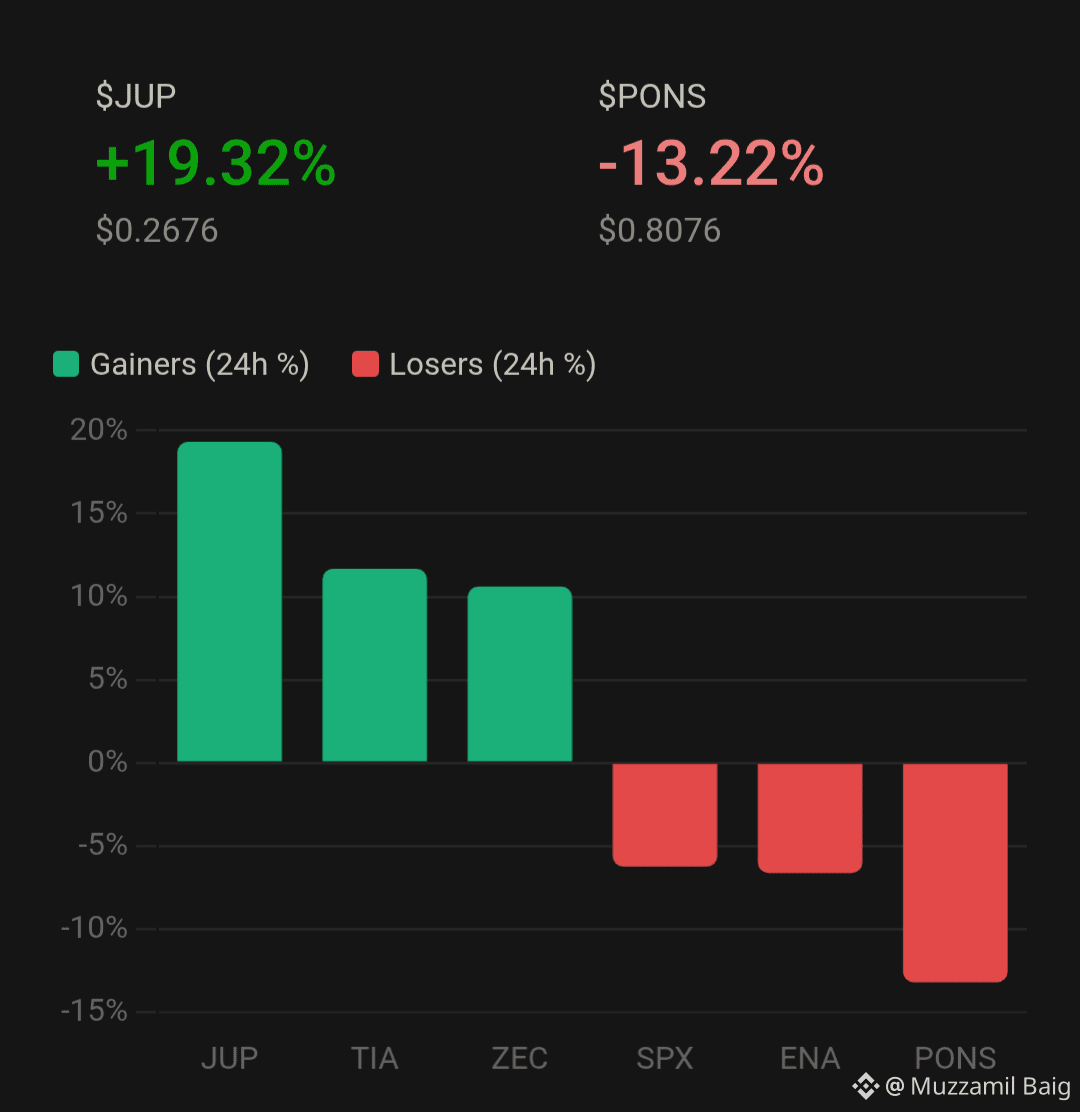
📈 $JUP es el mayor ganador de hoy, con +19.32% en las últimas 24 h — ahora cotizando cerca de $0.2676
📉 $PONS lidera los perdedores, con -13.22%, actualmente en $0.8076
También a tener en cuenta: $TIA (+11.68%) y $ZEC (+10.60%) mostrando un fuerte impulso. La capitalización de mercado sube ligeramente, el Índice de Miedo y Codicia en 74 (zona de Codicia).
No es asesoramiento financiero — solo seguimiento de los movimientos de hoy. 📊
📈 $JUP es el mayor ganador de hoy, con +19.32% en las últimas 24 h — ahora cotizando cerca de $0.2676
📉 $PONS lidera los perdedores, con -13.22%, actualmente en $0.8076
También a tener en cuenta: $TIA (+11.68%) y $ZEC (+10.60%) mostrando un fuerte impulso. La capitalización de mercado sube ligeramente, el Índice de Miedo y Codicia en 74 (zona de Codicia).
No es asesoramiento financiero — solo seguimiento de los movimientos de hoy. 📊
📉 $PONS lidera los perdedores, con -13.22%, actualmente en $0.8076
También a tener en cuenta: $TIA (+11.68%) y $ZEC (+10.60%) mostrando un fuerte impulso. La capitalización de mercado sube ligeramente, el Índice de Miedo y Codicia en 74 (zona de Codicia).
No es asesoramiento financiero — solo seguimiento de los movimientos de hoy. 📊
272
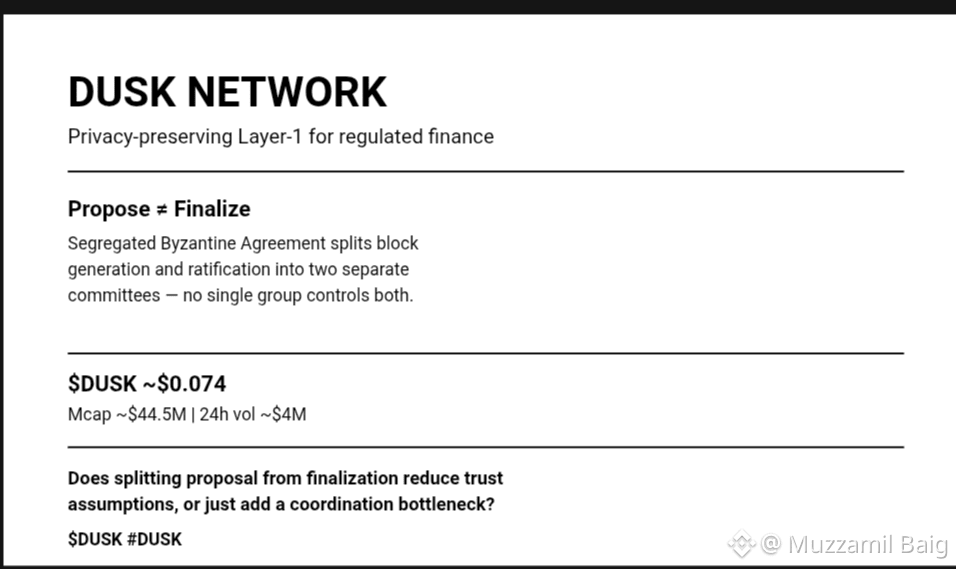
$DUSK is baja alrededor de 5% hoy, cotizando cerca de $0.074, con una capitalización de mercado de alrededor de $44.5M y aproximadamente $4M en volumen de 24h — lo suficientemente pequeña como para que unas pocas operaciones grandes la muevan más de lo que esperarías.
Lo más interesante que el gráfico, sin embargo, es cómo Dusk realmente alcanza el consenso. La mayoría de las Layer-1s permiten que el mismo grupo de validadores tanto proponga un bloque como lo finalice. El Acuerdo Bizantino Segregado de Dusk lo divide en dos pasos separados: un comité genera el bloque, otro lo ratifica. Ningún grupo controla ambos extremos del proceso a la vez.
¿Por qué importa eso para una cadena basada en transacciones privadas verificadas con ZK? Porque si los mismos validadores que construyen un bloque también pudieran aprobarlo de forma unilateral, hay más espacio para que ese bloque incluya algo que nadie fuera del grupo pueda verificar. Separar los roles da una comprobación adicional específicamente adecuada para una cadena en la que, por defecto, el contenido de las transacciones no es visible públicamente.
El costo es la sobrecarga de coordinación: dos comités que estén de acuerdo requiere más comunicación que un solo grupo votando, y eso tiene que mantenerse lo bastante rápido para el asentamiento real, no solo como una demo de testnet.
@Dusk_Foundation apuesta a que ese paso extra compensa el costo de latencia para instituciones que necesitan garantías de auditabilidad, no solo velocidad.
¿Dividir la propuesta de la finalización realmente reduce las suposiciones de confianza, o simplemente agrega un cuello de botella de coordinación disfrazado de seguridad?
$DUSK #dusk
$DUSK is baja alrededor de 5% hoy, cotizando cerca de $0.074, con una capitalización de mercado de alrededor de $44.5M y aproximadamente $4M en volumen de 24h — lo suficientemente pequeña como para que unas pocas operaciones grandes la muevan más de lo que esperarías.
Lo más interesante que el gráfico, sin embargo, es cómo Dusk realmente alcanza el consenso. La mayoría de las Layer-1s permiten que el mismo grupo de validadores tanto proponga un bloque como lo finalice. El Acuerdo Bizantino Segregado de Dusk lo divide en dos pasos separados: un comité genera el bloque, otro lo ratifica. Ningún grupo controla ambos extremos del proceso a la vez.
¿Por qué importa eso para una cadena basada en transacciones privadas verificadas con ZK? Porque si los mismos validadores que construyen un bloque también pudieran aprobarlo de forma unilateral, hay más espacio para que ese bloque incluya algo que nadie fuera del grupo pueda verificar. Separar los roles da una comprobación adicional específicamente adecuada para una cadena en la que, por defecto, el contenido de las transacciones no es visible públicamente.
El costo es la sobrecarga de coordinación: dos comités que estén de acuerdo requiere más comunicación que un solo grupo votando, y eso tiene que mantenerse lo bastante rápido para el asentamiento real, no solo como una demo de testnet.
@Dusk apuesta a que ese paso extra compensa el costo de latencia para instituciones que necesitan garantías de auditabilidad, no solo velocidad.
¿Dividir la propuesta de la finalización realmente reduce las suposiciones de confianza, o simplemente agrega un cuello de botella de coordinación disfrazado de seguridad?
$DUSK #dusk
Lo más interesante que el gráfico, sin embargo, es cómo Dusk realmente alcanza el consenso. La mayoría de las Layer-1s permiten que el mismo grupo de validadores tanto proponga un bloque como lo finalice. El Acuerdo Bizantino Segregado de Dusk lo divide en dos pasos separados: un comité genera el bloque, otro lo ratifica. Ningún grupo controla ambos extremos del proceso a la vez.
¿Por qué importa eso para una cadena basada en transacciones privadas verificadas con ZK? Porque si los mismos validadores que construyen un bloque también pudieran aprobarlo de forma unilateral, hay más espacio para que ese bloque incluya algo que nadie fuera del grupo pueda verificar. Separar los roles da una comprobación adicional específicamente adecuada para una cadena en la que, por defecto, el contenido de las transacciones no es visible públicamente.
El costo es la sobrecarga de coordinación: dos comités que estén de acuerdo requiere más comunicación que un solo grupo votando, y eso tiene que mantenerse lo bastante rápido para el asentamiento real, no solo como una demo de testnet.
@Dusk apuesta a que ese paso extra compensa el costo de latencia para instituciones que necesitan garantías de auditabilidad, no solo velocidad.
¿Dividir la propuesta de la finalización realmente reduce las suposiciones de confianza, o simplemente agrega un cuello de botella de coordinación disfrazado de seguridad?
$DUSK #dusk
31
14
192
Verificado
Una breve aclaración para cualquiera confundido sobre lo que significa realmente "EVM-compatible" para una cadena de privacidad — porque DuskEVM no funciona como la gente asume.
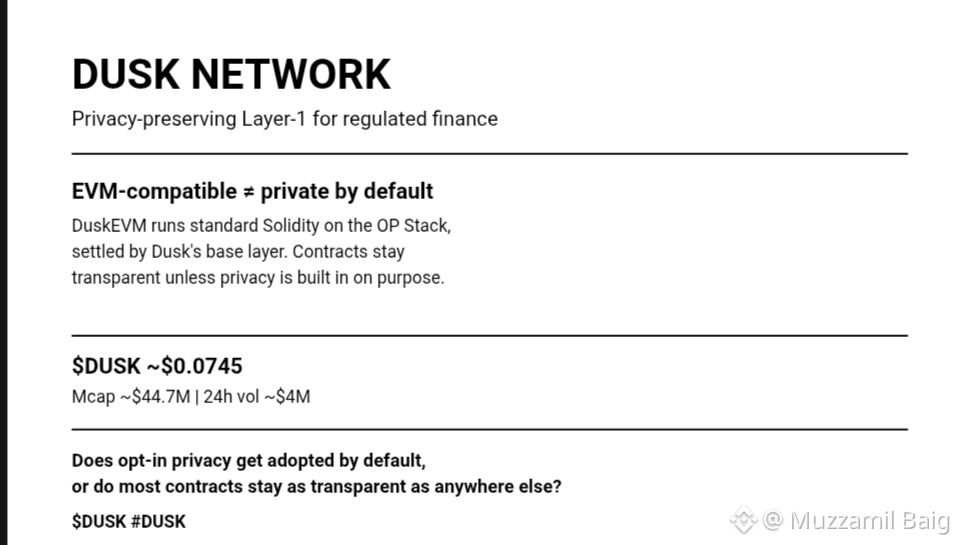
La suposición común: Dusk es una cadena de privacidad, así que todo lo que se construya sobre ella debe ser privado por defecto. No es así como funciona DuskEVM. Ejecuta contratos Solidity estándar usando OP Stack para la ejecución, mientras que la capa base de Dusk se encarga del settlement. Eso significa que los desarrolladores obtienen herramientas familiares: los mismos contratos, el mismo flujo de despliegue que en cualquier otra cadena EVM. Pero esos contratos son transparentes, a menos que un desarrollador construya específicamente con las primitivas confidenciales de Dusk.
Así que la compatibilidad con EVM y la privacidad son dos decisiones de diseño separadas, no una función empaquetada. Un equipo podría desplegar en DuskEVM hoy y terminar con un contrato totalmente público, igual que al desplegar en cualquier L2. Las herramientas de privacidad existen, pero son opcionales, no automáticas.
Vale la pena saber esto antes de asumir que cada dApp en Dusk hereda la reputación de privacidad de la cadena.
$DUSK está operando alrededor de $0.0745 hoy, con una capitalización de mercado cerca de $44.7M, y aproximadamente $4M en volumen de 24h.
@Dusk_Foundation está apostando claramente a que los desarrolladores elegirán la ruta confidencial una vez que sea lo suficientemente fácil. La pregunta es si la "privacidad con opción" se adoptará por defecto, o si la mayoría de los contratos en DuskEVM terminan siendo igual de transparentes que en cualquier otro lugar.
$DUSK #dusk
Una breve aclaración para cualquiera confundido sobre lo que significa realmente "EVM-compatible" para una cadena de privacidad — porque DuskEVM no funciona como la gente asume.
La suposición común: Dusk es una cadena de privacidad, así que todo lo que se construya sobre ella debe ser privado por defecto. No es así como funciona DuskEVM. Ejecuta contratos Solidity estándar usando OP Stack para la ejecución, mientras que la capa base de Dusk se encarga del settlement. Eso significa que los desarrolladores obtienen herramientas familiares: los mismos contratos, el mismo flujo de despliegue que en cualquier otra cadena EVM. Pero esos contratos son transparentes, a menos que un desarrollador construya específicamente con las primitivas confidenciales de Dusk.
Así que la compatibilidad con EVM y la privacidad son dos decisiones de diseño separadas, no una función empaquetada. Un equipo podría desplegar en DuskEVM hoy y terminar con un contrato totalmente público, igual que al desplegar en cualquier L2. Las herramientas de privacidad existen, pero son opcionales, no automáticas.
Vale la pena saber esto antes de asumir que cada dApp en Dusk hereda la reputación de privacidad de la cadena.
$DUSK está operando alrededor de $0.0745 hoy, con una capitalización de mercado cerca de $44.7M, y aproximadamente $4M en volumen de 24h.
@Dusk está apostando claramente a que los desarrolladores elegirán la ruta confidencial una vez que sea lo suficientemente fácil. La pregunta es si la "privacidad con opción" se adoptará por defecto, o si la mayoría de los contratos en DuskEVM terminan siendo igual de transparentes que en cualquier otro lugar.
$DUSK #dusk
La suposición común: Dusk es una cadena de privacidad, así que todo lo que se construya sobre ella debe ser privado por defecto. No es así como funciona DuskEVM. Ejecuta contratos Solidity estándar usando OP Stack para la ejecución, mientras que la capa base de Dusk se encarga del settlement. Eso significa que los desarrolladores obtienen herramientas familiares: los mismos contratos, el mismo flujo de despliegue que en cualquier otra cadena EVM. Pero esos contratos son transparentes, a menos que un desarrollador construya específicamente con las primitivas confidenciales de Dusk.
Así que la compatibilidad con EVM y la privacidad son dos decisiones de diseño separadas, no una función empaquetada. Un equipo podría desplegar en DuskEVM hoy y terminar con un contrato totalmente público, igual que al desplegar en cualquier L2. Las herramientas de privacidad existen, pero son opcionales, no automáticas.
Vale la pena saber esto antes de asumir que cada dApp en Dusk hereda la reputación de privacidad de la cadena.
$DUSK está operando alrededor de $0.0745 hoy, con una capitalización de mercado cerca de $44.7M, y aproximadamente $4M en volumen de 24h.
@Dusk está apostando claramente a que los desarrolladores elegirán la ruta confidencial una vez que sea lo suficientemente fácil. La pregunta es si la "privacidad con opción" se adoptará por defecto, o si la mayoría de los contratos en DuskEVM terminan siendo igual de transparentes que en cualquier otro lugar.
$DUSK #dusk
40
19
160
Verificado
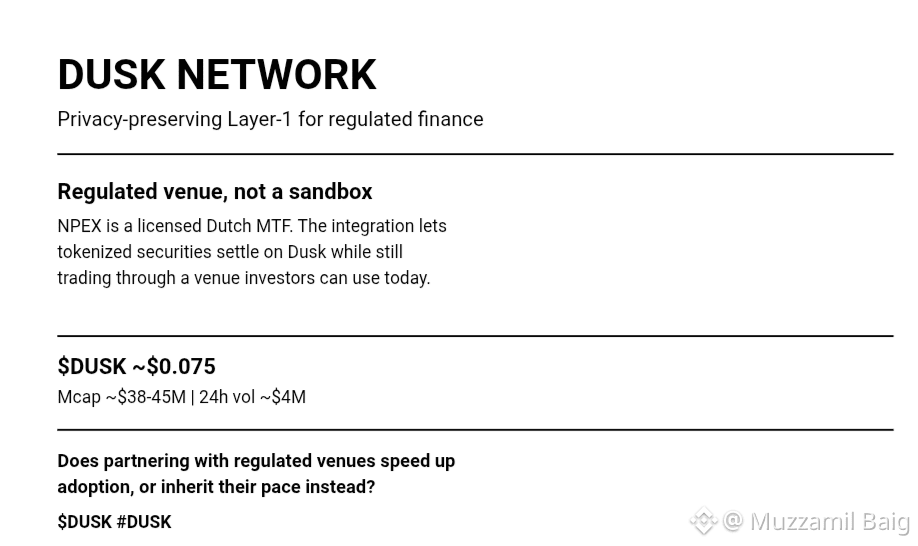
$DUSK está alrededor de 0,075 $ hoy; la capitalización de mercado está aproximadamente en el rango de 38–45 M $, según el rastreador, con unos 4 M $ de volumen en 24 h.
Más allá de los números, lo más interesante de esta semana fue revisar los detalles de la asociación de NPEX de Dusk en lugar del gráfico de precios. Supuse que era otro comunicado del tipo "nos asociamos con un exchange", de esos que saca cualquiera de las L1. No es eso. NPEX es un MTF holandés: un centro de negociación regulado bajo la legislación de la UE. La integración permite que los valores tokenizados se liquiden en Dusk mientras se negocia todavía a través de un centro con licencia que los inversores pueden usar hoy, no una sandbox.
Esto es algo más acotado que lo que se suele llamar "tokenización de RWA", que ahora mismo se usa de forma laxa. La mayoría de los proyectos de tokenización envuelven un activo y esperan luego que algún centro regulado lo adopte. Dusk construyó primero en función de la relación con el centro.
El costo/beneficio que vale la pena mencionar: la velocidad de liquidación y la privacidad en cadena no importan tanto si, al otro lado, el centro regulado sigue su propio calendario y sus propias reglas. La infraestructura de Dusk solo puede avanzar tan rápido como el participante regulado más lento con el que está conectado.
@Dusk_Foundation apuesta por emparejarse con centros con licencia desde el principio, en lugar de construir infraestructura y esperar después a que los reguladores se pongan al día.
¿Asociarse con centros regulados realmente acelera la adopción institucional, o simplemente hereda su ritmo?
$DUSK #dusk
$DUSK está alrededor de 0,075 $ hoy; la capitalización de mercado está aproximadamente en el rango de 38–45 M $, según el rastreador, con unos 4 M $ de volumen en 24 h.
Más allá de los números, lo más interesante de esta semana fue revisar los detalles de la asociación de NPEX de Dusk en lugar del gráfico de precios. Supuse que era otro comunicado del tipo "nos asociamos con un exchange", de esos que saca cualquiera de las L1. No es eso. NPEX es un MTF holandés: un centro de negociación regulado bajo la legislación de la UE. La integración permite que los valores tokenizados se liquiden en Dusk mientras se negocia todavía a través de un centro con licencia que los inversores pueden usar hoy, no una sandbox.
Esto es algo más acotado que lo que se suele llamar "tokenización de RWA", que ahora mismo se usa de forma laxa. La mayoría de los proyectos de tokenización envuelven un activo y esperan luego que algún centro regulado lo adopte. Dusk construyó primero en función de la relación con el centro.
El costo/beneficio que vale la pena mencionar: la velocidad de liquidación y la privacidad en cadena no importan tanto si, al otro lado, el centro regulado sigue su propio calendario y sus propias reglas. La infraestructura de Dusk solo puede avanzar tan rápido como el participante regulado más lento con el que está conectado.
@Dusk apuesta por emparejarse con centros con licencia desde el principio, en lugar de construir infraestructura y esperar después a que los reguladores se pongan al día.
¿Asociarse con centros regulados realmente acelera la adopción institucional, o simplemente hereda su ritmo?
$DUSK #dusk
Más allá de los números, lo más interesante de esta semana fue revisar los detalles de la asociación de NPEX de Dusk en lugar del gráfico de precios. Supuse que era otro comunicado del tipo "nos asociamos con un exchange", de esos que saca cualquiera de las L1. No es eso. NPEX es un MTF holandés: un centro de negociación regulado bajo la legislación de la UE. La integración permite que los valores tokenizados se liquiden en Dusk mientras se negocia todavía a través de un centro con licencia que los inversores pueden usar hoy, no una sandbox.
Esto es algo más acotado que lo que se suele llamar "tokenización de RWA", que ahora mismo se usa de forma laxa. La mayoría de los proyectos de tokenización envuelven un activo y esperan luego que algún centro regulado lo adopte. Dusk construyó primero en función de la relación con el centro.
El costo/beneficio que vale la pena mencionar: la velocidad de liquidación y la privacidad en cadena no importan tanto si, al otro lado, el centro regulado sigue su propio calendario y sus propias reglas. La infraestructura de Dusk solo puede avanzar tan rápido como el participante regulado más lento con el que está conectado.
@Dusk apuesta por emparejarse con centros con licencia desde el principio, en lugar de construir infraestructura y esperar después a que los reguladores se pongan al día.
¿Asociarse con centros regulados realmente acelera la adopción institucional, o simplemente hereda su ritmo?
$DUSK #dusk
30
13
155
Parcialmente cierto
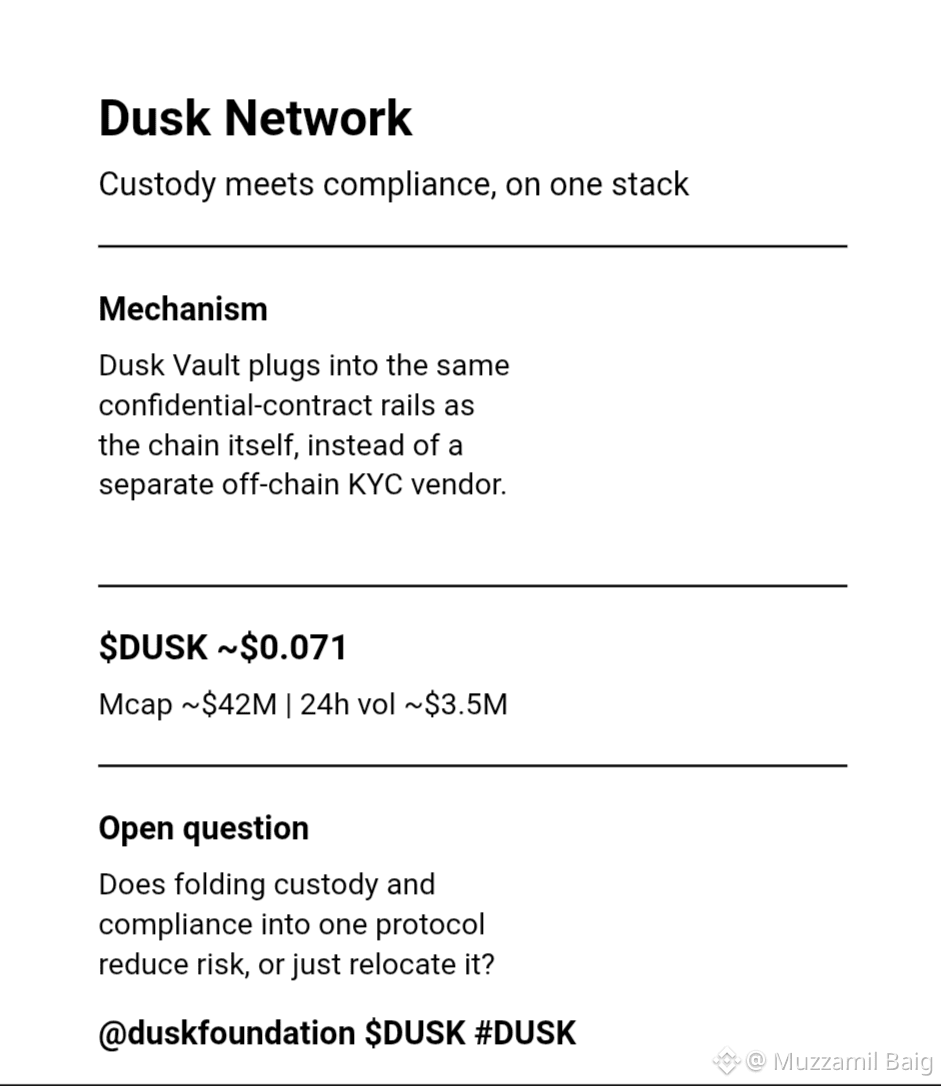
Me deslicé por otra cabecera de "solución de custodia" y casi me fui, hasta que noté que Dusk Vault está más cerca del settlement que un producto de wallet normal. Asumí que era almacenamiento en frío con un logo de Dusk. En realidad, se conecta a las mismas vías de contratos confidenciales que usa la cadena para activos regulados, así que la custodia y el cumplimiento pasan por una sola pila en lugar de que una wallet hable con un proveedor de KYC separado, instalado después.
La mayor parte de la custodia cripto institucional hoy funciona de forma inversa: la cadena se mantiene tonta y transparente, y el cumplimiento ocurre fuera de la cadena en la base de datos de alguien. Dusk está incorporando esa lógica directamente al protocolo.
$DUSK hoy está alrededor de 0,071 USD, bajando unos pocos puntos porcentuales, con una capitalización de mercado cerca de 42M USD; y alrededor de 3,5M USD moviéndose en el volumen de 24h.
Más limpio sobre el papel, pero también significa que Dusk Network ahora posee más de la superficie de confianza que antes las instituciones solían externalizar a custodios especializados. @Dusk_Foundation está apostando a que esa es la operación correcta para una finanza conforme.
¿Incorporar la custodia y el cumplimiento en un solo protocolo realmente reduce el riesgo, o simplemente traslada el punto único de fallo a algún lugar menos familiar?
$DUSK #dusk
Me deslicé por otra cabecera de "solución de custodia" y casi me fui, hasta que noté que Dusk Vault está más cerca del settlement que un producto de wallet normal. Asumí que era almacenamiento en frío con un logo de Dusk. En realidad, se conecta a las mismas vías de contratos confidenciales que usa la cadena para activos regulados, así que la custodia y el cumplimiento pasan por una sola pila en lugar de que una wallet hable con un proveedor de KYC separado, instalado después.
La mayor parte de la custodia cripto institucional hoy funciona de forma inversa: la cadena se mantiene tonta y transparente, y el cumplimiento ocurre fuera de la cadena en la base de datos de alguien. Dusk está incorporando esa lógica directamente al protocolo.
$DUSK hoy está alrededor de 0,071 USD, bajando unos pocos puntos porcentuales, con una capitalización de mercado cerca de 42M USD; y alrededor de 3,5M USD moviéndose en el volumen de 24h.
Más limpio sobre el papel, pero también significa que Dusk Network ahora posee más de la superficie de confianza que antes las instituciones solían externalizar a custodios especializados. @Dusk está apostando a que esa es la operación correcta para una finanza conforme.
¿Incorporar la custodia y el cumplimiento en un solo protocolo realmente reduce el riesgo, o simplemente traslada el punto único de fallo a algún lugar menos familiar?
$DUSK #dusk
La mayor parte de la custodia cripto institucional hoy funciona de forma inversa: la cadena se mantiene tonta y transparente, y el cumplimiento ocurre fuera de la cadena en la base de datos de alguien. Dusk está incorporando esa lógica directamente al protocolo.
$DUSK hoy está alrededor de 0,071 USD, bajando unos pocos puntos porcentuales, con una capitalización de mercado cerca de 42M USD; y alrededor de 3,5M USD moviéndose en el volumen de 24h.
Más limpio sobre el papel, pero también significa que Dusk Network ahora posee más de la superficie de confianza que antes las instituciones solían externalizar a custodios especializados. @Dusk está apostando a que esa es la operación correcta para una finanza conforme.
¿Incorporar la custodia y el cumplimiento en un solo protocolo realmente reduce el riesgo, o simplemente traslada el punto único de fallo a algún lugar menos familiar?
$DUSK #dusk
36
18
123
Verificado
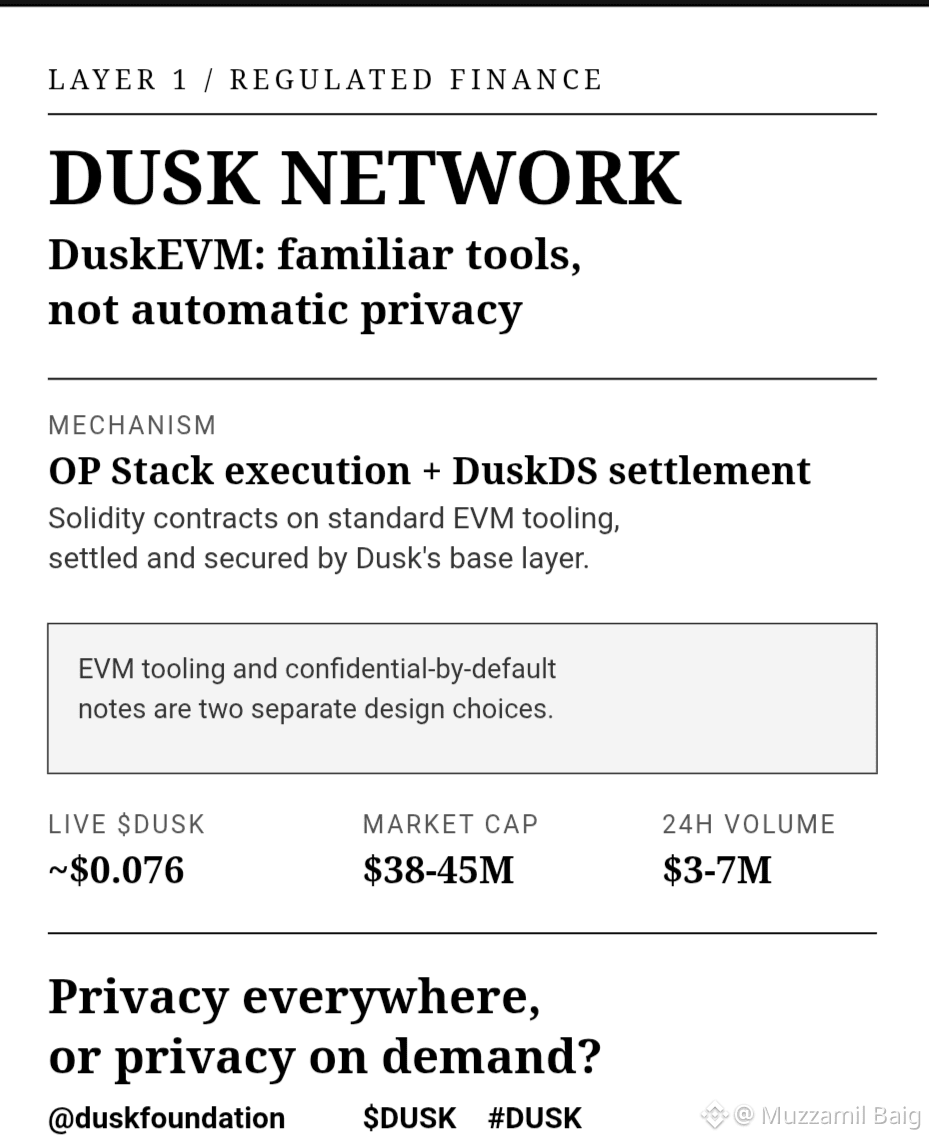
$DUSK sentado alrededor de $0.076 hoy, con una capitalización bursátil en el rango de $38-45M dependiendo del rastreador, y un volumen diario en el rango de $3-7M. Números pequeños. Lo que realmente captó mi atención esta semana fue una página de documentos, no el gráfico.
Estaba leyendo sobre DuskEVM esperando el típico discurso de “cadena compatible con EVM”: despliega tus contratos Solidity y listo, sin más. Pero no es exactamente así. DuskEVM es un entorno de ejecución basado en OP Stack que se sitúa sobre DuskDS; eso significa que se asienta y obtiene su disponibilidad de datos desde la capa base de Dusk, mientras ofrece a los desarrolladores herramientas EVM estándar en lugar de obligarlos a aprender un stack nuevo.
Compáralo con la forma en que la mayoría de las cadenas de privacidad manejan la compatibilidad: o se mantienen aisladas con herramientas personalizadas que nadie fuera del ecosistema quiere aprender, o se vuelven completamente transparentes para integrarse con DeFi existente. Dusk Network está intentando un tercer camino: mantener la capa de liquidación nativa de privacidad (Phoenix, notas protegidas) debajo, pero permitir que los contratos Solidity se ejecuten en un entorno equivalente a EVM y familiar por encima.
Así es lo que significa en la práctica: los contratos desplegados en DuskEVM no heredan automáticamente el tratamiento confidencial por defecto que Phoenix aplica a las transacciones nativas de Dusk. Obtienes herramientas conocidas, no privacidad automática: son dos decisiones de diseño separadas, no una sola.
@Dusk_Foundation está apostando claramente a que la compatibilidad conseguirá que entren más desarrolladores antes que la “pureza” de la privacidad. Apuesta justa, tal vez.
Entonces, ¿qué logra que los equipos de desarrollo institucional construyan más rápido sobre infraestructura de finanzas reguladas: una cadena que sea nativa de privacidad en todas partes, o una que solo lo garantiza en entornos de ejecución específicos?
#dusk
$DUSK sentado alrededor de $0.076 hoy, con una capitalización bursátil en el rango de $38-45M dependiendo del rastreador, y un volumen diario en el rango de $3-7M. Números pequeños. Lo que realmente captó mi atención esta semana fue una página de documentos, no el gráfico.
Estaba leyendo sobre DuskEVM esperando el típico discurso de “cadena compatible con EVM”: despliega tus contratos Solidity y listo, sin más. Pero no es exactamente así. DuskEVM es un entorno de ejecución basado en OP Stack que se sitúa sobre DuskDS; eso significa que se asienta y obtiene su disponibilidad de datos desde la capa base de Dusk, mientras ofrece a los desarrolladores herramientas EVM estándar en lugar de obligarlos a aprender un stack nuevo.
Compáralo con la forma en que la mayoría de las cadenas de privacidad manejan la compatibilidad: o se mantienen aisladas con herramientas personalizadas que nadie fuera del ecosistema quiere aprender, o se vuelven completamente transparentes para integrarse con DeFi existente. Dusk Network está intentando un tercer camino: mantener la capa de liquidación nativa de privacidad (Phoenix, notas protegidas) debajo, pero permitir que los contratos Solidity se ejecuten en un entorno equivalente a EVM y familiar por encima.
Así es lo que significa en la práctica: los contratos desplegados en DuskEVM no heredan automáticamente el tratamiento confidencial por defecto que Phoenix aplica a las transacciones nativas de Dusk. Obtienes herramientas conocidas, no privacidad automática: son dos decisiones de diseño separadas, no una sola.
@Dusk está apostando claramente a que la compatibilidad conseguirá que entren más desarrolladores antes que la “pureza” de la privacidad. Apuesta justa, tal vez.
Entonces, ¿qué logra que los equipos de desarrollo institucional construyan más rápido sobre infraestructura de finanzas reguladas: una cadena que sea nativa de privacidad en todas partes, o una que solo lo garantiza en entornos de ejecución específicos?
#dusk
Estaba leyendo sobre DuskEVM esperando el típico discurso de “cadena compatible con EVM”: despliega tus contratos Solidity y listo, sin más. Pero no es exactamente así. DuskEVM es un entorno de ejecución basado en OP Stack que se sitúa sobre DuskDS; eso significa que se asienta y obtiene su disponibilidad de datos desde la capa base de Dusk, mientras ofrece a los desarrolladores herramientas EVM estándar en lugar de obligarlos a aprender un stack nuevo.
Compáralo con la forma en que la mayoría de las cadenas de privacidad manejan la compatibilidad: o se mantienen aisladas con herramientas personalizadas que nadie fuera del ecosistema quiere aprender, o se vuelven completamente transparentes para integrarse con DeFi existente. Dusk Network está intentando un tercer camino: mantener la capa de liquidación nativa de privacidad (Phoenix, notas protegidas) debajo, pero permitir que los contratos Solidity se ejecuten en un entorno equivalente a EVM y familiar por encima.
Así es lo que significa en la práctica: los contratos desplegados en DuskEVM no heredan automáticamente el tratamiento confidencial por defecto que Phoenix aplica a las transacciones nativas de Dusk. Obtienes herramientas conocidas, no privacidad automática: son dos decisiones de diseño separadas, no una sola.
@Dusk está apostando claramente a que la compatibilidad conseguirá que entren más desarrolladores antes que la “pureza” de la privacidad. Apuesta justa, tal vez.
Entonces, ¿qué logra que los equipos de desarrollo institucional construyan más rápido sobre infraestructura de finanzas reguladas: una cadena que sea nativa de privacidad en todas partes, o una que solo lo garantiza en entornos de ejecución específicos?
#dusk
50
23
847
Inicia sesión para explorar más contenidos
Únete a usuarios globales de criptomonedas en Binance Square
⚡️ Obtén información útil y actualizada sobre criptos.
💬 Avalado por el mayor exchange de criptomonedas en el mundo.
👍 Descubre perspectivas reales de creadores verificados.
Email/número de teléfono
Temas populares
EarningsSeason
268,802 vistas
2,299 están debatiendo
Temporada de Resultados: Ganancias del 4T de Micron — ¿Alcista o Bajista?
Binance Square Official
·366 me gusta
·750.8k vistas
BitwiseLaunchesFirstSpotNEARETF
18,398 vistas
442 están debatiendo
USJobOpeningsFallToFiveMonthLow
24,695 vistas
329 están debatiendo