

Crypto Inertia
631 Publicaciones
Crypto Inertia
Denunciar
Bloquear usuario
Traders de alta frecuencia
3.6 año(s)
123 Siguiendo
125 Seguidores
248 Me gusta
Publicaciones
Todo
Citas
PINNED
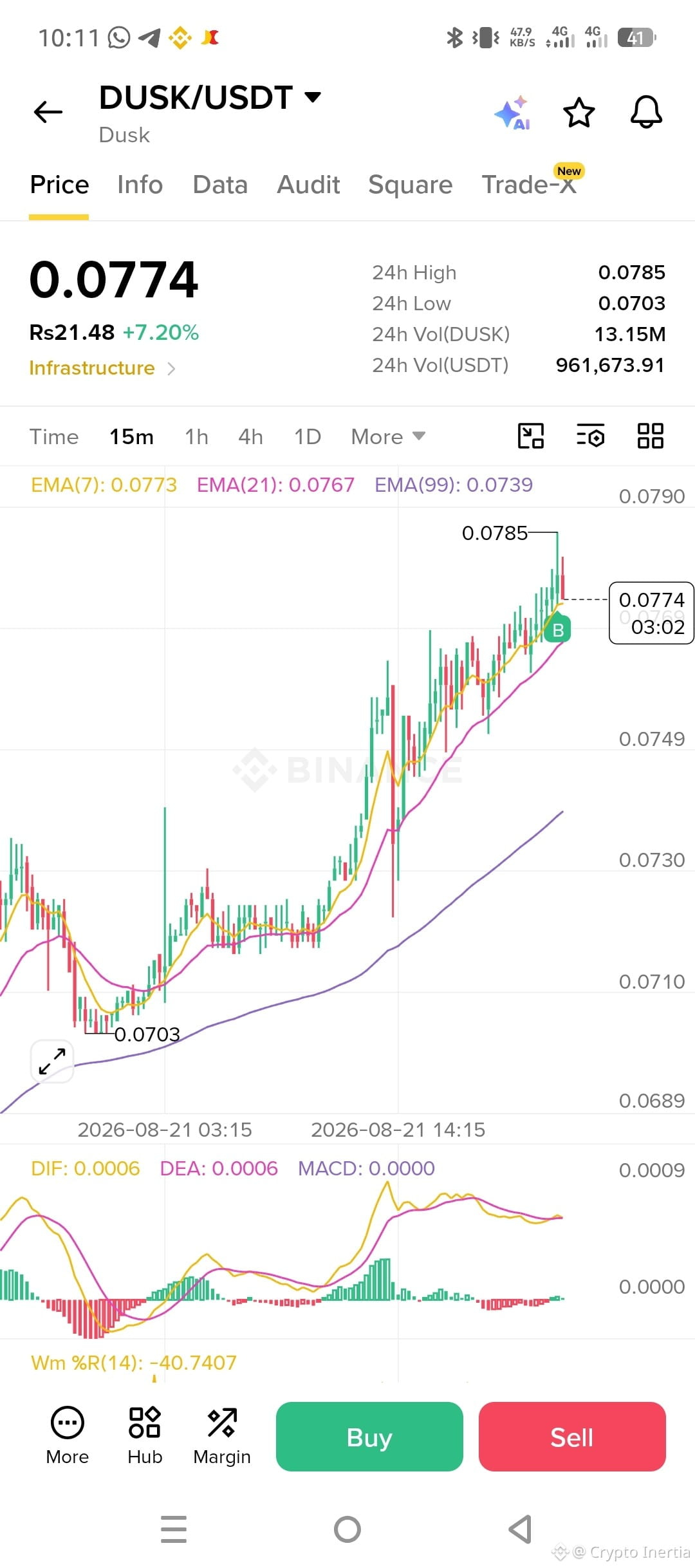
#dusk $DUSK @Dusk_Foundation I've been sitting with my DUSK trade and one number keeps nagging me.
Entered at 0.0630. Current price 0.0779. That's roughly 23% up. Solid on paper. But Williams %R is sitting at -3.97. Deep overbought. The MACD is still positive and the EMA stack is bullish — 7 above 21 above 99. Everything says uptrend. Except that overbought signal.
What does that tell me? Either momentum is strong enough to push through 0.0785 resistance and keep running, or the easy move is done and a rejection sends it back toward the EMAs. Probably both if I'm honest — a test of resistance, then consolidation.
Then I looked at the volume. 13.14M DUSK traded in 24 hours. That's real activity. Not a dead chart. Buy average at 0.0630, sell average at 0.0623. The market is balanced but slightly leaning buy. My entry sits right where buyers stepped in.
What I genuinely don't know is whether this pump is campaign-driven or something deeper in the ecosystem. The partnerships are real. NPEX. Chainlink. EURQ. But the chart doesn't care about announcements. It cares about liquidity and momentum.
The question I keep coming back to — when I research a chain for a campaign and trade it at the same time, am I reading the project or just reading the chart? $DUSK #dusk
#dusk $DUSK @Dusk I've been sitting with my DUSK trade and one number keeps nagging me.
Entered at 0.0630. Current price 0.0779. That's roughly 23% up. Solid on paper. But Williams %R is sitting at -3.97. Deep overbought. The MACD is still positive and the EMA stack is bullish — 7 above 21 above 99. Everything says uptrend. Except that overbought signal.
What does that tell me? Either momentum is strong enough to push through 0.0785 resistance and keep running, or the easy move is done and a rejection sends it back toward the EMAs. Probably both if I'm honest — a test of resistance, then consolidation.
Then I looked at the volume. 13.14M DUSK traded in 24 hours. That's real activity. Not a dead chart. Buy average at 0.0630, sell average at 0.0623. The market is balanced but slightly leaning buy. My entry sits right where buyers stepped in.
What I genuinely don't know is whether this pump is campaign-driven or something deeper in the ecosystem. The partnerships are real. NPEX. Chainlink. EURQ. But the chart doesn't care about announcements. It cares about liquidity and momentum.
The question I keep coming back to — when I research a chain for a campaign and trade it at the same time, am I reading the project or just reading the chart? $DUSK #dusk
Entered at 0.0630. Current price 0.0779. That's roughly 23% up. Solid on paper. But Williams %R is sitting at -3.97. Deep overbought. The MACD is still positive and the EMA stack is bullish — 7 above 21 above 99. Everything says uptrend. Except that overbought signal.
What does that tell me? Either momentum is strong enough to push through 0.0785 resistance and keep running, or the easy move is done and a rejection sends it back toward the EMAs. Probably both if I'm honest — a test of resistance, then consolidation.
Then I looked at the volume. 13.14M DUSK traded in 24 hours. That's real activity. Not a dead chart. Buy average at 0.0630, sell average at 0.0623. The market is balanced but slightly leaning buy. My entry sits right where buyers stepped in.
What I genuinely don't know is whether this pump is campaign-driven or something deeper in the ecosystem. The partnerships are real. NPEX. Chainlink. EURQ. But the chart doesn't care about announcements. It cares about liquidity and momentum.
The question I keep coming back to — when I research a chain for a campaign and trade it at the same time, am I reading the project or just reading the chart? $DUSK #dusk
74
participa en esto y gana recompensas sorprendentes el enlace de la oferta es
#BinanceMidAutumn https://t.me/binancecanteen/254
#BinanceSquareTG
$XAI
{spot}(XAIUSDT)
$NOM
{spot}(NOMUSDT)
participa en esto y gana recompensas sorprendentes el enlace de la oferta es
#BinanceMidAutumn https://t.me/binancecanteen/254
#BinanceSquareTG
$XAI
$NOM
#BinanceMidAutumn https://t.me/binancecanteen/254
#BinanceSquareTG
$XAI
$NOM

427
#dusk $DUSK @Dusk_Foundation ---
El crepúsculo dice finanzas reguladas en cadena. Asociación con NPEX. 21X con licencia DLT-TSS. Quantoz con EURQ. Todo parece sólido.
Pero luego revisé el despliegue real. Dusk Trade sigue en construcción. DuskEVM testnet. Hedger testnet. Licencia DLT-TSS en proceso. Asociaciones firmadas, pero los productos no están listos.
En cadena es la misma historia. 206 provisioners. Participación concentrada. La participación pendiente casi es cero. Presentación institucional, pero la forma real ahora mismo parece un club de validadores.
No sé si esto es normal o si la brecha es demasiado grande. Cuando las instituciones abren el explorador, ¿qué ven — infraestructura de liquidación o una línea de montaje?
$DUSK #dusk
---
#dusk $DUSK @Dusk ---
El crepúsculo dice finanzas reguladas en cadena. Asociación con NPEX. 21X con licencia DLT-TSS. Quantoz con EURQ. Todo parece sólido.
Pero luego revisé el despliegue real. Dusk Trade sigue en construcción. DuskEVM testnet. Hedger testnet. Licencia DLT-TSS en proceso. Asociaciones firmadas, pero los productos no están listos.
En cadena es la misma historia. 206 provisioners. Participación concentrada. La participación pendiente casi es cero. Presentación institucional, pero la forma real ahora mismo parece un club de validadores.
No sé si esto es normal o si la brecha es demasiado grande. Cuando las instituciones abren el explorador, ¿qué ven — infraestructura de liquidación o una línea de montaje?
$DUSK #dusk
---
El crepúsculo dice finanzas reguladas en cadena. Asociación con NPEX. 21X con licencia DLT-TSS. Quantoz con EURQ. Todo parece sólido.
Pero luego revisé el despliegue real. Dusk Trade sigue en construcción. DuskEVM testnet. Hedger testnet. Licencia DLT-TSS en proceso. Asociaciones firmadas, pero los productos no están listos.
En cadena es la misma historia. 206 provisioners. Participación concentrada. La participación pendiente casi es cero. Presentación institucional, pero la forma real ahora mismo parece un club de validadores.
No sé si esto es normal o si la brecha es demasiado grande. Cuando las instituciones abren el explorador, ¿qué ven — infraestructura de liquidación o una línea de montaje?
$DUSK #dusk
---
180
#dusk $DUSK @Dusk_Foundation He estado sentado con el ecosistema DUSK y hay un patrón que no deja de darme vueltas.
Dusk ha reunido socios regulados como ningún otro chain. NPEX con licencias MTF, Broker y ECSP. 21X con el primer DLT-TSS de Europa. Quantoz con EURQ compatible con MiCA. Chainlink para la infraestructura. Cordial para la custodia. Cada asociación aporta algo real. Sólido.
Pero cuando rastreé dónde se conectan realmente estos socios con Dusk ahora mismo, las conexiones son más delgadas de lo que sugieren los anuncios. 21X “está planeando” integrar DuskEVM. La emisión nativa de NPEX necesita aún una licencia en progreso. Dusk Trade está en construcción. Las asociaciones están firmadas. Los puntos de integración están, en su mayoría, por delante.
O bien la secuencia es deliberada: trabajo de base regulatoria antes del despliegue técnico, o la capa de producto va retrasada respecto a la capa de asociación. Probablemente ambas, si soy honesto.
Luego está la otra cara. En la cadena, la red funciona con 206 provisioners con participación concentrada. En papel, es infraestructura institucional. En cadena, es una fase de arranque. Las dos realidades aún no encajan.
Lo que de verdad no sé es si las instituciones evalúan Dusk por la lista de socios o por el estado del despliegue. Ahora mismo, esas cosas cuentan historias distintas.
La pregunta a la que no dejo de volver es: si las asociaciones son lo más fuerte de Dusk y los productos todavía están poniéndose al día, ¿qué significa eso para los próximos seis meses? $DUSK #dusk
#dusk $DUSK @Dusk He estado sentado con el ecosistema DUSK y hay un patrón que no deja de darme vueltas.
Dusk ha reunido socios regulados como ningún otro chain. NPEX con licencias MTF, Broker y ECSP. 21X con el primer DLT-TSS de Europa. Quantoz con EURQ compatible con MiCA. Chainlink para la infraestructura. Cordial para la custodia. Cada asociación aporta algo real. Sólido.
Pero cuando rastreé dónde se conectan realmente estos socios con Dusk ahora mismo, las conexiones son más delgadas de lo que sugieren los anuncios. 21X “está planeando” integrar DuskEVM. La emisión nativa de NPEX necesita aún una licencia en progreso. Dusk Trade está en construcción. Las asociaciones están firmadas. Los puntos de integración están, en su mayoría, por delante.
O bien la secuencia es deliberada: trabajo de base regulatoria antes del despliegue técnico, o la capa de producto va retrasada respecto a la capa de asociación. Probablemente ambas, si soy honesto.
Luego está la otra cara. En la cadena, la red funciona con 206 provisioners con participación concentrada. En papel, es infraestructura institucional. En cadena, es una fase de arranque. Las dos realidades aún no encajan.
Lo que de verdad no sé es si las instituciones evalúan Dusk por la lista de socios o por el estado del despliegue. Ahora mismo, esas cosas cuentan historias distintas.
La pregunta a la que no dejo de volver es: si las asociaciones son lo más fuerte de Dusk y los productos todavía están poniéndose al día, ¿qué significa eso para los próximos seis meses? $DUSK #dusk
Dusk ha reunido socios regulados como ningún otro chain. NPEX con licencias MTF, Broker y ECSP. 21X con el primer DLT-TSS de Europa. Quantoz con EURQ compatible con MiCA. Chainlink para la infraestructura. Cordial para la custodia. Cada asociación aporta algo real. Sólido.
Pero cuando rastreé dónde se conectan realmente estos socios con Dusk ahora mismo, las conexiones son más delgadas de lo que sugieren los anuncios. 21X “está planeando” integrar DuskEVM. La emisión nativa de NPEX necesita aún una licencia en progreso. Dusk Trade está en construcción. Las asociaciones están firmadas. Los puntos de integración están, en su mayoría, por delante.
O bien la secuencia es deliberada: trabajo de base regulatoria antes del despliegue técnico, o la capa de producto va retrasada respecto a la capa de asociación. Probablemente ambas, si soy honesto.
Luego está la otra cara. En la cadena, la red funciona con 206 provisioners con participación concentrada. En papel, es infraestructura institucional. En cadena, es una fase de arranque. Las dos realidades aún no encajan.
Lo que de verdad no sé es si las instituciones evalúan Dusk por la lista de socios o por el estado del despliegue. Ahora mismo, esas cosas cuentan historias distintas.
La pregunta a la que no dejo de volver es: si las asociaciones son lo más fuerte de Dusk y los productos todavía están poniéndose al día, ¿qué significa eso para los próximos seis meses? $DUSK #dusk
1
1
96
#dusk $DUSK @Dusk_Foundation He estado sentado con el anuncio de DUSK y 21X, y un detalle no deja de rondarme la cabeza.
21X es la primera empresa en recibir la licencia DLT-TSS bajo Europa$DUSK
{spot}(DUSKUSDT)
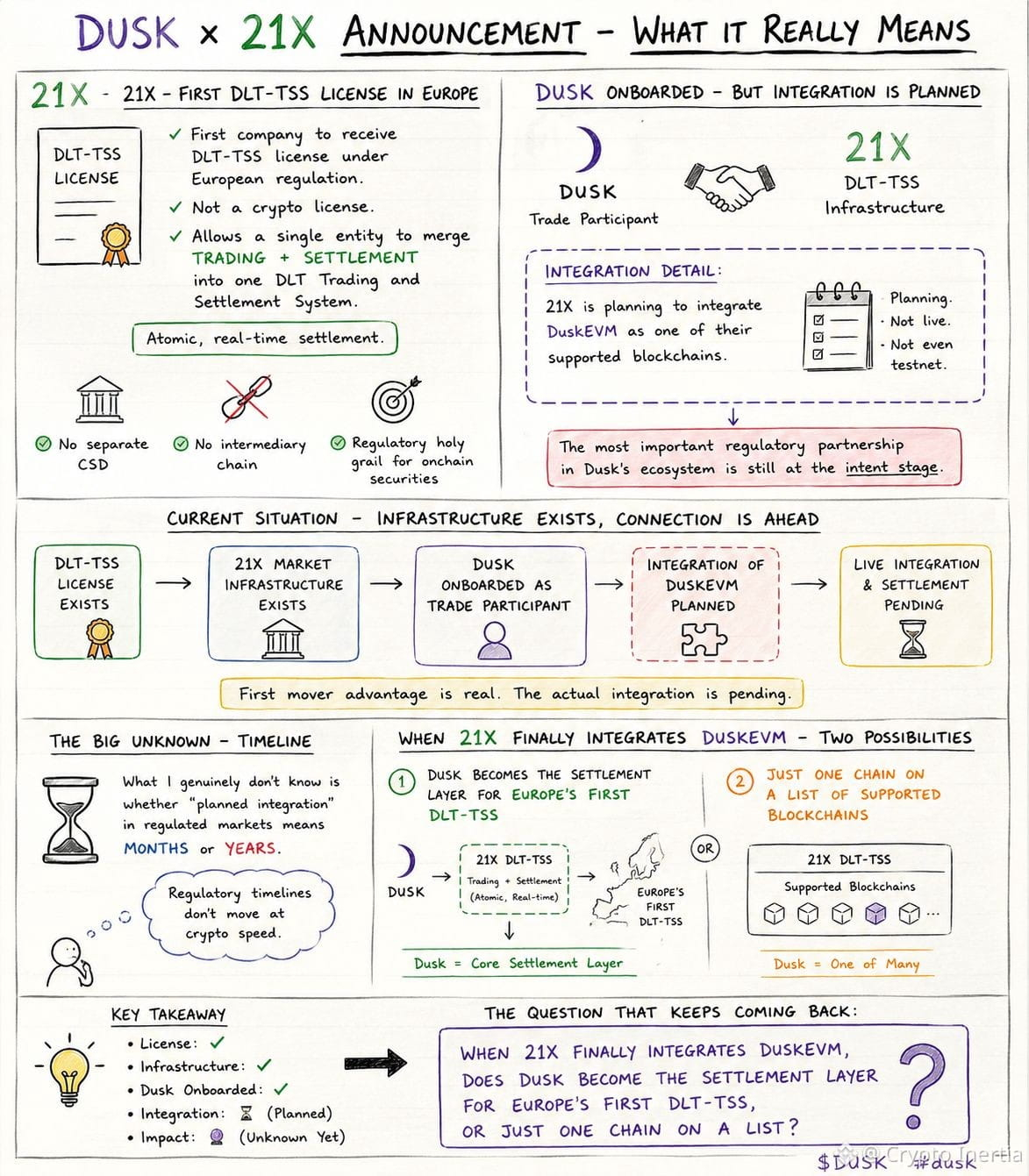
regulación. Eso no es una licencia de cripto. Permite que una sola entidad unifique la negociación y la liquidación —funciones tradicionalmente separadas— en un único Sistema de Negociación y Liquidación con DLT. Liquidación atómica y en tiempo real. Sin CSD independiente. Sin cadena intermediaria. Este es el santo grial regulatorio para los valores onchain.
Dusk está incorporado como participante de la negociación. Sólido. Pero luego leo el detalle de la integración. 21X “planea integrar DuskEVM” como una de sus blockchains compatibles. Planificado. No en vivo. Ni siquiera testnet. La asociación regulatoria más importante en el ecosistema de Dusk aún está en la fase de intención. O la incorporación regulatoria tarda más de lo que sugiere el anuncio, o la integración técnica está esperando a que DuskEVM madure primero. Probablemente ambas.
Luego está el patrón más amplio. NPEX ha confirmado €200M+ en financiación, pero DLT-TSS está en marcha. Dusk Trade está construyéndose. Hedger es testnet. La lista de socios es real, pero la pila de despliegue detrás aún se está ensamblando. El relato regulatorio dice “el primer exchange de valores impulsado por blockchain de Europa”. Los documentos dicen “en construcción” y “testnet”.
Lo que de verdad no sé es si “integración planificada” en mercados regulados significa meses o años. Los plazos regulatorios no avanzan a la velocidad del cripto.
La pregunta a la que no dejo de volver —cuando 21X finalmente integre DuskEVM— ¿Dusk se convierte en la capa de liquidación para el primer DLT-TSS de Europa, o solo en una cadena más de una lista?
#dusk $DUSK @Dusk He estado sentado con el anuncio de DUSK y 21X, y un detalle no deja de rondarme la cabeza.
21X es la primera empresa en recibir la licencia DLT-TSS bajo Europa$DUSK
regulación. Eso no es una licencia de cripto. Permite que una sola entidad unifique la negociación y la liquidación —funciones tradicionalmente separadas— en un único Sistema de Negociación y Liquidación con DLT. Liquidación atómica y en tiempo real. Sin CSD independiente. Sin cadena intermediaria. Este es el santo grial regulatorio para los valores onchain.
Dusk está incorporado como participante de la negociación. Sólido. Pero luego leo el detalle de la integración. 21X “planea integrar DuskEVM” como una de sus blockchains compatibles. Planificado. No en vivo. Ni siquiera testnet. La asociación regulatoria más importante en el ecosistema de Dusk aún está en la fase de intención. O la incorporación regulatoria tarda más de lo que sugiere el anuncio, o la integración técnica está esperando a que DuskEVM madure primero. Probablemente ambas.
Luego está el patrón más amplio. NPEX ha confirmado €200M+ en financiación, pero DLT-TSS está en marcha. Dusk Trade está construyéndose. Hedger es testnet. La lista de socios es real, pero la pila de despliegue detrás aún se está ensamblando. El relato regulatorio dice “el primer exchange de valores impulsado por blockchain de Europa”. Los documentos dicen “en construcción” y “testnet”.
Lo que de verdad no sé es si “integración planificada” en mercados regulados significa meses o años. Los plazos regulatorios no avanzan a la velocidad del cripto.
La pregunta a la que no dejo de volver —cuando 21X finalmente integre DuskEVM— ¿Dusk se convierte en la capa de liquidación para el primer DLT-TSS de Europa, o solo en una cadena más de una lista?
21X es la primera empresa en recibir la licencia DLT-TSS bajo Europa$DUSK
regulación. Eso no es una licencia de cripto. Permite que una sola entidad unifique la negociación y la liquidación —funciones tradicionalmente separadas— en un único Sistema de Negociación y Liquidación con DLT. Liquidación atómica y en tiempo real. Sin CSD independiente. Sin cadena intermediaria. Este es el santo grial regulatorio para los valores onchain.
Dusk está incorporado como participante de la negociación. Sólido. Pero luego leo el detalle de la integración. 21X “planea integrar DuskEVM” como una de sus blockchains compatibles. Planificado. No en vivo. Ni siquiera testnet. La asociación regulatoria más importante en el ecosistema de Dusk aún está en la fase de intención. O la incorporación regulatoria tarda más de lo que sugiere el anuncio, o la integración técnica está esperando a que DuskEVM madure primero. Probablemente ambas.
Luego está el patrón más amplio. NPEX ha confirmado €200M+ en financiación, pero DLT-TSS está en marcha. Dusk Trade está construyéndose. Hedger es testnet. La lista de socios es real, pero la pila de despliegue detrás aún se está ensamblando. El relato regulatorio dice “el primer exchange de valores impulsado por blockchain de Europa”. Los documentos dicen “en construcción” y “testnet”.
Lo que de verdad no sé es si “integración planificada” en mercados regulados significa meses o años. Los plazos regulatorios no avanzan a la velocidad del cripto.
La pregunta a la que no dejo de volver —cuando 21X finalmente integre DuskEVM— ¿Dusk se convierte en la capa de liquidación para el primer DLT-TSS de Europa, o solo en una cadena más de una lista?
87
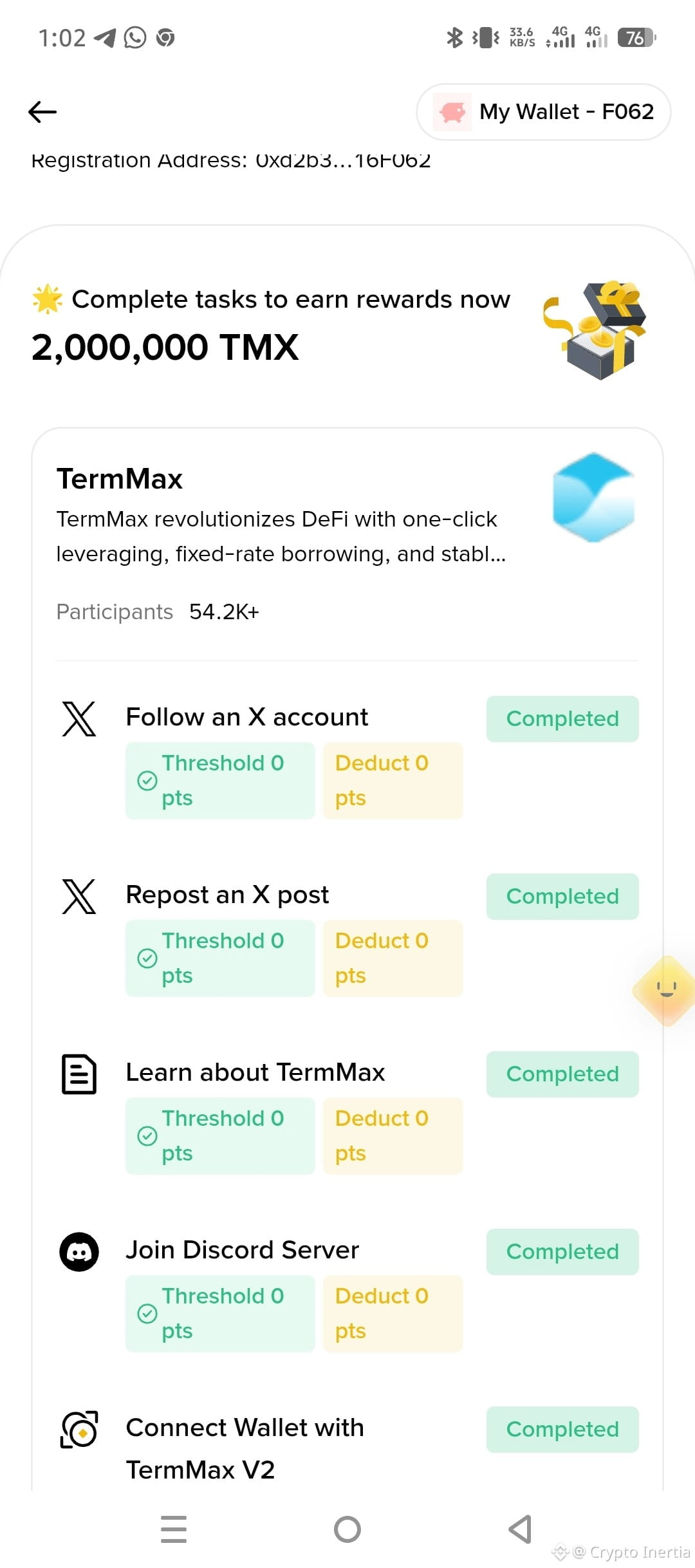
#termmax @termmax Terminé hoy las tareas de la campaña del booster TermMax y algo del quiz en realidad se me quedó.
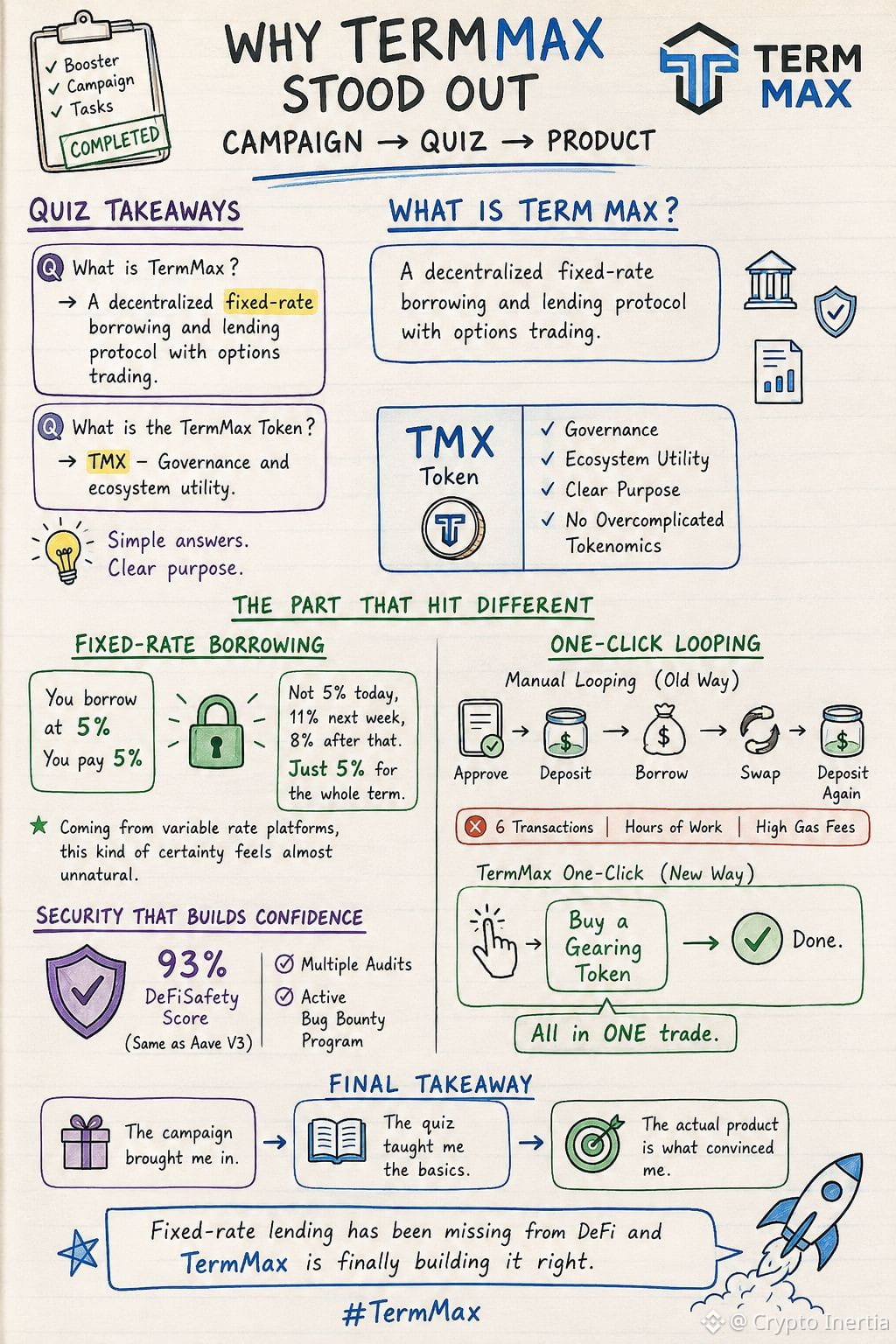
La sección de aprendizaje preguntó qué es TermMax. La respuesta fue simple. Un protocolo descentralizado de préstamos y empréstitos con tasa fija, con opciones de trading. Tasas fijas. Plazos fijos. No el caos de tasa variable al que todos estamos acostumbrados. Luego preguntó sobre el token. TMX. Gobernanza y utilidad en el ecosistema. Sin tokenomics innecesariamente complicadas. Solo un propósito claro.
Eso fue lo que me llevó a profundizar en los documentos de @TermMax.
La parte de los préstamos a tasa fija es lo que sigo pensando. Te prestas al 5%. Pagas 5%. No 5% hoy, 11% la próxima semana, 8% después. Solo 5% durante todo el plazo. Al venir de plataformas donde las tasas fluctúan constantemente, ese tipo de certeza se siente casi antinatural. El bucle con un solo clic también es inteligente. Recuerdo que el looping manual me llevaba seis transacciones y toda una tarde. Aprobar, depositar, pedir prestado, intercambiar, depositar de nuevo. Comisiones de gas en cada paso. TermMax lo envuelve todo en una sola operación. Compras un Gearing Token y listo.
En seguridad van bien. Puntuación DeFiSafety del 93%. Igual que Aave V3. Múltiples auditorías y un bug bounty activo.
La campaña me trajo. El quiz me enseñó los fundamentos. El producto en sí es lo que me convenció. El lending a tasa fija le faltaba a DeFi y TermMax por fin lo está construyendo bien.
#termmax @TermMax Terminé hoy las tareas de la campaña del booster TermMax y algo del quiz en realidad se me quedó.
La sección de aprendizaje preguntó qué es TermMax. La respuesta fue simple. Un protocolo descentralizado de préstamos y empréstitos con tasa fija, con opciones de trading. Tasas fijas. Plazos fijos. No el caos de tasa variable al que todos estamos acostumbrados. Luego preguntó sobre el token. TMX. Gobernanza y utilidad en el ecosistema. Sin tokenomics innecesariamente complicadas. Solo un propósito claro.
Eso fue lo que me llevó a profundizar en los documentos de @TermMax.
La parte de los préstamos a tasa fija es lo que sigo pensando. Te prestas al 5%. Pagas 5%. No 5% hoy, 11% la próxima semana, 8% después. Solo 5% durante todo el plazo. Al venir de plataformas donde las tasas fluctúan constantemente, ese tipo de certeza se siente casi antinatural. El bucle con un solo clic también es inteligente. Recuerdo que el looping manual me llevaba seis transacciones y toda una tarde. Aprobar, depositar, pedir prestado, intercambiar, depositar de nuevo. Comisiones de gas en cada paso. TermMax lo envuelve todo en una sola operación. Compras un Gearing Token y listo.
En seguridad van bien. Puntuación DeFiSafety del 93%. Igual que Aave V3. Múltiples auditorías y un bug bounty activo.
La campaña me trajo. El quiz me enseñó los fundamentos. El producto en sí es lo que me convenció. El lending a tasa fija le faltaba a DeFi y TermMax por fin lo está construyendo bien.
La sección de aprendizaje preguntó qué es TermMax. La respuesta fue simple. Un protocolo descentralizado de préstamos y empréstitos con tasa fija, con opciones de trading. Tasas fijas. Plazos fijos. No el caos de tasa variable al que todos estamos acostumbrados. Luego preguntó sobre el token. TMX. Gobernanza y utilidad en el ecosistema. Sin tokenomics innecesariamente complicadas. Solo un propósito claro.
Eso fue lo que me llevó a profundizar en los documentos de @TermMax.
La parte de los préstamos a tasa fija es lo que sigo pensando. Te prestas al 5%. Pagas 5%. No 5% hoy, 11% la próxima semana, 8% después. Solo 5% durante todo el plazo. Al venir de plataformas donde las tasas fluctúan constantemente, ese tipo de certeza se siente casi antinatural. El bucle con un solo clic también es inteligente. Recuerdo que el looping manual me llevaba seis transacciones y toda una tarde. Aprobar, depositar, pedir prestado, intercambiar, depositar de nuevo. Comisiones de gas en cada paso. TermMax lo envuelve todo en una sola operación. Compras un Gearing Token y listo.
En seguridad van bien. Puntuación DeFiSafety del 93%. Igual que Aave V3. Múltiples auditorías y un bug bounty activo.
La campaña me trajo. El quiz me enseñó los fundamentos. El producto en sí es lo que me convenció. El lending a tasa fija le faltaba a DeFi y TermMax por fin lo está construyendo bien.
2
90
#dusk $DUSK @Dusk_Foundation
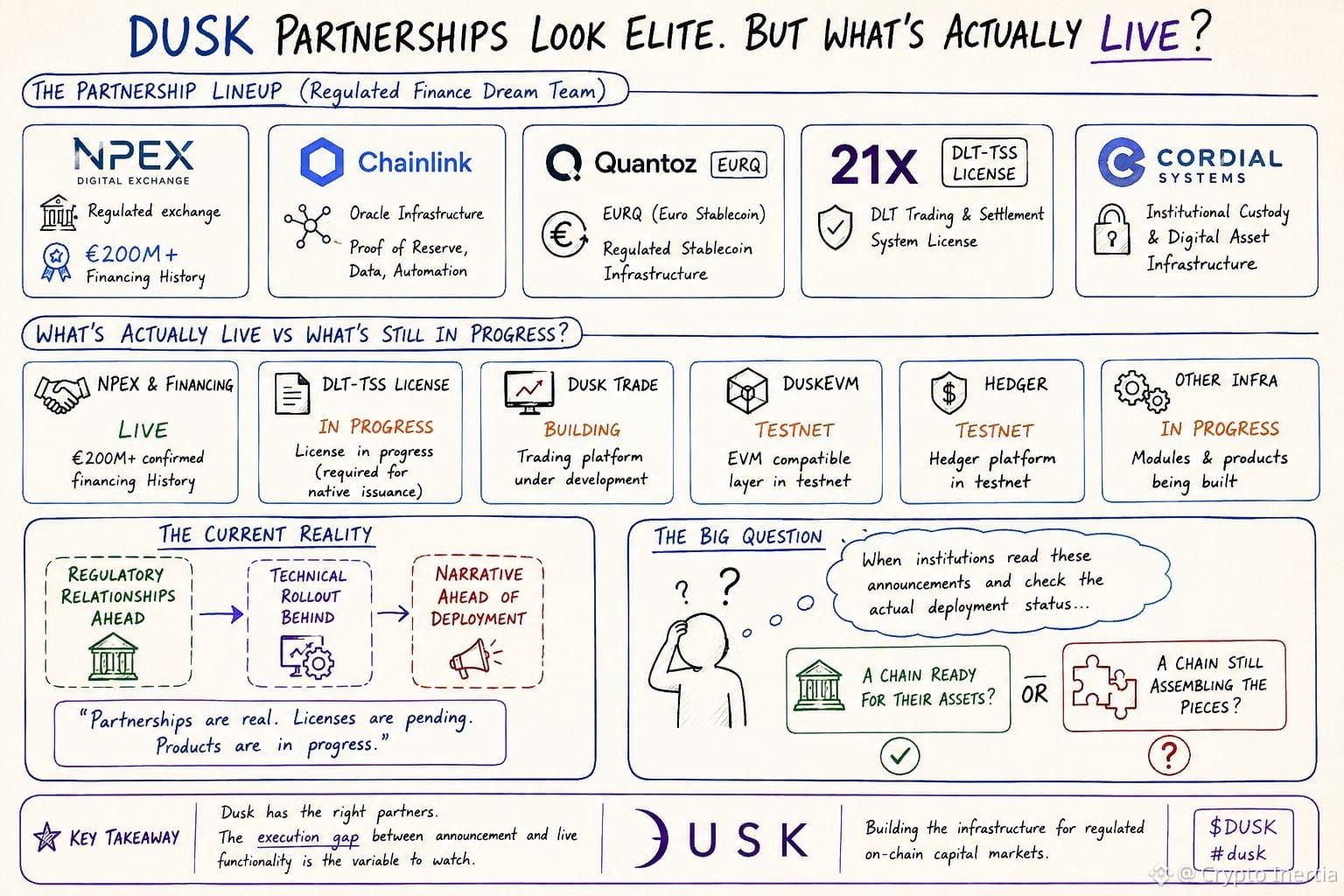
He estado leyendo los anuncios de la alianza de DUSK y hay algo que no deja de rondarme.
Dusk tiene NPEX. Chainlink. Quantoz con EURQ. 21X con la licencia DLT-TSS. Cordial Systems para custodia. La lista de alianzas parece un equipo soñado de finanzas reguladas: cada una aporta licencias, infraestructura o alcance institucional. Sólido.
Pero entonces miré lo que realmente está en funcionamiento frente a lo que se ha anunciado. NPEX ha confirmado un historial de financiación de más de 200M€ , pero la licencia DLT-TSS necesaria para la emisión nativa aún está en progreso. Dusk Trade sigue construyéndose. DuskEVM está en testnet. Hedger está en testnet. Los anuncios de la alianza son reales. El estado de producción de los productos de los que dependen esas alianzas es otra historia.
Así que tienes una situación en la que las relaciones regulatorias van por delante del despliegue técnico. Las instituciones se nombran. Las licencias están pendientes. Los productos están en progreso. El relato dice "el primer exchange de seguridad basado en blockchain de Europa". La documentación dice "en construcción" y "testnet."
Lo que honestamente no sé es si esta es una secuencia normal para una infraestructura regulada — alianzas primero, productos después — o si la brecha entre el anuncio y la funcionalidad en vivo es mayor de lo que sugieren los titulares.
La pregunta que no dejo de repetirme — cuando las instituciones leen estos anuncios y luego revisan el estado real del despliegue — ¿ven una cadena lista para sus activos, o una cadena todavía ensamblando las piezas?
#dusk $DUSK @Dusk
He estado leyendo los anuncios de la alianza de DUSK y hay algo que no deja de rondarme.
Dusk tiene NPEX. Chainlink. Quantoz con EURQ. 21X con la licencia DLT-TSS. Cordial Systems para custodia. La lista de alianzas parece un equipo soñado de finanzas reguladas: cada una aporta licencias, infraestructura o alcance institucional. Sólido.
Pero entonces miré lo que realmente está en funcionamiento frente a lo que se ha anunciado. NPEX ha confirmado un historial de financiación de más de 200M€ , pero la licencia DLT-TSS necesaria para la emisión nativa aún está en progreso. Dusk Trade sigue construyéndose. DuskEVM está en testnet. Hedger está en testnet. Los anuncios de la alianza son reales. El estado de producción de los productos de los que dependen esas alianzas es otra historia.
Así que tienes una situación en la que las relaciones regulatorias van por delante del despliegue técnico. Las instituciones se nombran. Las licencias están pendientes. Los productos están en progreso. El relato dice "el primer exchange de seguridad basado en blockchain de Europa". La documentación dice "en construcción" y "testnet."
Lo que honestamente no sé es si esta es una secuencia normal para una infraestructura regulada — alianzas primero, productos después — o si la brecha entre el anuncio y la funcionalidad en vivo es mayor de lo que sugieren los titulares.
La pregunta que no dejo de repetirme — cuando las instituciones leen estos anuncios y luego revisan el estado real del despliegue — ¿ven una cadena lista para sus activos, o una cadena todavía ensamblando las piezas?
He estado leyendo los anuncios de la alianza de DUSK y hay algo que no deja de rondarme.
Dusk tiene NPEX. Chainlink. Quantoz con EURQ. 21X con la licencia DLT-TSS. Cordial Systems para custodia. La lista de alianzas parece un equipo soñado de finanzas reguladas: cada una aporta licencias, infraestructura o alcance institucional. Sólido.
Pero entonces miré lo que realmente está en funcionamiento frente a lo que se ha anunciado. NPEX ha confirmado un historial de financiación de más de 200M€ , pero la licencia DLT-TSS necesaria para la emisión nativa aún está en progreso. Dusk Trade sigue construyéndose. DuskEVM está en testnet. Hedger está en testnet. Los anuncios de la alianza son reales. El estado de producción de los productos de los que dependen esas alianzas es otra historia.
Así que tienes una situación en la que las relaciones regulatorias van por delante del despliegue técnico. Las instituciones se nombran. Las licencias están pendientes. Los productos están en progreso. El relato dice "el primer exchange de seguridad basado en blockchain de Europa". La documentación dice "en construcción" y "testnet."
Lo que honestamente no sé es si esta es una secuencia normal para una infraestructura regulada — alianzas primero, productos después — o si la brecha entre el anuncio y la funcionalidad en vivo es mayor de lo que sugieren los titulares.
La pregunta que no dejo de repetirme — cuando las instituciones leen estos anuncios y luego revisan el estado real del despliegue — ¿ven una cadena lista para sus activos, o una cadena todavía ensamblando las piezas?
1
1
84
#termmax @termmax
He estado usando plataformas de préstamos DeFi durante dos años y TermMax es la primera que realmente me sorprendió.
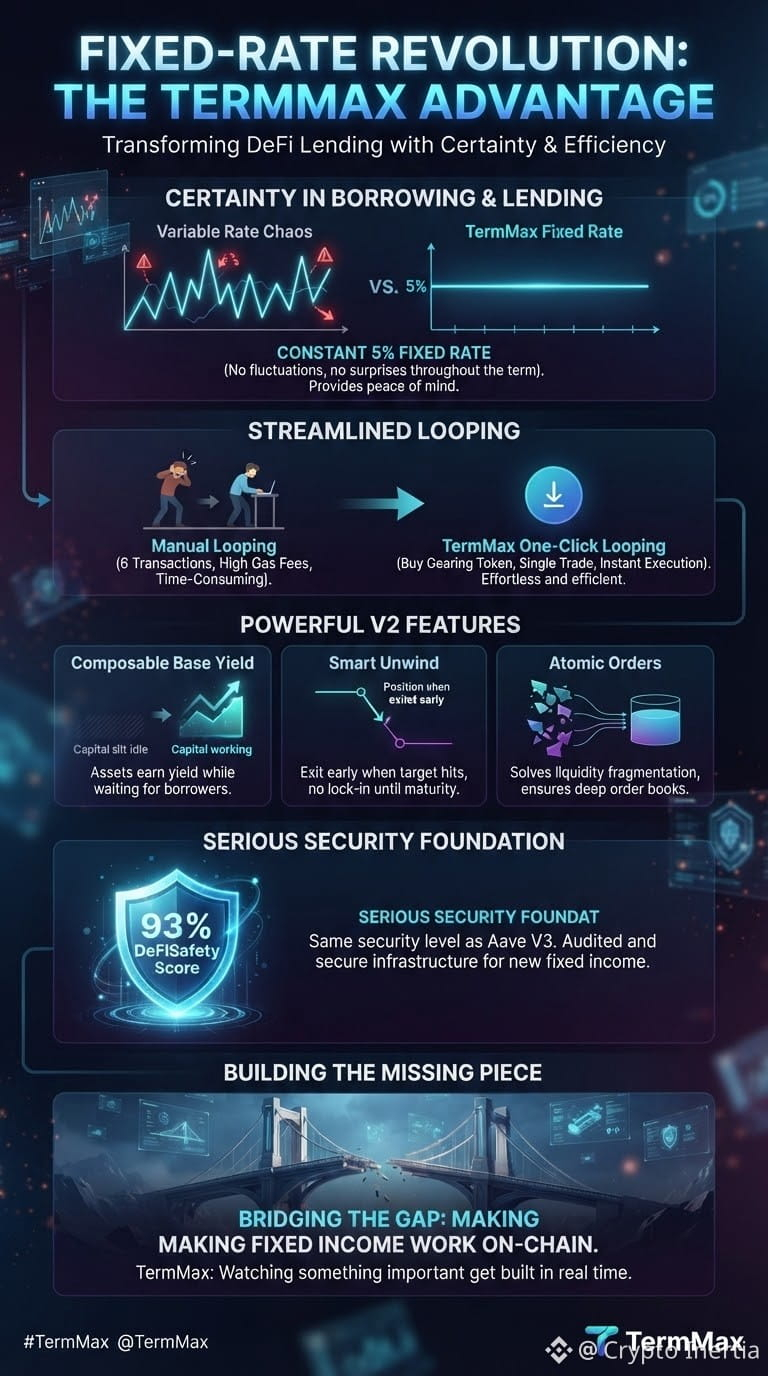
lo de la tasa fija suena simple hasta que lo experimentas. Pides prestado al 5%. Pagas el 5%. No un 5% hoy, 8% mañana, 12% la próxima semana cuando se dispare la utilización. Solo 5%. Durante todo el plazo. Esa clase de certeza no existe en ningún otro lugar de DeFi ahora mismo.
Luego está el bucle en un solo clic. Recuerdo haber pasado toda una tarde haciendo bucle manual en otra plataforma. Seis transacciones. Las comisiones de gas se comían mi posición. Revisando constantemente si lo había hecho bien. TermMax hace todo eso en una sola operación. Compras el Token Gearing y ya está. Casi demasiado fácil.
Las funciones de la V2 son lo que de verdad llamó mi atención. Composable Base Yield significa que tus activos generan ganancias mientras esperas a los prestatarios. Sin capital ocioso. Smart Unwind te permite salir antes cuando alcanzas tu objetivo en lugar de quedar bloqueado hasta el vencimiento. Atomic Orders resuelve la fragmentación de liquidez que destruyó a las plataformas de tasa fija anteriores. No son mejoras pequeñas. Están resolviendo los problemas exactos que hicieron que el DeFi de tasa fija fallara antes.
Y la seguridad es genuinamente seria. Puntuación 93% DeFiSafety. Igual que Aave V3. Eso es raro para un protocolo tan joven.
El lending de tasa fija ha sido la pieza que faltaba en DeFi. Las tasas variables son impredecibles. TermMax está construyendo la infraestructura que realmente hace que la renta fija funcione on-chain.
Esto se siente como ver algo importante construirse en tiempo real.
$BOME
{spot}(BOMEUSDT)
$BIO
{spot}(BIOUSDT)
$RE
{spot}(REUSDT)
#termmax @TermMax
He estado usando plataformas de préstamos DeFi durante dos años y TermMax es la primera que realmente me sorprendió.
lo de la tasa fija suena simple hasta que lo experimentas. Pides prestado al 5%. Pagas el 5%. No un 5% hoy, 8% mañana, 12% la próxima semana cuando se dispare la utilización. Solo 5%. Durante todo el plazo. Esa clase de certeza no existe en ningún otro lugar de DeFi ahora mismo.
Luego está el bucle en un solo clic. Recuerdo haber pasado toda una tarde haciendo bucle manual en otra plataforma. Seis transacciones. Las comisiones de gas se comían mi posición. Revisando constantemente si lo había hecho bien. TermMax hace todo eso en una sola operación. Compras el Token Gearing y ya está. Casi demasiado fácil.
Las funciones de la V2 son lo que de verdad llamó mi atención. Composable Base Yield significa que tus activos generan ganancias mientras esperas a los prestatarios. Sin capital ocioso. Smart Unwind te permite salir antes cuando alcanzas tu objetivo en lugar de quedar bloqueado hasta el vencimiento. Atomic Orders resuelve la fragmentación de liquidez que destruyó a las plataformas de tasa fija anteriores. No son mejoras pequeñas. Están resolviendo los problemas exactos que hicieron que el DeFi de tasa fija fallara antes.
Y la seguridad es genuinamente seria. Puntuación 93% DeFiSafety. Igual que Aave V3. Eso es raro para un protocolo tan joven.
El lending de tasa fija ha sido la pieza que faltaba en DeFi. Las tasas variables son impredecibles. TermMax está construyendo la infraestructura que realmente hace que la renta fija funcione on-chain.
Esto se siente como ver algo importante construirse en tiempo real.
$BOME
$BIO
$RE
He estado usando plataformas de préstamos DeFi durante dos años y TermMax es la primera que realmente me sorprendió.
lo de la tasa fija suena simple hasta que lo experimentas. Pides prestado al 5%. Pagas el 5%. No un 5% hoy, 8% mañana, 12% la próxima semana cuando se dispare la utilización. Solo 5%. Durante todo el plazo. Esa clase de certeza no existe en ningún otro lugar de DeFi ahora mismo.
Luego está el bucle en un solo clic. Recuerdo haber pasado toda una tarde haciendo bucle manual en otra plataforma. Seis transacciones. Las comisiones de gas se comían mi posición. Revisando constantemente si lo había hecho bien. TermMax hace todo eso en una sola operación. Compras el Token Gearing y ya está. Casi demasiado fácil.
Las funciones de la V2 son lo que de verdad llamó mi atención. Composable Base Yield significa que tus activos generan ganancias mientras esperas a los prestatarios. Sin capital ocioso. Smart Unwind te permite salir antes cuando alcanzas tu objetivo en lugar de quedar bloqueado hasta el vencimiento. Atomic Orders resuelve la fragmentación de liquidez que destruyó a las plataformas de tasa fija anteriores. No son mejoras pequeñas. Están resolviendo los problemas exactos que hicieron que el DeFi de tasa fija fallara antes.
Y la seguridad es genuinamente seria. Puntuación 93% DeFiSafety. Igual que Aave V3. Eso es raro para un protocolo tan joven.
El lending de tasa fija ha sido la pieza que faltaba en DeFi. Las tasas variables son impredecibles. TermMax está construyendo la infraestructura que realmente hace que la renta fija funcione on-chain.
Esto se siente como ver algo importante construirse en tiempo real.
$BOME
$BIO
$RE
199
#dusk $DUSK @Dusk_Foundation He vuelto a estar sentado de nuevo con el explorador DUDE no oficial y hay una cosa que no me deja.
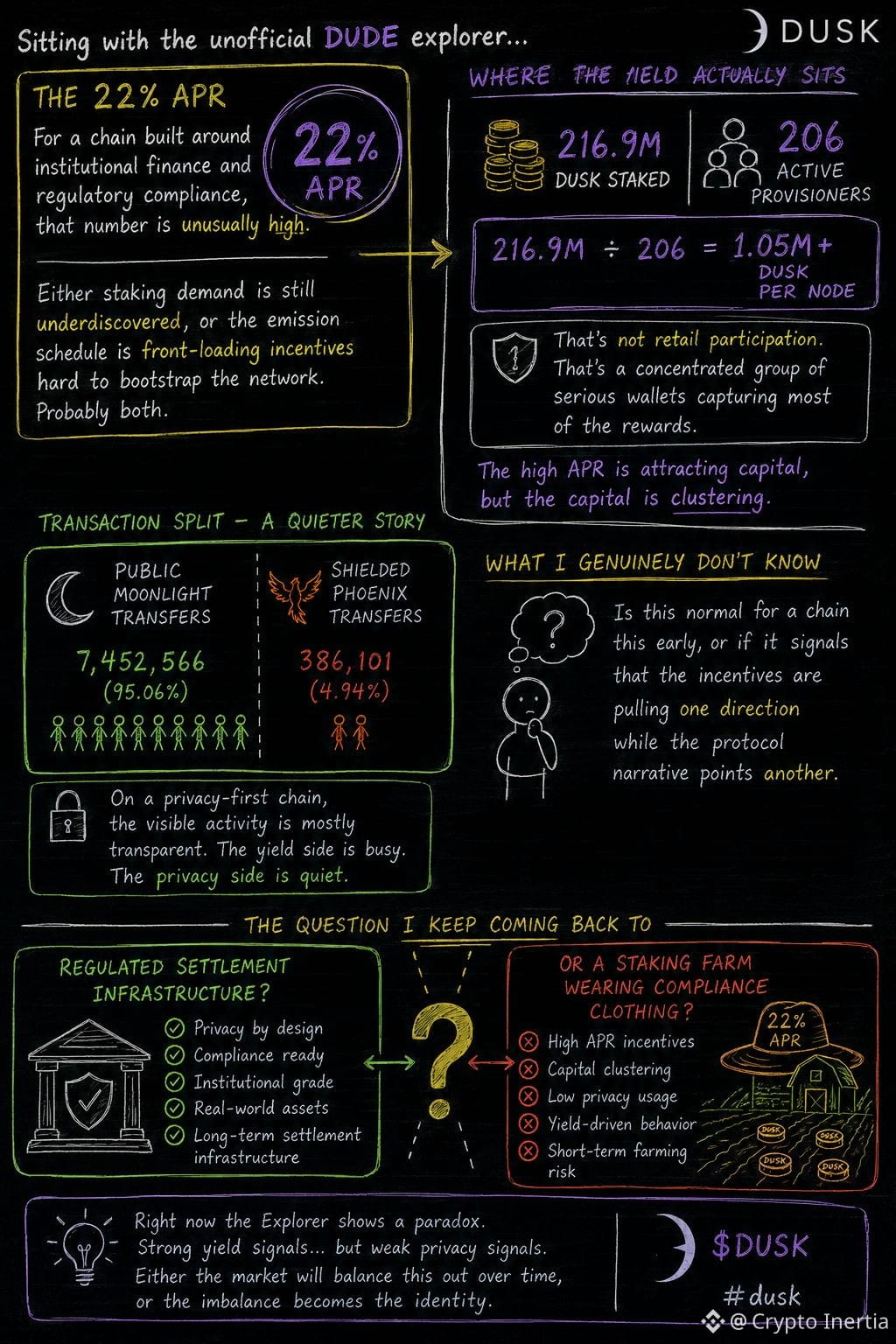
El 22% de APR. Para una cadena construida alrededor de las finanzas institucionales y el cumplimiento normativo, ese número es inusualmente alto. O bien aún no se ha descubierto del todo la demanda de staking, o el calendario de emisiones está adelantando con fuerza incentivos para arrancar la red. Probablemente ambas.
Luego miré dónde realmente se ubica ese rendimiento. 216.9M @Dusk en staking. 206 provisioners activos. Las cuentas dan un promedio de más de un millón de DUSK por nodo. Eso no es participación minorista. Es un grupo concentrado de carteras serias que captura la mayor parte de las recompensas. El alto APR está atrayendo capital, pero el capital se está agrupando.
Mientras tanto, la distribución de transacciones cuenta otra historia más silenciosa. Las transferencias de Moonlight público van mucho por delante de las transacciones de Phoenix con escudo. En una cadena orientada a la privacidad, la actividad visible es mayormente transparente. La parte del rendimiento está ocupada. La parte de la privacidad está en silencio.
Lo que de verdad no sé es si esto es normal para una cadena tan temprana, o si señala que los incentivos están tirando en una dirección mientras que la narrativa del protocolo apunta a otra.
La pregunta a la que vuelvo una y otra vez — cuando las instituciones miran este explorador, ¿ven infraestructura de liquidación regulada, o ven una granja de staking con ropa de cumplimiento? $DUSK #dusk
#dusk $DUSK @Dusk He vuelto a estar sentado de nuevo con el explorador DUDE no oficial y hay una cosa que no me deja.
El 22% de APR. Para una cadena construida alrededor de las finanzas institucionales y el cumplimiento normativo, ese número es inusualmente alto. O bien aún no se ha descubierto del todo la demanda de staking, o el calendario de emisiones está adelantando con fuerza incentivos para arrancar la red. Probablemente ambas.
Luego miré dónde realmente se ubica ese rendimiento. 216.9M @Dusk en staking. 206 provisioners activos. Las cuentas dan un promedio de más de un millón de DUSK por nodo. Eso no es participación minorista. Es un grupo concentrado de carteras serias que captura la mayor parte de las recompensas. El alto APR está atrayendo capital, pero el capital se está agrupando.
Mientras tanto, la distribución de transacciones cuenta otra historia más silenciosa. Las transferencias de Moonlight público van mucho por delante de las transacciones de Phoenix con escudo. En una cadena orientada a la privacidad, la actividad visible es mayormente transparente. La parte del rendimiento está ocupada. La parte de la privacidad está en silencio.
Lo que de verdad no sé es si esto es normal para una cadena tan temprana, o si señala que los incentivos están tirando en una dirección mientras que la narrativa del protocolo apunta a otra.
La pregunta a la que vuelvo una y otra vez — cuando las instituciones miran este explorador, ¿ven infraestructura de liquidación regulada, o ven una granja de staking con ropa de cumplimiento? $DUSK #dusk
El 22% de APR. Para una cadena construida alrededor de las finanzas institucionales y el cumplimiento normativo, ese número es inusualmente alto. O bien aún no se ha descubierto del todo la demanda de staking, o el calendario de emisiones está adelantando con fuerza incentivos para arrancar la red. Probablemente ambas.
Luego miré dónde realmente se ubica ese rendimiento. 216.9M @Dusk en staking. 206 provisioners activos. Las cuentas dan un promedio de más de un millón de DUSK por nodo. Eso no es participación minorista. Es un grupo concentrado de carteras serias que captura la mayor parte de las recompensas. El alto APR está atrayendo capital, pero el capital se está agrupando.
Mientras tanto, la distribución de transacciones cuenta otra historia más silenciosa. Las transferencias de Moonlight público van mucho por delante de las transacciones de Phoenix con escudo. En una cadena orientada a la privacidad, la actividad visible es mayormente transparente. La parte del rendimiento está ocupada. La parte de la privacidad está en silencio.
Lo que de verdad no sé es si esto es normal para una cadena tan temprana, o si señala que los incentivos están tirando en una dirección mientras que la narrativa del protocolo apunta a otra.
La pregunta a la que vuelvo una y otra vez — cuando las instituciones miran este explorador, ¿ven infraestructura de liquidación regulada, o ven una granja de staking con ropa de cumplimiento? $DUSK #dusk
2
75
#termmax @termmax
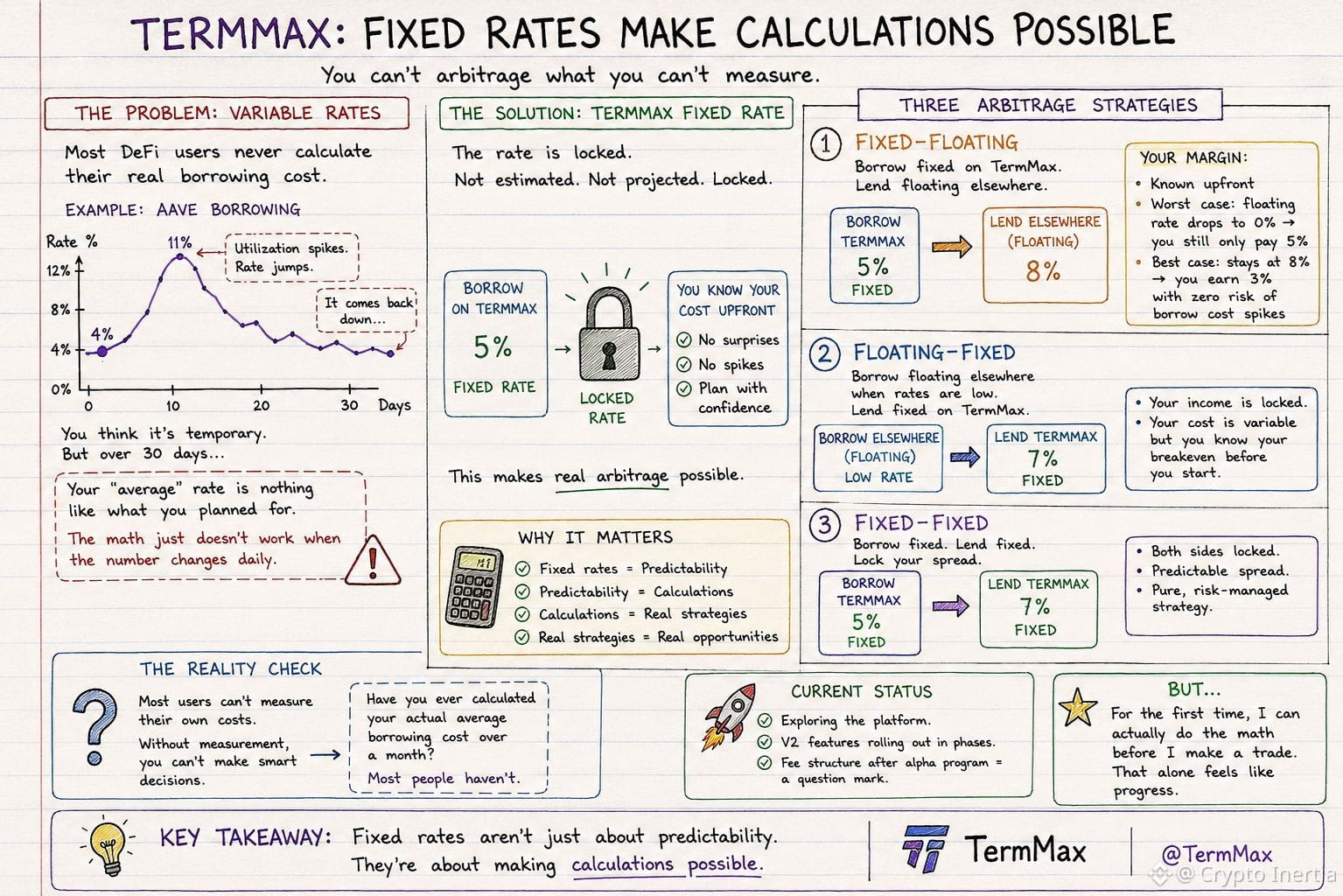
La mayoría de los usuarios de DeFi nunca han calculado realmente su coste real de endeudamiento. Lo sé porque yo tampoco lo hice durante meses. Te prestas en Aave al 4%. Parece bien. Entonces la utilización se dispara y de repente es 11%. Te dices a ti mismo que es temporal. Vuelve a bajar. Pero cuando realmente lo sigues durante 30 días, tu "tasa" "promedio" no se parece en nada a lo que planeaste. La matemática simplemente no funciona cuando el número cambia a diario.
termMax lo arregla de una manera que suena aburrida hasta que lo piensas. La tasa queda bloqueada. No es estimada. No es proyectada. Queda bloqueada.
Eso significa que por fin puedes hacer un arbitraje de tasas correcto. Pide prestado fijo en TermMax al 5%. Presta flotante en otro lugar al 8%. Tu margen se conoce de antemano. En el peor de los casos, la tasa flotante cae a cero y aun así solo pierdes un 5%. En el mejor de los casos se mantiene en 8% y te llevas un 3% con cero riesgo de que tu coste de endeudamiento explote. O al revés. Pide prestado flotante en otro lugar cuando las tasas están bajas. Presta fijo en TermMax al 7%. Tus ingresos quedan bloqueados. Tu coste es variable, pero conoces tu punto de equilibrio antes incluso de empezar. Los documentos lo explican claramente: tres estrategias. Fijo-flotante. Flotante-fijo. Fijo-fijo. Se lee como un manual de un trader de bonos, no como un whitepaper de DeFi. Y eso es exactamente lo que lo hace interesante.
Las tasas fijas no son solo por la previsibilidad. Son para que las cuentas sean posibles. No puedes hacer arbitraje de lo que no puedes medir. Y ahora mismo, en DeFi, la mayoría de los usuarios no puede medir sus propios costes.
Sigo explorando la plataforma. Todavía no todo está claro. Las funciones de la V2 se están implementando por fases y la estructura de comisiones después del programa alfa es una incógnita. Pero por primera vez, puedo hacer las cuentas antes de hacer una operación. Solo eso ya se siente como progreso.
¿Qué hay de ti? ¿Alguna vez calculaste tu coste real promedio de endeudamiento durante un mes? La mayoría no. Y tal vez ese sea el verdadero problema que TermMax está resolviendo.
#termmax @TermMax
La mayoría de los usuarios de DeFi nunca han calculado realmente su coste real de endeudamiento. Lo sé porque yo tampoco lo hice durante meses. Te prestas en Aave al 4%. Parece bien. Entonces la utilización se dispara y de repente es 11%. Te dices a ti mismo que es temporal. Vuelve a bajar. Pero cuando realmente lo sigues durante 30 días, tu "tasa" "promedio" no se parece en nada a lo que planeaste. La matemática simplemente no funciona cuando el número cambia a diario.
termMax lo arregla de una manera que suena aburrida hasta que lo piensas. La tasa queda bloqueada. No es estimada. No es proyectada. Queda bloqueada.
Eso significa que por fin puedes hacer un arbitraje de tasas correcto. Pide prestado fijo en TermMax al 5%. Presta flotante en otro lugar al 8%. Tu margen se conoce de antemano. En el peor de los casos, la tasa flotante cae a cero y aun así solo pierdes un 5%. En el mejor de los casos se mantiene en 8% y te llevas un 3% con cero riesgo de que tu coste de endeudamiento explote. O al revés. Pide prestado flotante en otro lugar cuando las tasas están bajas. Presta fijo en TermMax al 7%. Tus ingresos quedan bloqueados. Tu coste es variable, pero conoces tu punto de equilibrio antes incluso de empezar. Los documentos lo explican claramente: tres estrategias. Fijo-flotante. Flotante-fijo. Fijo-fijo. Se lee como un manual de un trader de bonos, no como un whitepaper de DeFi. Y eso es exactamente lo que lo hace interesante.
Las tasas fijas no son solo por la previsibilidad. Son para que las cuentas sean posibles. No puedes hacer arbitraje de lo que no puedes medir. Y ahora mismo, en DeFi, la mayoría de los usuarios no puede medir sus propios costes.
Sigo explorando la plataforma. Todavía no todo está claro. Las funciones de la V2 se están implementando por fases y la estructura de comisiones después del programa alfa es una incógnita. Pero por primera vez, puedo hacer las cuentas antes de hacer una operación. Solo eso ya se siente como progreso.
¿Qué hay de ti? ¿Alguna vez calculaste tu coste real promedio de endeudamiento durante un mes? La mayoría no. Y tal vez ese sea el verdadero problema que TermMax está resolviendo.
La mayoría de los usuarios de DeFi nunca han calculado realmente su coste real de endeudamiento. Lo sé porque yo tampoco lo hice durante meses. Te prestas en Aave al 4%. Parece bien. Entonces la utilización se dispara y de repente es 11%. Te dices a ti mismo que es temporal. Vuelve a bajar. Pero cuando realmente lo sigues durante 30 días, tu "tasa" "promedio" no se parece en nada a lo que planeaste. La matemática simplemente no funciona cuando el número cambia a diario.
termMax lo arregla de una manera que suena aburrida hasta que lo piensas. La tasa queda bloqueada. No es estimada. No es proyectada. Queda bloqueada.
Eso significa que por fin puedes hacer un arbitraje de tasas correcto. Pide prestado fijo en TermMax al 5%. Presta flotante en otro lugar al 8%. Tu margen se conoce de antemano. En el peor de los casos, la tasa flotante cae a cero y aun así solo pierdes un 5%. En el mejor de los casos se mantiene en 8% y te llevas un 3% con cero riesgo de que tu coste de endeudamiento explote. O al revés. Pide prestado flotante en otro lugar cuando las tasas están bajas. Presta fijo en TermMax al 7%. Tus ingresos quedan bloqueados. Tu coste es variable, pero conoces tu punto de equilibrio antes incluso de empezar. Los documentos lo explican claramente: tres estrategias. Fijo-flotante. Flotante-fijo. Fijo-fijo. Se lee como un manual de un trader de bonos, no como un whitepaper de DeFi. Y eso es exactamente lo que lo hace interesante.
Las tasas fijas no son solo por la previsibilidad. Son para que las cuentas sean posibles. No puedes hacer arbitraje de lo que no puedes medir. Y ahora mismo, en DeFi, la mayoría de los usuarios no puede medir sus propios costes.
Sigo explorando la plataforma. Todavía no todo está claro. Las funciones de la V2 se están implementando por fases y la estructura de comisiones después del programa alfa es una incógnita. Pero por primera vez, puedo hacer las cuentas antes de hacer una operación. Solo eso ya se siente como progreso.
¿Qué hay de ti? ¿Alguna vez calculaste tu coste real promedio de endeudamiento durante un mes? La mayoría no. Y tal vez ese sea el verdadero problema que TermMax está resolviendo.
1
2
95
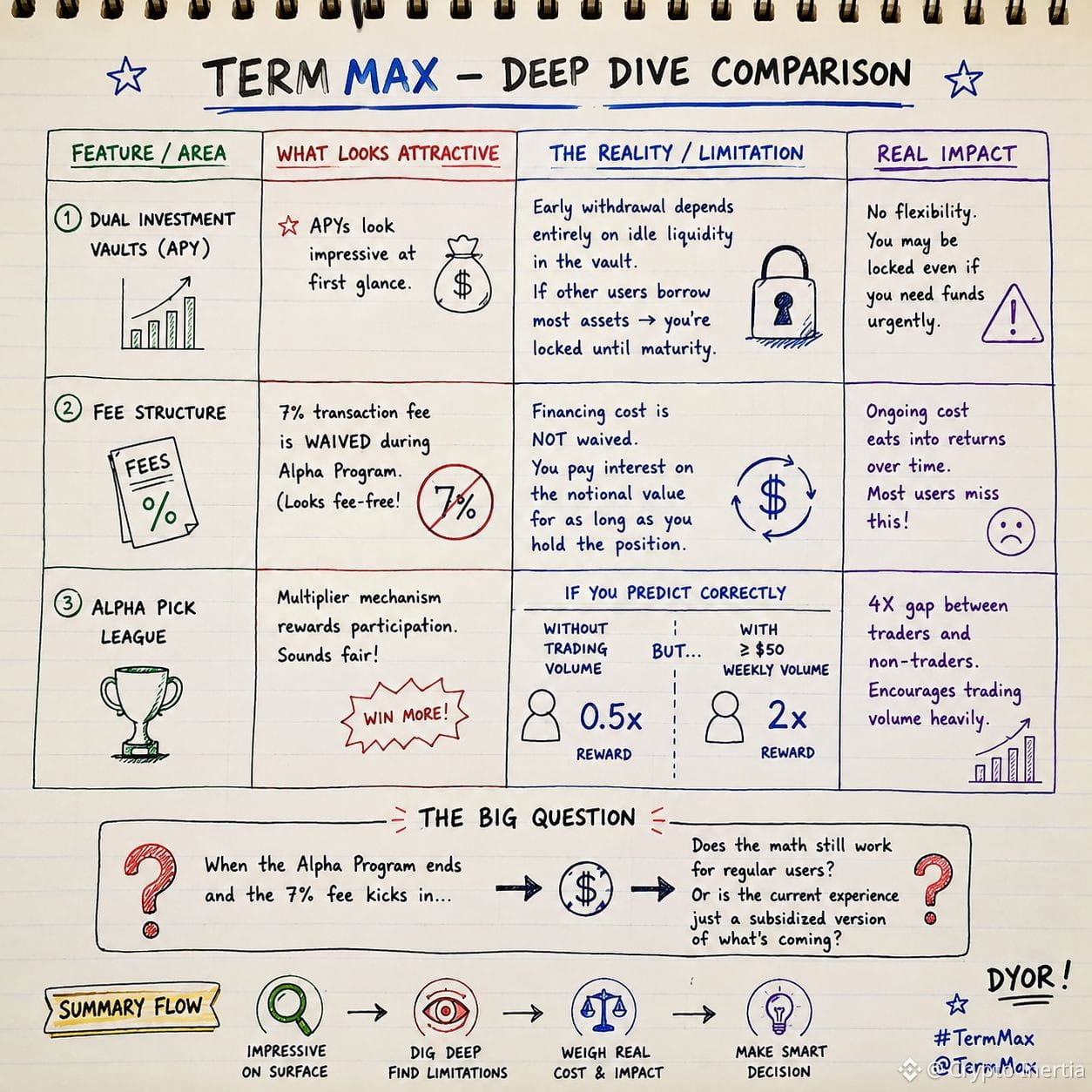
#termmax @termmax He estado husmeando por TermMax y hay una cosa que no deja de preocuparme. Las bóvedas de Dual Investment están ofreciendo APYs que parecen impresionantes a primera vista. Pero cuando realmente profundizas en la mecánica de retiro, la flexibilidad simplemente no existe. El retiro anticipado depende completamente de cuánto liquidez ociosa haya en la bóveda. Si otros usuarios han pedido prestados la mayor parte de los activos, quedas bloqueado hasta el vencimiento. No hay forma de evitarlo.
Luego miré la estructura de comisiones. La comisión de transacción del 7% actualmente se exime durante el programa alfa. Pero el costo de financiación no se exime. Pagas intereses sobre el valor nocional mientras mantengas la posición. La documentación lo explica de manera transparente. Pero la mayoría ve "programa alfa sin comisiones" y pasa por alto el costo continuo. La Alpha Pick League, sin embargo, es ingeniosa. El mecanismo del multiplicador básicamente te castiga por no operar. Si aciertas sin volumen de trading, recibes una recompensa de 0.5x. Si alcanzas $50 de volumen semanal, de repente es 2x. Esa brecha de cuatro veces entre traders y no traders no es sutil.
Lo que no dejo de pensar es esto: cuando termine el programa alfa y entre en vigor la comisión del 7%, ¿las cuentas siguen funcionando para los usuarios habituales? ¿O la experiencia actual solo es una versión subsidiada de lo que viene?
#termmax @TermMax He estado husmeando por TermMax y hay una cosa que no deja de preocuparme. Las bóvedas de Dual Investment están ofreciendo APYs que parecen impresionantes a primera vista. Pero cuando realmente profundizas en la mecánica de retiro, la flexibilidad simplemente no existe. El retiro anticipado depende completamente de cuánto liquidez ociosa haya en la bóveda. Si otros usuarios han pedido prestados la mayor parte de los activos, quedas bloqueado hasta el vencimiento. No hay forma de evitarlo.
Luego miré la estructura de comisiones. La comisión de transacción del 7% actualmente se exime durante el programa alfa. Pero el costo de financiación no se exime. Pagas intereses sobre el valor nocional mientras mantengas la posición. La documentación lo explica de manera transparente. Pero la mayoría ve "programa alfa sin comisiones" y pasa por alto el costo continuo. La Alpha Pick League, sin embargo, es ingeniosa. El mecanismo del multiplicador básicamente te castiga por no operar. Si aciertas sin volumen de trading, recibes una recompensa de 0.5x. Si alcanzas $50 de volumen semanal, de repente es 2x. Esa brecha de cuatro veces entre traders y no traders no es sutil.
Lo que no dejo de pensar es esto: cuando termine el programa alfa y entre en vigor la comisión del 7%, ¿las cuentas siguen funcionando para los usuarios habituales? ¿O la experiencia actual solo es una versión subsidiada de lo que viene?
Luego miré la estructura de comisiones. La comisión de transacción del 7% actualmente se exime durante el programa alfa. Pero el costo de financiación no se exime. Pagas intereses sobre el valor nocional mientras mantengas la posición. La documentación lo explica de manera transparente. Pero la mayoría ve "programa alfa sin comisiones" y pasa por alto el costo continuo. La Alpha Pick League, sin embargo, es ingeniosa. El mecanismo del multiplicador básicamente te castiga por no operar. Si aciertas sin volumen de trading, recibes una recompensa de 0.5x. Si alcanzas $50 de volumen semanal, de repente es 2x. Esa brecha de cuatro veces entre traders y no traders no es sutil.
Lo que no dejo de pensar es esto: cuando termine el programa alfa y entre en vigor la comisión del 7%, ¿las cuentas siguen funcionando para los usuarios habituales? ¿O la experiencia actual solo es una versión subsidiada de lo que viene?
4
1
86
·
--
Bajista
#dusk @Dusk_Foundation
He estado revisando los anuncios oficiales de DUSK y hay una comparación que no me deja en paz.
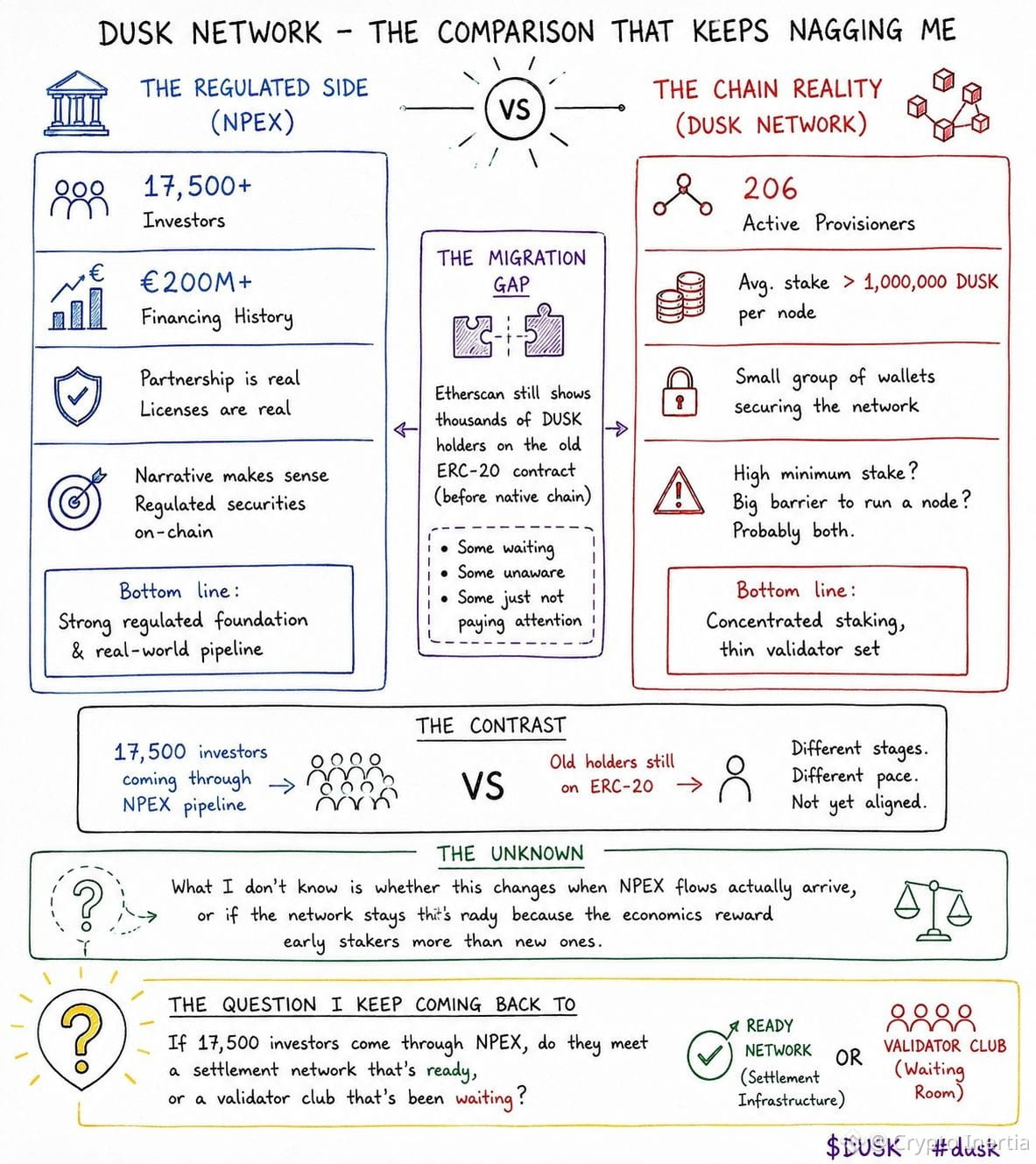
NPEX reúne a 17.500+ inversores y más de 200M€ en historial de financiación. Ese es el lado regulado. Números sólidos. La asociación es real, las licencias son reales, el relato tiene sentido. Pero luego miras la cadena en sí. 206 provisionadores activos asegurando la red. Apuesta media de más de un millón de DUSK por nodo. Para una cadena que quiere liquidar valores regulados para miles de inversores, la infraestructura que hace el trabajo real de consenso está en manos de un grupo pequeño de carteras. O bien el stake mínimo está filtrando demasiado, o ejecutar un nodo es una barrera mayor de lo que admiten los documentos. Probablemente ambas.
Luego está la brecha de migración. Etherscan todavía muestra miles de holders de DUSK en el contrato antiguo ERC-20, de antes de la cadena nativa. Algunos esperando. Algunos sin saberlo. Algunos simplemente no prestan atención. El lado regulado tiene 17.500 inversores en la cola. El lado de la cadena aún tiene holders antiguos que no se han movido.
El discurso es la liquidación institucional. La forma on-chain ahora mismo está concentrada en staking y con una cola de entrada delgada. Lo que de verdad no sé es si esto cambia cuando realmente entren los flujos de NPEX, o si la red se mantiene así porque la economía premia más a los stakers tempranos que a los nuevos.
La pregunta a la que sigo volviendo — si llegan 17.500 inversores por NPEX, ¿encuentran una red de liquidación lista, o un club de validadores que ha estado esperando?$DUSK
{spot}(DUSKUSDT)
#dusk @Dusk
He estado revisando los anuncios oficiales de DUSK y hay una comparación que no me deja en paz.
NPEX reúne a 17.500+ inversores y más de 200M€ en historial de financiación. Ese es el lado regulado. Números sólidos. La asociación es real, las licencias son reales, el relato tiene sentido. Pero luego miras la cadena en sí. 206 provisionadores activos asegurando la red. Apuesta media de más de un millón de DUSK por nodo. Para una cadena que quiere liquidar valores regulados para miles de inversores, la infraestructura que hace el trabajo real de consenso está en manos de un grupo pequeño de carteras. O bien el stake mínimo está filtrando demasiado, o ejecutar un nodo es una barrera mayor de lo que admiten los documentos. Probablemente ambas.
Luego está la brecha de migración. Etherscan todavía muestra miles de holders de DUSK en el contrato antiguo ERC-20, de antes de la cadena nativa. Algunos esperando. Algunos sin saberlo. Algunos simplemente no prestan atención. El lado regulado tiene 17.500 inversores en la cola. El lado de la cadena aún tiene holders antiguos que no se han movido.
El discurso es la liquidación institucional. La forma on-chain ahora mismo está concentrada en staking y con una cola de entrada delgada. Lo que de verdad no sé es si esto cambia cuando realmente entren los flujos de NPEX, o si la red se mantiene así porque la economía premia más a los stakers tempranos que a los nuevos.
La pregunta a la que sigo volviendo — si llegan 17.500 inversores por NPEX, ¿encuentran una red de liquidación lista, o un club de validadores que ha estado esperando?$DUSK
He estado revisando los anuncios oficiales de DUSK y hay una comparación que no me deja en paz.
NPEX reúne a 17.500+ inversores y más de 200M€ en historial de financiación. Ese es el lado regulado. Números sólidos. La asociación es real, las licencias son reales, el relato tiene sentido. Pero luego miras la cadena en sí. 206 provisionadores activos asegurando la red. Apuesta media de más de un millón de DUSK por nodo. Para una cadena que quiere liquidar valores regulados para miles de inversores, la infraestructura que hace el trabajo real de consenso está en manos de un grupo pequeño de carteras. O bien el stake mínimo está filtrando demasiado, o ejecutar un nodo es una barrera mayor de lo que admiten los documentos. Probablemente ambas.
Luego está la brecha de migración. Etherscan todavía muestra miles de holders de DUSK en el contrato antiguo ERC-20, de antes de la cadena nativa. Algunos esperando. Algunos sin saberlo. Algunos simplemente no prestan atención. El lado regulado tiene 17.500 inversores en la cola. El lado de la cadena aún tiene holders antiguos que no se han movido.
El discurso es la liquidación institucional. La forma on-chain ahora mismo está concentrada en staking y con una cola de entrada delgada. Lo que de verdad no sé es si esto cambia cuando realmente entren los flujos de NPEX, o si la red se mantiene así porque la economía premia más a los stakers tempranos que a los nuevos.
La pregunta a la que sigo volviendo — si llegan 17.500 inversores por NPEX, ¿encuentran una red de liquidación lista, o un club de validadores que ha estado esperando?$DUSK
5
2
105
#dusk $DUSK @Dusk_Foundation
He estado comparando @dusk con la forma en que los mercados financieros regulados manejan hoy el derecho a la privacidad. No la teoría. Las opciones reales que tienen las instituciones.
Aquí está el problema. Las blockchains públicas lo exponen todo. Cada posición. Cada contraparte. Cada saldo. Eso funciona para DeFi. No funciona cuando estás liquidando valores donde la divulgación es selectiva y el escrutinio está definido legalmente. Las instituciones no pueden operar en una cadena donde su cap table es pública y sus operaciones son visibles para competidores.
Entonces, ¿qué hacen hoy? Se quedan en bases de datos privadas. Sistemas cerrados. Vías heredadas. La liquidación tarda días. Los sistemas no se hablan entre sí. Cada integración necesita abogados. Obtienen privacidad, pero pierden eficiencia. Es un compromiso que nadie cuestiona ya porque es simplemente como siempre han funcionado las cosas.
Dusk elimina ese compromiso. Las transacciones de Phoenix son confidenciales por defecto. Las pruebas de conocimiento cero verifican la corrección sin exponer los datos subyacentes. La divulgación selectiva significa que un regulador puede ver exactamente lo que tiene derecho a ver y nada más. Y todo se liquida en unos 10 segundos. No T+2. No días hábiles. Segundos.
Esa es la diferencia. La privacidad no se añade encima de una cadena general. El cumplimiento no es un envoltorio sobre DeFi. La capa base está diseñada para esto desde el principio. NPEX, un exchange neerlandés regulado por la AFM, ya confirmó más de 200M€ en emisión con Dusk. Chainlink está involucrado a nivel de infraestructura. No son experimentos nativos de las criptomonedas. Son instituciones reguladas moviendo flujos de trabajo reales.
No digo que sea perfecto. La aceptación legal de las pruebas de ZK todavía necesita ponerse al día. Pero la brecha entre lo que ofrecen las cadenas públicas y lo que los mercados regulados necesitan ha existido durante años. Dusk es la primera infraestructura que he visto que realmente la cierra.
¿Cuál es el gran obstáculo para los activos regulados onchain — la privacidad, el cumplimiento o simplemente la velocidad de liquidación?
$GPS
{spot}(GPSUSDT)
$TUT
{spot}(TUTUSDT)
#dusk $DUSK @Dusk
He estado comparando @dusk con la forma en que los mercados financieros regulados manejan hoy el derecho a la privacidad. No la teoría. Las opciones reales que tienen las instituciones.
Aquí está el problema. Las blockchains públicas lo exponen todo. Cada posición. Cada contraparte. Cada saldo. Eso funciona para DeFi. No funciona cuando estás liquidando valores donde la divulgación es selectiva y el escrutinio está definido legalmente. Las instituciones no pueden operar en una cadena donde su cap table es pública y sus operaciones son visibles para competidores.
Entonces, ¿qué hacen hoy? Se quedan en bases de datos privadas. Sistemas cerrados. Vías heredadas. La liquidación tarda días. Los sistemas no se hablan entre sí. Cada integración necesita abogados. Obtienen privacidad, pero pierden eficiencia. Es un compromiso que nadie cuestiona ya porque es simplemente como siempre han funcionado las cosas.
Dusk elimina ese compromiso. Las transacciones de Phoenix son confidenciales por defecto. Las pruebas de conocimiento cero verifican la corrección sin exponer los datos subyacentes. La divulgación selectiva significa que un regulador puede ver exactamente lo que tiene derecho a ver y nada más. Y todo se liquida en unos 10 segundos. No T+2. No días hábiles. Segundos.
Esa es la diferencia. La privacidad no se añade encima de una cadena general. El cumplimiento no es un envoltorio sobre DeFi. La capa base está diseñada para esto desde el principio. NPEX, un exchange neerlandés regulado por la AFM, ya confirmó más de 200M€ en emisión con Dusk. Chainlink está involucrado a nivel de infraestructura. No son experimentos nativos de las criptomonedas. Son instituciones reguladas moviendo flujos de trabajo reales.
No digo que sea perfecto. La aceptación legal de las pruebas de ZK todavía necesita ponerse al día. Pero la brecha entre lo que ofrecen las cadenas públicas y lo que los mercados regulados necesitan ha existido durante años. Dusk es la primera infraestructura que he visto que realmente la cierra.
¿Cuál es el gran obstáculo para los activos regulados onchain — la privacidad, el cumplimiento o simplemente la velocidad de liquidación?
$GPS
$TUT
He estado comparando @dusk con la forma en que los mercados financieros regulados manejan hoy el derecho a la privacidad. No la teoría. Las opciones reales que tienen las instituciones.
Aquí está el problema. Las blockchains públicas lo exponen todo. Cada posición. Cada contraparte. Cada saldo. Eso funciona para DeFi. No funciona cuando estás liquidando valores donde la divulgación es selectiva y el escrutinio está definido legalmente. Las instituciones no pueden operar en una cadena donde su cap table es pública y sus operaciones son visibles para competidores.
Entonces, ¿qué hacen hoy? Se quedan en bases de datos privadas. Sistemas cerrados. Vías heredadas. La liquidación tarda días. Los sistemas no se hablan entre sí. Cada integración necesita abogados. Obtienen privacidad, pero pierden eficiencia. Es un compromiso que nadie cuestiona ya porque es simplemente como siempre han funcionado las cosas.
Dusk elimina ese compromiso. Las transacciones de Phoenix son confidenciales por defecto. Las pruebas de conocimiento cero verifican la corrección sin exponer los datos subyacentes. La divulgación selectiva significa que un regulador puede ver exactamente lo que tiene derecho a ver y nada más. Y todo se liquida en unos 10 segundos. No T+2. No días hábiles. Segundos.
Esa es la diferencia. La privacidad no se añade encima de una cadena general. El cumplimiento no es un envoltorio sobre DeFi. La capa base está diseñada para esto desde el principio. NPEX, un exchange neerlandés regulado por la AFM, ya confirmó más de 200M€ en emisión con Dusk. Chainlink está involucrado a nivel de infraestructura. No son experimentos nativos de las criptomonedas. Son instituciones reguladas moviendo flujos de trabajo reales.
No digo que sea perfecto. La aceptación legal de las pruebas de ZK todavía necesita ponerse al día. Pero la brecha entre lo que ofrecen las cadenas públicas y lo que los mercados regulados necesitan ha existido durante años. Dusk es la primera infraestructura que he visto que realmente la cierra.
¿Cuál es el gran obstáculo para los activos regulados onchain — la privacidad, el cumplimiento o simplemente la velocidad de liquidación?
$GPS
$TUT
208
#termmax @termmax
He estado comparando TermMax con cómo funciona la concesión de préstamos DeFi ahora mismo. No teoría. Opciones reales que he usado.
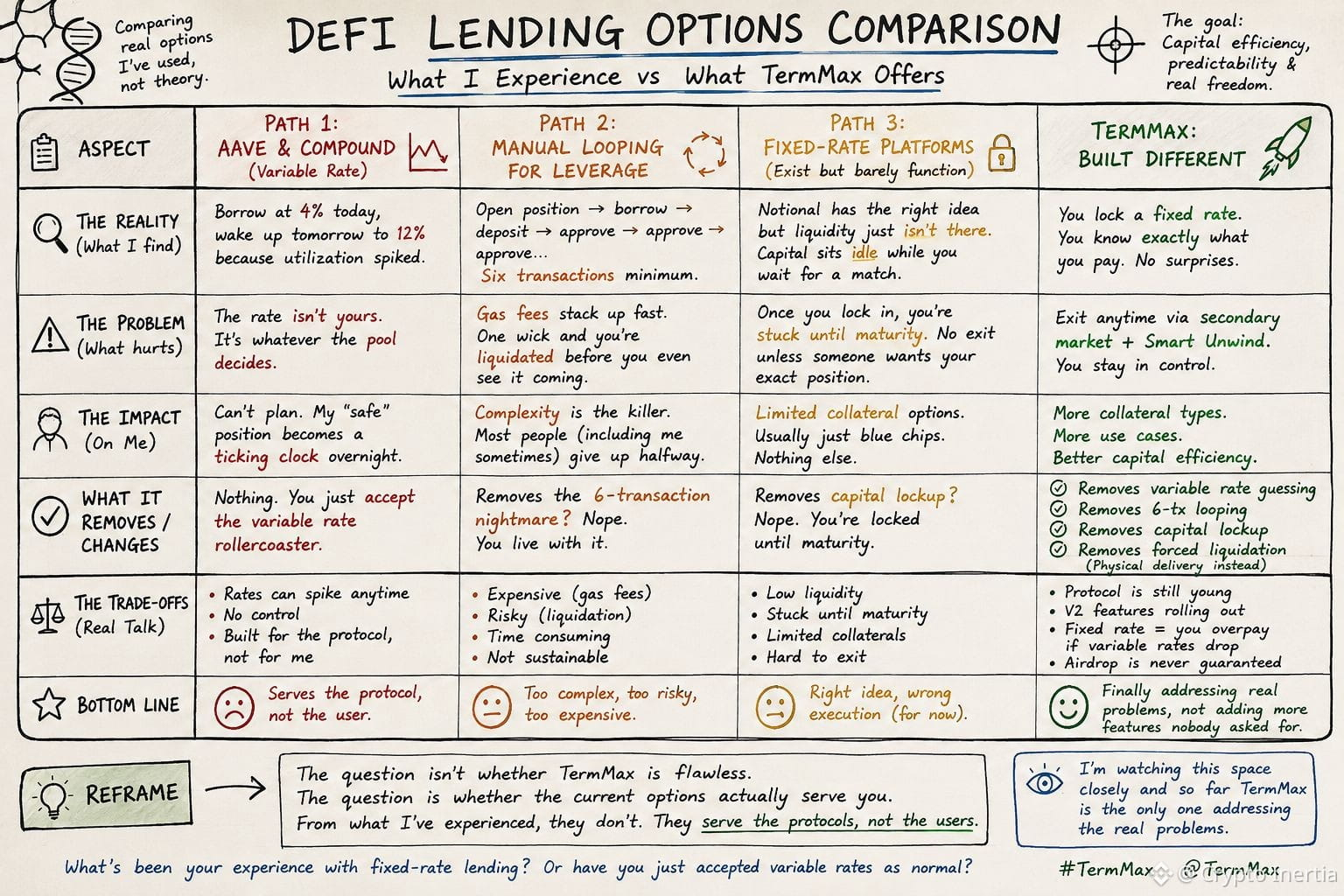
Esto es lo que encuentro. Tres caminos. Todos rotos de su propia manera.
Camino 1: Aave y Compound. El problema de la tasa variable es real. Pides prestado al 4% hoy, te levantas mañana y está al 12% porque la utilización se disparó. No puedes planificar eso. Tu posición "segura" se convierte en un reloj que no se detiene durante la noche. La tasa no es tuya. Es lo que decida el pool.
Camino 2: Enfoque manual para apalancarte. Este es el que más duele porque lo he hecho. Abres una posición en un protocolo, pides prestado en otro, depositas en otro lugar, autorizas, autorizas, autorizas. Mínimo seis transacciones. Las comisiones de gas se acumulan rápido. Y mejor que lo monitorees, porque un simple wick y estás liquidado antes de que siquiera lo veas venir. La complejidad es el golpe maestro. .
Camino 3: Plataformas de tasa fija que existen pero apenas funcionan. Notional tiene la idea correcta, pero la liquidez no está ahí. El capital queda ocioso mientras esperas un emparejamiento. Una vez que lo fijas, te quedas ahí hasta el vencimiento. No hay salida a menos que alguien quiera tu posición exacta. .
TermMax está construido de manera diferente. Elimina el juego de adivinar la tasa variable. Elimina la pesadilla del bucle de seis transacciones. Elimina el bloqueo de capital con salidas en mercado secundario y Smart Unwind. Elimina el modelo de liquidación forzada con entrega física, en su lugar.
No digo que sea perfecto. El protocolo todavía es joven. Las funciones de la V2 se están implementando por fases. Las tasas fijas significan que pagas de más si las tasas variables bajan. Y lo del airdrop nunca está garantizado.
Pero aquí va el replanteamiento. La pregunta no es si TermMax es flawles (defectuoso). La pregunta es si las opciones actuales realmente te sirven. Por lo que he experimentado, no. Le sirven a los protocolos, no a los usuarios.
Estoy siguiendo de cerca este espacio y hasta ahora TermMax es el que está abordando los problemas reales en lugar de añadir más funciones que nadie pidió.
¿Cuál ha sido tu experiencia con el lending a tasa fija? ¿O simplemente aceptaste las tasas variables como algo normal?
$GPS
{spot}(GPSUSDT)
$PORTAL
{spot}(PORTALUSDT)
#termmax @TermMax
He estado comparando TermMax con cómo funciona la concesión de préstamos DeFi ahora mismo. No teoría. Opciones reales que he usado.
Esto es lo que encuentro. Tres caminos. Todos rotos de su propia manera.
Camino 1: Aave y Compound. El problema de la tasa variable es real. Pides prestado al 4% hoy, te levantas mañana y está al 12% porque la utilización se disparó. No puedes planificar eso. Tu posición "segura" se convierte en un reloj que no se detiene durante la noche. La tasa no es tuya. Es lo que decida el pool.
Camino 2: Enfoque manual para apalancarte. Este es el que más duele porque lo he hecho. Abres una posición en un protocolo, pides prestado en otro, depositas en otro lugar, autorizas, autorizas, autorizas. Mínimo seis transacciones. Las comisiones de gas se acumulan rápido. Y mejor que lo monitorees, porque un simple wick y estás liquidado antes de que siquiera lo veas venir. La complejidad es el golpe maestro. .
Camino 3: Plataformas de tasa fija que existen pero apenas funcionan. Notional tiene la idea correcta, pero la liquidez no está ahí. El capital queda ocioso mientras esperas un emparejamiento. Una vez que lo fijas, te quedas ahí hasta el vencimiento. No hay salida a menos que alguien quiera tu posición exacta. .
TermMax está construido de manera diferente. Elimina el juego de adivinar la tasa variable. Elimina la pesadilla del bucle de seis transacciones. Elimina el bloqueo de capital con salidas en mercado secundario y Smart Unwind. Elimina el modelo de liquidación forzada con entrega física, en su lugar.
No digo que sea perfecto. El protocolo todavía es joven. Las funciones de la V2 se están implementando por fases. Las tasas fijas significan que pagas de más si las tasas variables bajan. Y lo del airdrop nunca está garantizado.
Pero aquí va el replanteamiento. La pregunta no es si TermMax es flawles (defectuoso). La pregunta es si las opciones actuales realmente te sirven. Por lo que he experimentado, no. Le sirven a los protocolos, no a los usuarios.
Estoy siguiendo de cerca este espacio y hasta ahora TermMax es el que está abordando los problemas reales en lugar de añadir más funciones que nadie pidió.
¿Cuál ha sido tu experiencia con el lending a tasa fija? ¿O simplemente aceptaste las tasas variables como algo normal?
$GPS
$PORTAL
He estado comparando TermMax con cómo funciona la concesión de préstamos DeFi ahora mismo. No teoría. Opciones reales que he usado.
Esto es lo que encuentro. Tres caminos. Todos rotos de su propia manera.
Camino 1: Aave y Compound. El problema de la tasa variable es real. Pides prestado al 4% hoy, te levantas mañana y está al 12% porque la utilización se disparó. No puedes planificar eso. Tu posición "segura" se convierte en un reloj que no se detiene durante la noche. La tasa no es tuya. Es lo que decida el pool.
Camino 2: Enfoque manual para apalancarte. Este es el que más duele porque lo he hecho. Abres una posición en un protocolo, pides prestado en otro, depositas en otro lugar, autorizas, autorizas, autorizas. Mínimo seis transacciones. Las comisiones de gas se acumulan rápido. Y mejor que lo monitorees, porque un simple wick y estás liquidado antes de que siquiera lo veas venir. La complejidad es el golpe maestro. .
Camino 3: Plataformas de tasa fija que existen pero apenas funcionan. Notional tiene la idea correcta, pero la liquidez no está ahí. El capital queda ocioso mientras esperas un emparejamiento. Una vez que lo fijas, te quedas ahí hasta el vencimiento. No hay salida a menos que alguien quiera tu posición exacta. .
TermMax está construido de manera diferente. Elimina el juego de adivinar la tasa variable. Elimina la pesadilla del bucle de seis transacciones. Elimina el bloqueo de capital con salidas en mercado secundario y Smart Unwind. Elimina el modelo de liquidación forzada con entrega física, en su lugar.
No digo que sea perfecto. El protocolo todavía es joven. Las funciones de la V2 se están implementando por fases. Las tasas fijas significan que pagas de más si las tasas variables bajan. Y lo del airdrop nunca está garantizado.
Pero aquí va el replanteamiento. La pregunta no es si TermMax es flawles (defectuoso). La pregunta es si las opciones actuales realmente te sirven. Por lo que he experimentado, no. Le sirven a los protocolos, no a los usuarios.
Estoy siguiendo de cerca este espacio y hasta ahora TermMax es el que está abordando los problemas reales en lugar de añadir más funciones que nadie pidió.
¿Cuál ha sido tu experiencia con el lending a tasa fija? ¿O simplemente aceptaste las tasas variables como algo normal?
$GPS
$PORTAL
1
244
Trade de 30d $DUSK 229.8 USDT
#dusk $DUSK
He estado sentado con el explorador DUDE no oficial y un número no deja de molestarme.
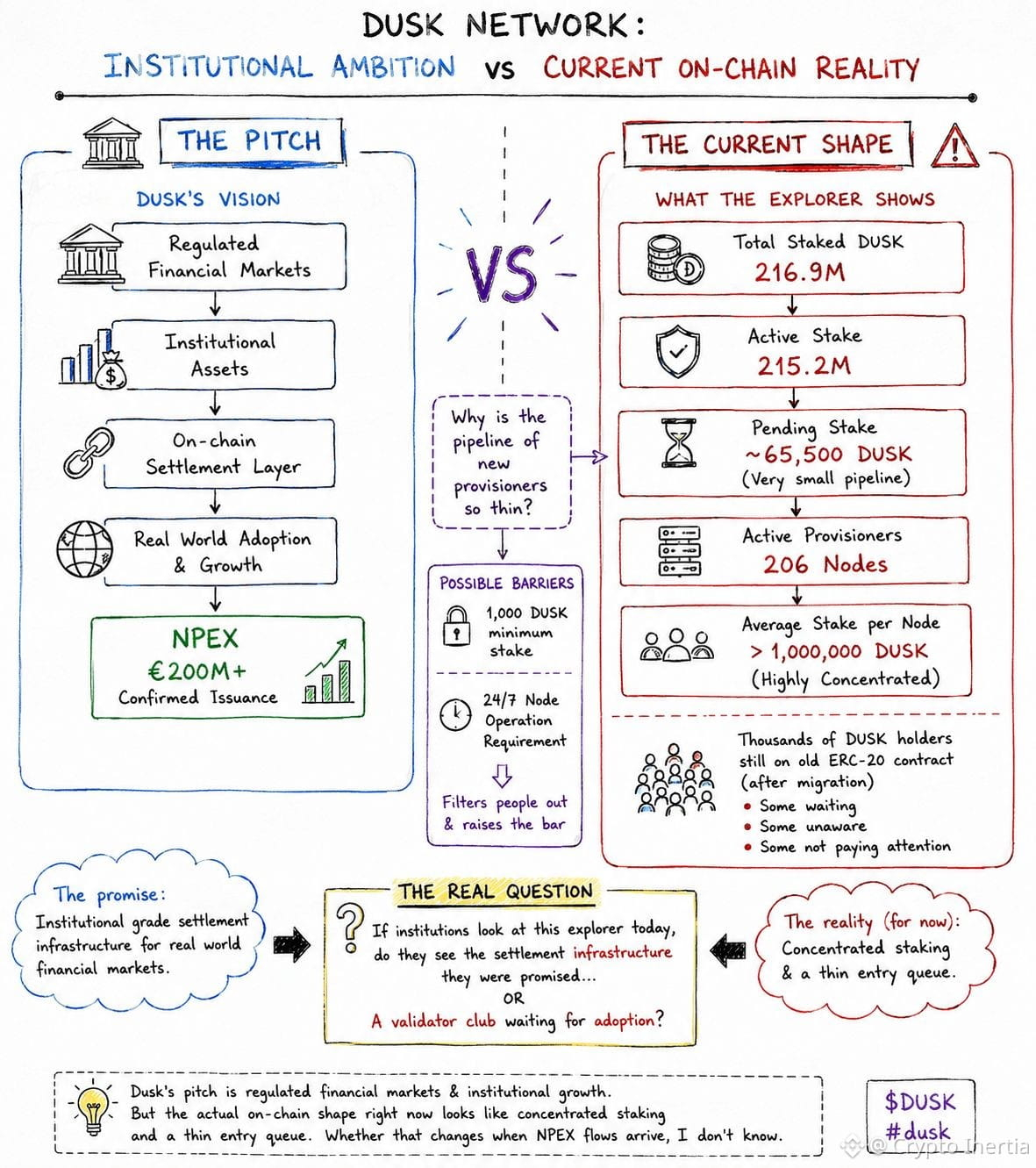
Ahora mismo 216.9M @Dusk_Foundation
{spot}(DUSKUSDT)
k está en staking con 215.2M activos. Sólido. Pero el staking pendiente es solo de alrededor de 65,500 DUSK. Esa proporción es casi inexistente. Para una red que habla de crecimiento institucional, el flujo de nuevos provisioners se ve plano. O el mínimo de 1,000 DUSK está haciendo su trabajo filtrando gente, o ejecutar un nodo 24/7 es una barrera mayor de la que admiten los documentos. Probablemente ambas.
Luego miré el conteo de provisioners activos: 206 nodos. Una apuesta promedio de más de un millón de DUSK cada uno. Eso no es descentralización. Eso es un puñado de carteras serias ejecutando la red. Mientras tanto, Etherscan todavía muestra miles de holders de DUSK aferrados al antiguo contrato ERC-20 de antes de la migración. Algunos esperando. Algunos no enterados. Algunos simplemente no prestando atención.
La propuesta de Dusk es mercados financieros regulados. Pero la forma real en cadena ahora mismo parece staking concentrado y una cola de entrada delgada. No sé de verdad si eso cambia cuando lleguen los flujos de NPEX.
A lo que sigo volviendo — si las instituciones miran este explorador, ¿ven la infraestructura de liquidación que les prometieron, o un club de validadores esperando ser adoptado? $DUSK #dusk
#dusk $DUSK
He estado sentado con el explorador DUDE no oficial y un número no deja de molestarme.
Ahora mismo 216.9M @Dusk
k está en staking con 215.2M activos. Sólido. Pero el staking pendiente es solo de alrededor de 65,500 DUSK. Esa proporción es casi inexistente. Para una red que habla de crecimiento institucional, el flujo de nuevos provisioners se ve plano. O el mínimo de 1,000 DUSK está haciendo su trabajo filtrando gente, o ejecutar un nodo 24/7 es una barrera mayor de la que admiten los documentos. Probablemente ambas.
Luego miré el conteo de provisioners activos: 206 nodos. Una apuesta promedio de más de un millón de DUSK cada uno. Eso no es descentralización. Eso es un puñado de carteras serias ejecutando la red. Mientras tanto, Etherscan todavía muestra miles de holders de DUSK aferrados al antiguo contrato ERC-20 de antes de la migración. Algunos esperando. Algunos no enterados. Algunos simplemente no prestando atención.
La propuesta de Dusk es mercados financieros regulados. Pero la forma real en cadena ahora mismo parece staking concentrado y una cola de entrada delgada. No sé de verdad si eso cambia cuando lleguen los flujos de NPEX.
A lo que sigo volviendo — si las instituciones miran este explorador, ¿ven la infraestructura de liquidación que les prometieron, o un club de validadores esperando ser adoptado? $DUSK #dusk
He estado sentado con el explorador DUDE no oficial y un número no deja de molestarme.
Ahora mismo 216.9M @Dusk
k está en staking con 215.2M activos. Sólido. Pero el staking pendiente es solo de alrededor de 65,500 DUSK. Esa proporción es casi inexistente. Para una red que habla de crecimiento institucional, el flujo de nuevos provisioners se ve plano. O el mínimo de 1,000 DUSK está haciendo su trabajo filtrando gente, o ejecutar un nodo 24/7 es una barrera mayor de la que admiten los documentos. Probablemente ambas.
Luego miré el conteo de provisioners activos: 206 nodos. Una apuesta promedio de más de un millón de DUSK cada uno. Eso no es descentralización. Eso es un puñado de carteras serias ejecutando la red. Mientras tanto, Etherscan todavía muestra miles de holders de DUSK aferrados al antiguo contrato ERC-20 de antes de la migración. Algunos esperando. Algunos no enterados. Algunos simplemente no prestando atención.
La propuesta de Dusk es mercados financieros regulados. Pero la forma real en cadena ahora mismo parece staking concentrado y una cola de entrada delgada. No sé de verdad si eso cambia cuando lleguen los flujos de NPEX.
A lo que sigo volviendo — si las instituciones miran este explorador, ¿ven la infraestructura de liquidación que les prometieron, o un club de validadores esperando ser adoptado? $DUSK #dusk
2
1
98
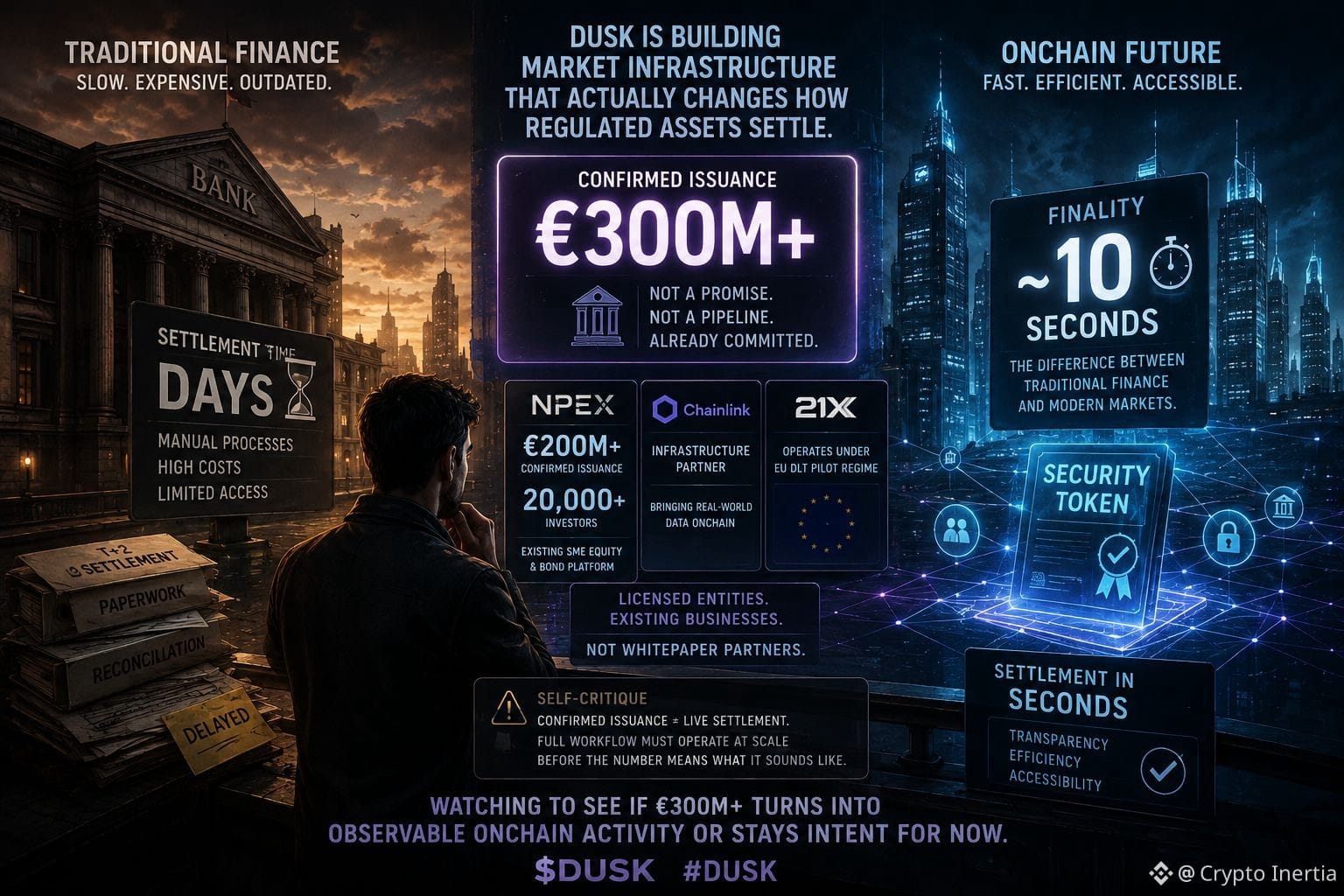
#dusk $DUSK Veo una diferencia que la mayoría de la gente no tiene en cuenta al observar las cifras de Dusk: la emisión confirmada de 300M€+ suena a una promesa, pero en realidad refleja algo más inmediato.
Esa cifra no es un objetivo de financiación. Son activos que las instituciones reguladas ya se han comprometido a trasladar a la cadena (onchain). NPEX, por sí sola, representa 200M€+ de emisión confirmada, respaldada por una base de inversores de más de 20.000. Chainlink participa a nivel de infraestructura. 21X opera bajo el Régimen Piloto de DLT de la UE. No son socios de whitepaper. Son entidades con licencia y negocios existentes.
Lo que la mayoría de los proyectos RWA hacen es anunciar un pipeline. Un montón de logotipos. Una diapositiva de hoja de ruta con activos "próximamente". Luego esperas y no se asienta nada. El enfoque distinto de Dusk es que la cifra de emisión está vinculada a flujos regulatorios existentes, no a esperanzas futuras. NPEX ya gestiona capital de pymes y bonos. El paso a la cadena (onchain) es un cambio estructural, no un arranque en frío.
Lo que de verdad me detuvo, sin embargo, es la inmediatez (finalidad). Unos 10 segundos. Para valores regulados, eso no es un “detalle agradable”. Es la diferencia entre una liquidación que parece un mercado moderno y una liquidación que todavía se siente como las finanzas tradicionales. Si NPEX trae instrumentos existentes a la cadena (onchain) y se liquidan en segundos en lugar de días, eso no es una historia sobre que blockchain es más rápido. Es una historia sobre cómo la infraestructura de mercado realmente está cambiando.
Autocrítica: la emisión confirmada no es lo mismo que la liquidación en vivo. Los activos pueden estar comprometidos, pero el flujo de trabajo completo todavía necesita operar a escala antes de que el número signifique lo que suena.
Estoy esperando ver si la cifra de 300M€ se convierte en actividad onchain observable, o si por ahora se queda como intención confirmada. @Dusk_Foundation
$COW
{spot}(COWUSDT)
$WAL
{spot}(WALUSDT)
#dusk $DUSK Veo una diferencia que la mayoría de la gente no tiene en cuenta al observar las cifras de Dusk: la emisión confirmada de 300M€+ suena a una promesa, pero en realidad refleja algo más inmediato.
Esa cifra no es un objetivo de financiación. Son activos que las instituciones reguladas ya se han comprometido a trasladar a la cadena (onchain). NPEX, por sí sola, representa 200M€+ de emisión confirmada, respaldada por una base de inversores de más de 20.000. Chainlink participa a nivel de infraestructura. 21X opera bajo el Régimen Piloto de DLT de la UE. No son socios de whitepaper. Son entidades con licencia y negocios existentes.
Lo que la mayoría de los proyectos RWA hacen es anunciar un pipeline. Un montón de logotipos. Una diapositiva de hoja de ruta con activos "próximamente". Luego esperas y no se asienta nada. El enfoque distinto de Dusk es que la cifra de emisión está vinculada a flujos regulatorios existentes, no a esperanzas futuras. NPEX ya gestiona capital de pymes y bonos. El paso a la cadena (onchain) es un cambio estructural, no un arranque en frío.
Lo que de verdad me detuvo, sin embargo, es la inmediatez (finalidad). Unos 10 segundos. Para valores regulados, eso no es un “detalle agradable”. Es la diferencia entre una liquidación que parece un mercado moderno y una liquidación que todavía se siente como las finanzas tradicionales. Si NPEX trae instrumentos existentes a la cadena (onchain) y se liquidan en segundos en lugar de días, eso no es una historia sobre que blockchain es más rápido. Es una historia sobre cómo la infraestructura de mercado realmente está cambiando.
Autocrítica: la emisión confirmada no es lo mismo que la liquidación en vivo. Los activos pueden estar comprometidos, pero el flujo de trabajo completo todavía necesita operar a escala antes de que el número signifique lo que suena.
Estoy esperando ver si la cifra de 300M€ se convierte en actividad onchain observable, o si por ahora se queda como intención confirmada. @Dusk
$COW
$WAL
Esa cifra no es un objetivo de financiación. Son activos que las instituciones reguladas ya se han comprometido a trasladar a la cadena (onchain). NPEX, por sí sola, representa 200M€+ de emisión confirmada, respaldada por una base de inversores de más de 20.000. Chainlink participa a nivel de infraestructura. 21X opera bajo el Régimen Piloto de DLT de la UE. No son socios de whitepaper. Son entidades con licencia y negocios existentes.
Lo que la mayoría de los proyectos RWA hacen es anunciar un pipeline. Un montón de logotipos. Una diapositiva de hoja de ruta con activos "próximamente". Luego esperas y no se asienta nada. El enfoque distinto de Dusk es que la cifra de emisión está vinculada a flujos regulatorios existentes, no a esperanzas futuras. NPEX ya gestiona capital de pymes y bonos. El paso a la cadena (onchain) es un cambio estructural, no un arranque en frío.
Lo que de verdad me detuvo, sin embargo, es la inmediatez (finalidad). Unos 10 segundos. Para valores regulados, eso no es un “detalle agradable”. Es la diferencia entre una liquidación que parece un mercado moderno y una liquidación que todavía se siente como las finanzas tradicionales. Si NPEX trae instrumentos existentes a la cadena (onchain) y se liquidan en segundos en lugar de días, eso no es una historia sobre que blockchain es más rápido. Es una historia sobre cómo la infraestructura de mercado realmente está cambiando.
Autocrítica: la emisión confirmada no es lo mismo que la liquidación en vivo. Los activos pueden estar comprometidos, pero el flujo de trabajo completo todavía necesita operar a escala antes de que el número signifique lo que suena.
Estoy esperando ver si la cifra de 300M€ se convierte en actividad onchain observable, o si por ahora se queda como intención confirmada. @Dusk
$COW
$WAL
1
1
260
.Veo una distinción que la mayoría de las personas pasa por alto al hablar de activos regulados en cadena: las blockchains públicas tratan la privacidad como una función, pero @Dusk_Foundation la trata como un requisito.
En Ethereum o Solana, la privacidad es algo que se añade más tarde. Un mezclador aquí, una herramienta de transferencia confidencial allá. La cadena en sí es transparente por defecto. Cada posición, cada contraparte, cada saldo visible para cualquiera que mire. Eso funciona para las DeFi sin permisos. No funciona cuando estás liquidando valores regulados, donde la divulgación es selectiva y el escrutinio está definido legalmente.
Dusk invierte eso. Las transacciones de Phoenix son confidenciales por defecto. Las pruebas de conocimiento cero verifican la corrección sin exponer los datos subyacentes. La divulgación selectiva significa que un auditor o un regulador puede ver exactamente lo que tiene derecho a ver y nada más. No es una herramienta de privacidad añadida encima. La capa base está construida a partir de eso.
Lo que captó mi atención es cómo esto conecta con NPEX. Un exchange regulado por la AFM en Países Bajos que gestiona capital de pymes y bonos. Un lugar como ese no puede operar en una cadena transparente. Los traders no quieren que sus posiciones sean públicas. Los emisores no quieren que sus libros de capital (cap tables) estén abiertos a competidores. Los reguladores quieren auditabilidad sin exposición pública. La arquitectura de Dusk se alinea con lo que los centros regulados realmente necesitan, no con lo que el cripto asume que deberían aceptar.
Autocrítica: la tecnología de privacidad solo importa si los reguladores la aceptan. Las pruebas de conocimiento cero no ayudan si un regulador exige datos brutos en un formato que reconozca. La aceptación legal se queda atrás frente a la capacidad técnica.
Estoy esperando ver si el modelo de privacidad de Dusk se trata como infraestructura compatible por los reguladores europeos, o solo como criptografía ingeniosa sobre la que las instituciones siguen siendo cautelosas. $DUSK #dusk
.Veo una distinción que la mayoría de las personas pasa por alto al hablar de activos regulados en cadena: las blockchains públicas tratan la privacidad como una función, pero @Dusk la trata como un requisito.
En Ethereum o Solana, la privacidad es algo que se añade más tarde. Un mezclador aquí, una herramienta de transferencia confidencial allá. La cadena en sí es transparente por defecto. Cada posición, cada contraparte, cada saldo visible para cualquiera que mire. Eso funciona para las DeFi sin permisos. No funciona cuando estás liquidando valores regulados, donde la divulgación es selectiva y el escrutinio está definido legalmente.
Dusk invierte eso. Las transacciones de Phoenix son confidenciales por defecto. Las pruebas de conocimiento cero verifican la corrección sin exponer los datos subyacentes. La divulgación selectiva significa que un auditor o un regulador puede ver exactamente lo que tiene derecho a ver y nada más. No es una herramienta de privacidad añadida encima. La capa base está construida a partir de eso.
Lo que captó mi atención es cómo esto conecta con NPEX. Un exchange regulado por la AFM en Países Bajos que gestiona capital de pymes y bonos. Un lugar como ese no puede operar en una cadena transparente. Los traders no quieren que sus posiciones sean públicas. Los emisores no quieren que sus libros de capital (cap tables) estén abiertos a competidores. Los reguladores quieren auditabilidad sin exposición pública. La arquitectura de Dusk se alinea con lo que los centros regulados realmente necesitan, no con lo que el cripto asume que deberían aceptar.
Autocrítica: la tecnología de privacidad solo importa si los reguladores la aceptan. Las pruebas de conocimiento cero no ayudan si un regulador exige datos brutos en un formato que reconozca. La aceptación legal se queda atrás frente a la capacidad técnica.
Estoy esperando ver si el modelo de privacidad de Dusk se trata como infraestructura compatible por los reguladores europeos, o solo como criptografía ingeniosa sobre la que las instituciones siguen siendo cautelosas. $DUSK #dusk
En Ethereum o Solana, la privacidad es algo que se añade más tarde. Un mezclador aquí, una herramienta de transferencia confidencial allá. La cadena en sí es transparente por defecto. Cada posición, cada contraparte, cada saldo visible para cualquiera que mire. Eso funciona para las DeFi sin permisos. No funciona cuando estás liquidando valores regulados, donde la divulgación es selectiva y el escrutinio está definido legalmente.
Dusk invierte eso. Las transacciones de Phoenix son confidenciales por defecto. Las pruebas de conocimiento cero verifican la corrección sin exponer los datos subyacentes. La divulgación selectiva significa que un auditor o un regulador puede ver exactamente lo que tiene derecho a ver y nada más. No es una herramienta de privacidad añadida encima. La capa base está construida a partir de eso.
Lo que captó mi atención es cómo esto conecta con NPEX. Un exchange regulado por la AFM en Países Bajos que gestiona capital de pymes y bonos. Un lugar como ese no puede operar en una cadena transparente. Los traders no quieren que sus posiciones sean públicas. Los emisores no quieren que sus libros de capital (cap tables) estén abiertos a competidores. Los reguladores quieren auditabilidad sin exposición pública. La arquitectura de Dusk se alinea con lo que los centros regulados realmente necesitan, no con lo que el cripto asume que deberían aceptar.
Autocrítica: la tecnología de privacidad solo importa si los reguladores la aceptan. Las pruebas de conocimiento cero no ayudan si un regulador exige datos brutos en un formato que reconozca. La aceptación legal se queda atrás frente a la capacidad técnica.
Estoy esperando ver si el modelo de privacidad de Dusk se trata como infraestructura compatible por los reguladores europeos, o solo como criptografía ingeniosa sobre la que las instituciones siguen siendo cautelosas. $DUSK #dusk
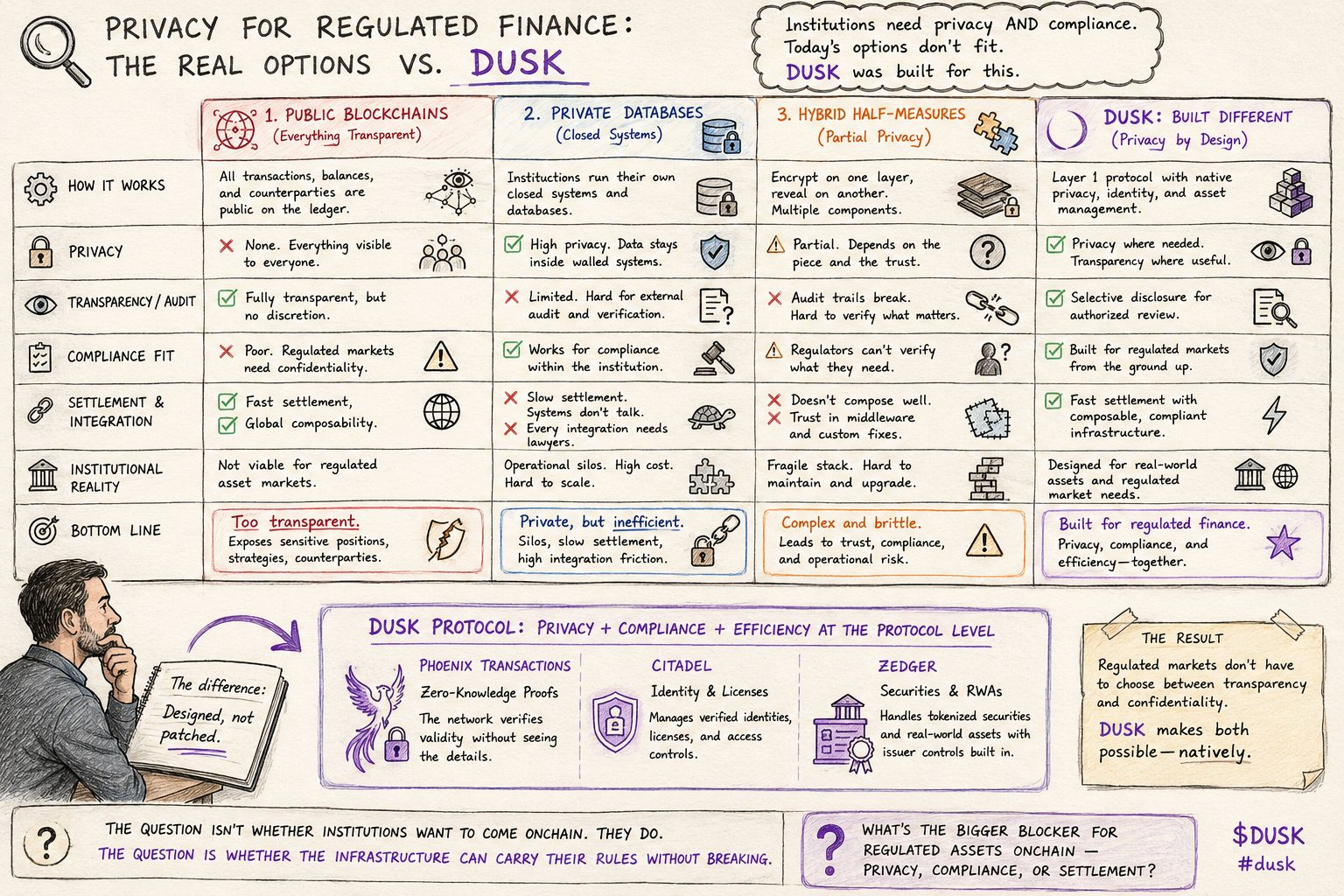
2
1
344
Inicia sesión para explorar más contenidos
Únete a usuarios globales de criptomonedas en Binance Square
⚡️ Obtén información útil y actualizada sobre criptos.
💬 Avalado por el mayor exchange de criptomonedas en el mundo.
👍 Descubre perspectivas reales de creadores verificados.
Email/número de teléfono
Temas populares
BinancePick
3.2M vistas
155,557 están debatiendo
¡Únete a #TemporadaDeResultados: predice resultados en Binance Pick y comparte tu opinión en Binance Square!
Binance Square Official
·413 me gusta
·343.8k vistas
EarningsSeason
5.4M vistas
26,151 están debatiendo
AnthropicTTMRevenueGrewAbout1200%
39,643 vistas
479 están debatiendo