

x_Trader_
234 Publicaciones

x_Trader_
Denunciar
Bloquear usuario
Content Creator | Crypto Trader | Gold Trader. I think that's enough.
63 Siguiendo
3.2K+ Seguidores
593 Me gusta
Publicaciones
Todo
Citas
Live
PINNED
·
--
Verificado
#KiteBBW $KITE
Hay dos formas perezosas de dejar que un agente de IA gaste dinero.
Darle una clave permanente y cruzar los dedos, o aprobar cada pago a mano y dejar de usar el agente para cualquier cosa real.
El Passport de Kite ocupa el espacio entre ambas opciones, y lo que me interesa es la cantidad de controles independientes que ofrece al usuario.
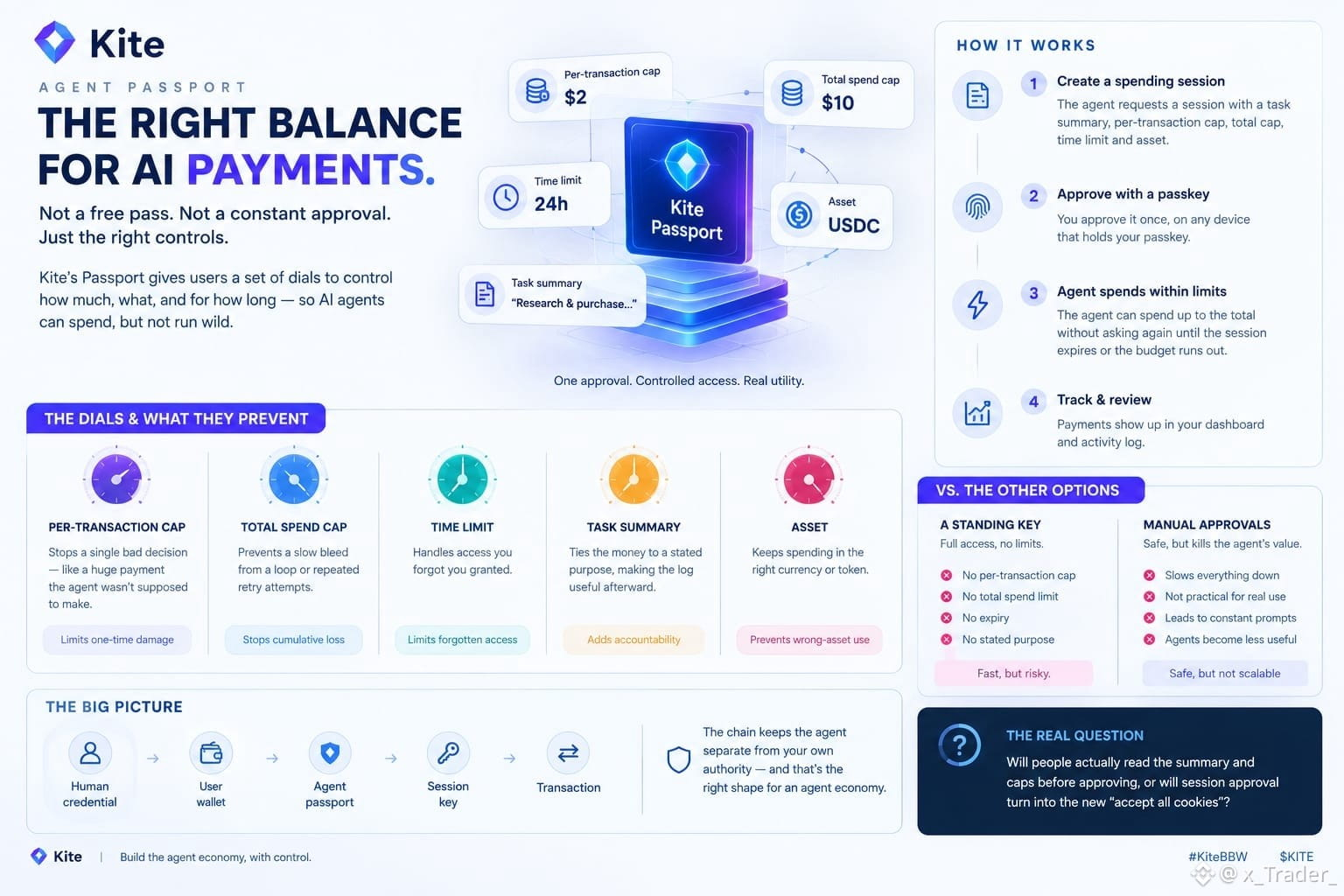
Según la documentación, un agente que quiere pagar crea una sesión de gasto con un resumen de la tarea, un límite por transacción, un límite de gasto total, un límite de tiempo y un activo.
El usuario la aprueba una sola vez con una clave de acceso, en cualquier dispositivo que la tenga.
Después, el agente puede gastar hasta el límite total sin volver a pedir permiso, hasta que venza la sesión o se agote el presupuesto.
Los ejemplos de la propia documentación son deliberadamente modestos: 2 $ por transacción y 10 $ en total durante 24 horas, o 1 $ y 5 $ durante dos horas. La cartera se financia por adelantado, y los pagos aparecen en un panel y en un registro de actividad.
Mi interpretación es que cada control cubre un tipo distinto de fallo. El límite por transacción limita una mala decisión, como que convenzan al agente de hacer un único pago enorme. El límite total limita una sangría lenta causada por un bucle que no para de reintentar.
El límite de tiempo se ocupa del acceso que olvidaste CONCEDER. El resumen de la tarea vincula el dinero con un propósito declarado, lo que hace que el registro resulte útil después.
Una clave de API típica o una tarjeta guardada tienen pocas de estas protecciones: ningún propósito declarado, a menudo ninguna fecha de vencimiento y ningún límite aparte del saldo de la cuenta.
Un análisis técnico en profundidad de Passport describe la cadena como credencial humana, cartera del usuario, pasaporte del agente, clave de sesión y, por último, la transacción; así, el agente queda un paso alejado de la autoridad propia del usuario.
Esa es la estructura adecuada para una economía de agentes en la que el software gasta más rápido de lo que las personas pueden revisar.
El eslabón débil es el toque humano.
Una sesión es tan segura como la persona que lee el resumen y los límites antes de aprobarla.
¿La gente leerá de verdad esos campos o la aprobación de sesiones se convertirá en el nuevo «aceptar todas las cookies» y anulará discretamente las protecciones creadas a su alrededor?
$KITE @GoKiteAI
{future}(KITEUSDT)
#KiteBBW $KITE
Hay dos formas perezosas de dejar que un agente de IA gaste dinero.
Darle una clave permanente y cruzar los dedos, o aprobar cada pago a mano y dejar de usar el agente para cualquier cosa real.
El Passport de Kite ocupa el espacio entre ambas opciones, y lo que me interesa es la cantidad de controles independientes que ofrece al usuario.
Según la documentación, un agente que quiere pagar crea una sesión de gasto con un resumen de la tarea, un límite por transacción, un límite de gasto total, un límite de tiempo y un activo.
El usuario la aprueba una sola vez con una clave de acceso, en cualquier dispositivo que la tenga.
Después, el agente puede gastar hasta el límite total sin volver a pedir permiso, hasta que venza la sesión o se agote el presupuesto.
Los ejemplos de la propia documentación son deliberadamente modestos: 2 $ por transacción y 10 $ en total durante 24 horas, o 1 $ y 5 $ durante dos horas. La cartera se financia por adelantado, y los pagos aparecen en un panel y en un registro de actividad.
Mi interpretación es que cada control cubre un tipo distinto de fallo. El límite por transacción limita una mala decisión, como que convenzan al agente de hacer un único pago enorme. El límite total limita una sangría lenta causada por un bucle que no para de reintentar.
El límite de tiempo se ocupa del acceso que olvidaste CONCEDER. El resumen de la tarea vincula el dinero con un propósito declarado, lo que hace que el registro resulte útil después.
Una clave de API típica o una tarjeta guardada tienen pocas de estas protecciones: ningún propósito declarado, a menudo ninguna fecha de vencimiento y ningún límite aparte del saldo de la cuenta.
Un análisis técnico en profundidad de Passport describe la cadena como credencial humana, cartera del usuario, pasaporte del agente, clave de sesión y, por último, la transacción; así, el agente queda un paso alejado de la autoridad propia del usuario.
Esa es la estructura adecuada para una economía de agentes en la que el software gasta más rápido de lo que las personas pueden revisar.
El eslabón débil es el toque humano.
Una sesión es tan segura como la persona que lee el resumen y los límites antes de aprobarla.
¿La gente leerá de verdad esos campos o la aprobación de sesiones se convertirá en el nuevo «aceptar todas las cookies» y anulará discretamente las protecciones creadas a su alrededor?
$KITE @KITE AI 中文
Hay dos formas perezosas de dejar que un agente de IA gaste dinero.
Darle una clave permanente y cruzar los dedos, o aprobar cada pago a mano y dejar de usar el agente para cualquier cosa real.
El Passport de Kite ocupa el espacio entre ambas opciones, y lo que me interesa es la cantidad de controles independientes que ofrece al usuario.
Según la documentación, un agente que quiere pagar crea una sesión de gasto con un resumen de la tarea, un límite por transacción, un límite de gasto total, un límite de tiempo y un activo.
El usuario la aprueba una sola vez con una clave de acceso, en cualquier dispositivo que la tenga.
Después, el agente puede gastar hasta el límite total sin volver a pedir permiso, hasta que venza la sesión o se agote el presupuesto.
Los ejemplos de la propia documentación son deliberadamente modestos: 2 $ por transacción y 10 $ en total durante 24 horas, o 1 $ y 5 $ durante dos horas. La cartera se financia por adelantado, y los pagos aparecen en un panel y en un registro de actividad.
Mi interpretación es que cada control cubre un tipo distinto de fallo. El límite por transacción limita una mala decisión, como que convenzan al agente de hacer un único pago enorme. El límite total limita una sangría lenta causada por un bucle que no para de reintentar.
El límite de tiempo se ocupa del acceso que olvidaste CONCEDER. El resumen de la tarea vincula el dinero con un propósito declarado, lo que hace que el registro resulte útil después.
Una clave de API típica o una tarjeta guardada tienen pocas de estas protecciones: ningún propósito declarado, a menudo ninguna fecha de vencimiento y ningún límite aparte del saldo de la cuenta.
Un análisis técnico en profundidad de Passport describe la cadena como credencial humana, cartera del usuario, pasaporte del agente, clave de sesión y, por último, la transacción; así, el agente queda un paso alejado de la autoridad propia del usuario.
Esa es la estructura adecuada para una economía de agentes en la que el software gasta más rápido de lo que las personas pueden revisar.
El eslabón débil es el toque humano.
Una sesión es tan segura como la persona que lee el resumen y los límites antes de aprobarla.
¿La gente leerá de verdad esos campos o la aprobación de sesiones se convertirá en el nuevo «aceptar todas las cookies» y anulará discretamente las protecciones creadas a su alrededor?
$KITE @KITE AI 中文
1
1
278
PINNED
·
--
¡Buenos días, gente! 🌞 🧧🎉
Publicación de recompensas basada en misiones.
1. Vuelve a publicar esta publicación ✅
2. Comenta 👉 " hola "
¡Buenos días, gente! 🌞 🧧🎉
Publicación de recompensas basada en misiones.
1. Vuelve a publicar esta publicación ✅
2. Comenta 👉 " hola "
Publicación de recompensas basada en misiones.
1. Vuelve a publicar esta publicación ✅
2. Comenta 👉 " hola "

114
1
5
114
·
--
$KITE nuevo
{future}(KITEUSDT)
$KITE nuevo

Luke_龙
·
--
#KiteBBW $KITE
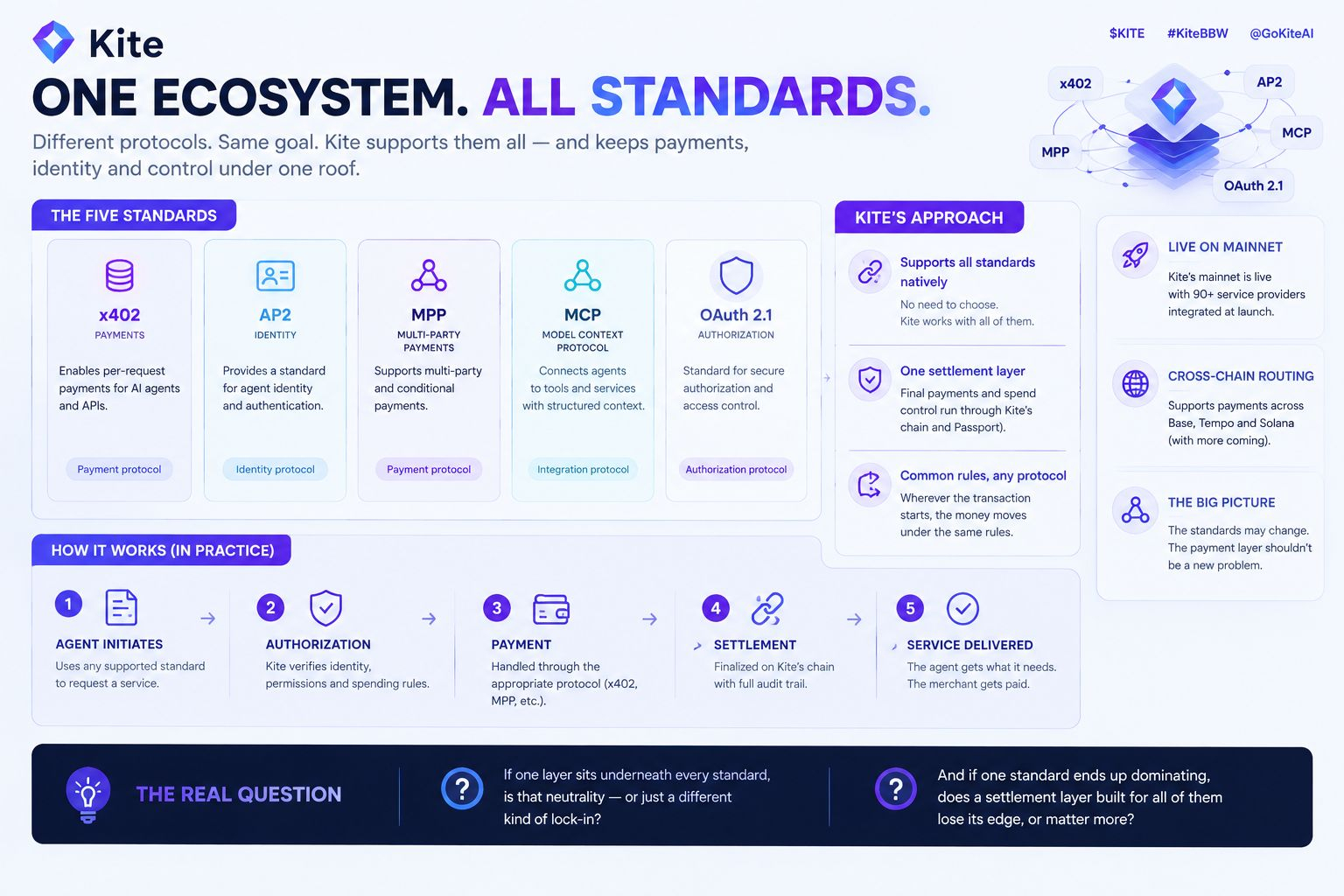
x402, AP2, MPP, MCP, OAuth 2.1.
Cinco protocolos que se le podría pedir a un agente que use, y nadie sabe cuál prevalecerá.
La respuesta de Kite es no elegir.
Cada uno cubre una parte distinta. x402 recupera el estado HTTP «pago requerido» para que un servicio pueda cobrar por solicitud.
AP2 es el protocolo de pagos para agentes de Google, MPP es el protocolo de pagos entre máquinas de Stripe, MCP es la forma de Anthropic de conectar agentes con herramientas y OAuth 2.1 se encarga de la autorización.
Como lo planteó un informe de investigación, un agente que usa x402 puede pagar por solicitud, pero sigue necesitando una billetera aparte, una capa de identidad independiente y su propia lógica para limitar gastos.
El enfoque declarado de Kite es dar soporte nativo a todos ellos y mantener lo que importa —la liquidación final y el control del gasto— anclado a su propia cadena y a Passport.
Sea cual sea el protocolo que inicia la transacción, se supone que el dinero se mueve según las mismas reglas que estableció el usuario: un presupuesto, un límite de tiempo, la aprobación con una clave de acceso y la revocación instantánea.
Kite también destaca la finalidad determinista en menos de un segundo y los canales de pago dedicados para agentes, aspectos más importantes para un agente que para una persona.
Una persona puede esperar una confirmación.
Un agente que actúa por su cuenta necesita saber que un pago realmente se ha completado. Me gusta la lógica porque evita la disputa por los estándares.
También es una apuesta discreta sobre dónde reside el valor en la economía de los agentes:
no en la capa de solicitudes, que podría cambiar cada año, sino en la capa que decide si se permite liquidar un pago.
Kite también es miembro de la Agentic AI Foundation de la Linux Foundation, lo que sugiere que quiere tener un lugar en la conversación sobre estándares, no quedarse al margen.
La mainnet se lanzó el 30 de abril de 2026, con más de 90 proveedores de servicios ya integrados, así que la verdadera prueba será si esa neutralidad y esos canales de pago resisten el tráfico real.
Me gustaría conocer las opiniones de otras personas.
1. Si hay una capa que subyace a todos los estándares, ¿eso es neutralidad o simplemente otra forma de dependencia?
2. Si al final un estándar termina dominando de todos modos, ¿una capa de liquidación diseñada para todos pierde su ventaja o se vuelve más importante porque todo pasa por ella?
x402, AP2, MPP, MCP, OAuth 2.1.
Cinco protocolos que se le podría pedir a un agente que use, y nadie sabe cuál prevalecerá.
La respuesta de Kite es no elegir.
Cada uno cubre una parte distinta. x402 recupera el estado HTTP «pago requerido» para que un servicio pueda cobrar por solicitud.
AP2 es el protocolo de pagos para agentes de Google, MPP es el protocolo de pagos entre máquinas de Stripe, MCP es la forma de Anthropic de conectar agentes con herramientas y OAuth 2.1 se encarga de la autorización.
Como lo planteó un informe de investigación, un agente que usa x402 puede pagar por solicitud, pero sigue necesitando una billetera aparte, una capa de identidad independiente y su propia lógica para limitar gastos.
El enfoque declarado de Kite es dar soporte nativo a todos ellos y mantener lo que importa —la liquidación final y el control del gasto— anclado a su propia cadena y a Passport.
Sea cual sea el protocolo que inicia la transacción, se supone que el dinero se mueve según las mismas reglas que estableció el usuario: un presupuesto, un límite de tiempo, la aprobación con una clave de acceso y la revocación instantánea.
Kite también destaca la finalidad determinista en menos de un segundo y los canales de pago dedicados para agentes, aspectos más importantes para un agente que para una persona.
Una persona puede esperar una confirmación.
Un agente que actúa por su cuenta necesita saber que un pago realmente se ha completado. Me gusta la lógica porque evita la disputa por los estándares.
También es una apuesta discreta sobre dónde reside el valor en la economía de los agentes:
no en la capa de solicitudes, que podría cambiar cada año, sino en la capa que decide si se permite liquidar un pago.
Kite también es miembro de la Agentic AI Foundation de la Linux Foundation, lo que sugiere que quiere tener un lugar en la conversación sobre estándares, no quedarse al margen.
La mainnet se lanzó el 30 de abril de 2026, con más de 90 proveedores de servicios ya integrados, así que la verdadera prueba será si esa neutralidad y esos canales de pago resisten el tráfico real.
Me gustaría conocer las opiniones de otras personas.
1. Si hay una capa que subyace a todos los estándares, ¿eso es neutralidad o simplemente otra forma de dependencia?
2. Si al final un estándar termina dominando de todos modos, ¿una capa de liquidación diseñada para todos pierde su ventaja o se vuelve más importante porque todo pasa por ella?
37
·
--
Esta semana podría ser la más importante para las criptomonedas en 2026 y la mayoría de la gente no está lista 👀
Tres cosas suceden una tras otra —
La Ley de CLARIDAD llegó al pleno del Senado el 15 de septiembre. Primera votación real sobre regulación de cripto en la historia de EE. UU. El Senado necesita superar un umbral de 60 votos para avanzar para el debate.
La Fed acaba de subir las tasas 25 puntos básicos — los mercados habían asignado 85% de probabilidad a una subida de tasas en medio de una inflación persistente. Tasas más altas = presión sobre las criptomonedas.
Y el Banco de Japón se reúne HOY 17 de septiembre. Los cambios en la política del BOJ mueven la liquidez global y eso mueve las criptos.
Mientras tanto, $BTC está por encima de $78K después de recuperarse de $60K en agosto 😅
Tres eventos políticos, monetarios y globales. Cuatro días. Un mercado.
Sea lo que pase esta semana — marca el tono para el resto de 2026.
¿Estás posicionado para ello? 👇
$BTC
{future}(BTCUSDT)
Esta semana podría ser la más importante para las criptomonedas en 2026 y la mayoría de la gente no está lista 👀
Tres cosas suceden una tras otra —
La Ley de CLARIDAD llegó al pleno del Senado el 15 de septiembre. Primera votación real sobre regulación de cripto en la historia de EE. UU. El Senado necesita superar un umbral de 60 votos para avanzar para el debate.
La Fed acaba de subir las tasas 25 puntos básicos — los mercados habían asignado 85% de probabilidad a una subida de tasas en medio de una inflación persistente. Tasas más altas = presión sobre las criptomonedas.
Y el Banco de Japón se reúne HOY 17 de septiembre. Los cambios en la política del BOJ mueven la liquidez global y eso mueve las criptos.
Mientras tanto, $BTC está por encima de $78K después de recuperarse de $60K en agosto 😅
Tres eventos políticos, monetarios y globales. Cuatro días. Un mercado.
Sea lo que pase esta semana — marca el tono para el resto de 2026.
¿Estás posicionado para ello? 👇
$BTC
Tres cosas suceden una tras otra —
La Ley de CLARIDAD llegó al pleno del Senado el 15 de septiembre. Primera votación real sobre regulación de cripto en la historia de EE. UU. El Senado necesita superar un umbral de 60 votos para avanzar para el debate.
La Fed acaba de subir las tasas 25 puntos básicos — los mercados habían asignado 85% de probabilidad a una subida de tasas en medio de una inflación persistente. Tasas más altas = presión sobre las criptomonedas.
Y el Banco de Japón se reúne HOY 17 de septiembre. Los cambios en la política del BOJ mueven la liquidez global y eso mueve las criptos.
Mientras tanto, $BTC está por encima de $78K después de recuperarse de $60K en agosto 😅
Tres eventos políticos, monetarios y globales. Cuatro días. Un mercado.
Sea lo que pase esta semana — marca el tono para el resto de 2026.
¿Estás posicionado para ello? 👇
$BTC

247
2
24
247


·
--
Verificado
#dusk $DUSK @Dusk_Foundation
Lee dos veces esta semana la sección de implementación del whitepaper. Primera pasada: me limité a hojear, y me salté la parte sobre las "host functions", asumiendo que era solo una nota técnica sobre cómo se construye la VM. Segunda pasada: esa suposición no resistió.
Había estado tratando "los smart contracts se ejecutan en una VM" y "las operaciones criptográficas se ejecutan en una VM" como si fueran la misma afirmación. No lo son, y la brecha entre ambas es, en realidad, la decisión de diseño interesante.
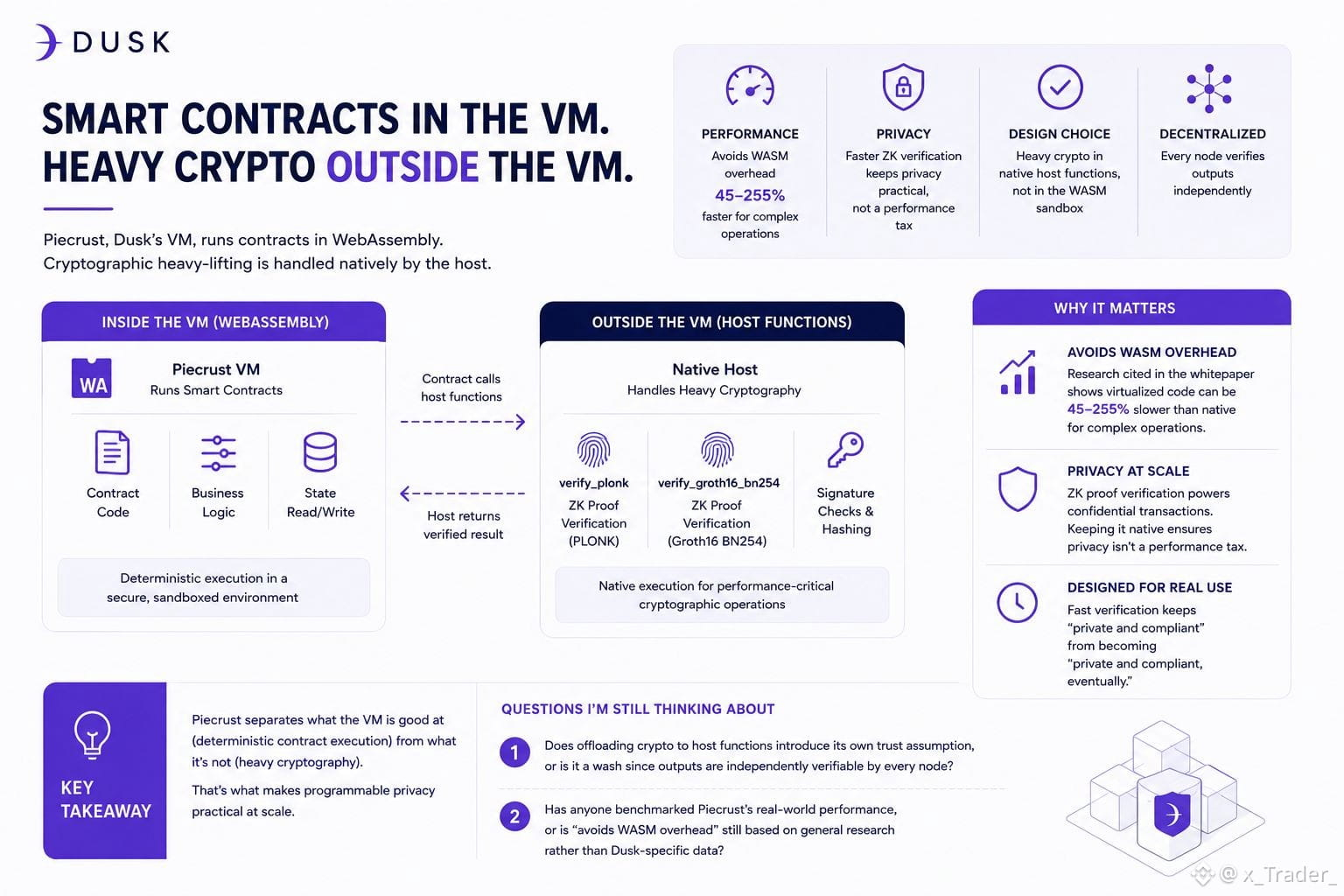
Piecrust, la VM de Dusk, ejecuta contratos en WebAssembly. Pero no ejecuta la carga criptográfica pesada — hashing, verificación de pruebas ZK, comprobaciones de firmas — dentro de ese entorno aislado de WASM. Eso se extrae y se gestiona de forma nativa por el host, a través de funciones expuestas como verify_plonk y verify_groth16_bn254. El contrato llama a esas funciones, pero las matemáticas costosas nunca tocan el entorno virtualizado.
He aquí por qué esto no es un simple detalle de implementación. La investigación sobre la ejecución de WASM que cita el whitepaper muestra que el código virtualizado puede ejecutarse entre un 45% y un 255% más lento que el código nativo para operaciones complejas — la sobrecarga está incorporada en cómo funcionan la memoria y las instrucciones en el sandbox, no es algo que se optimice fácilmente.
Así que las transacciones confidenciales, que se apoyan en la verificación de pruebas ZK para prácticamente todo, pagarían ese impuesto en cada una de ellas si la verificación se ejecutara dentro de la VM como una llamada normal a un contrato.
Eso es lo que conecta de vuelta con el diseño de la privacidad. La privacidad programable no es solo una elección criptográfica, también es una restricción de rendimiento — si la verificación de pruebas es lenta, "privada y compatible" termina convirtiéndose silenciosamente en "privada y compatible, eventualmente". Extraer la cripto a funciones del host es lo que evita que la privacidad sea un costo adicional sobre cada transacción, en lugar de una propiedad de ella.
¿Alguien ha medido realmente los números en el mundo real de Piecrust aquí, o "evita la sobrecarga de WASM" sigue basándose en la investigación general citada, y no en datos específicos de Dusk?"
#dusk $DUSK @Dusk
Lee dos veces esta semana la sección de implementación del whitepaper. Primera pasada: me limité a hojear, y me salté la parte sobre las "host functions", asumiendo que era solo una nota técnica sobre cómo se construye la VM. Segunda pasada: esa suposición no resistió.
Había estado tratando "los smart contracts se ejecutan en una VM" y "las operaciones criptográficas se ejecutan en una VM" como si fueran la misma afirmación. No lo son, y la brecha entre ambas es, en realidad, la decisión de diseño interesante.
Piecrust, la VM de Dusk, ejecuta contratos en WebAssembly. Pero no ejecuta la carga criptográfica pesada — hashing, verificación de pruebas ZK, comprobaciones de firmas — dentro de ese entorno aislado de WASM. Eso se extrae y se gestiona de forma nativa por el host, a través de funciones expuestas como verify_plonk y verify_groth16_bn254. El contrato llama a esas funciones, pero las matemáticas costosas nunca tocan el entorno virtualizado.
He aquí por qué esto no es un simple detalle de implementación. La investigación sobre la ejecución de WASM que cita el whitepaper muestra que el código virtualizado puede ejecutarse entre un 45% y un 255% más lento que el código nativo para operaciones complejas — la sobrecarga está incorporada en cómo funcionan la memoria y las instrucciones en el sandbox, no es algo que se optimice fácilmente.
Así que las transacciones confidenciales, que se apoyan en la verificación de pruebas ZK para prácticamente todo, pagarían ese impuesto en cada una de ellas si la verificación se ejecutara dentro de la VM como una llamada normal a un contrato.
Eso es lo que conecta de vuelta con el diseño de la privacidad. La privacidad programable no es solo una elección criptográfica, también es una restricción de rendimiento — si la verificación de pruebas es lenta, "privada y compatible" termina convirtiéndose silenciosamente en "privada y compatible, eventualmente". Extraer la cripto a funciones del host es lo que evita que la privacidad sea un costo adicional sobre cada transacción, en lugar de una propiedad de ella.
¿Alguien ha medido realmente los números en el mundo real de Piecrust aquí, o "evita la sobrecarga de WASM" sigue basándose en la investigación general citada, y no en datos específicos de Dusk?"
Lee dos veces esta semana la sección de implementación del whitepaper. Primera pasada: me limité a hojear, y me salté la parte sobre las "host functions", asumiendo que era solo una nota técnica sobre cómo se construye la VM. Segunda pasada: esa suposición no resistió.
Había estado tratando "los smart contracts se ejecutan en una VM" y "las operaciones criptográficas se ejecutan en una VM" como si fueran la misma afirmación. No lo son, y la brecha entre ambas es, en realidad, la decisión de diseño interesante.
Piecrust, la VM de Dusk, ejecuta contratos en WebAssembly. Pero no ejecuta la carga criptográfica pesada — hashing, verificación de pruebas ZK, comprobaciones de firmas — dentro de ese entorno aislado de WASM. Eso se extrae y se gestiona de forma nativa por el host, a través de funciones expuestas como verify_plonk y verify_groth16_bn254. El contrato llama a esas funciones, pero las matemáticas costosas nunca tocan el entorno virtualizado.
He aquí por qué esto no es un simple detalle de implementación. La investigación sobre la ejecución de WASM que cita el whitepaper muestra que el código virtualizado puede ejecutarse entre un 45% y un 255% más lento que el código nativo para operaciones complejas — la sobrecarga está incorporada en cómo funcionan la memoria y las instrucciones en el sandbox, no es algo que se optimice fácilmente.
Así que las transacciones confidenciales, que se apoyan en la verificación de pruebas ZK para prácticamente todo, pagarían ese impuesto en cada una de ellas si la verificación se ejecutara dentro de la VM como una llamada normal a un contrato.
Eso es lo que conecta de vuelta con el diseño de la privacidad. La privacidad programable no es solo una elección criptográfica, también es una restricción de rendimiento — si la verificación de pruebas es lenta, "privada y compatible" termina convirtiéndose silenciosamente en "privada y compatible, eventualmente". Extraer la cripto a funciones del host es lo que evita que la privacidad sea un costo adicional sobre cada transacción, en lugar de una propiedad de ella.
¿Alguien ha medido realmente los números en el mundo real de Piecrust aquí, o "evita la sobrecarga de WASM" sigue basándose en la investigación general citada, y no en datos específicos de Dusk?"
5
5
539
·
--
Verificado
#dusk
Asumí que el diseño del rollup de DuskEVM era, básicamente, un detalle técnico: secuenciador, batcher, capa base, lo que sea. Luego comparé su modelo de disputa con el de Arbitrum y Optimism, y la suposición se desmoronó.
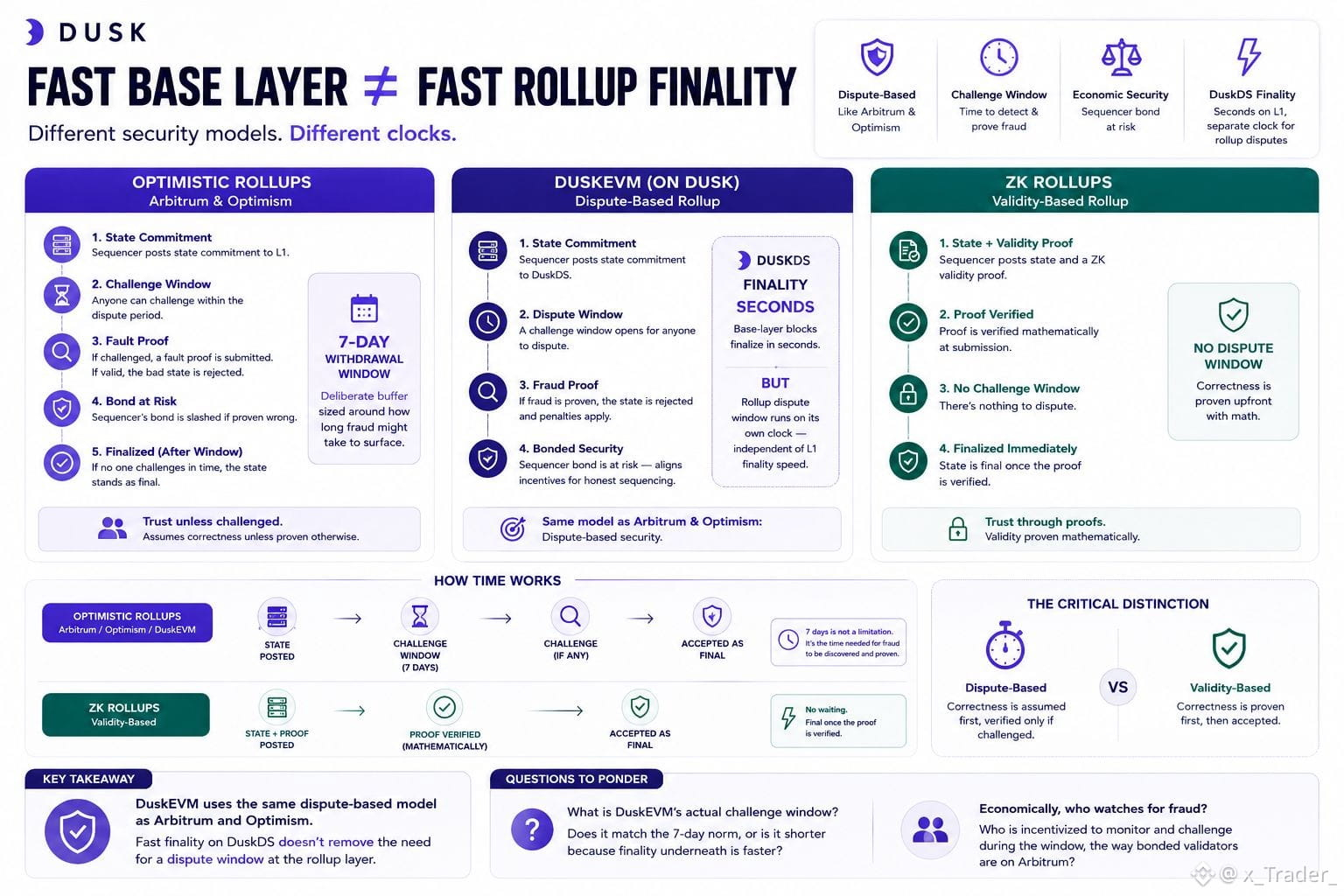
Los rollups optimistas no verifican por defecto. Verifican mediante un desafío. Un secuenciador publica una confirmación del estado. Cualquiera puede enviar una prueba de fallo contra ella. Si la prueba se mantiene, el estado incorrecto se rechaza y se le recorta (slashing) la garantía al secuenciador. Si nadie lo desafía a tiempo, se mantiene como definitivo, independientemente de si en realidad estaba bien.
Esto es lo que no había conectado hasta que puse los números lado a lado. Arbitrum y Optimism imponen una ventana de retirada de 7 días: no es una limitación, sino un búfer deliberado dimensionado según cuánto podría tardar en salir a la luz el fraude. Los zk-rollups se saltan eso por completo: una prueba de validez se comprueba matemáticamente al enviarla, así que no queda nada que disputar.
DuskDS finaliza bloques de la capa base en segundos. Asumí que esa rapidez se transfiere automáticamente hasta la capa del rollup. No es así. La ventana de disputa funciona con su propio reloj, independientemente de qué tan rápido se asienta la capa que está debajo.
Así que la comparación real no es "DuskEVM vs. los rollups de Ethereum". Es "seguridad basada en disputas vs. seguridad basada en matemáticas", y DuskEVM eligió el mismo lado que Arbitrum y Optimism.
$DUSK
@Dusk_Foundation
¿Cuál es la ventana de desafío real de DuskEVM: coincide con la norma de 7 días, o es más corta porque la finalización por debajo es más rápida?
#dusk
Asumí que el diseño del rollup de DuskEVM era, básicamente, un detalle técnico: secuenciador, batcher, capa base, lo que sea. Luego comparé su modelo de disputa con el de Arbitrum y Optimism, y la suposición se desmoronó.
Los rollups optimistas no verifican por defecto. Verifican mediante un desafío. Un secuenciador publica una confirmación del estado. Cualquiera puede enviar una prueba de fallo contra ella. Si la prueba se mantiene, el estado incorrecto se rechaza y se le recorta (slashing) la garantía al secuenciador. Si nadie lo desafía a tiempo, se mantiene como definitivo, independientemente de si en realidad estaba bien.
Esto es lo que no había conectado hasta que puse los números lado a lado. Arbitrum y Optimism imponen una ventana de retirada de 7 días: no es una limitación, sino un búfer deliberado dimensionado según cuánto podría tardar en salir a la luz el fraude. Los zk-rollups se saltan eso por completo: una prueba de validez se comprueba matemáticamente al enviarla, así que no queda nada que disputar.
DuskDS finaliza bloques de la capa base en segundos. Asumí que esa rapidez se transfiere automáticamente hasta la capa del rollup. No es así. La ventana de disputa funciona con su propio reloj, independientemente de qué tan rápido se asienta la capa que está debajo.
Así que la comparación real no es "DuskEVM vs. los rollups de Ethereum". Es "seguridad basada en disputas vs. seguridad basada en matemáticas", y DuskEVM eligió el mismo lado que Arbitrum y Optimism.
$DUSK
@Dusk
¿Cuál es la ventana de desafío real de DuskEVM: coincide con la norma de 7 días, o es más corta porque la finalización por debajo es más rápida?
Asumí que el diseño del rollup de DuskEVM era, básicamente, un detalle técnico: secuenciador, batcher, capa base, lo que sea. Luego comparé su modelo de disputa con el de Arbitrum y Optimism, y la suposición se desmoronó.
Los rollups optimistas no verifican por defecto. Verifican mediante un desafío. Un secuenciador publica una confirmación del estado. Cualquiera puede enviar una prueba de fallo contra ella. Si la prueba se mantiene, el estado incorrecto se rechaza y se le recorta (slashing) la garantía al secuenciador. Si nadie lo desafía a tiempo, se mantiene como definitivo, independientemente de si en realidad estaba bien.
Esto es lo que no había conectado hasta que puse los números lado a lado. Arbitrum y Optimism imponen una ventana de retirada de 7 días: no es una limitación, sino un búfer deliberado dimensionado según cuánto podría tardar en salir a la luz el fraude. Los zk-rollups se saltan eso por completo: una prueba de validez se comprueba matemáticamente al enviarla, así que no queda nada que disputar.
DuskDS finaliza bloques de la capa base en segundos. Asumí que esa rapidez se transfiere automáticamente hasta la capa del rollup. No es así. La ventana de disputa funciona con su propio reloj, independientemente de qué tan rápido se asienta la capa que está debajo.
Así que la comparación real no es "DuskEVM vs. los rollups de Ethereum". Es "seguridad basada en disputas vs. seguridad basada en matemáticas", y DuskEVM eligió el mismo lado que Arbitrum y Optimism.
$DUSK
@Dusk
¿Cuál es la ventana de desafío real de DuskEVM: coincide con la norma de 7 días, o es más corta porque la finalización por debajo es más rápida?
1
3
306
·
--
Verificado
#dusk $DUSK
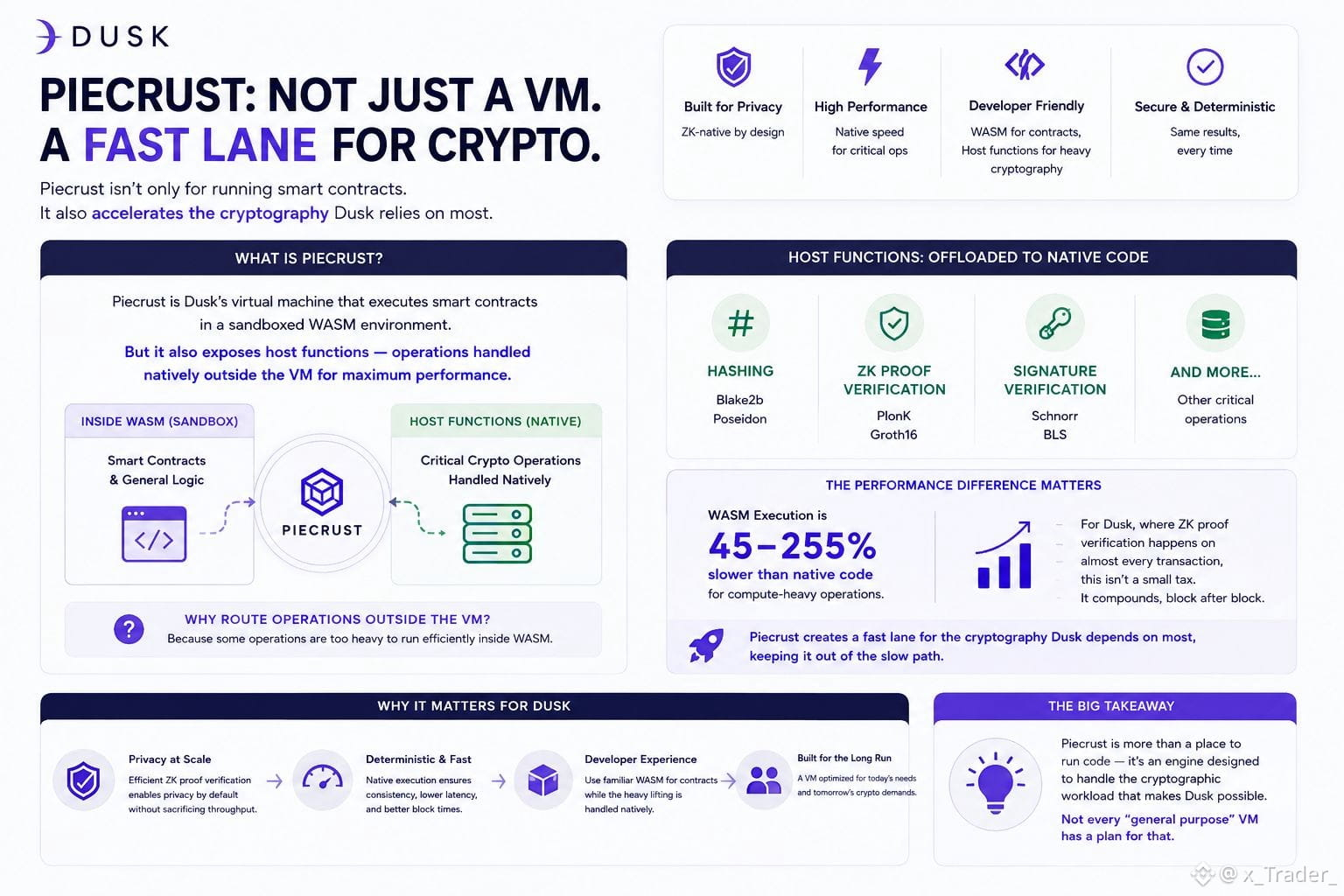
Pensé que Piecrust, la máquina virtual virtual de Dusk, estaba ahí solo para ejecutar contratos inteligentes. Mismo trabajo que cualquier VM hace: ejecutar código, mantener el estado y listo. Resulta que quizá es solo la mitad de lo que en realidad hace.
Revisando la documentación, Piecrust expone un conjunto de funciones de host.
operaciones que la VM delega en código nativo en lugar de ejecutarse dentro del entorno WASM aislado.
Hashing, mediante Blake2b y Poseidon.
Verificar pruebas de conocimiento cero PlonK y Groth16.
Validar firmas Schnorr y BLS.
Nada de eso corre como bytecode de contrato normal.
¿Por qué una VM se molestaría en desviar operaciones específicas a su alrededor en lugar de limitarse a ejecutarlo todo de la forma habitual?
Resulta que la ejecución de WASM puede ser 45-255% más lenta que el código nativo para operaciones pesadas; la sobrecarga viene de la gestión de memoria virtualizada y del manejo adicional de instrucciones que introduce un entorno sandbox.
En una cadena donde la verificación de pruebas ZK no es algo ocasional, sino que ocurre prácticamente en cada transacción, ejecutar esa matemática dentro de WASM en vez de hacerlo de forma nativa no es un recargo pequeño.
Se acumula, bloque tras bloque.
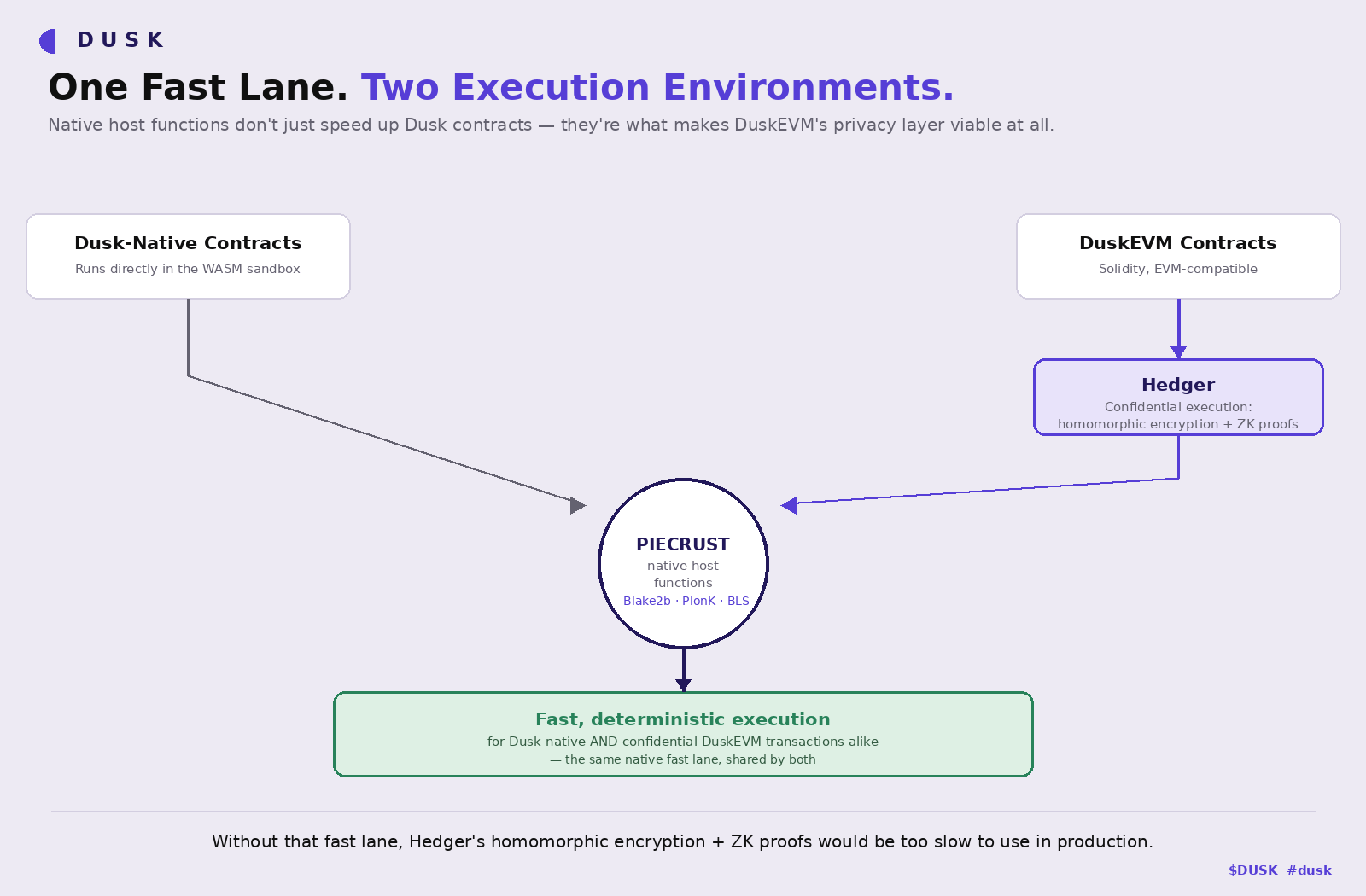
Este mismo principio se traslada directamente a DuskEVM, la capa compatible con EVM que acerca a los desarrolladores de Solidity a Dusk.
Hedger, su módulo de ejecución confidencial, se apoya en cifrado homomórfico más pruebas ZK para mantener las transacciones privadas; y nada de eso sería lo suficientemente rápido como para importar si, debajo, no existieran primero las funciones nativas del host haciendo el trabajo pesado.
Así que Piecrust no es solo el lugar donde se ejecutan los contratos. También es un carril rápido para las operaciones criptográficas exactas @Dusk_Foundation de las que más dependen, deliberadamente mantenidas fuera del camino lento, y ese mismo carril rápido es lo que hace viable la capa de privacidad de DuskEVM, no solo para contratos nativos de Dusk.
Me hace preguntarme: ¿cuántas otras VMs de “propósito general” están comiéndose, en silencio, un impuesto de verificación de pruebas al que nadie se ha molestado en medir?
#dusk $DUSK
Pensé que Piecrust, la máquina virtual virtual de Dusk, estaba ahí solo para ejecutar contratos inteligentes. Mismo trabajo que cualquier VM hace: ejecutar código, mantener el estado y listo. Resulta que quizá es solo la mitad de lo que en realidad hace.
Revisando la documentación, Piecrust expone un conjunto de funciones de host.
operaciones que la VM delega en código nativo en lugar de ejecutarse dentro del entorno WASM aislado.
Hashing, mediante Blake2b y Poseidon.
Verificar pruebas de conocimiento cero PlonK y Groth16.
Validar firmas Schnorr y BLS.
Nada de eso corre como bytecode de contrato normal.
¿Por qué una VM se molestaría en desviar operaciones específicas a su alrededor en lugar de limitarse a ejecutarlo todo de la forma habitual?
Resulta que la ejecución de WASM puede ser 45-255% más lenta que el código nativo para operaciones pesadas; la sobrecarga viene de la gestión de memoria virtualizada y del manejo adicional de instrucciones que introduce un entorno sandbox.
En una cadena donde la verificación de pruebas ZK no es algo ocasional, sino que ocurre prácticamente en cada transacción, ejecutar esa matemática dentro de WASM en vez de hacerlo de forma nativa no es un recargo pequeño.
Se acumula, bloque tras bloque.
Este mismo principio se traslada directamente a DuskEVM, la capa compatible con EVM que acerca a los desarrolladores de Solidity a Dusk.
Hedger, su módulo de ejecución confidencial, se apoya en cifrado homomórfico más pruebas ZK para mantener las transacciones privadas; y nada de eso sería lo suficientemente rápido como para importar si, debajo, no existieran primero las funciones nativas del host haciendo el trabajo pesado.
Así que Piecrust no es solo el lugar donde se ejecutan los contratos. También es un carril rápido para las operaciones criptográficas exactas @Dusk de las que más dependen, deliberadamente mantenidas fuera del camino lento, y ese mismo carril rápido es lo que hace viable la capa de privacidad de DuskEVM, no solo para contratos nativos de Dusk.
Me hace preguntarme: ¿cuántas otras VMs de “propósito general” están comiéndose, en silencio, un impuesto de verificación de pruebas al que nadie se ha molestado en medir?
Pensé que Piecrust, la máquina virtual virtual de Dusk, estaba ahí solo para ejecutar contratos inteligentes. Mismo trabajo que cualquier VM hace: ejecutar código, mantener el estado y listo. Resulta que quizá es solo la mitad de lo que en realidad hace.
Revisando la documentación, Piecrust expone un conjunto de funciones de host.
operaciones que la VM delega en código nativo en lugar de ejecutarse dentro del entorno WASM aislado.
Hashing, mediante Blake2b y Poseidon.
Verificar pruebas de conocimiento cero PlonK y Groth16.
Validar firmas Schnorr y BLS.
Nada de eso corre como bytecode de contrato normal.
¿Por qué una VM se molestaría en desviar operaciones específicas a su alrededor en lugar de limitarse a ejecutarlo todo de la forma habitual?
Resulta que la ejecución de WASM puede ser 45-255% más lenta que el código nativo para operaciones pesadas; la sobrecarga viene de la gestión de memoria virtualizada y del manejo adicional de instrucciones que introduce un entorno sandbox.
En una cadena donde la verificación de pruebas ZK no es algo ocasional, sino que ocurre prácticamente en cada transacción, ejecutar esa matemática dentro de WASM en vez de hacerlo de forma nativa no es un recargo pequeño.
Se acumula, bloque tras bloque.
Este mismo principio se traslada directamente a DuskEVM, la capa compatible con EVM que acerca a los desarrolladores de Solidity a Dusk.
Hedger, su módulo de ejecución confidencial, se apoya en cifrado homomórfico más pruebas ZK para mantener las transacciones privadas; y nada de eso sería lo suficientemente rápido como para importar si, debajo, no existieran primero las funciones nativas del host haciendo el trabajo pesado.
Así que Piecrust no es solo el lugar donde se ejecutan los contratos. También es un carril rápido para las operaciones criptográficas exactas @Dusk de las que más dependen, deliberadamente mantenidas fuera del camino lento, y ese mismo carril rápido es lo que hace viable la capa de privacidad de DuskEVM, no solo para contratos nativos de Dusk.
Me hace preguntarme: ¿cuántas otras VMs de “propósito general” están comiéndose, en silencio, un impuesto de verificación de pruebas al que nadie se ha molestado en medir?
13
9
660
·
--
#dusk $DUSK @Dusk_Foundation
El crepúsculo tiene dos modelos de transacción, y seguí tratándolos como si fueran uno solo, un sistema de privacidad con dos nombres.
Volví a revisar la documentación porque eso no terminaba de tener sentido. Resulta que están resolviendo dos problemas distintos.
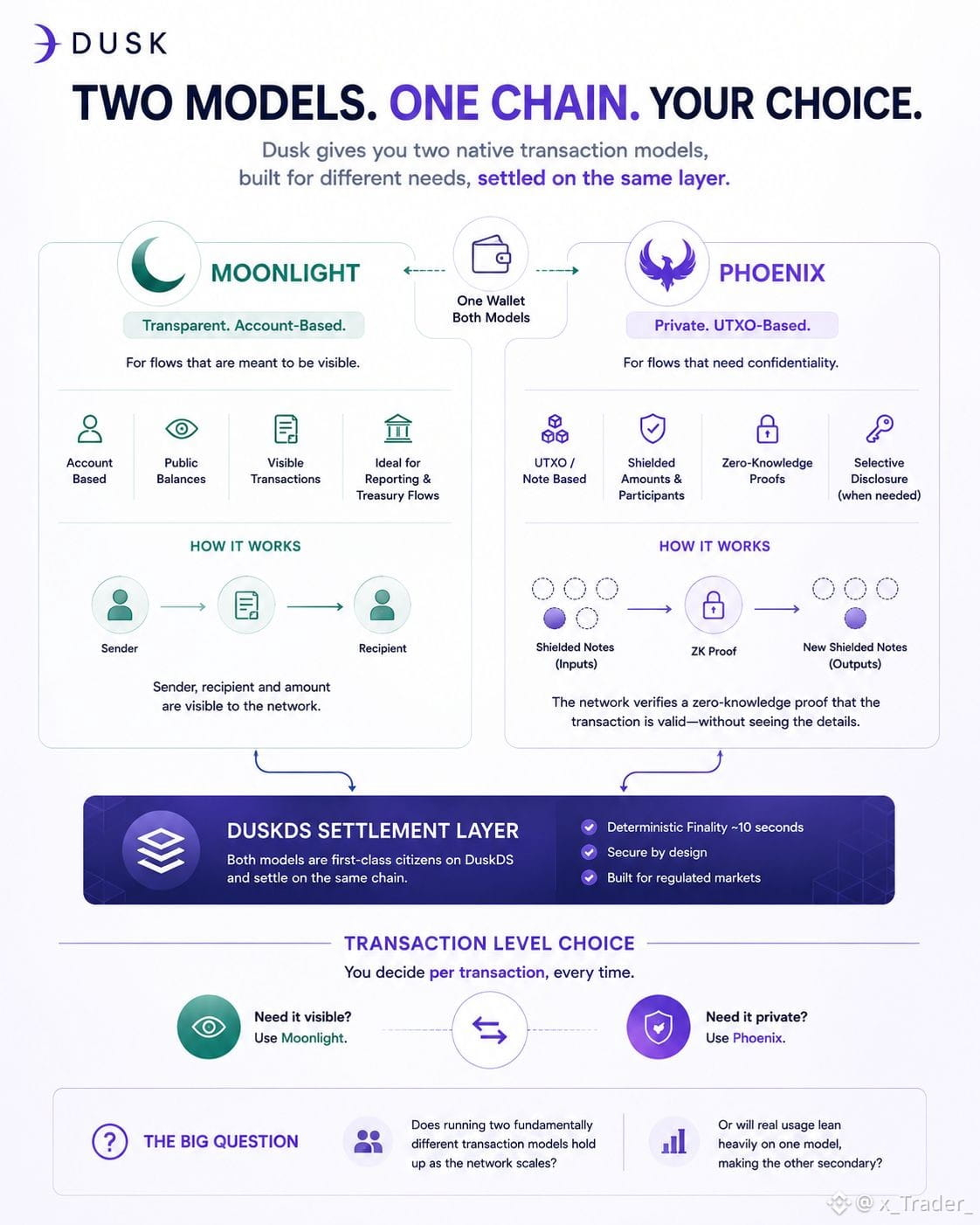
MOONLIGHT es el transparente: basado en cuentas, con saldos visibles, remitente, destinatario y monto. Útil cuando se supone que un flujo sea observable.
PHOENIX funciona de manera completamente diferente. Está basado en UTXO, así que los fondos existen como notas protegidas en lugar de un saldo visible en funcionamiento. En vez de revelar los detalles de la transacción, la red verifica una prueba de conocimiento cero de que el gasto es válido, incluyendo que los fondos existen y que no se están gastando dos veces.
La parte que me pareció más interesante:
Ninguno es un sustituto del otro.
Ambos son modelos de transacción nativos en DuskDS y se liquidan en la misma cadena. Un perfil de billetera puede administrar una cuenta Moonlight y una cuenta Phoenix lado a lado.
Así que la privacidad no es algo que activas una sola vez.
Es una elección a nivel de transacción.
¿Quieres la transferencia visible? Moonlight.
¿Necesitas que el monto y los participantes estén protegidos? Phoenix.
Y si una parte autorizada necesita pruebas más adelante, Dusk admite divulgación selectiva mediante claves de visualización.
Esa es una elección de diseño bastante distinta a tomar un modelo de transacción y añadirle una capa de privacidad.
Pero me deja con la pregunta que realmente me interesa:
¿Mantener dos modelos de transacción fundamentalmente diferentes se convierte en una fortaleza a medida que Dusk escala, o en un dolor de cabeza de ingeniería a largo plazo?
Y en el uso real, ¿los mercados regulados realmente necesitan ambos, o uno de ellos terminará haciendo la mayor parte del trabajo?
#dusk $DUSK @Dusk
El crepúsculo tiene dos modelos de transacción, y seguí tratándolos como si fueran uno solo, un sistema de privacidad con dos nombres.
Volví a revisar la documentación porque eso no terminaba de tener sentido. Resulta que están resolviendo dos problemas distintos.
MOONLIGHT es el transparente: basado en cuentas, con saldos visibles, remitente, destinatario y monto. Útil cuando se supone que un flujo sea observable.
PHOENIX funciona de manera completamente diferente. Está basado en UTXO, así que los fondos existen como notas protegidas en lugar de un saldo visible en funcionamiento. En vez de revelar los detalles de la transacción, la red verifica una prueba de conocimiento cero de que el gasto es válido, incluyendo que los fondos existen y que no se están gastando dos veces.
La parte que me pareció más interesante:
Ninguno es un sustituto del otro.
Ambos son modelos de transacción nativos en DuskDS y se liquidan en la misma cadena. Un perfil de billetera puede administrar una cuenta Moonlight y una cuenta Phoenix lado a lado.
Así que la privacidad no es algo que activas una sola vez.
Es una elección a nivel de transacción.
¿Quieres la transferencia visible? Moonlight.
¿Necesitas que el monto y los participantes estén protegidos? Phoenix.
Y si una parte autorizada necesita pruebas más adelante, Dusk admite divulgación selectiva mediante claves de visualización.
Esa es una elección de diseño bastante distinta a tomar un modelo de transacción y añadirle una capa de privacidad.
Pero me deja con la pregunta que realmente me interesa:
¿Mantener dos modelos de transacción fundamentalmente diferentes se convierte en una fortaleza a medida que Dusk escala, o en un dolor de cabeza de ingeniería a largo plazo?
Y en el uso real, ¿los mercados regulados realmente necesitan ambos, o uno de ellos terminará haciendo la mayor parte del trabajo?
El crepúsculo tiene dos modelos de transacción, y seguí tratándolos como si fueran uno solo, un sistema de privacidad con dos nombres.
Volví a revisar la documentación porque eso no terminaba de tener sentido. Resulta que están resolviendo dos problemas distintos.
MOONLIGHT es el transparente: basado en cuentas, con saldos visibles, remitente, destinatario y monto. Útil cuando se supone que un flujo sea observable.
PHOENIX funciona de manera completamente diferente. Está basado en UTXO, así que los fondos existen como notas protegidas en lugar de un saldo visible en funcionamiento. En vez de revelar los detalles de la transacción, la red verifica una prueba de conocimiento cero de que el gasto es válido, incluyendo que los fondos existen y que no se están gastando dos veces.
La parte que me pareció más interesante:
Ninguno es un sustituto del otro.
Ambos son modelos de transacción nativos en DuskDS y se liquidan en la misma cadena. Un perfil de billetera puede administrar una cuenta Moonlight y una cuenta Phoenix lado a lado.
Así que la privacidad no es algo que activas una sola vez.
Es una elección a nivel de transacción.
¿Quieres la transferencia visible? Moonlight.
¿Necesitas que el monto y los participantes estén protegidos? Phoenix.
Y si una parte autorizada necesita pruebas más adelante, Dusk admite divulgación selectiva mediante claves de visualización.
Esa es una elección de diseño bastante distinta a tomar un modelo de transacción y añadirle una capa de privacidad.
Pero me deja con la pregunta que realmente me interesa:
¿Mantener dos modelos de transacción fundamentalmente diferentes se convierte en una fortaleza a medida que Dusk escala, o en un dolor de cabeza de ingeniería a largo plazo?
Y en el uso real, ¿los mercados regulados realmente necesitan ambos, o uno de ellos terminará haciendo la mayor parte del trabajo?
11
10
621
·
--
#dusk $DUSK @Dusk_Foundation
Lee la sección de consenso del whitepaper dos veces esta semana, una tras otra. Pero no pasó nada nuevo la primera vez.
En la segunda pasada, una cosa que había estado haciendo mal finalmente encajó.
Había estado tratando “un bloque fue aprobado” y “un bloque ES final” como básicamente el mismo evento. No lo son. Hay una brecha entre ambos, y ahí es donde vive el pensamiento de seguridad interesante.
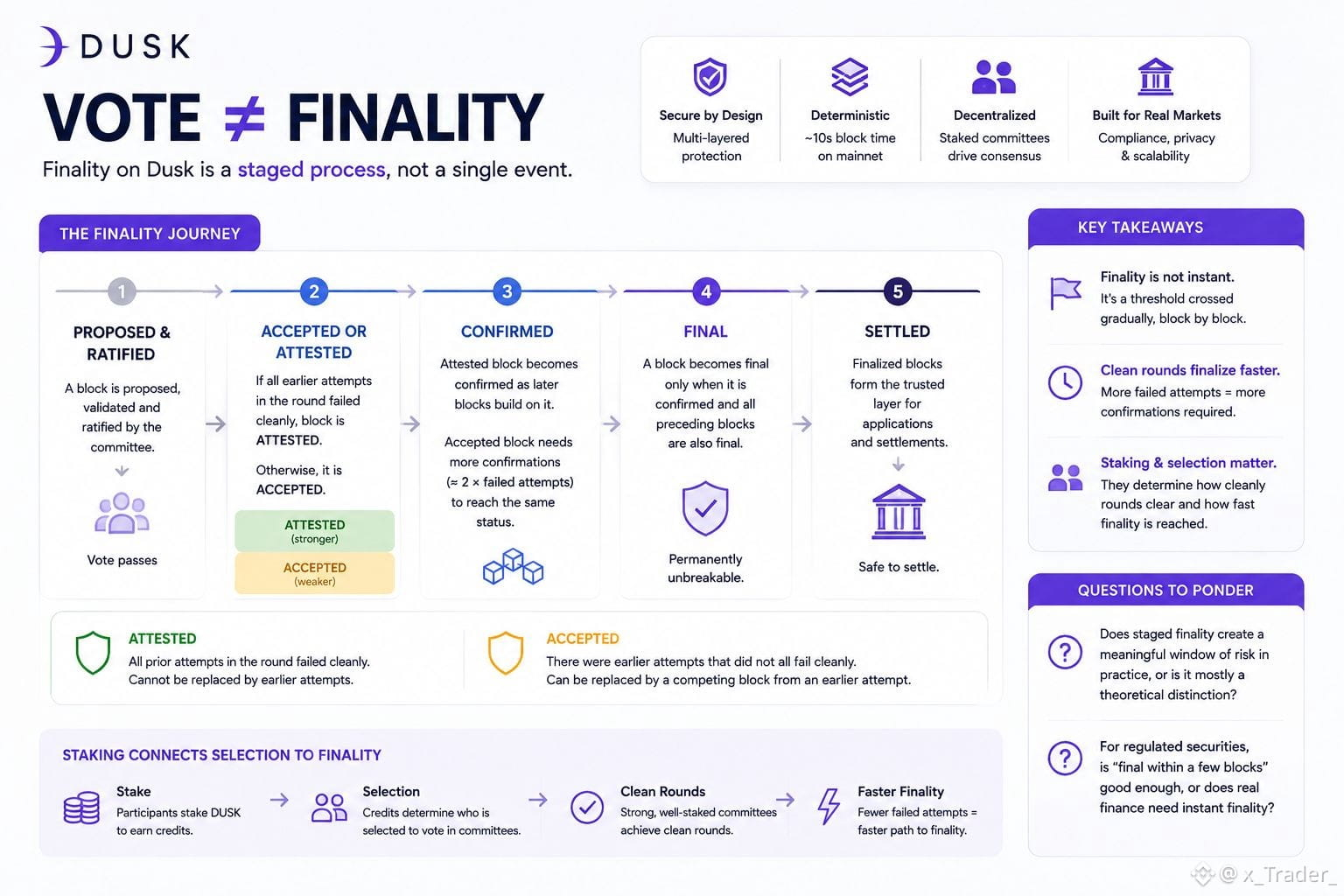
Un bloque que supera la validación y la ratificación pasa a ser TESTIMONIADO solo si todos los intentos anteriores de esa ronda fallaron de manera limpia. Si no, es “aceptado”, que es más débil. Un bloque aceptado aún, en teoría, puede reemplazarse por un bloque competidor de un intento anterior. Uno atestiguado no.
Luego la finalización se construye por etapas.
Un bloque atestiguado se confirma a medida que se van construyendo bloques posteriores sobre él. Un bloque aceptado necesita más confirmaciones para alcanzar el mismo estado, aproximadamente el doble del número de intentos fallidos que quedan detrás de él.
Solo cuando un bloque está confirmado, y todo lo que está antes de él también es final, realmente se vuelve final.
Así que “final” no es un solo evento que ocurre cuando una votación se aprueba. Es un umbral que se cruza bloque por bloque, y lo rápido que llegas a él depende en parte de qué tan limpia fue la ronda.
Aquí es donde los bucles de staking vuelven a entrar.
Quién se selecciona para votar, y quién tiene suficientes créditos en un comité para influir en el quórum, afecta qué tan limpiamente se superan las rondas. Una ronda desordenada no solo hace que las cosas se retrasen de forma vaga. Empuja el cronograma de finalización hacia fuera de una manera literal y contable.
La selección y la finalidad no son dos mecanismos no relacionados que están uno al lado del otro en el whitepaper. Uno decide quién vota. El otro decide cuándo su voto se vuelve inquebrantable.
Esa es la parte que me resulta interesante.
Y tengo dos preguntas que realmente me intrigan:
¿Esta finalización por etapas crea en la práctica una ventana significativa de riesgo, o es sobre todo una distinción teórica?
Y para valores regulados, ¿es “final dentro de unos pocos bloques” realmente suficiente, o las finanzas reales eventualmente exigen algo más cercano a la finalización instantánea?
#dusk $DUSK @Dusk
Lee la sección de consenso del whitepaper dos veces esta semana, una tras otra. Pero no pasó nada nuevo la primera vez.
En la segunda pasada, una cosa que había estado haciendo mal finalmente encajó.
Había estado tratando “un bloque fue aprobado” y “un bloque ES final” como básicamente el mismo evento. No lo son. Hay una brecha entre ambos, y ahí es donde vive el pensamiento de seguridad interesante.
Un bloque que supera la validación y la ratificación pasa a ser TESTIMONIADO solo si todos los intentos anteriores de esa ronda fallaron de manera limpia. Si no, es “aceptado”, que es más débil. Un bloque aceptado aún, en teoría, puede reemplazarse por un bloque competidor de un intento anterior. Uno atestiguado no.
Luego la finalización se construye por etapas.
Un bloque atestiguado se confirma a medida que se van construyendo bloques posteriores sobre él. Un bloque aceptado necesita más confirmaciones para alcanzar el mismo estado, aproximadamente el doble del número de intentos fallidos que quedan detrás de él.
Solo cuando un bloque está confirmado, y todo lo que está antes de él también es final, realmente se vuelve final.
Así que “final” no es un solo evento que ocurre cuando una votación se aprueba. Es un umbral que se cruza bloque por bloque, y lo rápido que llegas a él depende en parte de qué tan limpia fue la ronda.
Aquí es donde los bucles de staking vuelven a entrar.
Quién se selecciona para votar, y quién tiene suficientes créditos en un comité para influir en el quórum, afecta qué tan limpiamente se superan las rondas. Una ronda desordenada no solo hace que las cosas se retrasen de forma vaga. Empuja el cronograma de finalización hacia fuera de una manera literal y contable.
La selección y la finalidad no son dos mecanismos no relacionados que están uno al lado del otro en el whitepaper. Uno decide quién vota. El otro decide cuándo su voto se vuelve inquebrantable.
Esa es la parte que me resulta interesante.
Y tengo dos preguntas que realmente me intrigan:
¿Esta finalización por etapas crea en la práctica una ventana significativa de riesgo, o es sobre todo una distinción teórica?
Y para valores regulados, ¿es “final dentro de unos pocos bloques” realmente suficiente, o las finanzas reales eventualmente exigen algo más cercano a la finalización instantánea?
Lee la sección de consenso del whitepaper dos veces esta semana, una tras otra. Pero no pasó nada nuevo la primera vez.
En la segunda pasada, una cosa que había estado haciendo mal finalmente encajó.
Había estado tratando “un bloque fue aprobado” y “un bloque ES final” como básicamente el mismo evento. No lo son. Hay una brecha entre ambos, y ahí es donde vive el pensamiento de seguridad interesante.
Un bloque que supera la validación y la ratificación pasa a ser TESTIMONIADO solo si todos los intentos anteriores de esa ronda fallaron de manera limpia. Si no, es “aceptado”, que es más débil. Un bloque aceptado aún, en teoría, puede reemplazarse por un bloque competidor de un intento anterior. Uno atestiguado no.
Luego la finalización se construye por etapas.
Un bloque atestiguado se confirma a medida que se van construyendo bloques posteriores sobre él. Un bloque aceptado necesita más confirmaciones para alcanzar el mismo estado, aproximadamente el doble del número de intentos fallidos que quedan detrás de él.
Solo cuando un bloque está confirmado, y todo lo que está antes de él también es final, realmente se vuelve final.
Así que “final” no es un solo evento que ocurre cuando una votación se aprueba. Es un umbral que se cruza bloque por bloque, y lo rápido que llegas a él depende en parte de qué tan limpia fue la ronda.
Aquí es donde los bucles de staking vuelven a entrar.
Quién se selecciona para votar, y quién tiene suficientes créditos en un comité para influir en el quórum, afecta qué tan limpiamente se superan las rondas. Una ronda desordenada no solo hace que las cosas se retrasen de forma vaga. Empuja el cronograma de finalización hacia fuera de una manera literal y contable.
La selección y la finalidad no son dos mecanismos no relacionados que están uno al lado del otro en el whitepaper. Uno decide quién vota. El otro decide cuándo su voto se vuelve inquebrantable.
Esa es la parte que me resulta interesante.
Y tengo dos preguntas que realmente me intrigan:
¿Esta finalización por etapas crea en la práctica una ventana significativa de riesgo, o es sobre todo una distinción teórica?
Y para valores regulados, ¿es “final dentro de unos pocos bloques” realmente suficiente, o las finanzas reales eventualmente exigen algo más cercano a la finalización instantánea?
25
27
3.3k
·
--
Verificado
#dusk
Aquí tienes un detalle sobre las finanzas reguladas que me sorprendió ayer mientras navegaba por los documentos de Dusk durante la hora de comer.
La mayor parte de la infraestructura blockchain regulada, en realidad, no es pública.
Es con permisos.
Un libro privado, gestionado por una institución, que simplemente utiliza una tecnología con forma de blockchain por debajo. Parece descentralizado en el discurso de la presentación. No lo es.
Hay una razón para eso: los reguladores son cautelosos con las cadenas públicas y sin permisos específicamente.
No hay una sola parte que controle quién valida, quién puede ver qué, o quién puede rendir cuentas si algo sale mal.
Ese es el objetivo de una cadena pública, y es exactamente lo que pone nervioso a un regulador.
Por eso 21X me llamó la atención.
21X es la primera empresa en obtener una licencia DLT-TSS bajo regulación europea para un mercado de valores totalmente tokenizado. Esa licencia hace dos cosas: les permite combinar la negociación y la liquidación en un solo paso en lugar de conciliar más tarde, y les permite operar sobre una cadena pública sin permisos, no sobre una cadena privada disfrazada para parecer descentralizada.
Esa es la parte con la que sigo pensando. La mayoría de las plataformas reguladas obtienen permiso manteniéndose cerradas. 21X obtuvo permiso para usar lo real.
El papel de Dusk aquí es una relación de participante comercial: 21X planea integrar DuskEVM como una de las cadenas que respaldan. Acceso a su exención regulatoria de un lado, la infraestructura de Dusk del otro. Ninguna de las dos partes tenía el panorama completo por sí sola.
La tokenización nunca fue lo difícil.
El permiso para operar sobre infraestructura que nadie controla, sí.
21X lo resolvió en la capa regulatoria.
Dusk lo está resolviendo en la capa de protocolo (liquidación determinista, divulgación selectiva).
El mismo muro, otro lado.
Pregunta real:
¿Una licencia pública y sin permisos es realmente rara, o es que la regulación simplemente está alcanzando? Y si más reguladores siguen a 21X, ¿"cumplimiento" redefine el cripto, o el cripto solo se convierte en infraestructura invisible?
$DUSK @Dusk_Foundation
{future}(DUSKUSDT)
Adivina qué hace que la licencia de 21X sea inusual 🔍
#dusk
Aquí tienes un detalle sobre las finanzas reguladas que me sorprendió ayer mientras navegaba por los documentos de Dusk durante la hora de comer.
La mayor parte de la infraestructura blockchain regulada, en realidad, no es pública.
Es con permisos.
Un libro privado, gestionado por una institución, que simplemente utiliza una tecnología con forma de blockchain por debajo. Parece descentralizado en el discurso de la presentación. No lo es.
Hay una razón para eso: los reguladores son cautelosos con las cadenas públicas y sin permisos específicamente.
No hay una sola parte que controle quién valida, quién puede ver qué, o quién puede rendir cuentas si algo sale mal.
Ese es el objetivo de una cadena pública, y es exactamente lo que pone nervioso a un regulador.
Por eso 21X me llamó la atención.
21X es la primera empresa en obtener una licencia DLT-TSS bajo regulación europea para un mercado de valores totalmente tokenizado. Esa licencia hace dos cosas: les permite combinar la negociación y la liquidación en un solo paso en lugar de conciliar más tarde, y les permite operar sobre una cadena pública sin permisos, no sobre una cadena privada disfrazada para parecer descentralizada.
Esa es la parte con la que sigo pensando. La mayoría de las plataformas reguladas obtienen permiso manteniéndose cerradas. 21X obtuvo permiso para usar lo real.
El papel de Dusk aquí es una relación de participante comercial: 21X planea integrar DuskEVM como una de las cadenas que respaldan. Acceso a su exención regulatoria de un lado, la infraestructura de Dusk del otro. Ninguna de las dos partes tenía el panorama completo por sí sola.
La tokenización nunca fue lo difícil.
El permiso para operar sobre infraestructura que nadie controla, sí.
21X lo resolvió en la capa regulatoria.
Dusk lo está resolviendo en la capa de protocolo (liquidación determinista, divulgación selectiva).
El mismo muro, otro lado.
Pregunta real:
¿Una licencia pública y sin permisos es realmente rara, o es que la regulación simplemente está alcanzando? Y si más reguladores siguen a 21X, ¿"cumplimiento" redefine el cripto, o el cripto solo se convierte en infraestructura invisible?
$DUSK @Dusk
Adivina qué hace que la licencia de 21X sea inusual 🔍
Aquí tienes un detalle sobre las finanzas reguladas que me sorprendió ayer mientras navegaba por los documentos de Dusk durante la hora de comer.
La mayor parte de la infraestructura blockchain regulada, en realidad, no es pública.
Es con permisos.
Un libro privado, gestionado por una institución, que simplemente utiliza una tecnología con forma de blockchain por debajo. Parece descentralizado en el discurso de la presentación. No lo es.
Hay una razón para eso: los reguladores son cautelosos con las cadenas públicas y sin permisos específicamente.
No hay una sola parte que controle quién valida, quién puede ver qué, o quién puede rendir cuentas si algo sale mal.
Ese es el objetivo de una cadena pública, y es exactamente lo que pone nervioso a un regulador.
Por eso 21X me llamó la atención.
21X es la primera empresa en obtener una licencia DLT-TSS bajo regulación europea para un mercado de valores totalmente tokenizado. Esa licencia hace dos cosas: les permite combinar la negociación y la liquidación en un solo paso en lugar de conciliar más tarde, y les permite operar sobre una cadena pública sin permisos, no sobre una cadena privada disfrazada para parecer descentralizada.
Esa es la parte con la que sigo pensando. La mayoría de las plataformas reguladas obtienen permiso manteniéndose cerradas. 21X obtuvo permiso para usar lo real.
El papel de Dusk aquí es una relación de participante comercial: 21X planea integrar DuskEVM como una de las cadenas que respaldan. Acceso a su exención regulatoria de un lado, la infraestructura de Dusk del otro. Ninguna de las dos partes tenía el panorama completo por sí sola.
La tokenización nunca fue lo difícil.
El permiso para operar sobre infraestructura que nadie controla, sí.
21X lo resolvió en la capa regulatoria.
Dusk lo está resolviendo en la capa de protocolo (liquidación determinista, divulgación selectiva).
El mismo muro, otro lado.
Pregunta real:
¿Una licencia pública y sin permisos es realmente rara, o es que la regulación simplemente está alcanzando? Y si más reguladores siguen a 21X, ¿"cumplimiento" redefine el cripto, o el cripto solo se convierte en infraestructura invisible?
$DUSK @Dusk
Adivina qué hace que la licencia de 21X sea inusual 🔍
A private, permissioned chain
75%
Public, permissionless chain
0%
It's not actually licensed yet
25%
It only covers stablecoins
0%
4 Voto(s) • Votación cerrada
5
5
326
·
--
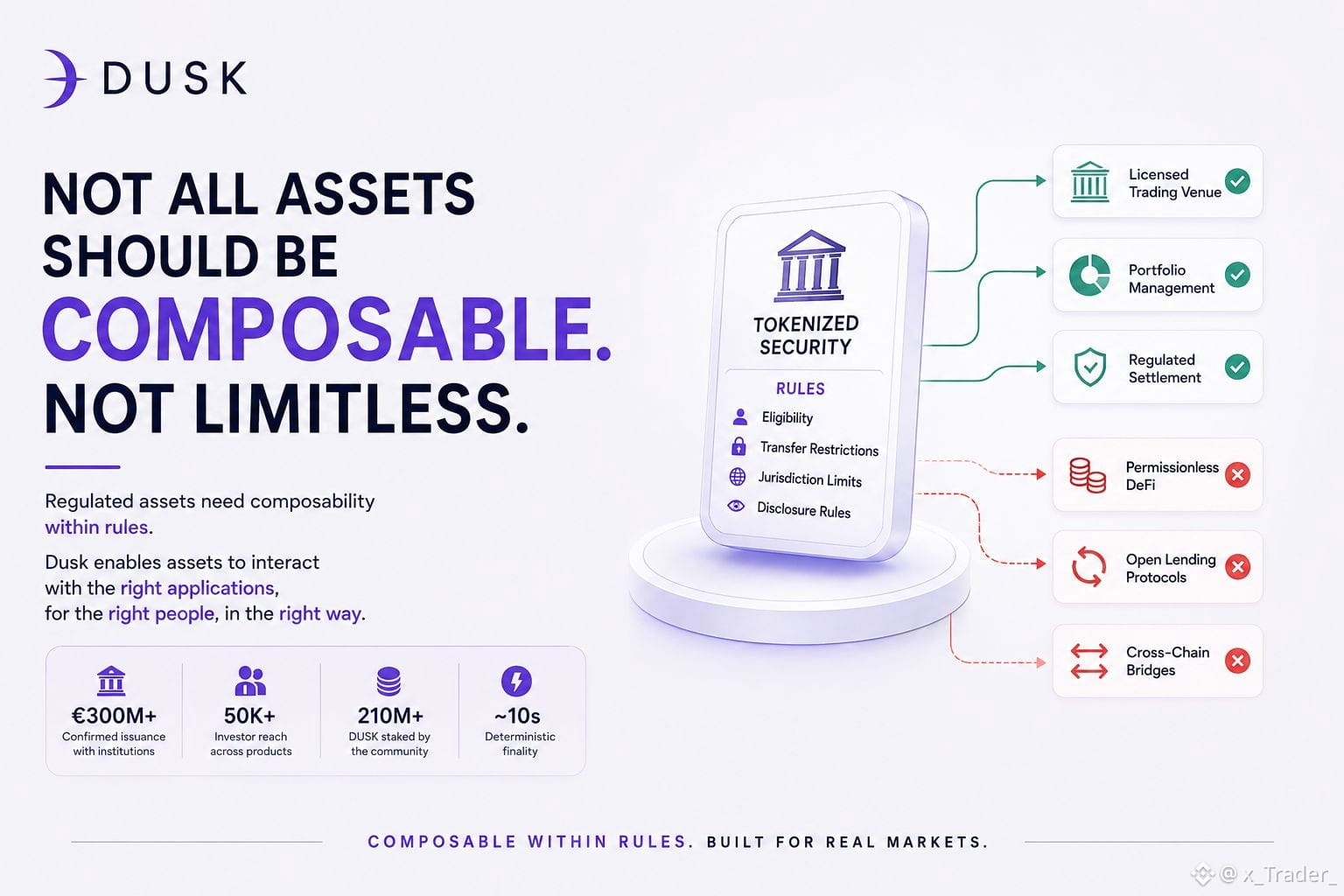
Recientemente, el anuncio de la campaña sobre #dusk me hizo cuestionar una de las palabras favoritas de las criptomonedas: la composabilidad.
Hablamos de la composabilidad como si “más” fuera automáticamente mejor.
Un token debería poder moverse entre protocolos, convertirse en colateral, interactuar con DeFi, cruzar cadenas, conectarse con nuevas aplicaciones...
Para un activo normal sin permisos, claro.
Pero imagina hacerlo con un bono regulado.
El bono podría tener requisitos de elegibilidad para inversores, restricciones de transferencia, normas de jurisdicción y obligaciones de divulgación.
Así que “hazlo composable con todo” de repente suena menos impresionante.
El problema interesante es lograr que sea composable sin eliminar las reglas que se adjuntan al activo.
Ahí es donde Dusk se vuelve bastante técnico.
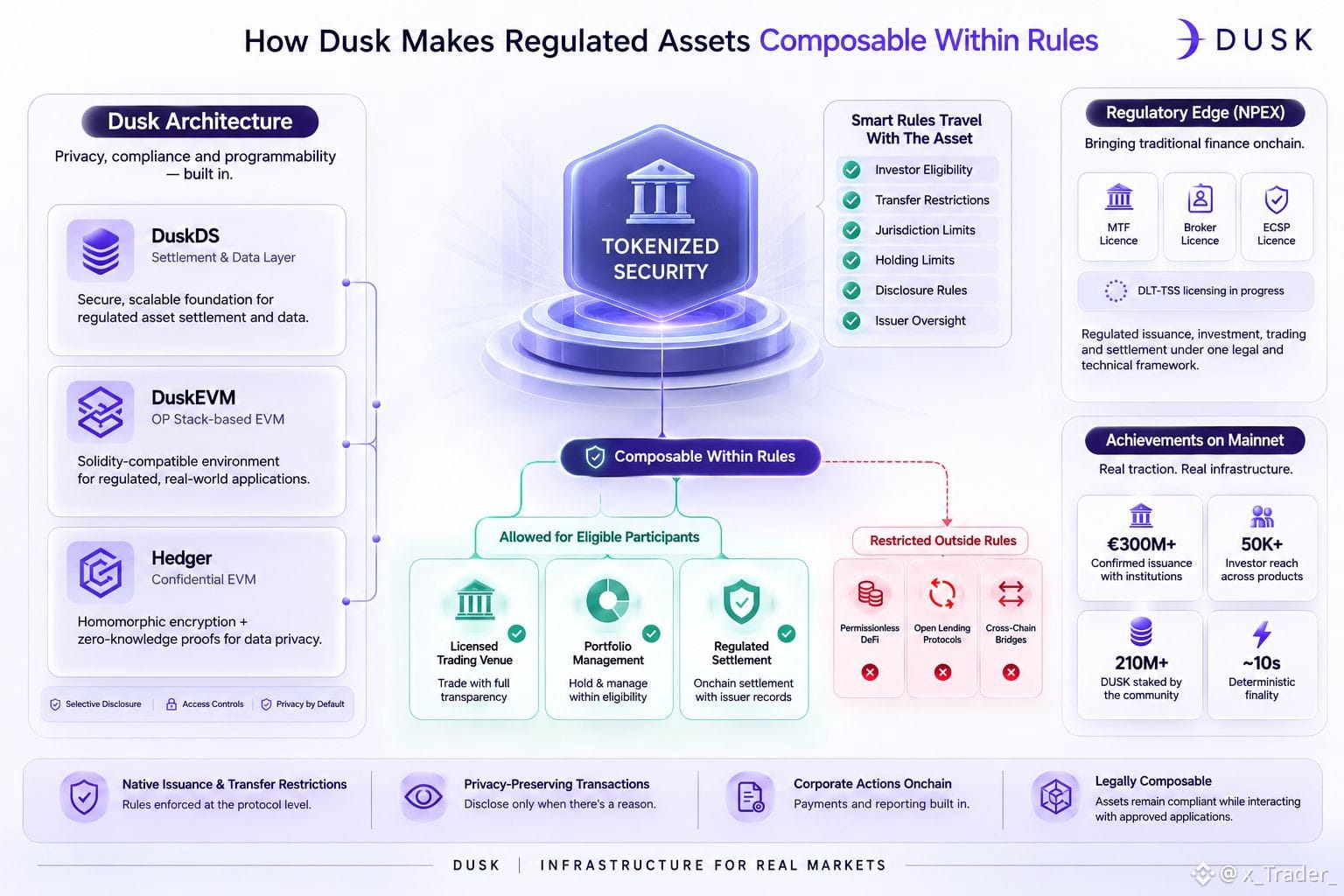
Su arquitectura actual separa la capa de liquidación/datos, DuskDS, de DuskEVM, un entorno EVM basado en OP Stack. Los desarrolladores pueden usar herramientas familiares de Solidity, mientras las aplicaciones liquidan de vuelta en la red subyacente de Dusk. Hedger agrega flujos EVM confidenciales usando cifrado homomórfico y pruebas de conocimiento cero.
Luego está el lado regulatorio.
A través de su relación con NPEX, Dusk afirma que el ecosistema tiene acceso a licencias MTF, Broker y ECSP, con licenciamiento DLT-TSS en proceso. La idea es poner la emisión, la inversión, el trading y la liquidación reguladas bajo un marco legal y técnico compartido.
Y esto no es solo arquitectura en una diapositiva.
Dusk actualmente reporta €300M+ en emisiones confirmadas con instituciones, alcance de 50K+ inversores, 210M+ DUSK apostados y una finalización determinista de ~10 segundos.
Esto cambia mi pregunta por completo.
Me interesa menos preguntar:
“¿Las RWA pueden ser composables?”
Ya sabemos que pueden moverse.
Quiero saber:
¿Puede un activo regulado permanecer composable mientras conserva consigo su identidad, elegibilidad, privacidad y reglas de transferencia?
Porque si la respuesta es sí, empieza a parecerse menos a colocar valores en una blockchain...
y más a reconstruir la infraestructura financiera a su alrededor.
$DUSK @Dusk_Foundation
Recientemente, el anuncio de la campaña sobre #dusk me hizo cuestionar una de las palabras favoritas de las criptomonedas: la composabilidad.
Hablamos de la composabilidad como si “más” fuera automáticamente mejor.
Un token debería poder moverse entre protocolos, convertirse en colateral, interactuar con DeFi, cruzar cadenas, conectarse con nuevas aplicaciones...
Para un activo normal sin permisos, claro.
Pero imagina hacerlo con un bono regulado.
El bono podría tener requisitos de elegibilidad para inversores, restricciones de transferencia, normas de jurisdicción y obligaciones de divulgación.
Así que “hazlo composable con todo” de repente suena menos impresionante.
El problema interesante es lograr que sea composable sin eliminar las reglas que se adjuntan al activo.
Ahí es donde Dusk se vuelve bastante técnico.
Su arquitectura actual separa la capa de liquidación/datos, DuskDS, de DuskEVM, un entorno EVM basado en OP Stack. Los desarrolladores pueden usar herramientas familiares de Solidity, mientras las aplicaciones liquidan de vuelta en la red subyacente de Dusk. Hedger agrega flujos EVM confidenciales usando cifrado homomórfico y pruebas de conocimiento cero.
Luego está el lado regulatorio.
A través de su relación con NPEX, Dusk afirma que el ecosistema tiene acceso a licencias MTF, Broker y ECSP, con licenciamiento DLT-TSS en proceso. La idea es poner la emisión, la inversión, el trading y la liquidación reguladas bajo un marco legal y técnico compartido.
Y esto no es solo arquitectura en una diapositiva.
Dusk actualmente reporta €300M+ en emisiones confirmadas con instituciones, alcance de 50K+ inversores, 210M+ DUSK apostados y una finalización determinista de ~10 segundos.
Esto cambia mi pregunta por completo.
Me interesa menos preguntar:
“¿Las RWA pueden ser composables?”
Ya sabemos que pueden moverse.
Quiero saber:
¿Puede un activo regulado permanecer composable mientras conserva consigo su identidad, elegibilidad, privacidad y reglas de transferencia?
Porque si la respuesta es sí, empieza a parecerse menos a colocar valores en una blockchain...
y más a reconstruir la infraestructura financiera a su alrededor.
$DUSK @Dusk
Hablamos de la composabilidad como si “más” fuera automáticamente mejor.
Un token debería poder moverse entre protocolos, convertirse en colateral, interactuar con DeFi, cruzar cadenas, conectarse con nuevas aplicaciones...
Para un activo normal sin permisos, claro.
Pero imagina hacerlo con un bono regulado.
El bono podría tener requisitos de elegibilidad para inversores, restricciones de transferencia, normas de jurisdicción y obligaciones de divulgación.
Así que “hazlo composable con todo” de repente suena menos impresionante.
El problema interesante es lograr que sea composable sin eliminar las reglas que se adjuntan al activo.
Ahí es donde Dusk se vuelve bastante técnico.
Su arquitectura actual separa la capa de liquidación/datos, DuskDS, de DuskEVM, un entorno EVM basado en OP Stack. Los desarrolladores pueden usar herramientas familiares de Solidity, mientras las aplicaciones liquidan de vuelta en la red subyacente de Dusk. Hedger agrega flujos EVM confidenciales usando cifrado homomórfico y pruebas de conocimiento cero.
Luego está el lado regulatorio.
A través de su relación con NPEX, Dusk afirma que el ecosistema tiene acceso a licencias MTF, Broker y ECSP, con licenciamiento DLT-TSS en proceso. La idea es poner la emisión, la inversión, el trading y la liquidación reguladas bajo un marco legal y técnico compartido.
Y esto no es solo arquitectura en una diapositiva.
Dusk actualmente reporta €300M+ en emisiones confirmadas con instituciones, alcance de 50K+ inversores, 210M+ DUSK apostados y una finalización determinista de ~10 segundos.
Esto cambia mi pregunta por completo.
Me interesa menos preguntar:
“¿Las RWA pueden ser composables?”
Ya sabemos que pueden moverse.
Quiero saber:
¿Puede un activo regulado permanecer composable mientras conserva consigo su identidad, elegibilidad, privacidad y reglas de transferencia?
Porque si la respuesta es sí, empieza a parecerse menos a colocar valores en una blockchain...
y más a reconstruir la infraestructura financiera a su alrededor.
$DUSK @Dusk
20
16
471
·
--
#dusk $DUSK @Dusk_Foundation
Antes pensaba que la “finalidad de blockchain” significaba lo mismo en todas partes. No es así.
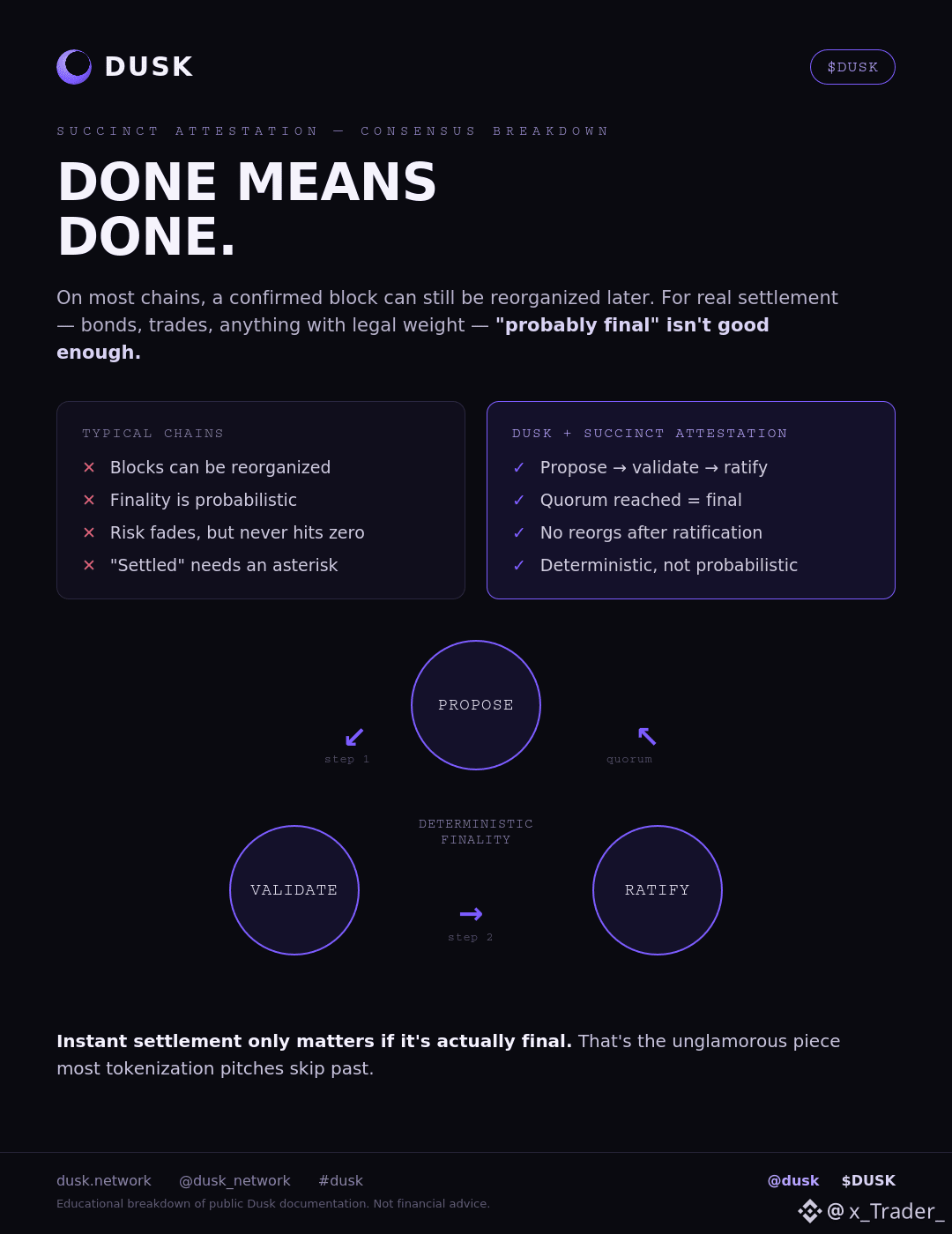
En muchas cadenas, un bloque que se añade no es realmente el final de la historia. Aún puede reorganizarse o reemplazarse si más adelante aparece una cadena más larga. Para una transferencia casual, ese es un riesgo de fondo que nunca consideras. Para un asentamiento financiero real, un pago de bonos, una operación, cualquier cosa con peso legal adjunto, “probablemente final” no es una respuesta aceptable.
El consenso de Dusk funciona en tres pasos. Un validador propone un bloque. Un comité comprueba que es válido. Un segundo comité confirma que esa verificación realmente se mantuvo. Cuando los tres terminan, el bloque queda hecho. No “hecho, probablemente”, hecho. Sin reorgs esperando ocurrir unos bloques después.
Nadie escribe titulares sobre la mecánica del consenso. Pero es la pieza poco glamorosa que permite que un exchange regulado le diga a un cliente “esto se liquidó” y que lo signifique literalmente, no “se liquidó, salvo un evento improbable dentro de tres bloques”.
La liquidación instantánea solo importa si es realmente definitiva. Esa es la parte que la mayoría de las propuestas de tokenización se saltan.
Encuesta:
Adivina qué pasa cuando un bloque llega al quórum en Dusk 🧠
⏳ Todavía puede revertirse más adelante
✅ Es final: sin reorgs
📅 Espera 2 días para liquidar
⛽ Depende del precio del gas
#dusk $DUSK @Dusk
Antes pensaba que la “finalidad de blockchain” significaba lo mismo en todas partes. No es así.
En muchas cadenas, un bloque que se añade no es realmente el final de la historia. Aún puede reorganizarse o reemplazarse si más adelante aparece una cadena más larga. Para una transferencia casual, ese es un riesgo de fondo que nunca consideras. Para un asentamiento financiero real, un pago de bonos, una operación, cualquier cosa con peso legal adjunto, “probablemente final” no es una respuesta aceptable.
El consenso de Dusk funciona en tres pasos. Un validador propone un bloque. Un comité comprueba que es válido. Un segundo comité confirma que esa verificación realmente se mantuvo. Cuando los tres terminan, el bloque queda hecho. No “hecho, probablemente”, hecho. Sin reorgs esperando ocurrir unos bloques después.
Nadie escribe titulares sobre la mecánica del consenso. Pero es la pieza poco glamorosa que permite que un exchange regulado le diga a un cliente “esto se liquidó” y que lo signifique literalmente, no “se liquidó, salvo un evento improbable dentro de tres bloques”.
La liquidación instantánea solo importa si es realmente definitiva. Esa es la parte que la mayoría de las propuestas de tokenización se saltan.
Encuesta:
Adivina qué pasa cuando un bloque llega al quórum en Dusk 🧠
⏳ Todavía puede revertirse más adelante
✅ Es final: sin reorgs
📅 Espera 2 días para liquidar
⛽ Depende del precio del gas
Antes pensaba que la “finalidad de blockchain” significaba lo mismo en todas partes. No es así.
En muchas cadenas, un bloque que se añade no es realmente el final de la historia. Aún puede reorganizarse o reemplazarse si más adelante aparece una cadena más larga. Para una transferencia casual, ese es un riesgo de fondo que nunca consideras. Para un asentamiento financiero real, un pago de bonos, una operación, cualquier cosa con peso legal adjunto, “probablemente final” no es una respuesta aceptable.
El consenso de Dusk funciona en tres pasos. Un validador propone un bloque. Un comité comprueba que es válido. Un segundo comité confirma que esa verificación realmente se mantuvo. Cuando los tres terminan, el bloque queda hecho. No “hecho, probablemente”, hecho. Sin reorgs esperando ocurrir unos bloques después.
Nadie escribe titulares sobre la mecánica del consenso. Pero es la pieza poco glamorosa que permite que un exchange regulado le diga a un cliente “esto se liquidó” y que lo signifique literalmente, no “se liquidó, salvo un evento improbable dentro de tres bloques”.
La liquidación instantánea solo importa si es realmente definitiva. Esa es la parte que la mayoría de las propuestas de tokenización se saltan.
Encuesta:
Adivina qué pasa cuando un bloque llega al quórum en Dusk 🧠
⏳ Todavía puede revertirse más adelante
✅ Es final: sin reorgs
📅 Espera 2 días para liquidar
⛽ Depende del precio del gas
1
3
192
·
--
Verificado
#dusk
Creo que a veces la gente malinterpreta el problema de la privacidad en las finanzas reguladas.
No es simplemente:
“¿Cómo ocultamos la transacción?”
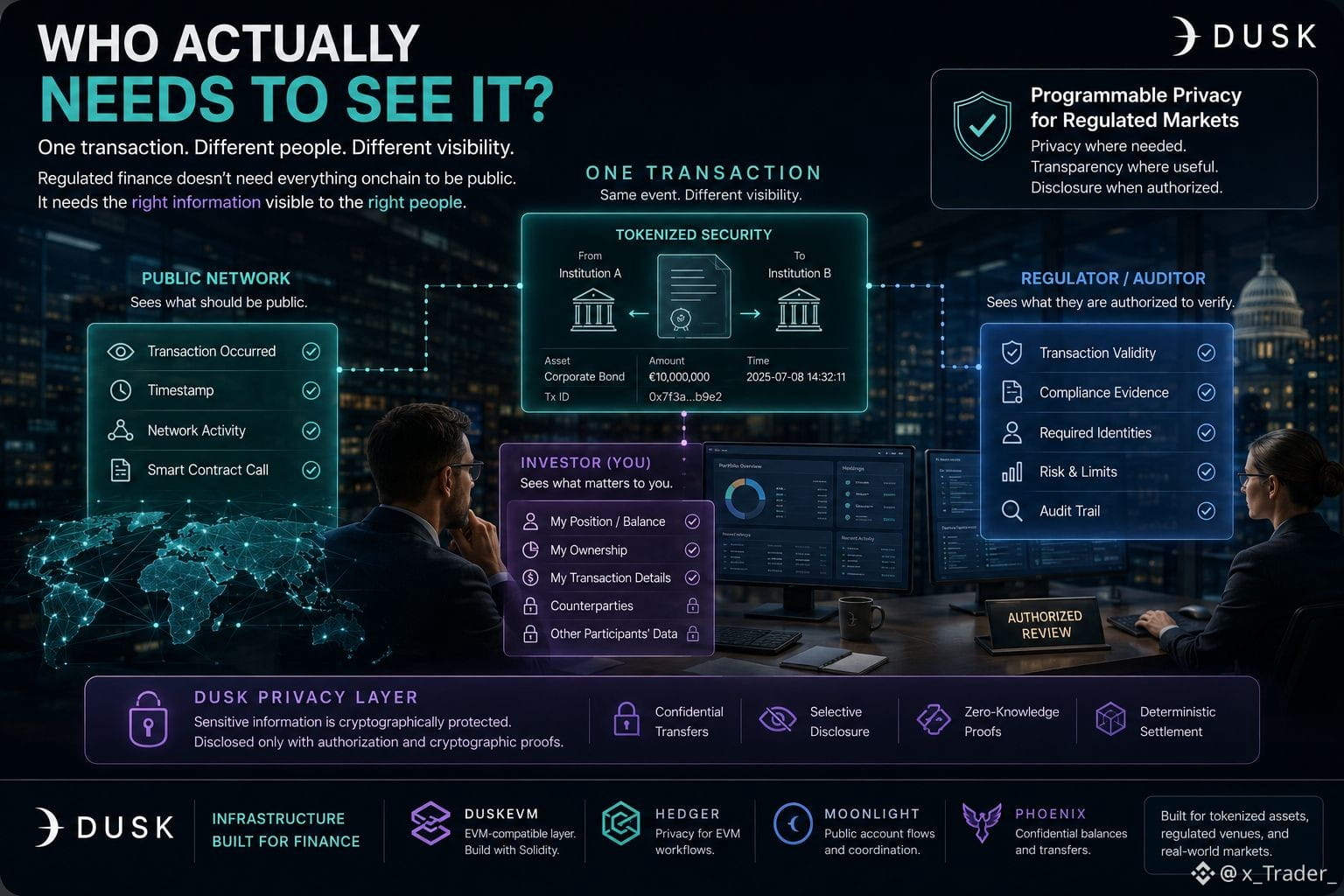
La pregunta más difícil es:
“¿Quién realmente necesita verla?”
Un inversor no debería necesariamente tener toda su posición expuesta a cada monedero que observa la cadena.
Pero un regulador podría necesitar verificar algo.
Un auditor podría necesitar evidencia.
Un emisor podría necesitar comprobar la propiedad o la elegibilidad.
Y el propio mercado todavía necesita cosas que se puedan observar y liquidar.
Esa es la parte de @Dusk_Foundation que me resulta genuinamente interesante.
Dusk no está tratando la privacidad como un interruptor de encendido/apagado. Su arquitectura separa los flujos públicos de los confidenciales, permitiendo al mismo tiempo que la información se divulgue a partes autorizadas cuando exista una razón legítima para que la vean.
Eso tiene mucho más sentido para los mercados financieros.
Porque poner un bono, un fondo u otro valor en la cadena no es lo difícil.
Lo difícil es decidir qué sucede cuando diferentes personas necesitan distintos niveles de visibilidad sobre el mismo activo.
Ese es un problema del que la mayoría de las conversaciones sobre cripto no hablan el tiempo suficiente.
Dusk lo está construyendo alrededor de eso.
Y con DuskEVM, ese enfoque se está llevando a un entorno compatible con EVM, con Hedger respaldando flujos confidenciales de EVM.
Es un planteamiento mucho más interesante que “blockchain, pero privada”.
$DUSK @Dusk_Foundation
#dusk
Creo que a veces la gente malinterpreta el problema de la privacidad en las finanzas reguladas.
No es simplemente:
“¿Cómo ocultamos la transacción?”
La pregunta más difícil es:
“¿Quién realmente necesita verla?”
Un inversor no debería necesariamente tener toda su posición expuesta a cada monedero que observa la cadena.
Pero un regulador podría necesitar verificar algo.
Un auditor podría necesitar evidencia.
Un emisor podría necesitar comprobar la propiedad o la elegibilidad.
Y el propio mercado todavía necesita cosas que se puedan observar y liquidar.
Esa es la parte de @Dusk que me resulta genuinamente interesante.
Dusk no está tratando la privacidad como un interruptor de encendido/apagado. Su arquitectura separa los flujos públicos de los confidenciales, permitiendo al mismo tiempo que la información se divulgue a partes autorizadas cuando exista una razón legítima para que la vean.
Eso tiene mucho más sentido para los mercados financieros.
Porque poner un bono, un fondo u otro valor en la cadena no es lo difícil.
Lo difícil es decidir qué sucede cuando diferentes personas necesitan distintos niveles de visibilidad sobre el mismo activo.
Ese es un problema del que la mayoría de las conversaciones sobre cripto no hablan el tiempo suficiente.
Dusk lo está construyendo alrededor de eso.
Y con DuskEVM, ese enfoque se está llevando a un entorno compatible con EVM, con Hedger respaldando flujos confidenciales de EVM.
Es un planteamiento mucho más interesante que “blockchain, pero privada”.
$DUSK @Dusk
Creo que a veces la gente malinterpreta el problema de la privacidad en las finanzas reguladas.
No es simplemente:
“¿Cómo ocultamos la transacción?”
La pregunta más difícil es:
“¿Quién realmente necesita verla?”
Un inversor no debería necesariamente tener toda su posición expuesta a cada monedero que observa la cadena.
Pero un regulador podría necesitar verificar algo.
Un auditor podría necesitar evidencia.
Un emisor podría necesitar comprobar la propiedad o la elegibilidad.
Y el propio mercado todavía necesita cosas que se puedan observar y liquidar.
Esa es la parte de @Dusk que me resulta genuinamente interesante.
Dusk no está tratando la privacidad como un interruptor de encendido/apagado. Su arquitectura separa los flujos públicos de los confidenciales, permitiendo al mismo tiempo que la información se divulgue a partes autorizadas cuando exista una razón legítima para que la vean.
Eso tiene mucho más sentido para los mercados financieros.
Porque poner un bono, un fondo u otro valor en la cadena no es lo difícil.
Lo difícil es decidir qué sucede cuando diferentes personas necesitan distintos niveles de visibilidad sobre el mismo activo.
Ese es un problema del que la mayoría de las conversaciones sobre cripto no hablan el tiempo suficiente.
Dusk lo está construyendo alrededor de eso.
Y con DuskEVM, ese enfoque se está llevando a un entorno compatible con EVM, con Hedger respaldando flujos confidenciales de EVM.
Es un planteamiento mucho más interesante que “blockchain, pero privada”.
$DUSK @Dusk
32
15
900
·
--
Alcista
Verificado
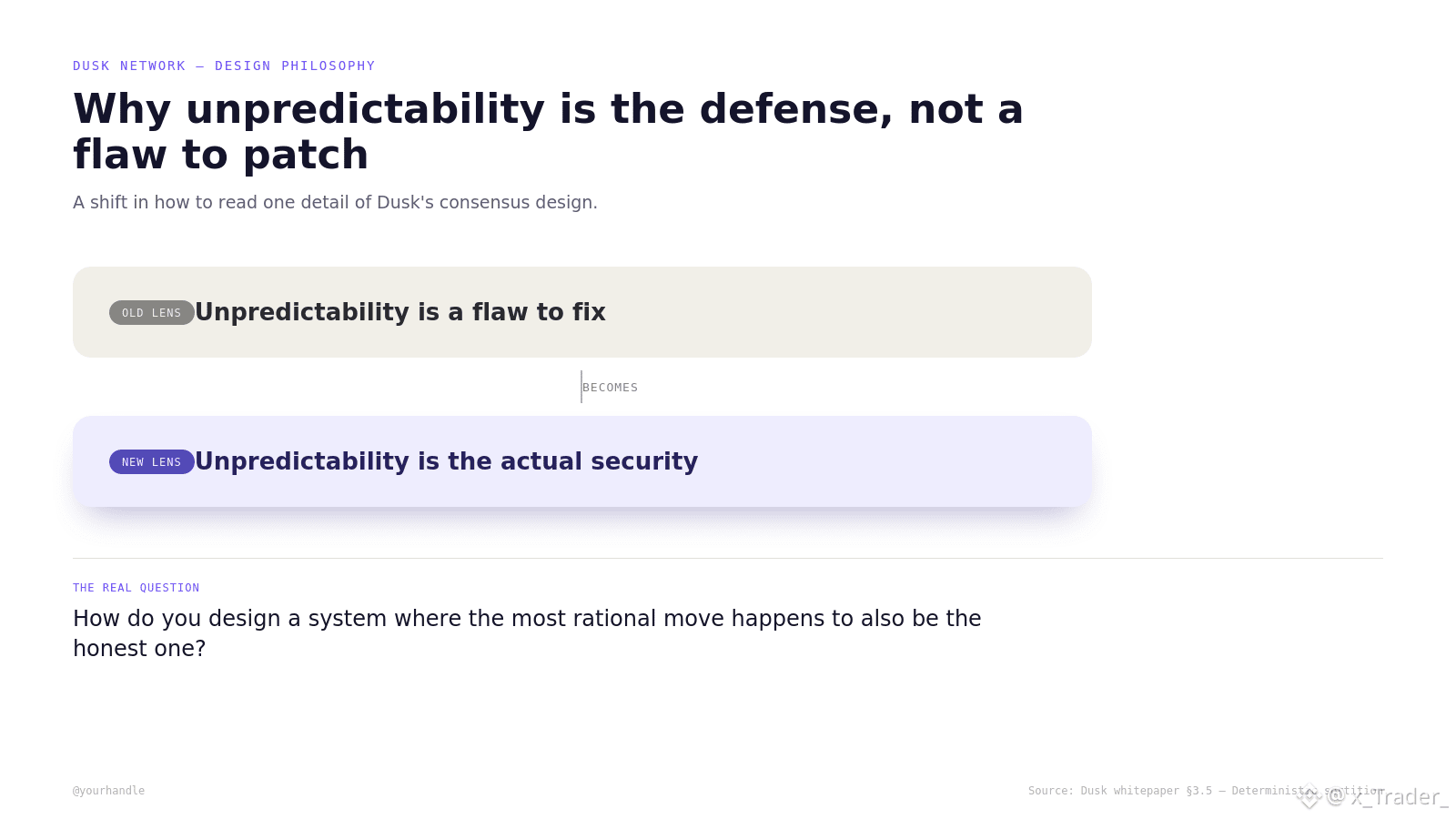
Antes pensaba que la imprevisibilidad en una blockchain era un fallo que toleras, no una función que diseñarías realmente.
Estudiar Dusk cambió eso.
Imagina que eres un provisionador. Has apostado, eres elegible, sabes que podrías ser elegido para generar el siguiente bloque. Pero no sabes si lo serás. Nadie más tampoco. Ni los demás validadores. Ni siquiera tú, diez segundos antes de que ocurra.
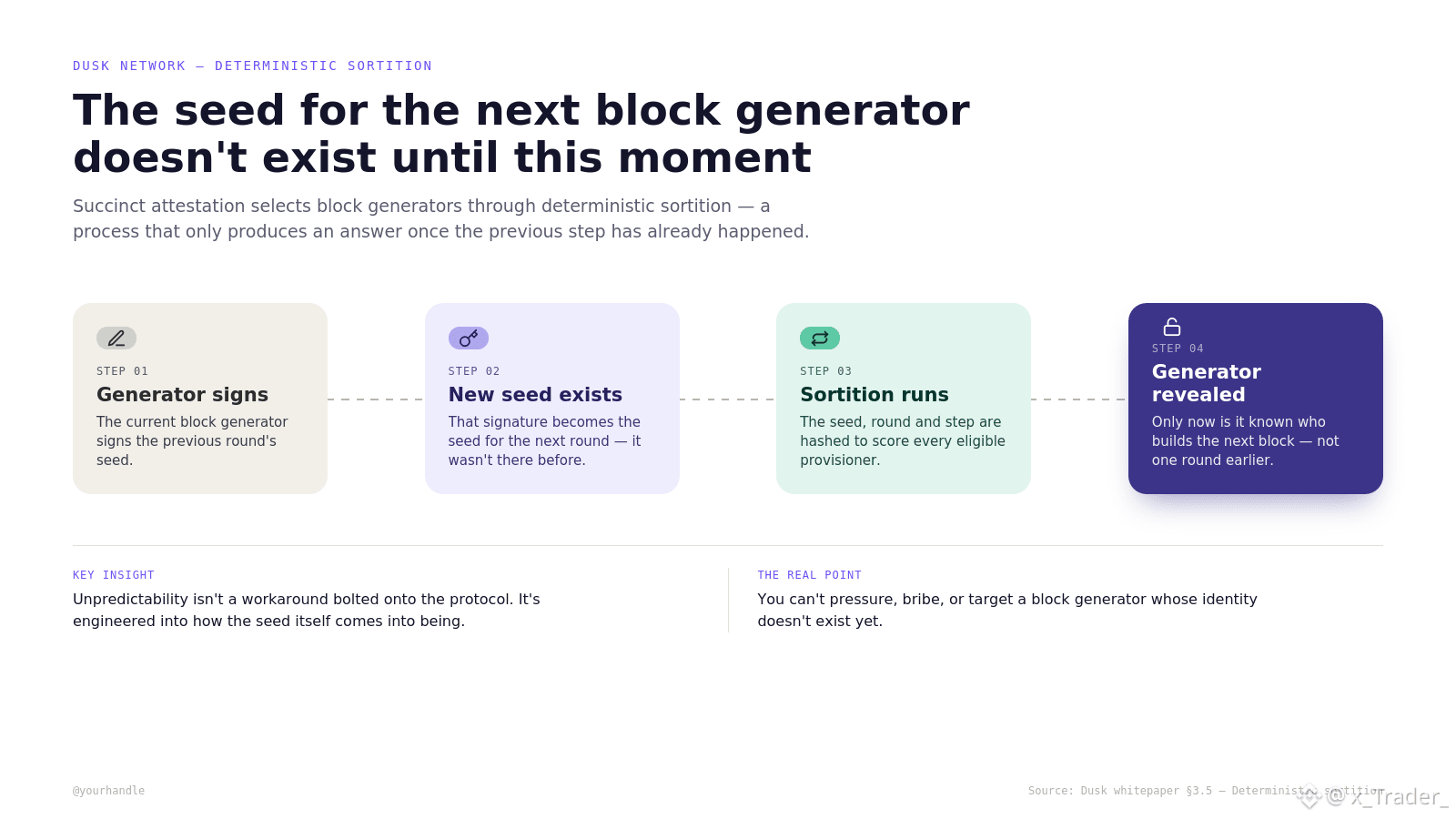
Aquí está la parte extraña. La semilla que decide quién es elegido para el bloque N+1 todavía no existe mientras el bloque N aún se está construyendo. Se genera literalmente a partir de la firma del generador del bloque actual que firma la semilla anterior. La respuesta a "¿quién sigue?" no está oculta en algún lugar — aún no se ha calculado.
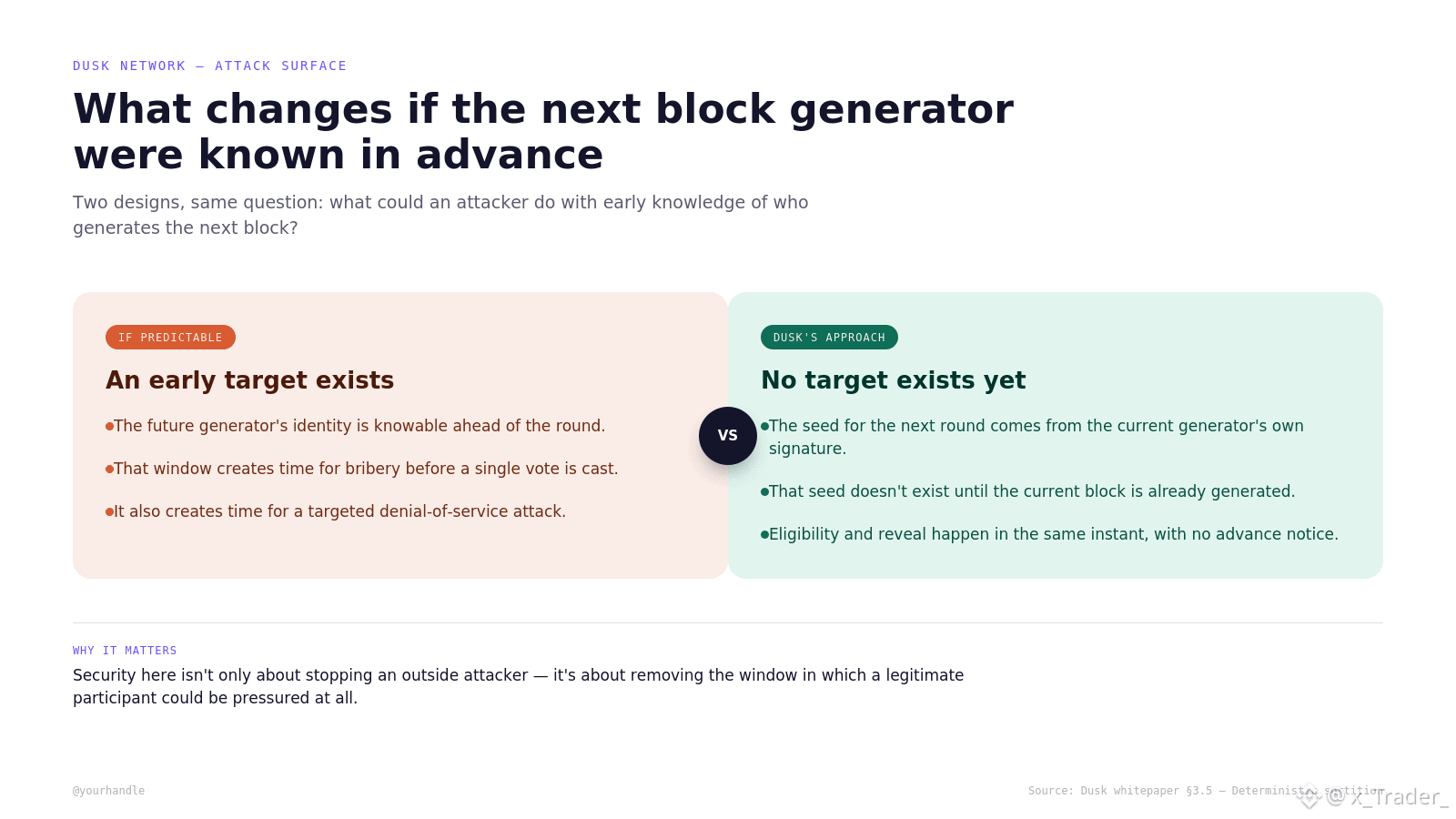
¿Por qué importa? Porque aquí la previsibilidad es una responsabilidad, no una comodidad. Si un atacante pudiera averiguar hoy quién genera el bloque 40, tendría todo el tiempo del mundo para atacar a ese validador: sobornarlo, hacerle DDoS, presionarlo — antes de que llegue el momento.
La sortición determinista de Dusk cierra esa ventana por completo. Solo te enteras de que eres el generador en el instante mismo en que ya es una verdad.
Así que la pregunta real de diseño no era "¿cómo elegimos a un líder?". Era "¿cómo lo elegimos sin permitir nunca que alguien lo planee".
Adivina qué pasa en el momento en que la selección de bloques se vuelve predecible, incluso ligeramente, con antelación?
#dusk $DUSK @Dusk_Foundation
Encuesta:
Adivina qué se rompe primero si pudieras predecir el siguiente generador de bloques
🎯 El soborno se vuelve posible
🛑 El DDoS se vuelve posible
⚖️ Ambos, misma vulnerabilidad
🔒 Nada, sigue siendo seguro
Antes pensaba que la imprevisibilidad en una blockchain era un fallo que toleras, no una función que diseñarías realmente.
Estudiar Dusk cambió eso.
Imagina que eres un provisionador. Has apostado, eres elegible, sabes que podrías ser elegido para generar el siguiente bloque. Pero no sabes si lo serás. Nadie más tampoco. Ni los demás validadores. Ni siquiera tú, diez segundos antes de que ocurra.
Aquí está la parte extraña. La semilla que decide quién es elegido para el bloque N+1 todavía no existe mientras el bloque N aún se está construyendo. Se genera literalmente a partir de la firma del generador del bloque actual que firma la semilla anterior. La respuesta a "¿quién sigue?" no está oculta en algún lugar — aún no se ha calculado.
¿Por qué importa? Porque aquí la previsibilidad es una responsabilidad, no una comodidad. Si un atacante pudiera averiguar hoy quién genera el bloque 40, tendría todo el tiempo del mundo para atacar a ese validador: sobornarlo, hacerle DDoS, presionarlo — antes de que llegue el momento.
La sortición determinista de Dusk cierra esa ventana por completo. Solo te enteras de que eres el generador en el instante mismo en que ya es una verdad.
Así que la pregunta real de diseño no era "¿cómo elegimos a un líder?". Era "¿cómo lo elegimos sin permitir nunca que alguien lo planee".
Adivina qué pasa en el momento en que la selección de bloques se vuelve predecible, incluso ligeramente, con antelación?
#dusk $DUSK @Dusk
Encuesta:
Adivina qué se rompe primero si pudieras predecir el siguiente generador de bloques
🎯 El soborno se vuelve posible
🛑 El DDoS se vuelve posible
⚖️ Ambos, misma vulnerabilidad
🔒 Nada, sigue siendo seguro
Estudiar Dusk cambió eso.
Imagina que eres un provisionador. Has apostado, eres elegible, sabes que podrías ser elegido para generar el siguiente bloque. Pero no sabes si lo serás. Nadie más tampoco. Ni los demás validadores. Ni siquiera tú, diez segundos antes de que ocurra.
Aquí está la parte extraña. La semilla que decide quién es elegido para el bloque N+1 todavía no existe mientras el bloque N aún se está construyendo. Se genera literalmente a partir de la firma del generador del bloque actual que firma la semilla anterior. La respuesta a "¿quién sigue?" no está oculta en algún lugar — aún no se ha calculado.
¿Por qué importa? Porque aquí la previsibilidad es una responsabilidad, no una comodidad. Si un atacante pudiera averiguar hoy quién genera el bloque 40, tendría todo el tiempo del mundo para atacar a ese validador: sobornarlo, hacerle DDoS, presionarlo — antes de que llegue el momento.
La sortición determinista de Dusk cierra esa ventana por completo. Solo te enteras de que eres el generador en el instante mismo en que ya es una verdad.
Así que la pregunta real de diseño no era "¿cómo elegimos a un líder?". Era "¿cómo lo elegimos sin permitir nunca que alguien lo planee".
Adivina qué pasa en el momento en que la selección de bloques se vuelve predecible, incluso ligeramente, con antelación?
#dusk $DUSK @Dusk
Encuesta:
Adivina qué se rompe primero si pudieras predecir el siguiente generador de bloques
🎯 El soborno se vuelve posible
🛑 El DDoS se vuelve posible
⚖️ Ambos, misma vulnerabilidad
🔒 Nada, sigue siendo seguro
21
15
542
·
--
Verificado
Alguien en las respuestas me preguntó algo que no pude dejar pasar:
¿cómo sabes realmente que un bono tokenizado en Dusk sigue respaldado por activos reales seis meses después de que se lanzó? Las pruebas ZK no responden eso.
Confirman que una transacción siguió las reglas — balances correctos, sin doble gasto.
No pueden decirte si el bono real detrás del token aún existe o si sigue siendo solvente.
Ese es un problema de confianza distinto, y por eso @Dusk_Foundation funciona con Chainlink.
Una vez que algo se tokeniza, alguien todavía tiene que seguir alimentando datos del mundo real — precios, reservas, prueba de respaldo — en la cadena de forma continua, no solo en el momento de la emisión.
Básicamente, eso es lo que es un oráculo: la tubería que lleva la verdad externa dentro de un sistema que, de otro modo, solo sabe lo que está escrito en sí mismo.
Antes asumía que "en cadena" significaba "confiable por defecto".
No lo hace.
Significa verificable por defecto, y lo verificable solo cubre lo que realmente está en la cadena.
Cualquier cosa del mundo exterior tiene que introducirse deliberadamente — y esa es la parte que la gente se salta cuando habla de los RWAs como si ya estuviera resuelto.
La criptografía demuestra que las cuentas cuadran.
Los oráculos demuestran que la realidad subyacente no ha cambiado en silencio. $DUSK necesita ambas cosas para que "bono tokenizado" signifique algo meses después, no solo el primer día.
#dusk $DUSK @Dusk_Foundation
Tu turno: Adivina qué es lo que un oráculo de Chainlink realmente alimenta en Dusk
🔗 Datos de precio/reserva del mundo real
🔐 La propia prueba ZK
🏦 Aprobación regulatoria
⚡ Finalidad de la transacción
Alguien en las respuestas me preguntó algo que no pude dejar pasar:
¿cómo sabes realmente que un bono tokenizado en Dusk sigue respaldado por activos reales seis meses después de que se lanzó? Las pruebas ZK no responden eso.
Confirman que una transacción siguió las reglas — balances correctos, sin doble gasto.
No pueden decirte si el bono real detrás del token aún existe o si sigue siendo solvente.
Ese es un problema de confianza distinto, y por eso @Dusk funciona con Chainlink.
Una vez que algo se tokeniza, alguien todavía tiene que seguir alimentando datos del mundo real — precios, reservas, prueba de respaldo — en la cadena de forma continua, no solo en el momento de la emisión.
Básicamente, eso es lo que es un oráculo: la tubería que lleva la verdad externa dentro de un sistema que, de otro modo, solo sabe lo que está escrito en sí mismo.
Antes asumía que "en cadena" significaba "confiable por defecto".
No lo hace.
Significa verificable por defecto, y lo verificable solo cubre lo que realmente está en la cadena.
Cualquier cosa del mundo exterior tiene que introducirse deliberadamente — y esa es la parte que la gente se salta cuando habla de los RWAs como si ya estuviera resuelto.
La criptografía demuestra que las cuentas cuadran.
Los oráculos demuestran que la realidad subyacente no ha cambiado en silencio. $DUSK necesita ambas cosas para que "bono tokenizado" signifique algo meses después, no solo el primer día.
#dusk $DUSK @Dusk
Tu turno: Adivina qué es lo que un oráculo de Chainlink realmente alimenta en Dusk
🔗 Datos de precio/reserva del mundo real
🔐 La propia prueba ZK
🏦 Aprobación regulatoria
⚡ Finalidad de la transacción
¿cómo sabes realmente que un bono tokenizado en Dusk sigue respaldado por activos reales seis meses después de que se lanzó? Las pruebas ZK no responden eso.
Confirman que una transacción siguió las reglas — balances correctos, sin doble gasto.
No pueden decirte si el bono real detrás del token aún existe o si sigue siendo solvente.
Ese es un problema de confianza distinto, y por eso @Dusk funciona con Chainlink.
Una vez que algo se tokeniza, alguien todavía tiene que seguir alimentando datos del mundo real — precios, reservas, prueba de respaldo — en la cadena de forma continua, no solo en el momento de la emisión.
Básicamente, eso es lo que es un oráculo: la tubería que lleva la verdad externa dentro de un sistema que, de otro modo, solo sabe lo que está escrito en sí mismo.
Antes asumía que "en cadena" significaba "confiable por defecto".
No lo hace.
Significa verificable por defecto, y lo verificable solo cubre lo que realmente está en la cadena.
Cualquier cosa del mundo exterior tiene que introducirse deliberadamente — y esa es la parte que la gente se salta cuando habla de los RWAs como si ya estuviera resuelto.
La criptografía demuestra que las cuentas cuadran.
Los oráculos demuestran que la realidad subyacente no ha cambiado en silencio. $DUSK necesita ambas cosas para que "bono tokenizado" signifique algo meses después, no solo el primer día.
#dusk $DUSK @Dusk
Tu turno: Adivina qué es lo que un oráculo de Chainlink realmente alimenta en Dusk
🔗 Datos de precio/reserva del mundo real
🔐 La propia prueba ZK
🏦 Aprobación regulatoria
⚡ Finalidad de la transacción
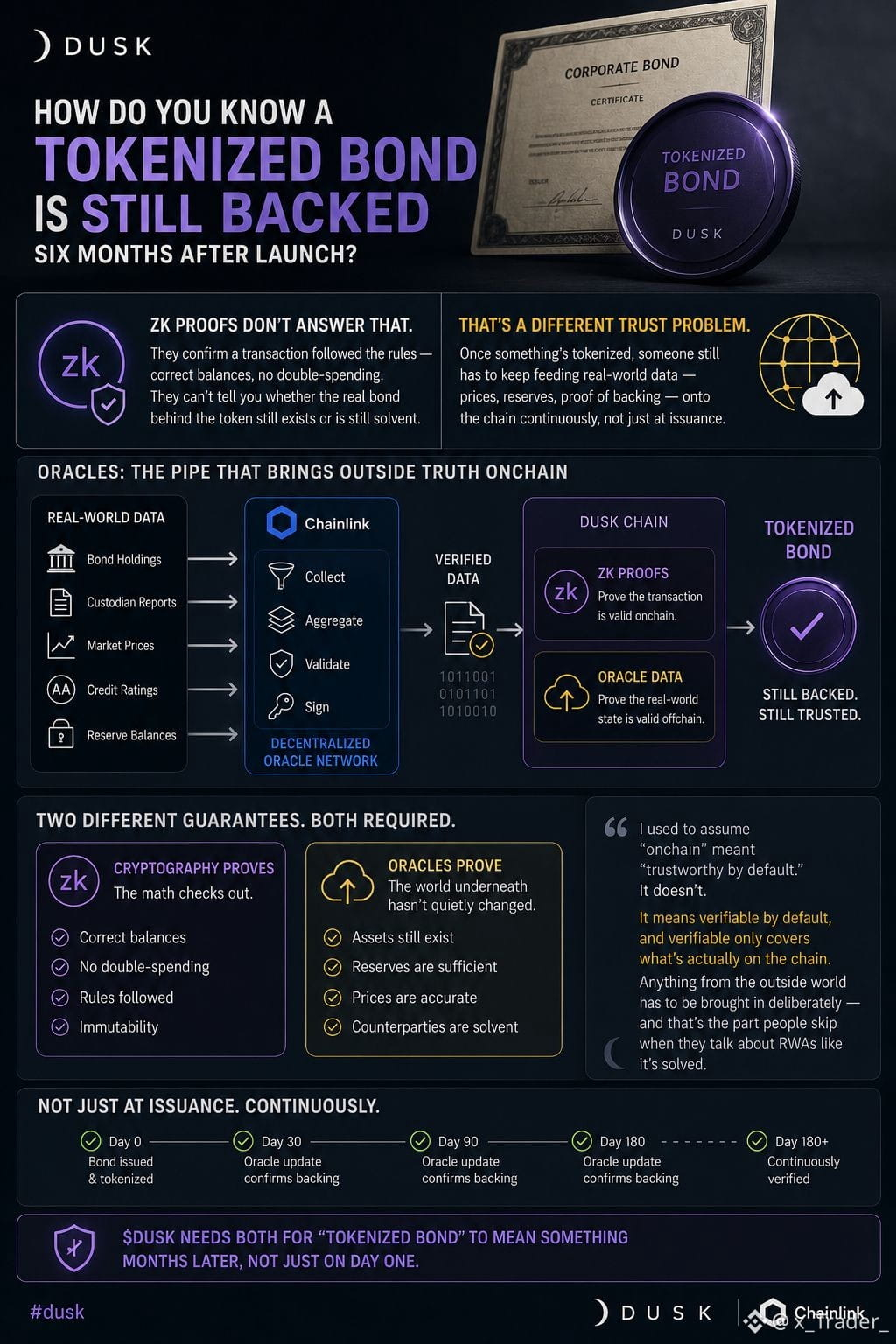
19
11
575
·
--
Esto es también por lo que el momento importa: la red principal de DuskEVM necesita estar activa y estable antes de que un exchange como NPEX pueda en realidad enrutar activos reales a través de ella. La asociación y el despliegue de la infraestructura van en el mismo reloj."
$DUSK
{future}(DUSKUSDT)
Esto es también por lo que el momento importa: la red principal de DuskEVM necesita estar activa y estable antes de que un exchange como NPEX pueda en realidad enrutar activos reales a través de ella. La asociación y el despliegue de la infraestructura van en el mismo reloj."
$DUSK
$DUSK
3
179
Inicia sesión para explorar más contenidos
Únete a usuarios globales de criptomonedas en Binance Square
⚡️ Obtén información útil y actualizada sobre criptos.
💬 Avalado por el mayor exchange de criptomonedas en el mundo.
👍 Descubre perspectivas reales de creadores verificados.
Email/número de teléfono
Temas populares
BinancePick
2.6M vistas
139,462 están debatiendo
¡Únete a #TemporadaDeResultados: predice resultados en Binance Pick y comparte tu opinión en Binance Square!
Binance Square Official
·400 me gusta
·337.6k vistas
EarningsSeason
5M vistas
24,102 están debatiendo
StrategyMSTRSurpassesNasdaqInMarketCap
21 vistas
11 están debatiendo