

Crypto.Andy
552 Publicaciones

Crypto.Andy
Denunciar
Bloquear usuario
Top #1 Community Creator on CoinMarketCap according to CoinGape | Investor and trader | Listing & Institutional Services Partner of WhiteBIT | Affiliate & Listing Partner of BitUnix | Listing Partner of BitMart & MEXC
0 Siguiendo
4 Seguidores
26 Me gusta
Publicaciones
·
--
Ver traducción
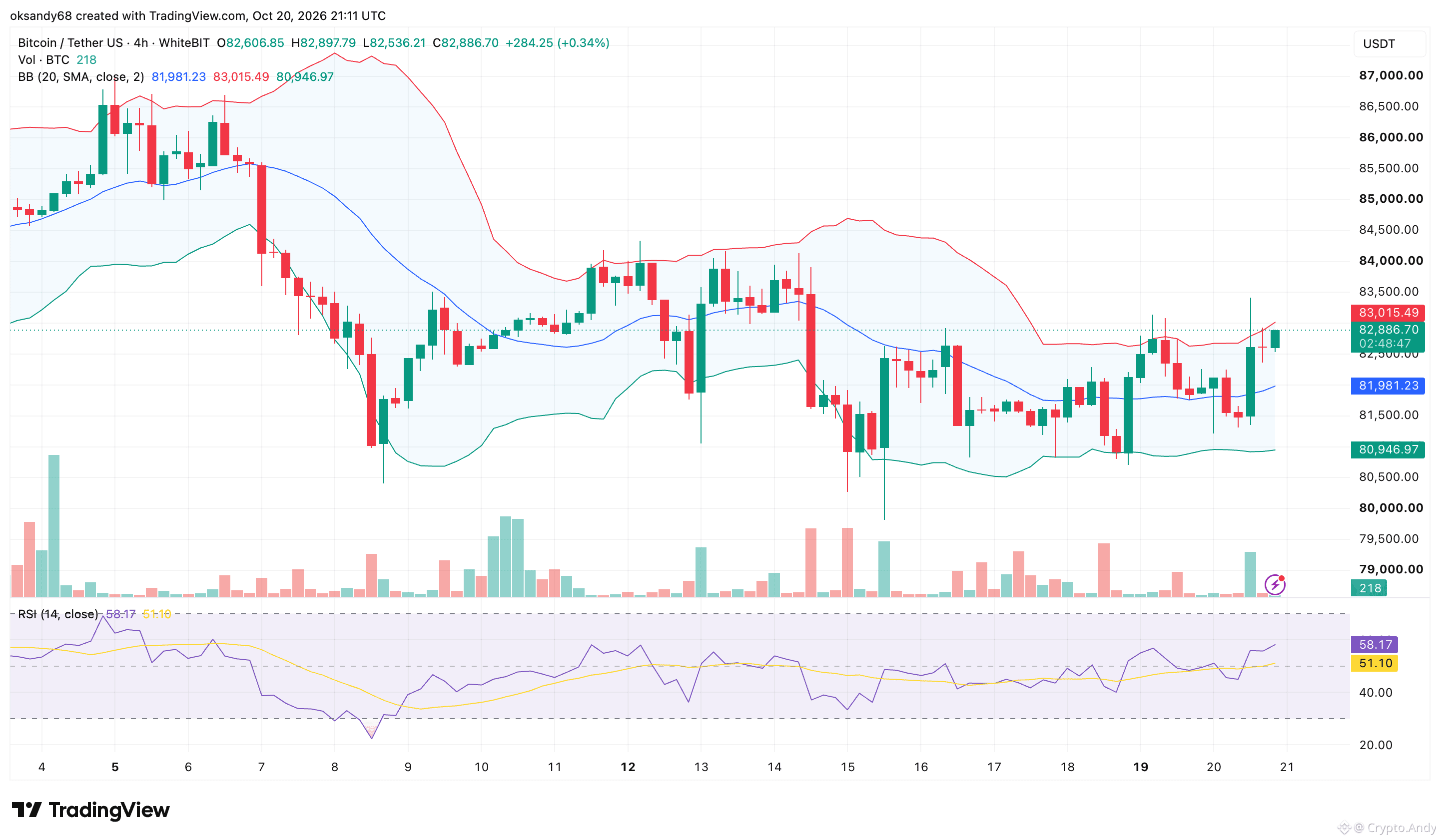
$BTC shot above $83K after headlines about a new US-Iran peace plan. The excitement didn’t last long: traders figured a quick deal is unlikely and BTC gave back a good part of the move. What the chart shows (4H): 🕯 The spike candle left a long wick near $83,700, so sellers were waiting up there 📊 Price is now ~$82,900, pressing the upper Bollinger Band at ~$83,000 🌡 RSI is at 58, so there’s still room before it gets overheated Levels I’m watching: 🔴 $83,000–83,700: the wick zone. A 4H close above it opens the way to $84K+ 🟢 $82,000: the middle band, the first support 🟢 $81,000: lower band and the bottom of the range Until we get a clean close above the wick, I treat this as another fakeout inside the range. Did the peace headlines catch you in a long? 👇 DYOR! #BTC Price Analysis# #Bitcoin Price Prediction: What is Bitcoins next move?#
$BTC shot above $83K after headlines about a new US-Iran peace plan. The excitement didn’t last long: traders figured a quick deal is unlikely and BTC gave back a good part of the move. What the chart shows (4H): 🕯 The spike candle left a long wick near $83,700, so sellers were waiting up there 📊 Price is now ~$82,900, pressing the upper Bollinger Band at ~$83,000 🌡 RSI is at 58, so there’s still room before it gets overheated Levels I’m watching: 🔴 $83,000–83,700: the wick zone. A 4H close above it opens the way to $84K+ 🟢 $82,000: the middle band, the first support 🟢 $81,000: lower band and the bottom of the range Until we get a clean close above the wick, I treat this as another fakeout inside the range. Did the peace headlines catch you in a long? 👇 DYOR! #BTC Price Analysis# #Bitcoin Price Prediction: What is Bitcoins next move?#
67
·
--
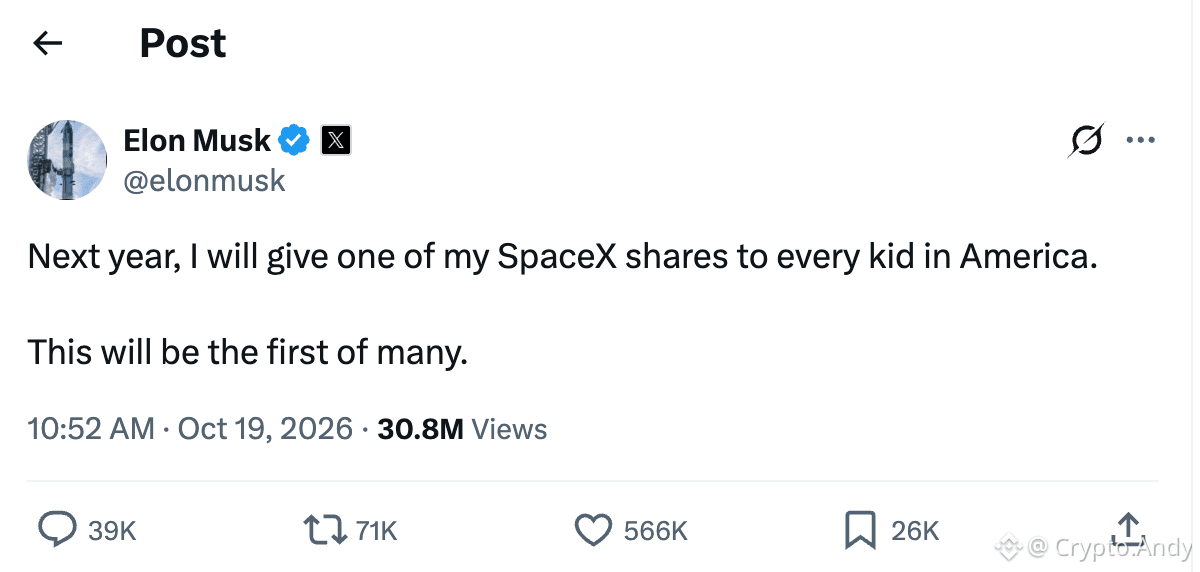
🚀 Musk regalará acciones de SpaceX a todos los niños de Estados Unidos El lunes, Elon Musk publicó en X que el próximo año regalará una de sus acciones de $SPCX a cada niño de EE. UU. y lo llamó «el primero de muchos». En EE. UU. hay alrededor de 73 millones de niños menores de 18 años. Al precio actual de unos $146 por acción, sería un regalo valorado en más de $10.000 millones, aproximadamente el 1 % de la fortuna de Musk 😳 Musk no ha explicado cómo funcionará la distribución. Lo más probable es que se haga a través de las Cuentas Trump, las cuentas de inversión gubernamentales para niños, que ya aceptan donaciones de acciones. Más noticias breves en mi comunidad 📲 https://bit.ly/4jdykHo El momento también es interesante. El anuncio llegó un día antes de los resultados del tercer trimestre de SpaceX, que se publican hoy, 20 de octubre, después del cierre del mercado. Cuesta imaginar una mejor campaña de marketing antes de un informe 😄 En agosto, SpaceX presentó ingresos de $7.800 millones y una pérdida neta de $541 millones en el segundo trimestre. Hoy veremos si las cifras mejoraron. ¿Te alegraría recibir una acción de SpaceX como regalo o preferirías tener $BTC? 👇 #Análisis del precio de BTC# #Perspectivas macroeconómicas#
🚀 Musk regalará acciones de SpaceX a todos los niños de Estados Unidos El lunes, Elon Musk publicó en X que el próximo año regalará una de sus acciones de $SPCX a cada niño de EE. UU. y lo llamó «el primero de muchos». En EE. UU. hay alrededor de 73 millones de niños menores de 18 años. Al precio actual de unos $146 por acción, sería un regalo valorado en más de $10.000 millones, aproximadamente el 1 % de la fortuna de Musk 😳 Musk no ha explicado cómo funcionará la distribución. Lo más probable es que se haga a través de las Cuentas Trump, las cuentas de inversión gubernamentales para niños, que ya aceptan donaciones de acciones. Más noticias breves en mi comunidad 📲 https://bit.ly/4jdykHo El momento también es interesante. El anuncio llegó un día antes de los resultados del tercer trimestre de SpaceX, que se publican hoy, 20 de octubre, después del cierre del mercado. Cuesta imaginar una mejor campaña de marketing antes de un informe 😄 En agosto, SpaceX presentó ingresos de $7.800 millones y una pérdida neta de $541 millones en el segundo trimestre. Hoy veremos si las cifras mejoraron. ¿Te alegraría recibir una acción de SpaceX como regalo o preferirías tener $BTC? 👇 #Análisis del precio de BTC# #Perspectivas macroeconómicas#
97
·
--
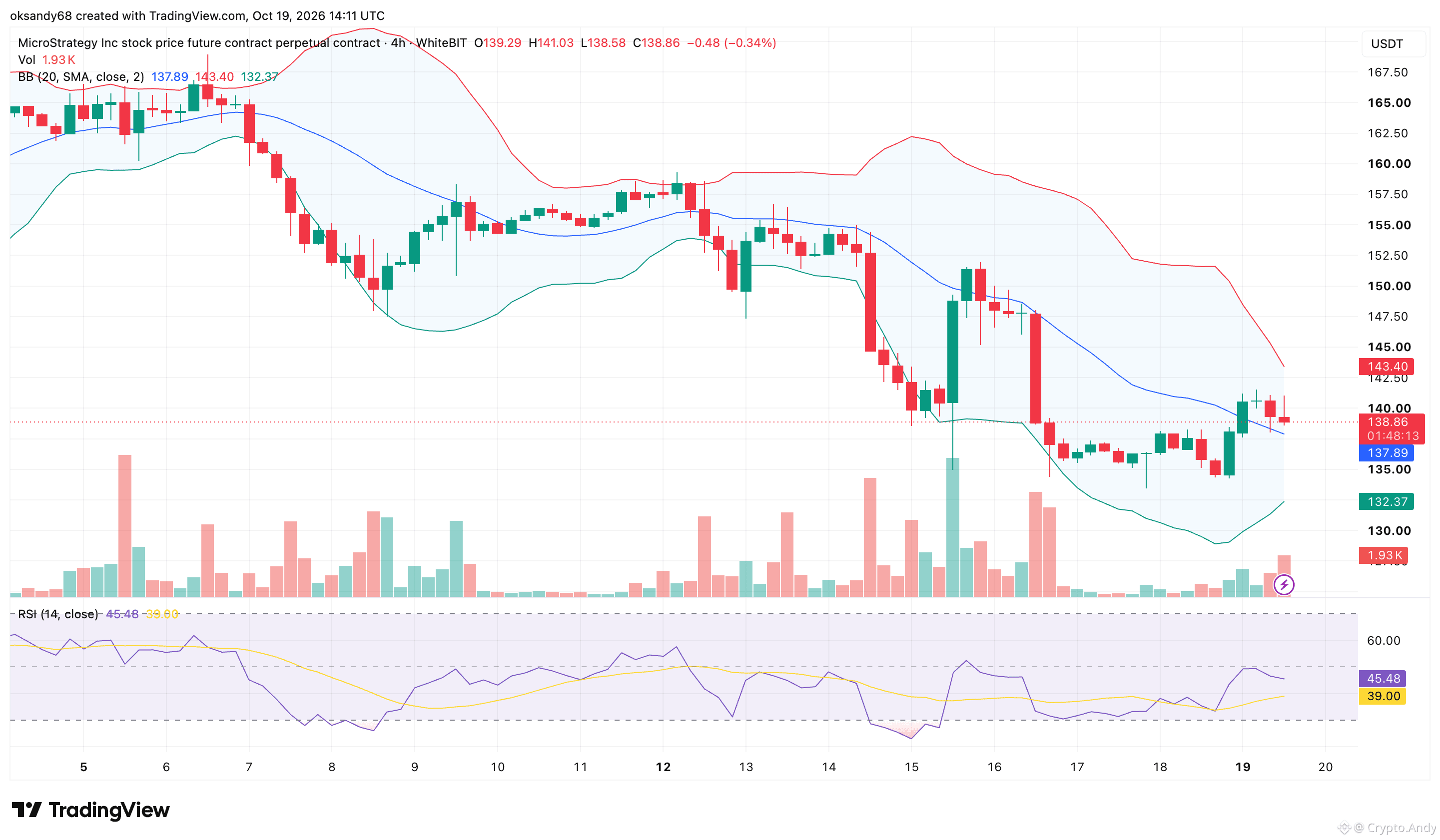
$MSTR: una empresa de software que posee el 4 % de todos los $BTC Ahora estoy preparando una guía de acciones para principiantes, y hay una empresa que aparece en todas las listas para los aficionados a las criptomonedas: Strategy, antes MicroStrategy. Básicamente, es la mayor apuesta corporativa por BTC del mundo. La empresa posee unos 848.000 bitcoins, aproximadamente el 4 % de todos los BTC que existirán. Su precio medio de compra ronda los 75.000 $, así que, con BTC cerca de los 82.000 $, su posición sigue siendo rentable. ¿Lo sabías? 🤔 Strategy empezó en 1989 como una empresa normal de software empresarial. No empezó a comprar Bitcoin hasta años después, y ahora sus acciones cotizan casi como una posición apalancada en BTC. Otro dato que mucha gente pasó por alto: la empresa conocida por «no vender nunca» vendió en realidad 1.690 BTC en agosto para recomprar sus acciones preferentes. Lo que muestra el gráfico (contrato perpetuo de MSTR, 4H): 📉 En las últimas dos semanas, el precio cayó de unos 165 $ a un mínimo cercano a los 134 $ 📈 Hoy rebotó hasta unos 141 $ y ahora se encuentra en la banda media de Bollinger, alrededor de los 138 $ 🌡 El RSI está en 45 Niveles que estoy siguiendo: 🟢 132–134 $: banda inferior y mínimos recientes 🔴 143 $: banda superior y primera prueba real para los compradores Como MSTR sigue muy de cerca a Bitcoin, mucho depende de si $BTC puede mantenerse por encima de los 80.000 $. Si lo consigue, MSTR tiene buenas posibilidades de volver a probar los 143 $ y luego los 150 $. #Análisis del precio de BTC# #Perspectivas macroeconómicas#
$MSTR: una empresa de software que posee el 4 % de todos los $BTC Ahora estoy preparando una guía de acciones para principiantes, y hay una empresa que aparece en todas las listas para los aficionados a las criptomonedas: Strategy, antes MicroStrategy. Básicamente, es la mayor apuesta corporativa por BTC del mundo. La empresa posee unos 848.000 bitcoins, aproximadamente el 4 % de todos los BTC que existirán. Su precio medio de compra ronda los 75.000 $, así que, con BTC cerca de los 82.000 $, su posición sigue siendo rentable. ¿Lo sabías? 🤔 Strategy empezó en 1989 como una empresa normal de software empresarial. No empezó a comprar Bitcoin hasta años después, y ahora sus acciones cotizan casi como una posición apalancada en BTC. Otro dato que mucha gente pasó por alto: la empresa conocida por «no vender nunca» vendió en realidad 1.690 BTC en agosto para recomprar sus acciones preferentes. Lo que muestra el gráfico (contrato perpetuo de MSTR, 4H): 📉 En las últimas dos semanas, el precio cayó de unos 165 $ a un mínimo cercano a los 134 $ 📈 Hoy rebotó hasta unos 141 $ y ahora se encuentra en la banda media de Bollinger, alrededor de los 138 $ 🌡 El RSI está en 45 Niveles que estoy siguiendo: 🟢 132–134 $: banda inferior y mínimos recientes 🔴 143 $: banda superior y primera prueba real para los compradores Como MSTR sigue muy de cerca a Bitcoin, mucho depende de si $BTC puede mantenerse por encima de los 80.000 $. Si lo consigue, MSTR tiene buenas posibilidades de volver a probar los 143 $ y luego los 150 $. #Análisis del precio de BTC# #Perspectivas macroeconómicas#
27
·
--
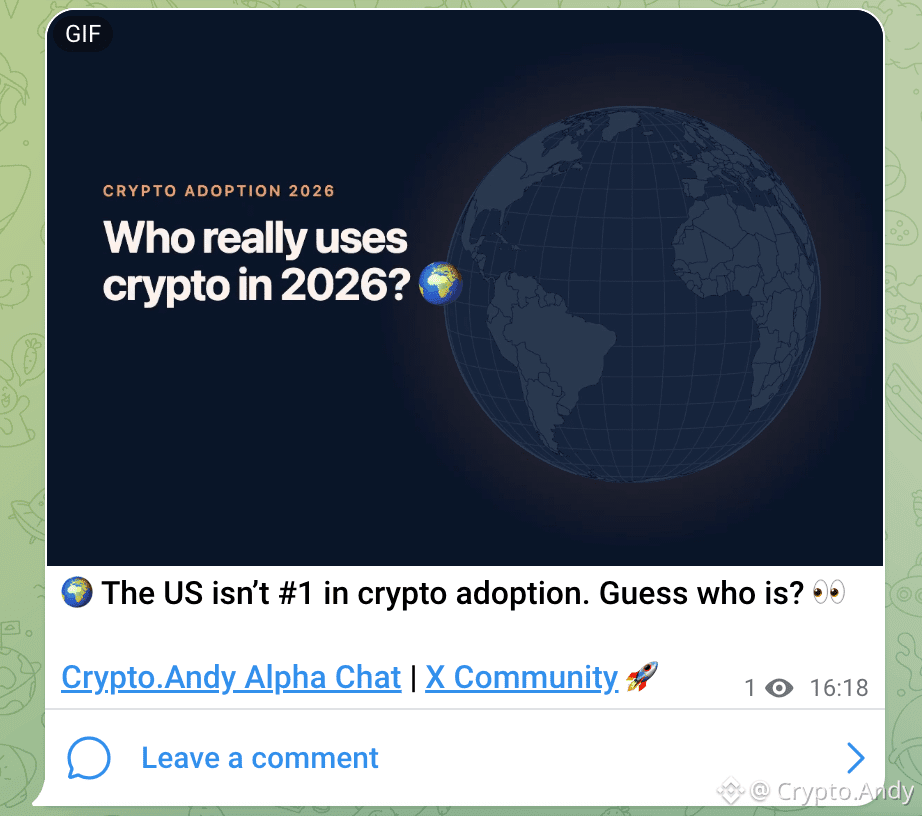
EE. UU. ocupa el puesto n.º 1 del mundo en dinero que entra en las criptomonedas, como $BTC, pero apenas el n.º 20 en personas que se envían criptomonedas entre sí 🤔 Ese es uno de los detalles más interesantes del nuevo Índice Global de Adopción de Criptomonedas 2026 de Chainalysis. En EE. UU., las criptomonedas son principalmente una inversión: la gente las compra a través de ETF y aplicaciones, y las conserva. Nigeria muestra una realidad muy distinta. Ocupa el primer puesto del mundo en transferencias entre personas y flujos transfronterizos, porque allí las criptomonedas suelen sustituir a los bancos. Y Brasil, que las usa de ambas maneras, quedó en primer lugar en la clasificación general. Analicé estos tres países y los 10 primeros de la lista completa en mi comunidad https://bit.ly/4jdykHo ¿Cómo se usan las criptomonedas en tu país? 🌍 #Análisis del precio de BTC# #Predicción del precio de Bitcoin: ¿Cuál será el próximo movimiento de Bitcoin?#
EE. UU. ocupa el puesto n.º 1 del mundo en dinero que entra en las criptomonedas, como $BTC, pero apenas el n.º 20 en personas que se envían criptomonedas entre sí 🤔 Ese es uno de los detalles más interesantes del nuevo Índice Global de Adopción de Criptomonedas 2026 de Chainalysis. En EE. UU., las criptomonedas son principalmente una inversión: la gente las compra a través de ETF y aplicaciones, y las conserva. Nigeria muestra una realidad muy distinta. Ocupa el primer puesto del mundo en transferencias entre personas y flujos transfronterizos, porque allí las criptomonedas suelen sustituir a los bancos. Y Brasil, que las usa de ambas maneras, quedó en primer lugar en la clasificación general. Analicé estos tres países y los 10 primeros de la lista completa en mi comunidad https://bit.ly/4jdykHo ¿Cómo se usan las criptomonedas en tu país? 🌍 #Análisis del precio de BTC# #Predicción del precio de Bitcoin: ¿Cuál será el próximo movimiento de Bitcoin?#
40
·
--
☀️ ¡Feliz lunes a todos! Aquí tienen un breve resumen del mercado de hoy: Las 5 principales criptomonedas: 🟢 $BTC: $83,014 (+1.12%) 🟢 ETH: $2,444 (+0.87%) 🟢 BNB: $726.70 (+0.56%) 🟢 XRP: $1.32 (+1.31%) 🟢 SOL: $105.83 (+1.82%) Acciones relacionadas con criptomonedas: 🔴 Strategy (MSTR): $136.83 (−9.56%) 🔴 Coinbase (COIN): $173.16 (−5.79%) 🔴 Circle (CRCL): $82.22 (−5.46%) 🔴 Block (XYZ): $77.89 (−2.43%) 🔴 IREN: $26.99 (−11.19%) #Análisis del precio de BTC# #Predicción del precio de Bitcoin: ¿cuál será el próximo movimiento de Bitcoin?#
☀️ ¡Feliz lunes a todos! Aquí tienen un breve resumen del mercado de hoy: Las 5 principales criptomonedas: 🟢 $BTC: $83,014 (+1.12%) 🟢 ETH: $2,444 (+0.87%) 🟢 BNB: $726.70 (+0.56%) 🟢 XRP: $1.32 (+1.31%) 🟢 SOL: $105.83 (+1.82%) Acciones relacionadas con criptomonedas: 🔴 Strategy (MSTR): $136.83 (−9.56%) 🔴 Coinbase (COIN): $173.16 (−5.79%) 🔴 Circle (CRCL): $82.22 (−5.46%) 🔴 Block (XYZ): $77.89 (−2.43%) 🔴 IREN: $26.99 (−11.19%) #Análisis del precio de BTC# #Predicción del precio de Bitcoin: ¿cuál será el próximo movimiento de Bitcoin?#

63
·
--
☀️ ¡Feliz lunes a todos! El fin de semana terminó, lo que significa que es hora de volver a los gráficos de $BTC, los nuevos niveles y las nuevas operaciones 📊 Les deseo a todos un comienzo de semana tranquilo, entradas limpias y la menor cantidad posible de stop loss 😄 Esto es lo que estoy preparando para hoy: quiero profundizar en las acciones y averiguar cuáles podrían funcionar mejor para la cartera de un principiante. Qué empresas vale la pena tener en cuenta, cómo equilibrar el riesgo y por dónde empezar si nunca has comprado acciones. ¿Les interesaría? 👇 🔥 Sí, cuéntame 🤔 Mejor sigo con las criptomonedas #Análisis del precio de BTC# #Perspectivas macroeconómicas#
☀️ ¡Feliz lunes a todos! El fin de semana terminó, lo que significa que es hora de volver a los gráficos de $BTC, los nuevos niveles y las nuevas operaciones 📊 Les deseo a todos un comienzo de semana tranquilo, entradas limpias y la menor cantidad posible de stop loss 😄 Esto es lo que estoy preparando para hoy: quiero profundizar en las acciones y averiguar cuáles podrían funcionar mejor para la cartera de un principiante. Qué empresas vale la pena tener en cuenta, cómo equilibrar el riesgo y por dónde empezar si nunca has comprado acciones. ¿Les interesaría? 👇 🔥 Sí, cuéntame 🤔 Mejor sigo con las criptomonedas #Análisis del precio de BTC# #Perspectivas macroeconómicas#

69
·
--
Desempaqueté un plan de depósito de criptomonedas para empresas con $BTC. Esto es lo que había dentro Los préstamos de criptomonedas están recibiendo cada vez más atención por parte de las instituciones este año. 📈 En una encuesta de Nomura y Laser Digital publicada en abril, el 65 % de los inversionistas institucionales dijo que apunta a los préstamos y los activos tokenizados. Para una empresa, esto suele significar un plan de depósito acordado individualmente con un proveedor. Me gusta imaginarlo como un juego de construcción. 🧩 Todos reciben las mismas cinco piezas en la caja, y cada empresa las encaja según su propio flujo de caja. Entonces, ¿qué hay en la caja? 🔹 Parte 1: el monto. Cuánto puede apartar la empresa sin afectar sus operaciones diarias. 🔹 Parte 2: los activos. Qué monedas incluir: ¿stablecoins, BTC o una combinación? 🔹 Parte 3: el plazo. Cuánto tiempo pueden permanecer los fondos en el plan, según las previsiones de caja. 🔹 Parte 4: la tasa. Qué ofrece el proveedor para ese monto, activo y plazo específicos. 🔹 Parte 5: la salida anticipada. ¿Qué ocurre si se necesita el dinero antes de lo previsto? Lo fundamental es comprobar si el proveedor te permite armar el modelo a tu manera o si solo te entrega un conjunto ya ensamblado. Por ejemplo, WhiteBIT Crypto Lending for Businesses puede configurar planes de depósito de forma individual. https://institutional.whitebit.com/crypto-lending-for-business?utm_source=coinmarketcap&utm_medium=lendb2_andy&utm_campaign=post Los plazos pueden ir de 10 días a unos cuantos años; puede haber varias criptomonedas disponibles; las tasas son flexibles; y las condiciones de cierre anticipado se acuerdan con cada cliente. Los planes empiezan desde 600.000 USDT. Si estuvieras armando tu primer plan de depósito con $BTC, ¿qué pieza pondrías primero? 🧩 Aviso: Esto no es asesoramiento financiero ni de inversión. Investiga por tu cuenta antes de tomar cualquier decisión. Actúa bajo tu propia responsabilidad. #Análisis del precio de BTC# #Predicción del precio de Bitcoin: ¿cuál será el próximo movimiento de Bitcoin?#
Desempaqueté un plan de depósito de criptomonedas para empresas con $BTC. Esto es lo que había dentro Los préstamos de criptomonedas están recibiendo cada vez más atención por parte de las instituciones este año. 📈 En una encuesta de Nomura y Laser Digital publicada en abril, el 65 % de los inversionistas institucionales dijo que apunta a los préstamos y los activos tokenizados. Para una empresa, esto suele significar un plan de depósito acordado individualmente con un proveedor. Me gusta imaginarlo como un juego de construcción. 🧩 Todos reciben las mismas cinco piezas en la caja, y cada empresa las encaja según su propio flujo de caja. Entonces, ¿qué hay en la caja? 🔹 Parte 1: el monto. Cuánto puede apartar la empresa sin afectar sus operaciones diarias. 🔹 Parte 2: los activos. Qué monedas incluir: ¿stablecoins, BTC o una combinación? 🔹 Parte 3: el plazo. Cuánto tiempo pueden permanecer los fondos en el plan, según las previsiones de caja. 🔹 Parte 4: la tasa. Qué ofrece el proveedor para ese monto, activo y plazo específicos. 🔹 Parte 5: la salida anticipada. ¿Qué ocurre si se necesita el dinero antes de lo previsto? Lo fundamental es comprobar si el proveedor te permite armar el modelo a tu manera o si solo te entrega un conjunto ya ensamblado. Por ejemplo, WhiteBIT Crypto Lending for Businesses puede configurar planes de depósito de forma individual. https://institutional.whitebit.com/crypto-lending-for-business?utm_source=coinmarketcap&utm_medium=lendb2_andy&utm_campaign=post Los plazos pueden ir de 10 días a unos cuantos años; puede haber varias criptomonedas disponibles; las tasas son flexibles; y las condiciones de cierre anticipado se acuerdan con cada cliente. Los planes empiezan desde 600.000 USDT. Si estuvieras armando tu primer plan de depósito con $BTC, ¿qué pieza pondrías primero? 🧩 Aviso: Esto no es asesoramiento financiero ni de inversión. Investiga por tu cuenta antes de tomar cualquier decisión. Actúa bajo tu propia responsabilidad. #Análisis del precio de BTC# #Predicción del precio de Bitcoin: ¿cuál será el próximo movimiento de Bitcoin?#

·
--
☕ Modo domingo: activado. Hoy es un día para descansar de los gráficos, las noticias y consultar los precios constantemente 😌 Sal a caminar, pasa tiempo con tus seres queridos o simplemente disfruta de tu café sin mirar el precio de $BTC cada cinco minutos. El mercado seguirá aquí mañana, y nosotros también. El lunes llegan nuevos gráficos, niveles e ideas frescas 📊 #Análisis del precio de BTC# #Predicción del precio de Bitcoin: ¿Cuál será el próximo movimiento de Bitcoin?#
☕ Modo domingo: activado. Hoy es un día para descansar de los gráficos, las noticias y consultar los precios constantemente 😌 Sal a caminar, pasa tiempo con tus seres queridos o simplemente disfruta de tu café sin mirar el precio de $BTC cada cinco minutos. El mercado seguirá aquí mañana, y nosotros también. El lunes llegan nuevos gráficos, niveles e ideas frescas 📊 #Análisis del precio de BTC# #Predicción del precio de Bitcoin: ¿Cuál será el próximo movimiento de Bitcoin?#

84
·
--
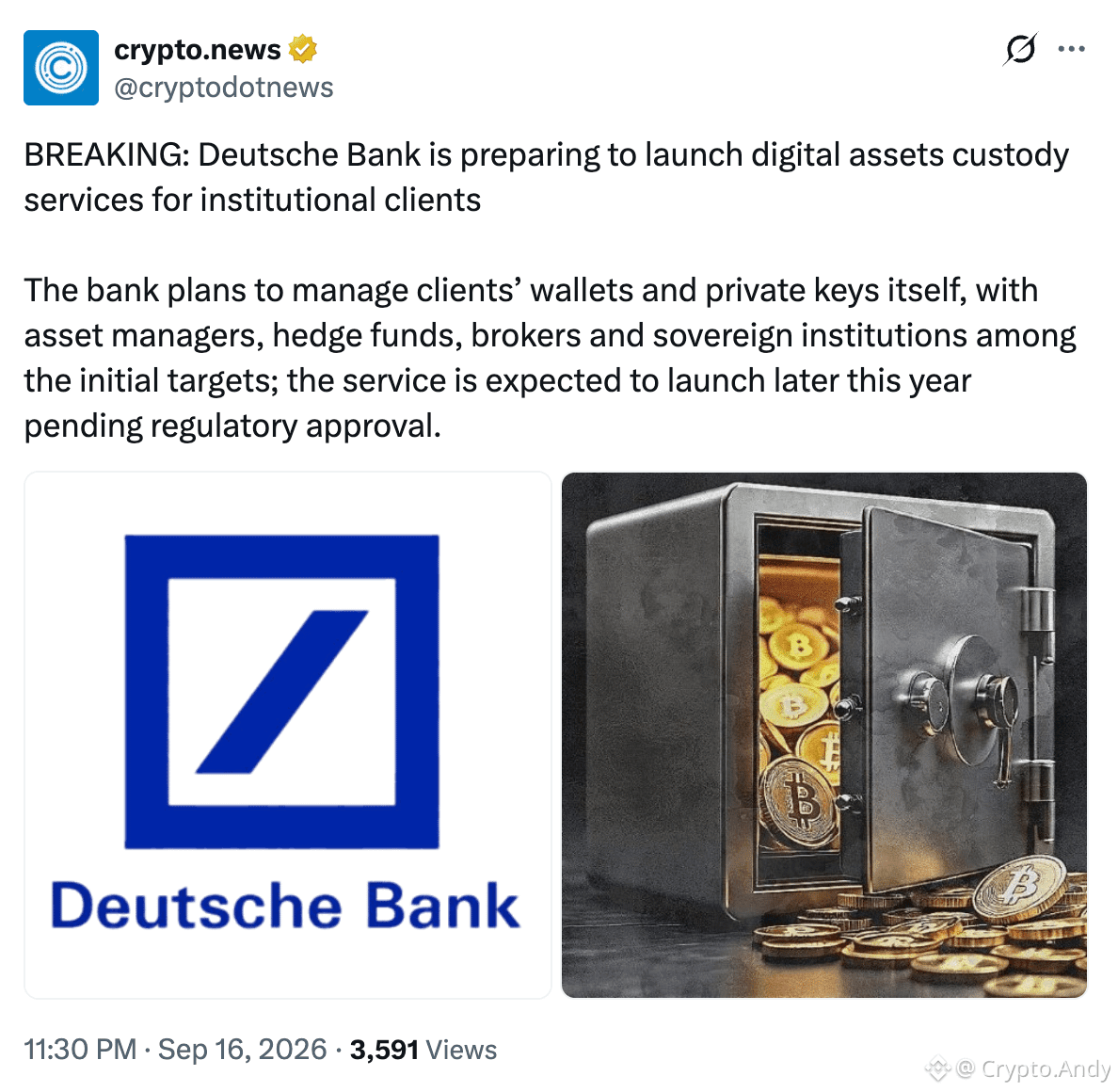
Uno de los bancos más grandes de Europa está a punto de empezar a custodiar criptomonedas 🏦 Deutsche Bank afirma que su primer servicio de custodia de activos digitales se lanzará en unas semanas. En una entrevista con Reuters el 16 de octubre, Gerald Podobnik, codirector de banca corporativa, dijo que el servicio comenzará con la custodia de $BTC y Ether en Alemania. La idea es sencilla: el banco gestionará las billeteras y las claves privadas de sus clientes, para que los fondos y las empresas no tengan que crear sus propios sistemas de gestión de claves. La protección incluirá almacenamiento en frío y en caliente, aprobaciones de varias personas e infraestructura de respaldo. Los materiales del banco también incluyen USDC, EURC y EURAU entre los activos admitidos. Aun así, los servicios de monedas estables, los depósitos tokenizados y los valores digitales están previstos como el siguiente paso, así que lo más probable es que el lanzamiento se centre en $BTC y ETH. Algunas cosas a tener en cuenta: 🔹 el servicio está dirigido a instituciones, empresas y gestores patrimoniales, no a clientes minoristas 🔹 Alemania será el primer mercado, y se prevé llegar a los centros financieros asiáticos en 2027 🔹 la fecha exacta del lanzamiento aún depende de la preparación normativa y técnica Para mí, esto es otra señal de que las criptomonedas están pasando a formar parte de la infraestructura bancaria cotidiana. Cuando un banco de este tamaño empieza a custodiar Bitcoin para sus clientes corporativos, resulta mucho más fácil que otras empresas sigan sus pasos. #Análisis del precio de BTC# #Predicción del precio de Bitcoin: ¿Cuál será el próximo movimiento de Bitcoin?#
Uno de los bancos más grandes de Europa está a punto de empezar a custodiar criptomonedas 🏦 Deutsche Bank afirma que su primer servicio de custodia de activos digitales se lanzará en unas semanas. En una entrevista con Reuters el 16 de octubre, Gerald Podobnik, codirector de banca corporativa, dijo que el servicio comenzará con la custodia de $BTC y Ether en Alemania. La idea es sencilla: el banco gestionará las billeteras y las claves privadas de sus clientes, para que los fondos y las empresas no tengan que crear sus propios sistemas de gestión de claves. La protección incluirá almacenamiento en frío y en caliente, aprobaciones de varias personas e infraestructura de respaldo. Los materiales del banco también incluyen USDC, EURC y EURAU entre los activos admitidos. Aun así, los servicios de monedas estables, los depósitos tokenizados y los valores digitales están previstos como el siguiente paso, así que lo más probable es que el lanzamiento se centre en $BTC y ETH. Algunas cosas a tener en cuenta: 🔹 el servicio está dirigido a instituciones, empresas y gestores patrimoniales, no a clientes minoristas 🔹 Alemania será el primer mercado, y se prevé llegar a los centros financieros asiáticos en 2027 🔹 la fecha exacta del lanzamiento aún depende de la preparación normativa y técnica Para mí, esto es otra señal de que las criptomonedas están pasando a formar parte de la infraestructura bancaria cotidiana. Cuando un banco de este tamaño empieza a custodiar Bitcoin para sus clientes corporativos, resulta mucho más fácil que otras empresas sigan sus pasos. #Análisis del precio de BTC# #Predicción del precio de Bitcoin: ¿Cuál será el próximo movimiento de Bitcoin?#
·
--
Desempaqueté un plan de depósito de criptomonedas para empresas. Esto es lo que había dentro Los préstamos con criptomonedas $BTC están recibiendo cada vez más atención por parte de las instituciones este año. 📈 En una encuesta de Nomura y Laser Digital publicada en abril, el 65 % de los inversores institucionales dijo que apuesta por los préstamos y los activos tokenizados. Para una empresa, esto suele significar acordar un plan de depósito personalizado con un proveedor. Me gusta imaginarlo como un juego de construcción. 🧩 Todo el mundo recibe las mismas cinco piezas en la caja y cada empresa las encaja según su propio flujo de caja. Entonces, ¿qué hay en la caja? 🔹 Parte 1: el importe. Cuánto puede reservar la empresa sin afectar las operaciones del día a día. 🔹 Parte 2: los activos. ¿Qué criptomonedas se incluyen? ¿Stablecoins, BTC o una combinación? 🔹 Parte 3: el plazo. Cuánto tiempo pueden permanecer los fondos en el plan, según las previsiones de caja. 🔹 Parte 4: la tasa. Qué ofrece el proveedor para ese importe, activo y plazo específicos. 🔹 Parte 5: la salida anticipada. ¿Qué ocurre si se necesita el dinero antes de lo previsto? Lo más importante es comprobar si el proveedor te permite construir el modelo a tu manera o si solo te ofrece un conjunto ya montado. Por ejemplo, WhiteBIT Crypto Lending for Businesses permite crear planes de depósito personalizados. https://institutional.whitebit.com/crypto-lending-for-business?utm_source=coinmarketcap&utm_medium=lendb2_andy&utm_campaign=post Los plazos pueden ir de 10 días a varios años; puede haber varias criptomonedas disponibles; las tasas son flexibles, y las condiciones de cierre anticipado se acuerdan con cada cliente. Los planes empiezan a partir de 600 000 USDT. Si estuvieras creando tu primer plan de depósito, ¿qué pieza colocarías primero? 🧩 Aviso legal: Esto no es asesoramiento financiero ni de inversión. Investiga por tu cuenta antes de tomar cualquier decisión. Úsalo bajo tu propia responsabilidad. #AnálisisDelPrecioDeBTC# #PredicciónDelPrecioDeBitcoin:¿CuálSeráElPróximoMovimientoDeBitcoin?#
Desempaqueté un plan de depósito de criptomonedas para empresas. Esto es lo que había dentro Los préstamos con criptomonedas $BTC están recibiendo cada vez más atención por parte de las instituciones este año. 📈 En una encuesta de Nomura y Laser Digital publicada en abril, el 65 % de los inversores institucionales dijo que apuesta por los préstamos y los activos tokenizados. Para una empresa, esto suele significar acordar un plan de depósito personalizado con un proveedor. Me gusta imaginarlo como un juego de construcción. 🧩 Todo el mundo recibe las mismas cinco piezas en la caja y cada empresa las encaja según su propio flujo de caja. Entonces, ¿qué hay en la caja? 🔹 Parte 1: el importe. Cuánto puede reservar la empresa sin afectar las operaciones del día a día. 🔹 Parte 2: los activos. ¿Qué criptomonedas se incluyen? ¿Stablecoins, BTC o una combinación? 🔹 Parte 3: el plazo. Cuánto tiempo pueden permanecer los fondos en el plan, según las previsiones de caja. 🔹 Parte 4: la tasa. Qué ofrece el proveedor para ese importe, activo y plazo específicos. 🔹 Parte 5: la salida anticipada. ¿Qué ocurre si se necesita el dinero antes de lo previsto? Lo más importante es comprobar si el proveedor te permite construir el modelo a tu manera o si solo te ofrece un conjunto ya montado. Por ejemplo, WhiteBIT Crypto Lending for Businesses permite crear planes de depósito personalizados. https://institutional.whitebit.com/crypto-lending-for-business?utm_source=coinmarketcap&utm_medium=lendb2_andy&utm_campaign=post Los plazos pueden ir de 10 días a varios años; puede haber varias criptomonedas disponibles; las tasas son flexibles, y las condiciones de cierre anticipado se acuerdan con cada cliente. Los planes empiezan a partir de 600 000 USDT. Si estuvieras creando tu primer plan de depósito, ¿qué pieza colocarías primero? 🧩 Aviso legal: Esto no es asesoramiento financiero ni de inversión. Investiga por tu cuenta antes de tomar cualquier decisión. Úsalo bajo tu propia responsabilidad. #AnálisisDelPrecioDeBTC# #PredicciónDelPrecioDeBitcoin:¿CuálSeráElPróximoMovimientoDeBitcoin?#

1
·
--
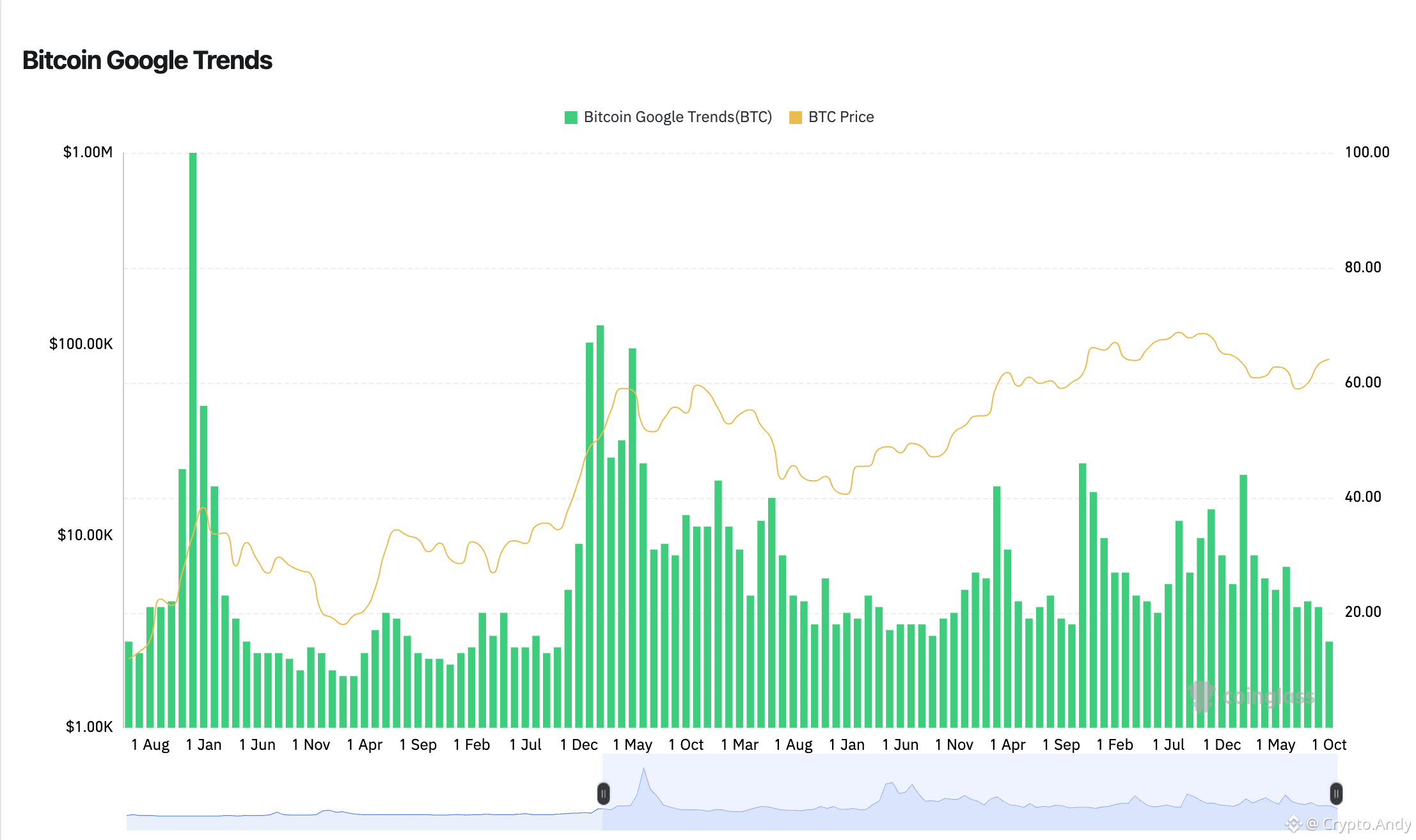
Ya nadie busca $BTC en Google... Las búsquedas de «bitcoin» en Google han caído a alrededor de 14 en una escala de 100 puntos, su nivel más bajo en aproximadamente seis años. El analista on-chain Willy Woo lo considera una señal de compra: históricamente, los períodos de menor actividad han sido los mejores momentos para acumular. La historia respalda esta idea. Las búsquedas alcanzaron su máximo en diciembre de 2017, justo cuando $BTC tocó techo cerca de los 20.000 $. Durante el mercado bajista de 2018–2019, cayeron hasta alrededor de 10, lo que resultó ser una excelente oportunidad de compra. Este ciclo, sin embargo, parece algo diferente. Las búsquedas de «bitcoin» nunca superaron aproximadamente los 45, mientras que las búsquedas de «BTCUSD» alcanzaron un récord en 2025, justo antes del máximo histórico de octubre. Esto sugiere que ahora son los traders y los inversores en ETF quienes generan la mayor parte del interés, en lugar de los recién llegados curiosos. La señal también tiene un problema de sincronización. En 2021, el interés de búsqueda alcanzó su máximo unos seis meses antes del techo de precio, así que es mejor usarlo como indicador de contexto que como punto de entrada exacto. Para ponerlo en perspectiva, Bitcoin vale alrededor de 1,65 billones de dólares, mientras que el oro ronda los 29,3 billones, aproximadamente 18 veces más. Algunos ven esto como margen para crecer, mientras que otros señalan las elecciones, las guerras y los problemas energéticos como motivos para que BTC se mantenga dentro de un rango durante un tiempo. ¿Ves este período de calma como una oportunidad para acumular? 🤔 #Análisis del precio de BTC# #Predicción del precio de Bitcoin: ¿Cuál será el próximo movimiento de Bitcoin?#
Ya nadie busca $BTC en Google... Las búsquedas de «bitcoin» en Google han caído a alrededor de 14 en una escala de 100 puntos, su nivel más bajo en aproximadamente seis años. El analista on-chain Willy Woo lo considera una señal de compra: históricamente, los períodos de menor actividad han sido los mejores momentos para acumular. La historia respalda esta idea. Las búsquedas alcanzaron su máximo en diciembre de 2017, justo cuando $BTC tocó techo cerca de los 20.000 $. Durante el mercado bajista de 2018–2019, cayeron hasta alrededor de 10, lo que resultó ser una excelente oportunidad de compra. Este ciclo, sin embargo, parece algo diferente. Las búsquedas de «bitcoin» nunca superaron aproximadamente los 45, mientras que las búsquedas de «BTCUSD» alcanzaron un récord en 2025, justo antes del máximo histórico de octubre. Esto sugiere que ahora son los traders y los inversores en ETF quienes generan la mayor parte del interés, en lugar de los recién llegados curiosos. La señal también tiene un problema de sincronización. En 2021, el interés de búsqueda alcanzó su máximo unos seis meses antes del techo de precio, así que es mejor usarlo como indicador de contexto que como punto de entrada exacto. Para ponerlo en perspectiva, Bitcoin vale alrededor de 1,65 billones de dólares, mientras que el oro ronda los 29,3 billones, aproximadamente 18 veces más. Algunos ven esto como margen para crecer, mientras que otros señalan las elecciones, las guerras y los problemas energéticos como motivos para que BTC se mantenga dentro de un rango durante un tiempo. ¿Ves este período de calma como una oportunidad para acumular? 🤔 #Análisis del precio de BTC# #Predicción del precio de Bitcoin: ¿Cuál será el próximo movimiento de Bitcoin?#
42
·
--
☕ Pensamientos del sábado Esta semana, Charles Schwab terminó de habilitar las operaciones con criptomonedas para todos sus clientes minoristas que cumplen los requisitos. Ahora pueden comprar $BTC y Ether directamente desde sus cuentas habituales de Schwab, junto con sus acciones y ETF. Parece una pequeña novedad, pero piensa en la magnitud. Schwab gestiona alrededor de 13 billones de dólares y sus clientes ya poseen cerca del 20 % de todos los activos de los ETF de criptomonedas al contado. Muchas de estas personas nunca han abierto una cuenta en una plataforma de intercambio de criptomonedas y probablemente nunca lo harán. Ahora no tienen por qué hacerlo. El equipo de investigación de Schwab también es bastante optimista. Señala que los ETF de Bitcoin han recibido casi 60.000 millones de dólares en entradas desde principios de 2024 y afirma que la volatilidad de BTC ha bajado a cerca del 40 %, desde el rango anterior de 50–60 %. Para un corredor tradicional, esto viene a decir que Bitcoin ya ha madurado 😄 Sin embargo, esta comodidad tiene un precio. Cada operación cuesta un 0,75 %, bastante más que en la mayoría de las plataformas de intercambio de criptomonedas. Aun así, muchos inversores estarán encantados de pagarlo con tal de tenerlo todo en un solo lugar de confianza. ¿Comprarías criptomonedas a través de tu banco o corredor, o prefieres las plataformas de intercambio? 👇 #Análisis del precio de BTC# #Predicción del precio de Bitcoin: ¿cuál será su próximo movimiento?#
☕ Pensamientos del sábado Esta semana, Charles Schwab terminó de habilitar las operaciones con criptomonedas para todos sus clientes minoristas que cumplen los requisitos. Ahora pueden comprar $BTC y Ether directamente desde sus cuentas habituales de Schwab, junto con sus acciones y ETF. Parece una pequeña novedad, pero piensa en la magnitud. Schwab gestiona alrededor de 13 billones de dólares y sus clientes ya poseen cerca del 20 % de todos los activos de los ETF de criptomonedas al contado. Muchas de estas personas nunca han abierto una cuenta en una plataforma de intercambio de criptomonedas y probablemente nunca lo harán. Ahora no tienen por qué hacerlo. El equipo de investigación de Schwab también es bastante optimista. Señala que los ETF de Bitcoin han recibido casi 60.000 millones de dólares en entradas desde principios de 2024 y afirma que la volatilidad de BTC ha bajado a cerca del 40 %, desde el rango anterior de 50–60 %. Para un corredor tradicional, esto viene a decir que Bitcoin ya ha madurado 😄 Sin embargo, esta comodidad tiene un precio. Cada operación cuesta un 0,75 %, bastante más que en la mayoría de las plataformas de intercambio de criptomonedas. Aun así, muchos inversores estarán encantados de pagarlo con tal de tenerlo todo en un solo lugar de confianza. ¿Comprarías criptomonedas a través de tu banco o corredor, o prefieres las plataformas de intercambio? 👇 #Análisis del precio de BTC# #Predicción del precio de Bitcoin: ¿cuál será su próximo movimiento?#

54
·
--
Según Santiment, el número de billeteras que tienen entre 10 y 10.000 $BTC ha alcanzado un nuevo máximo histórico de 20.338 direcciones. Este grupo no ha dejado de crecer desde mediados de julio, a pesar de todas las fluctuaciones de precios. Los datos de CryptoQuant muestran lo mismo. Los saldos de las ballenas, excluidos los exchanges y los pools de minería, aumentaron de unos 2,94 millones de $BTC a finales de agosto a casi 3 millones de BTC. Eso equivale a unos 60.000 BTC añadidos, o un +2 %, y al nivel más alto de este año. La acumulación se ralentizó en septiembre y luego se aceleró bruscamente a finales de septiembre y principios de octubre, después de que el precio ya hubiera empezado a recuperarse. En otras palabras, las ballenas no intentaron adivinar cuándo tocaría fondo. Siguieron comprando mientras se desarrollaba el repunte. Los analistas afirman que esto podría ayudar a absorber la toma de ganancias y convertir un breve rebote en un movimiento alcista más prolongado. CryptoQuant también añade una salvedad importante: los cambios bruscos en los saldos pueden deberse a veces a una reorganización de billeteras, así que la confirmación real será que las ballenas mantengan sus posiciones o compren durante las caídas. ¿Sigues la actividad de las ballenas cuando haces tus propias operaciones? 🤔 #Análisis del precio de BTC# #Predicción del precio de Bitcoin: ¿Cuál será el próximo movimiento de Bitcoin?#
Según Santiment, el número de billeteras que tienen entre 10 y 10.000 $BTC ha alcanzado un nuevo máximo histórico de 20.338 direcciones. Este grupo no ha dejado de crecer desde mediados de julio, a pesar de todas las fluctuaciones de precios. Los datos de CryptoQuant muestran lo mismo. Los saldos de las ballenas, excluidos los exchanges y los pools de minería, aumentaron de unos 2,94 millones de $BTC a finales de agosto a casi 3 millones de BTC. Eso equivale a unos 60.000 BTC añadidos, o un +2 %, y al nivel más alto de este año. La acumulación se ralentizó en septiembre y luego se aceleró bruscamente a finales de septiembre y principios de octubre, después de que el precio ya hubiera empezado a recuperarse. En otras palabras, las ballenas no intentaron adivinar cuándo tocaría fondo. Siguieron comprando mientras se desarrollaba el repunte. Los analistas afirman que esto podría ayudar a absorber la toma de ganancias y convertir un breve rebote en un movimiento alcista más prolongado. CryptoQuant también añade una salvedad importante: los cambios bruscos en los saldos pueden deberse a veces a una reorganización de billeteras, así que la confirmación real será que las ballenas mantengan sus posiciones o compren durante las caídas. ¿Sigues la actividad de las ballenas cuando haces tus propias operaciones? 🤔 #Análisis del precio de BTC# #Predicción del precio de Bitcoin: ¿Cuál será el próximo movimiento de Bitcoin?#

77
·
--
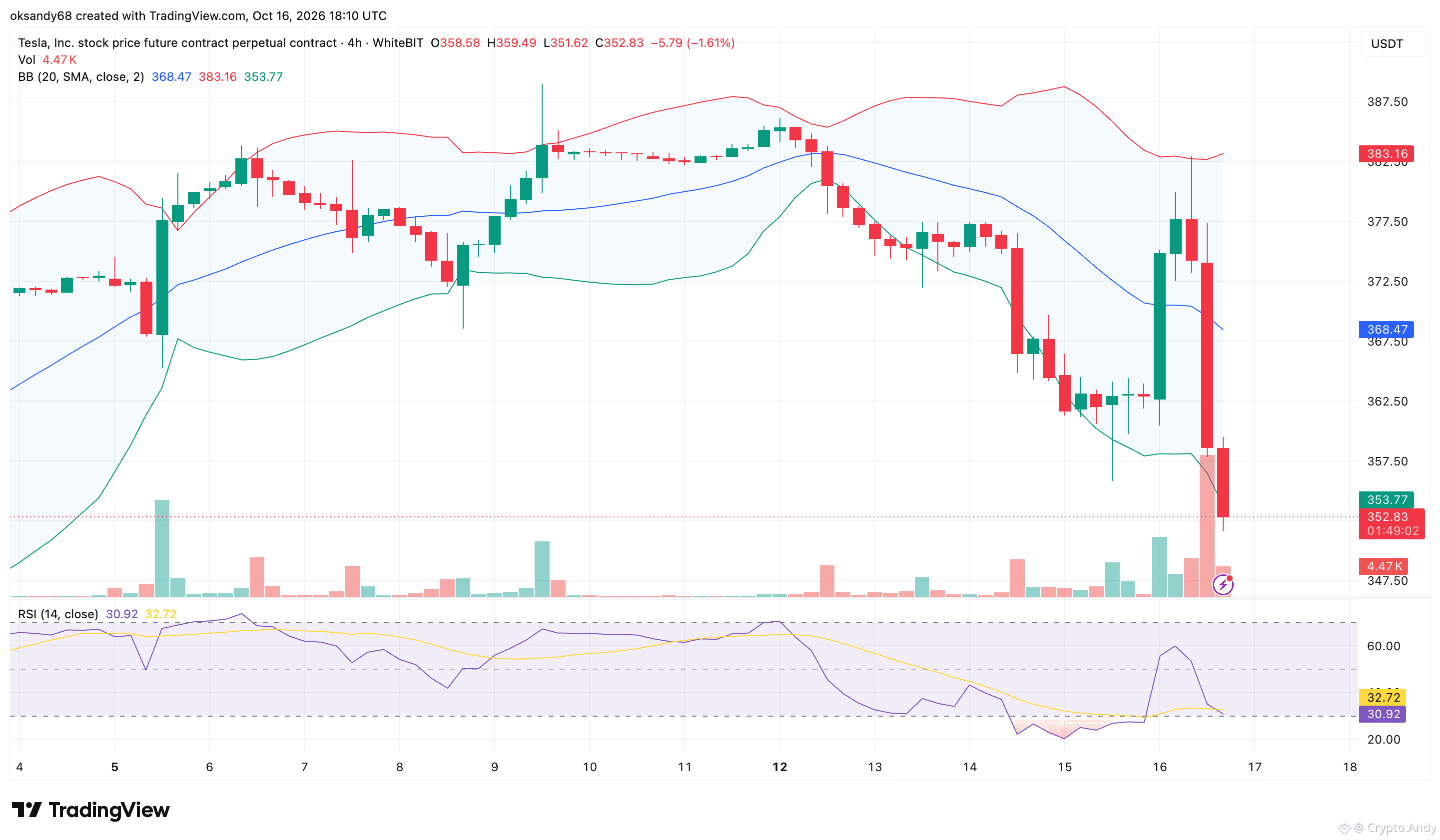
El Roadster de Tesla puede volar y dar volteretas en el aire. La acción de $TSLA decidió imitar solo la parte de las volteretas 🙃 De $382 a $353 en menos de un día. #Análisis macroeconómico# #Tesla
El Roadster de Tesla puede volar y dar volteretas en el aire. La acción de $TSLA decidió imitar solo la parte de las volteretas 🙃 De $382 a $353 en menos de un día. #Análisis macroeconómico# #Tesla
63
·
--
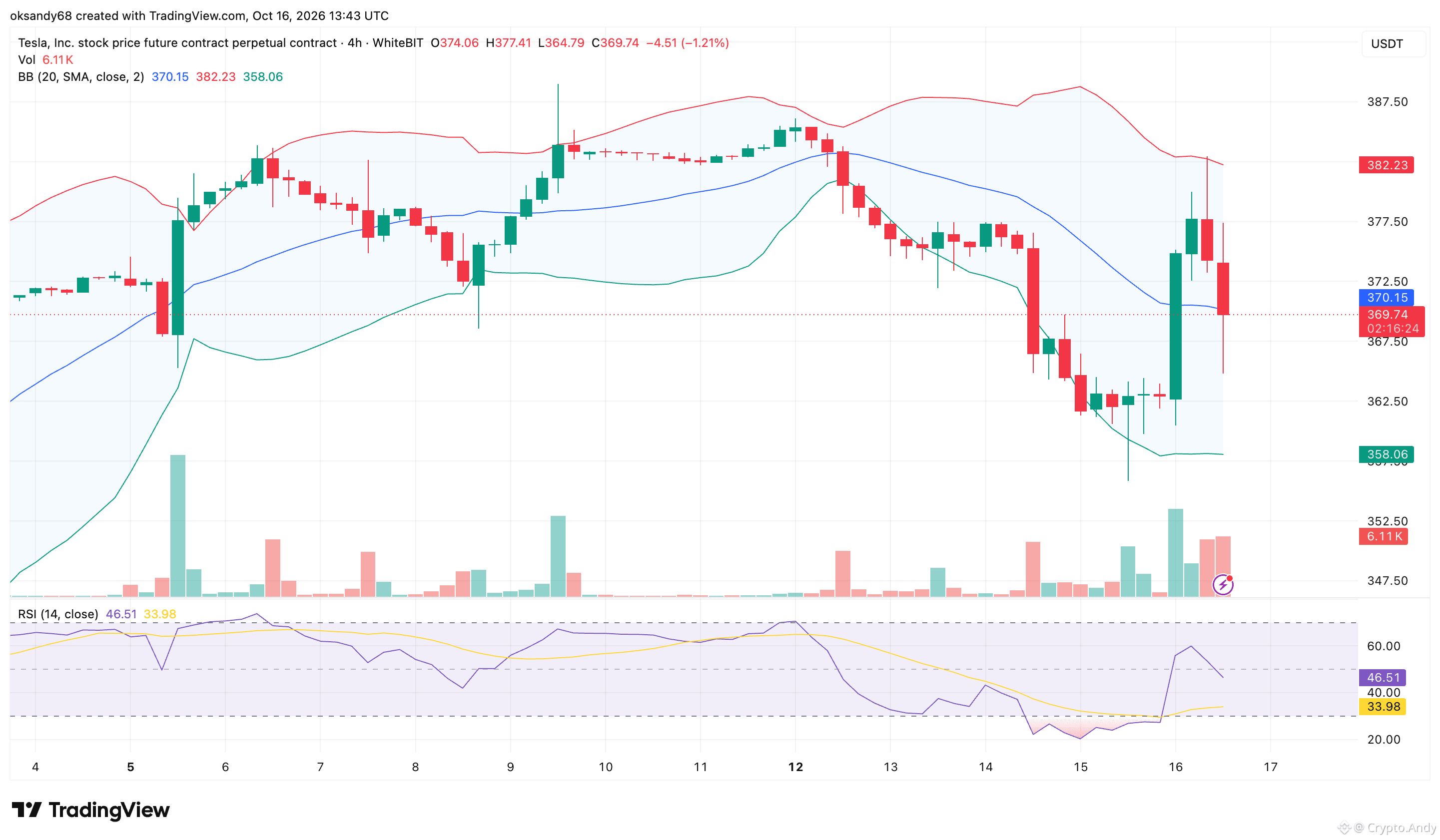
$TSLA acaba de hacer volar un auto 🚀 En el sitio de pruebas de SpaceX en Texas, Tesla finalmente presentó el nuevo Roadster. El auto condujo boca abajo por una rampa, salió disparado por el aire, dio una vuelta y aterrizó sobre sus ruedas. En la demostración, también aceleró de 0 a 60 mph en 0,81 segundos. El Roadster viene en tres versiones: 🔹 Performance: sin propulsores 🔹 Thrust: propulsores traseros para acelerar más 🔹 Rocket: solo por invitación, un asiento, 10 propulsores y un sistema de vuelo completo. Esta es la única versión que puede volar. La producción está prevista para 2028. ¿Qué muestra el gráfico ($TSLA perpetuo, 4H)? Tras el evento, el precio saltó de unos $363 hasta un máximo cercano a $382, justo en la banda superior de Bollinger. Los compradores no pudieron mantener ese nivel y el precio retrocedió hasta $369,7, justo en la banda media (~$370). El RSI rebotó desde niveles de sobreventa, cerca de 20, el 15 de octubre, y ahora se está enfriando en torno a 46. Niveles que estoy observando: 🟢 $358: banda inferior y mínimo de esta semana 🔴 $382: máximo tras la presentación y banda superior. Si el precio se mantiene por encima de $370, es posible que vuelva a probar los $382. Una caída por debajo de $358 borraría todo el repunte tras la presentación. ¿Pagarías $250K solo para reservar un Roadster con propulsores de cohete? 🤔 #Tesla #PerspectivasMacro
$TSLA acaba de hacer volar un auto 🚀 En el sitio de pruebas de SpaceX en Texas, Tesla finalmente presentó el nuevo Roadster. El auto condujo boca abajo por una rampa, salió disparado por el aire, dio una vuelta y aterrizó sobre sus ruedas. En la demostración, también aceleró de 0 a 60 mph en 0,81 segundos. El Roadster viene en tres versiones: 🔹 Performance: sin propulsores 🔹 Thrust: propulsores traseros para acelerar más 🔹 Rocket: solo por invitación, un asiento, 10 propulsores y un sistema de vuelo completo. Esta es la única versión que puede volar. La producción está prevista para 2028. ¿Qué muestra el gráfico ($TSLA perpetuo, 4H)? Tras el evento, el precio saltó de unos $363 hasta un máximo cercano a $382, justo en la banda superior de Bollinger. Los compradores no pudieron mantener ese nivel y el precio retrocedió hasta $369,7, justo en la banda media (~$370). El RSI rebotó desde niveles de sobreventa, cerca de 20, el 15 de octubre, y ahora se está enfriando en torno a 46. Niveles que estoy observando: 🟢 $358: banda inferior y mínimo de esta semana 🔴 $382: máximo tras la presentación y banda superior. Si el precio se mantiene por encima de $370, es posible que vuelva a probar los $382. Una caída por debajo de $358 borraría todo el repunte tras la presentación. ¿Pagarías $250K solo para reservar un Roadster con propulsores de cohete? 🤔 #Tesla #PerspectivasMacro

120
·
--
Ver traducción
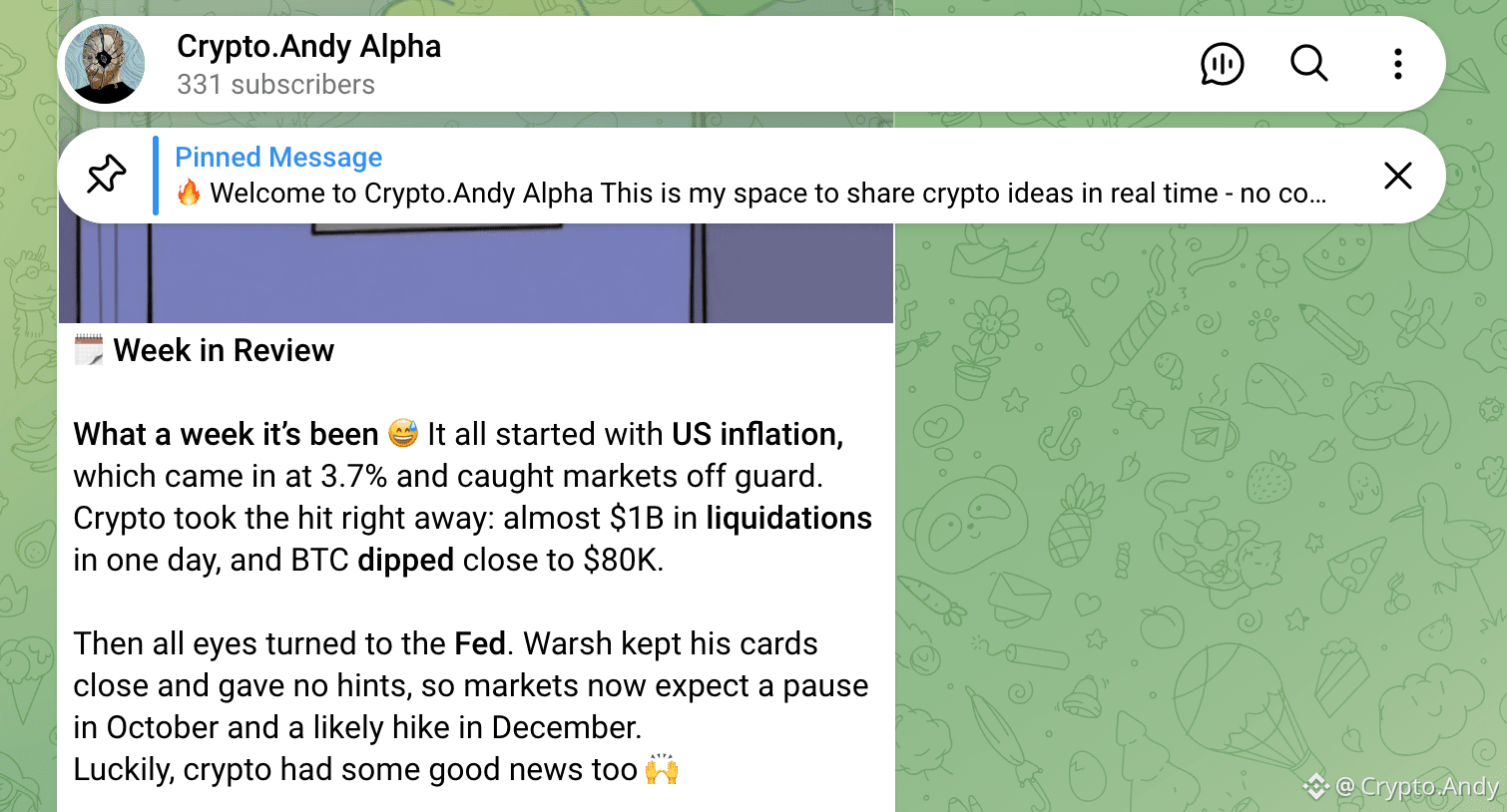
Every Friday I drop a weekly digest in my community and it’s already become a little tradition 😄 This week was a busy one: US inflation at 3.7%, almost $1B in crypto liquidations, and $BTC dipping close to $80K. Warsh gave no hints, so markets now expect a pause in October and a likely hike in December. There was good news too 🙌 USDC became the EU’s first “significant” stablecoin, Mastercard launched stablecoin payments, and Kraken is buying a bank in Lithuania. The full digest, with Tesla’s rocket Roadster and Netflix layoffs, is already waiting in Crypto.Andy's Community: https://bit.ly/4jdykHo See you there every Friday 👋 #BTC Price Analysis# #Bitcoin Price Prediction: What is Bitcoins next move?#
Every Friday I drop a weekly digest in my community and it’s already become a little tradition 😄 This week was a busy one: US inflation at 3.7%, almost $1B in crypto liquidations, and $BTC dipping close to $80K. Warsh gave no hints, so markets now expect a pause in October and a likely hike in December. There was good news too 🙌 USDC became the EU’s first “significant” stablecoin, Mastercard launched stablecoin payments, and Kraken is buying a bank in Lithuania. The full digest, with Tesla’s rocket Roadster and Netflix layoffs, is already waiting in Crypto.Andy's Community: https://bit.ly/4jdykHo See you there every Friday 👋 #BTC Price Analysis# #Bitcoin Price Prediction: What is Bitcoins next move?#
2
·
--
¿Qué pasa después de acordar un precio de $BTC en una mesa OTC? El trading OTC sigue creciendo en 2026 y, según Finery Markets, el volumen institucional de operaciones OTC al contado aumentó un 43 % interanual en el primer trimestre, mientras que el número de operaciones se disparó un 160 %. Con tantas operaciones en marcha, hay un momento que merece más atención de la que recibe. 🤔 Acordar el precio parece la meta, pero la operación no se cierra de verdad hasta que llega el dinero fiat. Y esa parte puede complicarse. Así que analicé una operación desde ambos lados de la mesa. Si eres cliente, solo quieres enviar el dinero por el medio que tu banco gestione mejor, de forma rápida y sin que comisiones inesperadas reduzcan el importe. Si eres proveedor, el precio ya está fijado y estás esperando la transferencia ⏳ Necesitas saber cuándo llegará y cómo asociarla a la operación correcta. En el artículo completo de Medium, analizo ambas perspectivas, comparto una breve lista de aspectos que conviene acordar antes de operar y cuento cómo gestionan la liquidación en fiat WhiteBIT, Gemini y BitGo: https://medium.com/@oksandy68/ever-wondered-what-your-otc-provider-is-waiting-for-after-the-price-is-locked-93a1a7db4538 ¿Qué te importa más en una operación OTC: el mejor precio o la liquidación más rápida? #Análisis del precio de BTC# #Predicción del precio de Bitcoin: ¿cuál será el próximo movimiento de Bitcoin?#
¿Qué pasa después de acordar un precio de $BTC en una mesa OTC? El trading OTC sigue creciendo en 2026 y, según Finery Markets, el volumen institucional de operaciones OTC al contado aumentó un 43 % interanual en el primer trimestre, mientras que el número de operaciones se disparó un 160 %. Con tantas operaciones en marcha, hay un momento que merece más atención de la que recibe. 🤔 Acordar el precio parece la meta, pero la operación no se cierra de verdad hasta que llega el dinero fiat. Y esa parte puede complicarse. Así que analicé una operación desde ambos lados de la mesa. Si eres cliente, solo quieres enviar el dinero por el medio que tu banco gestione mejor, de forma rápida y sin que comisiones inesperadas reduzcan el importe. Si eres proveedor, el precio ya está fijado y estás esperando la transferencia ⏳ Necesitas saber cuándo llegará y cómo asociarla a la operación correcta. En el artículo completo de Medium, analizo ambas perspectivas, comparto una breve lista de aspectos que conviene acordar antes de operar y cuento cómo gestionan la liquidación en fiat WhiteBIT, Gemini y BitGo: https://medium.com/@oksandy68/ever-wondered-what-your-otc-provider-is-waiting-for-after-the-price-is-locked-93a1a7db4538 ¿Qué te importa más en una operación OTC: el mejor precio o la liquidación más rápida? #Análisis del precio de BTC# #Predicción del precio de Bitcoin: ¿cuál será el próximo movimiento de Bitcoin?#
45
·
--
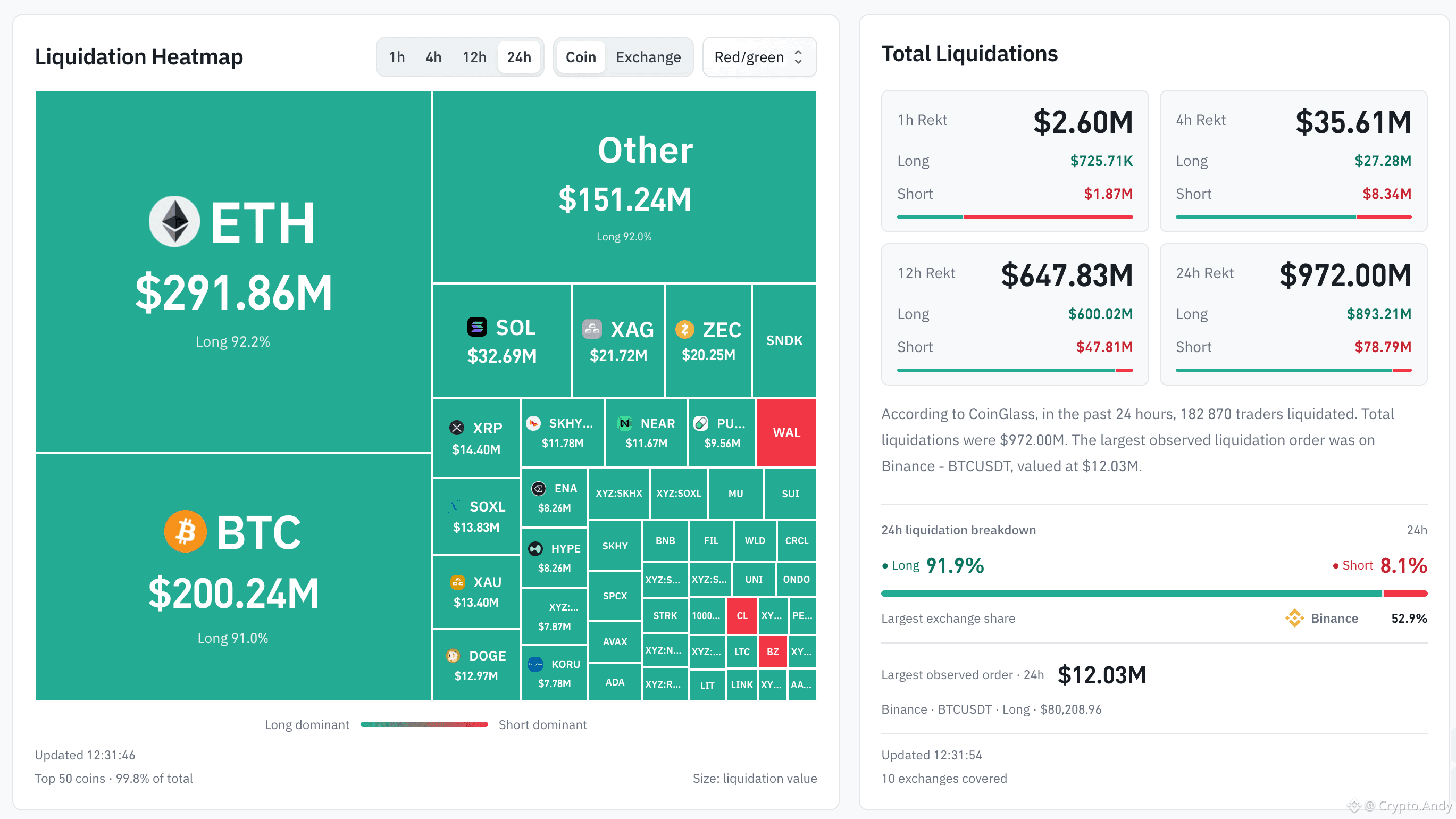
Casi 1.000 millones de dólares en liquidaciones de criptomonedas en 24 horas, y la venta masiva es global 📉 Según CoinGlass, en un día se liquidaron 972 millones de dólares, y alrededor del 92 % correspondió a posiciones largas. Más de 182.000 traders fueron liquidados. La orden individual más grande fue una posición larga de 12 millones de dólares en $BTC en Binance, cerrada a unos 80.200 dólares. Ethereum recibió el mayor golpe, con 292 millones de dólares en liquidaciones, seguido de Bitcoin, con 200 millones. Las acciones tampoco tuvieron mejor suerte. El Nasdaq cayó un 1,9 % tras unos datos de inflación de EE. UU. más altos de lo esperado, y los fabricantes de chips encabezaron las pérdidas. Asia se sumó a las ventas a la mañana siguiente. El KOSPI de Corea del Sur cayó casi un 9 % y provocó una suspensión de la negociación, la décima en lo que va de año. El Nikkei 225 de Japón perdió un 5 %. El principal factor es la Fed. Tras el informe de inflación, los mercados elevaron a cerca del 32 % la probabilidad de otra subida de tipos en la reunión del 27 y 28 de octubre. Los tipos más altos suelen reducir el apetito por el riesgo, y las criptomonedas son de las primeras en notarlo. #Análisis del precio de BTC# #Perspectivas macroeconómicas#
Casi 1.000 millones de dólares en liquidaciones de criptomonedas en 24 horas, y la venta masiva es global 📉 Según CoinGlass, en un día se liquidaron 972 millones de dólares, y alrededor del 92 % correspondió a posiciones largas. Más de 182.000 traders fueron liquidados. La orden individual más grande fue una posición larga de 12 millones de dólares en $BTC en Binance, cerrada a unos 80.200 dólares. Ethereum recibió el mayor golpe, con 292 millones de dólares en liquidaciones, seguido de Bitcoin, con 200 millones. Las acciones tampoco tuvieron mejor suerte. El Nasdaq cayó un 1,9 % tras unos datos de inflación de EE. UU. más altos de lo esperado, y los fabricantes de chips encabezaron las pérdidas. Asia se sumó a las ventas a la mañana siguiente. El KOSPI de Corea del Sur cayó casi un 9 % y provocó una suspensión de la negociación, la décima en lo que va de año. El Nikkei 225 de Japón perdió un 5 %. El principal factor es la Fed. Tras el informe de inflación, los mercados elevaron a cerca del 32 % la probabilidad de otra subida de tipos en la reunión del 27 y 28 de octubre. Los tipos más altos suelen reducir el apetito por el riesgo, y las criptomonedas son de las primeras en notarlo. #Análisis del precio de BTC# #Perspectivas macroeconómicas#
81
·
--
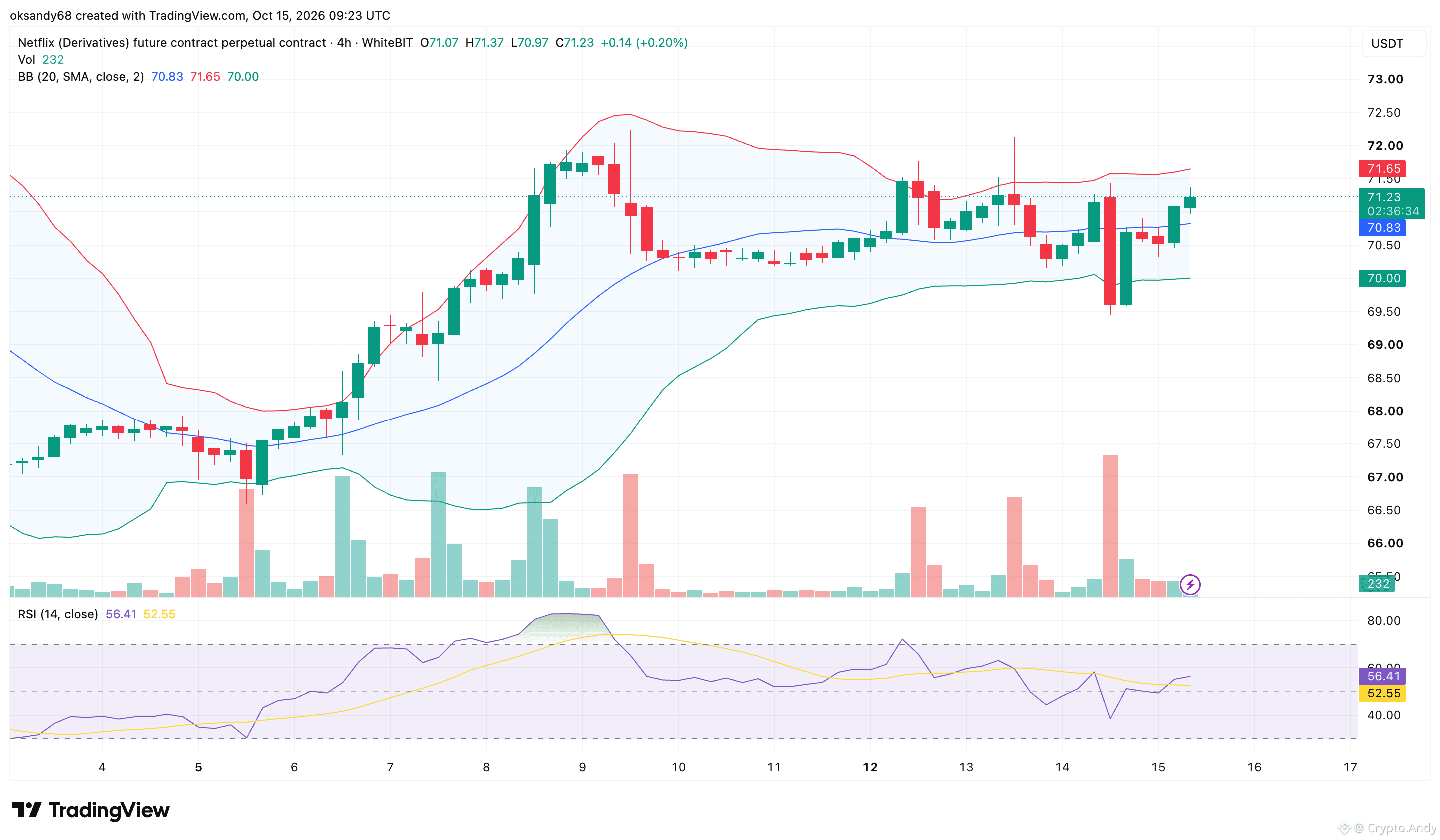
📍 Netflix anunció los mayores despidos desde 2022. La empresa reducirá alrededor del 6 % de su plantilla, unas 1.000 personas. La dirección afirma que el negocio sigue creciendo y que la previsión anual se mantiene. $NFLX ha bajado alrededor de un 25 % este año. En el gráfico de 4H, el 14 de octubre apareció una fuerte vela roja, de $71.6 a $69.5, con el mayor volumen del mes. Ese mismo día, los datos de inflación de EE. UU., más altos de lo esperado, sacudieron el mercado. Los compradores recuperaron la caída casi de inmediato y el precio vuelve a estar en $71.2. Desde el 9 de octubre, el precio se ha mantenido entre $70 y $72, y las bandas de Bollinger se están estrechando. Una ruptura por encima de $72 abriría espacio para subir, mientras que un cierre por debajo de $69.5 indicaría una corrección más profunda. Estoy pendiente de qué nivel se rompe primero 👀 #Netflix #Perspectivas macro# #Temporada de altcoins#
📍 Netflix anunció los mayores despidos desde 2022. La empresa reducirá alrededor del 6 % de su plantilla, unas 1.000 personas. La dirección afirma que el negocio sigue creciendo y que la previsión anual se mantiene. $NFLX ha bajado alrededor de un 25 % este año. En el gráfico de 4H, el 14 de octubre apareció una fuerte vela roja, de $71.6 a $69.5, con el mayor volumen del mes. Ese mismo día, los datos de inflación de EE. UU., más altos de lo esperado, sacudieron el mercado. Los compradores recuperaron la caída casi de inmediato y el precio vuelve a estar en $71.2. Desde el 9 de octubre, el precio se ha mantenido entre $70 y $72, y las bandas de Bollinger se están estrechando. Una ruptura por encima de $72 abriría espacio para subir, mientras que un cierre por debajo de $69.5 indicaría una corrección más profunda. Estoy pendiente de qué nivel se rompe primero 👀 #Netflix #Perspectivas macro# #Temporada de altcoins#
107
·
--
🧲 Standard Chartered abre el trading de $BTC y $ETH a clientes adinerados de los Emiratos Árabes Unidos Standard Chartered ahora permite a los inversores profesionales de los Emiratos Árabes Unidos comprar BTC y ETH directamente desde sus cuentas bancarias habituales. No hace falta usar una aplicación de criptomonedas aparte ni transferir dinero de un lado a otro: solo tienes que iniciar sesión y comprar 😎 El requisito es tener al menos AED 4M (~$1.1M) en activos netos. Y el banco no pierde el tiempo. A principios de septiembre abrió el trading de criptomonedas a clientes institucionales y, apenas un mes después, los particulares adinerados también pueden acceder. Los Emiratos Árabes Unidos se están convirtiendo en un auténtico imán para las criptomonedas El lunes, Payward, la empresa matriz de Kraken, recibió la aprobación del regulador de Dubái VARA, y en julio Revolut recibió la aprobación preliminar de VARA 🇦🇪 WhiteBIT también se sumó a la lista con una aprobación en principio de VARA. Es más bien una luz verde para pasar a la siguiente etapa. ¿Está Dubái a punto de convertirse en la capital mundial de las criptomonedas? 🇦🇪 #Análisis del precio de BTC# #Análisis del precio de BTC#
🧲 Standard Chartered abre el trading de $BTC y $ETH a clientes adinerados de los Emiratos Árabes Unidos Standard Chartered ahora permite a los inversores profesionales de los Emiratos Árabes Unidos comprar BTC y ETH directamente desde sus cuentas bancarias habituales. No hace falta usar una aplicación de criptomonedas aparte ni transferir dinero de un lado a otro: solo tienes que iniciar sesión y comprar 😎 El requisito es tener al menos AED 4M (~$1.1M) en activos netos. Y el banco no pierde el tiempo. A principios de septiembre abrió el trading de criptomonedas a clientes institucionales y, apenas un mes después, los particulares adinerados también pueden acceder. Los Emiratos Árabes Unidos se están convirtiendo en un auténtico imán para las criptomonedas El lunes, Payward, la empresa matriz de Kraken, recibió la aprobación del regulador de Dubái VARA, y en julio Revolut recibió la aprobación preliminar de VARA 🇦🇪 WhiteBIT también se sumó a la lista con una aprobación en principio de VARA. Es más bien una luz verde para pasar a la siguiente etapa. ¿Está Dubái a punto de convertirse en la capital mundial de las criptomonedas? 🇦🇪 #Análisis del precio de BTC# #Análisis del precio de BTC#
39
Inicia sesión para explorar más contenidos
Únete a usuarios globales de criptomonedas en Binance Square
⚡️ Obtén información útil y actualizada sobre criptos.
💬 Avalado por el mayor exchange de criptomonedas en el mundo.
👍 Descubre perspectivas reales de creadores verificados.
Email/número de teléfono
Temas populares
CanMicrosoftDeliverOnAI
110,624 vistas
840 están debatiendo
Sesión 3 de la temporada de resultados: ¿Superarán Google y Microsoft las expectativas?
Binance Square Official
·67 me gusta
·18.9k vistas
CanGoogleDefindItsCore
52,505 vistas
603 están debatiendo
FOMCWatch
9.1M vistas
28,091 están debatiendo