

#liquidations
liquidations
5.8M vistas
8,161 están debatiendo
Hot
Lo último

·
--
Alcista
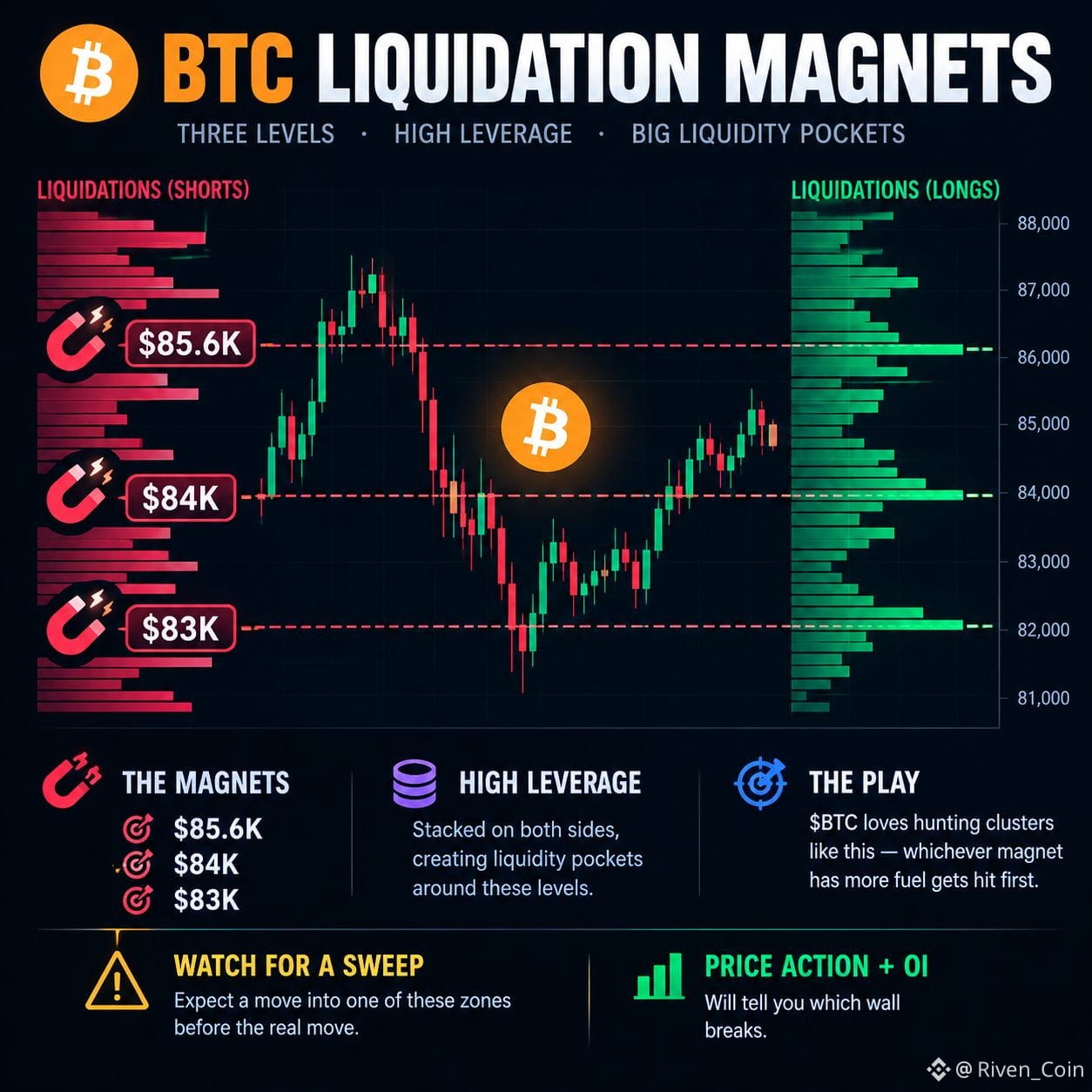
🧲 $BTC está sentado entre tres grandes imanes de liquidación:
🎯 $85.6K
🎯 $84K
🎯 $83K
El apalancamiento está fuertemente cargado en ambos lados, creando bolsillos de liquidez alrededor de estos niveles.
Bitcoin a menudo barre posiciones abarrotadas antes de elegir su dirección real. Observa de cerca una posible entrada en una de estas zonas.
La acción del precio + el Open Interest revelarán qué lado se elimina primero. 👀📊
#Rivencoin #Liquidations
{spot}(BTCUSDT)
$QNT
{future}(QNTUSDT)
$SOL
{future}(SOLUSDT)
🧲 $BTC está sentado entre tres grandes imanes de liquidación:
🎯 $85.6K
🎯 $84K
🎯 $83K
El apalancamiento está fuertemente cargado en ambos lados, creando bolsillos de liquidez alrededor de estos niveles.
Bitcoin a menudo barre posiciones abarrotadas antes de elegir su dirección real. Observa de cerca una posible entrada en una de estas zonas.
La acción del precio + el Open Interest revelarán qué lado se elimina primero. 👀📊
#Rivencoin #Liquidations
$QNT
$SOL
🎯 $85.6K
🎯 $84K
🎯 $83K
El apalancamiento está fuertemente cargado en ambos lados, creando bolsillos de liquidez alrededor de estos niveles.
Bitcoin a menudo barre posiciones abarrotadas antes de elegir su dirección real. Observa de cerca una posible entrada en una de estas zonas.
La acción del precio + el Open Interest revelarán qué lado se elimina primero. 👀📊
#Rivencoin #Liquidations
$QNT
$SOL
137

·
--
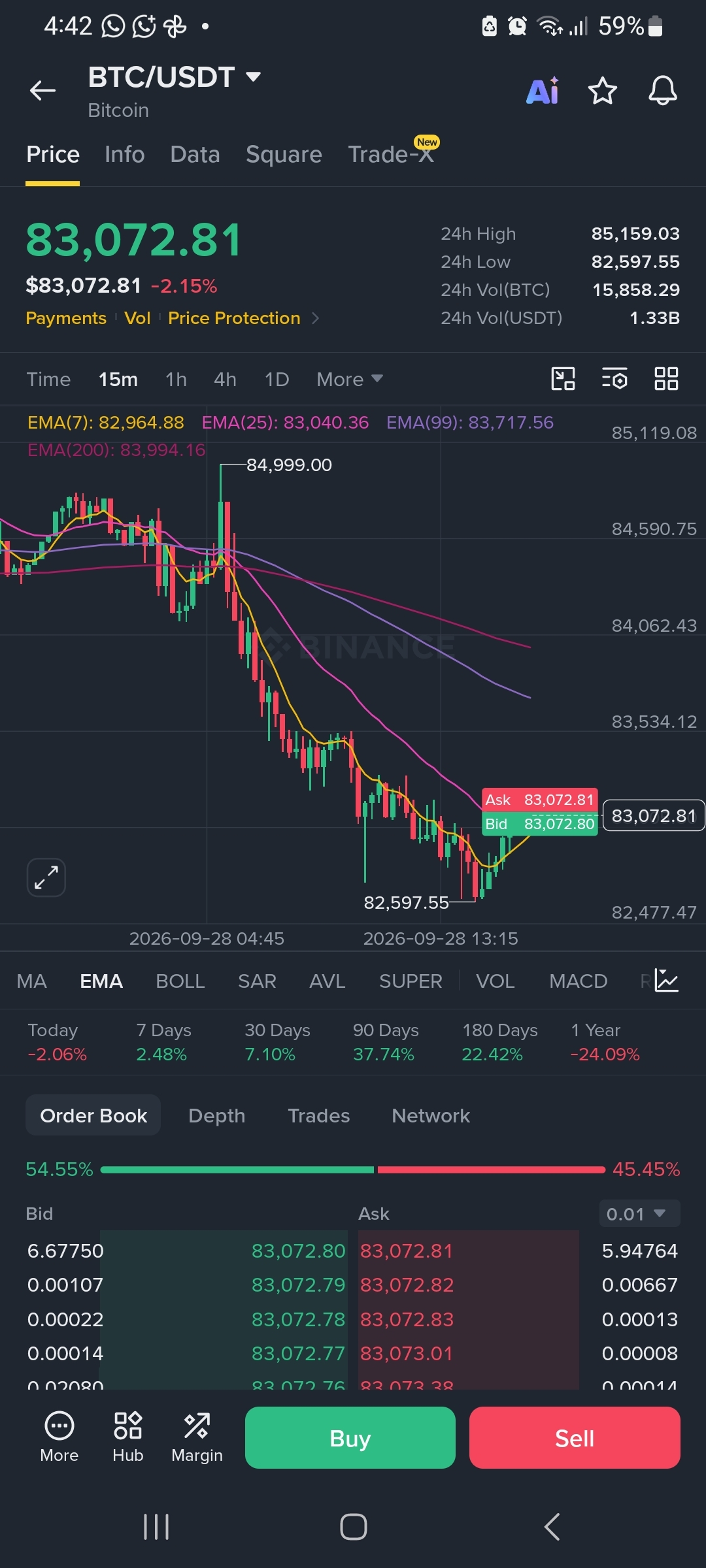
Pantalla roja otra vez hoy. Unos 107K traders fueron liquidados en las últimas 24 horas, aproximadamente $330M desaparecidos, y la mayor parte fueron posiciones largas. Solo BTC representó alrededor de $79M de eso. El apalancamiento se siente genial hasta que aparece una pequeña caída. Un tamaño más pequeño y un stop adecuado suelen superar perseguir una gran victoria. ¿Lo aguantaste o te sacudieron? $BTC $ETH $XRP #Crypto #Liquidations #Bitcoin #CryptoMarket
Pantalla roja otra vez hoy. Unos 107K traders fueron liquidados en las últimas 24 horas, aproximadamente $330M desaparecidos, y la mayor parte fueron posiciones largas. Solo BTC representó alrededor de $79M de eso. El apalancamiento se siente genial hasta que aparece una pequeña caída. Un tamaño más pequeño y un stop adecuado suelen superar perseguir una gran victoria. ¿Lo aguantaste o te sacudieron? $BTC $ETH $XRP #Crypto #Liquidations #Bitcoin #CryptoMarket
90

·
--
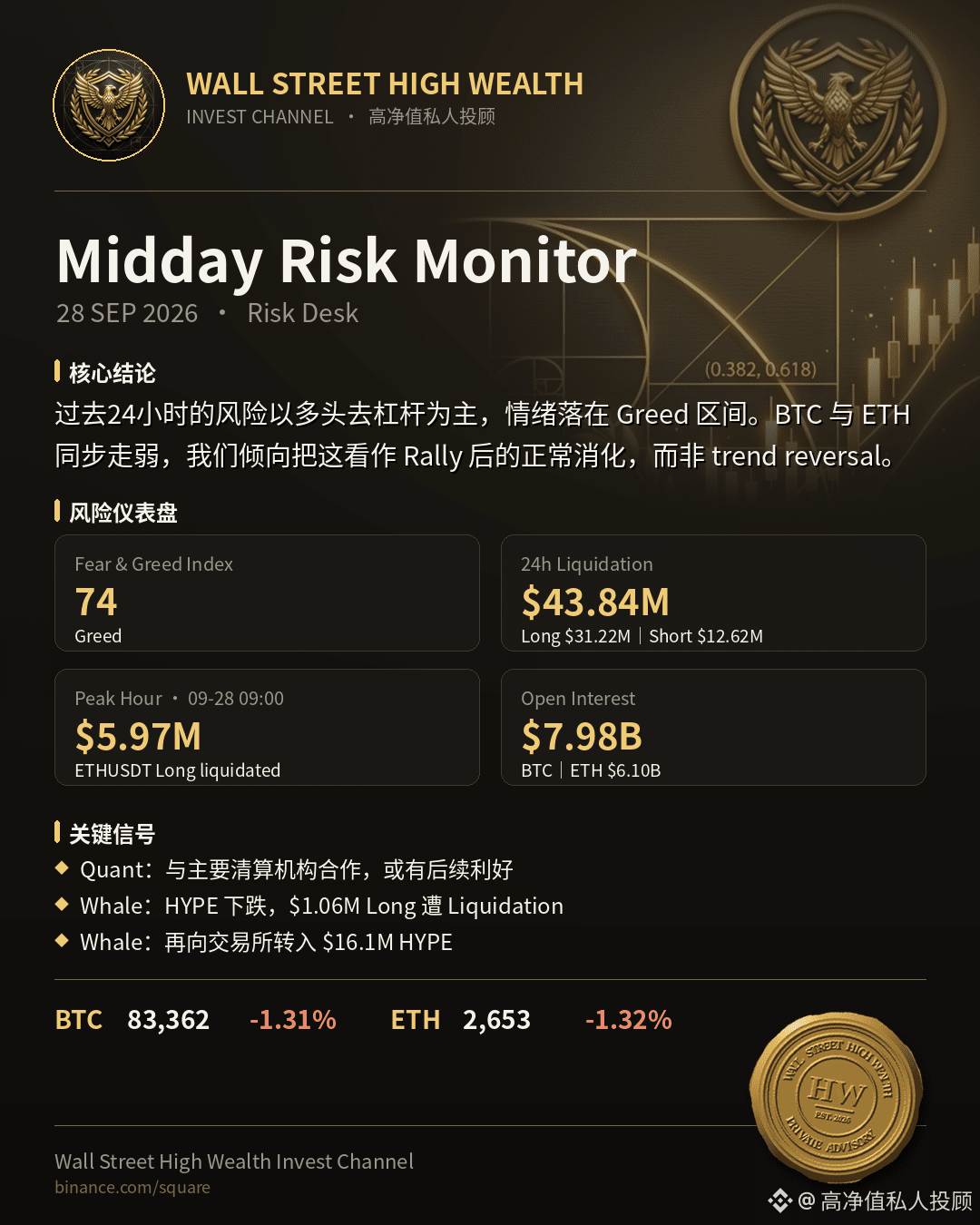
◆ Monitor de Riesgo al Mediodía · 09月28日
Bonjour. Bienvenido al Canal de Wall Street High Wealth Invest.
午安。
【Conclusión central】
En las últimas 24 horas, el riesgo estuvo dominado por el desapalancamiento de los alcistas; el sentimiento se ubicó en el rango de Greed. BTC y ETH cayeron de forma sincronizada. Tendemos a verlo como una digestión normal después de un Rally, en lugar de una reversión de tendencia.
【Panel de Riesgos】
· Fear & Greed Index: 74 (Greed)
· Liquidaciones 24h: 43,84 millones de USD | Long 31,22 | Short 12,62
· Periodo de pico: 09-28 09:00, se liquidó Long en ETHUSDT por 5,97 millones
· Open Interest: BTC 7.98 mil millones de USD | ETH 6.10 mil millones de USD
【Clasificación de liquidaciones】
· Bitcoin: en 2013 se gritaba/indicaba; ahora se indica QNT. ¿Cuáles son las nuevas noticias buenas después de que Quant y las principales instituciones de liquidación de EE. UU. colaboraran?
· Con la caída del precio de HYPE, cierta ballena de 1,06 millones de USD en longs fue liquidada
· «Maji» redujo su posición en longs de Bitcoin; en las últimas 24 horas, la cuenta perdió 1,42 millones de USD
Nuestra clasificación: esto es un «barrido de cuchillos». El 09-28 09:00, una punción en ETHUSDT liquidó 5,97 millones en longs; los shorts apenas fueron 60 mil. En 24 horas, los longs explotados por 31,22 millones superaron a los shorts de 12,62 millones. El apalancamiento estaba claramente congestionado del lado Long; ser limpiado no es inesperado. Cierta ballena con longs de HYPE sufrió una Liquidation de 1,06 millones; «Maji» recortó sus longs de BTC y registró una pérdida de 1,42 millones. Lo tomamos solo como muestra de sentimiento y evidencia de congestión, no como señal para seguir. Los datos de liquidaciones muestran la saturación de apalancamiento, no una señal de dirección.
【En cadena y Meme】
· Alguna ballena gigante de HYPE volvió a transferir al exchange 16,10 millones de USD en HYPE
· Otra ballena recargó de nuevo en la plataforma 16,10 millones de USD en HYPE; total: 177.5200 mil tokens
· Direcciones relacionadas con GMGN depositaron en Coinbase 6.100 ETH hace 8 horas, valor 16,38 millones de USD
Nuestra clasificación: la ballena gigante de HYPE volvió a mover 16,10 millones de USD en HYPE hacia el exchange; acumulado 177,52 mil unidades. La dirección vinculada a GMGN recargó a Coinbase 6.100 ETH hace 8 horas, aproximadamente 16,38 millones de USD. Los «fondos» se están moviendo desde direcciones de tenencia a largo plazo hacia saldos de exchange que se pueden vender en cualquier momento; estas transferencias normalmente anteceden a una retirada de liquidez. El sentimiento del Meme y la liquidez se derraman y se retiran rápido. Su valor está en indicar la temperatura del sentimiento, no en ser una oportunidad de asignación.
【Vinculación macro】
Desde el lado macro, no se respalda un activo de riesgo. El rendimiento del Treasury a 10 años subió a 5,184%, +2,2 bp en un solo día. El DXY está en 101,1, +0,67% en la última semana. Las expectativas de Rate Hike se intensifican; el Banco de Japón podría acelerar los pasos de alza de tasas. BTC 83.362, -1,31% en 24h; ETH 2.653, -1,32%. En la combinación de aumento de tasas y fortaleza del dólar, la caída cripto tiene una fuente macro clara y no hace falta buscar otra explicación. Mantenemos una actitud positiva y disciplinada respecto a que la Fed siga siendo Hawkish; el aumento construido solo con expectativas de recorte de tasas finalmente tendrá que devolverse.
【Recomendación de posicionamiento】
Para nuevas entradas, recomendamos mantener un apalancamiento bajo; si la dirección no está clara, no aumentar posiciones. Para posiciones existentes, fijar el Stop Loss siguiendo la disciplina; no hace falta usar apalancamiento para «cazar cuchillos». El Fear & Greed Index 74 sigue en zona de Greed; en ese nivel conviene reducir el riesgo, no aumentarlo.
$BTC #BTC #Liquidations
Tu asesor privado en Wall Street.
Bon après-midi.
◆ Monitor de Riesgo al Mediodía · 09月28日
Bonjour. Bienvenido al Canal de Wall Street High Wealth Invest.
午安。
【Conclusión central】
En las últimas 24 horas, el riesgo estuvo dominado por el desapalancamiento de los alcistas; el sentimiento se ubicó en el rango de Greed. BTC y ETH cayeron de forma sincronizada. Tendemos a verlo como una digestión normal después de un Rally, en lugar de una reversión de tendencia.
【Panel de Riesgos】
· Fear & Greed Index: 74 (Greed)
· Liquidaciones 24h: 43,84 millones de USD | Long 31,22 | Short 12,62
· Periodo de pico: 09-28 09:00, se liquidó Long en ETHUSDT por 5,97 millones
· Open Interest: BTC 7.98 mil millones de USD | ETH 6.10 mil millones de USD
【Clasificación de liquidaciones】
· Bitcoin: en 2013 se gritaba/indicaba; ahora se indica QNT. ¿Cuáles son las nuevas noticias buenas después de que Quant y las principales instituciones de liquidación de EE. UU. colaboraran?
· Con la caída del precio de HYPE, cierta ballena de 1,06 millones de USD en longs fue liquidada
· «Maji» redujo su posición en longs de Bitcoin; en las últimas 24 horas, la cuenta perdió 1,42 millones de USD
Nuestra clasificación: esto es un «barrido de cuchillos». El 09-28 09:00, una punción en ETHUSDT liquidó 5,97 millones en longs; los shorts apenas fueron 60 mil. En 24 horas, los longs explotados por 31,22 millones superaron a los shorts de 12,62 millones. El apalancamiento estaba claramente congestionado del lado Long; ser limpiado no es inesperado. Cierta ballena con longs de HYPE sufrió una Liquidation de 1,06 millones; «Maji» recortó sus longs de BTC y registró una pérdida de 1,42 millones. Lo tomamos solo como muestra de sentimiento y evidencia de congestión, no como señal para seguir. Los datos de liquidaciones muestran la saturación de apalancamiento, no una señal de dirección.
【En cadena y Meme】
· Alguna ballena gigante de HYPE volvió a transferir al exchange 16,10 millones de USD en HYPE
· Otra ballena recargó de nuevo en la plataforma 16,10 millones de USD en HYPE; total: 177.5200 mil tokens
· Direcciones relacionadas con GMGN depositaron en Coinbase 6.100 ETH hace 8 horas, valor 16,38 millones de USD
Nuestra clasificación: la ballena gigante de HYPE volvió a mover 16,10 millones de USD en HYPE hacia el exchange; acumulado 177,52 mil unidades. La dirección vinculada a GMGN recargó a Coinbase 6.100 ETH hace 8 horas, aproximadamente 16,38 millones de USD. Los «fondos» se están moviendo desde direcciones de tenencia a largo plazo hacia saldos de exchange que se pueden vender en cualquier momento; estas transferencias normalmente anteceden a una retirada de liquidez. El sentimiento del Meme y la liquidez se derraman y se retiran rápido. Su valor está en indicar la temperatura del sentimiento, no en ser una oportunidad de asignación.
【Vinculación macro】
Desde el lado macro, no se respalda un activo de riesgo. El rendimiento del Treasury a 10 años subió a 5,184%, +2,2 bp en un solo día. El DXY está en 101,1, +0,67% en la última semana. Las expectativas de Rate Hike se intensifican; el Banco de Japón podría acelerar los pasos de alza de tasas. BTC 83.362, -1,31% en 24h; ETH 2.653, -1,32%. En la combinación de aumento de tasas y fortaleza del dólar, la caída cripto tiene una fuente macro clara y no hace falta buscar otra explicación. Mantenemos una actitud positiva y disciplinada respecto a que la Fed siga siendo Hawkish; el aumento construido solo con expectativas de recorte de tasas finalmente tendrá que devolverse.
【Recomendación de posicionamiento】
Para nuevas entradas, recomendamos mantener un apalancamiento bajo; si la dirección no está clara, no aumentar posiciones. Para posiciones existentes, fijar el Stop Loss siguiendo la disciplina; no hace falta usar apalancamiento para «cazar cuchillos». El Fear & Greed Index 74 sigue en zona de Greed; en ese nivel conviene reducir el riesgo, no aumentarlo.
$BTC #BTC #Liquidations
Tu asesor privado en Wall Street.
Bon après-midi.
Bonjour. Bienvenido al Canal de Wall Street High Wealth Invest.
午安。
【Conclusión central】
En las últimas 24 horas, el riesgo estuvo dominado por el desapalancamiento de los alcistas; el sentimiento se ubicó en el rango de Greed. BTC y ETH cayeron de forma sincronizada. Tendemos a verlo como una digestión normal después de un Rally, en lugar de una reversión de tendencia.
【Panel de Riesgos】
· Fear & Greed Index: 74 (Greed)
· Liquidaciones 24h: 43,84 millones de USD | Long 31,22 | Short 12,62
· Periodo de pico: 09-28 09:00, se liquidó Long en ETHUSDT por 5,97 millones
· Open Interest: BTC 7.98 mil millones de USD | ETH 6.10 mil millones de USD
【Clasificación de liquidaciones】
· Bitcoin: en 2013 se gritaba/indicaba; ahora se indica QNT. ¿Cuáles son las nuevas noticias buenas después de que Quant y las principales instituciones de liquidación de EE. UU. colaboraran?
· Con la caída del precio de HYPE, cierta ballena de 1,06 millones de USD en longs fue liquidada
· «Maji» redujo su posición en longs de Bitcoin; en las últimas 24 horas, la cuenta perdió 1,42 millones de USD
Nuestra clasificación: esto es un «barrido de cuchillos». El 09-28 09:00, una punción en ETHUSDT liquidó 5,97 millones en longs; los shorts apenas fueron 60 mil. En 24 horas, los longs explotados por 31,22 millones superaron a los shorts de 12,62 millones. El apalancamiento estaba claramente congestionado del lado Long; ser limpiado no es inesperado. Cierta ballena con longs de HYPE sufrió una Liquidation de 1,06 millones; «Maji» recortó sus longs de BTC y registró una pérdida de 1,42 millones. Lo tomamos solo como muestra de sentimiento y evidencia de congestión, no como señal para seguir. Los datos de liquidaciones muestran la saturación de apalancamiento, no una señal de dirección.
【En cadena y Meme】
· Alguna ballena gigante de HYPE volvió a transferir al exchange 16,10 millones de USD en HYPE
· Otra ballena recargó de nuevo en la plataforma 16,10 millones de USD en HYPE; total: 177.5200 mil tokens
· Direcciones relacionadas con GMGN depositaron en Coinbase 6.100 ETH hace 8 horas, valor 16,38 millones de USD
Nuestra clasificación: la ballena gigante de HYPE volvió a mover 16,10 millones de USD en HYPE hacia el exchange; acumulado 177,52 mil unidades. La dirección vinculada a GMGN recargó a Coinbase 6.100 ETH hace 8 horas, aproximadamente 16,38 millones de USD. Los «fondos» se están moviendo desde direcciones de tenencia a largo plazo hacia saldos de exchange que se pueden vender en cualquier momento; estas transferencias normalmente anteceden a una retirada de liquidez. El sentimiento del Meme y la liquidez se derraman y se retiran rápido. Su valor está en indicar la temperatura del sentimiento, no en ser una oportunidad de asignación.
【Vinculación macro】
Desde el lado macro, no se respalda un activo de riesgo. El rendimiento del Treasury a 10 años subió a 5,184%, +2,2 bp en un solo día. El DXY está en 101,1, +0,67% en la última semana. Las expectativas de Rate Hike se intensifican; el Banco de Japón podría acelerar los pasos de alza de tasas. BTC 83.362, -1,31% en 24h; ETH 2.653, -1,32%. En la combinación de aumento de tasas y fortaleza del dólar, la caída cripto tiene una fuente macro clara y no hace falta buscar otra explicación. Mantenemos una actitud positiva y disciplinada respecto a que la Fed siga siendo Hawkish; el aumento construido solo con expectativas de recorte de tasas finalmente tendrá que devolverse.
【Recomendación de posicionamiento】
Para nuevas entradas, recomendamos mantener un apalancamiento bajo; si la dirección no está clara, no aumentar posiciones. Para posiciones existentes, fijar el Stop Loss siguiendo la disciplina; no hace falta usar apalancamiento para «cazar cuchillos». El Fear & Greed Index 74 sigue en zona de Greed; en ese nivel conviene reducir el riesgo, no aumentarlo.
$BTC #BTC #Liquidations
Tu asesor privado en Wall Street.
Bon après-midi.
502

·
--
Bajista
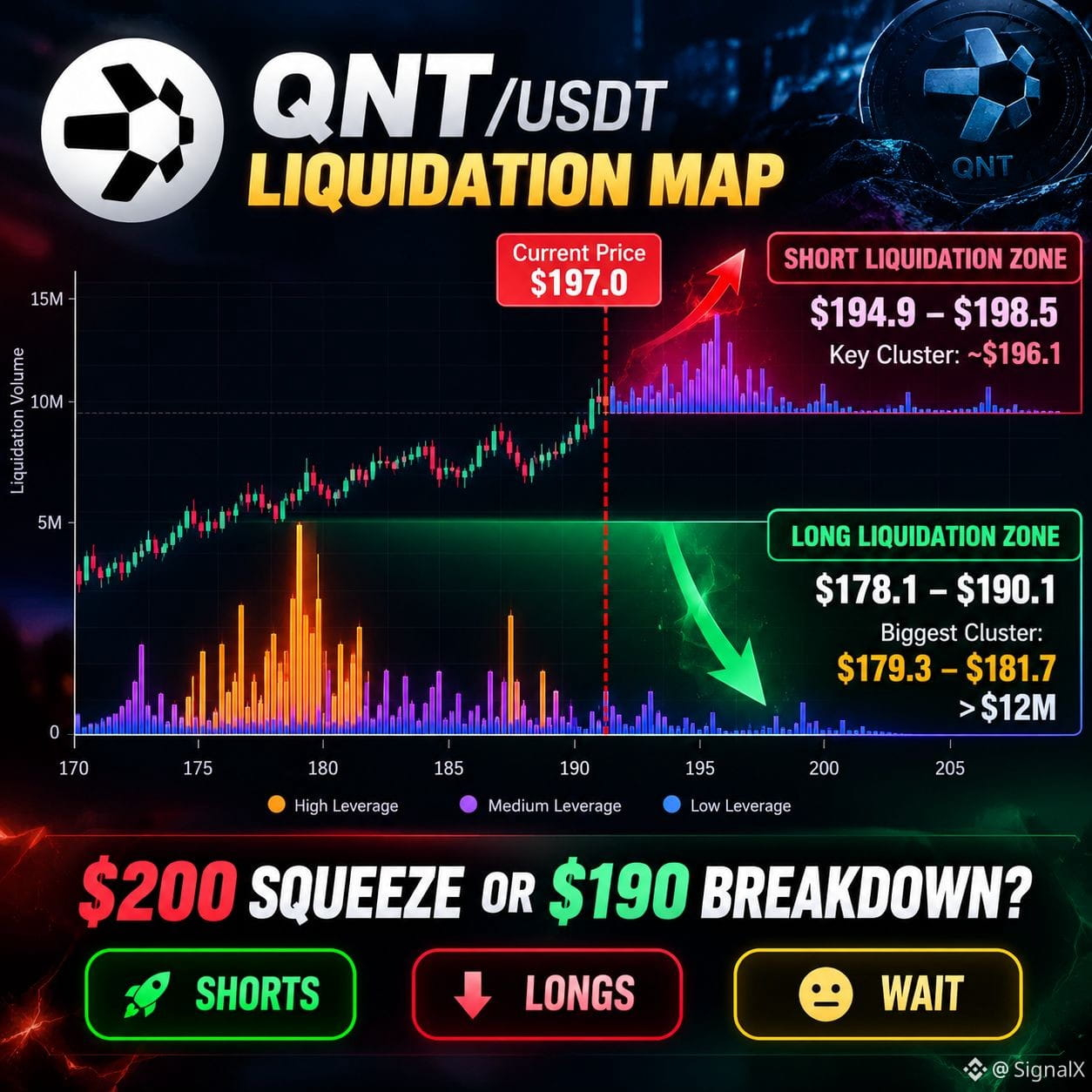
🚨 Mapa de liquidación $QNT LIQUIDATION 👀
La QNT ahora está en ~197.
🔥 Liquidaciones cortas: $194.9–$198.5
💥 Zona clave: ~$196.1
⚠️ Liquidaciones largas: $178.1–$190.1
💣 El clúster más grande: $179.3–$181.7 | >$12M
¿Apretón de $200 o ruptura en $190? 👀
🟢 CORTOS | 🔴 LARGOS | 🟡 ESPERA
$QNT #crypto #BinanceSquare #Liquidations
🚨 Mapa de liquidación $QNT LIQUIDATION 👀
La QNT ahora está en ~197.
🔥 Liquidaciones cortas: $194.9–$198.5
💥 Zona clave: ~$196.1
⚠️ Liquidaciones largas: $178.1–$190.1
💣 El clúster más grande: $179.3–$181.7 | >$12M
¿Apretón de $200 o ruptura en $190? 👀
🟢 CORTOS | 🔴 LARGOS | 🟡 ESPERA
$QNT #crypto #BinanceSquare #Liquidations
La QNT ahora está en ~197.
🔥 Liquidaciones cortas: $194.9–$198.5
💥 Zona clave: ~$196.1
⚠️ Liquidaciones largas: $178.1–$190.1
💣 El clúster más grande: $179.3–$181.7 | >$12M
¿Apretón de $200 o ruptura en $190? 👀
🟢 CORTOS | 🔴 LARGOS | 🟡 ESPERA
$QNT #crypto #BinanceSquare #Liquidations
1
315

·
--
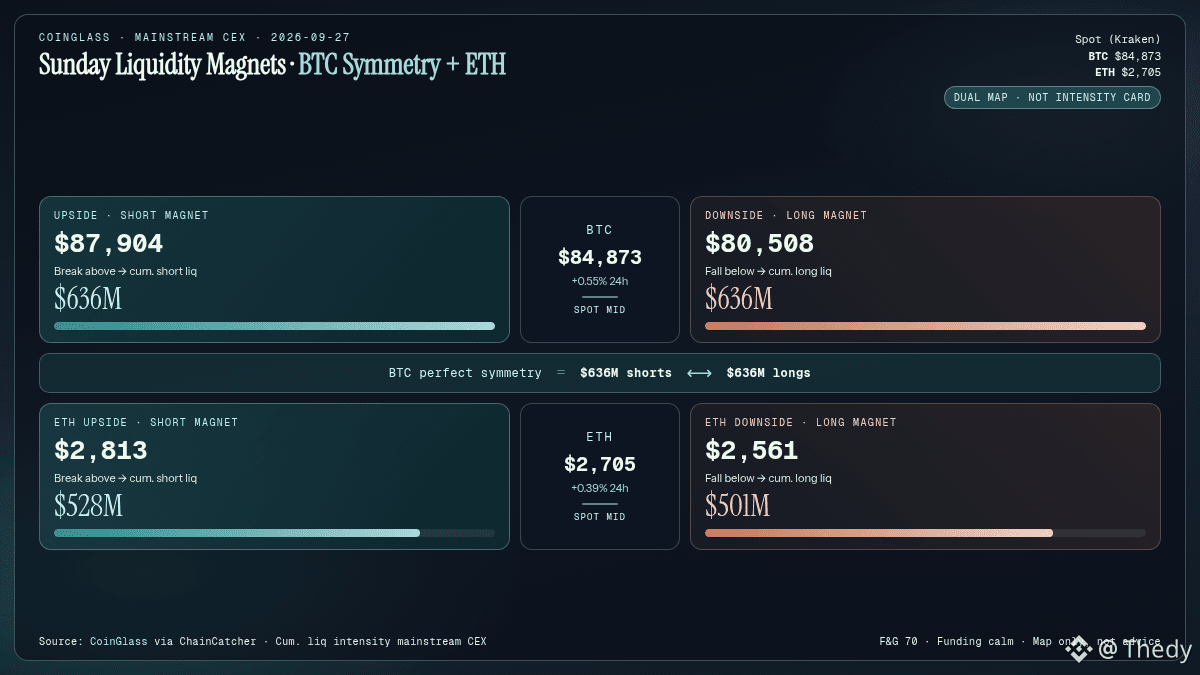
Mapa de imanes de liquidaciones CEX este domingo: $BTC en simetría perfecta, $ETH en espejo cercano.
HECHOS (CoinGlass vía ChainCatcher, lectura 27/09 ~12:00 UTC):
• $BTC : ruptura por encima de 87 904 $ → intensidad acumulada de liquidaciones short en CEX mainstream ≈ 636 M$. Caída por debajo de 80 508 $ → liquidaciones long acumuladas ≈ 636 M$. Misma cifra en ambos lados.
• $ETH (compañera, misma ventana): ruptura por encima de 2 813 $ → shorts ≈ 528 M$. Caída por debajo de 2 561 $ → longs ≈ 501 M$.
• Spot (Kraken, ~13:54 UTC): BTC ≈ 84 873 $ (+0,55%) · ETH ≈ 2 705 $ (+0,39%). Funding OKX en calma (BTC ≈ −0,0011% / ETH ≈ +0,0084%). F&G 70 (Greed).
INTERPRETACIÓN:
Esto no es un mapa de intensidad local alrededor del spot. Es un mapa de imanes más lejos: zonas donde el apalancamiento agregado se densifica si el precio llega allí. En BTC, la simetría 636/636 dice que el colchón alcista y bajista está equilibrado en nocional, no que la ruptura esté “garantizada”. En ETH, el upside y el downside se mantienen cercanos (~528 vs ~501), con un ligero sesgo nocional hacia los shorts si se rompe 2 813 $.
ESCENARIOS:
• BTC mantiene la banda 80,5k–87,9k: los imanes permanecen latentes, enfoque en el rango y en el funding.
• BTC rompe 87 904 $ con volumen: el cluster short de 636 M$ se convierte en el primer imán a vigilar (no es un objetivo de trading).
• BTC pierde 80 508 $: el cluster long de 636 M$ toma el relevo en el downside.
• ETH: ruptura de 2 813 $ → imán short ~528 M$; pérdida de 2 561 $ → imán long ~501 M$.
• Invalidación de la lectura “simetría”: si CoinGlass actualiza los niveles y la brecha short/long en BTC se abre de forma clara.
$BTC $ETH
¿La simetría BTC 636/636 te parece más un rango durable, o un simple equilibrio temporal antes de que llegue un imán?
#Bitcoin #Ethereum #Liquidations
Mapa de imanes de liquidaciones CEX este domingo: $BTC en simetría perfecta, $ETH en espejo cercano.
HECHOS (CoinGlass vía ChainCatcher, lectura 27/09 ~12:00 UTC):
• $BTC : ruptura por encima de 87 904 $ → intensidad acumulada de liquidaciones short en CEX mainstream ≈ 636 M$. Caída por debajo de 80 508 $ → liquidaciones long acumuladas ≈ 636 M$. Misma cifra en ambos lados.
• $ETH (compañera, misma ventana): ruptura por encima de 2 813 $ → shorts ≈ 528 M$. Caída por debajo de 2 561 $ → longs ≈ 501 M$.
• Spot (Kraken, ~13:54 UTC): BTC ≈ 84 873 $ (+0,55%) · ETH ≈ 2 705 $ (+0,39%). Funding OKX en calma (BTC ≈ −0,0011% / ETH ≈ +0,0084%). F&G 70 (Greed).
INTERPRETACIÓN:
Esto no es un mapa de intensidad local alrededor del spot. Es un mapa de imanes más lejos: zonas donde el apalancamiento agregado se densifica si el precio llega allí. En BTC, la simetría 636/636 dice que el colchón alcista y bajista está equilibrado en nocional, no que la ruptura esté “garantizada”. En ETH, el upside y el downside se mantienen cercanos (~528 vs ~501), con un ligero sesgo nocional hacia los shorts si se rompe 2 813 $.
ESCENARIOS:
• BTC mantiene la banda 80,5k–87,9k: los imanes permanecen latentes, enfoque en el rango y en el funding.
• BTC rompe 87 904 $ con volumen: el cluster short de 636 M$ se convierte en el primer imán a vigilar (no es un objetivo de trading).
• BTC pierde 80 508 $: el cluster long de 636 M$ toma el relevo en el downside.
• ETH: ruptura de 2 813 $ → imán short ~528 M$; pérdida de 2 561 $ → imán long ~501 M$.
• Invalidación de la lectura “simetría”: si CoinGlass actualiza los niveles y la brecha short/long en BTC se abre de forma clara.
$BTC $ETH
¿La simetría BTC 636/636 te parece más un rango durable, o un simple equilibrio temporal antes de que llegue un imán?
#Bitcoin #Ethereum #Liquidations
HECHOS (CoinGlass vía ChainCatcher, lectura 27/09 ~12:00 UTC):
• $BTC : ruptura por encima de 87 904 $ → intensidad acumulada de liquidaciones short en CEX mainstream ≈ 636 M$. Caída por debajo de 80 508 $ → liquidaciones long acumuladas ≈ 636 M$. Misma cifra en ambos lados.
• $ETH (compañera, misma ventana): ruptura por encima de 2 813 $ → shorts ≈ 528 M$. Caída por debajo de 2 561 $ → longs ≈ 501 M$.
• Spot (Kraken, ~13:54 UTC): BTC ≈ 84 873 $ (+0,55%) · ETH ≈ 2 705 $ (+0,39%). Funding OKX en calma (BTC ≈ −0,0011% / ETH ≈ +0,0084%). F&G 70 (Greed).
INTERPRETACIÓN:
Esto no es un mapa de intensidad local alrededor del spot. Es un mapa de imanes más lejos: zonas donde el apalancamiento agregado se densifica si el precio llega allí. En BTC, la simetría 636/636 dice que el colchón alcista y bajista está equilibrado en nocional, no que la ruptura esté “garantizada”. En ETH, el upside y el downside se mantienen cercanos (~528 vs ~501), con un ligero sesgo nocional hacia los shorts si se rompe 2 813 $.
ESCENARIOS:
• BTC mantiene la banda 80,5k–87,9k: los imanes permanecen latentes, enfoque en el rango y en el funding.
• BTC rompe 87 904 $ con volumen: el cluster short de 636 M$ se convierte en el primer imán a vigilar (no es un objetivo de trading).
• BTC pierde 80 508 $: el cluster long de 636 M$ toma el relevo en el downside.
• ETH: ruptura de 2 813 $ → imán short ~528 M$; pérdida de 2 561 $ → imán long ~501 M$.
• Invalidación de la lectura “simetría”: si CoinGlass actualiza los niveles y la brecha short/long en BTC se abre de forma clara.
$BTC $ETH
¿La simetría BTC 636/636 te parece más un rango durable, o un simple equilibrio temporal antes de que llegue un imán?
#Bitcoin #Ethereum #Liquidations
80


·
--
Bajista
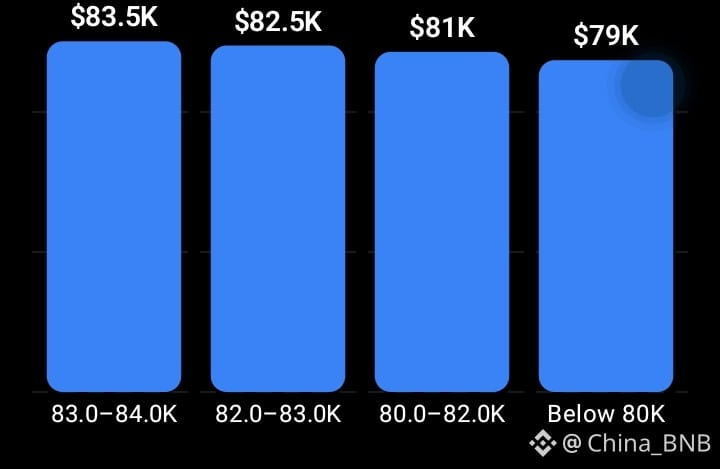
🔻 Mapa de liquidación de Long de BTC — Por debajo de $84K
Los datos actuales del mercado muestran que la liquidez clave se encuentra por debajo de $84K, con las áreas más importantes:
🔴 $82.0K–$83.0K — primera zona de liquidación
🔴 $80.0K–$82.0K — zona principal de liquidación
⚠️ Por debajo de $80K — riesgo de liquidación más profundo
🎯 Nivel técnico clave: ~ $81.4K
🚨 Zona de ruptura principal: ~ $81K
Los datos recientes reportaron aproximadamente $1.3B de liquidez potencial para liquidaciones entre $80K–$83K, mientras que el soporte técnico inmediato de BTC está alrededor de $83.8K.
Lectura a corto plazo: Si BTC pierde $83.8K, el siguiente nivel a vigilar es $82K–$83K. Una ruptura sostenida hacia $81K podría exponer el bolsillo de liquidación más grande de $80K–$82K. Un movimiento por debajo de $84K ya ha producido liquidaciones long significativas en las sesiones recientes, incluyendo alrededor de $280M en cuatro horas el 23 de sep.
Estas son zonas de liquidez, no precios exactos de liquidación; los niveles exactos varían según el exchange y el apalancamiento. �
coinmarketcap
#bitcoin #Liquidations #btc70k $BTC
🔻 Mapa de liquidación de Long de BTC — Por debajo de $84K
Los datos actuales del mercado muestran que la liquidez clave se encuentra por debajo de $84K, con las áreas más importantes:
🔴 $82.0K–$83.0K — primera zona de liquidación
🔴 $80.0K–$82.0K — zona principal de liquidación
⚠️ Por debajo de $80K — riesgo de liquidación más profundo
🎯 Nivel técnico clave: ~ $81.4K
🚨 Zona de ruptura principal: ~ $81K
Los datos recientes reportaron aproximadamente $1.3B de liquidez potencial para liquidaciones entre $80K–$83K, mientras que el soporte técnico inmediato de BTC está alrededor de $83.8K.
Lectura a corto plazo: Si BTC pierde $83.8K, el siguiente nivel a vigilar es $82K–$83K. Una ruptura sostenida hacia $81K podría exponer el bolsillo de liquidación más grande de $80K–$82K. Un movimiento por debajo de $84K ya ha producido liquidaciones long significativas en las sesiones recientes, incluyendo alrededor de $280M en cuatro horas el 23 de sep.
Estas son zonas de liquidez, no precios exactos de liquidación; los niveles exactos varían según el exchange y el apalancamiento. �
coinmarketcap
#bitcoin #Liquidations #btc70k $BTC
Los datos actuales del mercado muestran que la liquidez clave se encuentra por debajo de $84K, con las áreas más importantes:
🔴 $82.0K–$83.0K — primera zona de liquidación
🔴 $80.0K–$82.0K — zona principal de liquidación
⚠️ Por debajo de $80K — riesgo de liquidación más profundo
🎯 Nivel técnico clave: ~ $81.4K
🚨 Zona de ruptura principal: ~ $81K
Los datos recientes reportaron aproximadamente $1.3B de liquidez potencial para liquidaciones entre $80K–$83K, mientras que el soporte técnico inmediato de BTC está alrededor de $83.8K.
Lectura a corto plazo: Si BTC pierde $83.8K, el siguiente nivel a vigilar es $82K–$83K. Una ruptura sostenida hacia $81K podría exponer el bolsillo de liquidación más grande de $80K–$82K. Un movimiento por debajo de $84K ya ha producido liquidaciones long significativas en las sesiones recientes, incluyendo alrededor de $280M en cuatro horas el 23 de sep.
Estas son zonas de liquidez, no precios exactos de liquidación; los niveles exactos varían según el exchange y el apalancamiento. �
coinmarketcap
#bitcoin #Liquidations #btc70k $BTC
2
220

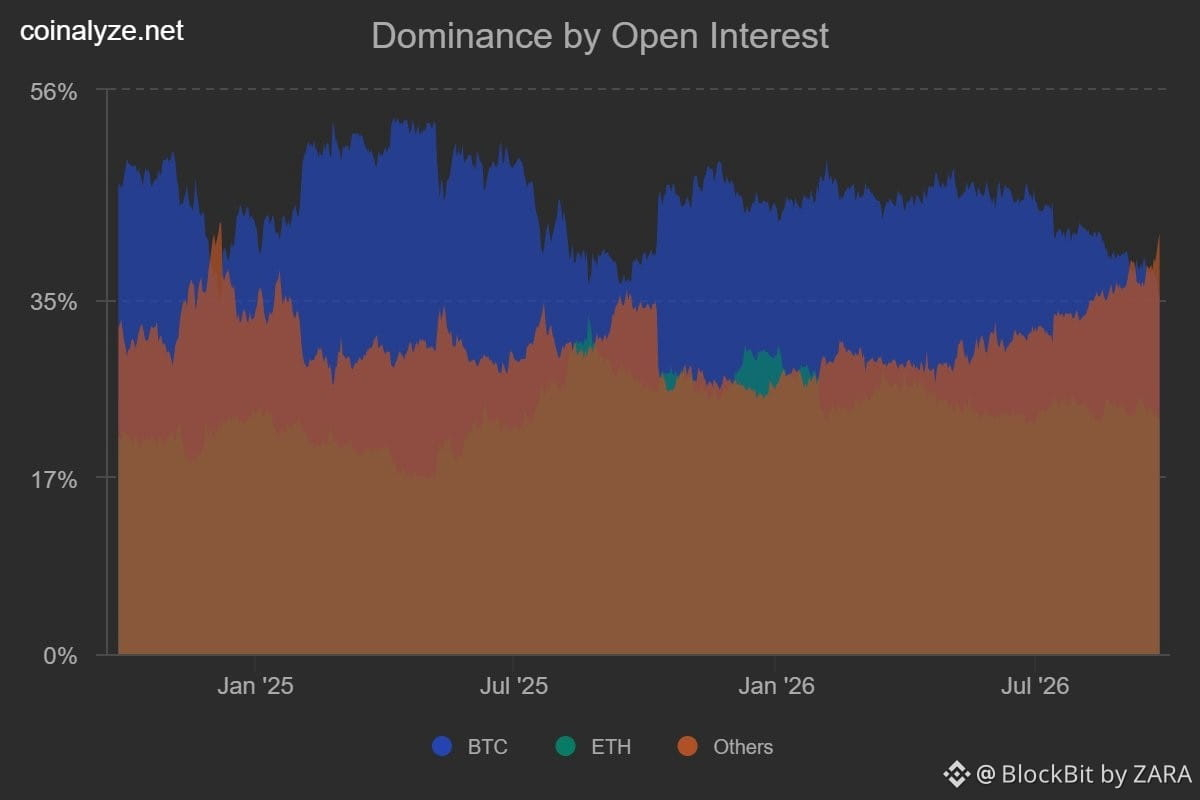
🚨 ¿El apalancamiento en altcoins se está poniendo DEMASIADO caliente?
Las altcoins ahora tienen más interés abierto de futuros perpetuos que Bitcoin, un escenario no visto desde finales de 2024.
Eso significa que los traders están acumulando apalancamiento en las alts
Más apalancamiento = mayor potencial alcista si el impulso continúa
Pero también liquidaciones más grandes si el mercado se da la vuelta
Entonces, ¿este es el inicio del altseason...
o los traders se están poniendo demasiado eufóricos? 👀
¿Qué piensas: ALTSEASON o LIQUIDACIÓN?
#altcoins #BTC #Liquidations #StrategyStriveAdd2305BitcoinThisWeek
🚨 ¿El apalancamiento en altcoins se está poniendo DEMASIADO caliente?
Las altcoins ahora tienen más interés abierto de futuros perpetuos que Bitcoin, un escenario no visto desde finales de 2024.
Eso significa que los traders están acumulando apalancamiento en las alts
Más apalancamiento = mayor potencial alcista si el impulso continúa
Pero también liquidaciones más grandes si el mercado se da la vuelta
Entonces, ¿este es el inicio del altseason...
o los traders se están poniendo demasiado eufóricos? 👀
¿Qué piensas: ALTSEASON o LIQUIDACIÓN?
#altcoins #BTC #Liquidations #StrategyStriveAdd2305BitcoinThisWeek
Las altcoins ahora tienen más interés abierto de futuros perpetuos que Bitcoin, un escenario no visto desde finales de 2024.
Eso significa que los traders están acumulando apalancamiento en las alts
Más apalancamiento = mayor potencial alcista si el impulso continúa
Pero también liquidaciones más grandes si el mercado se da la vuelta
Entonces, ¿este es el inicio del altseason...
o los traders se están poniendo demasiado eufóricos? 👀
¿Qué piensas: ALTSEASON o LIQUIDACIÓN?
#altcoins #BTC #Liquidations #StrategyStriveAdd2305BitcoinThisWeek
47
·
--
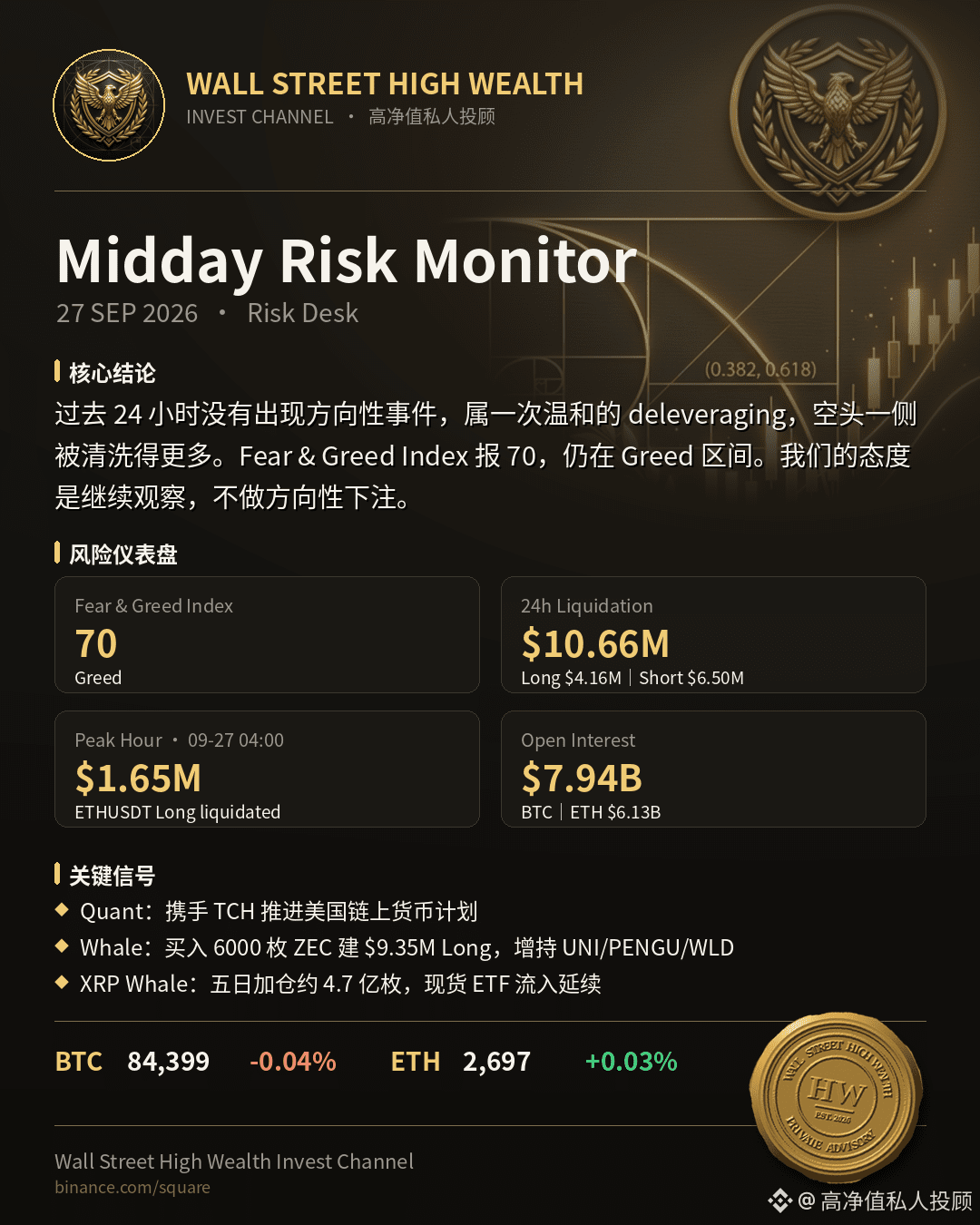
◆ Monitor de Riesgo al Mediodía · 09/27
Bonjour. Bienvenido al Canal de Wall Street High Wealth Invest.
午安。
【Conclusión central】
En las últimas 24 horas no se han presentado eventos con dirección, lo que corresponde a un deleveraging moderado; se ha limpiado más al lado de los cortos. El Índice Fear & Greed marca 70, aún dentro de la zona de Greed. Nuestra postura es continuar observando y no hacer apuestas direccionales.
【Panel de riesgos】
· Índice Fear & Greed: 70 (Greed)
· Liquidación 24h: 10,66 millones de USD | Long 4,16 | Short 6,50
· Momento pico: 09-27 04:00; Long en ETHUSDT liquidado por 1,65 millones
· Open Interest: BTC 7,94 mil millones USD | ETH 6,13 mil millones USD
【Clasificación de liquidaciones】
· Quant en colaboración con el exchange estadounidense TCH impulsa el plan de monedas on-chain en EE. UU.
· Un gran tiburón compró 6.000 ZEC para construir una posición Long de 9,35 millones de USD y aumentó UNI, PENGU y WLD
· Un gran tiburón estableció aproximadamente en 15 minutos una Long de 9,35 millones de USD en ZEC
Nuestra clasificación: esto es el “barrido” del mercado, no una reversión de tendencia. Los cortos se liquidaron por 6,50 millones USD y los largos por 4,16 millones USD; los cortos quedaron más limpiados. La franja más concentrada ocurrió en la hora de ETHUSDT: Long 1,65 millones contra Short 0,11 millones, lo que indica que ambos lados tienen apalancamiento abarrotado; se produce un impulso brusco y un recorte rápido que barre ambos. Un gran tiburón construyó 9,35 millones de USD en longs de ZEC en 15 minutos: solo es una muestra de saturación, no una señal a seguir. Los datos de liquidación muestran el nivel de apalancamiento abarrotado, no la dirección.
【On-chain y Meme】
· XRP: gran tiburón aumenta alrededor de 470 millones de tokens en cinco días; continúan las entradas al ETF spot
· Shiba Inu: la tasa diaria de quema se dispara 657%; 15,16 millones de SHIB enviados a una dirección “black hole”
· Una dirección acumuló en las últimas tres semanas ETH por 24,34 millones de USD y propuso un precio promedio de 2.658 USD
Nuestra clasificación: los movimientos del Meme y las anomalías on-chain son un termómetro de la emoción, no una oportunidad de asignación. Los grandes tiburones de XRP aumentaron cerca de 470 millones en cinco días y se mantiene la entrada al ETF spot; la tasa de quema de SHIB se incrementó 657% en un día y 15,16 millones de tokens entraron al “black hole”. Llega rápido y se va igual de rápido. Esa dirección acumuló en cerca de tres semanas ETH por 24,34 millones de USD y propuso un precio promedio de 2.658 USD: las fichas están pasando de dinero de corto plazo a tenedores con un costo más bajo.
【Vinculación macro】
Macro Linkage: el rendimiento del Tesoro a 10 años sube hasta 5,184%; suma 2,2 puntos básicos en un día. El DXY cotiza en 101,0; en el último mes +1,83%. Tasas y dólar se aprietan a la vez: es el resultado de que la Fed mantenga la disciplina. No tenemos objeciones al camino “hawkish”. El alza construida por expectativas de “volcar liquidez” tarde o temprano tiene que devolverse. BTC marca 84.399; en 24 horas -0,04%. Con el trasfondo de doble apretón (rendimientos y dólar) se mantiene lateral; es una digestión razonable, no una reversión de tendencia.
【Sugerencia de posicionamiento】
Positioning: Fear & Greed Index en 70. No conviene aumentar el apalancamiento al abrir nuevas posiciones; para las posiciones existentes, suba el Stop Loss y deje margen de amortiguación. BTCUSDT Open Interest: 7,94 mil millones USD; ETHUSDT: 6,13 mil millones USD: la saturación no es baja, así que el posicionamiento debería ser ligero. Preferimos conservar efectivo y esperar a que la Consolidation ofrezca una asimetría mejor.
$BTC #BTC #Liquidations
Tu asesor privado en Wall Street.
Bon après-midi.
◆ Monitor de Riesgo al Mediodía · 09/27
Bonjour. Bienvenido al Canal de Wall Street High Wealth Invest.
午安。
【Conclusión central】
En las últimas 24 horas no se han presentado eventos con dirección, lo que corresponde a un deleveraging moderado; se ha limpiado más al lado de los cortos. El Índice Fear & Greed marca 70, aún dentro de la zona de Greed. Nuestra postura es continuar observando y no hacer apuestas direccionales.
【Panel de riesgos】
· Índice Fear & Greed: 70 (Greed)
· Liquidación 24h: 10,66 millones de USD | Long 4,16 | Short 6,50
· Momento pico: 09-27 04:00; Long en ETHUSDT liquidado por 1,65 millones
· Open Interest: BTC 7,94 mil millones USD | ETH 6,13 mil millones USD
【Clasificación de liquidaciones】
· Quant en colaboración con el exchange estadounidense TCH impulsa el plan de monedas on-chain en EE. UU.
· Un gran tiburón compró 6.000 ZEC para construir una posición Long de 9,35 millones de USD y aumentó UNI, PENGU y WLD
· Un gran tiburón estableció aproximadamente en 15 minutos una Long de 9,35 millones de USD en ZEC
Nuestra clasificación: esto es el “barrido” del mercado, no una reversión de tendencia. Los cortos se liquidaron por 6,50 millones USD y los largos por 4,16 millones USD; los cortos quedaron más limpiados. La franja más concentrada ocurrió en la hora de ETHUSDT: Long 1,65 millones contra Short 0,11 millones, lo que indica que ambos lados tienen apalancamiento abarrotado; se produce un impulso brusco y un recorte rápido que barre ambos. Un gran tiburón construyó 9,35 millones de USD en longs de ZEC en 15 minutos: solo es una muestra de saturación, no una señal a seguir. Los datos de liquidación muestran el nivel de apalancamiento abarrotado, no la dirección.
【On-chain y Meme】
· XRP: gran tiburón aumenta alrededor de 470 millones de tokens en cinco días; continúan las entradas al ETF spot
· Shiba Inu: la tasa diaria de quema se dispara 657%; 15,16 millones de SHIB enviados a una dirección “black hole”
· Una dirección acumuló en las últimas tres semanas ETH por 24,34 millones de USD y propuso un precio promedio de 2.658 USD
Nuestra clasificación: los movimientos del Meme y las anomalías on-chain son un termómetro de la emoción, no una oportunidad de asignación. Los grandes tiburones de XRP aumentaron cerca de 470 millones en cinco días y se mantiene la entrada al ETF spot; la tasa de quema de SHIB se incrementó 657% en un día y 15,16 millones de tokens entraron al “black hole”. Llega rápido y se va igual de rápido. Esa dirección acumuló en cerca de tres semanas ETH por 24,34 millones de USD y propuso un precio promedio de 2.658 USD: las fichas están pasando de dinero de corto plazo a tenedores con un costo más bajo.
【Vinculación macro】
Macro Linkage: el rendimiento del Tesoro a 10 años sube hasta 5,184%; suma 2,2 puntos básicos en un día. El DXY cotiza en 101,0; en el último mes +1,83%. Tasas y dólar se aprietan a la vez: es el resultado de que la Fed mantenga la disciplina. No tenemos objeciones al camino “hawkish”. El alza construida por expectativas de “volcar liquidez” tarde o temprano tiene que devolverse. BTC marca 84.399; en 24 horas -0,04%. Con el trasfondo de doble apretón (rendimientos y dólar) se mantiene lateral; es una digestión razonable, no una reversión de tendencia.
【Sugerencia de posicionamiento】
Positioning: Fear & Greed Index en 70. No conviene aumentar el apalancamiento al abrir nuevas posiciones; para las posiciones existentes, suba el Stop Loss y deje margen de amortiguación. BTCUSDT Open Interest: 7,94 mil millones USD; ETHUSDT: 6,13 mil millones USD: la saturación no es baja, así que el posicionamiento debería ser ligero. Preferimos conservar efectivo y esperar a que la Consolidation ofrezca una asimetría mejor.
$BTC #BTC #Liquidations
Tu asesor privado en Wall Street.
Bon après-midi.
Bonjour. Bienvenido al Canal de Wall Street High Wealth Invest.
午安。
【Conclusión central】
En las últimas 24 horas no se han presentado eventos con dirección, lo que corresponde a un deleveraging moderado; se ha limpiado más al lado de los cortos. El Índice Fear & Greed marca 70, aún dentro de la zona de Greed. Nuestra postura es continuar observando y no hacer apuestas direccionales.
【Panel de riesgos】
· Índice Fear & Greed: 70 (Greed)
· Liquidación 24h: 10,66 millones de USD | Long 4,16 | Short 6,50
· Momento pico: 09-27 04:00; Long en ETHUSDT liquidado por 1,65 millones
· Open Interest: BTC 7,94 mil millones USD | ETH 6,13 mil millones USD
【Clasificación de liquidaciones】
· Quant en colaboración con el exchange estadounidense TCH impulsa el plan de monedas on-chain en EE. UU.
· Un gran tiburón compró 6.000 ZEC para construir una posición Long de 9,35 millones de USD y aumentó UNI, PENGU y WLD
· Un gran tiburón estableció aproximadamente en 15 minutos una Long de 9,35 millones de USD en ZEC
Nuestra clasificación: esto es el “barrido” del mercado, no una reversión de tendencia. Los cortos se liquidaron por 6,50 millones USD y los largos por 4,16 millones USD; los cortos quedaron más limpiados. La franja más concentrada ocurrió en la hora de ETHUSDT: Long 1,65 millones contra Short 0,11 millones, lo que indica que ambos lados tienen apalancamiento abarrotado; se produce un impulso brusco y un recorte rápido que barre ambos. Un gran tiburón construyó 9,35 millones de USD en longs de ZEC en 15 minutos: solo es una muestra de saturación, no una señal a seguir. Los datos de liquidación muestran el nivel de apalancamiento abarrotado, no la dirección.
【On-chain y Meme】
· XRP: gran tiburón aumenta alrededor de 470 millones de tokens en cinco días; continúan las entradas al ETF spot
· Shiba Inu: la tasa diaria de quema se dispara 657%; 15,16 millones de SHIB enviados a una dirección “black hole”
· Una dirección acumuló en las últimas tres semanas ETH por 24,34 millones de USD y propuso un precio promedio de 2.658 USD
Nuestra clasificación: los movimientos del Meme y las anomalías on-chain son un termómetro de la emoción, no una oportunidad de asignación. Los grandes tiburones de XRP aumentaron cerca de 470 millones en cinco días y se mantiene la entrada al ETF spot; la tasa de quema de SHIB se incrementó 657% en un día y 15,16 millones de tokens entraron al “black hole”. Llega rápido y se va igual de rápido. Esa dirección acumuló en cerca de tres semanas ETH por 24,34 millones de USD y propuso un precio promedio de 2.658 USD: las fichas están pasando de dinero de corto plazo a tenedores con un costo más bajo.
【Vinculación macro】
Macro Linkage: el rendimiento del Tesoro a 10 años sube hasta 5,184%; suma 2,2 puntos básicos en un día. El DXY cotiza en 101,0; en el último mes +1,83%. Tasas y dólar se aprietan a la vez: es el resultado de que la Fed mantenga la disciplina. No tenemos objeciones al camino “hawkish”. El alza construida por expectativas de “volcar liquidez” tarde o temprano tiene que devolverse. BTC marca 84.399; en 24 horas -0,04%. Con el trasfondo de doble apretón (rendimientos y dólar) se mantiene lateral; es una digestión razonable, no una reversión de tendencia.
【Sugerencia de posicionamiento】
Positioning: Fear & Greed Index en 70. No conviene aumentar el apalancamiento al abrir nuevas posiciones; para las posiciones existentes, suba el Stop Loss y deje margen de amortiguación. BTCUSDT Open Interest: 7,94 mil millones USD; ETHUSDT: 6,13 mil millones USD: la saturación no es baja, así que el posicionamiento debería ser ligero. Preferimos conservar efectivo y esperar a que la Consolidation ofrezca una asimetría mejor.
$BTC #BTC #Liquidations
Tu asesor privado en Wall Street.
Bon après-midi.
81

$BTC
{future}(BTCUSDT)
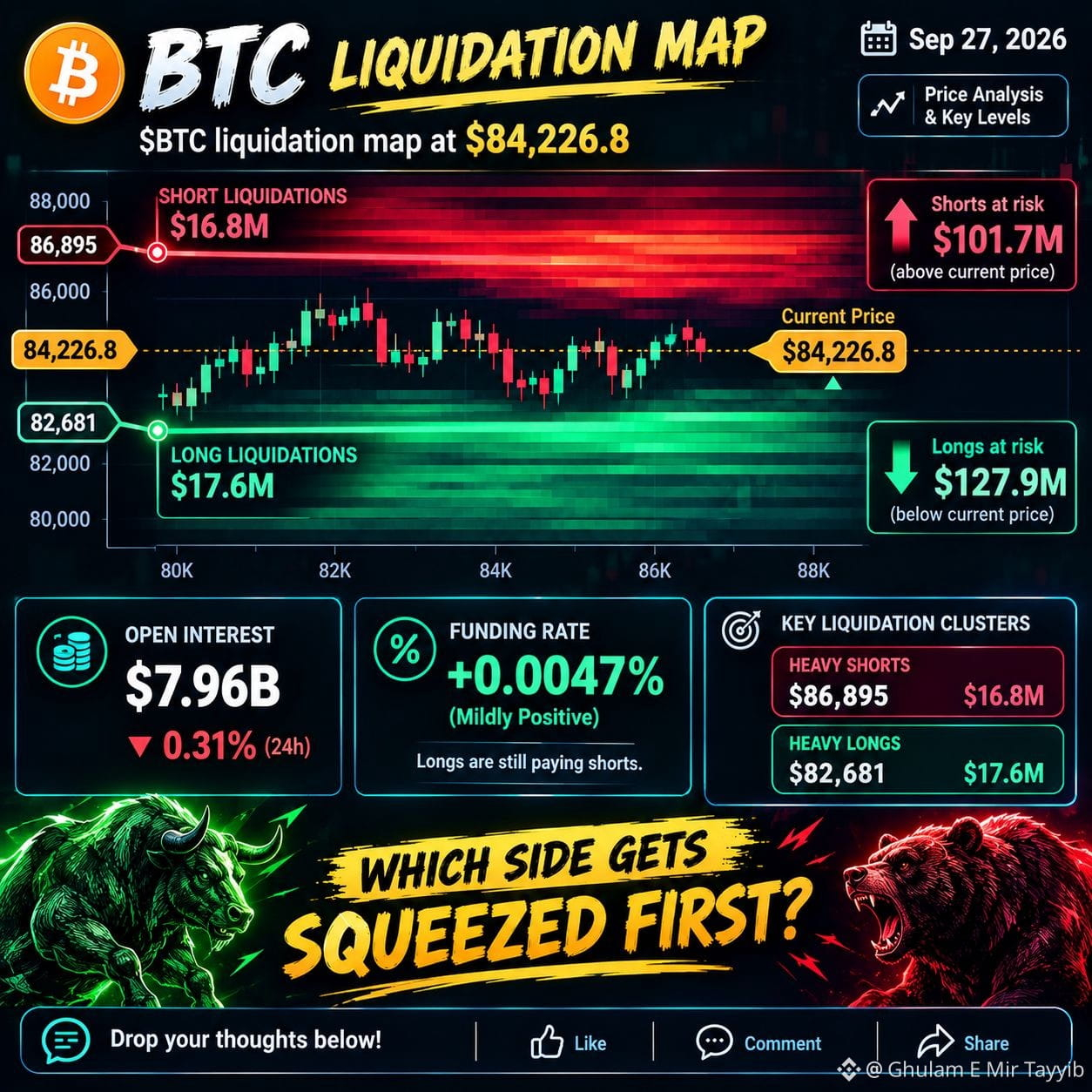
el mapa de liquidación en 84,226.8 muestra 127.9M en posiciones largas en riesgo por debajo del precio actual frente a 101.7M en cortas por encima — una zona de squeeze ligeramente más pesada para los largos.
El interés abierto se sitúa en 7.96B (-0.31% en 24 h), con la tasa de financiación ligeramente positiva en +0.0047%: los largos siguen pagando a las cortas. El principal clúster de liquidaciones de cortos se encuentra cerca de 86,895 (16.8M), mientras que los pesados cierres de largos se agrupan alrededor de 82,681 (17.6M).
¿Qué lado se comprime primero? 👇
#BTC #Liquidations
$BTC
el mapa de liquidación en 84,226.8 muestra 127.9M en posiciones largas en riesgo por debajo del precio actual frente a 101.7M en cortas por encima — una zona de squeeze ligeramente más pesada para los largos.
El interés abierto se sitúa en 7.96B (-0.31% en 24 h), con la tasa de financiación ligeramente positiva en +0.0047%: los largos siguen pagando a las cortas. El principal clúster de liquidaciones de cortos se encuentra cerca de 86,895 (16.8M), mientras que los pesados cierres de largos se agrupan alrededor de 82,681 (17.6M).
¿Qué lado se comprime primero? 👇
#BTC #Liquidations
el mapa de liquidación en 84,226.8 muestra 127.9M en posiciones largas en riesgo por debajo del precio actual frente a 101.7M en cortas por encima — una zona de squeeze ligeramente más pesada para los largos.
El interés abierto se sitúa en 7.96B (-0.31% en 24 h), con la tasa de financiación ligeramente positiva en +0.0047%: los largos siguen pagando a las cortas. El principal clúster de liquidaciones de cortos se encuentra cerca de 86,895 (16.8M), mientras que los pesados cierres de largos se agrupan alrededor de 82,681 (17.6M).
¿Qué lado se comprime primero? 👇
#BTC #Liquidations
1
56

·
--
Bajista
¡Los MUBARAK longs siguen siendo apretados sin parar! 🩸 Liquidaciones continuas mientras el precio rompe nuevos mínimos locales. ¡Los bajistas no están mostrando piedad en este momento! 😱
$MUBARAK
{future}(MUBARAKUSDT)
🔴 ZONA DE LIQUIDEZ ALCANZADA 🔴
Long liquidación detectada 🧨
$4.67K eliminados a $0.0587
La liquidez a la baja fue barrida: presión de liquidación intensa en aumento. Procede con extrema precaución 👀
🎯 Objetivos: $0.0560, $0.0535
#MUBARAK #Crypto #Liquidations
¡Los MUBARAK longs siguen siendo apretados sin parar! 🩸 Liquidaciones continuas mientras el precio rompe nuevos mínimos locales. ¡Los bajistas no están mostrando piedad en este momento! 😱
$MUBARAK
🔴 ZONA DE LIQUIDEZ ALCANZADA 🔴
Long liquidación detectada 🧨
$4.67K eliminados a $0.0587
La liquidez a la baja fue barrida: presión de liquidación intensa en aumento. Procede con extrema precaución 👀
🎯 Objetivos: $0.0560, $0.0535
#MUBARAK #Crypto #Liquidations
$MUBARAK
🔴 ZONA DE LIQUIDEZ ALCANZADA 🔴
Long liquidación detectada 🧨
$4.67K eliminados a $0.0587
La liquidez a la baja fue barrida: presión de liquidación intensa en aumento. Procede con extrema precaución 👀
🎯 Objetivos: $0.0560, $0.0535
#MUBARAK #Crypto #Liquidations
119
·
--
Bajista
¡Los largos sobreapalancados acaban de ser completamente aniquilados en MUBARAK! 🤦♂️ El libro de órdenes está sangrando rojo mientras las ballenas siguen empujando el suelo hacia abajo. ¡No intentes atrapar este cuchillo cayendo a menos que disfrutes que te corten las manos! 🔥
$MUBARAK
{future}(MUBARAKUSDT)
🔴 ZONA DE LIQUIDEZ IMPACTADA 🔴
Liquidación de largos detectada 🧨
Se limpiaron $5.05K a $0.0592
La liquidez a la baja fue barrida — Si el soporte no aguanta aquí, espera una caída rápida hacia la siguiente zona de demanda 👀
🎯 Objetivos: $0.0570, $0.0545
#MUBARAK #Crypto #Liquidations
¡Los largos sobreapalancados acaban de ser completamente aniquilados en MUBARAK! 🤦♂️ El libro de órdenes está sangrando rojo mientras las ballenas siguen empujando el suelo hacia abajo. ¡No intentes atrapar este cuchillo cayendo a menos que disfrutes que te corten las manos! 🔥
$MUBARAK
🔴 ZONA DE LIQUIDEZ IMPACTADA 🔴
Liquidación de largos detectada 🧨
Se limpiaron $5.05K a $0.0592
La liquidez a la baja fue barrida — Si el soporte no aguanta aquí, espera una caída rápida hacia la siguiente zona de demanda 👀
🎯 Objetivos: $0.0570, $0.0545
#MUBARAK #Crypto #Liquidations
$MUBARAK
🔴 ZONA DE LIQUIDEZ IMPACTADA 🔴
Liquidación de largos detectada 🧨
Se limpiaron $5.05K a $0.0592
La liquidez a la baja fue barrida — Si el soporte no aguanta aquí, espera una caída rápida hacia la siguiente zona de demanda 👀
🎯 Objetivos: $0.0570, $0.0545
#MUBARAK #Crypto #Liquidations
157
·
--
◆ Monitor de Riesgo al Mediodía · 09/26
Bonjour. Bienvenido al Canal de Wall Street High Wealth Invest Channel.
午安。
【Conclusión clave】
En las últimas 24 horas, la naturaleza del riesgo fue una consolidación en la zona alta con doble shakeout, con liquidaciones tanto en el lado de largos como en el de cortos; el sentimiento se mantiene en el rango de Greed. Nuestra postura es: no perseguir, no entrar en pánico y ejecutar según el marco establecido.
【Panel de control de riesgos】
· Fear & Greed Index: 74 (Greed)
· Liquidación 24h: 49,18 millones de USD | Long 25,93 millones | Short 23,24 millones
· Ventana de mayor pico: 09-25 22:00, se liquidó Long de BTCUSDT por 5,51 millones
· Open Interest: BTC 7,96 mil millones de USD | ETH 6,08 mil millones de USD
【Clasificación de liquidaciones】
· El gran cliente MK4 en Hyperliquid mantiene NEAR con ganancia flotante de casi 16 millones de USD
· “麻吉” sigue aumentando posiciones largas; su cuenta registra una ganancia flotante de 86.000 USD
· Algún “mega tiburón” aumentó su Long de BTC hasta 98,15 millones de USD; el tamaño de la posición asciende hasta el tercer lugar en Hyperliquid
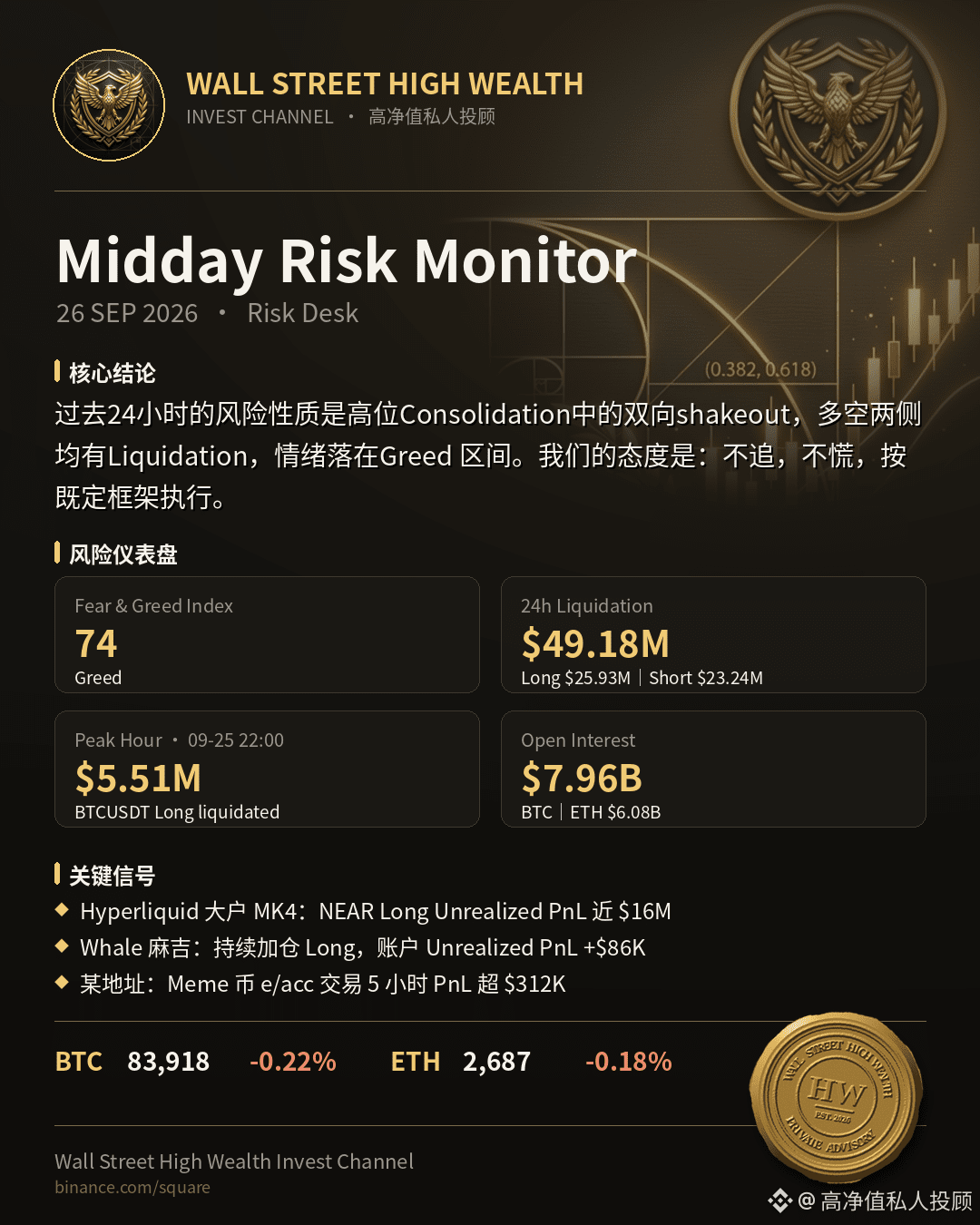
Nuestra clasificación: esto es un típico “barrido con cuchilla”. A las 09-25 22:00, en una hora se liquidaron Largos de BTCUSDT por 5,51 millones y Cortos por 1,11 millones. En total en 24 horas: Largos 25,93 millones vs Cortos 23,24 millones. Los largos recibieron el golpe con más fuerza, lo que indica que el apalancamiento sigue abarrotado del lado Long. En Hyperliquid, la ganancia flotante de los Largos de NEAR de MK4 ronda los 16 millones; “麻吉” sigue comprando; y algún Whale subió el Long de BTC hasta 98,15 millones y lo colocó como el tercero en la plataforma. Estos son muestras de congestión y sentimiento, no señales para seguir. Los datos de liquidación solo indican la distribución del apalancamiento, no señalan dirección.
【En la cadena y Meme】
· Una dirección opera el meme e/acc; en 5 horas gana más de 312.000 USD
· BP rompe por encima de 1,42 USD y vuelve a marcar máximo histórico; el impulso positivo de acciones tokenizadas en la cadena sigue intensificándose
· Un monedero recién creado transfiere 428.640 unidades de HYPE desde varias plataformas; valor aproximado de 39,23 millones de USD
Nuestra clasificación: el desbordamiento de liquidez en Meme y en la cadena llega rápido y se va igual de rápido. El trade de e/acc de una dirección en 5 horas obtuvo más de 312.000 USD, lo cual es una lectura de temperatura del sentimiento, no una oportunidad para asignar capital. BP al romper 1,42 USD y continuar con máximos sugiere un relato de “acciones tokenizadas”; la continuidad de estos temas depende del capital real, no solo del relato. El nuevo monedero extrae 428.640 HYPE (aprox. 39,23 millones de USD) desde múltiples plataformas: las fichas pasan de la plataforma de trading a una dirección de autocustodia, normalmente asociado a una intención de tenencia más larga. Vale la pena registrarlo, pero una sola dirección no basta para sustentar un veredicto.
【Vinculación macro】
Macro Linkage es la línea principal de este ciclo de riesgos cripto. El rendimiento del Treasury a 10 años sube a 5,184%, sumando 2,2 puntos básicos en un día; el DXY está en 101,0. La postura Hawkish de la Fed es clara: exige mantener una política monetaria restrictiva para reducir la inflación. En este contexto de tasas, BTC cotiza en 83.918 (24h -0,22%), ETH en 2.687 (24h -0,18%); desde julio aún acumula una subida del 45%, lo que indica que parte del alza previa se sustentó en expectativas de recorte de tasas; esa parte, tarde o temprano, tendrá que “pagarse de vuelta”. Circle cae 4,3% y en el after-hours llegó a caer más de 3%; es el mismo razonamiento trasladado al mercado de acciones. VIX 14,9 y S&P 500 y Nasdaq cierran al alza, lo que indica que la preferencia por riesgo todavía no se ha girado; la debilidad de cripto proviene más de la estructura interna del apalancamiento que de una mutación macro repentina.
【Sugerencias de posicionamiento】
En cuanto al posicionamiento, el Fear & Greed Index en 74 está en rango de Greed, no es un punto para añadir apalancamiento. Para aperturas nuevas, se recomienda expresarlo con spot o con bajo apalancamiento: en el lado Long no perseguir subidas; en Short no ir contra la tendencia. Para posiciones ya existentes, subir el Stop Loss para asegurar el Unrealized PnL, dejando margen para afrontar un retroceso más profundo. El Open Interest de BTCUSDT (7,96 mil millones) y de ETHUSDT (6,08 mil millones) aún es elevado: cuanto más dure la Consolidation, mayor es el rango al elegir dirección; preferimos hacer menos, y no equivocarnos.
$BTC #BTC #Liquidations
Tu asesor privado en Wall Street.
Bon après-midi.
◆ Monitor de Riesgo al Mediodía · 09/26
Bonjour. Bienvenido al Canal de Wall Street High Wealth Invest Channel.
午安。
【Conclusión clave】
En las últimas 24 horas, la naturaleza del riesgo fue una consolidación en la zona alta con doble shakeout, con liquidaciones tanto en el lado de largos como en el de cortos; el sentimiento se mantiene en el rango de Greed. Nuestra postura es: no perseguir, no entrar en pánico y ejecutar según el marco establecido.
【Panel de control de riesgos】
· Fear & Greed Index: 74 (Greed)
· Liquidación 24h: 49,18 millones de USD | Long 25,93 millones | Short 23,24 millones
· Ventana de mayor pico: 09-25 22:00, se liquidó Long de BTCUSDT por 5,51 millones
· Open Interest: BTC 7,96 mil millones de USD | ETH 6,08 mil millones de USD
【Clasificación de liquidaciones】
· El gran cliente MK4 en Hyperliquid mantiene NEAR con ganancia flotante de casi 16 millones de USD
· “麻吉” sigue aumentando posiciones largas; su cuenta registra una ganancia flotante de 86.000 USD
· Algún “mega tiburón” aumentó su Long de BTC hasta 98,15 millones de USD; el tamaño de la posición asciende hasta el tercer lugar en Hyperliquid
Nuestra clasificación: esto es un típico “barrido con cuchilla”. A las 09-25 22:00, en una hora se liquidaron Largos de BTCUSDT por 5,51 millones y Cortos por 1,11 millones. En total en 24 horas: Largos 25,93 millones vs Cortos 23,24 millones. Los largos recibieron el golpe con más fuerza, lo que indica que el apalancamiento sigue abarrotado del lado Long. En Hyperliquid, la ganancia flotante de los Largos de NEAR de MK4 ronda los 16 millones; “麻吉” sigue comprando; y algún Whale subió el Long de BTC hasta 98,15 millones y lo colocó como el tercero en la plataforma. Estos son muestras de congestión y sentimiento, no señales para seguir. Los datos de liquidación solo indican la distribución del apalancamiento, no señalan dirección.
【En la cadena y Meme】
· Una dirección opera el meme e/acc; en 5 horas gana más de 312.000 USD
· BP rompe por encima de 1,42 USD y vuelve a marcar máximo histórico; el impulso positivo de acciones tokenizadas en la cadena sigue intensificándose
· Un monedero recién creado transfiere 428.640 unidades de HYPE desde varias plataformas; valor aproximado de 39,23 millones de USD
Nuestra clasificación: el desbordamiento de liquidez en Meme y en la cadena llega rápido y se va igual de rápido. El trade de e/acc de una dirección en 5 horas obtuvo más de 312.000 USD, lo cual es una lectura de temperatura del sentimiento, no una oportunidad para asignar capital. BP al romper 1,42 USD y continuar con máximos sugiere un relato de “acciones tokenizadas”; la continuidad de estos temas depende del capital real, no solo del relato. El nuevo monedero extrae 428.640 HYPE (aprox. 39,23 millones de USD) desde múltiples plataformas: las fichas pasan de la plataforma de trading a una dirección de autocustodia, normalmente asociado a una intención de tenencia más larga. Vale la pena registrarlo, pero una sola dirección no basta para sustentar un veredicto.
【Vinculación macro】
Macro Linkage es la línea principal de este ciclo de riesgos cripto. El rendimiento del Treasury a 10 años sube a 5,184%, sumando 2,2 puntos básicos en un día; el DXY está en 101,0. La postura Hawkish de la Fed es clara: exige mantener una política monetaria restrictiva para reducir la inflación. En este contexto de tasas, BTC cotiza en 83.918 (24h -0,22%), ETH en 2.687 (24h -0,18%); desde julio aún acumula una subida del 45%, lo que indica que parte del alza previa se sustentó en expectativas de recorte de tasas; esa parte, tarde o temprano, tendrá que “pagarse de vuelta”. Circle cae 4,3% y en el after-hours llegó a caer más de 3%; es el mismo razonamiento trasladado al mercado de acciones. VIX 14,9 y S&P 500 y Nasdaq cierran al alza, lo que indica que la preferencia por riesgo todavía no se ha girado; la debilidad de cripto proviene más de la estructura interna del apalancamiento que de una mutación macro repentina.
【Sugerencias de posicionamiento】
En cuanto al posicionamiento, el Fear & Greed Index en 74 está en rango de Greed, no es un punto para añadir apalancamiento. Para aperturas nuevas, se recomienda expresarlo con spot o con bajo apalancamiento: en el lado Long no perseguir subidas; en Short no ir contra la tendencia. Para posiciones ya existentes, subir el Stop Loss para asegurar el Unrealized PnL, dejando margen para afrontar un retroceso más profundo. El Open Interest de BTCUSDT (7,96 mil millones) y de ETHUSDT (6,08 mil millones) aún es elevado: cuanto más dure la Consolidation, mayor es el rango al elegir dirección; preferimos hacer menos, y no equivocarnos.
$BTC #BTC #Liquidations
Tu asesor privado en Wall Street.
Bon après-midi.
Bonjour. Bienvenido al Canal de Wall Street High Wealth Invest Channel.
午安。
【Conclusión clave】
En las últimas 24 horas, la naturaleza del riesgo fue una consolidación en la zona alta con doble shakeout, con liquidaciones tanto en el lado de largos como en el de cortos; el sentimiento se mantiene en el rango de Greed. Nuestra postura es: no perseguir, no entrar en pánico y ejecutar según el marco establecido.
【Panel de control de riesgos】
· Fear & Greed Index: 74 (Greed)
· Liquidación 24h: 49,18 millones de USD | Long 25,93 millones | Short 23,24 millones
· Ventana de mayor pico: 09-25 22:00, se liquidó Long de BTCUSDT por 5,51 millones
· Open Interest: BTC 7,96 mil millones de USD | ETH 6,08 mil millones de USD
【Clasificación de liquidaciones】
· El gran cliente MK4 en Hyperliquid mantiene NEAR con ganancia flotante de casi 16 millones de USD
· “麻吉” sigue aumentando posiciones largas; su cuenta registra una ganancia flotante de 86.000 USD
· Algún “mega tiburón” aumentó su Long de BTC hasta 98,15 millones de USD; el tamaño de la posición asciende hasta el tercer lugar en Hyperliquid
Nuestra clasificación: esto es un típico “barrido con cuchilla”. A las 09-25 22:00, en una hora se liquidaron Largos de BTCUSDT por 5,51 millones y Cortos por 1,11 millones. En total en 24 horas: Largos 25,93 millones vs Cortos 23,24 millones. Los largos recibieron el golpe con más fuerza, lo que indica que el apalancamiento sigue abarrotado del lado Long. En Hyperliquid, la ganancia flotante de los Largos de NEAR de MK4 ronda los 16 millones; “麻吉” sigue comprando; y algún Whale subió el Long de BTC hasta 98,15 millones y lo colocó como el tercero en la plataforma. Estos son muestras de congestión y sentimiento, no señales para seguir. Los datos de liquidación solo indican la distribución del apalancamiento, no señalan dirección.
【En la cadena y Meme】
· Una dirección opera el meme e/acc; en 5 horas gana más de 312.000 USD
· BP rompe por encima de 1,42 USD y vuelve a marcar máximo histórico; el impulso positivo de acciones tokenizadas en la cadena sigue intensificándose
· Un monedero recién creado transfiere 428.640 unidades de HYPE desde varias plataformas; valor aproximado de 39,23 millones de USD
Nuestra clasificación: el desbordamiento de liquidez en Meme y en la cadena llega rápido y se va igual de rápido. El trade de e/acc de una dirección en 5 horas obtuvo más de 312.000 USD, lo cual es una lectura de temperatura del sentimiento, no una oportunidad para asignar capital. BP al romper 1,42 USD y continuar con máximos sugiere un relato de “acciones tokenizadas”; la continuidad de estos temas depende del capital real, no solo del relato. El nuevo monedero extrae 428.640 HYPE (aprox. 39,23 millones de USD) desde múltiples plataformas: las fichas pasan de la plataforma de trading a una dirección de autocustodia, normalmente asociado a una intención de tenencia más larga. Vale la pena registrarlo, pero una sola dirección no basta para sustentar un veredicto.
【Vinculación macro】
Macro Linkage es la línea principal de este ciclo de riesgos cripto. El rendimiento del Treasury a 10 años sube a 5,184%, sumando 2,2 puntos básicos en un día; el DXY está en 101,0. La postura Hawkish de la Fed es clara: exige mantener una política monetaria restrictiva para reducir la inflación. En este contexto de tasas, BTC cotiza en 83.918 (24h -0,22%), ETH en 2.687 (24h -0,18%); desde julio aún acumula una subida del 45%, lo que indica que parte del alza previa se sustentó en expectativas de recorte de tasas; esa parte, tarde o temprano, tendrá que “pagarse de vuelta”. Circle cae 4,3% y en el after-hours llegó a caer más de 3%; es el mismo razonamiento trasladado al mercado de acciones. VIX 14,9 y S&P 500 y Nasdaq cierran al alza, lo que indica que la preferencia por riesgo todavía no se ha girado; la debilidad de cripto proviene más de la estructura interna del apalancamiento que de una mutación macro repentina.
【Sugerencias de posicionamiento】
En cuanto al posicionamiento, el Fear & Greed Index en 74 está en rango de Greed, no es un punto para añadir apalancamiento. Para aperturas nuevas, se recomienda expresarlo con spot o con bajo apalancamiento: en el lado Long no perseguir subidas; en Short no ir contra la tendencia. Para posiciones ya existentes, subir el Stop Loss para asegurar el Unrealized PnL, dejando margen para afrontar un retroceso más profundo. El Open Interest de BTCUSDT (7,96 mil millones) y de ETHUSDT (6,08 mil millones) aún es elevado: cuanto más dure la Consolidation, mayor es el rango al elegir dirección; preferimos hacer menos, y no equivocarnos.
$BTC #BTC #Liquidations
Tu asesor privado en Wall Street.
Bon après-midi.
402

·
--
**$BTC Rebotó desde 87,3K y ahora está trabado en este “bolsillo de liquidez” de 84,2K–85K**
Primero, una idea que suele confundir a los principiantes: **zona de liquidación densa**, también conocida como bolsillo de liquidez. Piénsalo como una mesa con muchos “fichas” apiladas; cuando el precio se acerca, esas fichas se ven obligadas a cerrar posiciones: si los largos se liquidan, deben vender; si los cortos se liquidan, deben comprar. Por eso, en esa zona el precio a menudo se mueve rápido y con brusquedad. Las liquidaciones de más de 3.000 millones de dólares en las últimas 24 horas han sido como levantar un borde de esa mesa.
Ahora, los datos: $BTC cotiza en 83.913, con -0,27% en 24 horas; la tasa de financiación es 0,0020%. Es una lectura bastante neutral: sugiere que los largos apalancados no se están acumulando de forma frenética; más bien, como si el apalancamiento alto de la fase previa hubiera sido “limpiado” una ronda. El sentimiento marca 71 (codicia). Eso indica que el mercado todavía no está en pánico, pero la combinación “codicia + liquidaciones” normalmente significa que a quienes persiguieron el precio ya les dieron una lección.
Los niveles clave están claros: **84,2K–85K es el bolsillo de liquidez que se está probando ahora**. Si no logra recuperarlo, el precio suele continuar “deslizándose” hacia abajo; **87,3K arriba es el punto que en esta ronda fue rechazado**. Mientras no lo recupere, cualquier rebote solo puede considerarse una reparación, no una señal de fortaleza. El nivel de invalidación está **por debajo de 82K**: si cae y no puede recuperarse rápido, entonces no es solo limpieza de apalancamiento; es que el dinero está retirándose poco a poco.
¿Es “limpieza por instituciones y luego expansión”, o “caída lenta” ya empezó? Los principiantes no tienen que adivinar: basta con mirar la reacción del precio alrededor de 85K: **si sube y se mantiene, es más bien una dinámica de limpieza; si lo vuelven a presionar repetidamente hacia abajo, es más probable que sea una tendencia bajista lenta**.
En gestión de riesgos: no te vayas “all-in” apostando la dirección dentro de la zona de liquidación densa. Reduce la posición; si se rompe el nivel de invalidación, acepta que tu lectura fue incorrecta. Proteger el capital siempre es más importante que acertar cada movimiento del mercado.
#BTC #Crypto #Liquidations #新手科普
**$BTC Rebotó desde 87,3K y ahora está trabado en este “bolsillo de liquidez” de 84,2K–85K**
Primero, una idea que suele confundir a los principiantes: **zona de liquidación densa**, también conocida como bolsillo de liquidez. Piénsalo como una mesa con muchos “fichas” apiladas; cuando el precio se acerca, esas fichas se ven obligadas a cerrar posiciones: si los largos se liquidan, deben vender; si los cortos se liquidan, deben comprar. Por eso, en esa zona el precio a menudo se mueve rápido y con brusquedad. Las liquidaciones de más de 3.000 millones de dólares en las últimas 24 horas han sido como levantar un borde de esa mesa.
Ahora, los datos: $BTC cotiza en 83.913, con -0,27% en 24 horas; la tasa de financiación es 0,0020%. Es una lectura bastante neutral: sugiere que los largos apalancados no se están acumulando de forma frenética; más bien, como si el apalancamiento alto de la fase previa hubiera sido “limpiado” una ronda. El sentimiento marca 71 (codicia). Eso indica que el mercado todavía no está en pánico, pero la combinación “codicia + liquidaciones” normalmente significa que a quienes persiguieron el precio ya les dieron una lección.
Los niveles clave están claros: **84,2K–85K es el bolsillo de liquidez que se está probando ahora**. Si no logra recuperarlo, el precio suele continuar “deslizándose” hacia abajo; **87,3K arriba es el punto que en esta ronda fue rechazado**. Mientras no lo recupere, cualquier rebote solo puede considerarse una reparación, no una señal de fortaleza. El nivel de invalidación está **por debajo de 82K**: si cae y no puede recuperarse rápido, entonces no es solo limpieza de apalancamiento; es que el dinero está retirándose poco a poco.
¿Es “limpieza por instituciones y luego expansión”, o “caída lenta” ya empezó? Los principiantes no tienen que adivinar: basta con mirar la reacción del precio alrededor de 85K: **si sube y se mantiene, es más bien una dinámica de limpieza; si lo vuelven a presionar repetidamente hacia abajo, es más probable que sea una tendencia bajista lenta**.
En gestión de riesgos: no te vayas “all-in” apostando la dirección dentro de la zona de liquidación densa. Reduce la posición; si se rompe el nivel de invalidación, acepta que tu lectura fue incorrecta. Proteger el capital siempre es más importante que acertar cada movimiento del mercado.
#BTC #Crypto #Liquidations #新手科普
Primero, una idea que suele confundir a los principiantes: **zona de liquidación densa**, también conocida como bolsillo de liquidez. Piénsalo como una mesa con muchos “fichas” apiladas; cuando el precio se acerca, esas fichas se ven obligadas a cerrar posiciones: si los largos se liquidan, deben vender; si los cortos se liquidan, deben comprar. Por eso, en esa zona el precio a menudo se mueve rápido y con brusquedad. Las liquidaciones de más de 3.000 millones de dólares en las últimas 24 horas han sido como levantar un borde de esa mesa.
Ahora, los datos: $BTC cotiza en 83.913, con -0,27% en 24 horas; la tasa de financiación es 0,0020%. Es una lectura bastante neutral: sugiere que los largos apalancados no se están acumulando de forma frenética; más bien, como si el apalancamiento alto de la fase previa hubiera sido “limpiado” una ronda. El sentimiento marca 71 (codicia). Eso indica que el mercado todavía no está en pánico, pero la combinación “codicia + liquidaciones” normalmente significa que a quienes persiguieron el precio ya les dieron una lección.
Los niveles clave están claros: **84,2K–85K es el bolsillo de liquidez que se está probando ahora**. Si no logra recuperarlo, el precio suele continuar “deslizándose” hacia abajo; **87,3K arriba es el punto que en esta ronda fue rechazado**. Mientras no lo recupere, cualquier rebote solo puede considerarse una reparación, no una señal de fortaleza. El nivel de invalidación está **por debajo de 82K**: si cae y no puede recuperarse rápido, entonces no es solo limpieza de apalancamiento; es que el dinero está retirándose poco a poco.
¿Es “limpieza por instituciones y luego expansión”, o “caída lenta” ya empezó? Los principiantes no tienen que adivinar: basta con mirar la reacción del precio alrededor de 85K: **si sube y se mantiene, es más bien una dinámica de limpieza; si lo vuelven a presionar repetidamente hacia abajo, es más probable que sea una tendencia bajista lenta**.
En gestión de riesgos: no te vayas “all-in” apostando la dirección dentro de la zona de liquidación densa. Reduce la posición; si se rompe el nivel de invalidación, acepta que tu lectura fue incorrecta. Proteger el capital siempre es más importante que acertar cada movimiento del mercado.
#BTC #Crypto #Liquidations #新手科普
76

·
--
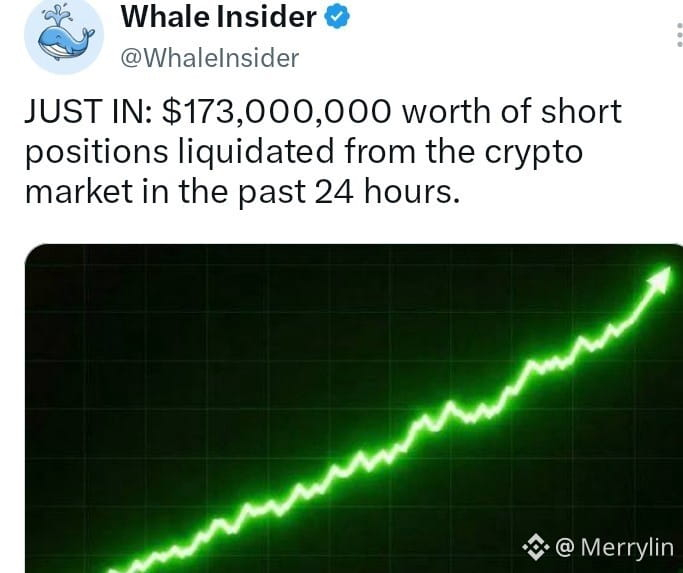
🚨 $173M Shorts Liquidated in 24 Hours! 💥
¡En un arrebato de mercado, las posiciones cortas por $173 millones ya fueron liquidadas!
💡 Idea clave:
En fuertes impulsos del mercado, el alto apalancamiento es muy riesgoso.
¡Siempre usa un Stop-Loss adecuado!
💬 ¿Cuál es tu estrategia hoy? ¿Largo, Corto o Spot? 👇
#Liquidations #BinanceSquare
🚨 $173M Shorts Liquidated in 24 Hours! 💥
¡En un arrebato de mercado, las posiciones cortas por $173 millones ya fueron liquidadas!
💡 Idea clave:
En fuertes impulsos del mercado, el alto apalancamiento es muy riesgoso.
¡Siempre usa un Stop-Loss adecuado!
💬 ¿Cuál es tu estrategia hoy? ¿Largo, Corto o Spot? 👇
#Liquidations #BinanceSquare
¡En un arrebato de mercado, las posiciones cortas por $173 millones ya fueron liquidadas!
💡 Idea clave:
En fuertes impulsos del mercado, el alto apalancamiento es muy riesgoso.
¡Siempre usa un Stop-Loss adecuado!
💬 ¿Cuál es tu estrategia hoy? ¿Largo, Corto o Spot? 👇
#Liquidations #BinanceSquare
1
29

·
--
$BTC
{future}(BTCUSDT)
SIGUIENTE MOVIMIENTO — LA LIQUIDEZ ES LA CLAVE**
BTC actualmente está situado entre dos zonas importantes de liquidación. Por encima, **$87,385** podría activar alrededor de **$870M en liquidaciones cortas**, mientras que por debajo, **$82,256** podría eliminar casi **$1B en posiciones largas**. Con el OI disminuyendo y el impulso enfriándose, mi sesgo actual es **bajista** — BTC podría primero buscar la mayor liquidez/combustible que se encuentra alrededor de **$82,256**.
#BTC #BitcoinDunyamiz #Crypto #trading #Liquidations
$BTC
SIGUIENTE MOVIMIENTO — LA LIQUIDEZ ES LA CLAVE**
BTC actualmente está situado entre dos zonas importantes de liquidación. Por encima, **$87,385** podría activar alrededor de **$870M en liquidaciones cortas**, mientras que por debajo, **$82,256** podría eliminar casi **$1B en posiciones largas**. Con el OI disminuyendo y el impulso enfriándose, mi sesgo actual es **bajista** — BTC podría primero buscar la mayor liquidez/combustible que se encuentra alrededor de **$82,256**.
#BTC #BitcoinDunyamiz #Crypto #trading #Liquidations
SIGUIENTE MOVIMIENTO — LA LIQUIDEZ ES LA CLAVE**
BTC actualmente está situado entre dos zonas importantes de liquidación. Por encima, **$87,385** podría activar alrededor de **$870M en liquidaciones cortas**, mientras que por debajo, **$82,256** podría eliminar casi **$1B en posiciones largas**. Con el OI disminuyendo y el impulso enfriándose, mi sesgo actual es **bajista** — BTC podría primero buscar la mayor liquidez/combustible que se encuentra alrededor de **$82,256**.
#BTC #BitcoinDunyamiz #Crypto #trading #Liquidations
82256
87385
3 día(s) restante(s)
1
99
·
--
Bajista
Trade de 30d $BTC 8.6K USDT
¿Qué significa liquidación?
La liquidación ocurre cuando un trader usa apalancamiento y el mercado se mueve con fuerza en contra de su posición.
Por ejemplo, si un trader abre una posición long de $1,000 usando $100 de su propio dinero, una fuerte caída de BTC puede reducir su margen hasta que el exchange cierre automáticamente la posición. Ese cierre forzado se llama liquidación.
Liquidación long: BTC cae → los compradores apalancados se ven obligados a cerrar.
Liquidación short: BTC sube → los vendedores apalancados se ven obligados a cerrar.
Grandes liquidaciones: A menudo significan que se ha eliminado un apalancamiento excesivo del mercado.
Importante: Las liquidaciones no significan automáticamente que Bitcoin vaya a caer o subir después. Principalmente muestran que los traders apalancados quedaron atrapados del lado equivocado de un movimiento.
Así que, cuando decimos “se liquidaron $462M”, significa que se cerraron forzosamente, aproximadamente, posiciones de futuros apalancados por un valor de $462M, no que $462M de Bitcoin simplemente se hayan vendido en el mercado spot.
#Liquidations $BTC
¿Qué significa liquidación?
La liquidación ocurre cuando un trader usa apalancamiento y el mercado se mueve con fuerza en contra de su posición.
Por ejemplo, si un trader abre una posición long de $1,000 usando $100 de su propio dinero, una fuerte caída de BTC puede reducir su margen hasta que el exchange cierre automáticamente la posición. Ese cierre forzado se llama liquidación.
Liquidación long: BTC cae → los compradores apalancados se ven obligados a cerrar.
Liquidación short: BTC sube → los vendedores apalancados se ven obligados a cerrar.
Grandes liquidaciones: A menudo significan que se ha eliminado un apalancamiento excesivo del mercado.
Importante: Las liquidaciones no significan automáticamente que Bitcoin vaya a caer o subir después. Principalmente muestran que los traders apalancados quedaron atrapados del lado equivocado de un movimiento.
Así que, cuando decimos “se liquidaron $462M”, significa que se cerraron forzosamente, aproximadamente, posiciones de futuros apalancados por un valor de $462M, no que $462M de Bitcoin simplemente se hayan vendido en el mercado spot.
#Liquidations $BTC
La liquidación ocurre cuando un trader usa apalancamiento y el mercado se mueve con fuerza en contra de su posición.
Por ejemplo, si un trader abre una posición long de $1,000 usando $100 de su propio dinero, una fuerte caída de BTC puede reducir su margen hasta que el exchange cierre automáticamente la posición. Ese cierre forzado se llama liquidación.
Liquidación long: BTC cae → los compradores apalancados se ven obligados a cerrar.
Liquidación short: BTC sube → los vendedores apalancados se ven obligados a cerrar.
Grandes liquidaciones: A menudo significan que se ha eliminado un apalancamiento excesivo del mercado.
Importante: Las liquidaciones no significan automáticamente que Bitcoin vaya a caer o subir después. Principalmente muestran que los traders apalancados quedaron atrapados del lado equivocado de un movimiento.
Así que, cuando decimos “se liquidaron $462M”, significa que se cerraron forzosamente, aproximadamente, posiciones de futuros apalancados por un valor de $462M, no que $462M de Bitcoin simplemente se hayan vendido en el mercado spot.
#Liquidations $BTC
1
221

·
--
¿Has notado por qué nadie habla del verdadero costo detrás de cada rally $BTC ?
Los traders siguen arruinándose persiguiendo estas subidas, viendo cómo sus posiciones se evaporan mientras el precio parece que va a la luna. El FOMO pega fuerte hasta que empiezan a llegar las liquidaciones.
Este movimiento de $5,000 en $BTC el otro día no fue la ruptura limpia que todos celebraron. Esas burbujas en el mapa de liquidaciones representan personas reales, y explotaron al ritmo de $1.3 mil millones. Aunque la región superior no pareciera abarrotada, los datos mostraron niveles altos de liquidación que eliminaron muchas apuestas apalancadas.
Lo mismo pasa con las altcoins. Cuando $BTC se mueve así, $ETH y $SOL los traders quedan atrapados en el fuego cruzado, amplificando las pérdidas en todo el tablero. Este es un caso claro de cómo estos gráficos capturan el elemento humano que la acción estándar del precio ignora.
¿Hacia dónde crees que va esto a partir de aquí, con tanto apalancamiento todavía en el sistema?
#Bitcoin #Altcoins #Liquidations
¿Has notado por qué nadie habla del verdadero costo detrás de cada rally $BTC ?
Los traders siguen arruinándose persiguiendo estas subidas, viendo cómo sus posiciones se evaporan mientras el precio parece que va a la luna. El FOMO pega fuerte hasta que empiezan a llegar las liquidaciones.
Este movimiento de $5,000 en $BTC el otro día no fue la ruptura limpia que todos celebraron. Esas burbujas en el mapa de liquidaciones representan personas reales, y explotaron al ritmo de $1.3 mil millones. Aunque la región superior no pareciera abarrotada, los datos mostraron niveles altos de liquidación que eliminaron muchas apuestas apalancadas.
Lo mismo pasa con las altcoins. Cuando $BTC se mueve así, $ETH y $SOL los traders quedan atrapados en el fuego cruzado, amplificando las pérdidas en todo el tablero. Este es un caso claro de cómo estos gráficos capturan el elemento humano que la acción estándar del precio ignora.
¿Hacia dónde crees que va esto a partir de aquí, con tanto apalancamiento todavía en el sistema?
#Bitcoin #Altcoins #Liquidations
Los traders siguen arruinándose persiguiendo estas subidas, viendo cómo sus posiciones se evaporan mientras el precio parece que va a la luna. El FOMO pega fuerte hasta que empiezan a llegar las liquidaciones.
Este movimiento de $5,000 en $BTC el otro día no fue la ruptura limpia que todos celebraron. Esas burbujas en el mapa de liquidaciones representan personas reales, y explotaron al ritmo de $1.3 mil millones. Aunque la región superior no pareciera abarrotada, los datos mostraron niveles altos de liquidación que eliminaron muchas apuestas apalancadas.
Lo mismo pasa con las altcoins. Cuando $BTC se mueve así, $ETH y $SOL los traders quedan atrapados en el fuego cruzado, amplificando las pérdidas en todo el tablero. Este es un caso claro de cómo estos gráficos capturan el elemento humano que la acción estándar del precio ignora.
¿Hacia dónde crees que va esto a partir de aquí, con tanto apalancamiento todavía en el sistema?
#Bitcoin #Altcoins #Liquidations

1
19

Liquidaciones e interés abierto
La entrada en los BTC-ETF al contado de EE. UU. fue de casi $1 mil millones; se liquidaron alrededor de $920 millones en posiciones cortas, y el interés abierto en futuros perpetuos alcanzó aproximadamente $160 mil millones. El alto apalancamiento intensifica los movimientos en ambos sentidos.
#Liquidations #etf #NFA✅
Liquidaciones e interés abierto
La entrada en los BTC-ETF al contado de EE. UU. fue de casi $1 mil millones; se liquidaron alrededor de $920 millones en posiciones cortas, y el interés abierto en futuros perpetuos alcanzó aproximadamente $160 mil millones. El alto apalancamiento intensifica los movimientos en ambos sentidos.
#Liquidations #etf #NFA✅
La entrada en los BTC-ETF al contado de EE. UU. fue de casi $1 mil millones; se liquidaron alrededor de $920 millones en posiciones cortas, y el interés abierto en futuros perpetuos alcanzó aproximadamente $160 mil millones. El alto apalancamiento intensifica los movimientos en ambos sentidos.
#Liquidations #etf #NFA✅
45
·
--
Si todavía estás sobreapalancando $BTC breakouts, detente ahora.
Demasiados traders son liquidados por perseguir la próxima subida. Ver cómo una posición desaparece después de comprar por FOMO en nuevos máximos es un dolor que nunca se hace más fácil.
Bitcoin acaba de superar los $84K, lo que disparó $230 millones en liquidaciones casi de inmediato. Las posiciones cortas fueron apretadas con fuerza mientras el precio atravesaba la resistencia.
Algunos traders lo ven como un lavado saludable que prepara la siguiente subida para $BTC y $ETH. Otros argumentan que demuestra lo apalancado que sigue estando todo el mercado, con $SOL posiciones igual de expuestas.
Estoy del lado de la cautela. $230 millones desaparecieron tan rápido que deja al descubierto un riesgo estructural mayor. Un solo retroceso y las liquidaciones podrían ir en la dirección contraria igual de rápido.
¿Dónde crees que va esta $BTC rally a partir de aquí?
#Bitcoin #CryptoTrading #Liquidations
Si todavía estás sobreapalancando $BTC breakouts, detente ahora.
Demasiados traders son liquidados por perseguir la próxima subida. Ver cómo una posición desaparece después de comprar por FOMO en nuevos máximos es un dolor que nunca se hace más fácil.
Bitcoin acaba de superar los $84K, lo que disparó $230 millones en liquidaciones casi de inmediato. Las posiciones cortas fueron apretadas con fuerza mientras el precio atravesaba la resistencia.
Algunos traders lo ven como un lavado saludable que prepara la siguiente subida para $BTC y $ETH . Otros argumentan que demuestra lo apalancado que sigue estando todo el mercado, con $SOL posiciones igual de expuestas.
Estoy del lado de la cautela. $230 millones desaparecieron tan rápido que deja al descubierto un riesgo estructural mayor. Un solo retroceso y las liquidaciones podrían ir en la dirección contraria igual de rápido.
¿Dónde crees que va esta $BTC rally a partir de aquí?
#Bitcoin #CryptoTrading #Liquidations
Demasiados traders son liquidados por perseguir la próxima subida. Ver cómo una posición desaparece después de comprar por FOMO en nuevos máximos es un dolor que nunca se hace más fácil.
Bitcoin acaba de superar los $84K, lo que disparó $230 millones en liquidaciones casi de inmediato. Las posiciones cortas fueron apretadas con fuerza mientras el precio atravesaba la resistencia.
Algunos traders lo ven como un lavado saludable que prepara la siguiente subida para $BTC y $ETH . Otros argumentan que demuestra lo apalancado que sigue estando todo el mercado, con $SOL posiciones igual de expuestas.
Estoy del lado de la cautela. $230 millones desaparecieron tan rápido que deja al descubierto un riesgo estructural mayor. Un solo retroceso y las liquidaciones podrían ir en la dirección contraria igual de rápido.
¿Dónde crees que va esta $BTC rally a partir de aquí?
#Bitcoin #CryptoTrading #Liquidations
26

todo el mundo cree que romper 84k en $btc es el inicio de la próxima pierna al alza, pero en realidad esos 230m en liquidaciones solo dejaron al descubierto lo frágil que sigue siendo este mercado.
ngl, perseguir estas subidas ha arruinado tantas cuentas. te metes por FOMO pensando que esta vez es diferente y lo siguiente es que tu posición desaparece cuando el squeeze se revierte.
btc rompiendo los 84k se veía limpio en el gráfico. pero se liquidaron 230 millones en el proceso, sobre todo shorts que fueron apretados.
el mayor riesgo aquí son los largos que entraron justo después. cuando el apalancamiento se llena tanto, un único retroceso puede desencadenar una cascada que arrastra a $eth y $sol también.
ya vimos que esto pasó antes y nunca termina bien para quienes entraron tarde.
¿hacia dónde va esto ahora?
#Bitcoin #CryptoTrading #Liquidations
todo el mundo cree que romper 84k en $btc es el inicio de la próxima pierna al alza, pero en realidad esos 230m en liquidaciones solo dejaron al descubierto lo frágil que sigue siendo este mercado.
ngl, perseguir estas subidas ha arruinado tantas cuentas. te metes por FOMO pensando que esta vez es diferente y lo siguiente es que tu posición desaparece cuando el squeeze se revierte.
btc rompiendo los 84k se veía limpio en el gráfico. pero se liquidaron 230 millones en el proceso, sobre todo shorts que fueron apretados.
el mayor riesgo aquí son los largos que entraron justo después. cuando el apalancamiento se llena tanto, un único retroceso puede desencadenar una cascada que arrastra a $eth y $sol también.
ya vimos que esto pasó antes y nunca termina bien para quienes entraron tarde.
¿hacia dónde va esto ahora?
#Bitcoin #CryptoTrading #Liquidations
ngl, perseguir estas subidas ha arruinado tantas cuentas. te metes por FOMO pensando que esta vez es diferente y lo siguiente es que tu posición desaparece cuando el squeeze se revierte.
btc rompiendo los 84k se veía limpio en el gráfico. pero se liquidaron 230 millones en el proceso, sobre todo shorts que fueron apretados.
el mayor riesgo aquí son los largos que entraron justo después. cuando el apalancamiento se llena tanto, un único retroceso puede desencadenar una cascada que arrastra a $eth y $sol también.
ya vimos que esto pasó antes y nunca termina bien para quienes entraron tarde.
¿hacia dónde va esto ahora?
#Bitcoin #CryptoTrading #Liquidations
27
Inicia sesión para explorar más contenidos
Únete a usuarios globales de criptomonedas en Binance Square
⚡️ Obtén información útil y actualizada sobre criptos.
💬 Avalado por el mayor exchange de criptomonedas en el mundo.
👍 Descubre perspectivas reales de creadores verificados.
Email/número de teléfono
Temas populares
1
#UKFCAWinsCourtOrderToRecover851400Pounds
4,932 vistas
377 están debatiendo
2
#ChainlinkLaunchesCCIP2WithEnterpriseVerification
17,132 vistas
641 están debatiendo
3
#GoldFallsTo$4144
7,385 vistas
114 están debatiendo
4
#QNTFallsOver40%FromMorningHigh
49,563 vistas
1,045 están debatiendo
5
#USDTAdds845900HoldersInPast7Days
5,056 vistas
248 están debatiendo
6
#KospiFalls2.7%SamsungSKHynixDropOver5%
12,347 vistas
461 están debatiendo
7
#BitgetCEOConfirms$388MStolenInHack
3,825 vistas
39 están debatiendo
8
#BTCFallsBelow$83000
21,846 vistas
151 están debatiendo
9
#BitgetDetailsSecurityIncidentTimeline
27,922 vistas
612 están debatiendo
10
#BitcoinSpotETFs$2.39BWeeklyNetInflow
9,026 vistas
40 están debatiendo