

#bitcoinmining
bitcoinmining
494,121 vistas
1,988 están debatiendo
Hot
Lo último

·
--
Artículo
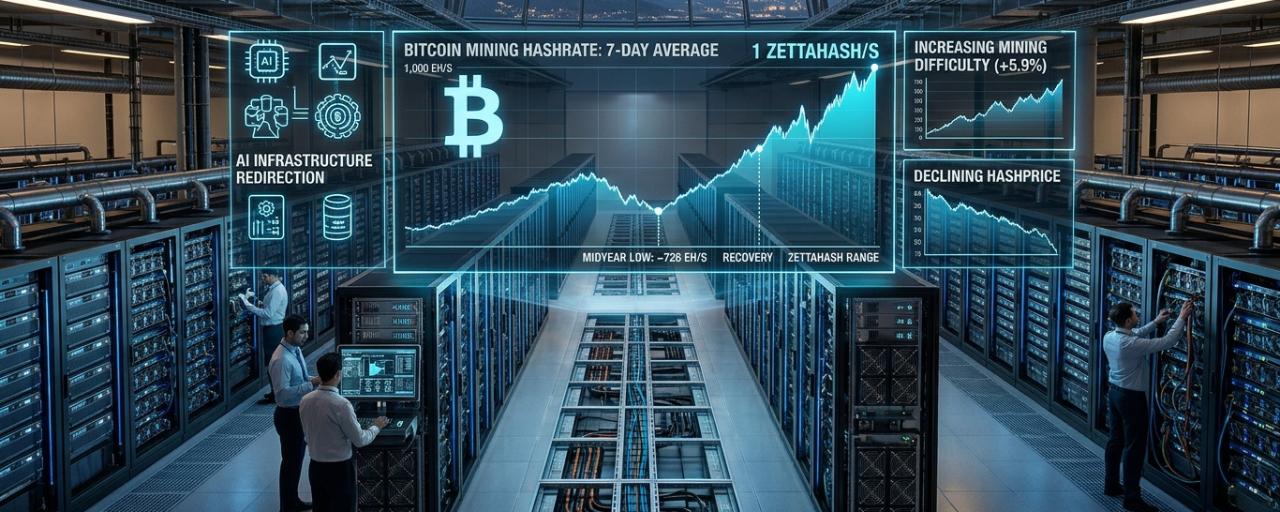
La tasa de hash de minería de Bitcoin vuelve a 1 zettahash mientras se intensifica la competenciaLa tasa de hash promedio de minería de Bitcoin de los últimos siete días ha vuelto a aproximadamente 1 zettahash por segundo (ZH/s), equivalente a 1.000 exahashes por segundo, y ha alcanzado su nivel más alto desde el 3 de marzo de 2026. La recuperación desde un mínimo de mitad de año de alrededor de 726 EH/s pone de relieve el creciente poder computacional dedicado a proteger la red de Bitcoin y competir por las recompensas de bloque. $BTC
Este repunte se produce pese a que varias grandes empresas de minería que cotizan en bolsa están redirigiendo parte de su infraestructura hacia la inteligencia artificial (IA) y la computación de alto rendimiento. Los equipos de minería de nueva generación, más eficientes, junto con operadores privados y de menor tamaño que han vuelto a poner en uso equipos existentes, han contribuido a recuperar la capacidad de minería de Bitcoin. Este avance sugiere que los incentivos para minar siguen siendo lo bastante fuertes como para atraer recursos computacionales, incluso cuando algunos grandes operadores diversifican sus actividades hacia la IA. $SOL
La tasa de hash de minería de Bitcoin vuelve a 1 zettahash mientras se intensifica la competencia
La tasa de hash promedio de minería de Bitcoin de los últimos siete días ha vuelto a aproximadamente 1 zettahash por segundo (ZH/s), equivalente a 1.000 exahashes por segundo, y ha alcanzado su nivel más alto desde el 3 de marzo de 2026. La recuperación desde un mínimo de mitad de año de alrededor de 726 EH/s pone de relieve el creciente poder computacional dedicado a proteger la red de Bitcoin y competir por las recompensas de bloque. $BTC
Este repunte se produce pese a que varias grandes empresas de minería que cotizan en bolsa están redirigiendo parte de su infraestructura hacia la inteligencia artificial (IA) y la computación de alto rendimiento. Los equipos de minería de nueva generación, más eficientes, junto con operadores privados y de menor tamaño que han vuelto a poner en uso equipos existentes, han contribuido a recuperar la capacidad de minería de Bitcoin. Este avance sugiere que los incentivos para minar siguen siendo lo bastante fuertes como para atraer recursos computacionales, incluso cuando algunos grandes operadores diversifican sus actividades hacia la IA. $SOL
Este repunte se produce pese a que varias grandes empresas de minería que cotizan en bolsa están redirigiendo parte de su infraestructura hacia la inteligencia artificial (IA) y la computación de alto rendimiento. Los equipos de minería de nueva generación, más eficientes, junto con operadores privados y de menor tamaño que han vuelto a poner en uso equipos existentes, han contribuido a recuperar la capacidad de minería de Bitcoin. Este avance sugiere que los incentivos para minar siguen siendo lo bastante fuertes como para atraer recursos computacionales, incluso cuando algunos grandes operadores diversifican sus actividades hacia la IA. $SOL
4
364

𝙻𝙰 𝙴𝙵𝙸𝙲𝙸𝙴𝙽𝙲𝙸𝙰 𝙴𝚂 𝙻𝙰 𝙽𝚄𝙴𝚅𝙰 𝙰𝙻𝙵𝙰.
Tether está ampliando su ecosistema más allá de la emisión de monedas estables al integrar la automatización con IA en las operaciones de minería de Bitcoin. Al conseguir el respaldo de gigantes del sector como Bitmain y Canaan para su plataforma MDK, Tether se está posicionando como un proveedor de infraestructura crítica para el sector minero. Este paso señala un cambio estratégico hacia la optimización de la eficiencia de la tasa de hash y la gestión operativa mediante tecnología de código abierto.
#Tether #BitcoinMining ⠀
𝙻𝙰 𝙴𝙵𝙸𝙲𝙸𝙴𝙽𝙲𝙸𝙰 𝙴𝚂 𝙻𝙰 𝙽𝚄𝙴𝚅𝙰 𝙰𝙻𝙵𝙰.
Tether está ampliando su ecosistema más allá de la emisión de monedas estables al integrar la automatización con IA en las operaciones de minería de Bitcoin. Al conseguir el respaldo de gigantes del sector como Bitmain y Canaan para su plataforma MDK, Tether se está posicionando como un proveedor de infraestructura crítica para el sector minero. Este paso señala un cambio estratégico hacia la optimización de la eficiencia de la tasa de hash y la gestión operativa mediante tecnología de código abierto.
#Tether #BitcoinMining ⠀
Tether está ampliando su ecosistema más allá de la emisión de monedas estables al integrar la automatización con IA en las operaciones de minería de Bitcoin. Al conseguir el respaldo de gigantes del sector como Bitmain y Canaan para su plataforma MDK, Tether se está posicionando como un proveedor de infraestructura crítica para el sector minero. Este paso señala un cambio estratégico hacia la optimización de la eficiencia de la tasa de hash y la gestión operativa mediante tecnología de código abierto.
#Tether #BitcoinMining ⠀
63

🚀 El poder de minería de Bitcoin se está recuperando, pero ¿es una señal alcista para $BTC?
La red de Bitcoin muestra una renovada fortaleza minera, y los últimos datos de dificultad nos dan algo importante que observar.
Esto es lo que nos dicen las cifras al 25 de octubre de 2026. 👇
⛏️ Dificultad de minería: 140.58T
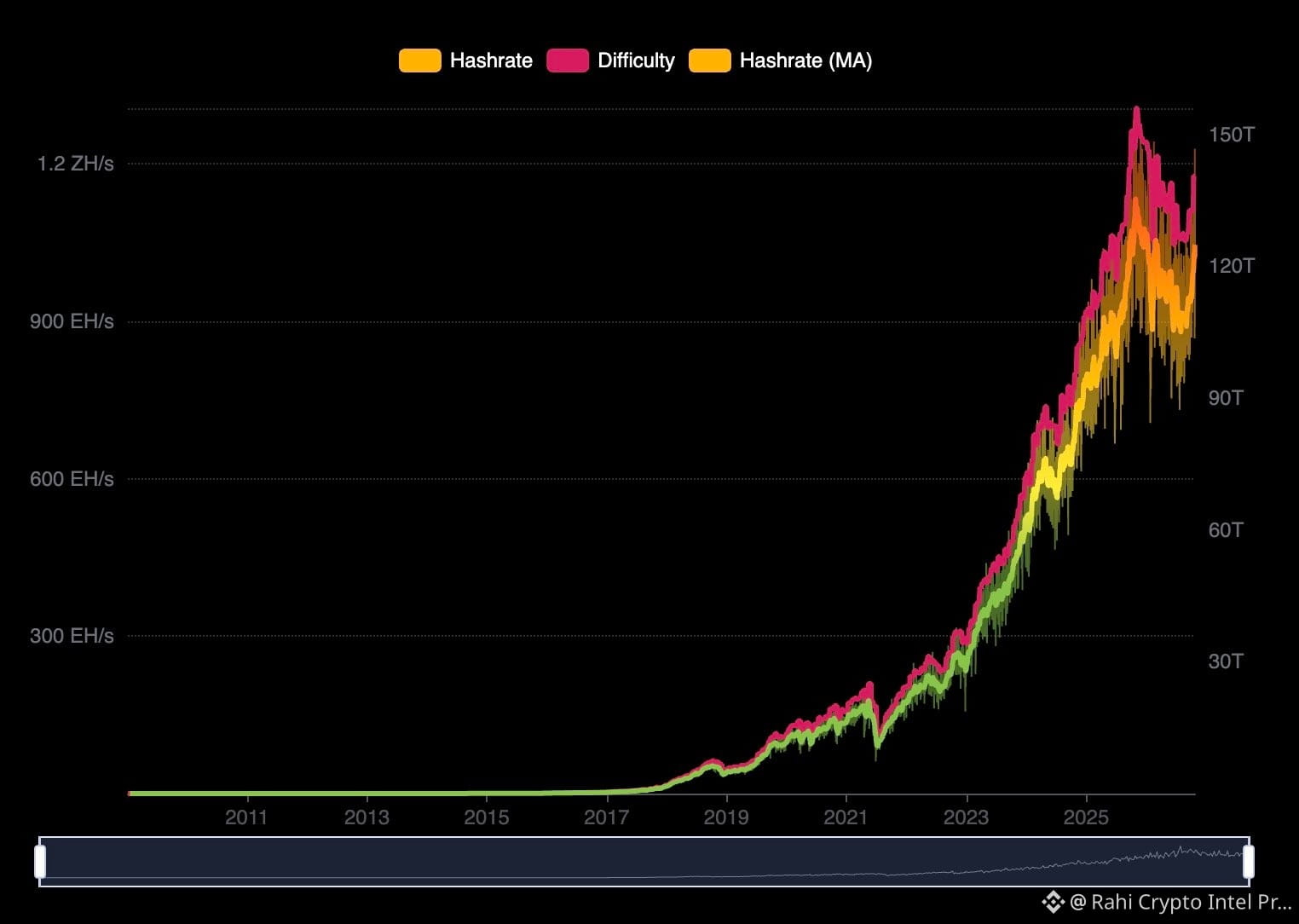
El último ajuste de dificultad de Bitcoin, realizado el 16 de octubre, aumentó un 5.92%, de 132.72T a 140.58T.
Esto significa que ahora los mineros se enfrentan a una competencia más dura para encontrar bloques válidos.
⚡ Tasa de hash: alrededor de 964 EH/s
CoinWarz estima que la tasa de hash de la red de Bitcoin es de aproximadamente 964 EH/s, un 6.79% más que en los últimos 30 días.
Sin embargo, las mediciones diarias fluctúan significativamente, así que una sola instantánea no cuenta toda la historia.
🛡️ ¿Por qué es importante?
Un aumento sostenido de la tasa de hash puede significar que hay más poder de cómputo ayudando a proteger la red de Bitcoin.
El aumento de la dificultad también refleja una mayor competencia entre los mineros. En conjunto, estas métricas ofrecen información útil sobre la solidez de la red de Bitcoin y la actividad minera.
Pero la historia tiene otra cara. 👀
💰 Más competencia no siempre significa más ganancias
Una mayor dificultad puede reducir las recompensas que obtiene cada minero en relación con su poder de cómputo.
Los costos de electricidad, la eficiencia del hardware, el precio de BTC y los gastos operativos influyen en la rentabilidad de la minería.
Y recuerda: una red más sólida NO significa automáticamente que el precio de mercado de Bitcoin vaya a subir.
📊 Actualmente, se estima que el próximo ajuste de dificultad tendrá lugar alrededor del 29 de octubre y podría traer otro aumento. Esa previsión aún puede cambiar antes de que se realice el ajuste.
Mi conclusión: los fundamentos de la minería de Bitcoin parecen favorables, pero la verdadera pregunta es si esta recuperación podrá mantenerse mientras los mineros siguen siendo rentables.
🔥 ¿Qué opinas? ¿Es el aumento de la tasa de hash una señal alcista significativa a largo plazo para Bitcoin, o sigue siendo más importante la acción del precio?
Comparte tu opinión abajo. 👇
#Bitcoin #BitcoinMining #RahiCryptoIntel
$BTC
{future}(BTCUSDT)
🚀 El poder de minería de Bitcoin se está recuperando, pero ¿es una señal alcista para $BTC ?
La red de Bitcoin muestra una renovada fortaleza minera, y los últimos datos de dificultad nos dan algo importante que observar.
Esto es lo que nos dicen las cifras al 25 de octubre de 2026. 👇
⛏️ Dificultad de minería: 140.58T
El último ajuste de dificultad de Bitcoin, realizado el 16 de octubre, aumentó un 5.92%, de 132.72T a 140.58T.
Esto significa que ahora los mineros se enfrentan a una competencia más dura para encontrar bloques válidos.
⚡ Tasa de hash: alrededor de 964 EH/s
CoinWarz estima que la tasa de hash de la red de Bitcoin es de aproximadamente 964 EH/s, un 6.79% más que en los últimos 30 días.
Sin embargo, las mediciones diarias fluctúan significativamente, así que una sola instantánea no cuenta toda la historia.
🛡️ ¿Por qué es importante?
Un aumento sostenido de la tasa de hash puede significar que hay más poder de cómputo ayudando a proteger la red de Bitcoin.
El aumento de la dificultad también refleja una mayor competencia entre los mineros. En conjunto, estas métricas ofrecen información útil sobre la solidez de la red de Bitcoin y la actividad minera.
Pero la historia tiene otra cara. 👀
💰 Más competencia no siempre significa más ganancias
Una mayor dificultad puede reducir las recompensas que obtiene cada minero en relación con su poder de cómputo.
Los costos de electricidad, la eficiencia del hardware, el precio de BTC y los gastos operativos influyen en la rentabilidad de la minería.
Y recuerda: una red más sólida NO significa automáticamente que el precio de mercado de Bitcoin vaya a subir.
📊 Actualmente, se estima que el próximo ajuste de dificultad tendrá lugar alrededor del 29 de octubre y podría traer otro aumento. Esa previsión aún puede cambiar antes de que se realice el ajuste.
Mi conclusión: los fundamentos de la minería de Bitcoin parecen favorables, pero la verdadera pregunta es si esta recuperación podrá mantenerse mientras los mineros siguen siendo rentables.
🔥 ¿Qué opinas? ¿Es el aumento de la tasa de hash una señal alcista significativa a largo plazo para Bitcoin, o sigue siendo más importante la acción del precio?
Comparte tu opinión abajo. 👇
#Bitcoin #BitcoinMining #RahiCryptoIntel
$BTC
La red de Bitcoin muestra una renovada fortaleza minera, y los últimos datos de dificultad nos dan algo importante que observar.
Esto es lo que nos dicen las cifras al 25 de octubre de 2026. 👇
⛏️ Dificultad de minería: 140.58T
El último ajuste de dificultad de Bitcoin, realizado el 16 de octubre, aumentó un 5.92%, de 132.72T a 140.58T.
Esto significa que ahora los mineros se enfrentan a una competencia más dura para encontrar bloques válidos.
⚡ Tasa de hash: alrededor de 964 EH/s
CoinWarz estima que la tasa de hash de la red de Bitcoin es de aproximadamente 964 EH/s, un 6.79% más que en los últimos 30 días.
Sin embargo, las mediciones diarias fluctúan significativamente, así que una sola instantánea no cuenta toda la historia.
🛡️ ¿Por qué es importante?
Un aumento sostenido de la tasa de hash puede significar que hay más poder de cómputo ayudando a proteger la red de Bitcoin.
El aumento de la dificultad también refleja una mayor competencia entre los mineros. En conjunto, estas métricas ofrecen información útil sobre la solidez de la red de Bitcoin y la actividad minera.
Pero la historia tiene otra cara. 👀
💰 Más competencia no siempre significa más ganancias
Una mayor dificultad puede reducir las recompensas que obtiene cada minero en relación con su poder de cómputo.
Los costos de electricidad, la eficiencia del hardware, el precio de BTC y los gastos operativos influyen en la rentabilidad de la minería.
Y recuerda: una red más sólida NO significa automáticamente que el precio de mercado de Bitcoin vaya a subir.
📊 Actualmente, se estima que el próximo ajuste de dificultad tendrá lugar alrededor del 29 de octubre y podría traer otro aumento. Esa previsión aún puede cambiar antes de que se realice el ajuste.
Mi conclusión: los fundamentos de la minería de Bitcoin parecen favorables, pero la verdadera pregunta es si esta recuperación podrá mantenerse mientras los mineros siguen siendo rentables.
🔥 ¿Qué opinas? ¿Es el aumento de la tasa de hash una señal alcista significativa a largo plazo para Bitcoin, o sigue siendo más importante la acción del precio?
Comparte tu opinión abajo. 👇
#Bitcoin #BitcoinMining #RahiCryptoIntel
$BTC
18


Artículo
La tasa de hash de Bitcoin alcanza su máximo en 7 meses: qué significa para BTCLa tasa de hash de Bitcoin supera 1 ZH/s: una red más sólida, pero no una subida automática del precio
Según informes, la potencia de cálculo de la red de Bitcoin ha superado 1 ZH/s (1.000 EH/s), lo que sitúa su tasa de hash promedio de 7 días en su nivel más alto desde marzo de 2026.
Este hito pone de relieve la competencia constante entre los mineros de Bitcoin, mientras algunos sectores de la industria minera exploran oportunidades en la computación de IA.
Por qué es importante:
Seguridad de la red: Una tasa de hash más alta suele significar que hay más potencia de cálculo respaldando la red de prueba de trabajo de Bitcoin.
La tasa de hash de Bitcoin alcanza su máximo en 7 meses: qué significa para BTC
La tasa de hash de Bitcoin supera 1 ZH/s: una red más sólida, pero no una subida automática del precio
Según informes, la potencia de cálculo de la red de Bitcoin ha superado 1 ZH/s (1.000 EH/s), lo que sitúa su tasa de hash promedio de 7 días en su nivel más alto desde marzo de 2026.
Este hito pone de relieve la competencia constante entre los mineros de Bitcoin, mientras algunos sectores de la industria minera exploran oportunidades en la computación de IA.
Por qué es importante:
Seguridad de la red: Una tasa de hash más alta suele significar que hay más potencia de cálculo respaldando la red de prueba de trabajo de Bitcoin.
Según informes, la potencia de cálculo de la red de Bitcoin ha superado 1 ZH/s (1.000 EH/s), lo que sitúa su tasa de hash promedio de 7 días en su nivel más alto desde marzo de 2026.
Este hito pone de relieve la competencia constante entre los mineros de Bitcoin, mientras algunos sectores de la industria minera exploran oportunidades en la computación de IA.
Por qué es importante:
Seguridad de la red: Una tasa de hash más alta suele significar que hay más potencia de cálculo respaldando la red de prueba de trabajo de Bitcoin.
4

·
--
#ElHashrateDeBitcoinAlcanzaUnMáximoDeSieteMeses
⛏️ La minería de Bitcoin se prepara para otro aumento de dificultad de ~5.5%
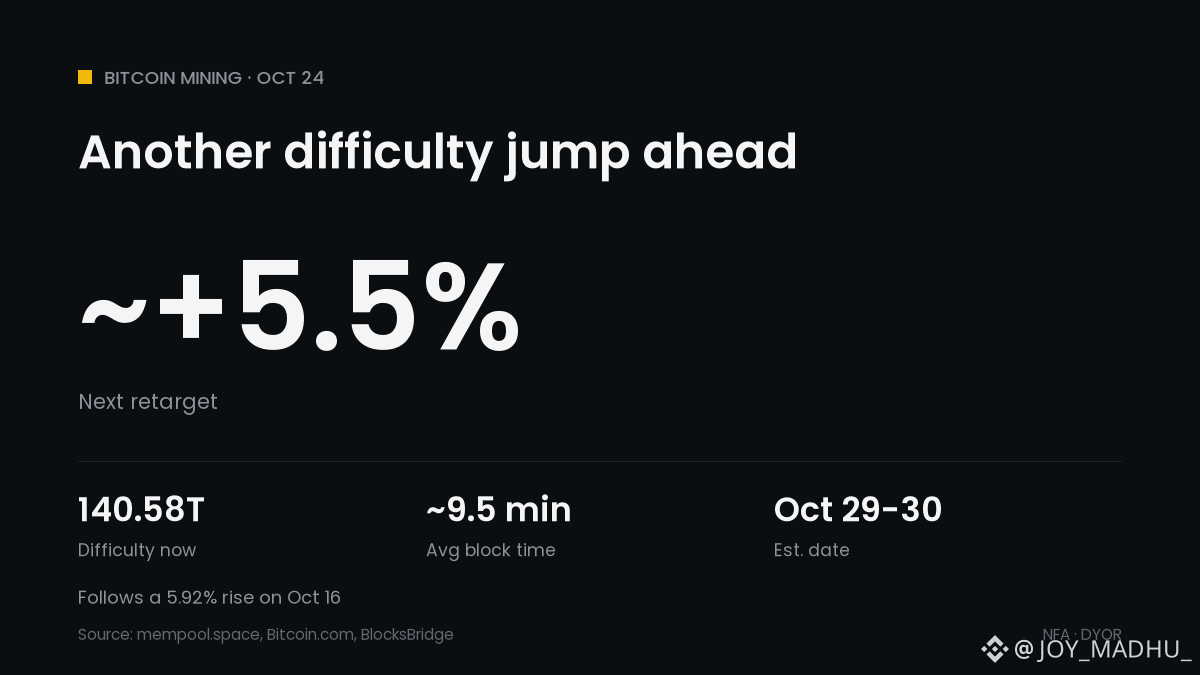
📊 La dificultad está en 140.58T tras subir un 5.92% el 16 de oct.
📈 mempool.space ahora proyecta un aumento de aproximadamente +5.5% en el próximo reajuste
📅 Se espera alrededor del 29-30 de oct., con 851 bloques restantes en la época
⏱️ Los bloques tardan en promedio unos 9.5 minutos, frente al objetivo de 10 minutos
🔁 Dos aumentos consecutivos sumarían aproximadamente un 11.7%
⚠️ El hashprice rondaba los $37 por PH/s al día, por debajo del nivel de mediados de septiembre
💻 Todo esto mientras los mineros que cotizan en bolsa destinan energía a la IA
Qué significa para las criptomonedas: una red más difícil de atacar es más segura para $BTC, pero con BTC cerca de los $80.9K, los equipos antiguos y los mineros con costos elevados se ven presionados. Conviene estar atentos a las ventas de los mineros.
¿El aumento de la dificultad llevará a más mineros a pasarse a la IA? 👇
$BTC
#CryptoNews #BitcoinMining #Hashrate #ElHashrateDeBitcoinAlcanzaUnMáximoDeSieteMeses
#ElHashrateDeBitcoinAlcanzaUnMáximoDeSieteMeses
⛏️ La minería de Bitcoin se prepara para otro aumento de dificultad de ~5.5%
📊 La dificultad está en 140.58T tras subir un 5.92% el 16 de oct.
📈 mempool.space ahora proyecta un aumento de aproximadamente +5.5% en el próximo reajuste
📅 Se espera alrededor del 29-30 de oct., con 851 bloques restantes en la época
⏱️ Los bloques tardan en promedio unos 9.5 minutos, frente al objetivo de 10 minutos
🔁 Dos aumentos consecutivos sumarían aproximadamente un 11.7%
⚠️ El hashprice rondaba los $37 por PH/s al día, por debajo del nivel de mediados de septiembre
💻 Todo esto mientras los mineros que cotizan en bolsa destinan energía a la IA
Qué significa para las criptomonedas: una red más difícil de atacar es más segura para $BTC , pero con BTC cerca de los $80.9K, los equipos antiguos y los mineros con costos elevados se ven presionados. Conviene estar atentos a las ventas de los mineros.
¿El aumento de la dificultad llevará a más mineros a pasarse a la IA? 👇
$BTC
#CryptoNews #BitcoinMining #Hashrate #ElHashrateDeBitcoinAlcanzaUnMáximoDeSieteMeses
⛏️ La minería de Bitcoin se prepara para otro aumento de dificultad de ~5.5%
📊 La dificultad está en 140.58T tras subir un 5.92% el 16 de oct.
📈 mempool.space ahora proyecta un aumento de aproximadamente +5.5% en el próximo reajuste
📅 Se espera alrededor del 29-30 de oct., con 851 bloques restantes en la época
⏱️ Los bloques tardan en promedio unos 9.5 minutos, frente al objetivo de 10 minutos
🔁 Dos aumentos consecutivos sumarían aproximadamente un 11.7%
⚠️ El hashprice rondaba los $37 por PH/s al día, por debajo del nivel de mediados de septiembre
💻 Todo esto mientras los mineros que cotizan en bolsa destinan energía a la IA
Qué significa para las criptomonedas: una red más difícil de atacar es más segura para $BTC , pero con BTC cerca de los $80.9K, los equipos antiguos y los mineros con costos elevados se ven presionados. Conviene estar atentos a las ventas de los mineros.
¿El aumento de la dificultad llevará a más mineros a pasarse a la IA? 👇
$BTC
#CryptoNews #BitcoinMining #Hashrate #ElHashrateDeBitcoinAlcanzaUnMáximoDeSieteMeses
46

·
--
$BTC | El hashrate de Bitcoin acaba de alcanzar su máximo en siete meses y Square lo considera una señal alcista. En la mesa, la salud de los mineros nunca se consideró una tesis independiente: indica estrés por el lado de la oferta, no la posición dentro del ciclo. El modelo de SatoshiMacro asigna apenas un 10 % de sus 48 señales al estrés de los mineros y la producción, porque Hash Ribbons está diseñado para detectar capitulaciones cerca de los mínimos, no para confirmar la fortaleza cerca de los máximos. Un máximo en siete meses es el caso opuesto. Mi lectura: descarta las ventas impulsadas por los mineros, nada más. El máximo del ciclo de 2021-11 todavía alcanzó 91.3 en el modelo calibrado, con el hashrate fuerte durante todo el periodo: un nivel de seis. En cualquier caso, sigue vigente el límite de apalancamiento de 2:1 de ASIC para los CFD de criptomonedas.
https://satoshimacro.com/tools/crypto/satoshimacro-model/?utm_source=binance_square&utm_medium=social&utm_campaign=autopilot_short-1
#SatoshiMacro #BitcoinHashrateHitsSevenMonthHigh #BitcoinMining #Bitcoin
$BTC | El hashrate de Bitcoin acaba de alcanzar su máximo en siete meses y Square lo considera una señal alcista. En la mesa, la salud de los mineros nunca se consideró una tesis independiente: indica estrés por el lado de la oferta, no la posición dentro del ciclo. El modelo de SatoshiMacro asigna apenas un 10 % de sus 48 señales al estrés de los mineros y la producción, porque Hash Ribbons está diseñado para detectar capitulaciones cerca de los mínimos, no para confirmar la fortaleza cerca de los máximos. Un máximo en siete meses es el caso opuesto. Mi lectura: descarta las ventas impulsadas por los mineros, nada más. El máximo del ciclo de 2021-11 todavía alcanzó 91.3 en el modelo calibrado, con el hashrate fuerte durante todo el periodo: un nivel de seis. En cualquier caso, sigue vigente el límite de apalancamiento de 2:1 de ASIC para los CFD de criptomonedas.
https://satoshimacro.com/tools/crypto/satoshimacro-model/?utm_source=binance_square&utm_medium=social&utm_campaign=autopilot_short-1
#SatoshiMacro #BitcoinHashrateHitsSevenMonthHigh #BitcoinMining #Bitcoin
https://satoshimacro.com/tools/crypto/satoshimacro-model/?utm_source=binance_square&utm_medium=social&utm_campaign=autopilot_short-1
#SatoshiMacro #BitcoinHashrateHitsSevenMonthHigh #BitcoinMining #Bitcoin
66
·
--
#bitcoinhashratehitssevenmonthhigh
Los mineros están orientándose hacia la IA. Entonces, ¿por qué sigue aumentando la tasa de hash de Bitcoin? 🤔
La tasa de hash promedio de Bitcoin de los últimos 7 días volvió a superar 1 ZH/s (1.000 EH/s), su nivel más alto desde el 3 de marzo de 2026, según BlocksBridge Consulting (22 de oct.).
📌 El contexto
Varios grandes mineros que cotizan en bolsa están trasladando capacidad a la IA y la computación de alto rendimiento (HPC). Es posible que operadores más pequeños estén comprando ASIC de segunda mano para cubrir el hueco.
⚖️ Dos caras de la historia
✅ Una mayor tasa de hash significa más potencia de cálculo protegiendo la red.
⚠️ La dificultad subió un 5,92 % hasta ~140,58 T el 16 de oct., y se estima que volverá a subir, lo que presiona a los mineros menos eficientes.
🧠 Mi opinión
La seguridad de la red, la rentabilidad de los mineros y la demanda del mercado son cosas distintas. Una tasa de hash sólida indica resiliencia, no una dirección del precio. Estoy pendiente del próximo ajuste de dificultad y de cualquier señal de ventas por parte de los mineros.
💬 ¿La IA alejará a los mineros de Bitcoin o abrirá las puertas a operadores más pequeños?
Esto no es asesoramiento financiero.
$BTC
{future}(BTCUSDT)
#Bitcoin #BitcoinMining #BinanceSquare
#bitcoinhashratehitssevenmonthhigh
Los mineros están orientándose hacia la IA. Entonces, ¿por qué sigue aumentando la tasa de hash de Bitcoin? 🤔
La tasa de hash promedio de Bitcoin de los últimos 7 días volvió a superar 1 ZH/s (1.000 EH/s), su nivel más alto desde el 3 de marzo de 2026, según BlocksBridge Consulting (22 de oct.).
📌 El contexto
Varios grandes mineros que cotizan en bolsa están trasladando capacidad a la IA y la computación de alto rendimiento (HPC). Es posible que operadores más pequeños estén comprando ASIC de segunda mano para cubrir el hueco.
⚖️ Dos caras de la historia
✅ Una mayor tasa de hash significa más potencia de cálculo protegiendo la red.
⚠️ La dificultad subió un 5,92 % hasta ~140,58 T el 16 de oct., y se estima que volverá a subir, lo que presiona a los mineros menos eficientes.
🧠 Mi opinión
La seguridad de la red, la rentabilidad de los mineros y la demanda del mercado son cosas distintas. Una tasa de hash sólida indica resiliencia, no una dirección del precio. Estoy pendiente del próximo ajuste de dificultad y de cualquier señal de ventas por parte de los mineros.
💬 ¿La IA alejará a los mineros de Bitcoin o abrirá las puertas a operadores más pequeños?
Esto no es asesoramiento financiero.
$BTC
#Bitcoin #BitcoinMining #BinanceSquare
Los mineros están orientándose hacia la IA. Entonces, ¿por qué sigue aumentando la tasa de hash de Bitcoin? 🤔
La tasa de hash promedio de Bitcoin de los últimos 7 días volvió a superar 1 ZH/s (1.000 EH/s), su nivel más alto desde el 3 de marzo de 2026, según BlocksBridge Consulting (22 de oct.).
📌 El contexto
Varios grandes mineros que cotizan en bolsa están trasladando capacidad a la IA y la computación de alto rendimiento (HPC). Es posible que operadores más pequeños estén comprando ASIC de segunda mano para cubrir el hueco.
⚖️ Dos caras de la historia
✅ Una mayor tasa de hash significa más potencia de cálculo protegiendo la red.
⚠️ La dificultad subió un 5,92 % hasta ~140,58 T el 16 de oct., y se estima que volverá a subir, lo que presiona a los mineros menos eficientes.
🧠 Mi opinión
La seguridad de la red, la rentabilidad de los mineros y la demanda del mercado son cosas distintas. Una tasa de hash sólida indica resiliencia, no una dirección del precio. Estoy pendiente del próximo ajuste de dificultad y de cualquier señal de ventas por parte de los mineros.
💬 ¿La IA alejará a los mineros de Bitcoin o abrirá las puertas a operadores más pequeños?
Esto no es asesoramiento financiero.
$BTC
#Bitcoin #BitcoinMining #BinanceSquare

2.4k

·
--
Alcista
Verificado
#bitcoinhashratehitssevenmonthhigh 🚨 EL HASHRATE DE BITCOIN ALCANZA SU MÁXIMO EN 7 MESES: ¿QUÉ SIGNIFICA PARA BTC?
¡La red de Bitcoin se está fortaleciendo! ⚡
El hashrate promedio de 7 días de BTC superó 1 ZH/s (1.000 EH/s), alcanzando su nivel más alto desde marzo de 2026, incluso mientras algunas grandes empresas de minería trasladan su capacidad de cómputo hacia la IA.
🔍 Por qué es importante
🔹 Seguridad de la red: Un hashrate más alto suele significar que hay más potencia de cómputo protegiendo la red de Bitcoin.
🔹 Competencia en la minería: Una mayor potencia de cómputo puede generar más competencia entre los mineros y aumentar la presión sobre los costos operativos.
🔹 IA frente a minería de Bitcoin: Aunque algunos mineros se están volcando a la IA, es posible que otros operadores estén volviendo a dedicar equipos a la minería de Bitcoin.
📊 MI ANÁLISIS
Este es un avance positivo para los fundamentos de la red de Bitcoin, pero no es una señal automáticamente alcista para el precio de BTC.
Los factores clave que hay que observar son la rentabilidad de la minería, los costos de electricidad, la dificultad de minería y la demanda real del mercado.
🔥 La gran pregunta: ¿Puede Bitcoin mantener una actividad sólida en la red mientras la industria minera se expande hacia la IA?
¿Qué opinas: es alcista para los fundamentos a largo plazo o neutral para la evolución del precio? 👇
#Bitcoin #BTC #CryptoNews #BitcoinMining
$BTC $ZEC $ONE
{future}(ONEUSDT)
{future}(ZECUSDT)
{future}(BTCUSDT)
#bitcoinhashratehitssevenmonthhigh 🚨 EL HASHRATE DE BITCOIN ALCANZA SU MÁXIMO EN 7 MESES: ¿QUÉ SIGNIFICA PARA BTC?
¡La red de Bitcoin se está fortaleciendo! ⚡
El hashrate promedio de 7 días de BTC superó 1 ZH/s (1.000 EH/s), alcanzando su nivel más alto desde marzo de 2026, incluso mientras algunas grandes empresas de minería trasladan su capacidad de cómputo hacia la IA.
🔍 Por qué es importante
🔹 Seguridad de la red: Un hashrate más alto suele significar que hay más potencia de cómputo protegiendo la red de Bitcoin.
🔹 Competencia en la minería: Una mayor potencia de cómputo puede generar más competencia entre los mineros y aumentar la presión sobre los costos operativos.
🔹 IA frente a minería de Bitcoin: Aunque algunos mineros se están volcando a la IA, es posible que otros operadores estén volviendo a dedicar equipos a la minería de Bitcoin.
📊 MI ANÁLISIS
Este es un avance positivo para los fundamentos de la red de Bitcoin, pero no es una señal automáticamente alcista para el precio de BTC.
Los factores clave que hay que observar son la rentabilidad de la minería, los costos de electricidad, la dificultad de minería y la demanda real del mercado.
🔥 La gran pregunta: ¿Puede Bitcoin mantener una actividad sólida en la red mientras la industria minera se expande hacia la IA?
¿Qué opinas: es alcista para los fundamentos a largo plazo o neutral para la evolución del precio? 👇
#Bitcoin #BTC #CryptoNews #BitcoinMining
$BTC $ZEC $ONE
¡La red de Bitcoin se está fortaleciendo! ⚡
El hashrate promedio de 7 días de BTC superó 1 ZH/s (1.000 EH/s), alcanzando su nivel más alto desde marzo de 2026, incluso mientras algunas grandes empresas de minería trasladan su capacidad de cómputo hacia la IA.
🔍 Por qué es importante
🔹 Seguridad de la red: Un hashrate más alto suele significar que hay más potencia de cómputo protegiendo la red de Bitcoin.
🔹 Competencia en la minería: Una mayor potencia de cómputo puede generar más competencia entre los mineros y aumentar la presión sobre los costos operativos.
🔹 IA frente a minería de Bitcoin: Aunque algunos mineros se están volcando a la IA, es posible que otros operadores estén volviendo a dedicar equipos a la minería de Bitcoin.
📊 MI ANÁLISIS
Este es un avance positivo para los fundamentos de la red de Bitcoin, pero no es una señal automáticamente alcista para el precio de BTC.
Los factores clave que hay que observar son la rentabilidad de la minería, los costos de electricidad, la dificultad de minería y la demanda real del mercado.
🔥 La gran pregunta: ¿Puede Bitcoin mantener una actividad sólida en la red mientras la industria minera se expande hacia la IA?
¿Qué opinas: es alcista para los fundamentos a largo plazo o neutral para la evolución del precio? 👇
#Bitcoin #BTC #CryptoNews #BitcoinMining
$BTC $ZEC $ONE

1
1.7k


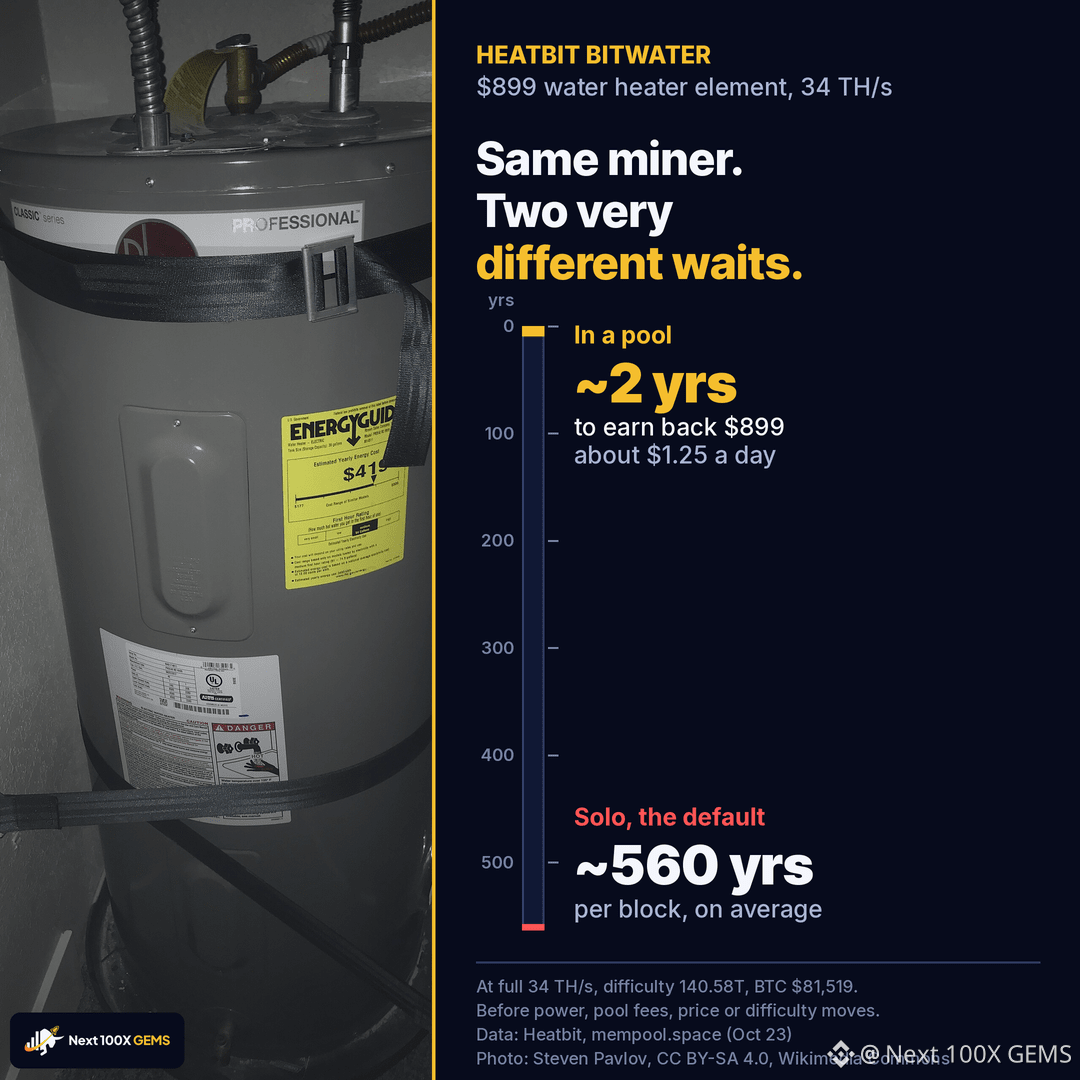
El nuevo Bitwater de Heatbit es un elemento calefactor de 899 $ que mina $BTC mientras calienta el depósito de agua. De fábrica, mina en solitario y, con la dificultad actual, una máquina de 34 TH/s encuentra un bloque aproximadamente una vez cada 560 años, en promedio.
Se instala en el puerto para elementos de 1 pulgada de los depósitos estándar de 30 a 80 galones en EE. UU. y Canadá. Heatbit anuncia hasta 34 TH/s con un consumo de hasta 600 W, 20 chips BM1370 y envíos en el primer trimestre de 2027. El precio de 899 $ corresponde al primer lote Genesis; los lotes posteriores subirán a 1.299 $.
La configuración predeterminada es minar en solitario en el pool de Heatbit. Si se encuentra un bloque, toda la recompensa es tuya, pero con 34 TH/s las probabilidades son de aproximadamente 1 entre 560 en un año cualquiera.
Si, en cambio, se conecta a un pool como Luxor, esa misma tasa de hash genera alrededor de 1,25 $ al día según las cifras actuales, unos 455 $ al año. Según nuestros cálculos, se tardarían aproximadamente 2 años en recuperar los 899 $ si funciona a pleno rendimiento, o unos 2,5 años con un tiempo de funcionamiento del 80 %. El precio, la dificultad y las comisiones del pool pueden cambiar esas cifras, y actualmente se estima que el próximo ajuste de dificultad será de alrededor de +5 %.
El calor no se desperdicia; esa es precisamente la propuesta. Solo asegúrate de saber en qué modo está antes de contar con esos ingresos.
#Bitcoin #MineríaDeBitcoin
No es asesoramiento financiero. Investiga por tu cuenta.
El nuevo Bitwater de Heatbit es un elemento calefactor de 899 $ que mina $BTC mientras calienta el depósito de agua. De fábrica, mina en solitario y, con la dificultad actual, una máquina de 34 TH/s encuentra un bloque aproximadamente una vez cada 560 años, en promedio.
Se instala en el puerto para elementos de 1 pulgada de los depósitos estándar de 30 a 80 galones en EE. UU. y Canadá. Heatbit anuncia hasta 34 TH/s con un consumo de hasta 600 W, 20 chips BM1370 y envíos en el primer trimestre de 2027. El precio de 899 $ corresponde al primer lote Genesis; los lotes posteriores subirán a 1.299 $.
La configuración predeterminada es minar en solitario en el pool de Heatbit. Si se encuentra un bloque, toda la recompensa es tuya, pero con 34 TH/s las probabilidades son de aproximadamente 1 entre 560 en un año cualquiera.
Si, en cambio, se conecta a un pool como Luxor, esa misma tasa de hash genera alrededor de 1,25 $ al día según las cifras actuales, unos 455 $ al año. Según nuestros cálculos, se tardarían aproximadamente 2 años en recuperar los 899 $ si funciona a pleno rendimiento, o unos 2,5 años con un tiempo de funcionamiento del 80 %. El precio, la dificultad y las comisiones del pool pueden cambiar esas cifras, y actualmente se estima que el próximo ajuste de dificultad será de alrededor de +5 %.
El calor no se desperdicia; esa es precisamente la propuesta. Solo asegúrate de saber en qué modo está antes de contar con esos ingresos.
#Bitcoin #MineríaDeBitcoin
No es asesoramiento financiero. Investiga por tu cuenta.
Se instala en el puerto para elementos de 1 pulgada de los depósitos estándar de 30 a 80 galones en EE. UU. y Canadá. Heatbit anuncia hasta 34 TH/s con un consumo de hasta 600 W, 20 chips BM1370 y envíos en el primer trimestre de 2027. El precio de 899 $ corresponde al primer lote Genesis; los lotes posteriores subirán a 1.299 $.
La configuración predeterminada es minar en solitario en el pool de Heatbit. Si se encuentra un bloque, toda la recompensa es tuya, pero con 34 TH/s las probabilidades son de aproximadamente 1 entre 560 en un año cualquiera.
Si, en cambio, se conecta a un pool como Luxor, esa misma tasa de hash genera alrededor de 1,25 $ al día según las cifras actuales, unos 455 $ al año. Según nuestros cálculos, se tardarían aproximadamente 2 años en recuperar los 899 $ si funciona a pleno rendimiento, o unos 2,5 años con un tiempo de funcionamiento del 80 %. El precio, la dificultad y las comisiones del pool pueden cambiar esas cifras, y actualmente se estima que el próximo ajuste de dificultad será de alrededor de +5 %.
El calor no se desperdicia; esa es precisamente la propuesta. Solo asegúrate de saber en qué modo está antes de contar con esos ingresos.
#Bitcoin #MineríaDeBitcoin
No es asesoramiento financiero. Investiga por tu cuenta.
158

·
--
#bitcoinhashratehitssevenmonthhigh #AKE #Bitcoinmining
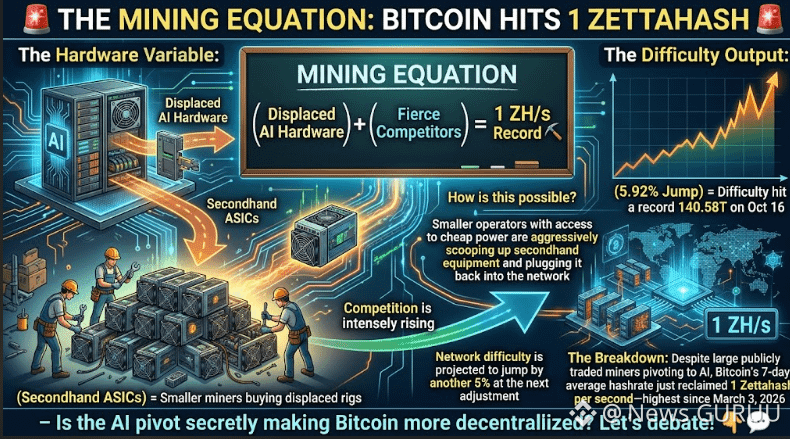
🚨 ¡BITCOIN ALCANZA 1 ZETTAHASH! ⛏️
¡El hashrate promedio de Bitcoin en 7 días ha recuperado 1 ZH/s, a pesar de que los grandes mineros están migrando hacia la IA! 🚀
📈 La dificultad de minería alcanzó 140.58T, un aumento del 5.92%.
⚡ Los mineros más pequeños están comprando ASIC de segunda mano y aprovechando la electricidad barata para seguir siendo competitivos.
🤔 ¿La IA está haciendo que la minería de Bitcoin esté más descentralizada? ¡Debatámoslo! 👇."HAZ CLIC EN LA ETIQUETA AMARILLA DE LA MONEDA DE ABAJO PARA IR A LA PÁGINA DE TRADING DESEADA Y OBTENER BENEFICIOS AL OPERAR"$BTC $AKE $MAGMA
{future}(MAGMAUSDT)
{future}(AKEUSDT)
{spot}(BTCUSDT)
#bitcoinhashratehitssevenmonthhigh #AKE #Bitcoinmining
🚨 ¡BITCOIN ALCANZA 1 ZETTAHASH! ⛏️
¡El hashrate promedio de Bitcoin en 7 días ha recuperado 1 ZH/s, a pesar de que los grandes mineros están migrando hacia la IA! 🚀
📈 La dificultad de minería alcanzó 140.58T, un aumento del 5.92%.
⚡ Los mineros más pequeños están comprando ASIC de segunda mano y aprovechando la electricidad barata para seguir siendo competitivos.
🤔 ¿La IA está haciendo que la minería de Bitcoin esté más descentralizada? ¡Debatámoslo! 👇."HAZ CLIC EN LA ETIQUETA AMARILLA DE LA MONEDA DE ABAJO PARA IR A LA PÁGINA DE TRADING DESEADA Y OBTENER BENEFICIOS AL OPERAR"$BTC $AKE $MAGMA
🚨 ¡BITCOIN ALCANZA 1 ZETTAHASH! ⛏️
¡El hashrate promedio de Bitcoin en 7 días ha recuperado 1 ZH/s, a pesar de que los grandes mineros están migrando hacia la IA! 🚀
📈 La dificultad de minería alcanzó 140.58T, un aumento del 5.92%.
⚡ Los mineros más pequeños están comprando ASIC de segunda mano y aprovechando la electricidad barata para seguir siendo competitivos.
🤔 ¿La IA está haciendo que la minería de Bitcoin esté más descentralizada? ¡Debatámoslo! 👇."HAZ CLIC EN LA ETIQUETA AMARILLA DE LA MONEDA DE ABAJO PARA IR A LA PÁGINA DE TRADING DESEADA Y OBTENER BENEFICIOS AL OPERAR"$BTC $AKE $MAGMA
2
214

#BitcoinHashrateHitsSevenMonthHigh
🚨 ¡La tasa de hash de Bitcoin alcanza su máximo en siete meses!
La tasa de hash de la red Bitcoin ha subido a su nivel más alto en siete meses, lo que indica una mayor capacidad de procesamiento y un aumento de la actividad minera en toda la red. ⛏️⚡
Por lo general, una tasa de hash más alta significa una mayor seguridad de la red, pero también implica una competencia más intensa para los mineros de Bitcoin.
Curiosamente, esto ocurre mientras algunas de las principales empresas mineras están trasladando parte de su capacidad de procesamiento a la IA y a la computación de alto rendimiento (HPC).
Mayor tasa de hash = Red Bitcoin más sólida + Más competencia minera
Pero recuerda: un aumento de la tasa de hash no significa necesariamente que el precio de BTC vaya a subir de inmediato. Principalmente, es una señal de solidez de los fundamentos de la red Bitcoin.
#Bitcoin #BTC #BitcoinMining #BitcoinHashrateHitsSevenMonthHigh $XAU
#BitcoinHashrateHitsSevenMonthHigh
🚨 ¡La tasa de hash de Bitcoin alcanza su máximo en siete meses!
La tasa de hash de la red Bitcoin ha subido a su nivel más alto en siete meses, lo que indica una mayor capacidad de procesamiento y un aumento de la actividad minera en toda la red. ⛏️⚡
Por lo general, una tasa de hash más alta significa una mayor seguridad de la red, pero también implica una competencia más intensa para los mineros de Bitcoin.
Curiosamente, esto ocurre mientras algunas de las principales empresas mineras están trasladando parte de su capacidad de procesamiento a la IA y a la computación de alto rendimiento (HPC).
Mayor tasa de hash = Red Bitcoin más sólida + Más competencia minera
Pero recuerda: un aumento de la tasa de hash no significa necesariamente que el precio de BTC vaya a subir de inmediato. Principalmente, es una señal de solidez de los fundamentos de la red Bitcoin.
#Bitcoin #BTC #BitcoinMining #BitcoinHashrateHitsSevenMonthHigh $XAU
🚨 ¡La tasa de hash de Bitcoin alcanza su máximo en siete meses!
La tasa de hash de la red Bitcoin ha subido a su nivel más alto en siete meses, lo que indica una mayor capacidad de procesamiento y un aumento de la actividad minera en toda la red. ⛏️⚡
Por lo general, una tasa de hash más alta significa una mayor seguridad de la red, pero también implica una competencia más intensa para los mineros de Bitcoin.
Curiosamente, esto ocurre mientras algunas de las principales empresas mineras están trasladando parte de su capacidad de procesamiento a la IA y a la computación de alto rendimiento (HPC).
Mayor tasa de hash = Red Bitcoin más sólida + Más competencia minera
Pero recuerda: un aumento de la tasa de hash no significa necesariamente que el precio de BTC vaya a subir de inmediato. Principalmente, es una señal de solidez de los fundamentos de la red Bitcoin.
#Bitcoin #BTC #BitcoinMining #BitcoinHashrateHitsSevenMonthHigh $XAU
64
·
--
#ElHashrateDeBitcoinAlcanzaUnMáximoDeSieteMeses
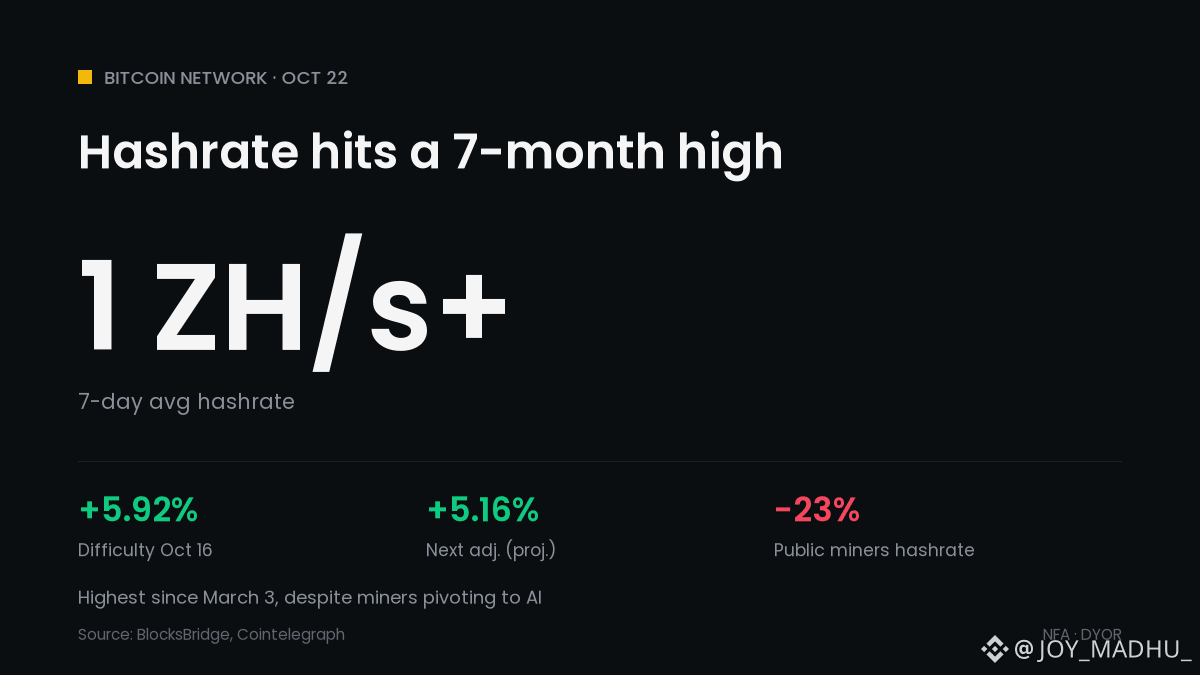
⛏️ El hashrate de Bitcoin vuelve a superar 1 ZH/s, su nivel más alto desde marzo
📊 El promedio de hashrate de 7 días superó los 1.000 EH/s el 22 de oct. (BlocksBridge Miner Weekly)
📅 Su nivel más alto desde el 3 de marzo
📈 La dificultad aumentó un 5,92 % el 16 de oct., y se proyecta otra subida de aproximadamente un 5,16 %
⚠️ Eso supondría cerca de un 11,4 % en dos ajustes consecutivos
📉 Sin embargo, el hashrate efectivo de los mineros cotizados cayó un 23 % al destinar energía a la IA
💻 Sus ingresos por IA y computación de alto rendimiento (HPC) aumentaron un 52 % en un trimestre
🔁 Puede que los mineros más pequeños que compran equipos usados estén cubriendo la brecha
Qué significa para las criptomonedas: un mayor hashrate hace que atacar la red $BTC sea más costoso. Pero, con BTC cerca de los 81,7 mil dólares, la mayor competencia reduce los márgenes de los mineros.
¿Los mineros se están pasando a la IA o Bitcoin simplemente está atrayendo a nuevos mineros? 👇
$BTC
#CryptoNews #BitcoinMining #Hashrate #ElHashrateDeBitcoinAlcanzaUnMáximoDeSieteMeses
#ElHashrateDeBitcoinAlcanzaUnMáximoDeSieteMeses
⛏️ El hashrate de Bitcoin vuelve a superar 1 ZH/s, su nivel más alto desde marzo
📊 El promedio de hashrate de 7 días superó los 1.000 EH/s el 22 de oct. (BlocksBridge Miner Weekly)
📅 Su nivel más alto desde el 3 de marzo
📈 La dificultad aumentó un 5,92 % el 16 de oct., y se proyecta otra subida de aproximadamente un 5,16 %
⚠️ Eso supondría cerca de un 11,4 % en dos ajustes consecutivos
📉 Sin embargo, el hashrate efectivo de los mineros cotizados cayó un 23 % al destinar energía a la IA
💻 Sus ingresos por IA y computación de alto rendimiento (HPC) aumentaron un 52 % en un trimestre
🔁 Puede que los mineros más pequeños que compran equipos usados estén cubriendo la brecha
Qué significa para las criptomonedas: un mayor hashrate hace que atacar la red $BTC sea más costoso. Pero, con BTC cerca de los 81,7 mil dólares, la mayor competencia reduce los márgenes de los mineros.
¿Los mineros se están pasando a la IA o Bitcoin simplemente está atrayendo a nuevos mineros? 👇
$BTC
#CryptoNews #BitcoinMining #Hashrate #ElHashrateDeBitcoinAlcanzaUnMáximoDeSieteMeses
⛏️ El hashrate de Bitcoin vuelve a superar 1 ZH/s, su nivel más alto desde marzo
📊 El promedio de hashrate de 7 días superó los 1.000 EH/s el 22 de oct. (BlocksBridge Miner Weekly)
📅 Su nivel más alto desde el 3 de marzo
📈 La dificultad aumentó un 5,92 % el 16 de oct., y se proyecta otra subida de aproximadamente un 5,16 %
⚠️ Eso supondría cerca de un 11,4 % en dos ajustes consecutivos
📉 Sin embargo, el hashrate efectivo de los mineros cotizados cayó un 23 % al destinar energía a la IA
💻 Sus ingresos por IA y computación de alto rendimiento (HPC) aumentaron un 52 % en un trimestre
🔁 Puede que los mineros más pequeños que compran equipos usados estén cubriendo la brecha
Qué significa para las criptomonedas: un mayor hashrate hace que atacar la red $BTC sea más costoso. Pero, con BTC cerca de los 81,7 mil dólares, la mayor competencia reduce los márgenes de los mineros.
¿Los mineros se están pasando a la IA o Bitcoin simplemente está atrayendo a nuevos mineros? 👇
$BTC
#CryptoNews #BitcoinMining #Hashrate #ElHashrateDeBitcoinAlcanzaUnMáximoDeSieteMeses
47

·
--
⚠️ ACTUALIZACIÓN DEL SERVICIO BINANCE POOL: FECHA LÍMITE DEL 10 DE NOVIEMBRE
Binance ha anunciado que Binance Pool y los servicios relacionados dejarán de estar disponibles el 10 de noviembre de 2026. Estos incluyen Pool Savings, Cloud Mining, Transaction Accelerator y funciones relacionadas.
📌 Si utilizas alguno de los servicios afectados, consulta el aviso oficial y planifica con antelación.
Este cambio afecta a servicios específicos relacionados con Pool; no supone el cierre del exchange de Binance.
💬 ¿Has usado alguna vez un pool de minería o prefieres otras formas de participar en el mundo de las criptomonedas?
¡Comparte tu opinión abajo! 👇
#EarningsSeason
#Binance #CryptoNews #BinanceSquare #BitcoinMining
⚠️ ACTUALIZACIÓN DEL SERVICIO BINANCE POOL: FECHA LÍMITE DEL 10 DE NOVIEMBRE
Binance ha anunciado que Binance Pool y los servicios relacionados dejarán de estar disponibles el 10 de noviembre de 2026. Estos incluyen Pool Savings, Cloud Mining, Transaction Accelerator y funciones relacionadas.
📌 Si utilizas alguno de los servicios afectados, consulta el aviso oficial y planifica con antelación.
Este cambio afecta a servicios específicos relacionados con Pool; no supone el cierre del exchange de Binance.
💬 ¿Has usado alguna vez un pool de minería o prefieres otras formas de participar en el mundo de las criptomonedas?
¡Comparte tu opinión abajo! 👇
#EarningsSeason
#Binance #CryptoNews #BinanceSquare #BitcoinMining
Binance ha anunciado que Binance Pool y los servicios relacionados dejarán de estar disponibles el 10 de noviembre de 2026. Estos incluyen Pool Savings, Cloud Mining, Transaction Accelerator y funciones relacionadas.
📌 Si utilizas alguno de los servicios afectados, consulta el aviso oficial y planifica con antelación.
Este cambio afecta a servicios específicos relacionados con Pool; no supone el cierre del exchange de Binance.
💬 ¿Has usado alguna vez un pool de minería o prefieres otras formas de participar en el mundo de las criptomonedas?
¡Comparte tu opinión abajo! 👇
#EarningsSeason
#Binance #CryptoNews #BinanceSquare #BitcoinMining
78
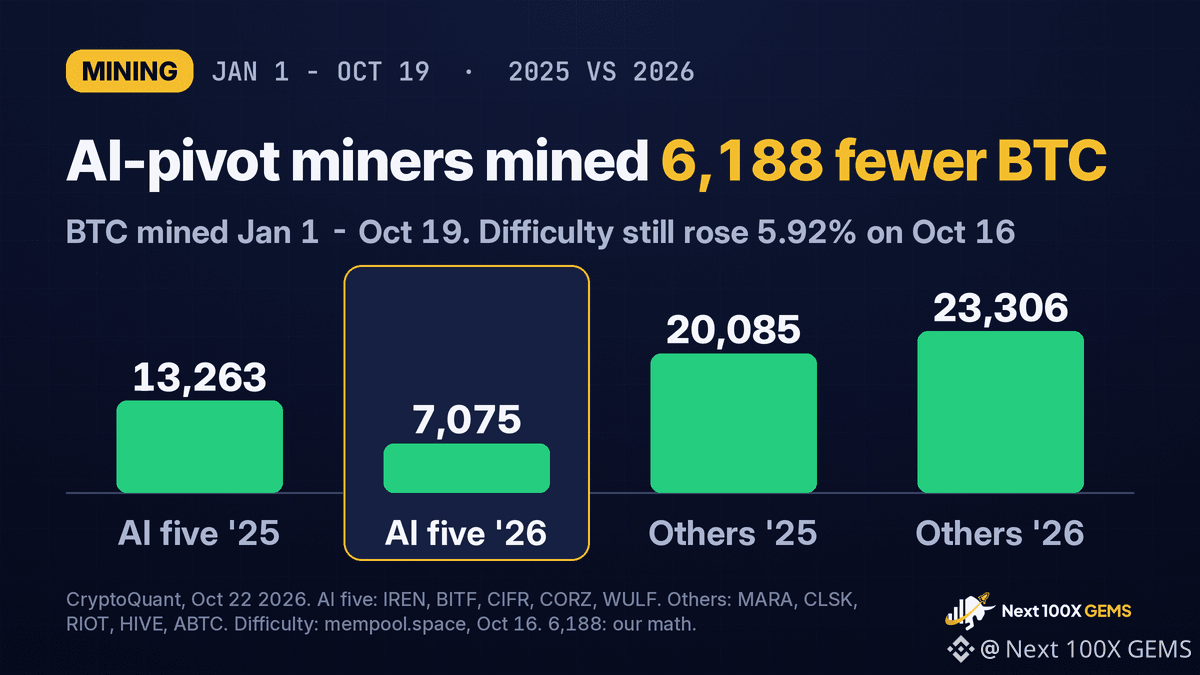
Cinco mineras de bitcoin que cotizan en bolsa trasladaron capacidad eléctrica a la IA y minaron 6.188 BTC menos entre el 1 de enero y el 19 de octubre que durante el mismo período de 2025. La minería, además, se volvió más difícil.
Las cifras de CryptoQuant: IREN, Bitfarms, Cipher, Core Scientific y TeraWulf pasaron de 13.263 BTC a 7.075, una caída del 47 %, al firmar importantes contratos de arrendamiento para IA y HPC. Cinco mineras que siguieron centradas en bitcoin (MARA, CleanSpark, Riot, HIVE y American Bitcoin) pasaron de 20.085 a 23.306. Eso supone 3.221 BTC más, cerca de la mitad de lo que dejó de producir el grupo de IA.
La red no perdió ritmo. La dificultad subió un 5,92 % el 16 de octubre, hasta 140,58 T, el mayor salto desde finales de junio y el nivel más alto desde principios de marzo, según mempool.space. Su estimación actual para el próximo ajuste, alrededor del 30 de octubre, es de aproximadamente un +3,6 %. Según CryptoQuant, el hashrate promedio de 30 días está cerca de un 8,8 % por debajo de su máximo histórico, después de situarse un 18,3 % por debajo en agosto.
Así que la potencia de hash que desconectaron las empresas que se pasaron a la IA ha sido reemplazada, y más, por máquinas ajenas a ese grupo. Para los tenedores de $BTC , una red más difícil es una buena noticia. Para las mineras que siguen operando, producir cada moneda acaba de encarecerse.
#Bitcoin #MineríaDeBitcoin
Esto no es asesoramiento financiero. Investiga por tu cuenta.
Cinco mineras de bitcoin que cotizan en bolsa trasladaron capacidad eléctrica a la IA y minaron 6.188 BTC menos entre el 1 de enero y el 19 de octubre que durante el mismo período de 2025. La minería, además, se volvió más difícil.
Las cifras de CryptoQuant: IREN, Bitfarms, Cipher, Core Scientific y TeraWulf pasaron de 13.263 BTC a 7.075, una caída del 47 %, al firmar importantes contratos de arrendamiento para IA y HPC. Cinco mineras que siguieron centradas en bitcoin (MARA, CleanSpark, Riot, HIVE y American Bitcoin) pasaron de 20.085 a 23.306. Eso supone 3.221 BTC más, cerca de la mitad de lo que dejó de producir el grupo de IA.
La red no perdió ritmo. La dificultad subió un 5,92 % el 16 de octubre, hasta 140,58 T, el mayor salto desde finales de junio y el nivel más alto desde principios de marzo, según mempool.space. Su estimación actual para el próximo ajuste, alrededor del 30 de octubre, es de aproximadamente un +3,6 %. Según CryptoQuant, el hashrate promedio de 30 días está cerca de un 8,8 % por debajo de su máximo histórico, después de situarse un 18,3 % por debajo en agosto.
Así que la potencia de hash que desconectaron las empresas que se pasaron a la IA ha sido reemplazada, y más, por máquinas ajenas a ese grupo. Para los tenedores de $BTC , una red más difícil es una buena noticia. Para las mineras que siguen operando, producir cada moneda acaba de encarecerse.
#Bitcoin #MineríaDeBitcoin
Esto no es asesoramiento financiero. Investiga por tu cuenta.
Las cifras de CryptoQuant: IREN, Bitfarms, Cipher, Core Scientific y TeraWulf pasaron de 13.263 BTC a 7.075, una caída del 47 %, al firmar importantes contratos de arrendamiento para IA y HPC. Cinco mineras que siguieron centradas en bitcoin (MARA, CleanSpark, Riot, HIVE y American Bitcoin) pasaron de 20.085 a 23.306. Eso supone 3.221 BTC más, cerca de la mitad de lo que dejó de producir el grupo de IA.
La red no perdió ritmo. La dificultad subió un 5,92 % el 16 de octubre, hasta 140,58 T, el mayor salto desde finales de junio y el nivel más alto desde principios de marzo, según mempool.space. Su estimación actual para el próximo ajuste, alrededor del 30 de octubre, es de aproximadamente un +3,6 %. Según CryptoQuant, el hashrate promedio de 30 días está cerca de un 8,8 % por debajo de su máximo histórico, después de situarse un 18,3 % por debajo en agosto.
Así que la potencia de hash que desconectaron las empresas que se pasaron a la IA ha sido reemplazada, y más, por máquinas ajenas a ese grupo. Para los tenedores de $BTC , una red más difícil es una buena noticia. Para las mineras que siguen operando, producir cada moneda acaba de encarecerse.
#Bitcoin #MineríaDeBitcoin
Esto no es asesoramiento financiero. Investiga por tu cuenta.
1
209

·
--
¡Llegó la reforma de la revisión ambiental en Estados Unidos! Ambos partidos impulsan políticas para acelerar los procesos de aprobación de minas. Es una gran noticia para el sector de la minería de criptomonedas, especialmente para los mineros de Bitcoin. Aunque las aprobaciones serán más rápidas, los desafíos persisten. 🔥
¡Llegó la reforma de la revisión ambiental en Estados Unidos! Ambos partidos impulsan medidas para acelerar los procesos de aprobación de minas. Una gran noticia para el sector de la minería de criptomonedas, especialmente para los mineros de Bitcoin. Aunque las aprobaciones serán más rápidas, los desafíos persisten. 🔥
#CryptoMining #BitcoinMining $BTC #Bitcoin
¡Llegó la reforma de la revisión ambiental en Estados Unidos! Ambos partidos impulsan políticas para acelerar los procesos de aprobación de minas. Es una gran noticia para el sector de la minería de criptomonedas, especialmente para los mineros de Bitcoin. Aunque las aprobaciones serán más rápidas, los desafíos persisten. 🔥
¡Llegó la reforma de la revisión ambiental en Estados Unidos! Ambos partidos impulsan medidas para acelerar los procesos de aprobación de minas. Una gran noticia para el sector de la minería de criptomonedas, especialmente para los mineros de Bitcoin. Aunque las aprobaciones serán más rápidas, los desafíos persisten. 🔥
#CryptoMining #BitcoinMining $BTC #Bitcoin
¡Llegó la reforma de la revisión ambiental en Estados Unidos! Ambos partidos impulsan medidas para acelerar los procesos de aprobación de minas. Una gran noticia para el sector de la minería de criptomonedas, especialmente para los mineros de Bitcoin. Aunque las aprobaciones serán más rápidas, los desafíos persisten. 🔥
#CryptoMining #BitcoinMining $BTC #Bitcoin
197

·
--
⚡ ¡UN ENFRENTAMIENTO LEGAL EN ARKANSAS PODRÍA CAMBIAR TODO EL PANORAMA DE LA MINERÍA $BTC ! 🏛️
Arkansas está librando una batalla ante el Tribunal de Apelaciones del Octavo Circuito para hacer cumplir estrictas prohibiciones que impiden a entidades de propiedad extranjera adquirir participaciones en la infraestructura minera local. Las autoridades estatales se oponen firmemente a las pretensiones de preeminencia federal y presentan el territorio dedicado a la minería de activos digitales como una cuestión de seguridad estatal. 🔍
La infraestructura minera institucional se está convirtiendo discretamente en el próximo gran campo de batalla regulatorio en todo Estados Unidos. 💡 A medida que los estados refuerzan su control sobre el hardware físico y la asignación de energía, el mapa de la tasa de hash podría experimentar una reestructuración importante. 💬 ¿Crees que las restricciones estatales trasladarán la potencia minera al extranjero o fortalecerán las redes nacionales? 👇
⚠️ Esto no es asesoramiento financiero. Gestiona siempre tus riesgos. 🛡️
🏷️ #BTC #BitcoinMining #CryptoRegulation #Mining
🦈 ⚡
⚡ ¡UN ENFRENTAMIENTO LEGAL EN ARKANSAS PODRÍA CAMBIAR TODO EL PANORAMA DE LA MINERÍA $BTC ! 🏛️
Arkansas está librando una batalla ante el Tribunal de Apelaciones del Octavo Circuito para hacer cumplir estrictas prohibiciones que impiden a entidades de propiedad extranjera adquirir participaciones en la infraestructura minera local. Las autoridades estatales se oponen firmemente a las pretensiones de preeminencia federal y presentan el territorio dedicado a la minería de activos digitales como una cuestión de seguridad estatal. 🔍
La infraestructura minera institucional se está convirtiendo discretamente en el próximo gran campo de batalla regulatorio en todo Estados Unidos. 💡 A medida que los estados refuerzan su control sobre el hardware físico y la asignación de energía, el mapa de la tasa de hash podría experimentar una reestructuración importante. 💬 ¿Crees que las restricciones estatales trasladarán la potencia minera al extranjero o fortalecerán las redes nacionales? 👇
⚠️ Esto no es asesoramiento financiero. Gestiona siempre tus riesgos. 🛡️
🏷️ #BTC #BitcoinMining #CryptoRegulation #Mining
🦈 ⚡
Arkansas está librando una batalla ante el Tribunal de Apelaciones del Octavo Circuito para hacer cumplir estrictas prohibiciones que impiden a entidades de propiedad extranjera adquirir participaciones en la infraestructura minera local. Las autoridades estatales se oponen firmemente a las pretensiones de preeminencia federal y presentan el territorio dedicado a la minería de activos digitales como una cuestión de seguridad estatal. 🔍
La infraestructura minera institucional se está convirtiendo discretamente en el próximo gran campo de batalla regulatorio en todo Estados Unidos. 💡 A medida que los estados refuerzan su control sobre el hardware físico y la asignación de energía, el mapa de la tasa de hash podría experimentar una reestructuración importante. 💬 ¿Crees que las restricciones estatales trasladarán la potencia minera al extranjero o fortalecerán las redes nacionales? 👇
⚠️ Esto no es asesoramiento financiero. Gestiona siempre tus riesgos. 🛡️
🏷️ #BTC #BitcoinMining #CryptoRegulation #Mining
🦈 ⚡
4

·
--
Artículo
La tasa de hash de Bitcoin alcanza un nuevo máximo mientras los mineros aumentan sus tenencias de BTCLa fortaleza de la red aumenta, pero la economía de la minería cuenta otra historia
Un indicador de Bitcoin que estoy siguiendo de cerca ahora mismo es la tasa de hash de la red.
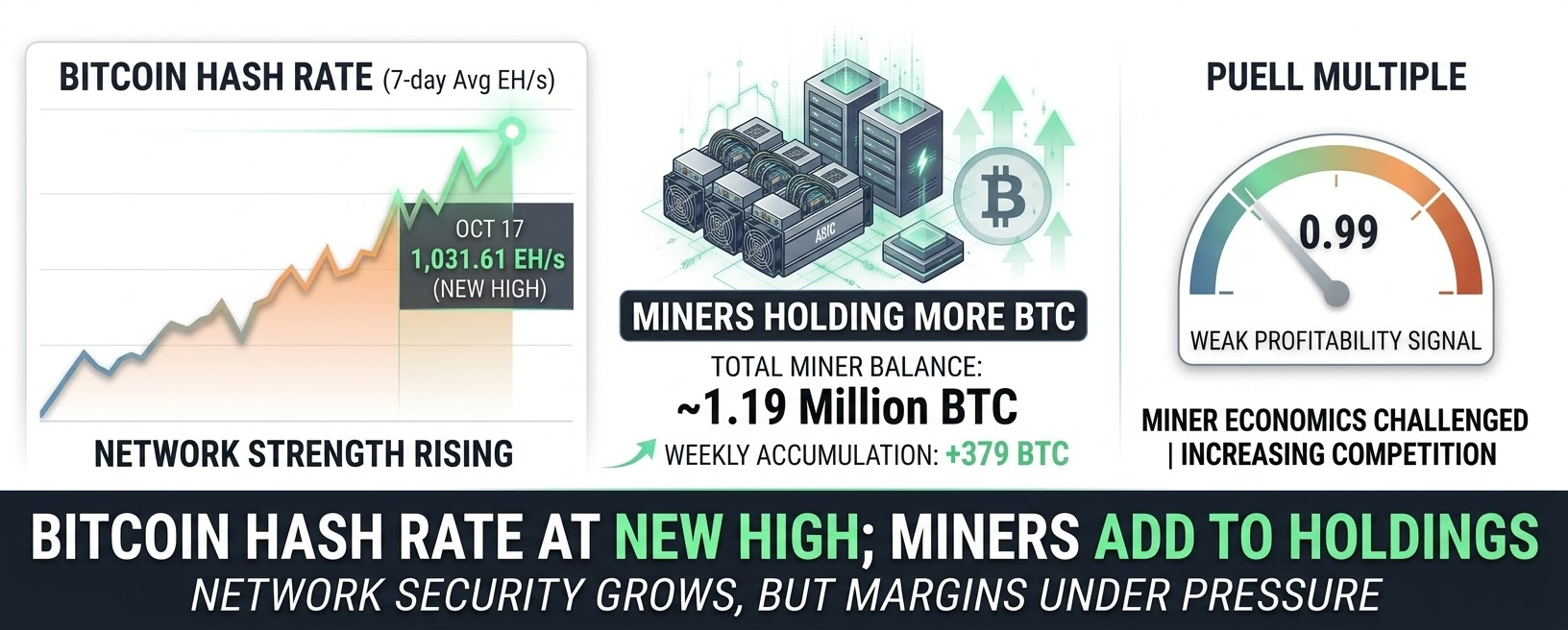
El promedio de siete días alcanzó los 1.031,61 EH/s el 17 de octubre, su nivel más alto desde el 29 de mayo. A primera vista, esto parece una señal clara de que la red se está fortaleciendo. Se está destinando más potencia de cálculo a proteger Bitcoin, y los mineros siguen operando a gran escala.
Pero lo más interesante es lo que ocurrió junto con ese aumento.
Los mineros de Bitcoin añadieron en conjunto 379 BTC a sus tenencias durante la última semana, lo que elevó su saldo combinado a aproximadamente 1,19 millones de BTC. Esto sugiere que, como grupo, los mineros no se han apresurado a reducir su exposición a Bitcoin pese a la presión generalizada del mercado.
La tasa de hash de Bitcoin alcanza un nuevo máximo mientras los mineros aumentan sus tenencias de BTC
La fortaleza de la red aumenta, pero la economía de la minería cuenta otra historia
Un indicador de Bitcoin que estoy siguiendo de cerca ahora mismo es la tasa de hash de la red.
El promedio de siete días alcanzó los 1.031,61 EH/s el 17 de octubre, su nivel más alto desde el 29 de mayo. A primera vista, esto parece una señal clara de que la red se está fortaleciendo. Se está destinando más potencia de cálculo a proteger Bitcoin, y los mineros siguen operando a gran escala.
Pero lo más interesante es lo que ocurrió junto con ese aumento.
Los mineros de Bitcoin añadieron en conjunto 379 BTC a sus tenencias durante la última semana, lo que elevó su saldo combinado a aproximadamente 1,19 millones de BTC. Esto sugiere que, como grupo, los mineros no se han apresurado a reducir su exposición a Bitcoin pese a la presión generalizada del mercado.
Un indicador de Bitcoin que estoy siguiendo de cerca ahora mismo es la tasa de hash de la red.
El promedio de siete días alcanzó los 1.031,61 EH/s el 17 de octubre, su nivel más alto desde el 29 de mayo. A primera vista, esto parece una señal clara de que la red se está fortaleciendo. Se está destinando más potencia de cálculo a proteger Bitcoin, y los mineros siguen operando a gran escala.
Pero lo más interesante es lo que ocurrió junto con ese aumento.
Los mineros de Bitcoin añadieron en conjunto 379 BTC a sus tenencias durante la última semana, lo que elevó su saldo combinado a aproximadamente 1,19 millones de BTC. Esto sugiere que, como grupo, los mineros no se han apresurado a reducir su exposición a Bitcoin pese a la presión generalizada del mercado.
3
425
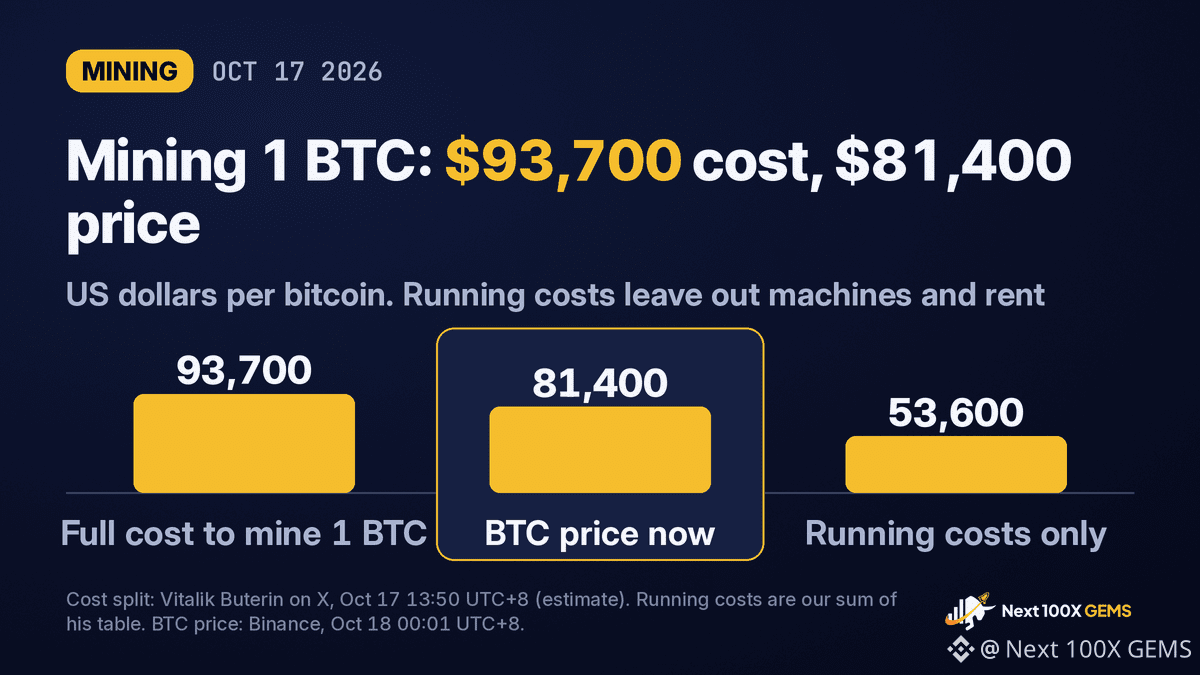
Vitalik Buterin publicó el 17 de octubre un desglose de costos que sitúa el costo total de minar un bitcoin en unos $93,700. Esta noche, bitcoin cotiza cerca de los $81,400.
Su tabla desglosa el costo por moneda: hardware, unos $37,600, incluido el financiamiento; electricidad para las máquinas, $40,600; otros gastos de energía, $2,400; mano de obra, $3,200; alquiler de las instalaciones, unos $2,500; y unos $7,400 en mantenimiento, seguros, impuestos y ancho de banda. Lo publicó para compararlo con la inferencia de IA, donde el hardware representa cerca del 76% del costo y la energía, solo el 4%.
Comparamos sus cifras con el precio. Todo, excepto las máquinas y el edificio, suma $53,600 por moneda, así que el precio actual todavía cubre los costos operativos y deja unos $27,800 de margen. El hardware y el alquiler cuestan $40,100. Eso deja cada nueva moneda unos $12,300 por debajo del costo total, aproximadamente un 13%.
Estas son sus estimaciones, y cada minero paga un precio distinto por la electricidad. Según su tabla, minar con bitcoin a $81,400 cubre las facturas, pero no permite recuperar el costo de los equipos.
$BTC
#Bitcoin #BitcoinMining
No es asesoramiento financiero. Investiga por tu cuenta.
Vitalik Buterin publicó el 17 de octubre un desglose de costos que sitúa el costo total de minar un bitcoin en unos $93,700. Esta noche, bitcoin cotiza cerca de los $81,400.
Su tabla desglosa el costo por moneda: hardware, unos $37,600, incluido el financiamiento; electricidad para las máquinas, $40,600; otros gastos de energía, $2,400; mano de obra, $3,200; alquiler de las instalaciones, unos $2,500; y unos $7,400 en mantenimiento, seguros, impuestos y ancho de banda. Lo publicó para compararlo con la inferencia de IA, donde el hardware representa cerca del 76% del costo y la energía, solo el 4%.
Comparamos sus cifras con el precio. Todo, excepto las máquinas y el edificio, suma $53,600 por moneda, así que el precio actual todavía cubre los costos operativos y deja unos $27,800 de margen. El hardware y el alquiler cuestan $40,100. Eso deja cada nueva moneda unos $12,300 por debajo del costo total, aproximadamente un 13%.
Estas son sus estimaciones, y cada minero paga un precio distinto por la electricidad. Según su tabla, minar con bitcoin a $81,400 cubre las facturas, pero no permite recuperar el costo de los equipos.
$BTC
#Bitcoin #BitcoinMining
No es asesoramiento financiero. Investiga por tu cuenta.
Su tabla desglosa el costo por moneda: hardware, unos $37,600, incluido el financiamiento; electricidad para las máquinas, $40,600; otros gastos de energía, $2,400; mano de obra, $3,200; alquiler de las instalaciones, unos $2,500; y unos $7,400 en mantenimiento, seguros, impuestos y ancho de banda. Lo publicó para compararlo con la inferencia de IA, donde el hardware representa cerca del 76% del costo y la energía, solo el 4%.
Comparamos sus cifras con el precio. Todo, excepto las máquinas y el edificio, suma $53,600 por moneda, así que el precio actual todavía cubre los costos operativos y deja unos $27,800 de margen. El hardware y el alquiler cuestan $40,100. Eso deja cada nueva moneda unos $12,300 por debajo del costo total, aproximadamente un 13%.
Estas son sus estimaciones, y cada minero paga un precio distinto por la electricidad. Según su tabla, minar con bitcoin a $81,400 cubre las facturas, pero no permite recuperar el costo de los equipos.
$BTC
#Bitcoin #BitcoinMining
No es asesoramiento financiero. Investiga por tu cuenta.
181

·
--
🚨 La dificultad de minería de Bitcoin aumentó un 5,92 % y alcanzó un máximo de siete meses de 140.58T, lo que indica una mayor seguridad de la red y el compromiso de los mineros. Esto suele reflejar confianza en el valor a largo plazo de BTC y podría reducir la presión vendedora de los mineros. Presta atención a las tendencias de la tasa de hash y a los cambios en los ingresos de los mineros. ¿Podría esto respaldar una fase de acumulación de BTC?
#MineríaBitcoin
$BTC #TradingSignal #AnálisisCripto
🚨 La dificultad de minería de Bitcoin aumentó un 5,92 % y alcanzó un máximo de siete meses de 140.58T, lo que indica una mayor seguridad de la red y el compromiso de los mineros. Esto suele reflejar confianza en el valor a largo plazo de BTC y podría reducir la presión vendedora de los mineros. Presta atención a las tendencias de la tasa de hash y a los cambios en los ingresos de los mineros. ¿Podría esto respaldar una fase de acumulación de BTC?
#MineríaBitcoin
$BTC #TradingSignal #AnálisisCripto
#MineríaBitcoin
$BTC #TradingSignal #AnálisisCripto

79

🚨 ¡USUARIOS DE BINANCE, GRAN NOTICIA! ⚠️
🔥 Binance ha anunciado el cierre de sus servicios de Pool, previsto para el 10 de noviembre de 2026. Los mineros deberían prepararse para cambiarse a otro pool antes de la fecha límite.
👀 ¿Crees que Binance está orientando su enfoque hacia la IA y nuevos productos de trading?
#Binance #CryptoNews #BitcoinMining #BTC
🚨 ¡USUARIOS DE BINANCE, GRAN NOTICIA! ⚠️
🔥 Binance ha anunciado el cierre de sus servicios de Pool, previsto para el 10 de noviembre de 2026. Los mineros deberían prepararse para cambiarse a otro pool antes de la fecha límite.
👀 ¿Crees que Binance está orientando su enfoque hacia la IA y nuevos productos de trading?
#Binance #CryptoNews #BitcoinMining #BTC
🔥 Binance ha anunciado el cierre de sus servicios de Pool, previsto para el 10 de noviembre de 2026. Los mineros deberían prepararse para cambiarse a otro pool antes de la fecha límite.
👀 ¿Crees que Binance está orientando su enfoque hacia la IA y nuevos productos de trading?
#Binance #CryptoNews #BitcoinMining #BTC
64
Inicia sesión para explorar más contenidos
Únete a usuarios globales de criptomonedas en Binance Square
⚡️ Obtén información útil y actualizada sobre criptos.
💬 Avalado por el mayor exchange de criptomonedas en el mundo.
👍 Descubre perspectivas reales de creadores verificados.
Email/número de teléfono
Temas populares
1
#BinancePick
3.2M vistas
156,265 están debatiendo
2
#EarningsSeason
5.4M vistas
26,186 están debatiendo
3
#SouthKoreaConsidersEducationTaxOnCryptoExchanges
0 vistas
2 están debatiendo
4
#OCCUrgesCommunityBanksToEnterStablecoinPayments
0 vistas
0 están debatiendo
5
#RippleWinsFullApprovalAsNationalTrustBank
0 vistas
1 están debatiendo
6
#OndoToOpenSubscriptionsForOpenAIPreIPOTokenizedNotes
0 vistas
0 están debatiendo
7
#AnthropicTTMRevenueGrewAbout1200%
40,636 vistas
491 están debatiendo
8
#AnthropicS1ExpectedToday
33,379 vistas
382 están debatiendo
9
#SouthKoreaReportedlyWeighsFourthCryptoTaxDelay
35,527 vistas
513 están debatiendo
10
#FranklinTempletonFilesForTwoDividendToBitcoinETFs
46,947 vistas
588 están debatiendo