
马克Mark-
4.3k Posts
马克Mark-
Report
Block User
👑 公众号《下雨时刻》精准策略🔸跟单进群🔹实盘交易
15 Following
5.4K+ Followers
1.3K+ Liked
Posts
All
Live
PINNED
·
--
[点击进入马克粉丝策略基地](https://app.binance.com/uni-qr/E2JiVJB8)
Binance chat room, the private chat feature is fully enabled!
1-on-1, secure and private—start chatting directly.
Want to cut losses, trade breakouts/bands, play long-term or short-term, and seize opportunities to make a comeback?
👉🏻 Scan the QR code and add me directly.
👉🏻 Search for my ID in the platform: 1268844076—you can find me there too
点击进入马克粉丝策略基地
Binance chat room, the private chat feature is fully enabled!
1-on-1, secure and private—start chatting directly.
Want to cut losses, trade breakouts/bands, play long-term or short-term, and seize opportunities to make a comeback?
👉🏻 Scan the QR code and add me directly.
👉🏻 Search for my ID in the platform: 1268844076—you can find me there too
Binance chat room, the private chat feature is fully enabled!
1-on-1, secure and private—start chatting directly.
Want to cut losses, trade breakouts/bands, play long-term or short-term, and seize opportunities to make a comeback?
👉🏻 Scan the QR code and add me directly.
👉🏻 Search for my ID in the platform: 1268844076—you can find me there too

1
94
·
--
Bearish
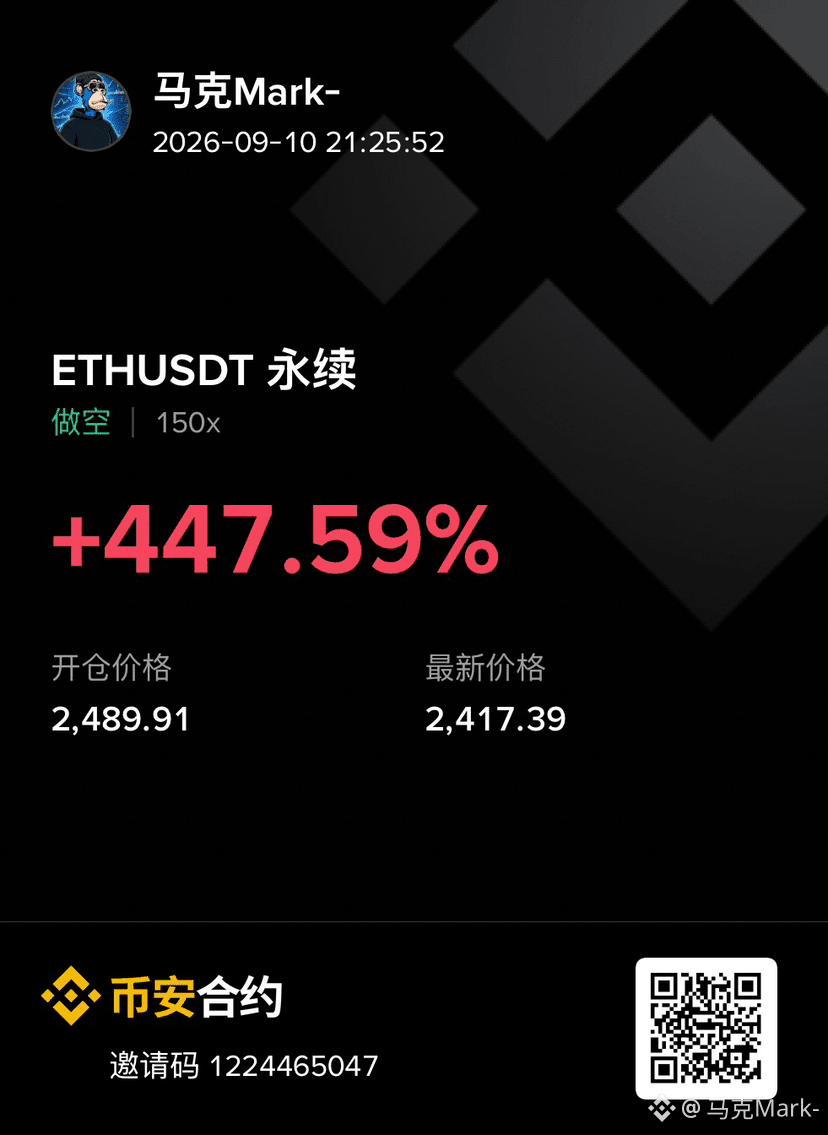
This $ETH empty order, with 150x leverage, ended up netting a +447.59% return. Honestly, when it opened at 2489.91, my heartbeat was still racing. $ZEC
At the time, the market felt like “the advance lacked strength.” The bulls hesitated before the 2500 level, yet volume couldn’t keep up. Many people were still chasing longs at a spot like that, but I thought it was actually an excellent place to try a short. I dared to go 150x because the stop loss was set extremely tight—if it broke the level, I ran, no holding the position. $BTC
When the price fell to 2417.39, the unrealized profit expanded quickly. High leverage really tests people’s nature—I didn’t get greedy. Seeing the gains multiply more than fourfold, I gradually locked in profits. The crypto world has no shortage of overnight-fortune myths; what it lacks are ways to actually take the money with you. This trade was great, but next time I’ll still maintain respect. #苹果发布首款折叠屏手机
This $ETH empty order, with 150x leverage, ended up netting a +447.59% return. Honestly, when it opened at 2489.91, my heartbeat was still racing. $ZEC
At the time, the market felt like “the advance lacked strength.” The bulls hesitated before the 2500 level, yet volume couldn’t keep up. Many people were still chasing longs at a spot like that, but I thought it was actually an excellent place to try a short. I dared to go 150x because the stop loss was set extremely tight—if it broke the level, I ran, no holding the position. $BTC
When the price fell to 2417.39, the unrealized profit expanded quickly. High leverage really tests people’s nature—I didn’t get greedy. Seeing the gains multiply more than fourfold, I gradually locked in profits. The crypto world has no shortage of overnight-fortune myths; what it lacks are ways to actually take the money with you. This trade was great, but next time I’ll still maintain respect. #苹果发布首款折叠屏手机
At the time, the market felt like “the advance lacked strength.” The bulls hesitated before the 2500 level, yet volume couldn’t keep up. Many people were still chasing longs at a spot like that, but I thought it was actually an excellent place to try a short. I dared to go 150x because the stop loss was set extremely tight—if it broke the level, I ran, no holding the position. $BTC
When the price fell to 2417.39, the unrealized profit expanded quickly. High leverage really tests people’s nature—I didn’t get greedy. Seeing the gains multiply more than fourfold, I gradually locked in profits. The crypto world has no shortage of overnight-fortune myths; what it lacks are ways to actually take the money with you. This trade was great, but next time I’ll still maintain respect. #苹果发布首款折叠屏手机

6
1
78
·
--
Bearish
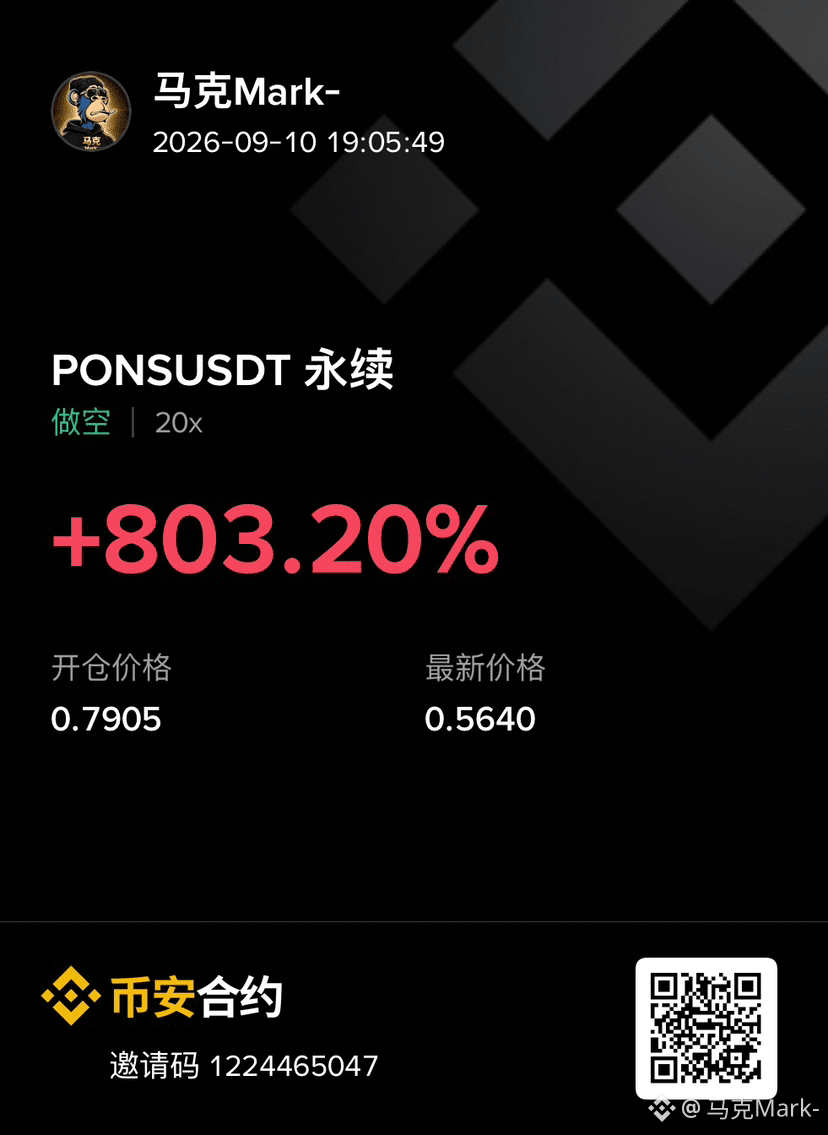
This 20x short on $PONS just directly pulled out +803% profit—honestly, even I’m a little excited.
Looking back at the entry price of 0.7905, the moment the price was pushed up to this level, it was clearly a bit unstable. There was heavy sell pressure overhead, and price action/volume simply couldn’t keep up. My judgment back then was: this is very likely going to pull back. If you dare to short near 0.79 trying to top the move, you’re basically betting that the bulls will run out of steam. Sure enough, the price slid all the way down to today’s 0.5640—this drop has been extremely smooth.
$ETH
With 20x leverage eating up such a big move, many people think it’s because I’m bold. But really, it’s mostly about trading feel. At this level, many people are prone to making mistakes—chasing higher and getting trapped. But I keyed in on the stall/breakdown signal and went in right away. The profit screenshot is there not to get everyone to blindly follow, but to say: in the crypto market, if you get the direction right and control leverage properly, the breakout happens in that single moment.
$ZEC
Next, I’ll keep watching—no fighting to the bitter end. Taking profit and going to cash is the bottom line for seasoned traders.
#苹果发布首款折叠屏手机
This 20x short on $PONS just directly pulled out +803% profit—honestly, even I’m a little excited.
Looking back at the entry price of 0.7905, the moment the price was pushed up to this level, it was clearly a bit unstable. There was heavy sell pressure overhead, and price action/volume simply couldn’t keep up. My judgment back then was: this is very likely going to pull back. If you dare to short near 0.79 trying to top the move, you’re basically betting that the bulls will run out of steam. Sure enough, the price slid all the way down to today’s 0.5640—this drop has been extremely smooth.
$ETH
With 20x leverage eating up such a big move, many people think it’s because I’m bold. But really, it’s mostly about trading feel. At this level, many people are prone to making mistakes—chasing higher and getting trapped. But I keyed in on the stall/breakdown signal and went in right away. The profit screenshot is there not to get everyone to blindly follow, but to say: in the crypto market, if you get the direction right and control leverage properly, the breakout happens in that single moment.
$ZEC
Next, I’ll keep watching—no fighting to the bitter end. Taking profit and going to cash is the bottom line for seasoned traders.
#苹果发布首款折叠屏手机
Looking back at the entry price of 0.7905, the moment the price was pushed up to this level, it was clearly a bit unstable. There was heavy sell pressure overhead, and price action/volume simply couldn’t keep up. My judgment back then was: this is very likely going to pull back. If you dare to short near 0.79 trying to top the move, you’re basically betting that the bulls will run out of steam. Sure enough, the price slid all the way down to today’s 0.5640—this drop has been extremely smooth.
$ETH
With 20x leverage eating up such a big move, many people think it’s because I’m bold. But really, it’s mostly about trading feel. At this level, many people are prone to making mistakes—chasing higher and getting trapped. But I keyed in on the stall/breakdown signal and went in right away. The profit screenshot is there not to get everyone to blindly follow, but to say: in the crypto market, if you get the direction right and control leverage properly, the breakout happens in that single moment.
$ZEC
Next, I’ll keep watching—no fighting to the bitter end. Taking profit and going to cash is the bottom line for seasoned traders.
#苹果发布首款折叠屏手机

6
1
58
·
--
Bearish
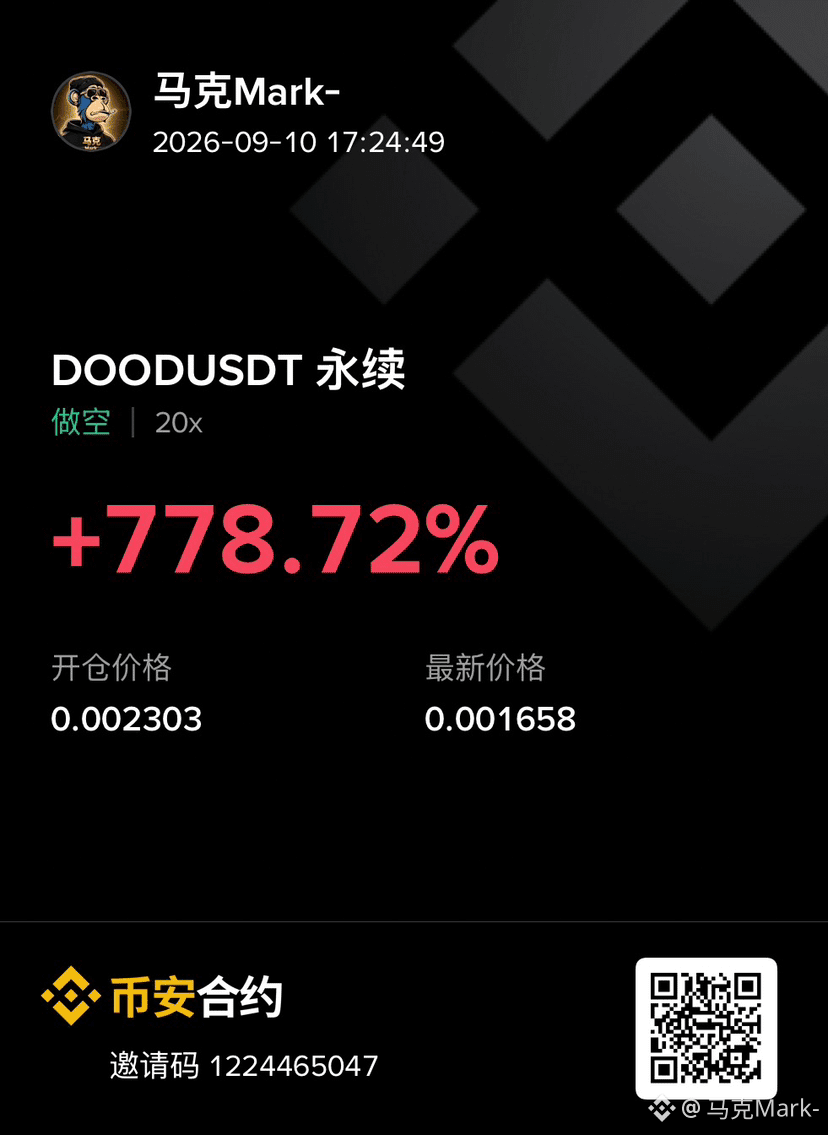
$DOOD This trade is simply going against market sentiment.
At the time, the order book was pumped up too aggressively. The level around 0.0023 clearly showed signs of stagnation. The people who chased the price were already red-eyed. I went the opposite way and opened a short position with 20x leverage—betting on a liquidation cascade. As everyone saw, the price then dropped straight to 0.001658, turning a floating profit into +778.72%.
The logic isn’t complicated: after a small coin explodes upward, the long-side profit-taking positions are the least able to withstand a pullback. The moment I opened the short, I knew that once the chart flipped, the stop-loss orders below would end up stepping on their own feet. A lot of people at this point make the same silly mistake, thinking, “It can still go up.” But veteran traders look for the emotional turning point. $ETH
20x isn’t small, but position control is in your hands—holding it is the real critical hit. This Binance futures trade paid off beautifully. Referral code 1224465047—followers, go ahead and sweep it. The market always rewards those who stay calm in the midst of frenzy, and this trade is the best proof. #布伦特原油突破100美元
$DOOD This trade is simply going against market sentiment.
At the time, the order book was pumped up too aggressively. The level around 0.0023 clearly showed signs of stagnation. The people who chased the price were already red-eyed. I went the opposite way and opened a short position with 20x leverage—betting on a liquidation cascade. As everyone saw, the price then dropped straight to 0.001658, turning a floating profit into +778.72%.
The logic isn’t complicated: after a small coin explodes upward, the long-side profit-taking positions are the least able to withstand a pullback. The moment I opened the short, I knew that once the chart flipped, the stop-loss orders below would end up stepping on their own feet. A lot of people at this point make the same silly mistake, thinking, “It can still go up.” But veteran traders look for the emotional turning point. $ETH
20x isn’t small, but position control is in your hands—holding it is the real critical hit. This Binance futures trade paid off beautifully. Referral code 1224465047—followers, go ahead and sweep it. The market always rewards those who stay calm in the midst of frenzy, and this trade is the best proof. #布伦特原油突破100美元
At the time, the order book was pumped up too aggressively. The level around 0.0023 clearly showed signs of stagnation. The people who chased the price were already red-eyed. I went the opposite way and opened a short position with 20x leverage—betting on a liquidation cascade. As everyone saw, the price then dropped straight to 0.001658, turning a floating profit into +778.72%.
The logic isn’t complicated: after a small coin explodes upward, the long-side profit-taking positions are the least able to withstand a pullback. The moment I opened the short, I knew that once the chart flipped, the stop-loss orders below would end up stepping on their own feet. A lot of people at this point make the same silly mistake, thinking, “It can still go up.” But veteran traders look for the emotional turning point. $ETH
20x isn’t small, but position control is in your hands—holding it is the real critical hit. This Binance futures trade paid off beautifully. Referral code 1224465047—followers, go ahead and sweep it. The market always rewards those who stay calm in the midst of frenzy, and this trade is the best proof. #布伦特原油突破100美元

5
1
107
·
--
Bearish
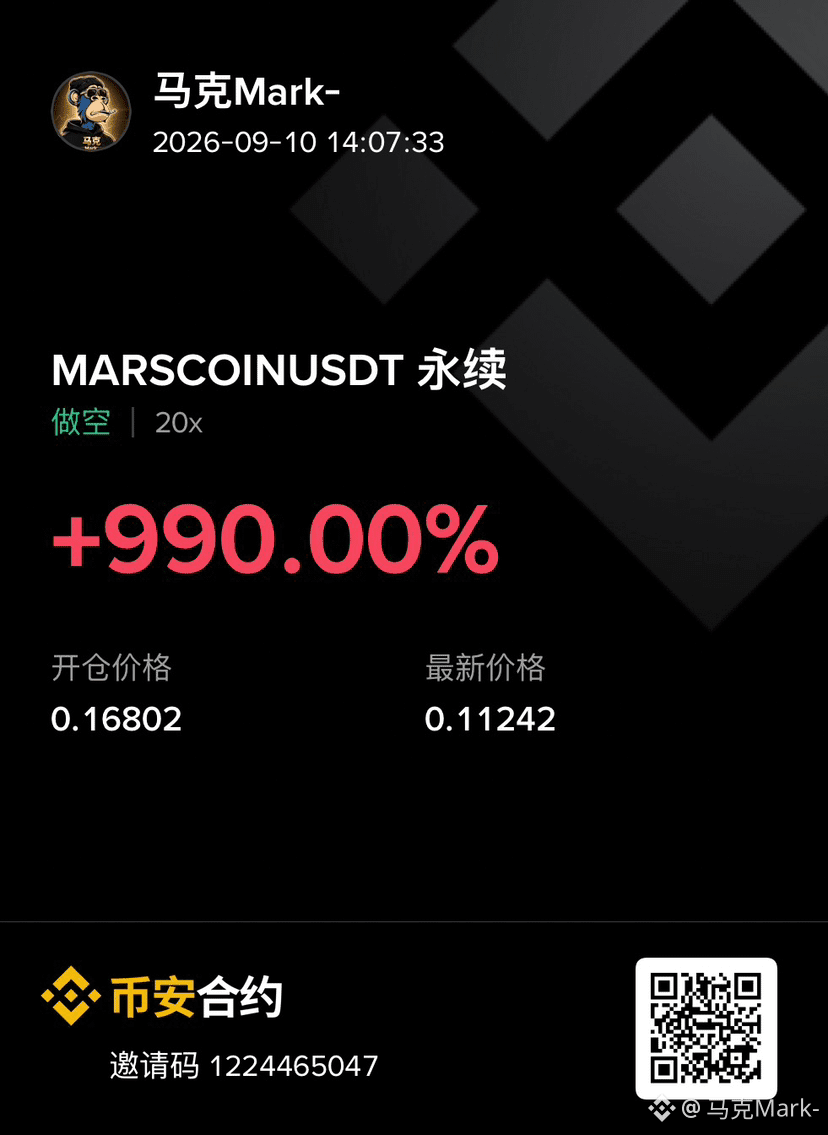
This short is on $MARSCOIN , 20x leverage targeting a gain of 990%. Honestly, even I’m a bit surprised.
In the afternoon market, MARS around 0.168 clearly couldn’t push higher—it stalled. Long upper wicks came one after another, but the volume couldn’t keep up. I stared at it for a long time. When a small coin gets pumped to a high level and then just trades sideways, eight out of ten times it’s a bull trap. At that time, many people were still shouting “breakout and make new highs,” but I felt this was the best spot to short. $BTC
After opening the short, I also went through a brief rebound and had a small floating loss, but with 20x leverage I could hold because the logic hadn’t changed—when a stock stalls and lingers at high levels, it should fall. Sure enough, once the chart couldn’t hold, it sold off all the way down. The low hit 0.11242, and the drawdown directly turned this trade into nearly a 10x gain. $ZEC
With coins like this, it’s all about emotional tug-of-war. When the longs are exhausted, it becomes the shorters’ feast. But with leverage of 20x like this, regular people shouldn’t imitate it. Take profit and secure your gains—that’s the real deal. #美财政部拟回购最多60亿美元国债
This short is on $MARSCOIN , 20x leverage targeting a gain of 990%. Honestly, even I’m a bit surprised.
In the afternoon market, MARS around 0.168 clearly couldn’t push higher—it stalled. Long upper wicks came one after another, but the volume couldn’t keep up. I stared at it for a long time. When a small coin gets pumped to a high level and then just trades sideways, eight out of ten times it’s a bull trap. At that time, many people were still shouting “breakout and make new highs,” but I felt this was the best spot to short. $BTC
After opening the short, I also went through a brief rebound and had a small floating loss, but with 20x leverage I could hold because the logic hadn’t changed—when a stock stalls and lingers at high levels, it should fall. Sure enough, once the chart couldn’t hold, it sold off all the way down. The low hit 0.11242, and the drawdown directly turned this trade into nearly a 10x gain. $ZEC
With coins like this, it’s all about emotional tug-of-war. When the longs are exhausted, it becomes the shorters’ feast. But with leverage of 20x like this, regular people shouldn’t imitate it. Take profit and secure your gains—that’s the real deal. #美财政部拟回购最多60亿美元国债
In the afternoon market, MARS around 0.168 clearly couldn’t push higher—it stalled. Long upper wicks came one after another, but the volume couldn’t keep up. I stared at it for a long time. When a small coin gets pumped to a high level and then just trades sideways, eight out of ten times it’s a bull trap. At that time, many people were still shouting “breakout and make new highs,” but I felt this was the best spot to short. $BTC
After opening the short, I also went through a brief rebound and had a small floating loss, but with 20x leverage I could hold because the logic hadn’t changed—when a stock stalls and lingers at high levels, it should fall. Sure enough, once the chart couldn’t hold, it sold off all the way down. The low hit 0.11242, and the drawdown directly turned this trade into nearly a 10x gain. $ZEC
With coins like this, it’s all about emotional tug-of-war. When the longs are exhausted, it becomes the shorters’ feast. But with leverage of 20x like this, regular people shouldn’t imitate it. Take profit and secure your gains—that’s the real deal. #美财政部拟回购最多60亿美元国债

6
1
148
·
--
Bearish
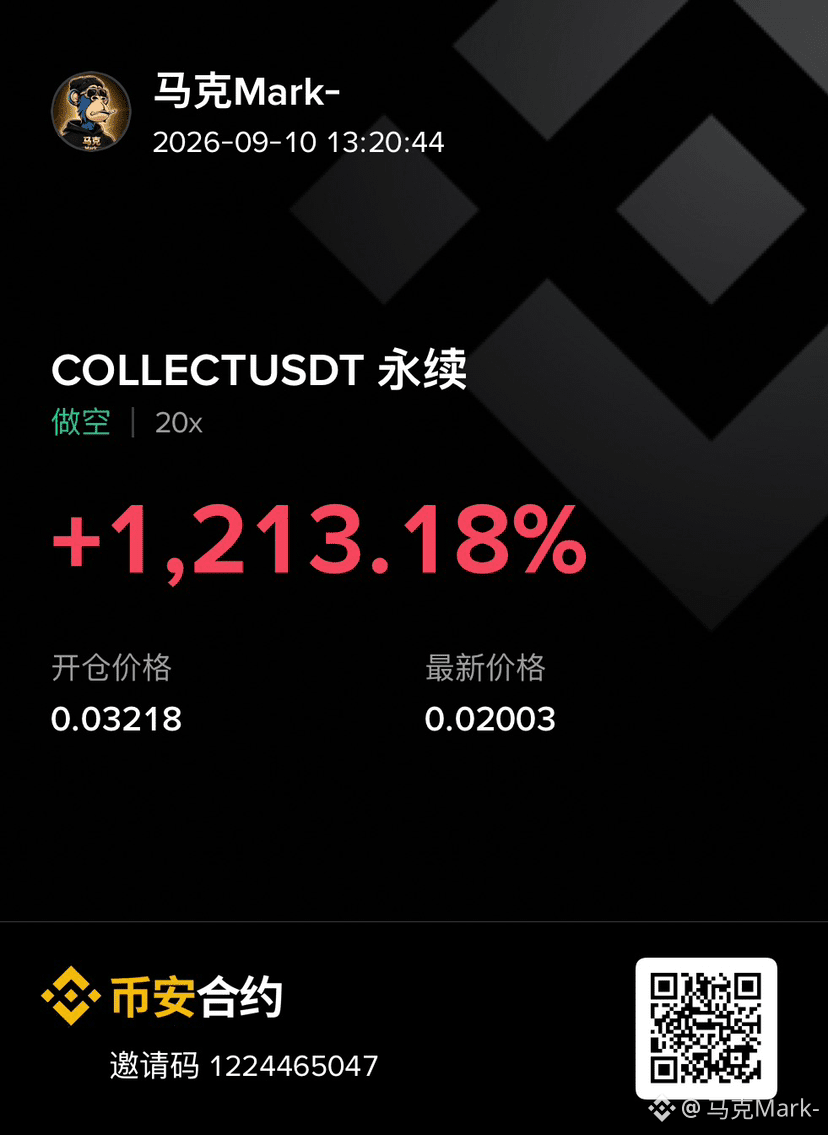
This one shorted $COLLECT with 20x leverage and managed to pull out +1213.18%. Honestly, even I’m a bit surprised. I opened the position at 0.03218, and it has since fallen to 0.02003. Along this whole run, it was really a precise capture of “the lofty height leaves no room for cold.” $SNDK
At the time, the market looked way too obvious: there was extremely heavy sell pressure overhead, and price and volume were diverging. A lot of people were still thinking about catching the knife and trying to bottom-fish, but I saw that at this level the main players were distributing, so I opened a short in line with the trend. 20x is a bit aggressive, but if the direction is right, holding it is what delivers a massive hit. $BTC
During the consolidation in the middle, I also thought about cutting down, and luckily I held on. Looking back now, when a coin like this drops, there’s basically no real support. From 0.032 down to 0.020—that move was brutal. The biggest fear with shorting is hesitation. If you dare to make the move at a high level, that’s how you can take the big meat.
Profit is just floating; logic is the real core. Next time you run into this kind of high-level stagnation, just keep shorting and that’s it. #布伦特原油突破100美元
This one shorted $COLLECT with 20x leverage and managed to pull out +1213.18%. Honestly, even I’m a bit surprised. I opened the position at 0.03218, and it has since fallen to 0.02003. Along this whole run, it was really a precise capture of “the lofty height leaves no room for cold.” $SNDK
At the time, the market looked way too obvious: there was extremely heavy sell pressure overhead, and price and volume were diverging. A lot of people were still thinking about catching the knife and trying to bottom-fish, but I saw that at this level the main players were distributing, so I opened a short in line with the trend. 20x is a bit aggressive, but if the direction is right, holding it is what delivers a massive hit. $BTC
During the consolidation in the middle, I also thought about cutting down, and luckily I held on. Looking back now, when a coin like this drops, there’s basically no real support. From 0.032 down to 0.020—that move was brutal. The biggest fear with shorting is hesitation. If you dare to make the move at a high level, that’s how you can take the big meat.
Profit is just floating; logic is the real core. Next time you run into this kind of high-level stagnation, just keep shorting and that’s it. #布伦特原油突破100美元
At the time, the market looked way too obvious: there was extremely heavy sell pressure overhead, and price and volume were diverging. A lot of people were still thinking about catching the knife and trying to bottom-fish, but I saw that at this level the main players were distributing, so I opened a short in line with the trend. 20x is a bit aggressive, but if the direction is right, holding it is what delivers a massive hit. $BTC
During the consolidation in the middle, I also thought about cutting down, and luckily I held on. Looking back now, when a coin like this drops, there’s basically no real support. From 0.032 down to 0.020—that move was brutal. The biggest fear with shorting is hesitation. If you dare to make the move at a high level, that’s how you can take the big meat.
Profit is just floating; logic is the real core. Next time you run into this kind of high-level stagnation, just keep shorting and that’s it. #布伦特原油突破100美元

5
1
96
·
--
Bearish
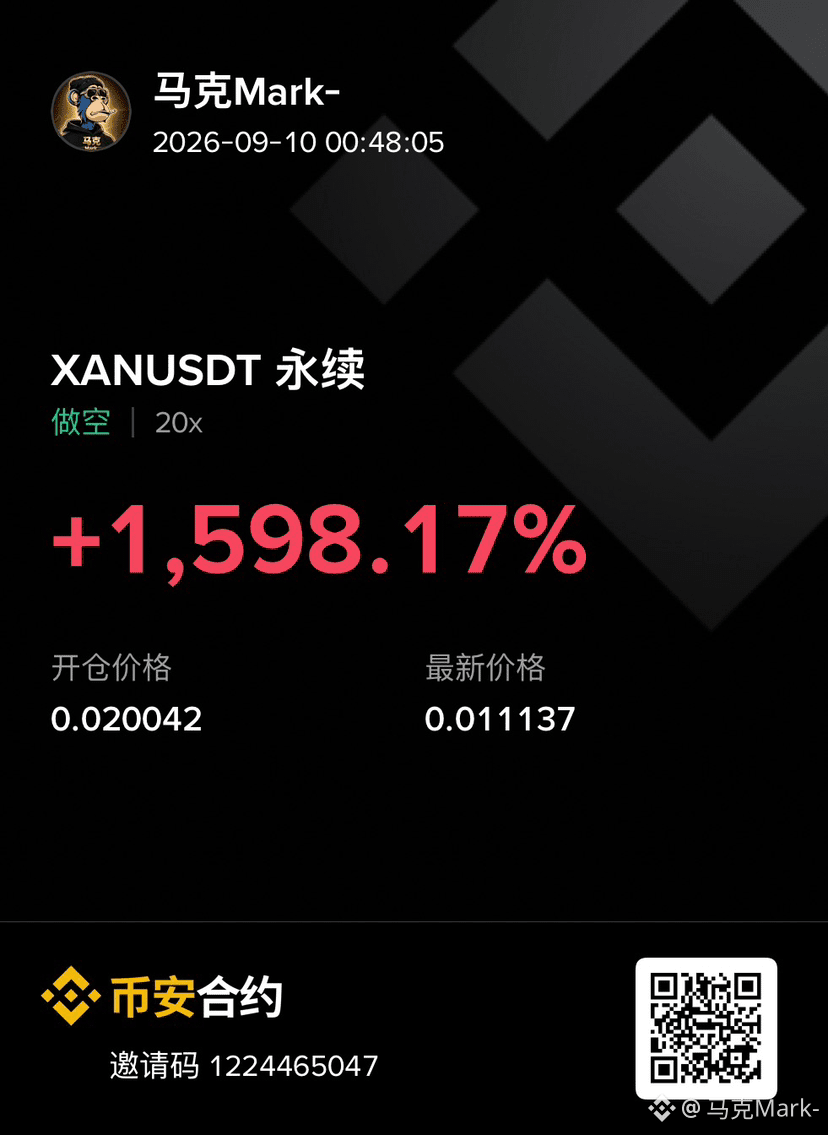
$XAN ,20x leverage, a 1598% unrealized profit. Honestly, when I got this trade, my fingers were sweating. $BTC
Looking back at the opening price of 0.020042: at the time, the coin was still hanging on at a high level, but the volume and price action had already clearly diverged. The sell pressure above was ridiculously heavy. I felt then that anyone chasing longs from that kind of position would most likely get buried. I immediately went short—20x leverage, no hesitation. $SNDK
Now the latest price has been hammered down to 0.011137, and the drop is definitely brutal. The logic of this trade isn’t complicated: range-bound stagnation at the highs plus a volume-driven breakdown in agreement—shorting has an extremely strong edge. A lot of people always want to bottom-fish and top-tick, but in the face of the trend, it’s most comfortable to follow along and take the middle chunk.
A return of 15x+ is luck too, but also discipline. Next, I’m planning to gradually take profit and not be greedy for the last piece of meat. #比特币突破79000美元
$XAN ,20x leverage, a 1598% unrealized profit. Honestly, when I got this trade, my fingers were sweating. $BTC
Looking back at the opening price of 0.020042: at the time, the coin was still hanging on at a high level, but the volume and price action had already clearly diverged. The sell pressure above was ridiculously heavy. I felt then that anyone chasing longs from that kind of position would most likely get buried. I immediately went short—20x leverage, no hesitation. $SNDK
Now the latest price has been hammered down to 0.011137, and the drop is definitely brutal. The logic of this trade isn’t complicated: range-bound stagnation at the highs plus a volume-driven breakdown in agreement—shorting has an extremely strong edge. A lot of people always want to bottom-fish and top-tick, but in the face of the trend, it’s most comfortable to follow along and take the middle chunk.
A return of 15x+ is luck too, but also discipline. Next, I’m planning to gradually take profit and not be greedy for the last piece of meat. #比特币突破79000美元
Looking back at the opening price of 0.020042: at the time, the coin was still hanging on at a high level, but the volume and price action had already clearly diverged. The sell pressure above was ridiculously heavy. I felt then that anyone chasing longs from that kind of position would most likely get buried. I immediately went short—20x leverage, no hesitation. $SNDK
Now the latest price has been hammered down to 0.011137, and the drop is definitely brutal. The logic of this trade isn’t complicated: range-bound stagnation at the highs plus a volume-driven breakdown in agreement—shorting has an extremely strong edge. A lot of people always want to bottom-fish and top-tick, but in the face of the trend, it’s most comfortable to follow along and take the middle chunk.
A return of 15x+ is luck too, but also discipline. Next, I’m planning to gradually take profit and not be greedy for the last piece of meat. #比特币突破79000美元

6
1
67
·
--
Bearish
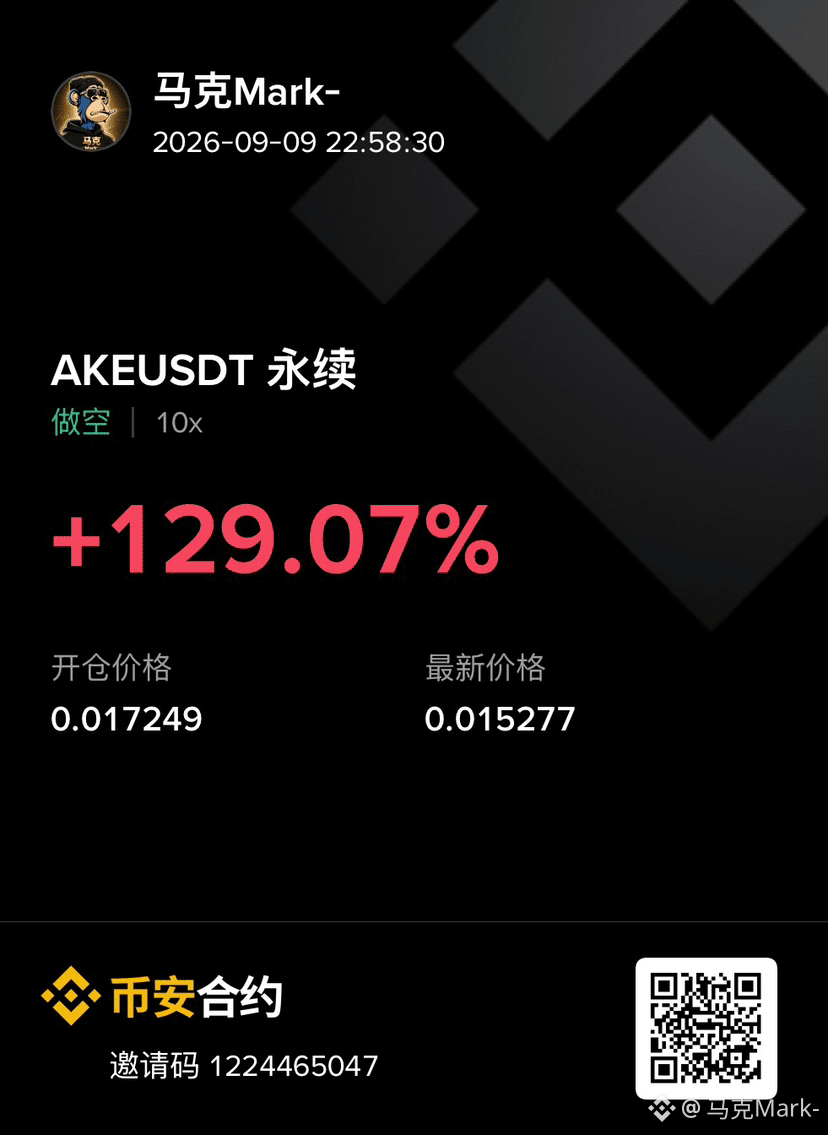
$AKE ,10x leverage, 129% return. This trade went pretty smoothly, but there was a heavy psychological tug-of-war throughout the process.
I opened the position at 0.017249. At that level, there was a lot of sell pressure overhead. Price and volume were diverging, and many people were still fantasizing about a breakout. I chose to reverse and go short. My read on the chart was: “It can’t rise anymore.” That’s the kind of spot that most easily traps long positions.
$ZEC
Now I’m at 0.015277. There was no small amount of fluctuation in between, and with 10x leverage it really tests your mindset. My logic is very simple: as long as the trend hasn’t changed, holding is the win. A lot of people tend to take profit too early during a down move, and end up missing out on the big gains.
$SNDK
That’s how crypto is: while others are greedy, I stay cautious. Market feel is something you build by constantly watching the screen and grinding it out. I’ll keep holding this position—don’t leave unless the level is broken.
#布伦特原油突破100美元
$AKE ,10x leverage, 129% return. This trade went pretty smoothly, but there was a heavy psychological tug-of-war throughout the process.
I opened the position at 0.017249. At that level, there was a lot of sell pressure overhead. Price and volume were diverging, and many people were still fantasizing about a breakout. I chose to reverse and go short. My read on the chart was: “It can’t rise anymore.” That’s the kind of spot that most easily traps long positions.
$ZEC
Now I’m at 0.015277. There was no small amount of fluctuation in between, and with 10x leverage it really tests your mindset. My logic is very simple: as long as the trend hasn’t changed, holding is the win. A lot of people tend to take profit too early during a down move, and end up missing out on the big gains.
$SNDK
That’s how crypto is: while others are greedy, I stay cautious. Market feel is something you build by constantly watching the screen and grinding it out. I’ll keep holding this position—don’t leave unless the level is broken.
#布伦特原油突破100美元
I opened the position at 0.017249. At that level, there was a lot of sell pressure overhead. Price and volume were diverging, and many people were still fantasizing about a breakout. I chose to reverse and go short. My read on the chart was: “It can’t rise anymore.” That’s the kind of spot that most easily traps long positions.
$ZEC
Now I’m at 0.015277. There was no small amount of fluctuation in between, and with 10x leverage it really tests your mindset. My logic is very simple: as long as the trend hasn’t changed, holding is the win. A lot of people tend to take profit too early during a down move, and end up missing out on the big gains.
$SNDK
That’s how crypto is: while others are greedy, I stay cautious. Market feel is something you build by constantly watching the screen and grinding it out. I’ll keep holding this position—don’t leave unless the level is broken.
#布伦特原油突破100美元

5
1
109
·
--
Bullish
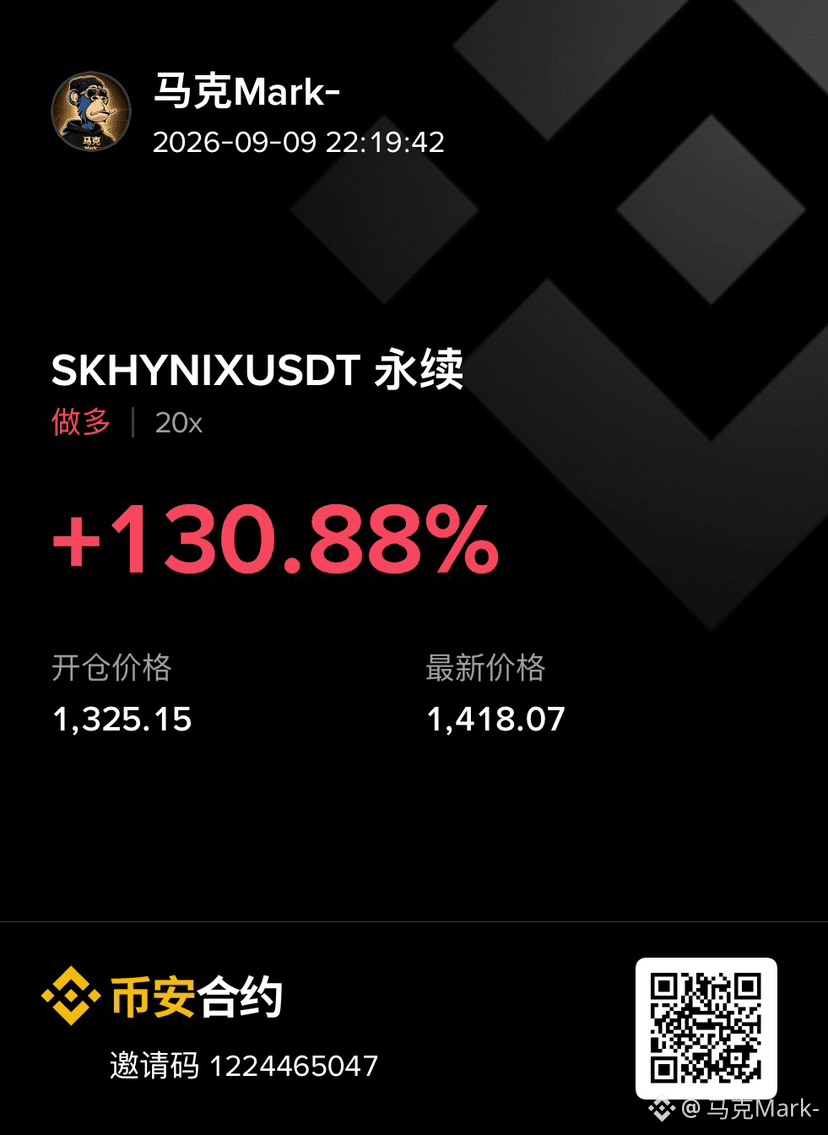
This $SKHYNIX long trade—using 20x leverage and it captured a floating profit of 130%. The real skill is being able to hold it in real trading. $ETH
Let me talk about what I was thinking at the time. When it was around 1325 and I opened the long, the chart was actually quite frustrating—many people at this level didn’t dare to take it, fearing that a long consolidation would inevitably lead to a drop. But I saw that the capital support was steady; the pullback didn’t break the prior low. That’s the bulls building their strength. I rarely use 20x leverage, but the risk-reward ratio at this point was too tempting. I kept the stop-loss tight. If I’m wrong, it only hurts the skin; if I’m right, it’s a big gain. $SNDK
When it ran up to 1418, the floating profit was already sitting there—nothing much to brag about. The market just gave the opportunity. For this kind of stock, volatility is high; max leverage is a double-edged sword. Don’t just look at returns—risk control always comes first. #布伦特原油突破100美元
This $SKHYNIX long trade—using 20x leverage and it captured a floating profit of 130%. The real skill is being able to hold it in real trading. $ETH
Let me talk about what I was thinking at the time. When it was around 1325 and I opened the long, the chart was actually quite frustrating—many people at this level didn’t dare to take it, fearing that a long consolidation would inevitably lead to a drop. But I saw that the capital support was steady; the pullback didn’t break the prior low. That’s the bulls building their strength. I rarely use 20x leverage, but the risk-reward ratio at this point was too tempting. I kept the stop-loss tight. If I’m wrong, it only hurts the skin; if I’m right, it’s a big gain. $SNDK
When it ran up to 1418, the floating profit was already sitting there—nothing much to brag about. The market just gave the opportunity. For this kind of stock, volatility is high; max leverage is a double-edged sword. Don’t just look at returns—risk control always comes first. #布伦特原油突破100美元
Let me talk about what I was thinking at the time. When it was around 1325 and I opened the long, the chart was actually quite frustrating—many people at this level didn’t dare to take it, fearing that a long consolidation would inevitably lead to a drop. But I saw that the capital support was steady; the pullback didn’t break the prior low. That’s the bulls building their strength. I rarely use 20x leverage, but the risk-reward ratio at this point was too tempting. I kept the stop-loss tight. If I’m wrong, it only hurts the skin; if I’m right, it’s a big gain. $SNDK
When it ran up to 1418, the floating profit was already sitting there—nothing much to brag about. The market just gave the opportunity. For this kind of stock, volatility is high; max leverage is a double-edged sword. Don’t just look at returns—risk control always comes first. #布伦特原油突破100美元

6
1
77
·
--
Bearish
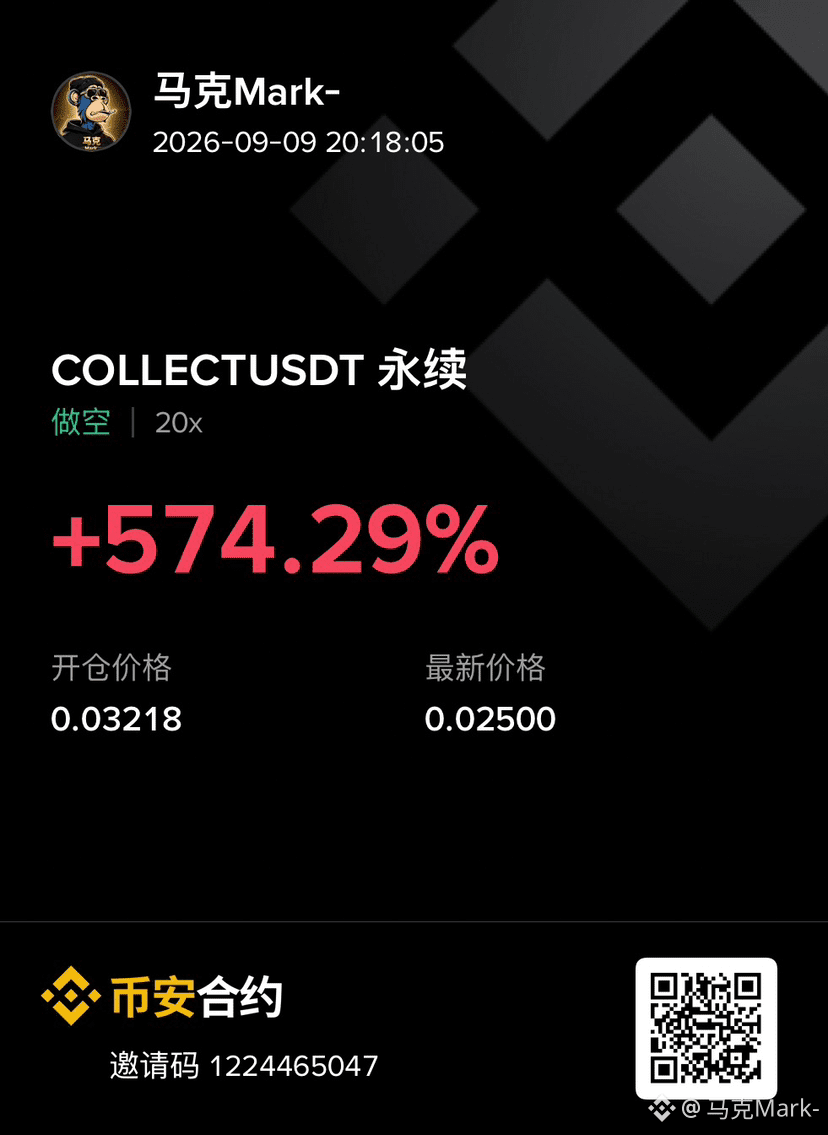
This wave of $COLLECT shorting, using 20x leverage, took a 570%+ gain—let me share my real thoughts.
I opened at 0.03218. Actually, at that time the chart had already stopped rising; there was heavy sell pressure overhead, and the volume couldn’t keep up. A lot of people still wanted to chase the long at this point, but I think that’s actually handing over the dish. I chose to go short directly, and 20x leverage is essentially a bet on this pullback. $ETH
Now it’s down to 0.025. I’m up 574% on paper. The way the market looks to me is that the panic selling hasn’t finished yet. It’s easy to pump a small coin up, but when you drop it, it falls faster. Once the people who chased high get liquidated, the price just free-falls. $BTC
After trading for so long, at positions like this, many people make the same mistake—when it rises, they’re afraid of missing out; when it drops, they don’t dare to buy in. I, on the other hand, prefer to act when nobody dares to short. Profit is just the outcome; it’s the logic that matters, otherwise you can’t hold on to it. #原油涨至7月来最高
This wave of $COLLECT shorting, using 20x leverage, took a 570%+ gain—let me share my real thoughts.
I opened at 0.03218. Actually, at that time the chart had already stopped rising; there was heavy sell pressure overhead, and the volume couldn’t keep up. A lot of people still wanted to chase the long at this point, but I think that’s actually handing over the dish. I chose to go short directly, and 20x leverage is essentially a bet on this pullback. $ETH
Now it’s down to 0.025. I’m up 574% on paper. The way the market looks to me is that the panic selling hasn’t finished yet. It’s easy to pump a small coin up, but when you drop it, it falls faster. Once the people who chased high get liquidated, the price just free-falls. $BTC
After trading for so long, at positions like this, many people make the same mistake—when it rises, they’re afraid of missing out; when it drops, they don’t dare to buy in. I, on the other hand, prefer to act when nobody dares to short. Profit is just the outcome; it’s the logic that matters, otherwise you can’t hold on to it. #原油涨至7月来最高
I opened at 0.03218. Actually, at that time the chart had already stopped rising; there was heavy sell pressure overhead, and the volume couldn’t keep up. A lot of people still wanted to chase the long at this point, but I think that’s actually handing over the dish. I chose to go short directly, and 20x leverage is essentially a bet on this pullback. $ETH
Now it’s down to 0.025. I’m up 574% on paper. The way the market looks to me is that the panic selling hasn’t finished yet. It’s easy to pump a small coin up, but when you drop it, it falls faster. Once the people who chased high get liquidated, the price just free-falls. $BTC
After trading for so long, at positions like this, many people make the same mistake—when it rises, they’re afraid of missing out; when it drops, they don’t dare to buy in. I, on the other hand, prefer to act when nobody dares to short. Profit is just the outcome; it’s the logic that matters, otherwise you can’t hold on to it. #原油涨至7月来最高

6
1
34
·
--
Bullish
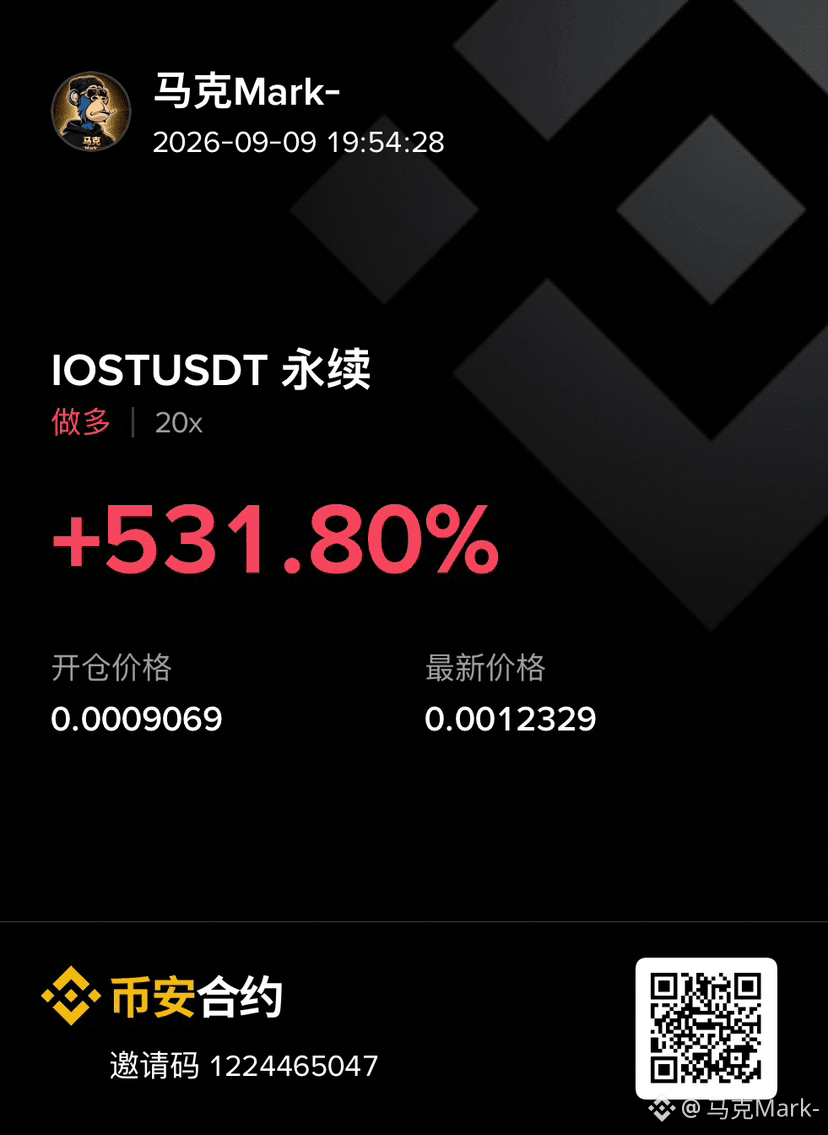
$IOST This order, 20x leverage, +531.8%—I really got a big bite of the meat.
I opened the position at 0.0009069. At that time, this level had been grinding for a long time; many people thought it was hopeless and left. But I saw from the order book that the sell pressure was already very light. For these coins that have been consolidating at the bottom for a long time, once they start moving, it’s a brutal vertical surge. I decisively put in the trade with 20x+ leverage and held it without letting go. Now the latest price is 0.0012329, with unrealized profit sitting here—price action is paying full respect. $BTC
After doing futures contracts for so many years, the biggest takeaway is: the bottom area is the hardest test of mindset. If you don’t dare to go in, it flies; if you go heavy and panic, it will shake you out. I was able to hold this trade because I knew clearly what I was doing—I wasn’t shaken out by short-term fluctuations. $ETH
20x leverage, profit and loss come from the same source. I didn’t “try to carry it” through—just rode the trend and ate along the way. Lock in gains and be content, then keep watching for the next wave. #美军打击霍尔木兹岛及贾斯克目标
$IOST This order, 20x leverage, +531.8%—I really got a big bite of the meat.
I opened the position at 0.0009069. At that time, this level had been grinding for a long time; many people thought it was hopeless and left. But I saw from the order book that the sell pressure was already very light. For these coins that have been consolidating at the bottom for a long time, once they start moving, it’s a brutal vertical surge. I decisively put in the trade with 20x+ leverage and held it without letting go. Now the latest price is 0.0012329, with unrealized profit sitting here—price action is paying full respect. $BTC
After doing futures contracts for so many years, the biggest takeaway is: the bottom area is the hardest test of mindset. If you don’t dare to go in, it flies; if you go heavy and panic, it will shake you out. I was able to hold this trade because I knew clearly what I was doing—I wasn’t shaken out by short-term fluctuations. $ETH
20x leverage, profit and loss come from the same source. I didn’t “try to carry it” through—just rode the trend and ate along the way. Lock in gains and be content, then keep watching for the next wave. #美军打击霍尔木兹岛及贾斯克目标
I opened the position at 0.0009069. At that time, this level had been grinding for a long time; many people thought it was hopeless and left. But I saw from the order book that the sell pressure was already very light. For these coins that have been consolidating at the bottom for a long time, once they start moving, it’s a brutal vertical surge. I decisively put in the trade with 20x+ leverage and held it without letting go. Now the latest price is 0.0012329, with unrealized profit sitting here—price action is paying full respect. $BTC
After doing futures contracts for so many years, the biggest takeaway is: the bottom area is the hardest test of mindset. If you don’t dare to go in, it flies; if you go heavy and panic, it will shake you out. I was able to hold this trade because I knew clearly what I was doing—I wasn’t shaken out by short-term fluctuations. $ETH
20x leverage, profit and loss come from the same source. I didn’t “try to carry it” through—just rode the trend and ate along the way. Lock in gains and be content, then keep watching for the next wave. #美军打击霍尔木兹岛及贾斯克目标

7
1
105
·
--
Bearish
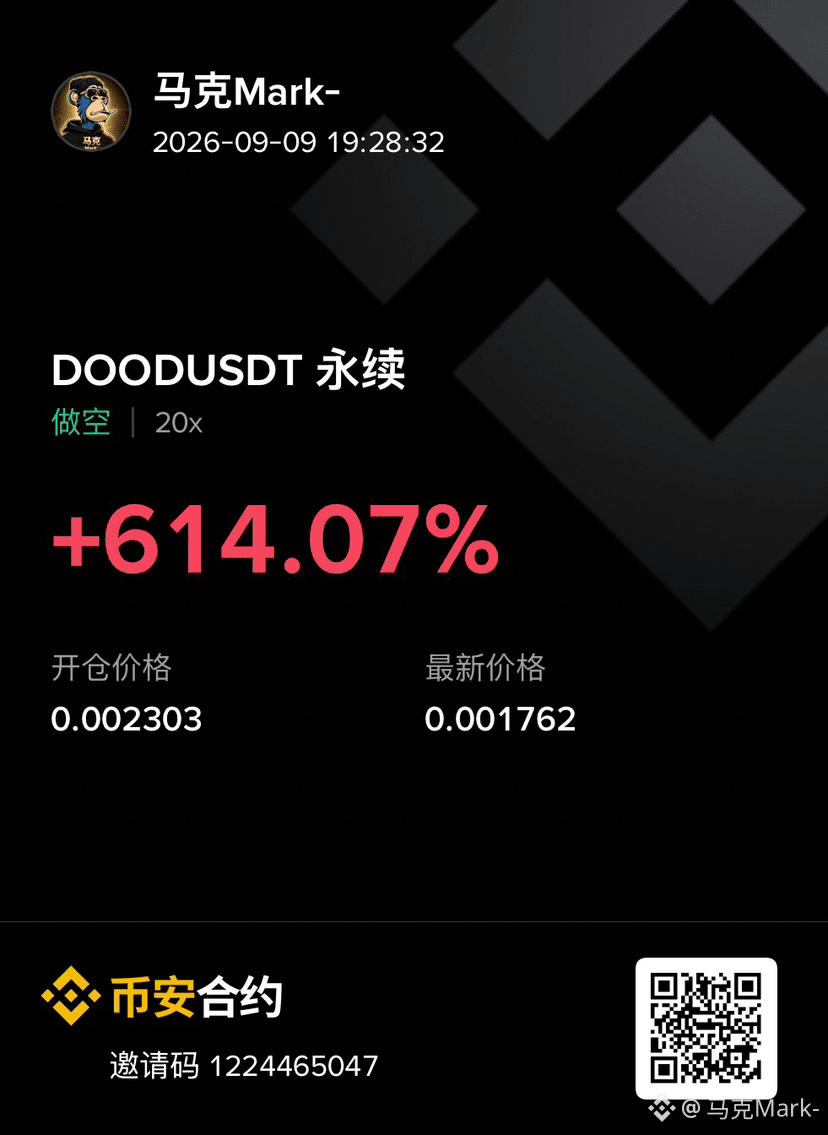
This wave of short $DOOD with 20x leverage made 600%+, honestly, the chance the chart offered was way too obvious.
I entered at 0.002303. Back then, after it pumped, the momentum clearly couldn’t keep up. In small-cap coins, when they’re stuck at a high level, it’s easiest to liquidate longs. I went straight short and went in with full force at 20x. Many people at this position still think about going long, believing that “after falling a lot it will rebound,” but look at the volume and price—after the main players finish dumping, it just drifts downward with no decent rebound at all. $ETH
Now it has hit 0.001762, and I’m up 614% unrealized. I won’t get greedy here. I plan to take profit in batches and keep a small portion of the position to see if it can dip further. With 20x leverage, locking in gains is what belongs to you—don’t end up stuck on a roller coaster. $BTC
The market always teaches people to respect it, but it also rewards those who dare to make a judgment. This trade is rock-solid. #原油涨至7月来最高
This wave of short $DOOD with 20x leverage made 600%+, honestly, the chance the chart offered was way too obvious.
I entered at 0.002303. Back then, after it pumped, the momentum clearly couldn’t keep up. In small-cap coins, when they’re stuck at a high level, it’s easiest to liquidate longs. I went straight short and went in with full force at 20x. Many people at this position still think about going long, believing that “after falling a lot it will rebound,” but look at the volume and price—after the main players finish dumping, it just drifts downward with no decent rebound at all. $ETH
Now it has hit 0.001762, and I’m up 614% unrealized. I won’t get greedy here. I plan to take profit in batches and keep a small portion of the position to see if it can dip further. With 20x leverage, locking in gains is what belongs to you—don’t end up stuck on a roller coaster. $BTC
The market always teaches people to respect it, but it also rewards those who dare to make a judgment. This trade is rock-solid. #原油涨至7月来最高
I entered at 0.002303. Back then, after it pumped, the momentum clearly couldn’t keep up. In small-cap coins, when they’re stuck at a high level, it’s easiest to liquidate longs. I went straight short and went in with full force at 20x. Many people at this position still think about going long, believing that “after falling a lot it will rebound,” but look at the volume and price—after the main players finish dumping, it just drifts downward with no decent rebound at all. $ETH
Now it has hit 0.001762, and I’m up 614% unrealized. I won’t get greedy here. I plan to take profit in batches and keep a small portion of the position to see if it can dip further. With 20x leverage, locking in gains is what belongs to you—don’t end up stuck on a roller coaster. $BTC
The market always teaches people to respect it, but it also rewards those who dare to make a judgment. This trade is rock-solid. #原油涨至7月来最高

6
1
92
·
--
Bullish
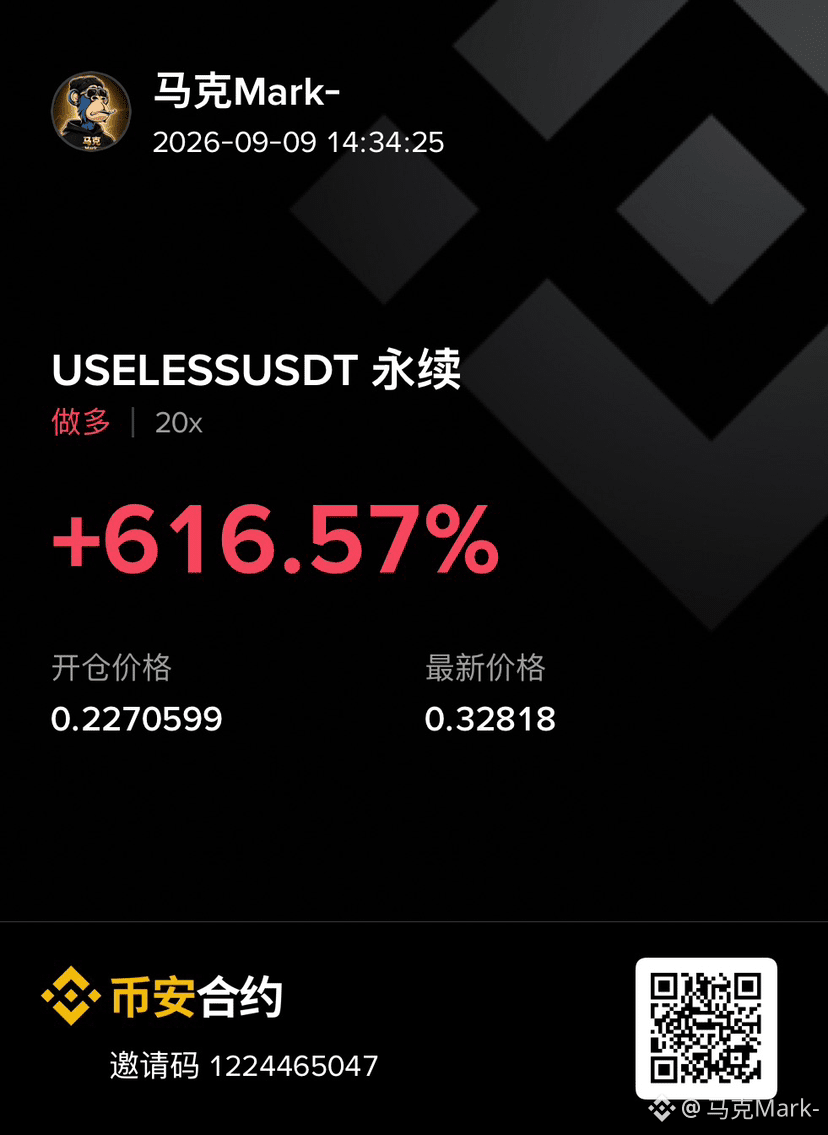
This 20x long on $USELESS , +616% profit—honestly, I was a bit surprised even by myself. But looking back, this level really is worth taking a “bet.” $BTC
I opened the position around 0.227. At the time, this coin was being cursed left and right—the name was even “useless.” Market sentiment was at rock bottom. But I watched the chart and noticed that the selling pressure below had already been exhausted; if it kept going sideways without dropping, that was a signal. A lot of people at this level didn’t dare to act—they were afraid it would go to zero. I felt the opposite: it was actually an opportunity. $ZEC
I directly set a 20x long and didn’t expect it to run this far. When it was pulled up to 0.328, the chart was still strong—I didn’t rush to close. And that’s how you get this 600% surprise.
That’s how crypto works. When everyone thinks something is “useless,” it’s often the turning point. Only those who dare to enter when nobody is paying attention can survive—this is the logic of old hands. #铜价创历史新高突破每磅6.80美元
This 20x long on $USELESS , +616% profit—honestly, I was a bit surprised even by myself. But looking back, this level really is worth taking a “bet.” $BTC
I opened the position around 0.227. At the time, this coin was being cursed left and right—the name was even “useless.” Market sentiment was at rock bottom. But I watched the chart and noticed that the selling pressure below had already been exhausted; if it kept going sideways without dropping, that was a signal. A lot of people at this level didn’t dare to act—they were afraid it would go to zero. I felt the opposite: it was actually an opportunity. $ZEC
I directly set a 20x long and didn’t expect it to run this far. When it was pulled up to 0.328, the chart was still strong—I didn’t rush to close. And that’s how you get this 600% surprise.
That’s how crypto works. When everyone thinks something is “useless,” it’s often the turning point. Only those who dare to enter when nobody is paying attention can survive—this is the logic of old hands. #铜价创历史新高突破每磅6.80美元
I opened the position around 0.227. At the time, this coin was being cursed left and right—the name was even “useless.” Market sentiment was at rock bottom. But I watched the chart and noticed that the selling pressure below had already been exhausted; if it kept going sideways without dropping, that was a signal. A lot of people at this level didn’t dare to act—they were afraid it would go to zero. I felt the opposite: it was actually an opportunity. $ZEC
I directly set a 20x long and didn’t expect it to run this far. When it was pulled up to 0.328, the chart was still strong—I didn’t rush to close. And that’s how you get this 600% surprise.
That’s how crypto works. When everyone thinks something is “useless,” it’s often the turning point. Only those who dare to enter when nobody is paying attention can survive—this is the logic of old hands. #铜价创历史新高突破每磅6.80美元

7
1
109
·
--
Bullish
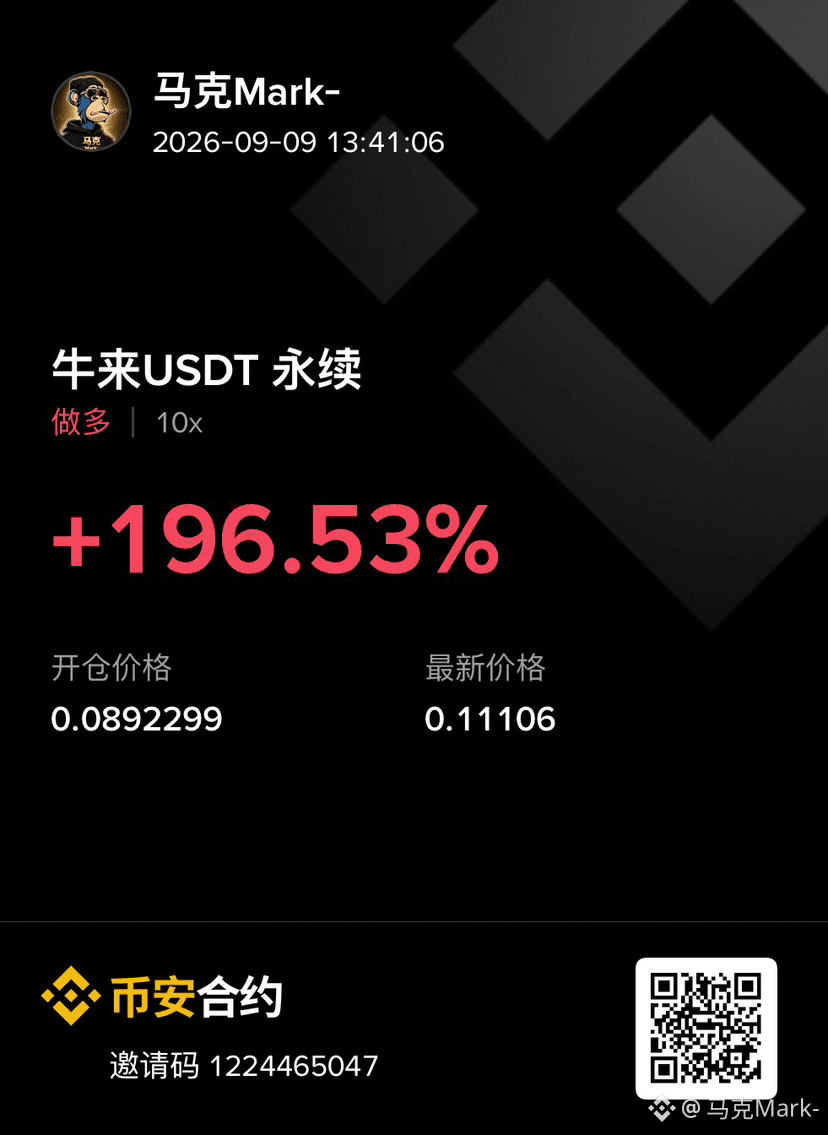
This one woke up and doubled instantly—10x-long positions ate 196%+!
“$牛来 ” really wasn’t a name picked in vain. Yesterday I watched the order book closely—around 0.089 there was a very active exchange of chips, and the bottom formation slowly started to take shape. Old traders all know: this kind of spot is the most grinding, but it’s also the easiest place to get a big chunk of meat. $ZEC
I put in a long order with 10x leverage—betting on a trend to kick in. When I woke up today and checked, the price had directly surged to 0.111, and the return was locked at +196.53%. Honestly, there were several times in the middle where I wanted to take profit, but the market sentiment was just too strong. Holding on was the win. $B
Many people at this point get hesitant: they feel it’s already gone up too much to chase, and they’re also afraid of missing out. My logic is simple: once the bottom is confirmed, go for it. With leverage, be bold—but stay steady. This trade was a real feast. Next, I’m watching for a pullback and re-acceptance. The market is never short of opportunities; what it lacks is the courage to overweight positions at low levels. #美加关税战升级
This one woke up and doubled instantly—10x-long positions ate 196%+!
“$牛来 ” really wasn’t a name picked in vain. Yesterday I watched the order book closely—around 0.089 there was a very active exchange of chips, and the bottom formation slowly started to take shape. Old traders all know: this kind of spot is the most grinding, but it’s also the easiest place to get a big chunk of meat. $ZEC
I put in a long order with 10x leverage—betting on a trend to kick in. When I woke up today and checked, the price had directly surged to 0.111, and the return was locked at +196.53%. Honestly, there were several times in the middle where I wanted to take profit, but the market sentiment was just too strong. Holding on was the win. $B
Many people at this point get hesitant: they feel it’s already gone up too much to chase, and they’re also afraid of missing out. My logic is simple: once the bottom is confirmed, go for it. With leverage, be bold—but stay steady. This trade was a real feast. Next, I’m watching for a pullback and re-acceptance. The market is never short of opportunities; what it lacks is the courage to overweight positions at low levels. #美加关税战升级
“$牛来 ” really wasn’t a name picked in vain. Yesterday I watched the order book closely—around 0.089 there was a very active exchange of chips, and the bottom formation slowly started to take shape. Old traders all know: this kind of spot is the most grinding, but it’s also the easiest place to get a big chunk of meat. $ZEC
I put in a long order with 10x leverage—betting on a trend to kick in. When I woke up today and checked, the price had directly surged to 0.111, and the return was locked at +196.53%. Honestly, there were several times in the middle where I wanted to take profit, but the market sentiment was just too strong. Holding on was the win. $B
Many people at this point get hesitant: they feel it’s already gone up too much to chase, and they’re also afraid of missing out. My logic is simple: once the bottom is confirmed, go for it. With leverage, be bold—but stay steady. This trade was a real feast. Next, I’m watching for a pullback and re-acceptance. The market is never short of opportunities; what it lacks is the courage to overweight positions at low levels. #美加关税战升级

6
1
82
·
--
Bearish
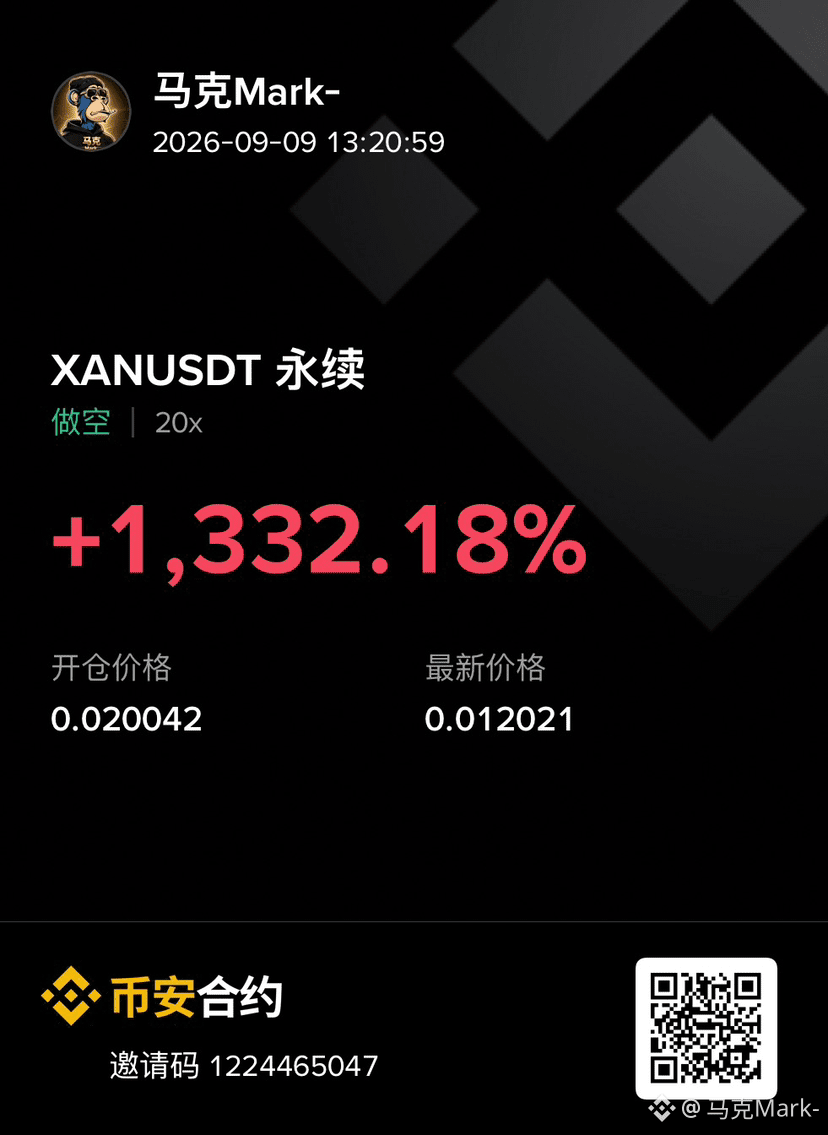
$XAN Perpetual, 20x short, and ultimately netting +1332.18%. The position was opened at 0.020042, and the low went down to around 0.012021. This trade wasn’t easy to hold, but the logic was very clear. $BTC
At the time, the market action was clearly stalling at the top. Around 0.02, there were lots of people chasing longs. I simply refused to believe that—because I felt the volume-price divergence was too severe. I decisively opened the short. 20x leverage—many people thought I was crazy, but I knew this was the spot where the bulls are most likely to make mistakes. $ZEC
It kept selling off all the way down, and the unrealized profit kept growing, landing +1332% in hand. That’s how the crypto market is: in extreme conditions, only those who dare to go against the prevailing sentiment can take the biggest gains. As for the rest, I’ll leave it to the market. #美加关税战升级
$XAN Perpetual, 20x short, and ultimately netting +1332.18%. The position was opened at 0.020042, and the low went down to around 0.012021. This trade wasn’t easy to hold, but the logic was very clear. $BTC
At the time, the market action was clearly stalling at the top. Around 0.02, there were lots of people chasing longs. I simply refused to believe that—because I felt the volume-price divergence was too severe. I decisively opened the short. 20x leverage—many people thought I was crazy, but I knew this was the spot where the bulls are most likely to make mistakes. $ZEC
It kept selling off all the way down, and the unrealized profit kept growing, landing +1332% in hand. That’s how the crypto market is: in extreme conditions, only those who dare to go against the prevailing sentiment can take the biggest gains. As for the rest, I’ll leave it to the market. #美加关税战升级
At the time, the market action was clearly stalling at the top. Around 0.02, there were lots of people chasing longs. I simply refused to believe that—because I felt the volume-price divergence was too severe. I decisively opened the short. 20x leverage—many people thought I was crazy, but I knew this was the spot where the bulls are most likely to make mistakes. $ZEC
It kept selling off all the way down, and the unrealized profit kept growing, landing +1332% in hand. That’s how the crypto market is: in extreme conditions, only those who dare to go against the prevailing sentiment can take the biggest gains. As for the rest, I’ll leave it to the market. #美加关税战升级

6
1
261
·
--
[世界黄金协会:金价年化回报约5%,长期趋势由财富贮存需求支撑](https://app.binance.com/uni-qr/E2JiVJB8)
Recently, the World Gold Council, together with twelve retail brands including Cai Bai Jewelry, Chow Tai Fook, Chow Sang Sang, Lao Feng Xiang, and others, jointly released on-site the
"2026 China Gold Jewelry Retail Trend Insights," and held a Q&A with reporters on the evolution of the hard gold category and the transformation of the gold jewelry consumption structure.$ETH
Wang Lixin, Chief Executive Officer of the World Gold Council China, told the media: "Hard gold is still the 'rising sun in the eight or nine o'clock position';
in the future, it will definitely be the one, with huge room to grow." This judgment is especially noteworthy in an industry undergoing dramatic structural adjustment.$BTC
What is the future trend of gold investment? The above insight report concludes: in the short term, the Fed's "hawkish" stance and the U.S. Treasury's "dovish" stance will be in tension; in the medium term, central bank gold purchases will provide support; and in the long term, economic growth will drive demand for consumption and wealth preservation. Historical data review shows that gold's long-term average annual return has remained stable at around 5%.#俄乌同时宣布停火3天
世界黄金协会:金价年化回报约5%,长期趋势由财富贮存需求支撑
Recently, the World Gold Council, together with twelve retail brands including Cai Bai Jewelry, Chow Tai Fook, Chow Sang Sang, Lao Feng Xiang, and others, jointly released on-site the
"2026 China Gold Jewelry Retail Trend Insights," and held a Q&A with reporters on the evolution of the hard gold category and the transformation of the gold jewelry consumption structure.$ETH
Wang Lixin, Chief Executive Officer of the World Gold Council China, told the media: "Hard gold is still the 'rising sun in the eight or nine o'clock position';
in the future, it will definitely be the one, with huge room to grow." This judgment is especially noteworthy in an industry undergoing dramatic structural adjustment.$BTC
What is the future trend of gold investment? The above insight report concludes: in the short term, the Fed's "hawkish" stance and the U.S. Treasury's "dovish" stance will be in tension; in the medium term, central bank gold purchases will provide support; and in the long term, economic growth will drive demand for consumption and wealth preservation. Historical data review shows that gold's long-term average annual return has remained stable at around 5%.#俄乌同时宣布停火3天
Recently, the World Gold Council, together with twelve retail brands including Cai Bai Jewelry, Chow Tai Fook, Chow Sang Sang, Lao Feng Xiang, and others, jointly released on-site the
"2026 China Gold Jewelry Retail Trend Insights," and held a Q&A with reporters on the evolution of the hard gold category and the transformation of the gold jewelry consumption structure.$ETH
Wang Lixin, Chief Executive Officer of the World Gold Council China, told the media: "Hard gold is still the 'rising sun in the eight or nine o'clock position';
in the future, it will definitely be the one, with huge room to grow." This judgment is especially noteworthy in an industry undergoing dramatic structural adjustment.$BTC
What is the future trend of gold investment? The above insight report concludes: in the short term, the Fed's "hawkish" stance and the U.S. Treasury's "dovish" stance will be in tension; in the medium term, central bank gold purchases will provide support; and in the long term, economic growth will drive demand for consumption and wealth preservation. Historical data review shows that gold's long-term average annual return has remained stable at around 5%.#俄乌同时宣布停火3天
6
1
108
·
--
Bullish
[点击进入马克粉丝策略基地](https://app.binance.com/uni-qr/E2JiVJB8)
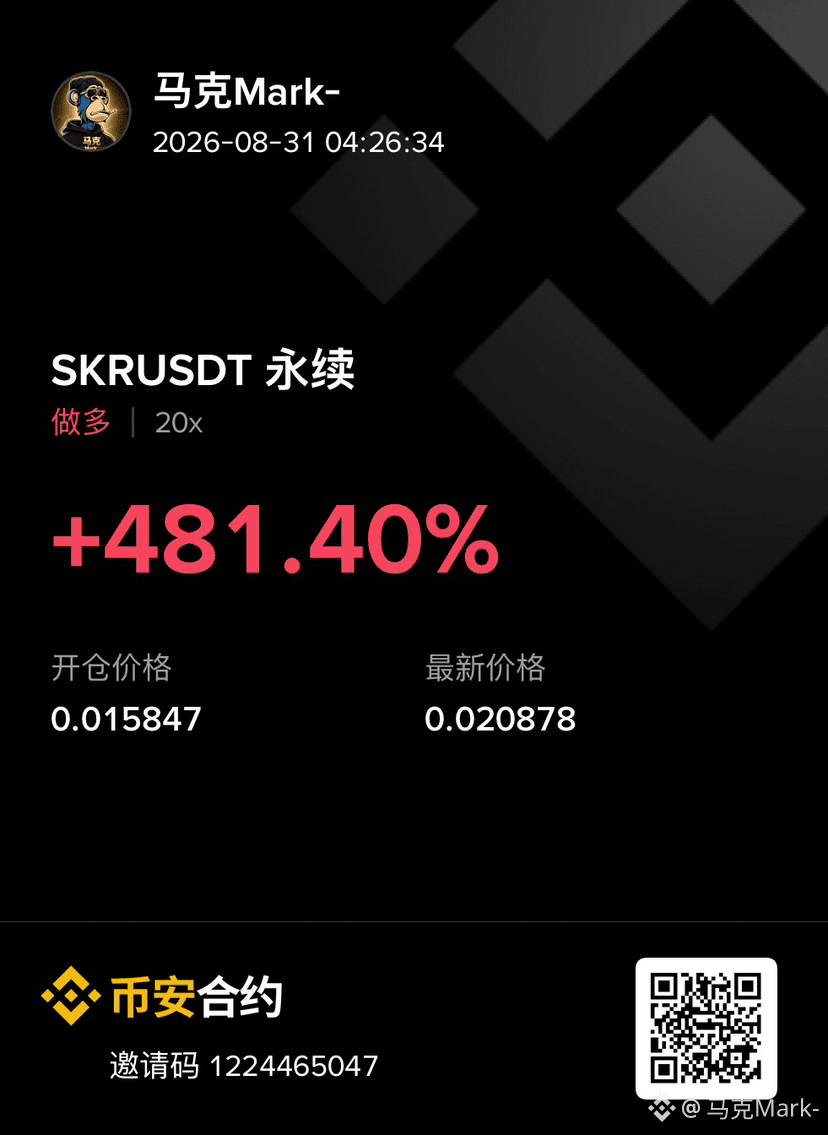
$SKR This one, 20x+ gains, +481%.
Honestly, when it was trading at 0.015847, there were even people next to me asking if I was looking for death. Back then the order book had just been smashed in a round, and the group chat was full of bearish takes—saying the small coin was beyond saving. But I watched for days: the volume shrank to the extreme, the orders were so thin they looked like paper—clearly they were washing out the last batch of people. At this level, experienced traders all know: when panic is over, it’s like a spring. $ETH
At 0.0158, I didn’t hesitate—I placed orders directly, maxed the leverage at 20x. This wasn’t impulsive; it was calculated: there’s limited room further down, and once sentiment flips back, the rebound would be very fierce. Sure enough, after the capital returned, it pushed straight to 0.020878, and the floating profit popped out. $BTC
Many people lose because they won’t hold when it’s falling, and when it rises a little, they’re afraid again. I’ve traded contracts for so many years—the real gains I take come from these moments where “nobody believes it.” Don’t look only at the high multiples; your entry price is what matters most. #韩国单股杠杆ETF交易下降
点击进入马克粉丝策略基地
$SKR This one, 20x+ gains, +481%.
Honestly, when it was trading at 0.015847, there were even people next to me asking if I was looking for death. Back then the order book had just been smashed in a round, and the group chat was full of bearish takes—saying the small coin was beyond saving. But I watched for days: the volume shrank to the extreme, the orders were so thin they looked like paper—clearly they were washing out the last batch of people. At this level, experienced traders all know: when panic is over, it’s like a spring. $ETH
At 0.0158, I didn’t hesitate—I placed orders directly, maxed the leverage at 20x. This wasn’t impulsive; it was calculated: there’s limited room further down, and once sentiment flips back, the rebound would be very fierce. Sure enough, after the capital returned, it pushed straight to 0.020878, and the floating profit popped out. $BTC
Many people lose because they won’t hold when it’s falling, and when it rises a little, they’re afraid again. I’ve traded contracts for so many years—the real gains I take come from these moments where “nobody believes it.” Don’t look only at the high multiples; your entry price is what matters most. #韩国单股杠杆ETF交易下降
$SKR This one, 20x+ gains, +481%.
Honestly, when it was trading at 0.015847, there were even people next to me asking if I was looking for death. Back then the order book had just been smashed in a round, and the group chat was full of bearish takes—saying the small coin was beyond saving. But I watched for days: the volume shrank to the extreme, the orders were so thin they looked like paper—clearly they were washing out the last batch of people. At this level, experienced traders all know: when panic is over, it’s like a spring. $ETH
At 0.0158, I didn’t hesitate—I placed orders directly, maxed the leverage at 20x. This wasn’t impulsive; it was calculated: there’s limited room further down, and once sentiment flips back, the rebound would be very fierce. Sure enough, after the capital returned, it pushed straight to 0.020878, and the floating profit popped out. $BTC
Many people lose because they won’t hold when it’s falling, and when it rises a little, they’re afraid again. I’ve traded contracts for so many years—the real gains I take come from these moments where “nobody believes it.” Don’t look only at the high multiples; your entry price is what matters most. #韩国单股杠杆ETF交易下降

6
1
3.8k
·
--
Bullish
[点击进入马克粉丝策略基地](https://app.binance.com/uni-qr/E2JiVJB8)
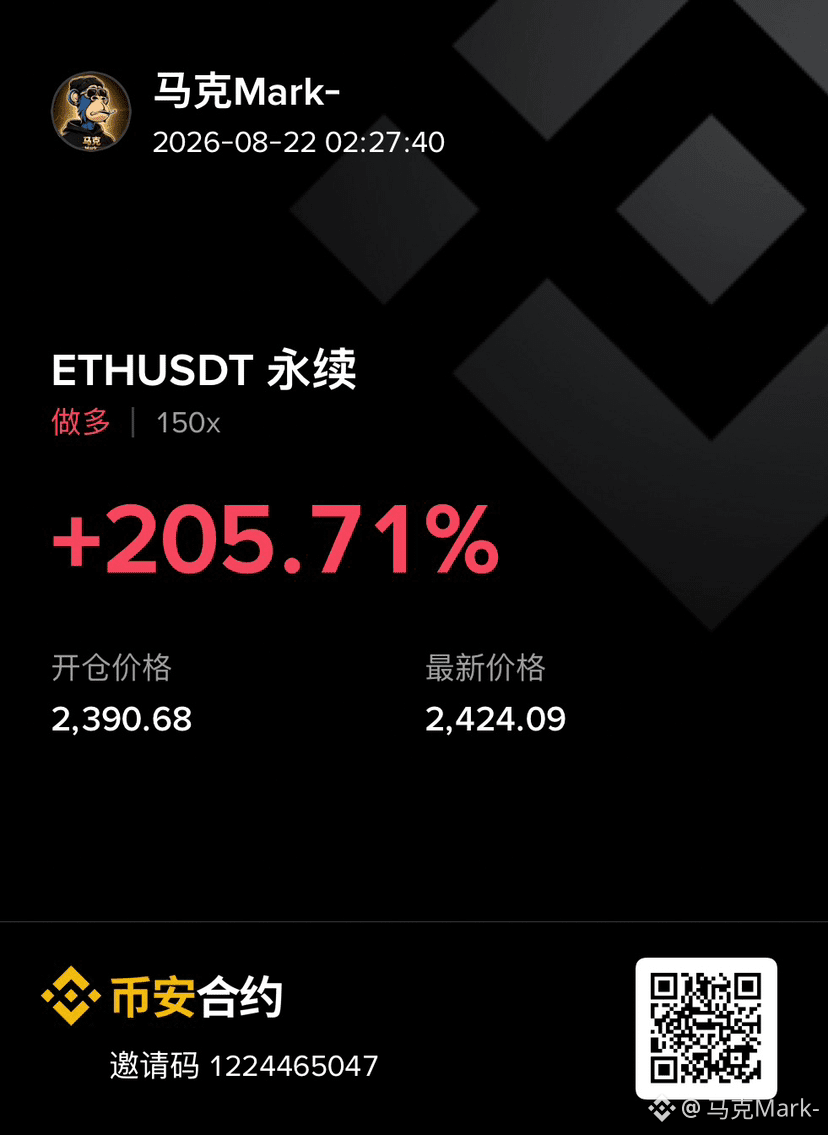
In the evening, this order $ETH really tested my nerve! Around 2390, I saw the support looked solid, so I went in with a 150x long. At the time, many people were guessing it would keep dropping, but I just felt the bears were running out of steam. $ETH
Then it surged to 2424 in one move—doubling my money and making a 205% profit! With this kind of high leverage, it’s basically life-or-death trading; the entry timing has to be nailed perfectly. $BTC
Time to sleep—taking profits and locking them in is the real skill. #比特币日内触及75500美元
点击进入马克粉丝策略基地
In the evening, this order $ETH really tested my nerve! Around 2390, I saw the support looked solid, so I went in with a 150x long. At the time, many people were guessing it would keep dropping, but I just felt the bears were running out of steam. $ETH
Then it surged to 2424 in one move—doubling my money and making a 205% profit! With this kind of high leverage, it’s basically life-or-death trading; the entry timing has to be nailed perfectly. $BTC
Time to sleep—taking profits and locking them in is the real skill. #比特币日内触及75500美元
In the evening, this order $ETH really tested my nerve! Around 2390, I saw the support looked solid, so I went in with a 150x long. At the time, many people were guessing it would keep dropping, but I just felt the bears were running out of steam. $ETH
Then it surged to 2424 in one move—doubling my money and making a 205% profit! With this kind of high leverage, it’s basically life-or-death trading; the entry timing has to be nailed perfectly. $BTC
Time to sleep—taking profits and locking them in is the real skill. #比特币日内触及75500美元
7
2
3.8k
·
--
Last night’s market action was like an unexpected midsummer downpour.
When Bitcoin slammed into the $70,000 mark and Ethereum broke above 2,200, and the numbers started jumping across the screen, I actually froze for a moment—not because I was surprised by the rise, but because it felt “familiar after a long absence.” Over the past few weeks, the market had become like a sluggish, viscous pool—buyers and sellers both seemed to have lost their strength, and even the candlesticks moved lazily.
But just a few hours before the Federal Reserve’s minutes were released, the board suddenly came alive. One big bullish candle shot up out of nowhere, pulverizing the short positions that had been piled up for so long—this isn’t some “price discovery” moment. It’s a liquidation targeting over-pessimism. When everyone was convinced, “It’s going to fall more,” going long the other way became the sharpest blade.
As for the deeper reason, I tend to believe the market was pricing in a “policy pivot” ahead of time. Trump’s meeting with crypto mining executives, the SEC’s rare willingness to offer exemption provisions—those signals layered together, and capital could smell the acceleration of compliance. Add to that the U.S. Treasury’s unexpected expansion of its balance sheet to repurchase long-dated bonds, and the dollar weakened on cue. Bitcoin, as the most liquidity-sensitive asset, naturally was the first to jump up and catch that falling water.
But if you ask me what “big trend signal” this is—truthfully, I’m cautious. Seventy thousand is a psychological level, but it’s not a breakout. This feels more like the brief gasp after a cornered beast fight than the triumphant chorus of a bull market. $ETH
A sudden surge or a sudden plunge is ultimately just a numbers game. What really matters is whether, after each bout of volatility, we’ve become a little more clear-headed. $BTC
Last night’s market action was like an unexpected midsummer downpour.
When Bitcoin slammed into the $70,000 mark and Ethereum broke above 2,200, and the numbers started jumping across the screen, I actually froze for a moment—not because I was surprised by the rise, but because it felt “familiar after a long absence.” Over the past few weeks, the market had become like a sluggish, viscous pool—buyers and sellers both seemed to have lost their strength, and even the candlesticks moved lazily.
But just a few hours before the Federal Reserve’s minutes were released, the board suddenly came alive. One big bullish candle shot up out of nowhere, pulverizing the short positions that had been piled up for so long—this isn’t some “price discovery” moment. It’s a liquidation targeting over-pessimism. When everyone was convinced, “It’s going to fall more,” going long the other way became the sharpest blade.
As for the deeper reason, I tend to believe the market was pricing in a “policy pivot” ahead of time. Trump’s meeting with crypto mining executives, the SEC’s rare willingness to offer exemption provisions—those signals layered together, and capital could smell the acceleration of compliance. Add to that the U.S. Treasury’s unexpected expansion of its balance sheet to repurchase long-dated bonds, and the dollar weakened on cue. Bitcoin, as the most liquidity-sensitive asset, naturally was the first to jump up and catch that falling water.
But if you ask me what “big trend signal” this is—truthfully, I’m cautious. Seventy thousand is a psychological level, but it’s not a breakout. This feels more like the brief gasp after a cornered beast fight than the triumphant chorus of a bull market. $ETH
A sudden surge or a sudden plunge is ultimately just a numbers game. What really matters is whether, after each bout of volatility, we’ve become a little more clear-headed. $BTC
When Bitcoin slammed into the $70,000 mark and Ethereum broke above 2,200, and the numbers started jumping across the screen, I actually froze for a moment—not because I was surprised by the rise, but because it felt “familiar after a long absence.” Over the past few weeks, the market had become like a sluggish, viscous pool—buyers and sellers both seemed to have lost their strength, and even the candlesticks moved lazily.
But just a few hours before the Federal Reserve’s minutes were released, the board suddenly came alive. One big bullish candle shot up out of nowhere, pulverizing the short positions that had been piled up for so long—this isn’t some “price discovery” moment. It’s a liquidation targeting over-pessimism. When everyone was convinced, “It’s going to fall more,” going long the other way became the sharpest blade.
As for the deeper reason, I tend to believe the market was pricing in a “policy pivot” ahead of time. Trump’s meeting with crypto mining executives, the SEC’s rare willingness to offer exemption provisions—those signals layered together, and capital could smell the acceleration of compliance. Add to that the U.S. Treasury’s unexpected expansion of its balance sheet to repurchase long-dated bonds, and the dollar weakened on cue. Bitcoin, as the most liquidity-sensitive asset, naturally was the first to jump up and catch that falling water.
But if you ask me what “big trend signal” this is—truthfully, I’m cautious. Seventy thousand is a psychological level, but it’s not a breakout. This feels more like the brief gasp after a cornered beast fight than the triumphant chorus of a bull market. $ETH
A sudden surge or a sudden plunge is ultimately just a numbers game. What really matters is whether, after each bout of volatility, we’ve become a little more clear-headed. $BTC
89
·
--
[加密逼空夜,BitMine看涨期权出现异常交易,机构投资者已提前布局加仓](https://app.binance.com/uni-qr/7yG6FoDc)
On August 20, the cryptocurrency market saw a long-awaited surge overnight, and crypto-related stocks also moved. According to BIT (bit.com) market data, Ethereum’s largest treasury company, BitMine, saw its stock price close up 10%. Notably, BitMine’s bullish call options also showed unusual activity overnight.
Data shows that on Wednesday, investors bought 181,684 call options—about 25% higher than the stock’s average daily call option trading volume (around 145,316). Multiple data platforms also marked several options trades for the stock that day as “unusual options activity.” In addition, the stock’s options implied volatility rose as well.
Recently, institutional investors have repeatedly announced increased positions in BitMine:
Marex Group increased its stake by 560.1% in last year’s Q4 and now holds about 10.02 million shares.
Weiss Asset Management increased its stake by 363.6% in this year’s Q1 and now holds about 4.32 million shares.
Morgan Stanley increased its stake by 25.8% in last year’s Q4 and now holds about 12.19 million shares.
加密逼空夜,BitMine看涨期权出现异常交易,机构投资者已提前布局加仓
On August 20, the cryptocurrency market saw a long-awaited surge overnight, and crypto-related stocks also moved. According to BIT (bit.com) market data, Ethereum’s largest treasury company, BitMine, saw its stock price close up 10%. Notably, BitMine’s bullish call options also showed unusual activity overnight.
Data shows that on Wednesday, investors bought 181,684 call options—about 25% higher than the stock’s average daily call option trading volume (around 145,316). Multiple data platforms also marked several options trades for the stock that day as “unusual options activity.” In addition, the stock’s options implied volatility rose as well.
Recently, institutional investors have repeatedly announced increased positions in BitMine:
Marex Group increased its stake by 560.1% in last year’s Q4 and now holds about 10.02 million shares.
Weiss Asset Management increased its stake by 363.6% in this year’s Q1 and now holds about 4.32 million shares.
Morgan Stanley increased its stake by 25.8% in last year’s Q4 and now holds about 12.19 million shares.
On August 20, the cryptocurrency market saw a long-awaited surge overnight, and crypto-related stocks also moved. According to BIT (bit.com) market data, Ethereum’s largest treasury company, BitMine, saw its stock price close up 10%. Notably, BitMine’s bullish call options also showed unusual activity overnight.
Data shows that on Wednesday, investors bought 181,684 call options—about 25% higher than the stock’s average daily call option trading volume (around 145,316). Multiple data platforms also marked several options trades for the stock that day as “unusual options activity.” In addition, the stock’s options implied volatility rose as well.
Recently, institutional investors have repeatedly announced increased positions in BitMine:
Marex Group increased its stake by 560.1% in last year’s Q4 and now holds about 10.02 million shares.
Weiss Asset Management increased its stake by 363.6% in this year’s Q1 and now holds about 4.32 million shares.
Morgan Stanley increased its stake by 25.8% in last year’s Q4 and now holds about 12.19 million shares.
5
1
153
Log in to explore more content
Join global crypto users on Binance Square
⚡️ Get latest and useful information about crypto.
💬 Trusted by the world’s largest crypto exchange.
👍 Discover real insights from verified creators.
Email / Phone number
Trending Topics
USAugustPPIRisesLessThanExpected
42,592 views
746 Discussing
🚨 US AUG PPI: Rises LESS Than Expected! Bullish for Crypto? 🚀
PPI +0.4% MoM as expected, but CORE PPI only +0.2% vs +0.3% expected - cooling!
What it means:
• Wholesale inflation softer than feared
• Fed rate hike chance now 62% - but dovish signals coming
• Core PCE revisions expected downward - bullish
• BTC usually pumps on softer PPI
Fed meeting Sep 15-16 - Market now expects pause, not hike?
Is this the green light for Q4 rally?
#Bitcoin #PPI #Fed #CryptoNews #BTC#usaugustppiriseslessthanexpected
True News
·1 Likes
·1.3k views
SECApprovesNasdaqTexasCommodityTrustRule
24,739 views
546 Discussing
ECBRaisesRatesSecondTimeTo2.5%
22,334 views
396 Discussing