
Zablon32
145 Posts

Zablon32
Open Trade
High-Frequency Trader
2.5 Years
3 Following
20 Followers
121 Liked
Posts
Portfolio
All
Quotes
Videos
#SpotVSFuturesStrategy
Spot and futures trading are two different strategies used in financial markets, including crypto. Spot trading involves buying or selling assets for immediate delivery—meaning you own the actual asset, like Bitcoin or Ethereum. It’s straightforward and best suited for beginners and long-term investors. Spot strategies often include holding (HODLing), swing trading, or dollar-cost averaging. In contrast, futures trading involves contracts to buy or sell an asset at a set price on a future date. You don’t own the underlying asset—instead, you’re speculating on its price direction. Futures strategies include leverage (borrowing funds to increase potential gains), shorting (profiting when prices fall), and hedging (protecting existing investments). Futures offer bigger opportunities for profit but carry higher risk, especially due to leverage. Spot trading is lower risk and good for building a portfolio, while futures are better for experienced traders seeking to profit from both rising and falling markets.
Spot and futures trading are two different strategies used in financial markets, including crypto. Spot trading involves buying or selling assets for immediate delivery—meaning you own the actual asset, like Bitcoin or Ethereum. It’s straightforward and best suited for beginners and long-term investors. Spot strategies often include holding (HODLing), swing trading, or dollar-cost averaging. In contrast, futures trading involves contracts to buy or sell an asset at a set price on a future date. You don’t own the underlying asset—instead, you’re speculating on its price direction. Futures strategies include leverage (borrowing funds to increase potential gains), shorting (profiting when prices fall), and hedging (protecting existing investments). Futures offer bigger opportunities for profit but carry higher risk, especially due to leverage. Spot trading is lower risk and good for building a portfolio, while futures are better for experienced traders seeking to profit from both rising and falling markets.
#HODLTradingStrategy
The HODL strategy—originally a misspelled version of “hold”—is a long-term investment approach used by cryptocurrency investors who choose to hold onto their assets regardless of market volatility. Instead of reacting to daily price fluctuations, HODLers believe in the long-term value and potential growth of cryptocurrencies like Bitcoin (BTC) or Ethereum (ETH). This strategy is often based on strong belief in the technology, limited supply, and future adoption of crypto assets. HODLing helps investors avoid emotional trading decisions, such as panic selling during a dip or FOMO buying during a spike. Many HODLers buy during market crashes and hold for years, waiting for major bull runs. While this strategy can lead to high returns in the long run, it also requires patience and strong risk tolerance, especially in the highly volatile crypto market. To minimize risk, some HODLers diversify their holdings or use dollar-cost averaging to invest consistently over time.
The HODL strategy—originally a misspelled version of “hold”—is a long-term investment approach used by cryptocurrency investors who choose to hold onto their assets regardless of market volatility. Instead of reacting to daily price fluctuations, HODLers believe in the long-term value and potential growth of cryptocurrencies like Bitcoin (BTC) or Ethereum (ETH). This strategy is often based on strong belief in the technology, limited supply, and future adoption of crypto assets. HODLing helps investors avoid emotional trading decisions, such as panic selling during a dip or FOMO buying during a spike. Many HODLers buy during market crashes and hold for years, waiting for major bull runs. While this strategy can lead to high returns in the long run, it also requires patience and strong risk tolerance, especially in the highly volatile crypto market. To minimize risk, some HODLers diversify their holdings or use dollar-cost averaging to invest consistently over time.
#DayTradingStrategy
Day trading involves buying and selling financial assets within the same day to profit from short-term price movements. Successful day traders rely on a variety of strategies to make quick decisions in fast-moving markets. One common method is scalping, where traders aim to profit from small price changes by entering and exiting trades within minutes. Another is momentum trading, which focuses on assets that show strong price movement and high volume, often following news or breakouts. Breakout trading is also popular, where traders enter positions when the price breaks above resistance or below support levels. Reversal strategies involve identifying overbought or oversold conditions using technical indicators like RSI or MACD. Day traders often use candlestick patterns, moving averages, and volume analysis to support their decisions. Because of the fast pace and risk involved, day trading requires strong discipline, risk management, and emotional control, along with a solid understanding of market behavior.
Day trading involves buying and selling financial assets within the same day to profit from short-term price movements. Successful day traders rely on a variety of strategies to make quick decisions in fast-moving markets. One common method is scalping, where traders aim to profit from small price changes by entering and exiting trades within minutes. Another is momentum trading, which focuses on assets that show strong price movement and high volume, often following news or breakouts. Breakout trading is also popular, where traders enter positions when the price breaks above resistance or below support levels. Reversal strategies involve identifying overbought or oversold conditions using technical indicators like RSI or MACD. Day traders often use candlestick patterns, moving averages, and volume analysis to support their decisions. Because of the fast pace and risk involved, day trading requires strong discipline, risk management, and emotional control, along with a solid understanding of market behavior.
#BreakoutTradingStrategy
A breakout strategy is a popular trading method used in both crypto and traditional markets. It involves identifying key price levels—such as support and resistance—and entering a trade when the price breaks out of these levels with increased volume. Traders often watch for consolidation patterns like triangles, rectangles, or flags, where the price moves within a tight range before a breakout. When the price breaks above resistance, it may signal a bullish trend, prompting a buy. If it breaks below support, it can indicate a bearish trend, triggering a sell. Successful breakouts are usually confirmed by high trading volume, which shows strong market interest. Traders often place stop-loss orders just below (for long positions) or above (for short positions) the breakout point to manage risk. While breakout strategies can capture big moves, false breakouts—where the price breaks a level but quickly reverses—can trap traders, so proper risk management is essential.
A breakout strategy is a popular trading method used in both crypto and traditional markets. It involves identifying key price levels—such as support and resistance—and entering a trade when the price breaks out of these levels with increased volume. Traders often watch for consolidation patterns like triangles, rectangles, or flags, where the price moves within a tight range before a breakout. When the price breaks above resistance, it may signal a bullish trend, prompting a buy. If it breaks below support, it can indicate a bearish trend, triggering a sell. Successful breakouts are usually confirmed by high trading volume, which shows strong market interest. Traders often place stop-loss orders just below (for long positions) or above (for short positions) the breakout point to manage risk. While breakout strategies can capture big moves, false breakouts—where the price breaks a level but quickly reverses—can trap traders, so proper risk management is essential.
#BreakoutTradingStrategy
A breakout strategy is a popular trading method used in both crypto and traditional markets. It involves identifying key price levels—such as support and resistance—and entering a trade when the price breaks out of these levels with increased volume. Traders often watch for consolidation patterns like triangles, rectangles, or flags, where the price moves within a tight range before a breakout. When the price breaks above resistance, it may signal a bullish trend, prompting a buy. If it breaks below support, it can indicate a bearish trend, triggering a sell. Successful breakouts are usually confirmed by high trading volume, which shows strong market interest. Traders often place stop-loss orders just below (for long positions) or above (for short positions) the breakout point to manage risk. While breakout strategies can capture big moves, false breakouts—where the price breaks a level but quickly reverses—can trap traders, so proper risk management is essential.
A breakout strategy is a popular trading method used in both crypto and traditional markets. It involves identifying key price levels—such as support and resistance—and entering a trade when the price breaks out of these levels with increased volume. Traders often watch for consolidation patterns like triangles, rectangles, or flags, where the price moves within a tight range before a breakout. When the price breaks above resistance, it may signal a bullish trend, prompting a buy. If it breaks below support, it can indicate a bearish trend, triggering a sell. Successful breakouts are usually confirmed by high trading volume, which shows strong market interest. Traders often place stop-loss orders just below (for long positions) or above (for short positions) the breakout point to manage risk. While breakout strategies can capture big moves, false breakouts—where the price breaks a level but quickly reverses—can trap traders, so proper risk management is essential.
$BTC
Bitcoin (BTC) is the world’s first and most well-known cryptocurrency, created in 2009 by an anonymous person or group using the name Satoshi Nakamoto. It introduced the concept of decentralized digital currency, allowing people to transfer value online without relying on banks or governments. Bitcoin operates on a peer-to-peer network using blockchain technology, where every transaction is recorded on a public, tamper-proof ledger. The total supply of Bitcoin is capped at 21 million, making it scarce and often referred to as “digital gold.” Over the years, BTC has become a popular store of value and investment asset, attracting both individual and institutional investors. It is also used for online purchases, remittances, and as a hedge against inflation in some countries. Despite price volatility and regulatory debates, Bitcoin continues to lead the crypto market, influencing the development of thousands of other cryptocurrencies and shaping the future of global finance.
Bitcoin (BTC) is the world’s first and most well-known cryptocurrency, created in 2009 by an anonymous person or group using the name Satoshi Nakamoto. It introduced the concept of decentralized digital currency, allowing people to transfer value online without relying on banks or governments. Bitcoin operates on a peer-to-peer network using blockchain technology, where every transaction is recorded on a public, tamper-proof ledger. The total supply of Bitcoin is capped at 21 million, making it scarce and often referred to as “digital gold.” Over the years, BTC has become a popular store of value and investment asset, attracting both individual and institutional investors. It is also used for online purchases, remittances, and as a hedge against inflation in some countries. Despite price volatility and regulatory debates, Bitcoin continues to lead the crypto market, influencing the development of thousands of other cryptocurrencies and shaping the future of global finance.
#TrumpTariffs
During his presidency, Donald Trump implemented a series of tariffs as part of his “America First” economic policy, aiming to reduce the U.S. trade deficit and revive domestic manufacturing. One of the most significant moves was the imposition of tariffs on Chinese goods, targeting over $360 billion worth of imports. Trump argued that China was engaging in unfair trade practices, including intellectual property theft and forced technology transfers. In response, China imposed retaliatory tariffs on U.S. exports, sparking a trade war that affected global markets. Trump also placed tariffs on steel and aluminum from allies like Canada and the European Union, citing national security concerns. These policies were controversial—supporters claimed they protected American jobs and industries, while critics argued they led to higher prices for consumers and strained international relations. While some sectors benefited, overall economic impacts were mixed, and many of the tariffs remained in place even after Trump left office.
During his presidency, Donald Trump implemented a series of tariffs as part of his “America First” economic policy, aiming to reduce the U.S. trade deficit and revive domestic manufacturing. One of the most significant moves was the imposition of tariffs on Chinese goods, targeting over $360 billion worth of imports. Trump argued that China was engaging in unfair trade practices, including intellectual property theft and forced technology transfers. In response, China imposed retaliatory tariffs on U.S. exports, sparking a trade war that affected global markets. Trump also placed tariffs on steel and aluminum from allies like Canada and the European Union, citing national security concerns. These policies were controversial—supporters claimed they protected American jobs and industries, while critics argued they led to higher prices for consumers and strained international relations. While some sectors benefited, overall economic impacts were mixed, and many of the tariffs remained in place even after Trump left office.
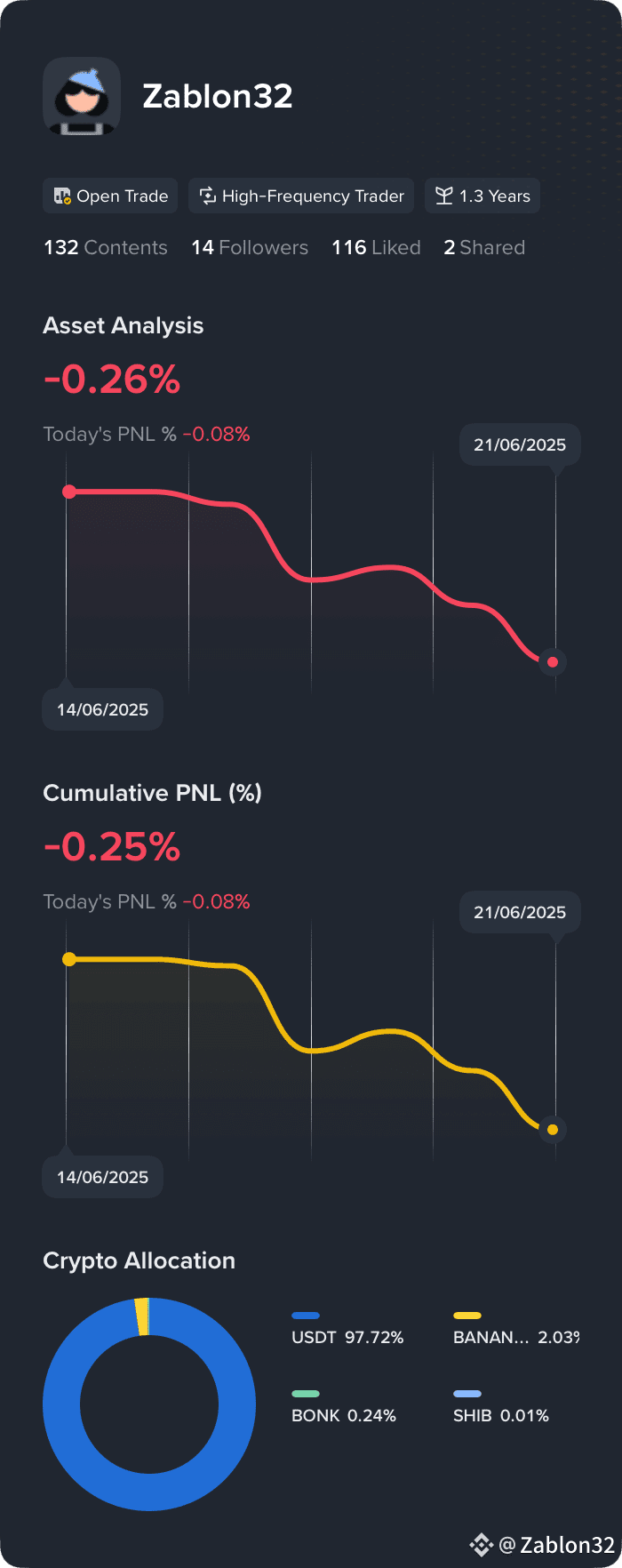
This week my portfolio dropped by **-0.27%**, with **today's PNL at -0.09%**. It’s been a slow bleed since June 14. The chart shows a small dip mid-week, followed by a steeper decline heading into today.
My holdings are mainly in **USDT (97.72%)**, keeping it safe for now. I'm still experimenting with small caps:
* **BANANAS31** – 2.03% of my bag, currently at **\$0.005284**, down **-6.41%** in the last 24h. Risky, but I'm watching it.
* **BONK** – 0.24%, hasn’t moved much.
* **SHIB** – Basically just holding dust, 0.01%.
Watching the market closely. Might rotate a bit if this trend continues. Let's see how the weekend closes.
My holdings are mainly in **USDT (97.72%)**, keeping it safe for now. I'm still experimenting with small caps:
* **BANANAS31** – 2.03% of my bag, currently at **\$0.005284**, down **-6.41%** in the last 24h. Risky, but I'm watching it.
* **BONK** – 0.24%, hasn’t moved much.
* **SHIB** – Basically just holding dust, 0.01%.
Watching the market closely. Might rotate a bit if this trend continues. Let's see how the weekend closes.
Trading Operation)
A trading operation refers to the process of buying and selling financial assets—such as stocks, currencies, commodities, or cryptocurrencies—with the goal of making a profit. It can be carried out by individual traders, institutional investors, or automated systems. The operation starts with market analysis, which may be technical (using charts and patterns) or fundamental (based on economic data and news). Once a decision is made, trades are executed through platforms like stock exchanges or digital brokers. Managing risk is essential, often involving tools like stop-loss orders and position sizing. Trading operations can be short-term, such as day trading or swing trading, or long-term, like value investing. In large financial institutions, trading operations are supported by teams that handle compliance, settlement, and reporting. Technology plays a crucial role in modern trading, enabling fast execution and real-time data. A successful trading operation requires strategy, discipline, and constant monitoring of market conditions.
A trading operation refers to the process of buying and selling financial assets—such as stocks, currencies, commodities, or cryptocurrencies—with the goal of making a profit. It can be carried out by individual traders, institutional investors, or automated systems. The operation starts with market analysis, which may be technical (using charts and patterns) or fundamental (based on economic data and news). Once a decision is made, trades are executed through platforms like stock exchanges or digital brokers. Managing risk is essential, often involving tools like stop-loss orders and position sizing. Trading operations can be short-term, such as day trading or swing trading, or long-term, like value investing. In large financial institutions, trading operations are supported by teams that handle compliance, settlement, and reporting. Technology plays a crucial role in modern trading, enabling fast execution and real-time data. A successful trading operation requires strategy, discipline, and constant monitoring of market conditions.
#USNationalDebt U.S. National Debt
The U.S. national debt is the total amount of money the federal government owes to creditors, both domestic and foreign. It is made up of two main parts: public debt, which is held by individuals, companies, and foreign governments, and intragovernmental debt, which is money the government owes to itself, mainly to trust funds like Social Security. As of 2025, the national debt has surpassed $34 trillion, driven by years of budget deficits where government spending exceeds tax revenue. Major contributors include military spending, healthcare programs, tax cuts, and emergency responses like the COVID-19 stimulus. The debt is managed by the U.S. Treasury through the sale of Treasury bonds and other securities. While some view the growing debt as a serious threat to economic stability, others believe it is manageable if the economy continues to grow. The issue remains central to debates on government policy, taxes, and future financial planning.
The U.S. national debt is the total amount of money the federal government owes to creditors, both domestic and foreign. It is made up of two main parts: public debt, which is held by individuals, companies, and foreign governments, and intragovernmental debt, which is money the government owes to itself, mainly to trust funds like Social Security. As of 2025, the national debt has surpassed $34 trillion, driven by years of budget deficits where government spending exceeds tax revenue. Major contributors include military spending, healthcare programs, tax cuts, and emergency responses like the COVID-19 stimulus. The debt is managed by the U.S. Treasury through the sale of Treasury bonds and other securities. While some view the growing debt as a serious threat to economic stability, others believe it is manageable if the economy continues to grow. The issue remains central to debates on government policy, taxes, and future financial planning.
Trading Operation
A trading operation involves the buying and selling of financial assets like stocks, currencies, or cryptocurrencies with the goal of making a profit. Traders can operate individually or as part of a firm, using strategies based on market analysis, news, or technical patterns. Trading can be short-term (like day trading or swing trading) or long-term (investing). Operations begin with market research, followed by order execution through a trading platform. Risk management is crucial, often using tools like stop-loss orders to limit potential losses. In a professional setting, trading operations include monitoring market trends, executing trades, and keeping accurate records. They also involve compliance with financial regulations and ensuring secure and timely transactions. Technology plays a key role in modern trading operations, with many traders using algorithms or bots for speed and efficiency. Whether in traditional markets or digital assets, a successful trading operation requires discipline, analysis, and quick decision-making.
A trading operation involves the buying and selling of financial assets like stocks, currencies, or cryptocurrencies with the goal of making a profit. Traders can operate individually or as part of a firm, using strategies based on market analysis, news, or technical patterns. Trading can be short-term (like day trading or swing trading) or long-term (investing). Operations begin with market research, followed by order execution through a trading platform. Risk management is crucial, often using tools like stop-loss orders to limit potential losses. In a professional setting, trading operations include monitoring market trends, executing trades, and keeping accurate records. They also involve compliance with financial regulations and ensuring secure and timely transactions. Technology plays a key role in modern trading operations, with many traders using algorithms or bots for speed and efficiency. Whether in traditional markets or digital assets, a successful trading operation requires discipline, analysis, and quick decision-making.
$BTC Bitcoin (BTC) is a decentralized digital currency that operates without a central authority like a bank or government. Created in 2009 by an unknown person or group using the name Satoshi Nakamoto, Bitcoin runs on a peer-to-peer network where users can send and receive payments directly. It uses blockchain technology, which is a public ledger containing all transaction records. Bitcoin is limited in supply, with only 21 million coins that can ever be mined, making it resistant to inflation. People invest in Bitcoin as a store of value or to hedge against traditional financial systems. It’s known for its price volatility, which attracts both long-term investors and short-term traders. Bitcoin can be stored in digital wallets and traded on crypto exchanges worldwide. Over the years, it has gained global attention, being accepted by some businesses and considered digital gold by many in the financial community.
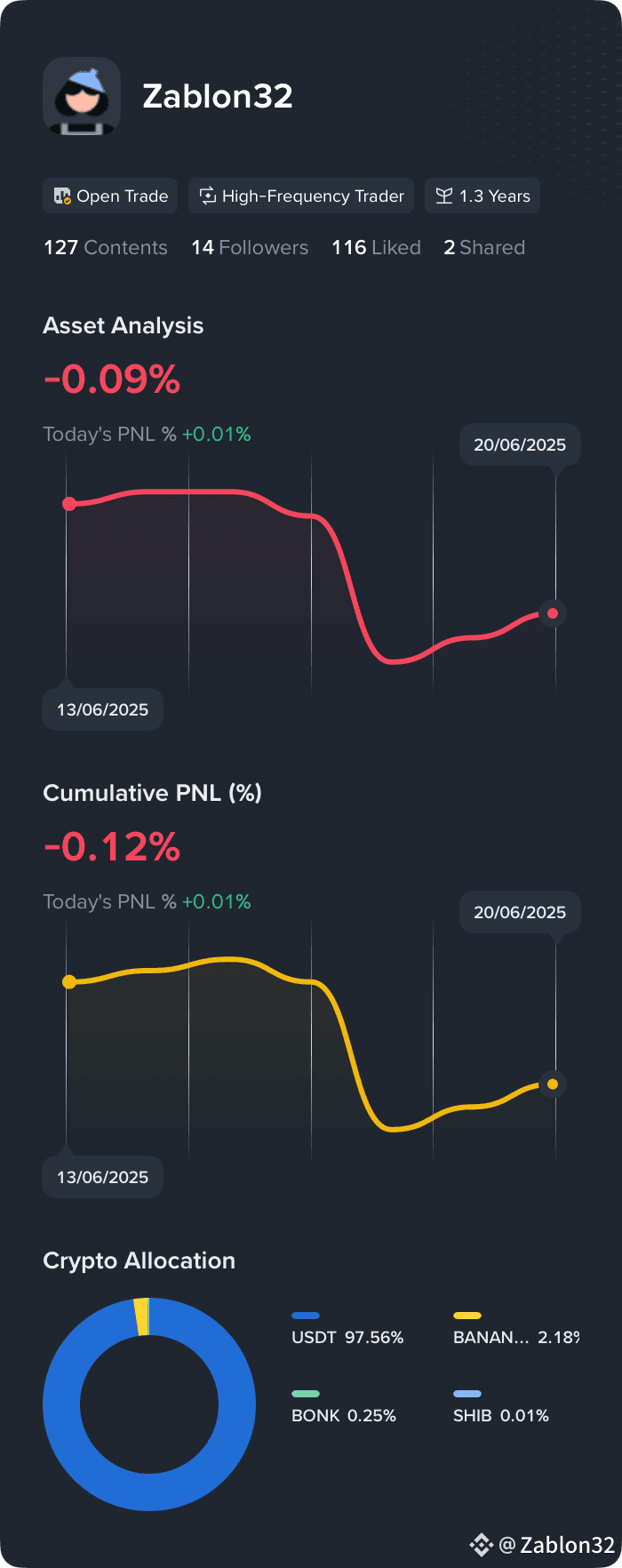
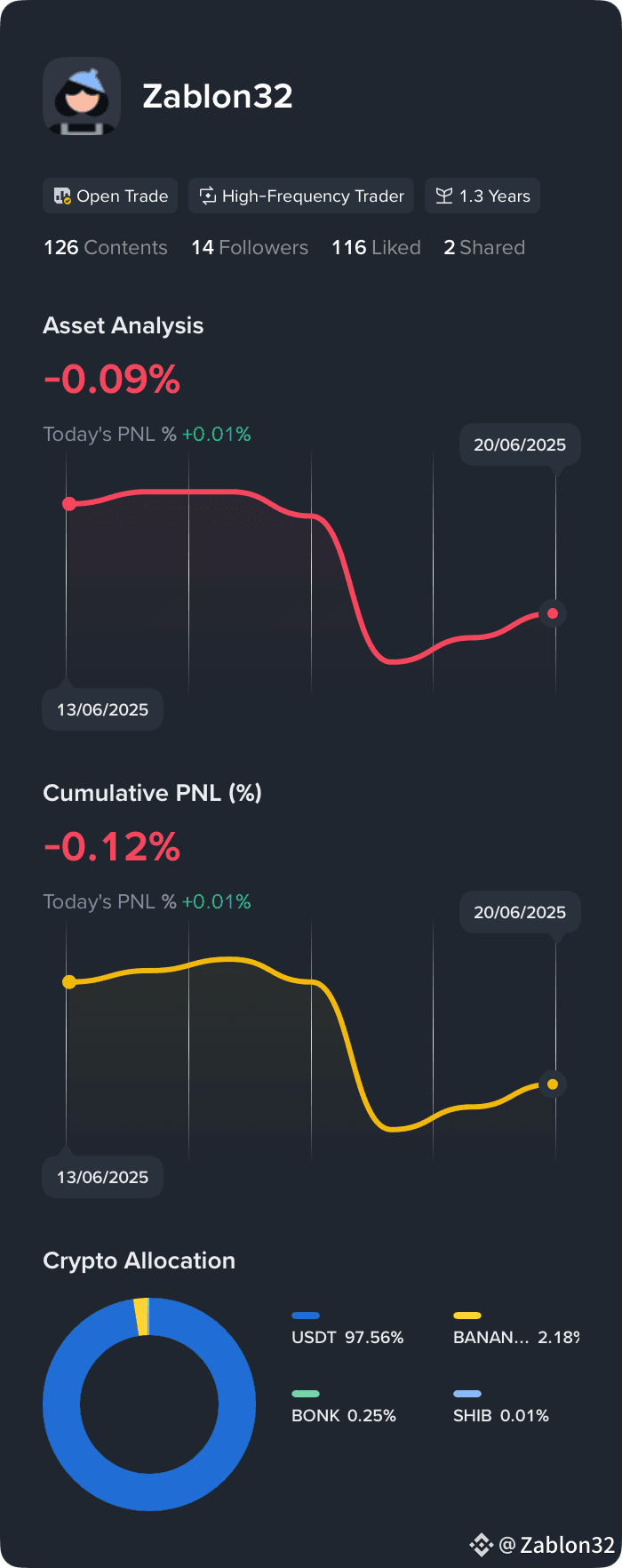
This is my crypto portfolio from June 20, 2025. I’m on the Portfolio tab, and my username is Zablon32 with 126 posts. Today’s PNL is +0.01%, so I’ve made a small gain. The 7-day chart shows my portfolio stayed flat for a while, then dropped, but now it’s starting to recover.
Most of my portfolio is in USDT, which makes up 97.56%. I also have 2.18% in BANANAS31, 0.25% in BONK, and just 0.01% in SHIB. The pie chart clearly shows that USDT takes up almost everything.
In the token list:
• BANANAS31 is listed first.
• BONK is priced at 0.00001443, and it’s up 1.05% today.
• SHIB is priced at 0.00001178, and it’s up 1.29% today.
BONK and SHIB are both in green, so they had a good day. My portfolio is mostly stable with USDT, but I’ve added a few meme coins to test them out and see how they perform.
Most of my portfolio is in USDT, which makes up 97.56%. I also have 2.18% in BANANAS31, 0.25% in BONK, and just 0.01% in SHIB. The pie chart clearly shows that USDT takes up almost everything.
In the token list:
• BANANAS31 is listed first.
• BONK is priced at 0.00001443, and it’s up 1.05% today.
• SHIB is priced at 0.00001178, and it’s up 1.29% today.
BONK and SHIB are both in green, so they had a good day. My portfolio is mostly stable with USDT, but I’ve added a few meme coins to test them out and see how they perform.
#XSuperApp Here’s the update on X’s transformation into a super‑app:
⸻
🌐 What is a “super‑app”?
A super‑app, like China’s WeChat, combines messaging, social media, payments, commerce, and mini‑apps into one unified platform  .
⸻
🛠️ X’s new super‑app features
1. Messaging + Audio/Video Calling
X now supports DMs with swipe‑to‑reply and cross‑platform audio/video calls—no phone number required .
2. X Money (Digital Wallet & Payments)
• “X Money” is launching in the U.S. as a digital wallet and peer‑to‑peer payment service, in partnership with Visa .
• Users will be able to send money, buy merchandise, tip creators, and eventually use debit/credit cards on X .
3. Commerce & Mini‑apps
• X has integrated shopping features like “Shops” and livestream commerce since 2021 .
• Plans include further expansion into gaming, reservations, and other services .
4. AI Integration (Grok)
• X has added Grok, an AI chatbot by xAI, to power features like summarization, research, and content creation .
⸻
🚧 Challenges & Criticisms
• American users may not embrace a single “everything app” like in Asia, where super‑apps dominate .
• Privacy, data handling, and regulatory compliance issues could arise from integrating finance and payments .
• X needs to earn users’ trust and attract third-party partners to build a vibrant ecosystem—no small feat .
⸻
📅 Timeline & Progress
• Early 2025: Digital wallet (X Money) and Visa partnership announced .
• Now: AI assistant Grok and audio/video calls already live.
• Next steps: Roll out payments, commerce, mini‑apps, possibly even a debit/credit card this year .
⸻
✅ Summary
X is actively evolving beyond social media toward being an “everything app”—adding payments, commerce, messaging, AI, and more. The vision is compelling, but adoption in Western markets will depend on trust, partnerships, and overcoming technical and regulatory hurdles.
⸻
⸻
🌐 What is a “super‑app”?
A super‑app, like China’s WeChat, combines messaging, social media, payments, commerce, and mini‑apps into one unified platform  .
⸻
🛠️ X’s new super‑app features
1. Messaging + Audio/Video Calling
X now supports DMs with swipe‑to‑reply and cross‑platform audio/video calls—no phone number required .
2. X Money (Digital Wallet & Payments)
• “X Money” is launching in the U.S. as a digital wallet and peer‑to‑peer payment service, in partnership with Visa .
• Users will be able to send money, buy merchandise, tip creators, and eventually use debit/credit cards on X .
3. Commerce & Mini‑apps
• X has integrated shopping features like “Shops” and livestream commerce since 2021 .
• Plans include further expansion into gaming, reservations, and other services .
4. AI Integration (Grok)
• X has added Grok, an AI chatbot by xAI, to power features like summarization, research, and content creation .
⸻
🚧 Challenges & Criticisms
• American users may not embrace a single “everything app” like in Asia, where super‑apps dominate .
• Privacy, data handling, and regulatory compliance issues could arise from integrating finance and payments .
• X needs to earn users’ trust and attract third-party partners to build a vibrant ecosystem—no small feat .
⸻
📅 Timeline & Progress
• Early 2025: Digital wallet (X Money) and Visa partnership announced .
• Now: AI assistant Grok and audio/video calls already live.
• Next steps: Roll out payments, commerce, mini‑apps, possibly even a debit/credit card this year .
⸻
✅ Summary
X is actively evolving beyond social media toward being an “everything app”—adding payments, commerce, messaging, AI, and more. The vision is compelling, but adoption in Western markets will depend on trust, partnerships, and overcoming technical and regulatory hurdles.
⸻
#SwingTradingStrategy Swing Trading Strategies (200 Words)
Swing trading is a strategy that aims to capture short- to medium-term gains in a stock, crypto, or other financial instrument over a few days to several weeks. Unlike day trading, it doesn’t require constant monitoring of the market, making it popular for part-time traders. One common swing trading strategy is trend following, where traders enter trades in the direction of the current trend. For example, in an uptrend, they buy dips and sell at resistance levels.
Another popular method is breakout trading, which involves entering a trade when the price breaks through a key support or resistance level, signaling potential momentum. Pullback trading is also common—this strategy looks for a temporary reversal within a larger trend, providing a better entry point. Traders often use technical indicators like the Relative Strength Index (RSI), Moving Averages, and MACD to confirm entry and exit signals.
Risk management is essential in swing trading. Traders typically use stop-loss orders to limit potential losses and take-profit targets to secure gains. Consistent success in swing trading requires discipline, chart analysis skills, and staying informed on market news that might affect price movements. Patience and strategy execution are key to long-term profitability.
Swing trading is a strategy that aims to capture short- to medium-term gains in a stock, crypto, or other financial instrument over a few days to several weeks. Unlike day trading, it doesn’t require constant monitoring of the market, making it popular for part-time traders. One common swing trading strategy is trend following, where traders enter trades in the direction of the current trend. For example, in an uptrend, they buy dips and sell at resistance levels.
Another popular method is breakout trading, which involves entering a trade when the price breaks through a key support or resistance level, signaling potential momentum. Pullback trading is also common—this strategy looks for a temporary reversal within a larger trend, providing a better entry point. Traders often use technical indicators like the Relative Strength Index (RSI), Moving Averages, and MACD to confirm entry and exit signals.
Risk management is essential in swing trading. Traders typically use stop-loss orders to limit potential losses and take-profit targets to secure gains. Consistent success in swing trading requires discipline, chart analysis skills, and staying informed on market news that might affect price movements. Patience and strategy execution are key to long-term profitability.
$BTC Bitcoin (BTC) is the world’s first decentralized digital currency, created in 2009 by an anonymous figure known as Satoshi Nakamoto. Unlike traditional currencies issued by governments, Bitcoin operates on a peer-to-peer network powered by blockchain technology. This blockchain is a public ledger that records all transactions securely and transparently. Bitcoin is limited in supply—only 21 million coins will ever exist—making it resistant to inflation. It can be used for online payments, held as a store of value, or traded on cryptocurrency exchanges. Over time, Bitcoin has gained attention from investors, tech enthusiasts, and institutions as “digital gold.” Its price is highly volatile, influenced by global economic trends, regulations, and market sentiment. Bitcoin has also played a key role in promoting financial freedom, especially in countries with unstable currencies. As the world becomes more digital, Bitcoin continues to shape the future of money and finance, despite ongoing debates and challenges.
#FOMCMeeting The Federal Open Market Committee (FOMC) meeting, held on June 18, 2025, is closely watched by investors and economists. The U.S. Federal Reserve is expected to keep interest rates unchanged at 4.25%–4.50%, as inflation is gradually cooling and the labor market remains stable. However, the Fed is taking a cautious approach due to ongoing risks like global conflicts, trade tensions, and rising oil prices. Investors are also focused on the updated “dot plot,” which may show fewer rate cuts projected for the rest of 2025. Fed Chair Jerome Powell will likely emphasize a data-driven strategy, resisting political pressure to cut rates quickly. The market is now expecting a possible rate cut in September or later. This meeting will be important in setting the tone for the rest of the year, especially if inflation remains sticky or global risks increase. Powell’s comments during the press conference will guide future market expectations.
$BTC Bitcoin (BTC) is a decentralized digital currency that allows users to send and receive money over the internet without relying on banks. Created in 2009 by the mysterious figure Satoshi Nakamoto, Bitcoin operates on a technology called blockchain, which records all transactions publicly and securely. It has a fixed supply of 21 million coins, making it resistant to inflation. Bitcoin is often viewed as “digital gold” and is used both for investment and as a means of payment. Its price is highly volatile, affected by news, regulations, and market demand. Despite risks, it remains the most popular cryptocurrency globally.
Log in to explore more content