
月入一千八天天笑哈哈
715 Posts

月入一千八天天笑哈哈
Report
Block User
16 Following
58 Followers
38 Liked
Posts
All
Quotes
·
--
⏱ 21:56|U.S. Treasury yields rose after U.S. economic data was released; the 10-year Treasury yield rose 1.82 basis points to 5.139%
So far, $BTC 64998.01, 1h +0.013%, 24h +1.31%.
Follow-up to watch: whether other media outlets report on this.
Trade rationally.
⏱ 21:56|U.S. Treasury yields rose after U.S. economic data was released; the 10-year Treasury yield rose 1.82 basis points to 5.139%
So far, $BTC 64998.01, 1h +0.013%, 24h +1.31%.
Follow-up to watch: whether other media outlets report on this.
Trade rationally.
So far, $BTC 64998.01, 1h +0.013%, 24h +1.31%.
Follow-up to watch: whether other media outlets report on this.
Trade rationally.
BTC-1.84%
IEFETF+0.23%
·
--
The address linked to the Binance hack has moved. On-chain monitoring shows that the 602,402 $ETH (about $1.09 billion) held by the address has started moving out; 74,880 $ETH, worth about $136.8 million, has been transferred out in the past 3 hours and is being converted to $BTC through THORChain using $ETH .
What can already be verified from this record is the amount transferred, the roughly 3-hour time window, and the THORChain exchange route; how much $BTC was received after the conversion is not yet disclosed—we only know that it is “being exchanged.”
Those using $ETH for transfers or contracts do not need to adjust gas or change how they interact for now; wallet and contract rules remain unchanged. What really affects the funds is where this batch of $ETH goes: it is being converted to $BTC through THORChain, and seeing what type of address this $BTC eventually lands in could help clarify whether it has become tradable or is still being moved around. For anything that hasn’t been quantified, let’s hold off on drawing conclusions.
The address linked to the Binance hack has moved. On-chain monitoring shows that the 602,402 $ETH (about $1.09 billion) held by the address has started moving out; 74,880 $ETH , worth about $136.8 million, has been transferred out in the past 3 hours and is being converted to $BTC through THORChain using $ETH .
What can already be verified from this record is the amount transferred, the roughly 3-hour time window, and the THORChain exchange route; how much $BTC was received after the conversion is not yet disclosed—we only know that it is “being exchanged.”
Those using $ETH for transfers or contracts do not need to adjust gas or change how they interact for now; wallet and contract rules remain unchanged. What really affects the funds is where this batch of $ETH goes: it is being converted to $BTC through THORChain, and seeing what type of address this $BTC eventually lands in could help clarify whether it has become tradable or is still being moved around. For anything that hasn’t been quantified, let’s hold off on drawing conclusions.
·
--
#BinanceAcademyCourse Watching videos takes a bit of time, but I still completed the level. Looking forward to learning more content $ETH
#BinanceAcademyCourse Watching videos takes a bit of time, but I still completed the level. Looking forward to learning more content $ETH


6
·
--
On-chain data monitoring shows that Huang Licheng’s 25x leveraged long position of $ETH was first reduced by a small amount, then gradually increased. He currently holds 660 coins, and the position has gone from profitable to loss-making overall, with a return on investment of -20%.
What matters is not the absolute amount of 660 coins, but the direction of the position adjustments: reducing and then adding again suggests that he did not take profits while the position was in the green, but instead increased his exposure again. At 25x leverage, an adverse price movement of about 4% would wipe out the entire margin. A -20% return means the position has already crossed the break-even point; continuing to hold it requires adding margin, or the position will be reduced automatically.
The facts can tell us the position’s current status, but not whether he will add margin or close it voluntarily next. Judging by the sequence of trades, adding after reducing looks more like a bet that the short-term pullback has ended and an attempt to lower the average cost, but the leverage has not been reduced. If $ETH sees another adverse move of the same magnitude, the pressure will be greater than before.
2
·
--
Whale Alert detected that 12,000 $ETH , among the stolen funds linked to the Binance Hack 2026, were transferred to an unknown wallet. They were worth approximately $21.9596 million at the time. The transaction hash is 0x91d580c…468bf0b.
This record confirms that “the funds moved,” not “who is selling.” Transferring funds to an unknown wallet is different from sending them to an exchange: if the goal is to cash out, a deposit or swap would still need to happen; if the funds were simply moved to another address for storage, that activity will remain visible on-chain. For ordinary $ETH users, this incident does not currently change the rules for transfers, Gas, or contract interactions. What I’m watching more closely is whether these coins later appear at an exchange deposit address or along a mixing route, because that will determine whether they become actual market supply. For now, only the amount, time, and hash can be confirmed; there is no public information yet about who owns the address or what has been done with the funds.
This record confirms that “the funds moved,” not “who is selling.” Transferring funds to an unknown wallet is different from sending them to an exchange: if the goal is to cash out, a deposit or swap would still need to happen; if the funds were simply moved to another address for storage, that activity will remain visible on-chain. For ordinary $ETH users, this incident does not currently change the rules for transfers, Gas, or contract interactions. What I’m watching more closely is whether these coins later appear at an exchange deposit address or along a mixing route, because that will determine whether they become actual market supply. For now, only the amount, time, and hash can be confirmed; there is no public information yet about who owns the address or what has been done with the funds.
·
--
Galaxy Head of Research Alex Thorn said Wells Fargo held Bitcoin ETFs equivalent to 30,553 $BTC in the third quarter, about double the 15,917 at the end of the second quarter, making it the largest institutional Bitcoin ETF holder by this measure. The data comes from 13F filings and reflects quarter-end holdings, not real-time positions.
Its holdings of BlackRock’s IBIT totaled about 49.58 million shares, compared with about 24.40 million at the end of the second quarter—also more than doubling. The 30,553 figure is the combined total of all Wells Fargo’s spot Bitcoin ETF holdings, converted into $BTC; it does not mean the bank directly bought that many $BTC.
This measure only shows that the bank’s exposure through ETFs grew significantly during the quarter; 13F filings do not say whether it adjusted its holdings after quarter-end.
Galaxy Head of Research Alex Thorn said Wells Fargo held Bitcoin ETFs equivalent to 30,553 $BTC in the third quarter, about double the 15,917 at the end of the second quarter, making it the largest institutional Bitcoin ETF holder by this measure. The data comes from 13F filings and reflects quarter-end holdings, not real-time positions.
Its holdings of BlackRock’s IBIT totaled about 49.58 million shares, compared with about 24.40 million at the end of the second quarter—also more than doubling. The 30,553 figure is the combined total of all Wells Fargo’s spot Bitcoin ETF holdings, converted into $BTC ; it does not mean the bank directly bought that many $BTC .
This measure only shows that the bank’s exposure through ETFs grew significantly during the quarter; 13F filings do not say whether it adjusted its holdings after quarter-end.
·
--
Lookonchain detected that Abraxas Capital has almost completely closed out its short positions on Hyperliquid, with only $11.6 million in open positions remaining. Over the past 24 hours, the account’s value fell from nearly $185 million to $22.4 million, a drop of $161 million.
Taken at face value, these figures show a steep decline in the account’s value and a large-scale position closeout. But public records only indicate that the positions were significantly reduced; they don’t say whether the shorts exited to cut losses or chose to scale back. For holders of $HYPE , this shift comes from a sizable counterparty: large positions that had been betting on prices falling are being withdrawn, leaving relatively few short positions behind. This may reduce some of the selling pressure or hedging demand. It doesn’t mean that $HYPE will necessarily rise next, but at least this account’s holdings have moved closer to neutral.
Taken at face value, these figures show a steep decline in the account’s value and a large-scale position closeout. But public records only indicate that the positions were significantly reduced; they don’t say whether the shorts exited to cut losses or chose to scale back. For holders of $HYPE , this shift comes from a sizable counterparty: large positions that had been betting on prices falling are being withdrawn, leaving relatively few short positions behind. This may reduce some of the selling pressure or hedging demand. It doesn’t mean that $HYPE will necessarily rise next, but at least this account’s holdings have moved closer to neutral.
·
--
An Aster user, furongfei, said that about $4.56 million was transferred out of their account in the early hours of November 13. According to them, they did not sign any transactions, and their wallet’s private key was not lost. The problem was the “agent key” automatically generated when opening a trade on the website. It was used to register an unfamiliar account, which then made seven transfers in about 44 minutes. The account’s 33 $BTC were transferred between futures and spot, then sold at market price in 17 separate trades.
What concerns me about this incident is the boundary of permissions: users think an agent key is just a tool for placing orders, but in fact it can also open accounts and transfer assets. An Aster user account manager said an investigation team had been formed and advised users to protect their private keys and account permissions. But the scope of the agent key’s permissions, and why each transfer was approved, have not yet been publicly explained.
For people who use $BTC for futures trading or keep it in an exchange account, this directly raises the question of “what can that key generated automatically by the website access?” My decision is that until the platform clearly explains the agent key’s permissions, I won’t let this kind of key be linked to large amounts of $BTC or assets left idle for long periods. furongfei has demanded compensation in the original assets. So far, the platform has only confirmed that an investigation team has been formed, with no further update on the compensation timeline.
·
--
According to Onchain Lens, wallets linked to Erik Voorhees bought 6,382 ETH via CoWSwap over the past 12 hours, worth approximately $11.6 million. Looking at a longer period, these addresses spent a total of $158.1 million over several days to buy 82,277 ETH at an average cost of around $1,921; they currently hold approximately 84,840 ETH, worth about $155.17 million, as well as roughly $12.2 million in stablecoins.
Based on current prices, these holdings are slightly below their average purchase price overall, showing no unrealized profit, yet the wallets are still adding to their positions. What this confirms is that funds are continuing to flow in—not that any profits have already been realized. For those following $ETH , what matters more than the size of any single purchase is whether these addresses keep buying or transfer their coins to exchanges.
Based on current prices, these holdings are slightly below their average purchase price overall, showing no unrealized profit, yet the wallets are still adding to their positions. What this confirms is that funds are continuing to flow in—not that any profits have already been realized. For those following $ETH , what matters more than the size of any single purchase is whether these addresses keep buying or transfer their coins to exchanges.
·
--
Market: $JCT 5 minutes +3.99%, current price 0.002235.
After rising, whether it can consolidate matters more than how high it surges.
#JCT
Market: $JCT 5 minutes +3.99%, current price 0.002235.
After rising, whether it can consolidate matters more than how high it surges.
#JCT
After rising, whether it can consolidate matters more than how high it surges.
#JCT
1
·
--
The address 0x9a80 monitored by Lookonchain bought 37.96 million ENA at $0.27 a month ago, worth about $10.29 million. Ten hours ago, the address deposited 20 million ENA (about $2.33 million) into Binance.
Based on the 17.96 million tokens it still holds (about $2.05 million), its total paper loss is $5.91 million, or 57.44%. This transfer confirms that the tokens moved, not that they were sold. Depositing them on an exchange makes selling easier, but public records don’t show whether a sale took place or at what price.
For ENA holders, the gap between the $0.27 purchase price and the current price of about $0.116 suggests that positions bought near the highs are being reduced, rather than held until they break even. This transaction alone doesn’t mean others will follow, but with these underwater tokens now on an exchange, the short-term supply pressure is more immediate than when they were held in a self-custody wallet.
$ENA
7
·
--
According to SoSoValue data, on November 16 Eastern Time, the $ZEC and $NEAR spot ETFs recorded combined net outflows of $9.6922 million: ZCSH saw $9.0289 million in outflows, while Bitwise’s NRR saw $663,300 in outflows.
This figure measures the net amount of creations and redemptions that day. It does not mean that someone liquidated their entire position, nor does it directly correspond to $ZEC or $NEAR transfers on-chain. The data only supports this interpretation: more ETF shares were sold than bought on a net basis that day. ZCSH still has cumulative net inflows of $169 million, and NRR has cumulative net inflows of $78.4286 million, so the single-day outflows represent a limited share of those totals. The NEAR ETF’s total net assets are just $47.9231 million, making a one-day outflow of $660,000 more significant relative to its size than the outflow on the ZEC side.
This figure measures the net amount of creations and redemptions that day. It does not mean that someone liquidated their entire position, nor does it directly correspond to $ZEC or $NEAR transfers on-chain. The data only supports this interpretation: more ETF shares were sold than bought on a net basis that day. ZCSH still has cumulative net inflows of $169 million, and NRR has cumulative net inflows of $78.4286 million, so the single-day outflows represent a limited share of those totals. The NEAR ETF’s total net assets are just $47.9231 million, making a one-day outflow of $660,000 more significant relative to its size than the outflow on the ZEC side.
3
·
--
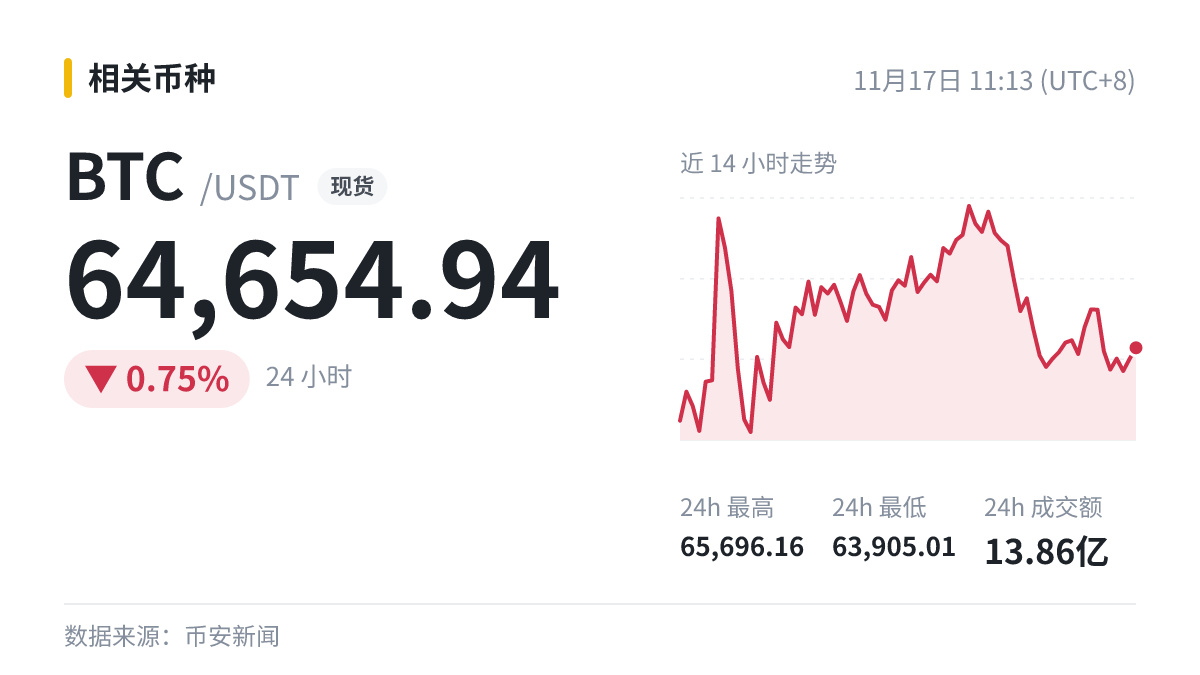
CryptoQuant analyst: Bitcoin MVRV falls below 1.2, triggering a bottom signal for the third time in the bear market—what does this mean for the market?
This is a drag on intraday sentiment; the fundamental impact will depend on further details. We’ll also have to see whether any opposing news emerges to offset it.
Related asset: $BTC Current price: 64654.94
This is a drag on intraday sentiment; the fundamental impact will depend on further details. We’ll also have to see whether any opposing news emerges to offset it.
Related asset: $BTC Current price: 64654.94
·
--
Castle Labs tallied about $13.7 billion in revenue for crypto protocols over the past 12 months. Excluding stablecoin issuers, the top 10 protocols generated 47% of revenue and captured 73% of token holder earnings. The top two in each sector accounted for at least 52% of fees, with some sectors exceeding 90%. Hyperliquid’s annualized fees are about $895 million, while Uniswap accounts for 25% of spot DEX trading volume over the past 30 days.
The report poses the same question to holders of $BTC and $HYPE : why don’t the money a protocol earns and the returns holders receive line up? Behind $HYPE is Hyperliquid, with annualized fees nearing $900 million. But the report makes clear that protocol revenue does not automatically translate into returns for token holders; that also depends on the value-capture mechanism, token issuance, market opportunity, and narrative. High revenue only indicates a large business. Whether that value flows through is what token holders need to verify.
The report poses the same question to holders of $BTC and $HYPE : why don’t the money a protocol earns and the returns holders receive line up? Behind $HYPE is Hyperliquid, with annualized fees nearing $900 million. But the report makes clear that protocol revenue does not automatically translate into returns for token holders; that also depends on the value-capture mechanism, token issuance, market opportunity, and narrative. High revenue only indicates a large business. Whether that value flows through is what token holders need to verify.
·
--
The candlestick body matters more than the wick: a solid close shows the strength is real.
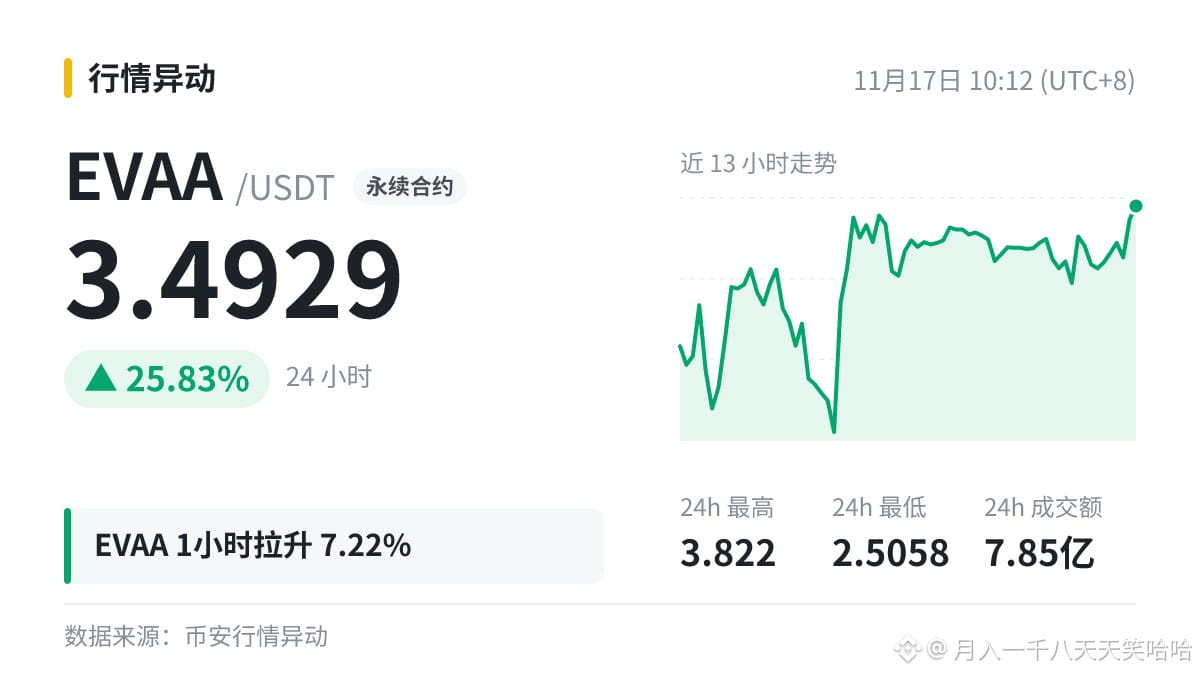
Here’s one right now: $EVAA surged 7.22% in 1 hour to 3.4929.
#EVAA
The candlestick body matters more than the wick: a solid close shows the strength is real.
Here’s one right now: $EVAA surged 7.22% in 1 hour to 3.4929.
#EVAA
Here’s one right now: $EVAA surged 7.22% in 1 hour to 3.4929.
#EVAA
·
--
A user of Aster posted on November 16 that $4.56 million was transferred out of their account in the early hours of November 13, 2026, Beijing time. Someone used a web proxy key to register a new account, and the signing address for all seven subsequent transfers was the proxy key 0x647E—not the main wallet. During the same period, 33 units of $BTC were transferred between the contract and spot markets, then sold in 17 market orders.
What can be answered here is why those seven transfers were authorized; so far, there is no answer. The user said that transfers to other users are withdrawal-level operations, that the key did not have withdrawal privileges, and that privacy mode—which prohibits internal transfers—was enabled on the account. The initial conclusion in the records of the discussion with Aster's CEO was that the proxy key had been exposed. The key itself is generated locally in the browser after authorization on the website. The permission design does not align with what was actually authorized; this is the most important issue for the platform to explain in writing.
As for where the funds went, 1,000 units of $ETH were sent to Tornado Cash, while another 768.1 units of $ETH and 993,999.67 USDT went to confidential swaps on NEAR Intents. $NEAR was used in the cross-chain swap leg, making it harder to trace without platform and on-chain records. The user has requested compensation in the original assets first, without waiting for recovery, covering 33 units of $BTC, 2,200,134.21 USDT, and liquidation fees. The platform has replied that it is forming an investigation team, but preservation of logs and a compensation timeline have yet to be confirmed.
A user of Aster posted on November 16 that $4.56 million was transferred out of their account in the early hours of November 13, 2026, Beijing time. Someone used a web proxy key to register a new account, and the signing address for all seven subsequent transfers was the proxy key 0x647E—not the main wallet. During the same period, 33 units of $BTC were transferred between the contract and spot markets, then sold in 17 market orders.
What can be answered here is why those seven transfers were authorized; so far, there is no answer. The user said that transfers to other users are withdrawal-level operations, that the key did not have withdrawal privileges, and that privacy mode—which prohibits internal transfers—was enabled on the account. The initial conclusion in the records of the discussion with Aster's CEO was that the proxy key had been exposed. The key itself is generated locally in the browser after authorization on the website. The permission design does not align with what was actually authorized; this is the most important issue for the platform to explain in writing.
As for where the funds went, 1,000 units of $ETH were sent to Tornado Cash, while another 768.1 units of $ETH and 993,999.67 USDT went to confidential swaps on NEAR Intents. $NEAR was used in the cross-chain swap leg, making it harder to trace without platform and on-chain records. The user has requested compensation in the original assets first, without waiting for recovery, covering 33 units of $BTC , 2,200,134.21 USDT, and liquidation fees. The platform has replied that it is forming an investigation team, but preservation of logs and a compensation timeline have yet to be confirmed.
1
·
--
$XAUT 24h -0.4%|Tether Capital invests $15 million in Brazilian fintech company Nomad
Read the breaking news three times, came up with three interpretations, and finally decided to wait and see. This kind of development won’t immediately reverse the trend, but it’s a clue.
#XAUT
$XAUT 24h -0.4%|Tether Capital invests $15 million in Brazilian fintech company Nomad
Read the breaking news three times, came up with three interpretations, and finally decided to wait and see. This kind of development won’t immediately reverse the trend, but it’s a clue.
#XAUT
Read the breaking news three times, came up with three interpretations, and finally decided to wait and see. This kind of development won’t immediately reverse the trend, but it’s a clue.
#XAUT
·
--
Tether Capital invested $15 million in Brazilian fintech company Nomad, aiming to make it easier for Brazilian consumers to access USDT and Tether Gold ($XAUT) through its existing dollar accounts, international payments, and global investment services.
For those following $XAUT , the only thing that can really be confirmed right now is the phrase “potential integration”—not that you can already buy tokenized gold directly through Nomad. Tether’s stated rationale is that Brazil is a large market: in 2025, stablecoins accounted for about 80% of the country’s reported crypto-asset trading volume. That figure explains the size of the Brazilian market, but for now it doesn’t tell us which product line $XAUT will be rolled out through, what the requirements will be, or how custody will work.
So what this $15 million investment makes me wonder is not “how big is the upside?” but whether, after the money goes in, $XAUT can become more than just a concept for ordinary consumers in Brazil—a place where they can actually place an order. The official wording leaves room for doubt: before integration, only half the groundwork has been laid.
Tether Capital invested $15 million in Brazilian fintech company Nomad, aiming to make it easier for Brazilian consumers to access USDT and Tether Gold ($XAUT ) through its existing dollar accounts, international payments, and global investment services.
For those following $XAUT , the only thing that can really be confirmed right now is the phrase “potential integration”—not that you can already buy tokenized gold directly through Nomad. Tether’s stated rationale is that Brazil is a large market: in 2025, stablecoins accounted for about 80% of the country’s reported crypto-asset trading volume. That figure explains the size of the Brazilian market, but for now it doesn’t tell us which product line $XAUT will be rolled out through, what the requirements will be, or how custody will work.
So what this $15 million investment makes me wonder is not “how big is the upside?” but whether, after the money goes in, $XAUT can become more than just a concept for ordinary consumers in Brazil—a place where they can actually place an order. The official wording leaves room for doubt: before integration, only half the groundwork has been laid.
4
·
--
$BIRB Shorts are paying, with a funding rate of -0.115%.
Following where the money flows is much more reliable than predicting direction.
#BIRB
$BIRB Shorts are paying, with a funding rate of -0.115%.
Following where the money flows is much more reliable than predicting direction.
#BIRB
Following where the money flows is much more reliable than predicting direction.
#BIRB
·
--
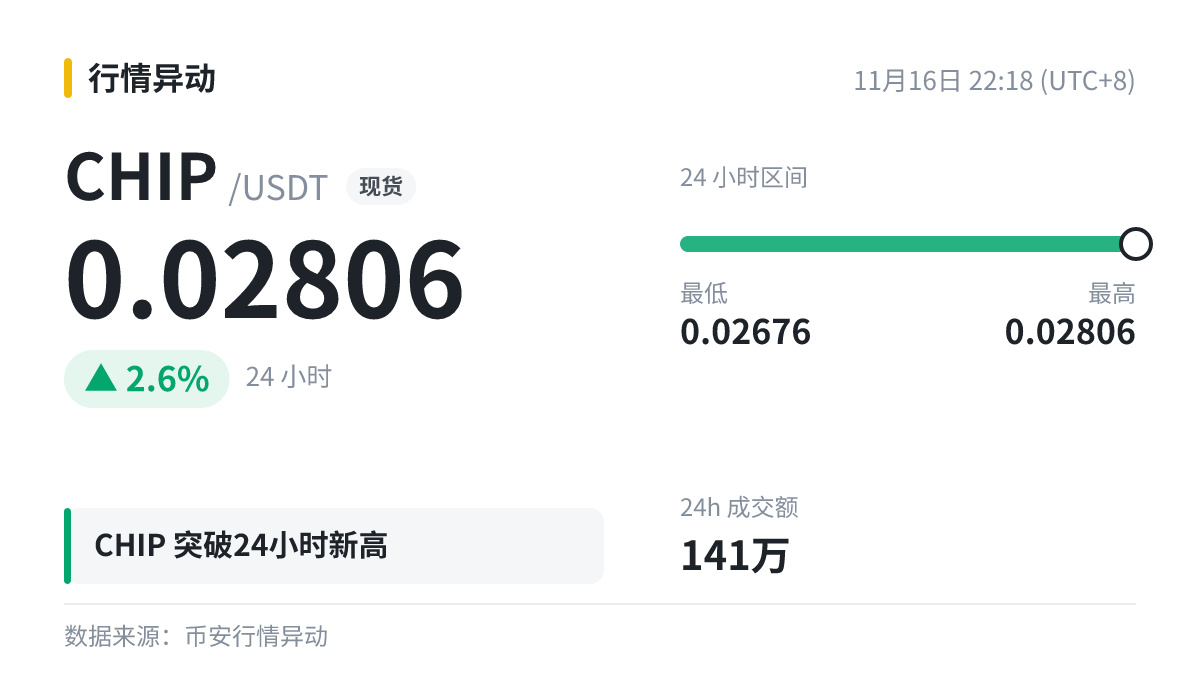
Straight to the data: $CHIP 24-hour high of 0.02806, previous high 0.02785, 24h +2.6%, trading volume $1.41 million.
Can the new high hold? The key is whether the next pullback stays above the previous high. Share your thoughts in the comments—someone may have a fresh perspective.
Straight to the data: $CHIP 24-hour high of 0.02806, previous high 0.02785, 24h +2.6%, trading volume $1.41 million.
Can the new high hold? The key is whether the next pullback stays above the previous high. Share your thoughts in the comments—someone may have a fresh perspective.
Can the new high hold? The key is whether the next pullback stays above the previous high. Share your thoughts in the comments—someone may have a fresh perspective.
4
Log in to explore more content
Join global crypto users on Binance Square
⚡️ Get latest and useful information about crypto.
💬 Trusted by the world’s largest crypto exchange.
👍 Discover real insights from verified creators.
Email / Phone number
Trending Topics
NvidiaEarningsTonight:AIStocks’NextMove?
72,980 views
974 Discussing
Nvidia Earnings Day: Interim CEO's First Appearance — Can the AI Story Hold?
Binance News
·17 Likes
·7.9k views
A Packed Week of Earnings and Data Tests Markets
124,521 views
621 Discussing
AnthropicIPOTestsInvestorAppetiteForAI
276,435 views
2,656 Discussing